
Muon Collider Design and RD Michael S Zisman
![Muon Collider Requirements • Typical example parameters for MC scenarios given below [Alexahin, Palmer]](https://slidetodoc.com/presentation_image/1c3b1d064a26aca43d076863b1d87bfe/image-8.jpg "Muon Collider Requirements • Typical example parameters for MC scenarios given below [Alexahin, Palmer]")
![Proton Beam Energy (2) • Recent inspection [Strait] of HARP data showed that falloff](https://slidetodoc.com/presentation_image/1c3b1d064a26aca43d076863b1d87bfe/image-12.jpg "Proton Beam Energy (2) • Recent inspection [Strait] of HARP data showed that falloff")
- Slides: 37
Muon Collider Design and R&D Michael S. Zisman Center for Beam Physics Accelerator & Fusion Research Division Lawrence Berkeley National Laboratory XXIV Rencontres de Physique de la Vallee d'Aoste—La Thuile March 6, 2010 Muon Collider: Zisman
Introduction • Muon-based collider would be a powerful tool in the experimentalist’s arsenal • Design and performance evaluations for such a facility have been ongoing for more than 10 years — two entities involved in coordinated program o Neutrino Factory and Muon Collider Collaboration (NFMCC) o Muon Collider Task Force (MCTF) — coordination done by leadership of the two organizations o NFMCC: A. Bross, H. Kirk, M. Zisman o MCTF: S. Geer, V. Shiltsev — organizations have now merged to form Muon Accelerator Program (MAP) • Recent interest by Fermilab management has spurred increased effort to understand Muon Collider design — and increased enthusiasm by DOE to support the required R&D effort March 6, 2010 Muon Collider: Zisman 2
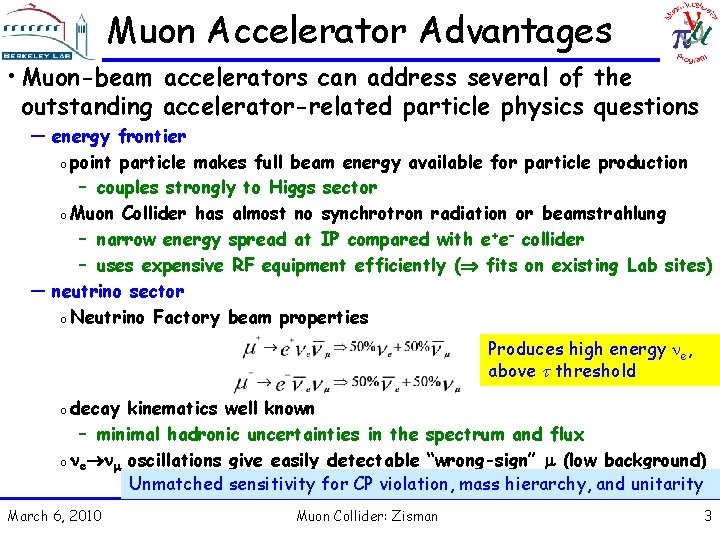
Muon Accelerator Advantages • Muon-beam accelerators can address several of the outstanding accelerator-related particle physics questions — energy frontier o point particle makes full beam energy available for particle production – couples strongly to Higgs sector o Muon Collider has almost no synchrotron radiation or beamstrahlung – narrow energy spread at IP compared with e+e– collider – uses expensive RF equipment efficiently ( fits on existing Lab sites) — neutrino sector o Neutrino Factory beam properties Produces high energy e, above threshold o decay kinematics well known – minimal hadronic uncertainties in the spectrum and flux o e oscillations give easily detectable “wrong-sign” (low background) Unmatched sensitivity for CP violation, mass hierarchy, and unitarity March 6, 2010 Muon Collider: Zisman 3
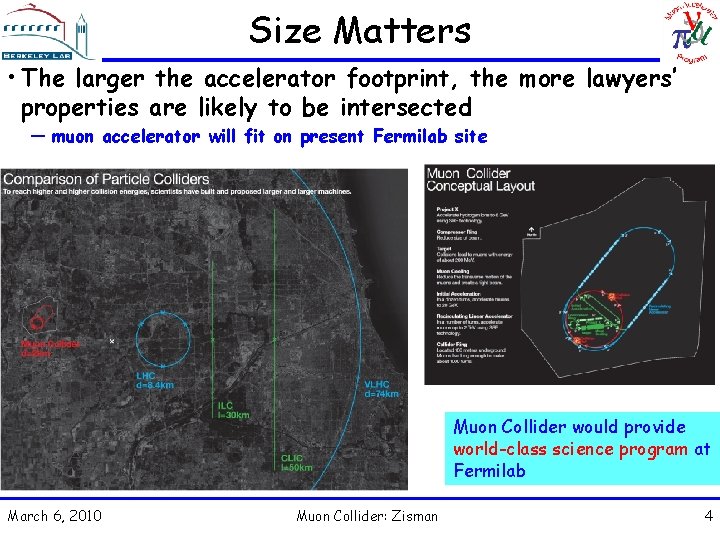
Size Matters • The larger the accelerator footprint, the more lawyers’ properties are likely to be intersected — muon accelerator will fit on present Fermilab site Muon Collider would provide world-class science program at Fermilab March 6, 2010 Muon Collider: Zisman 4
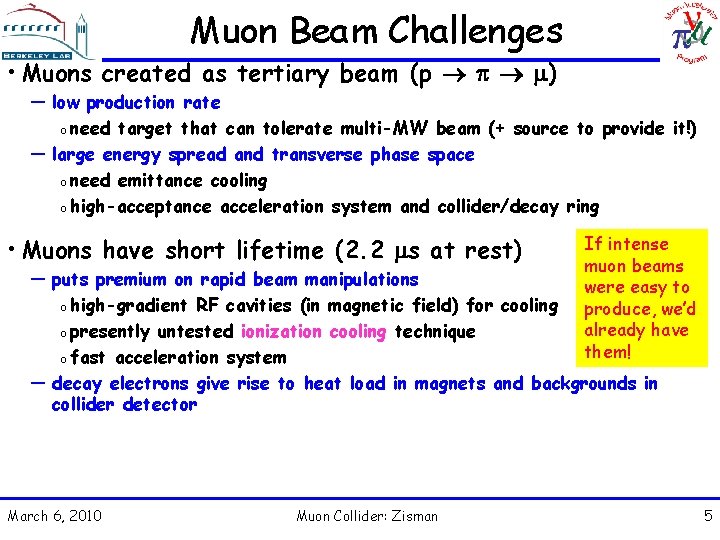
Muon Beam Challenges • Muons created as tertiary beam (p ) — low production rate o need target that can tolerate multi-MW beam (+ source to provide it!) — large energy spread and transverse phase space o need emittance cooling o high-acceptance acceleration system and collider/decay ring • Muons have short lifetime (2. 2 s at rest) If intense muon beams were easy to produce, we’d already have them! — puts premium on rapid beam manipulations o high-gradient RF cavities (in magnetic field) for cooling o presently untested ionization cooling technique o fast acceleration system — decay electrons give rise to heat load in magnets and backgrounds in collider detector March 6, 2010 Muon Collider: Zisman 5
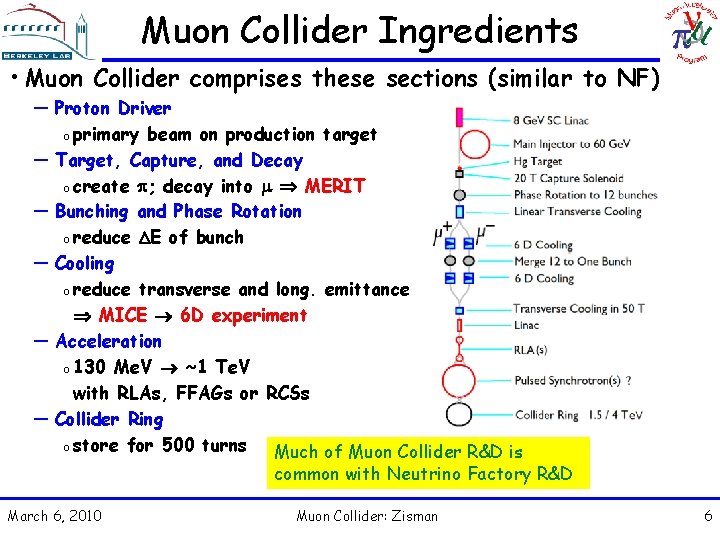
Muon Collider Ingredients • Muon Collider comprises these sections (similar to NF) — Proton Driver o primary beam on production target — Target, Capture, and Decay o create ; decay into MERIT — Bunching and Phase Rotation o reduce E of bunch — Cooling o reduce transverse and long. emittance MICE 6 D experiment — Acceleration o 130 Me. V ~1 Te. V with RLAs, FFAGs or RCSs — Collider Ring o store for 500 turns Much of Muon Collider R&D is common with Neutrino Factory R&D March 6, 2010 Muon Collider: Zisman 6
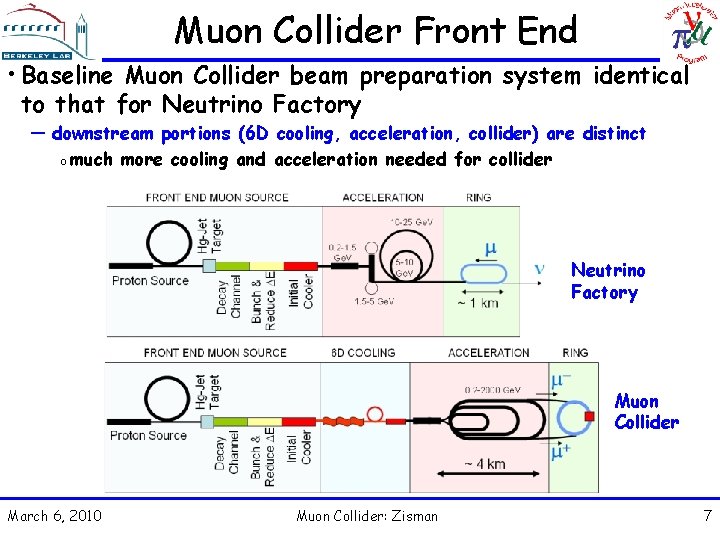
Muon Collider Front End • Baseline Muon Collider beam preparation system identical to that for Neutrino Factory — downstream portions (6 D cooling, acceleration, collider) are distinct o much more cooling and acceleration needed for collider Neutrino Factory Muon Collider March 6, 2010 Muon Collider: Zisman 7
Muon Collider Requirements • Typical example parameters for MC scenarios given below [Alexahin, Palmer] — caveat: power estimates based on assumed transmission values o could go up or down. . . – smart money is on “up” Needed to meet luminosity specification March 6, 2010 Muon Collider: Zisman 8
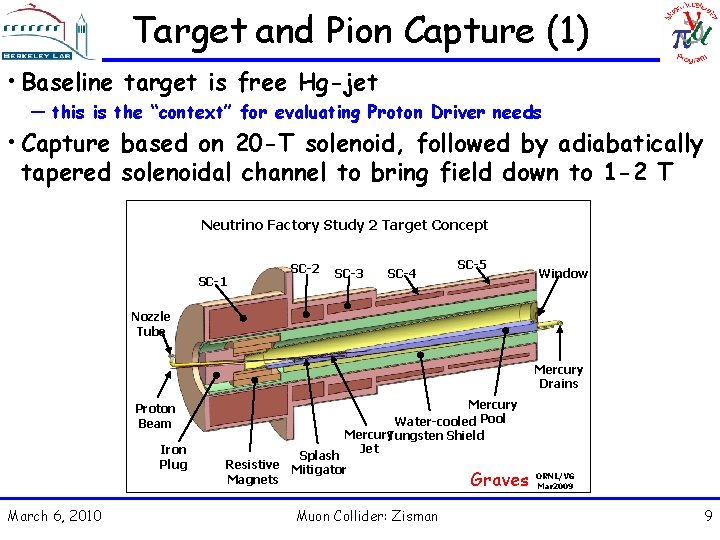
Target and Pion Capture (1) • Baseline target is free Hg-jet — this is the “context” for evaluating Proton Driver needs • Capture based on 20 -T solenoid, followed by adiabatically tapered solenoidal channel to bring field down to 1 -2 T Neutrino Factory Study 2 Target Concept SC-1 SC-2 SC-3 SC-4 SC-5 Window Nozzle Tube Mercury Drains Proton Beam Iron Plug March 6, 2010 Mercury Water-cooled Pool Mercury Tungsten Shield Jet Splash Resistive Mitigator Magnets Muon Collider: Zisman Graves ORNL/VG Mar 2009 9
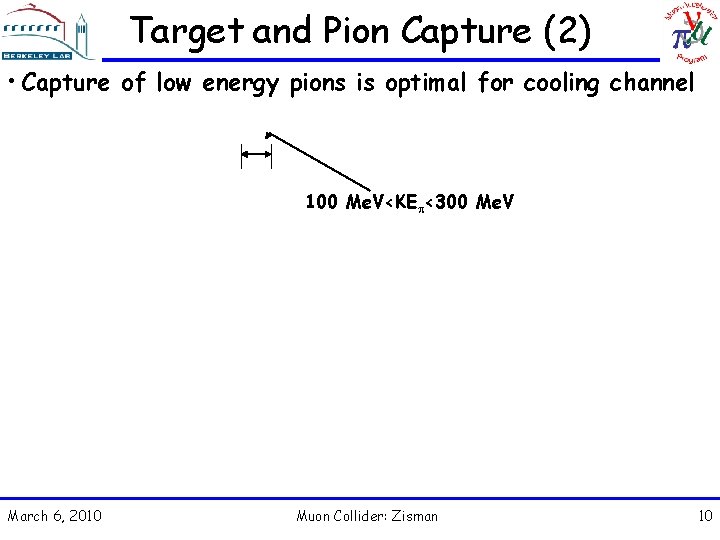
Target and Pion Capture (2) • Capture of low energy pions is optimal for cooling channel 100 Me. V<KE <300 Me. V March 6, 2010 Muon Collider: Zisman 10
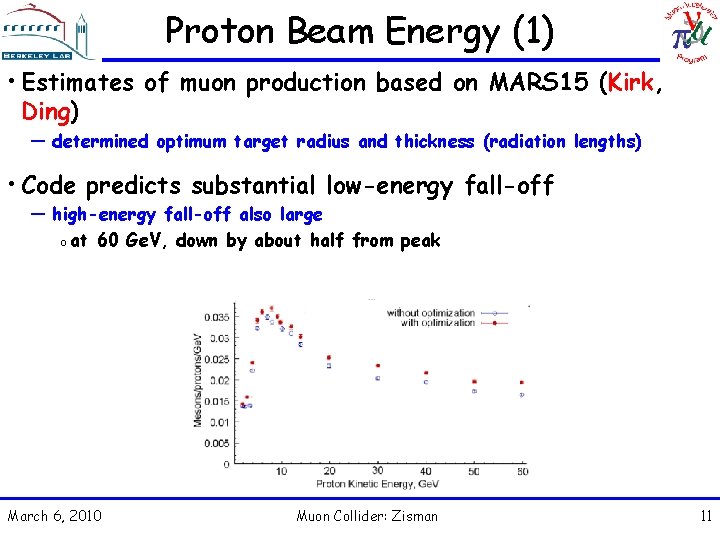
Proton Beam Energy (1) • Estimates of muon production based on MARS 15 (Kirk, Ding) — determined optimum target radius and thickness (radiation lengths) • Code predicts substantial low-energy fall-off — high-energy fall-off also large o at 60 Ge. V, down by about half from peak March 6, 2010 Muon Collider: Zisman 11
Proton Beam Energy (2) • Recent inspection [Strait] of HARP data showed that falloff predicted by MARS 15 at low energy is not correct — MARS meson generator (Mokhov) now improved based on HARP data Updated MARS generator HARP data March 6, 2010 Muon Collider: Zisman 12
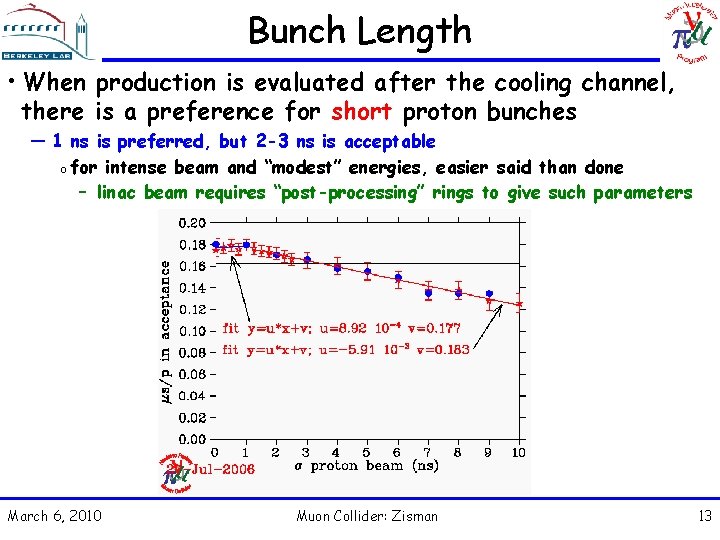
Bunch Length • When production is evaluated after the cooling channel, there is a preference for short proton bunches — 1 ns is preferred, but 2 -3 ns is acceptable o for intense beam and “modest” energies, easier said than done – linac beam requires “post-processing” rings to give such parameters March 6, 2010 Muon Collider: Zisman 13
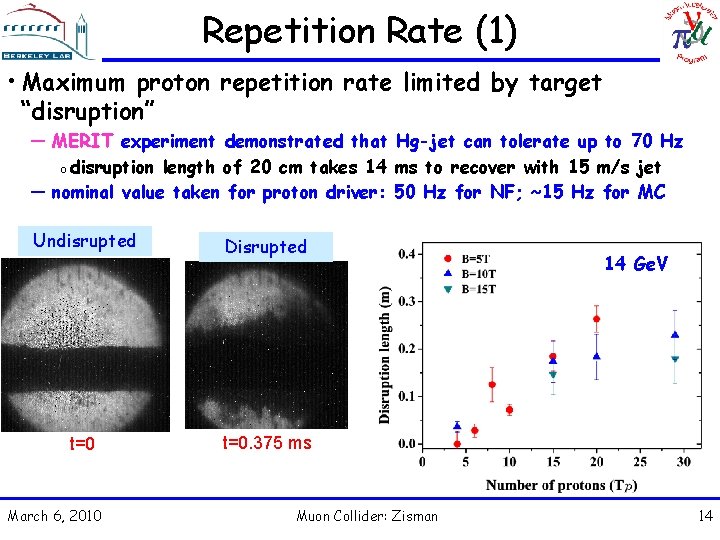
Repetition Rate (1) • Maximum proton repetition rate limited by target “disruption” — MERIT experiment demonstrated that Hg-jet can tolerate up to 70 Hz o disruption length of 20 cm takes 14 ms to recover with 15 m/s jet — nominal value taken for proton driver: 50 Hz for NF; ~15 Hz for MC Undisrupted Disrupted t=0. 375 ms March 6, 2010 Muon Collider: Zisman 14 Ge. V 14
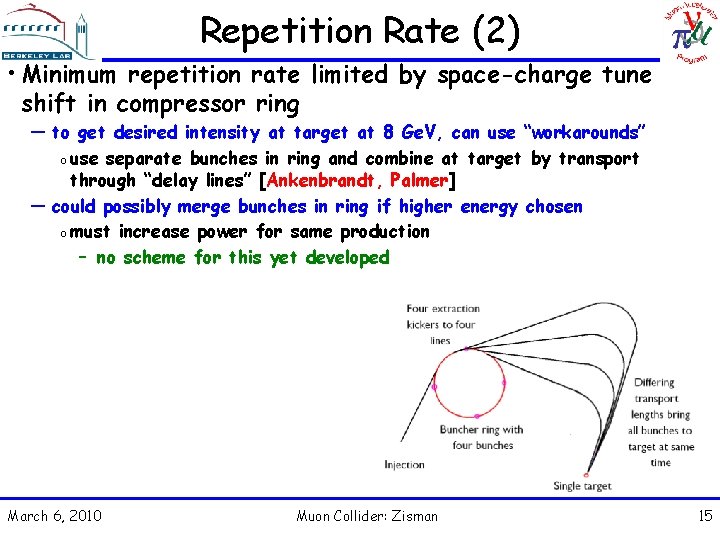
Repetition Rate (2) • Minimum repetition rate limited by space-charge tune shift in compressor ring — to get desired intensity at target at 8 Ge. V, can use “workarounds” o use separate bunches in ring and combine at target by transport through “delay lines” [Ankenbrandt, Palmer] — could possibly merge bunches in ring if higher energy chosen o must increase power for same production – no scheme for this yet developed March 6, 2010 Muon Collider: Zisman 15
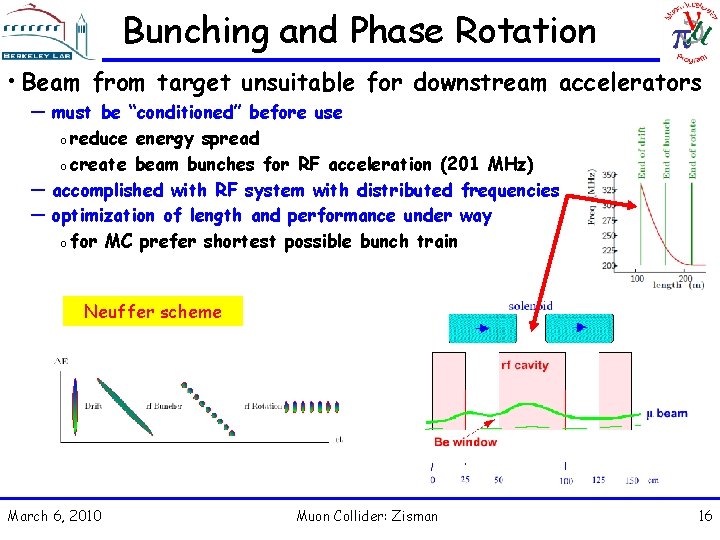
Bunching and Phase Rotation • Beam from target unsuitable for downstream accelerators — must be “conditioned” before use o reduce energy spread o create beam bunches for RF acceleration (201 MHz) — accomplished with RF system with distributed frequencies — optimization of length and performance under way o for MC prefer shortest possible bunch train Neuffer scheme March 6, 2010 Muon Collider: Zisman 16
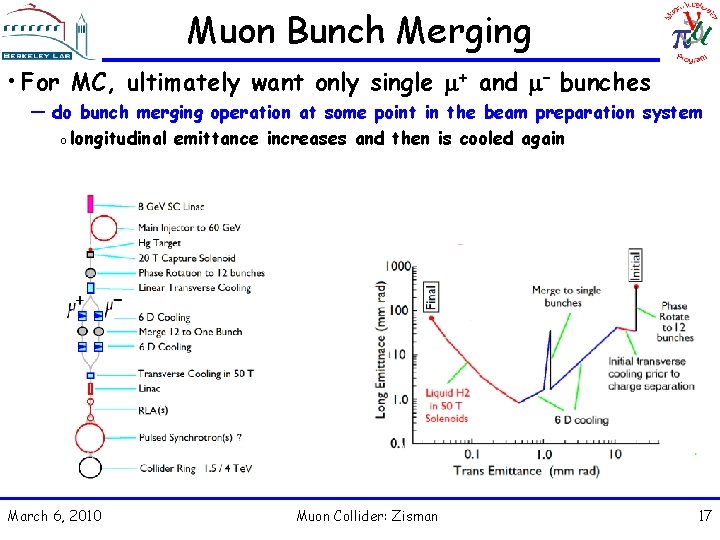
Muon Bunch Merging • For MC, ultimately want only single + and – bunches — do bunch merging operation at some point in the beam preparation system o longitudinal emittance increases and then is cooled again March 6, 2010 Muon Collider: Zisman 17
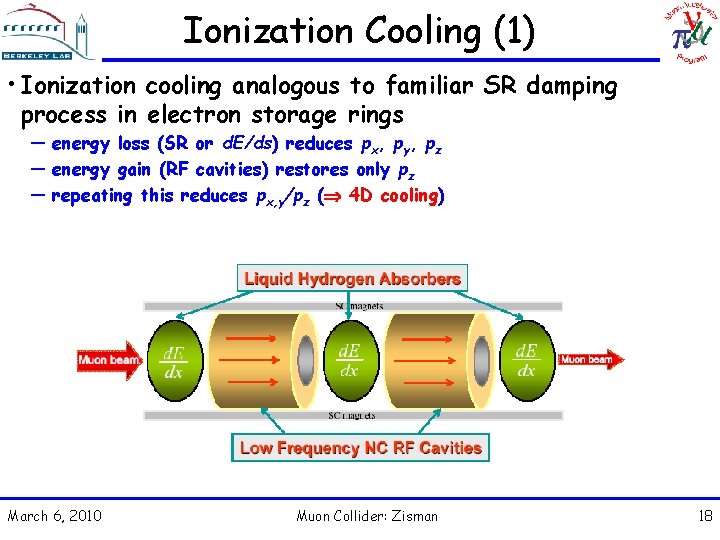
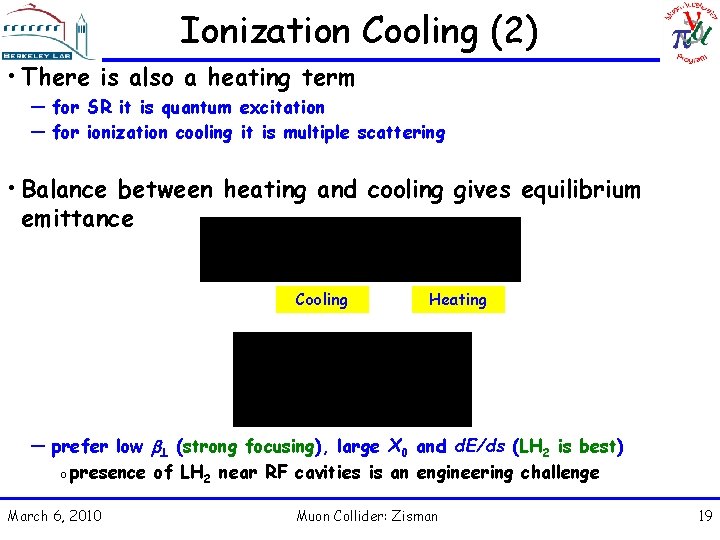
Ionization Cooling (1) • Ionization cooling analogous to familiar SR damping process in electron storage rings — energy loss (SR or d. E/ds) reduces px, py, pz — energy gain (RF cavities) restores only pz — repeating this reduces px, y/pz ( 4 D cooling) March 6, 2010 Muon Collider: Zisman 18
Ionization Cooling (2) • There is also a heating term — for SR it is quantum excitation — for ionization cooling it is multiple scattering • Balance between heating and cooling gives equilibrium emittance Cooling Heating — prefer low (strong focusing), large X 0 and d. E/ds (LH 2 is best) o presence of LH 2 near RF cavities is an engineering challenge March 6, 2010 Muon Collider: Zisman 19
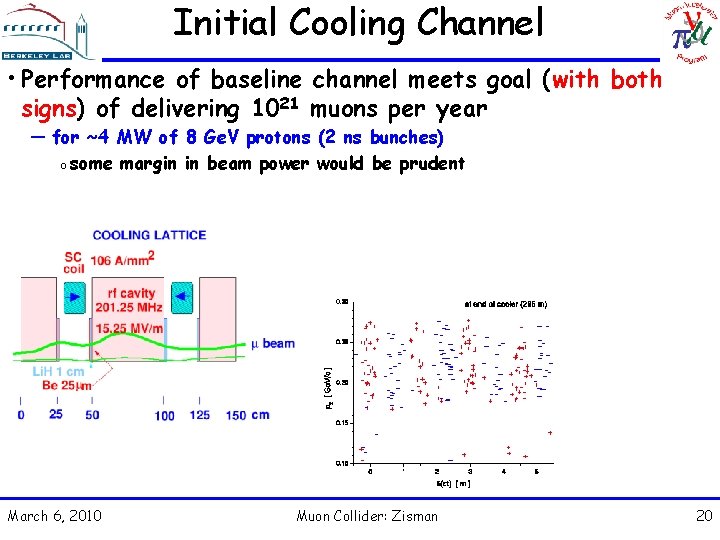
Initial Cooling Channel • Performance of baseline channel meets goal (with both signs) of delivering 1021 muons per year — for ~4 MW of 8 Ge. V protons (2 ns bunches) o some margin in beam power would be prudent March 6, 2010 Muon Collider: Zisman 20
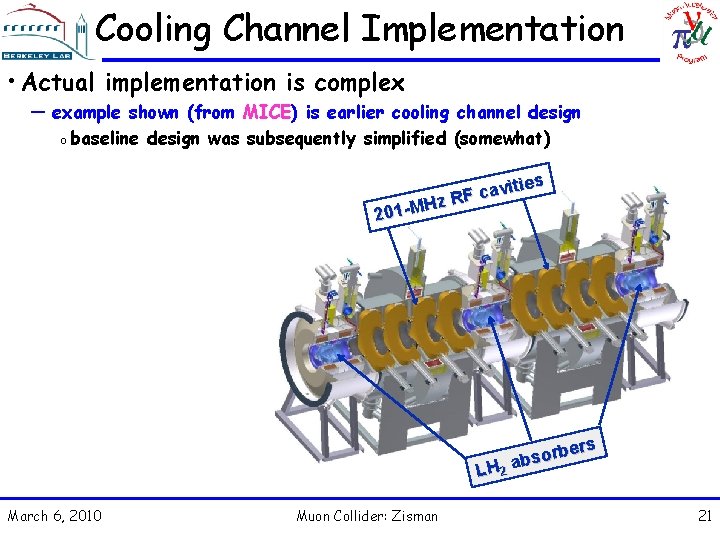
Cooling Channel Implementation • Actual implementation is complex — example shown (from MICE) is earlier cooling channel design o baseline design was subsequently simplified (somewhat) ities v a c z RF H M 201 LH 2 March 6, 2010 Muon Collider: Zisman rs e b r o abs 21
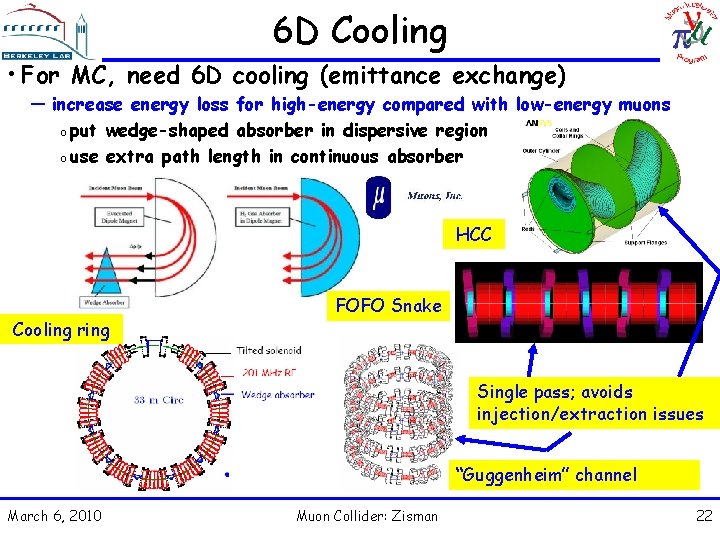
6 D Cooling • For MC, need 6 D cooling (emittance exchange) — increase energy loss for high-energy compared with low-energy muons o put wedge-shaped absorber in dispersive region o use extra path length in continuous absorber HCC Cooling ring FOFO Snake Single pass; avoids injection/extraction issues “Guggenheim” channel March 6, 2010 Muon Collider: Zisman 22
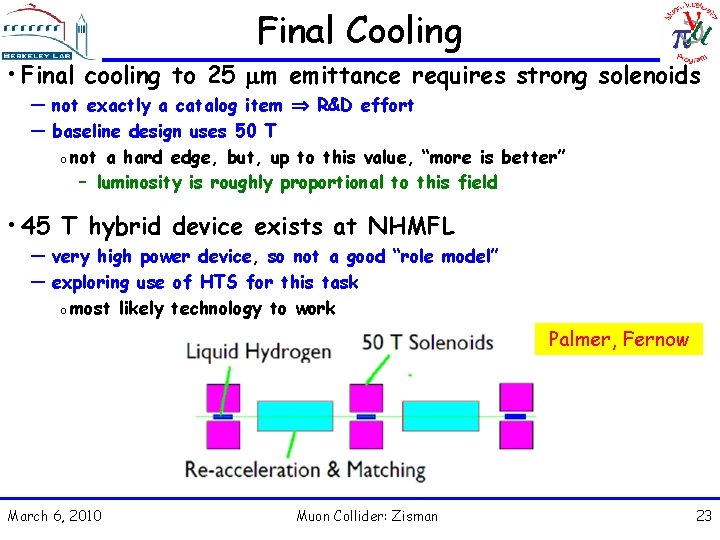
Final Cooling • Final cooling to 25 m emittance requires strong solenoids — not exactly a catalog item R&D effort — baseline design uses 50 T o not a hard edge, but, up to this value, “more is better” – luminosity is roughly proportional to this field • 45 T hybrid device exists at NHMFL — very high power device, so not a good “role model” — exploring use of HTS for this task o most likely technology to work Palmer, Fernow March 6, 2010 Muon Collider: Zisman 23
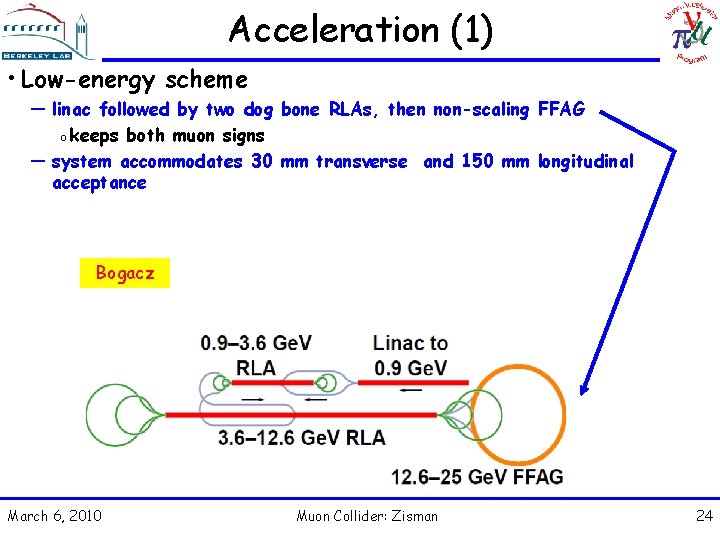
Acceleration (1) • Low-energy scheme — linac followed by two dog bone RLAs, then non-scaling FFAG o keeps both muon signs — system accommodates 30 mm transverse and 150 mm longitudinal acceptance Bogacz March 6, 2010 Muon Collider: Zisman 24
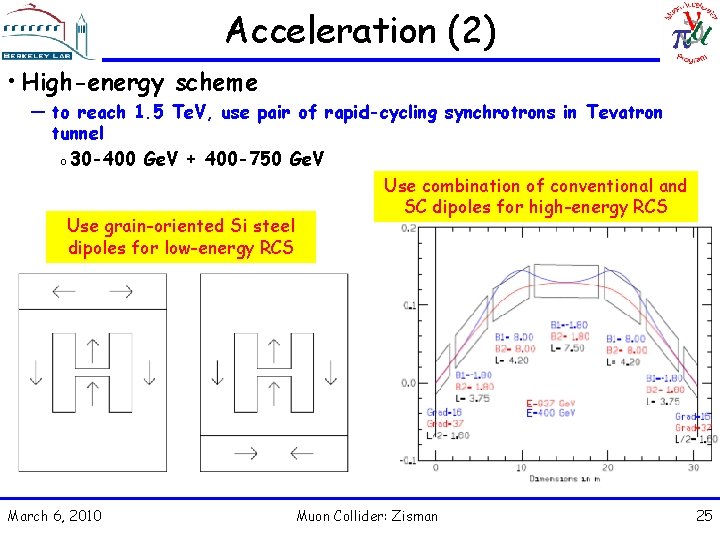
Acceleration (2) • High-energy scheme — to reach 1. 5 Te. V, use pair of rapid-cycling synchrotrons in Tevatron tunnel o 30 -400 Ge. V + 400 -750 Ge. V Use combination of conventional and SC dipoles for high-energy RCS Use grain-oriented Si steel dipoles for low-energy RCS March 6, 2010 Muon Collider: Zisman 25
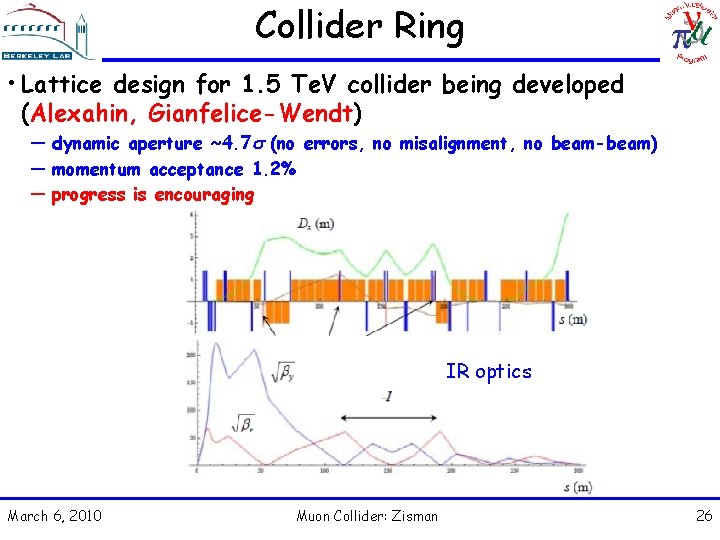
Collider Ring • Lattice design for 1. 5 Te. V collider being developed (Alexahin, Gianfelice-Wendt) — dynamic aperture ~4. 7 (no errors, no misalignment, no beam-beam) — momentum acceptance 1. 2% — progress is encouraging IR optics March 6, 2010 Muon Collider: Zisman 26
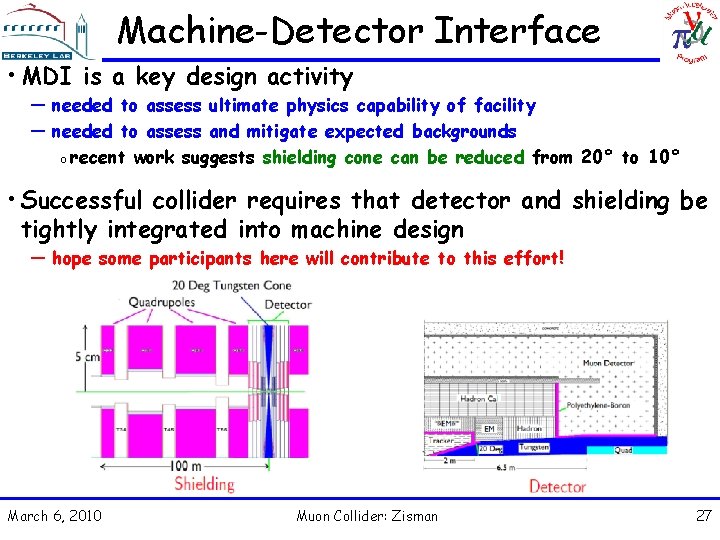
Machine-Detector Interface • MDI is a key design activity — needed to assess ultimate physics capability of facility — needed to assess and mitigate expected backgrounds o recent work suggests shielding cone can be reduced from 20° to 10° • Successful collider requires that detector and shielding be tightly integrated into machine design — hope some participants here will contribute to this effort! March 6, 2010 Muon Collider: Zisman 27
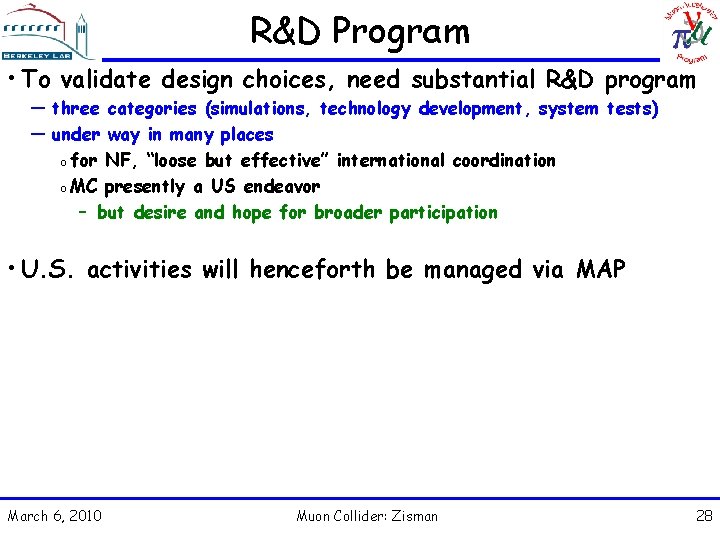
R&D Program • To validate design choices, need substantial R&D program — three categories (simulations, technology development, system tests) — under way in many places o for NF, “loose but effective” international coordination o MC presently a US endeavor – but desire and hope for broader participation • U. S. activities will henceforth be managed via MAP March 6, 2010 Muon Collider: Zisman 28
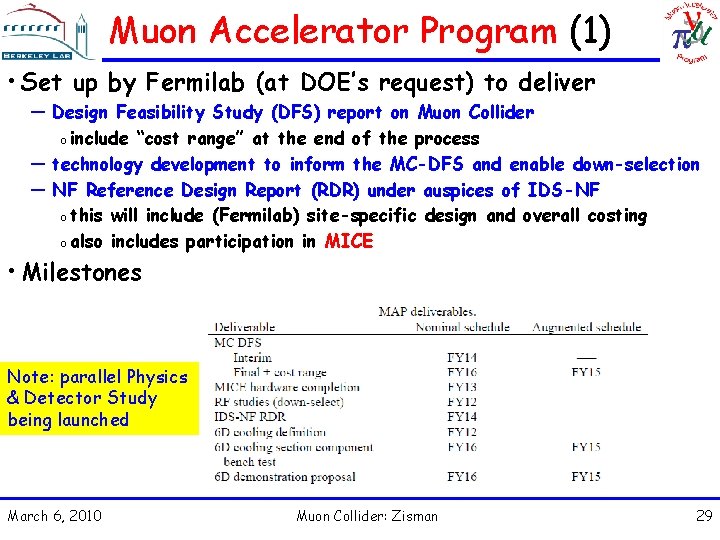
Muon Accelerator Program (1) • Set up by Fermilab (at DOE’s request) to deliver — Design Feasibility Study (DFS) report on Muon Collider o include “cost range” at the end of the process — technology development to inform the MC-DFS and enable down-selection — NF Reference Design Report (RDR) under auspices of IDS-NF o this will include (Fermilab) site-specific design and overall costing o also includes participation in MICE • Milestones Note: parallel Physics & Detector Study being launched March 6, 2010 Muon Collider: Zisman 29
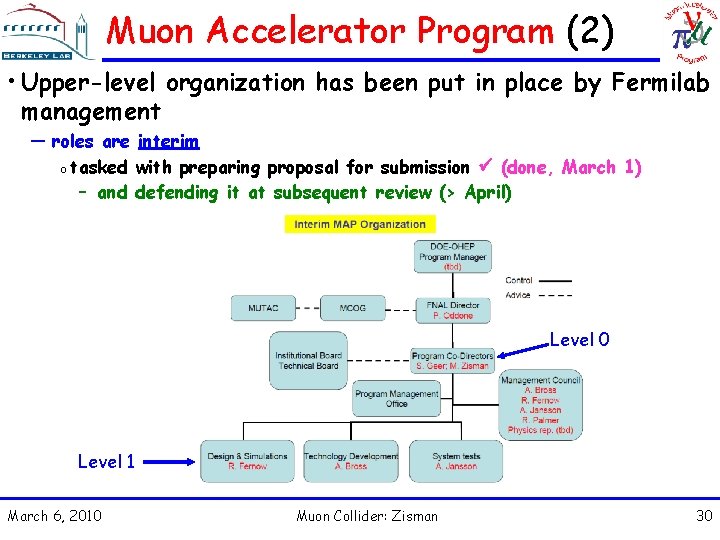
Muon Accelerator Program (2) • Upper-level organization has been put in place by Fermilab management — roles are interim o tasked with preparing proposal for submission (done, March 1) – and defending it at subsequent review (> April) Level 0 Level 1 March 6, 2010 Muon Collider: Zisman 30
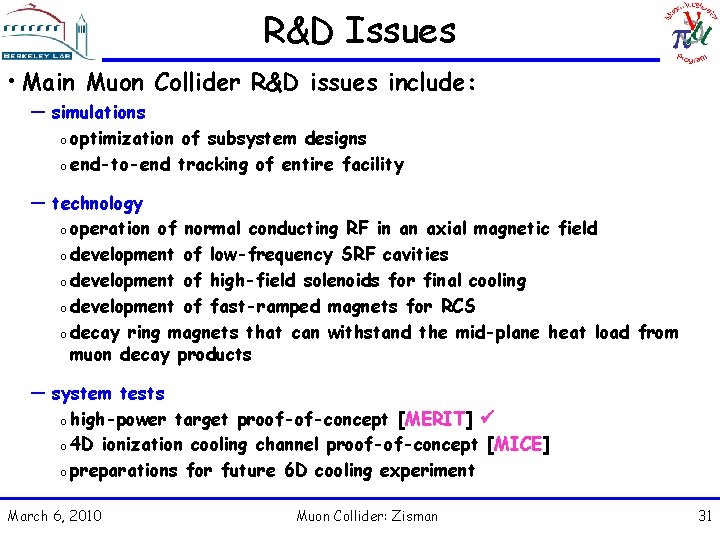
R&D Issues • Main Muon Collider R&D issues include: — simulations o optimization of subsystem designs o end-to-end tracking of entire facility — technology o operation of normal conducting RF in an axial magnetic field o development of low-frequency SRF cavities o development of high-field solenoids for final cooling o development of fast-ramped magnets for RCS o decay ring magnets that can withstand the mid-plane heat load from muon decay products — system tests o high-power target proof-of-concept [MERIT] o 4 D ionization cooling channel proof-of-concept [MICE] o preparations for future 6 D cooling experiment March 6, 2010 Muon Collider: Zisman 31
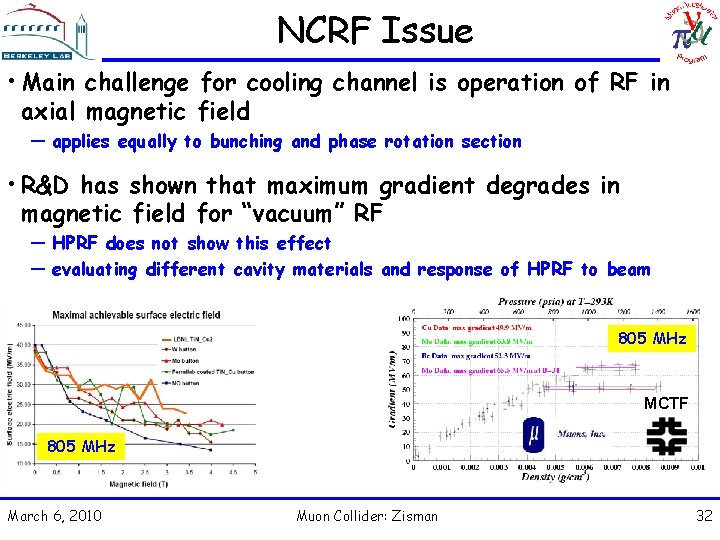
NCRF Issue • Main challenge for cooling channel is operation of RF in axial magnetic field — applies equally to bunching and phase rotation section • R&D has shown that maximum gradient degrades in magnetic field for “vacuum” RF — HPRF does not show this effect — evaluating different cavity materials and response of HPRF to beam 805 MHz MCTF 805 MHz March 6, 2010 Muon Collider: Zisman 32
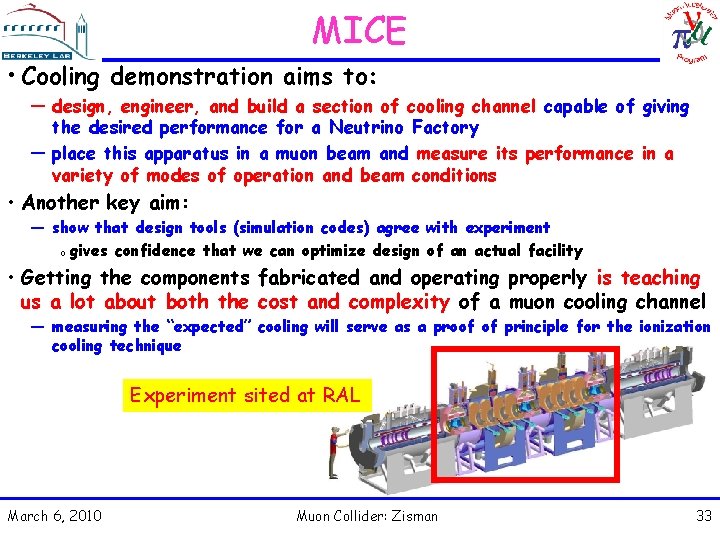
MICE • Cooling demonstration aims to: — design, engineer, and build a section of cooling channel capable of giving the desired performance for a Neutrino Factory — place this apparatus in a muon beam and measure its performance in a variety of modes of operation and beam conditions • Another key aim: — show that design tools (simulation codes) agree with experiment o gives confidence that we can optimize design of an actual facility • Getting the components fabricated and operating properly is teaching us a lot about both the cost and complexity of a muon cooling channel — measuring the “expected” cooling will serve as a proof of principle for the ionization cooling technique Experiment sited at RAL March 6, 2010 Muon Collider: Zisman 33
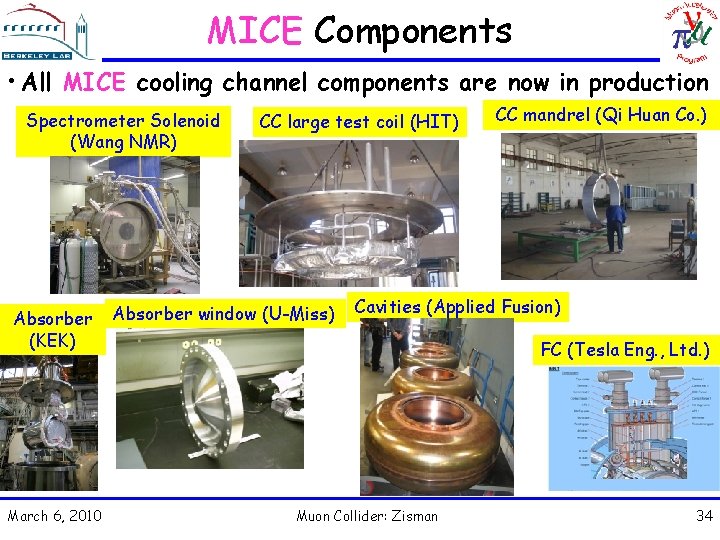
MICE Components • All MICE cooling channel components are now in production Spectrometer Solenoid (Wang NMR) Absorber (KEK) March 6, 2010 CC large test coil (HIT) Absorber window (U-Miss) CC mandrel (Qi Huan Co. ) Cavities (Applied Fusion) FC (Tesla Eng. , Ltd. ) Muon Collider: Zisman 34
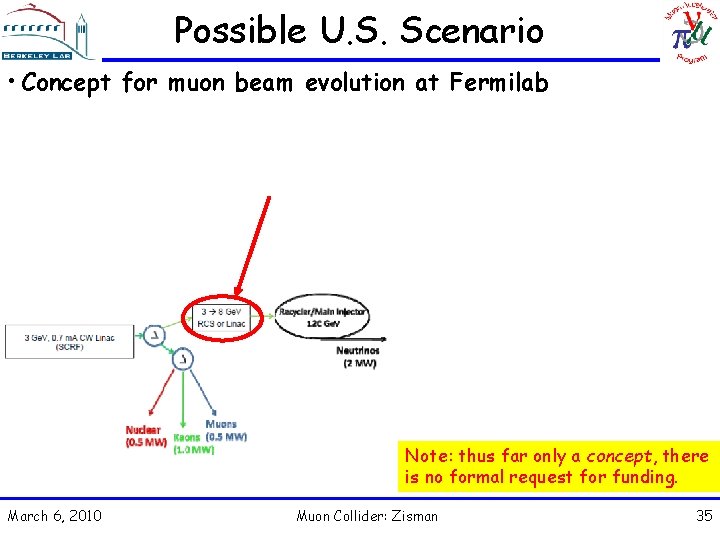
Possible U. S. Scenario • Concept for muon beam evolution at Fermilab Note: thus far only a concept, there is no formal request for funding. March 6, 2010 Muon Collider: Zisman 35
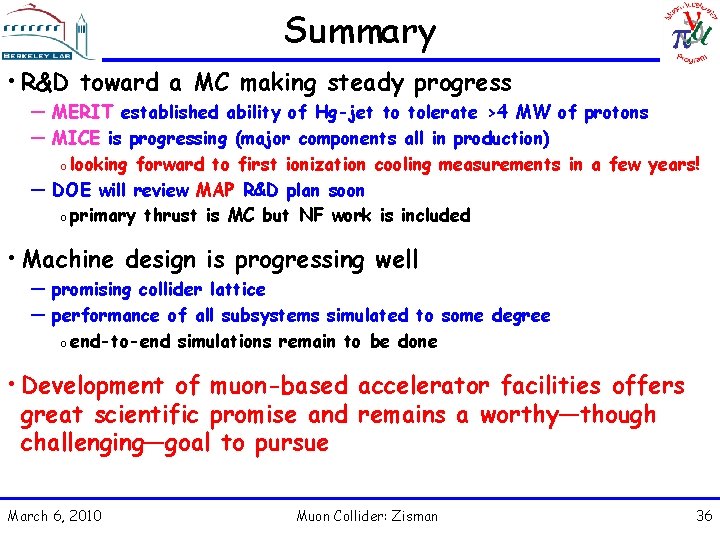
Summary • R&D toward a MC making steady progress — MERIT established ability of Hg-jet to tolerate >4 MW of protons — MICE is progressing (major components all in production) o looking forward to first ionization cooling measurements in a few years! — DOE will review MAP R&D plan soon o primary thrust is MC but NF work is included • Machine design is progressing well — promising collider lattice — performance of all subsystems simulated to some degree o end-to-end simulations remain to be done • Development of muon-based accelerator facilities offers great scientific promise and remains a worthy—though challenging—goal to pursue March 6, 2010 Muon Collider: Zisman 36
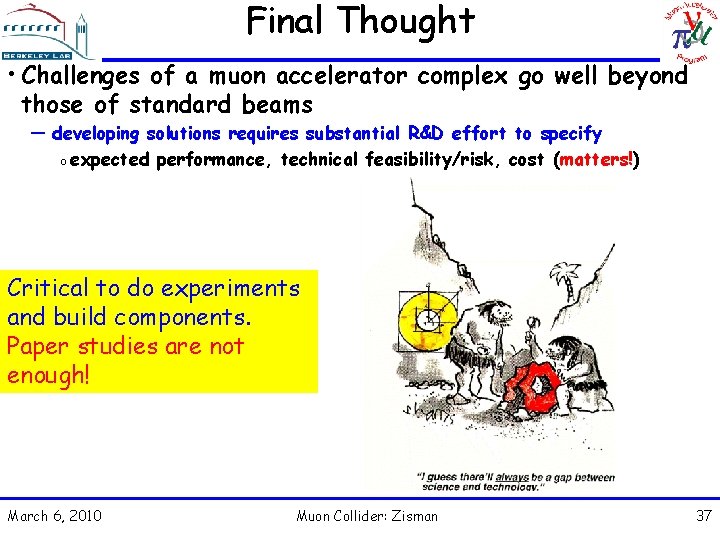
Final Thought • Challenges of a muon accelerator complex go well beyond those of standard beams — developing solutions requires substantial R&D effort to specify o expected performance, technical feasibility/risk, cost (matters!) Critical to do experiments and build components. Paper studies are not enough! March 6, 2010 Muon Collider: Zisman 37