
Muon beam transport based on SC solenoids International

Muon beam transport based on SC solenoids International review of EMu. S Nov. 20 -21, 2018, CSNS, Dongguan Yingpeng Song, Yu Bao
Outline • Beamline introduction • Beamline design – Surface muon beamline design – Decay muon & high-momentum muon beamline deisgn • Conclusions 30/10/2021 Yingpeng Song 2/22
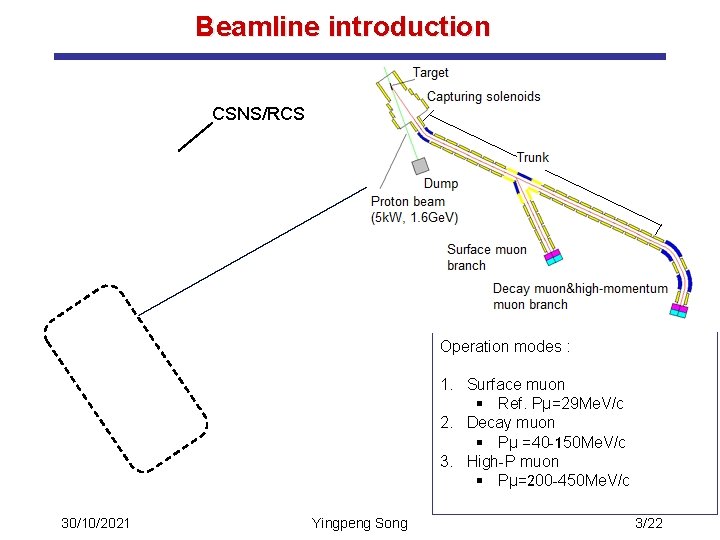
Beamline introduction CSNS/RCS Operation modes : 1. Surface muon § Ref. Pμ=29 Me. V/c 2. Decay muon § Pμ =40 -150 Me. V/c 3. High-P muon § Pμ=200 -450 Me. V/c 30/10/2021 Yingpeng Song 3/22
Challenges and possibilities For μSR applications, users want • High polarization • High muon intensity Proton beam § stand-alone Target thickness and geometry • Small beam spot Challenges for beamline design 30/10/2021 Yingpeng Song 4/22
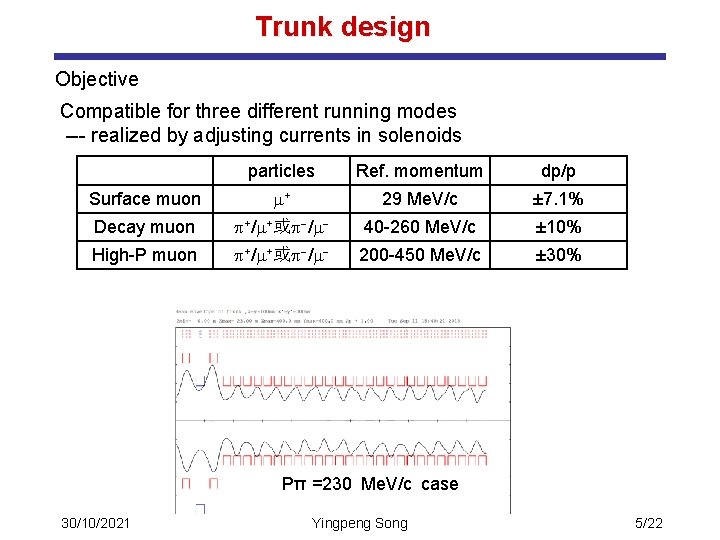
Trunk design Objective Compatible for three different running modes --- realized by adjusting currents in solenoids particles Ref. momentum dp/p Surface muon + 29 Me. V/c ± 7. 1% Decay muon +/ +或 / 40 -260 Me. V/c ± 10% High-P muon +/ +或 / 200 -450 Me. V/c ± 30% Pπ =230 Me. V/c case 30/10/2021 Yingpeng Song 5/22

Surface muon beamline design Objectives: • Intensity >1 E 6/s • Polarization >80% • Positron <10% • dp/p <15% (FWHM) • Beam spot FWHM ~30 mm • Ref. =29 Me. V/c; dp/p=± 3. 5%; acceptance=30 πmm rad 30/10/2021 Yingpeng Song 6/22
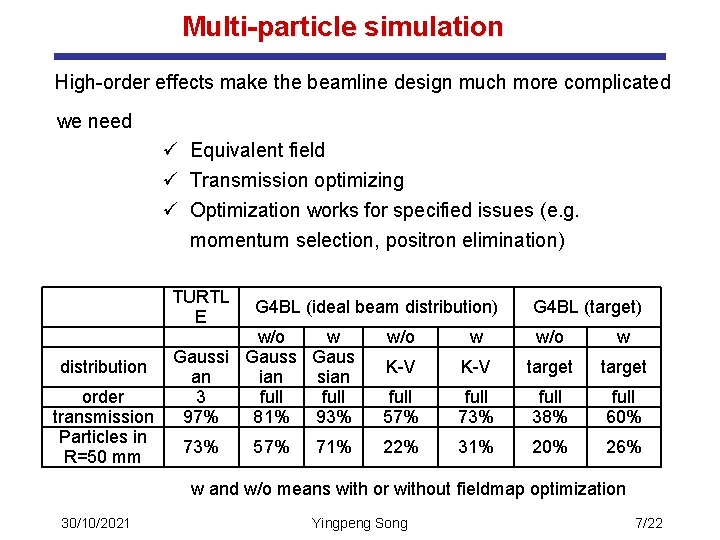
Multi-particle simulation High-order effects make the beamline design much more complicated we need ü Equivalent field ü Transmission optimizing ü Optimization works for specified issues (e. g. momentum selection, positron elimination) TURTL E distribution order transmission Particles in R=50 mm G 4 BL (ideal beam distribution) w/o w Gaussi Gauss Gaus an ian sian 3 full 97% 81% 93% 73% 57% 71% G 4 BL (target) w/o w K-V target full 57% full 73% full 38% full 60% 22% 31% 20% 26% w and w/o means with or without fieldmap optimization 30/10/2021 Yingpeng Song 7/22
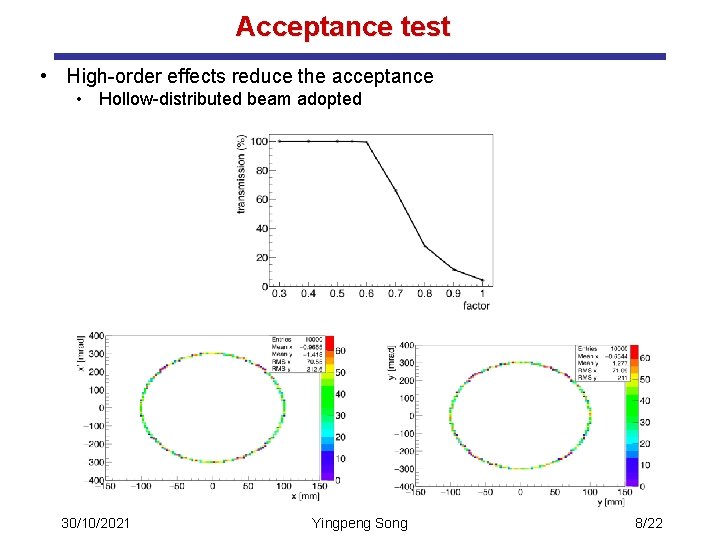
Acceptance test • High-order effects reduce the acceptance • Hollow-distributed beam adopted 30/10/2021 Yingpeng Song 8/22
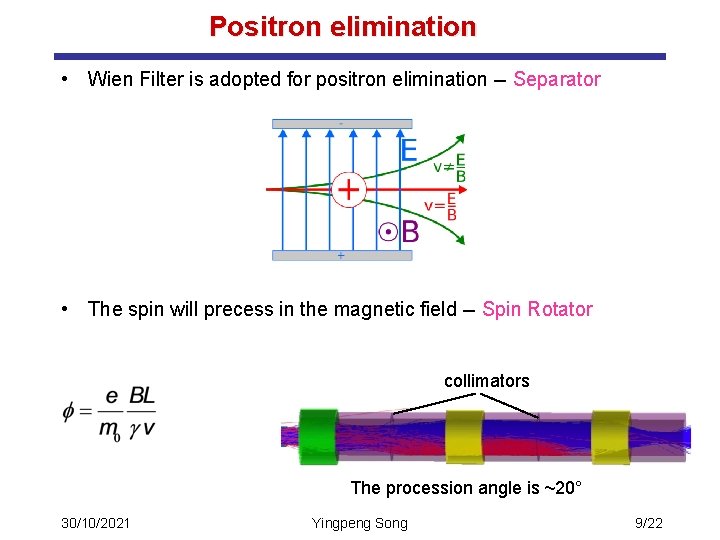
Positron elimination • Wien Filter is adopted for positron elimination -- Separator • The spin will precess in the magnetic field -- Spin Rotator collimators The procession angle is ~20° 30/10/2021 Yingpeng Song 9/22

Beam spot • The focal plan is tilted for different emittance particles (Fig. 1) and off-momentum particles (Fig. 2). Fig. 1 Fig. 2 Beam percentage in Φ 100 mm VS distance away from last solenoid 30/10/2021 Yingpeng Song 10/22
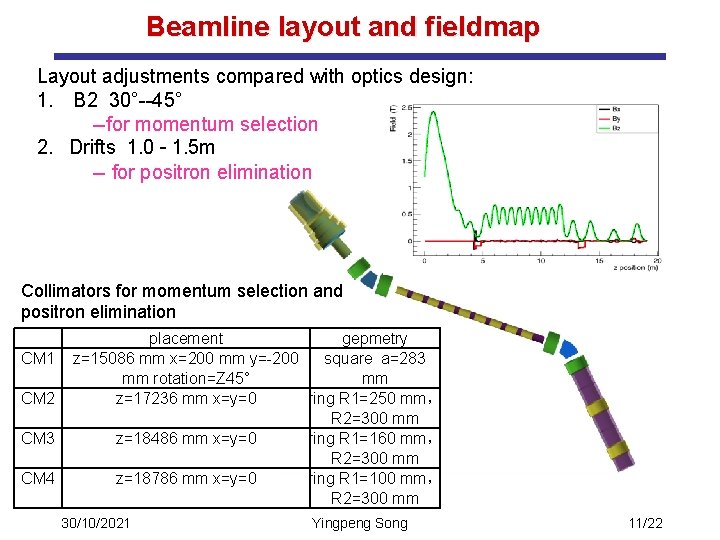
Beamline layout and fieldmap Layout adjustments compared with optics design: 1. B 2 30°--45° --for momentum selection 2. Drifts 1. 0 – 1. 5 m -- for positron elimination Collimators for momentum selection and positron elimination CM 1 CM 2 CM 3 CM 4 placement gepmetry z=15086 mm x=200 mm y=-200 square a=283 mm rotation=Z 45° mm z=17236 mm x=y=0 ring R 1=250 mm, R 2=300 mm z=18486 mm x=y=0 ring R 1=160 mm, R 2=300 mm z=18786 mm x=y=0 ring R 1=100 mm, R 2=300 mm 30/10/2021 Yingpeng Song 11/22
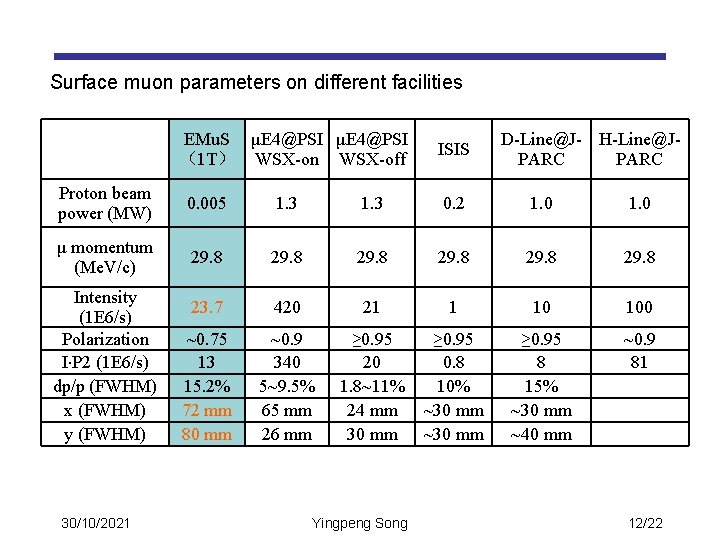
Surface muon parameters on different facilities EMu. S μE 4@PSI (1 T) WSX-on WSX-off ISIS D-Line@J- H-Line@JPARC Proton beam power (MW) 0. 005 1. 3 0. 2 1. 0 μ momentum (Me. V/c) 29. 8 23. 7 420 21 1 10 100 ~0. 75 13 15. 2% 72 mm 80 mm ~0. 9 340 5~9. 5% 65 mm 26 mm ≥ 0. 95 20 1. 8~11% 24 mm 30 mm ≥ 0. 95 0. 8 10% ~30 mm ≥ 0. 95 8 15% ~30 mm ~40 mm ~0. 9 81 Intensity (1 E 6/s) Polarization I P 2 (1 E 6/s) dp/p (FWHM) x (FWHM) y (FWHM) 30/10/2021 Yingpeng Song 12/22

Decay muon beamline design • Ways to obtain high polarized decay muon beam 1. 2. 3. Pion momentum selection ---> make decay muon IP 2 maximized Decay solenoid for pion decay ---> wide momentum acceptance Muon momentum selection ---> make IP 2 maximized 1 30/10/2021 2 Yingpeng Song 3 13/3
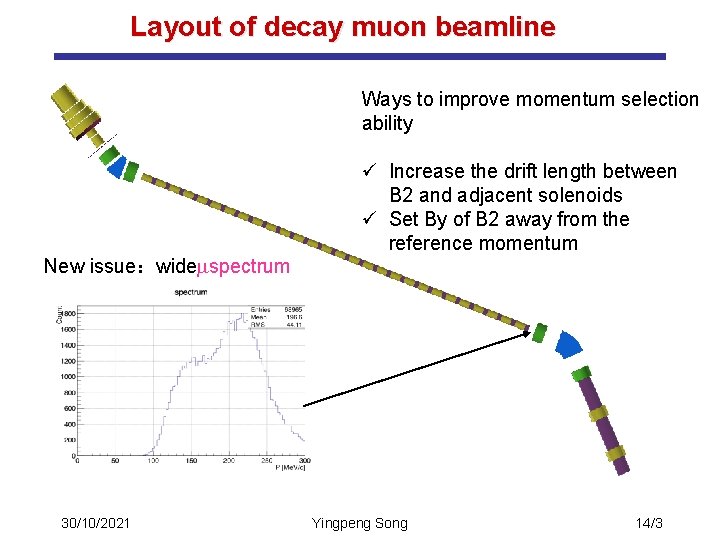
Layout of decay muon beamline Ways to improve momentum selection ability ü Increase the drift length between B 2 and adjacent solenoids ü Set By of B 2 away from the reference momentum New issue:wide spectrum 30/10/2021 Yingpeng Song 14/3
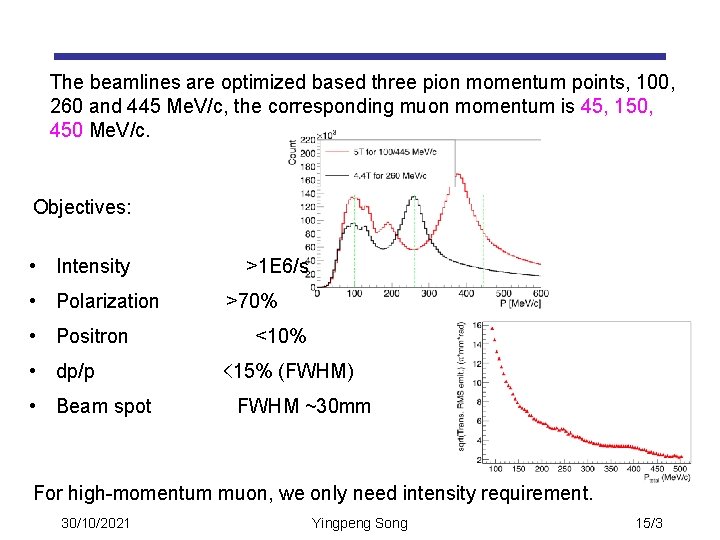
The beamlines are optimized based three pion momentum points, 100, 260 and 445 Me. V/c, the corresponding muon momentum is 45, 150, 450 Me. V/c. Objectives: • Intensity • Polarization • Positron • dp/p • Beam spot >1 E 6/s >70% <15% (FWHM) FWHM ~30 mm For high-momentum muon, we only need intensity requirement. 30/10/2021 Yingpeng Song 15/3
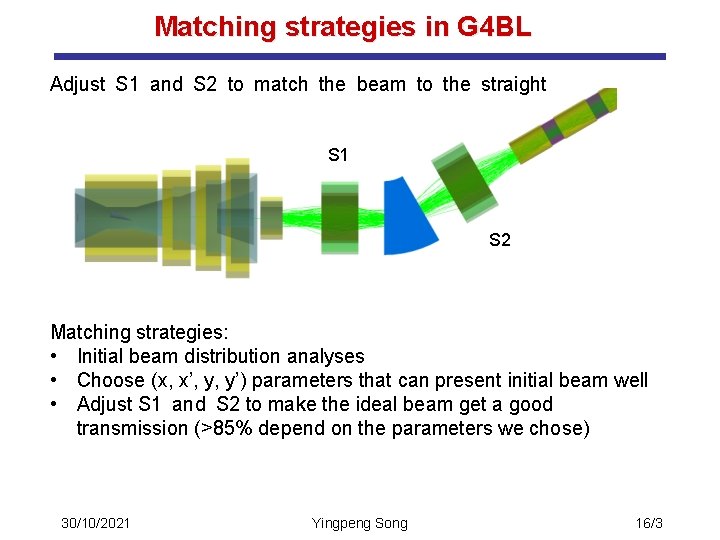
Matching strategies in G 4 BL Adjust S 1 and S 2 to match the beam to the straight S 1 S 2 Matching strategies: • Initial beam distribution analyses • Choose (x, x’, y, y’) parameters that can present initial beam well • Adjust S 1 and S 2 to make the ideal beam get a good transmission (>85% depend on the parameters we chose) 30/10/2021 Yingpeng Song 16/3
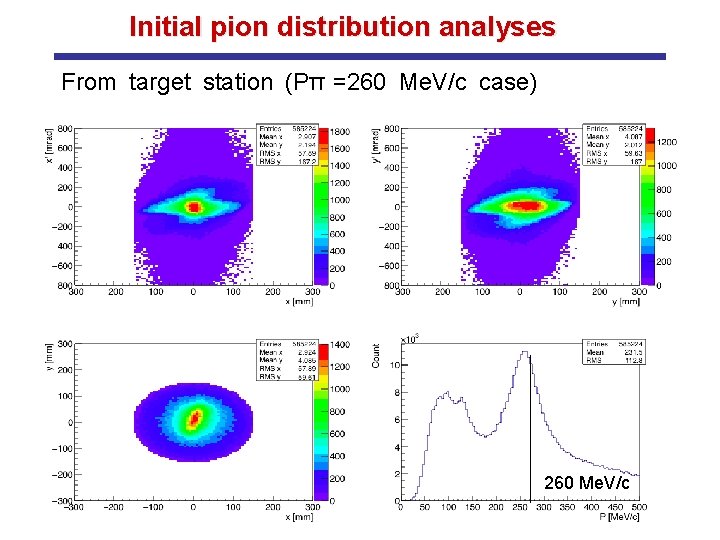
Initial pion distribution analyses From target station (Pπ =260 Me. V/c case) 260 Me. V/c 30/10/2021 Yingpeng Song 17/3
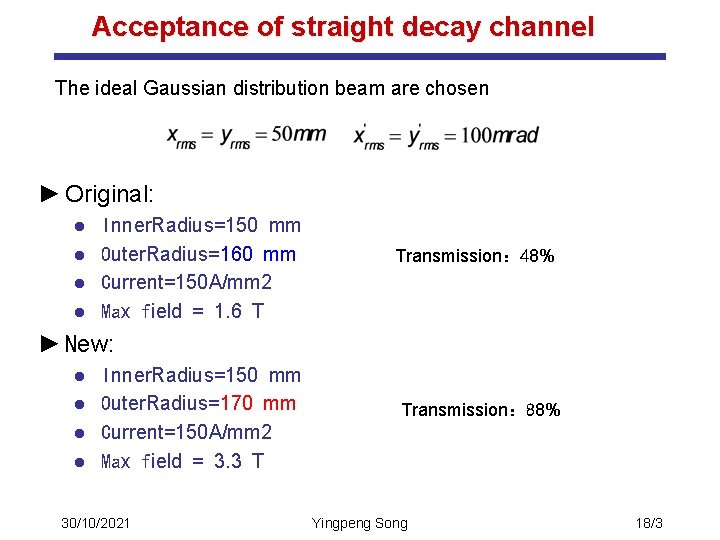
Acceptance of straight decay channel The ideal Gaussian distribution beam are chosen ► Original: Inner. Radius=150 mm l Outer. Radius=160 mm l Current=150 A/mm 2 l Max field = 1. 6 T l Transmission: 48% ► New: Inner. Radius=150 mm l Outer. Radius=170 mm l Current=150 A/mm 2 l Max field = 3. 3 T l 30/10/2021 Transmission: 88% Yingpeng Song 18/3
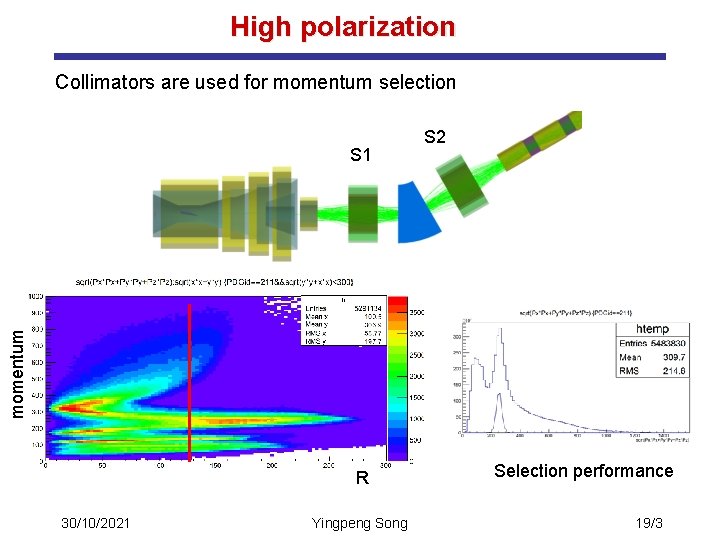
High polarization Collimators are used for momentum selection momentum S 1 S 2 R 30/10/2021 Yingpeng Song Selection performance 19/3
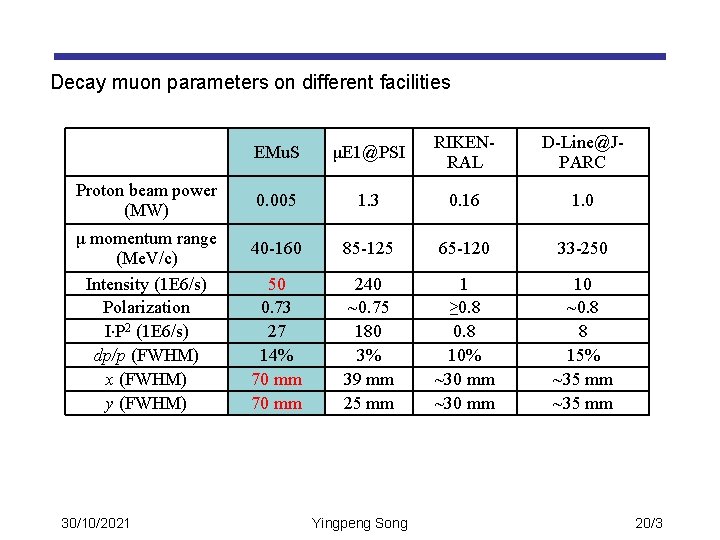
Decay muon parameters on different facilities Proton beam power (MW) μ momentum range (Me. V/c) Intensity (1 E 6/s) Polarization I P 2 (1 E 6/s) dp/p (FWHM) x (FWHM) y (FWHM) 30/10/2021 EMu. S μE 1@PSI RIKENRAL D-Line@JPARC 0. 005 1. 3 0. 16 1. 0 40 -160 85 -125 65 -120 33 -250 50 0. 73 27 14% 70 mm 240 ~0. 75 180 3% 39 mm 25 mm 1 ≥ 0. 8 10% ~30 mm 10 ~0. 8 8 15% ~35 mm Yingpeng Song 20/3
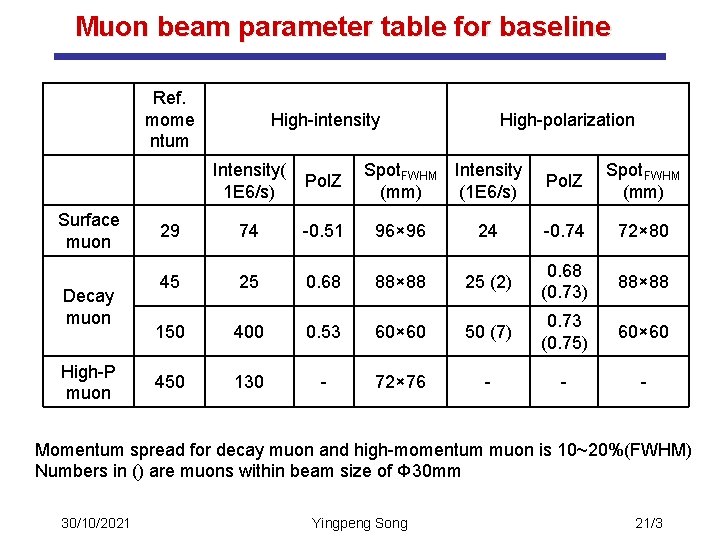
Muon beam parameter table for baseline Ref. mome ntum Surface muon Decay muon High-P muon High-intensity Intensity( 1 E 6/s) Pol. Z 29 74 -0. 51 96× 96 45 25 0. 68 150 400 450 130 High-polarization Spot. FWHM Intensity (mm) (1 E 6/s) Pol. Z Spot. FWHM (mm) 24 -0. 74 72× 80 88× 88 25 (2) 0. 68 (0. 73) 88× 88 0. 53 60× 60 50 (7) 0. 73 (0. 75) 60× 60 - 72× 76 - - - Momentum spread for decay muon and high-momentum muon is 10~20%(FWHM) Numbers in () are muons within beam size of Φ 30 mm 30/10/2021 Yingpeng Song 21/3
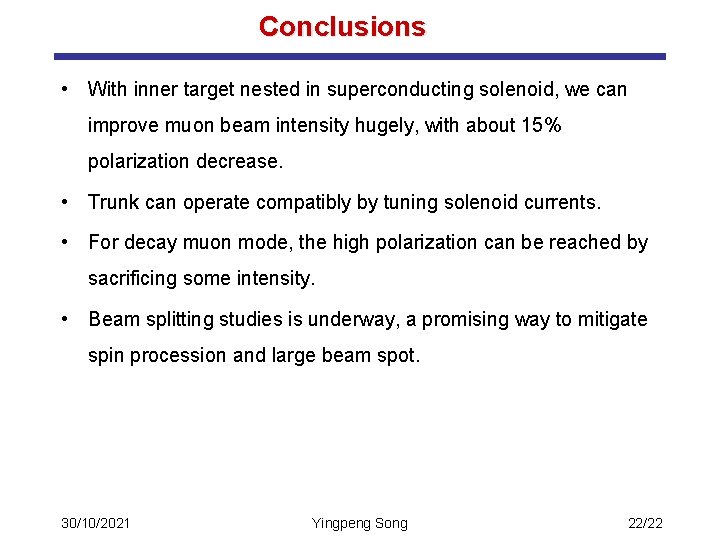
Conclusions • With inner target nested in superconducting solenoid, we can improve muon beam intensity hugely, with about 15% polarization decrease. • Trunk can operate compatibly by tuning solenoid currents. • For decay muon mode, the high polarization can be reached by sacrificing some intensity. • Beam splitting studies is underway, a promising way to mitigate spin procession and large beam spot. 30/10/2021 Yingpeng Song 22/22

BACK UP 30/10/2021 Yingpeng Song 23/22
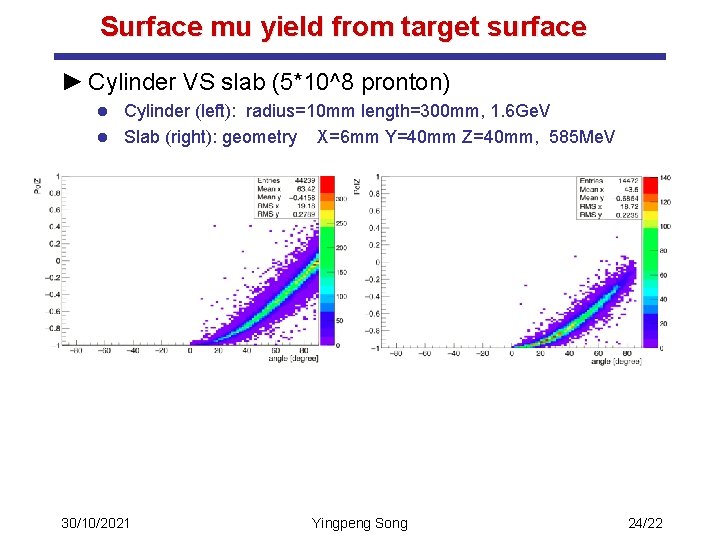
Surface mu yield from target surface ► Cylinder VS slab (5*10^8 pronton) Cylinder (left): radius=10 mm length=300 mm, 1. 6 Ge. V l Slab (right): geometry X=6 mm Y=40 mm Z=40 mm, 585 Me. V l 30/10/2021 Yingpeng Song 24/22
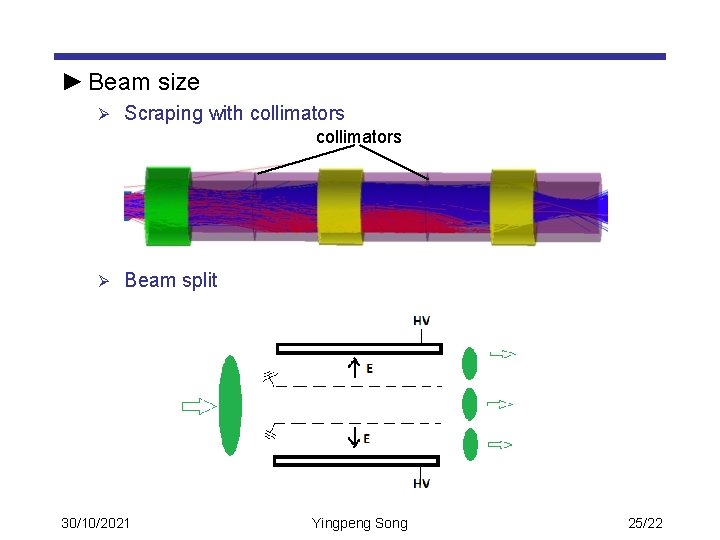
► Beam size Ø Scraping with collimators Ø Beam split 30/10/2021 Yingpeng Song 25/22
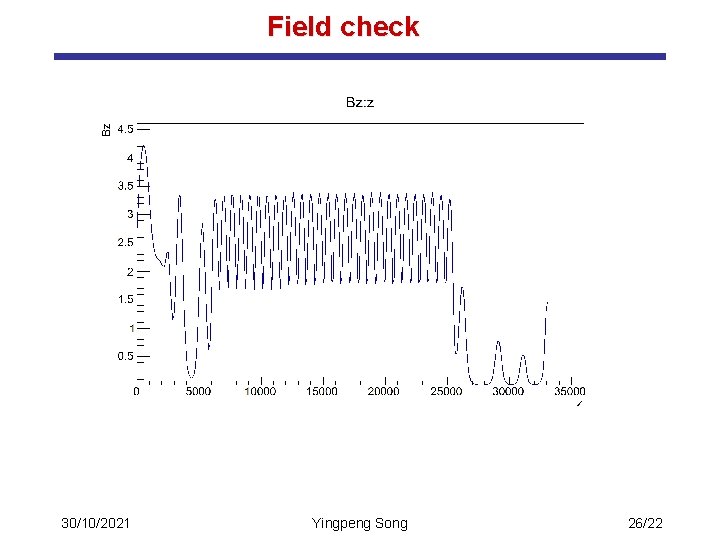
Field check 30/10/2021 Yingpeng Song 26/22
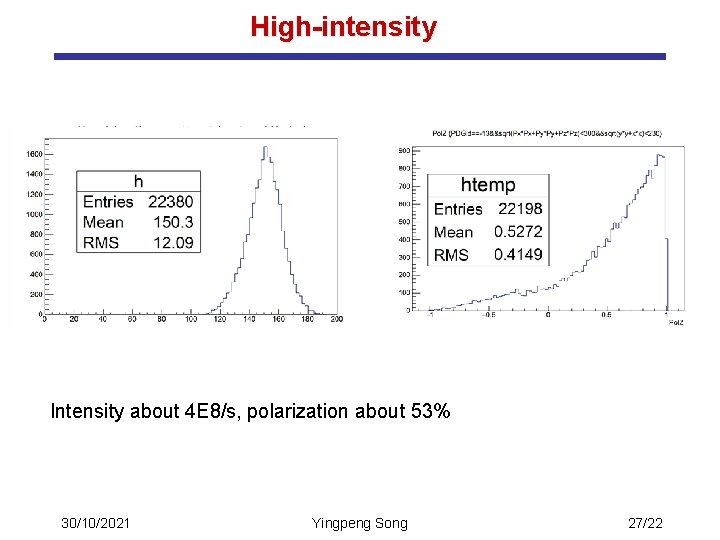
High-intensity Intensity about 4 E 8/s, polarization about 53% 30/10/2021 Yingpeng Song 27/22
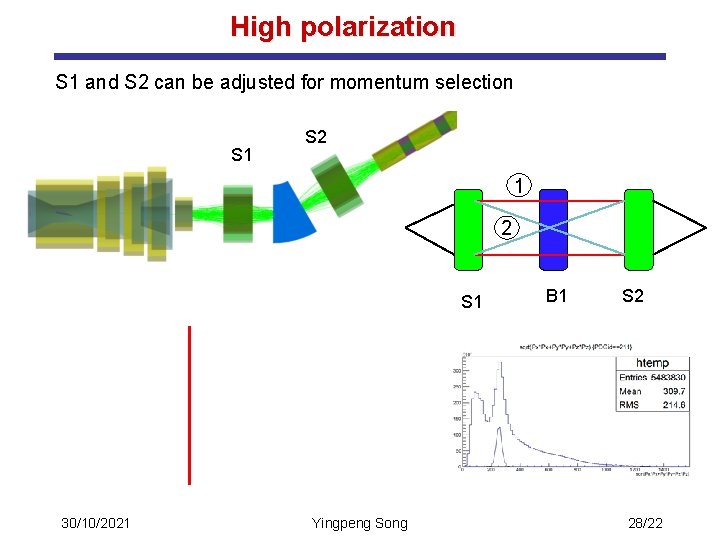
High polarization S 1 and S 2 can be adjusted for momentum selection S 1 S 2 1 2 S 1 30/10/2021 Yingpeng Song B 1 S 2 28/22
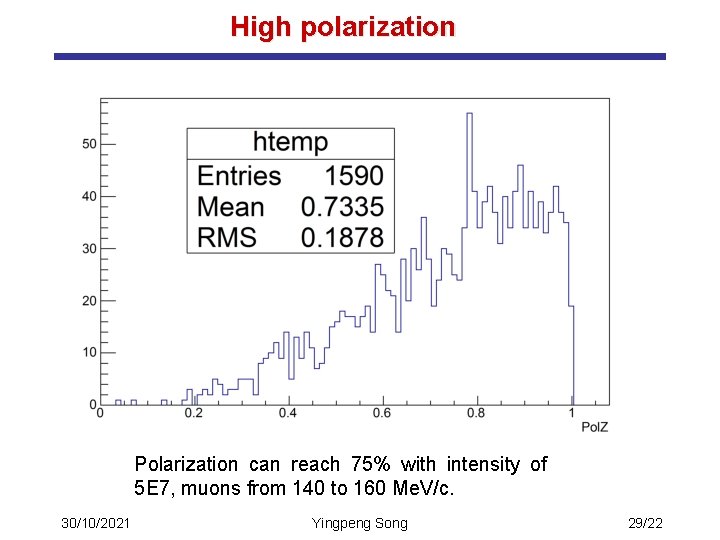
High polarization Polarization can reach 75% with intensity of 5 E 7, muons from 140 to 160 Me. V/c. 30/10/2021 Yingpeng Song 29/22
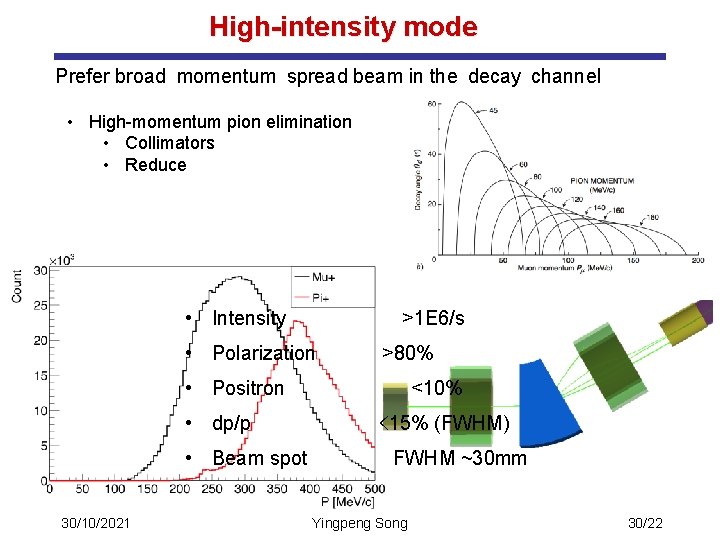
High-intensity mode Prefer broad momentum spread beam in the decay channel • High-momentum pion elimination • Collimators • Reduce • Intensity >1 E 6/s • Polarization >80% • Positron • dp/p • Beam spot 30/10/2021 <10% <15% (FWHM) FWHM ~30 mm Yingpeng Song 30/22
- Slides: 30