
Muon Accelerator Program Steve Geer Fermilab Institutional Review
Muon Accelerator Program Steve Geer Fermilab Institutional Review June 6 -9, 2011
Outline 2 • Introduction • Motivation, Challenges & Design • MAP • Progress / Fermilab Contributions • Plans • Conclusion Fermilab Institutional Review, June 6 -9, 2011
Introduction • Muon accelerator R&D at Fermilab is pursued within the context of the national Muon Accelerator program (MAP). The mission of the Muon Accelerator Program (MAP) is to develop and demonstrate the concepts and critical technologies required to produce, capture, condition, accelerate, and store intense beams of muons for Muon Colliders and Neutrino Factories. The goal of MAP is to deliver results that will permit the high-energy physics community to make an informed choice of the optimal path to a high-energy lepton collider and/or a next-generation neutrino beam facility. Coordination with the parallel Muon Collider Physics and Detector Study and with the International Design Study of a Neutrino Factory will ensure MAP responsiveness to physics requirements. 3 Fermilab Institutional Review, June 6 -9, 2011
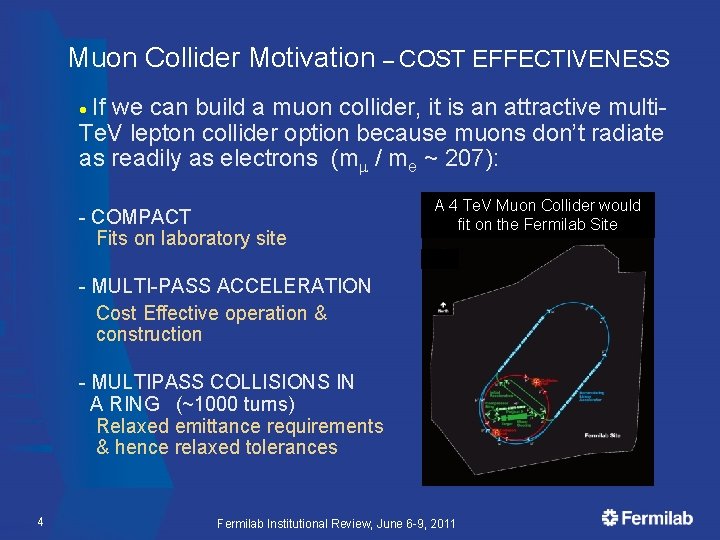
Muon Collider Motivation – COST EFFECTIVENESS If we can build a muon collider, it is an attractive multi. Te. V lepton collider option because muons don’t radiate as readily as electrons (mm / me ~ 207): · - COMPACT Fits on laboratory site A 4 Te. V Muon Collider would fit on the Fermilab Site - MULTI-PASS ACCELERATION Cost Effective operation & construction - MULTIPASS COLLISIONS IN A RING (~1000 turns) Relaxed emittance requirements & hence relaxed tolerances 4 Fermilab Institutional Review, June 6 -9, 2011
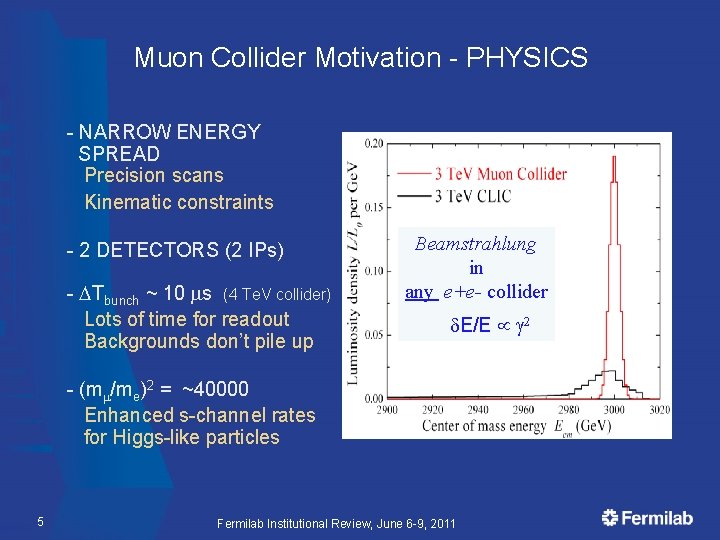
Muon Collider Motivation - PHYSICS - NARROW ENERGY SPREAD Precision scans Kinematic constraints - 2 DETECTORS (2 IPs) - DTbunch ~ 10 ms (4 Te. V collider) Lots of time for readout Backgrounds don’t pile up Beamstrahlung in any e+e- collider E/E 2 - (mm/me)2 = ~40000 Enhanced s-channel rates for Higgs-like particles 5 Fermilab Institutional Review, June 6 -9, 2011
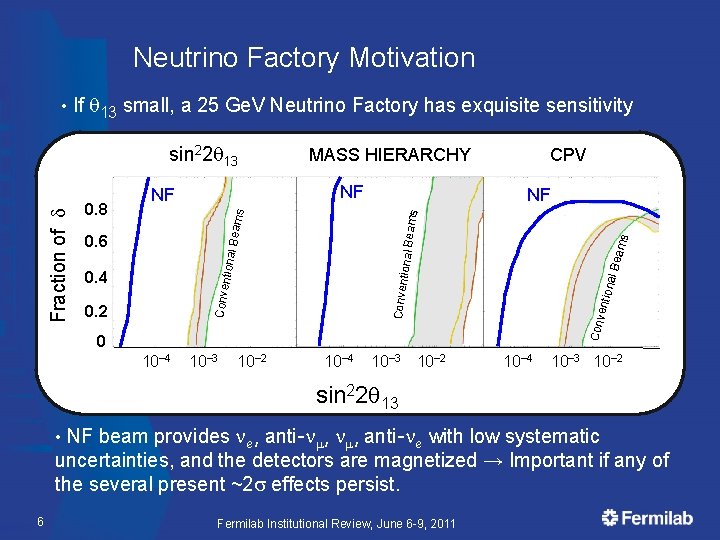
Neutrino Factory Motivation If q 13 small, a 25 Ge. V Neutrino Factory has exquisite sensitivity NF s s eam Con 0. 2 Conventi 0. 4 vent iona l. B 0. 6 CPV NF s NF l Beam 0. 8 MASS HIERARCHY Conve ntiona Fraction of sin 22 q 13 onal Bea m • 0 10 -4 10 -3 10 -2 sin 22 q 13 NF beam provides ne, anti-nm, anti-ne with low systematic uncertainties, and the detectors are magnetized → Important if any of the several present ~2 s effects persist. • 6 Fermilab Institutional Review, June 6 -9, 2011
Challenges Muons are produced as tertiary particles. To make enough of them we must start with a MW scale proton source & target facility. • Muons decay everything must be done fast and we must deal with the decay electrons (& neutrinos for CM energies above ~3 Te. V). • Muons are born within a large 6 D phase-space. For a MC we must cool them by O(106) before they decay New cooling technique (ionization cooling) must be demonstrated, and it requires components with demanding performance (NCRF in magnetic channel, high field solenoids. ) • After cooling, beams still have relatively large emittance. • 7 Fermilab Institutional Review, June 6 -9, 2011
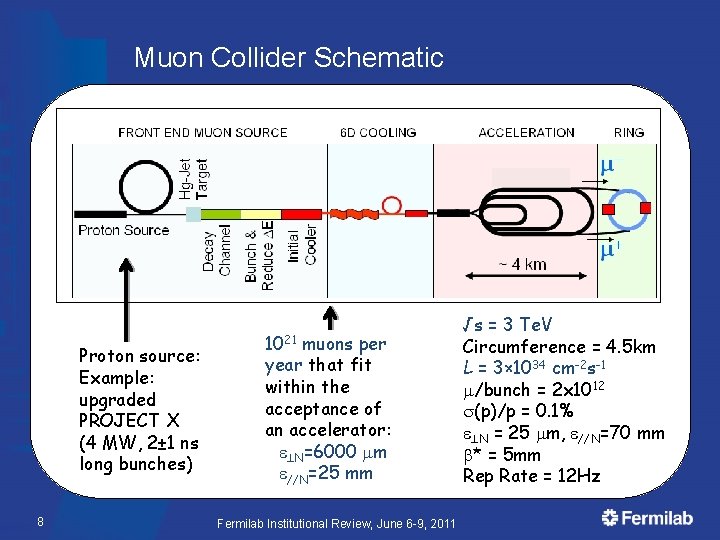
Muon Collider Schematic Proton source: Example: upgraded PROJECT X (4 MW, 2± 1 ns long bunches) 8 1021 muons per year that fit within the acceptance of an accelerator: e N=6000 mm e//N=25 mm Fermilab Institutional Review, June 6 -9, 2011 √s = 3 Te. V Circumference = 4. 5 km L = 3× 1034 cm-2 s-1 m/bunch = 2 x 10¹² s(p)/p = 0. 1% e N = 25 mm, e//N=70 mm b* = 5 mm Rep Rate = 12 Hz
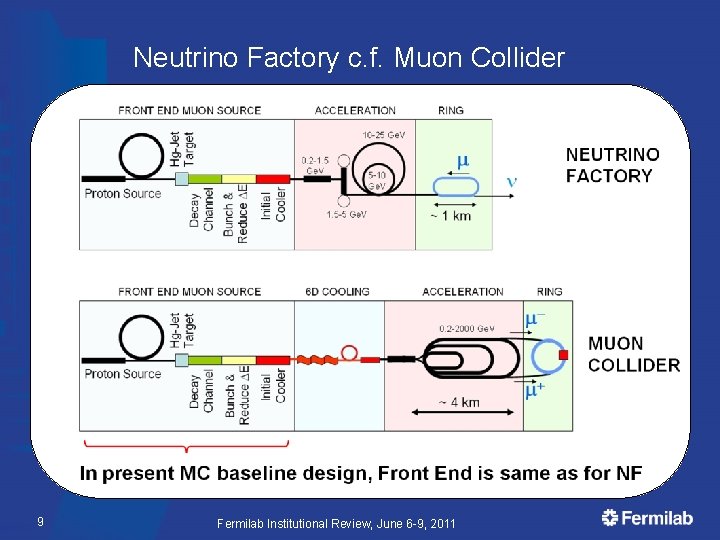
Neutrino Factory c. f. Muon Collider 9 Fermilab Institutional Review, June 6 -9, 2011
Birth of MAP • Oct 1, 2009 letter from DOE-OHEP to FNAL Director: “Our office believes that it is timely to mount a concerted national R&D program that addresses the technical challenges and feasibility issues relevant to the capabilities needed for future Neutrino Factory and multi -Te. V Muon Collider facilities. . ” • Letter requested a new organization for a national Muon Collider & Neutrino Factory R&D program, hosted at FNAL. • Muon Accelerator Program organization is now in place & functioning: >200 participants from 15 institutions: § § • 10 ANL, BNL, FNAL, JLab, LBNL, ORNL, SLAC, Cornell, IIT, Princeton, UCB, UCLA, UCR, U-Miss, U. Chicago http: //map. fnal. gov/ MAP R&D proposal reviewed August 2010 … committee concluded that the “proposed work was very important to the field of high energy physics. ” Fermilab Institutional Review, June 6 -9, 2011
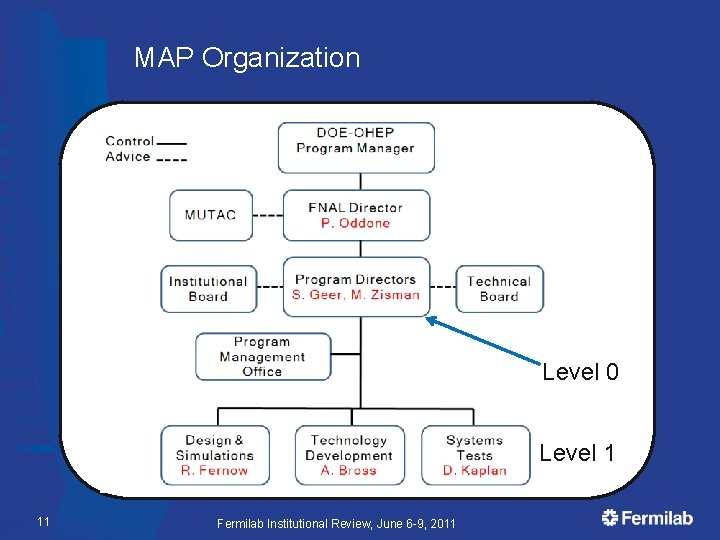
MAP Organization Level 0 Level 1 11 Fermilab Institutional Review, June 6 -9, 2011
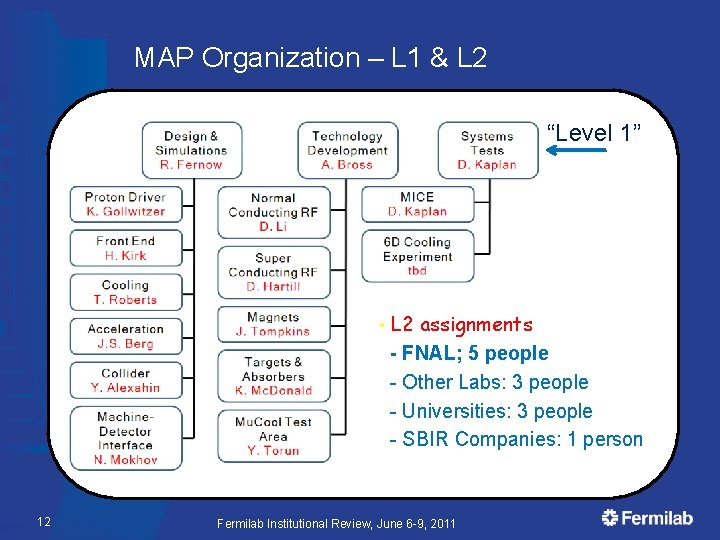
MAP Organization – L 1 & L 2 “Level 1” • 12 L 2 assignments - FNAL; 5 people - Other Labs: 3 people - Universities: 3 people - SBIR Companies: 1 person Fermilab Institutional Review, June 6 -9, 2011
Fermilab Contributions • Exploits Fermilab’s expertise and assets. • • • Significant activities: • • 13 Tackle the most critical and hardest problems. Exploit Fermilab’s unique testing capabilities Organization & leadership (Level 0, Level 1, Level 2) Front- end, cooling channel, & Collider Ring design studies. Machine –Detector Interface studies (interfacing to the Muon Collider physics/detector activities, including MARS background simulations). Ionization cooling channel component development and testing, including magnet and RF studies. Fermilab Institutional Review, June 6 -9, 2011
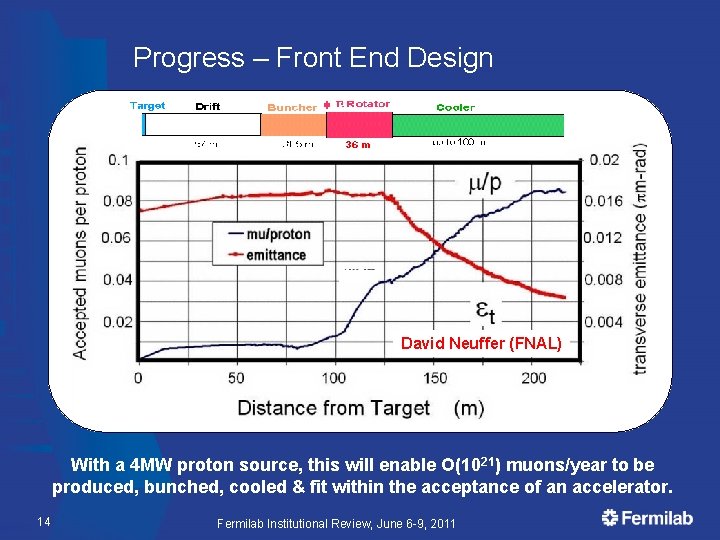
Progress – Front End Design David Neuffer (FNAL) With a 4 MW proton source, this will enable O(1021) muons/year to be produced, bunched, cooled & fit within the acceptance of an accelerator. 14 Fermilab Institutional Review, June 6 -9, 2011
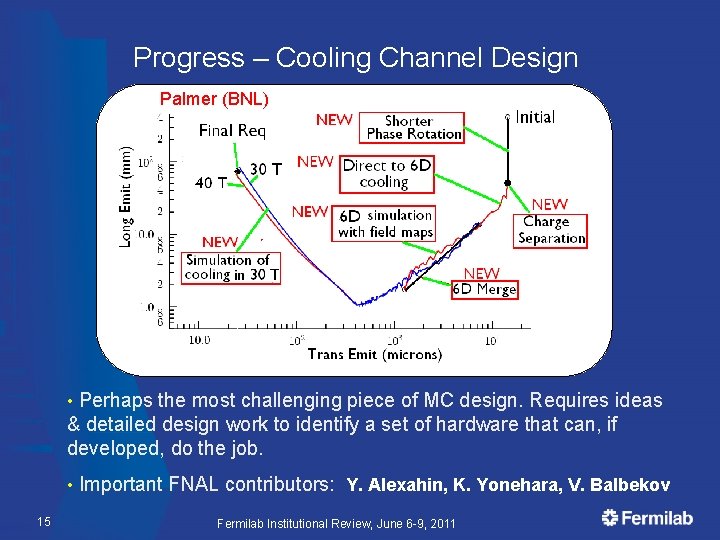
Progress – Cooling Channel Design Palmer (BNL) Perhaps the most challenging piece of MC design. Requires ideas & detailed design work to identify a set of hardware that can, if developed, do the job. • • 15 Important FNAL contributors: Y. Alexahin, K. Yonehara, V. Balbekov Fermilab Institutional Review, June 6 -9, 2011
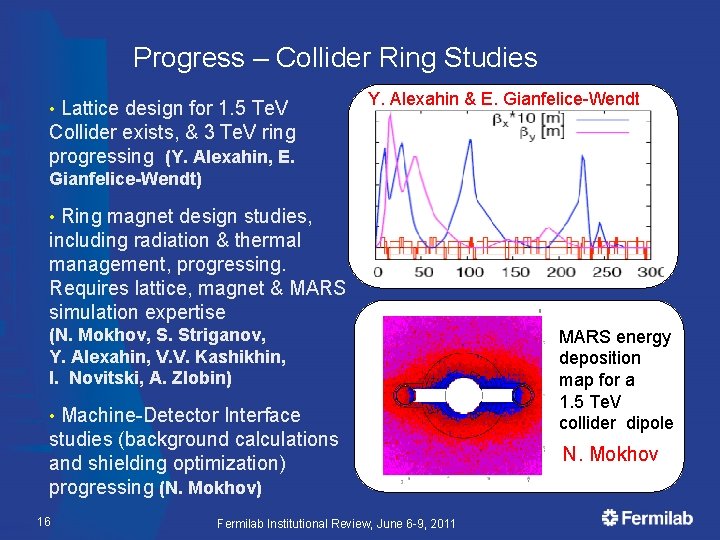
Progress – Collider Ring Studies Lattice design for 1. 5 Te. V Collider exists, & 3 Te. V ring progressing (Y. Alexahin, E. • Y. Alexahin & E. Gianfelice-Wendt) Ring magnet design studies, including radiation & thermal management, progressing. Requires lattice, magnet & MARS simulation expertise • (N. Mokhov, S. Striganov, Y. Alexahin, V. V. Kashikhin, I. Novitski, A. Zlobin) Machine-Detector Interface studies (background calculations and shielding optimization) progressing (N. Mokhov) • 16 Fermilab Institutional Review, June 6 -9, 2011 MARS energy deposition map for a 1. 5 Te. V collider dipole N. Mokhov
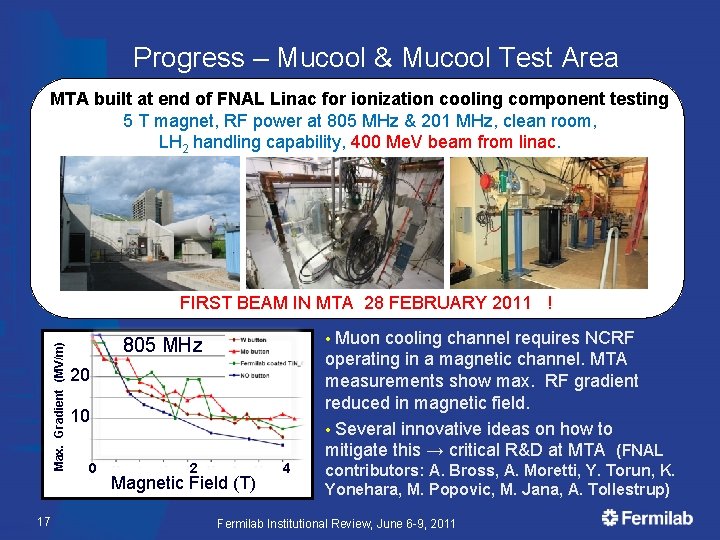
Progress – Mucool & Mucool Test Area MTA built at end of FNAL Linac for ionization cooling component testing 5 T magnet, RF power at 805 MHz & 201 MHz, clean room, LH 2 handling capability, 400 Me. V beam from linac. Max. Gradient (MV/m) FIRST BEAM IN MTA 28 FEBRUARY 2011 ! 17 Muon cooling channel requires NCRF operating in a magnetic channel. MTA measurements show max. RF gradient reduced in magnetic field. • Several innovative ideas on how to mitigate this → critical R&D at MTA (FNAL • 805 MHz 20 10 0 2 Magnetic Field (T) 4 contributors: A. Bross, A. Moretti, Y. Torun, K. Yonehara, M. Popovic, M. Jana, A. Tollestrup) Fermilab Institutional Review, June 6 -9, 2011
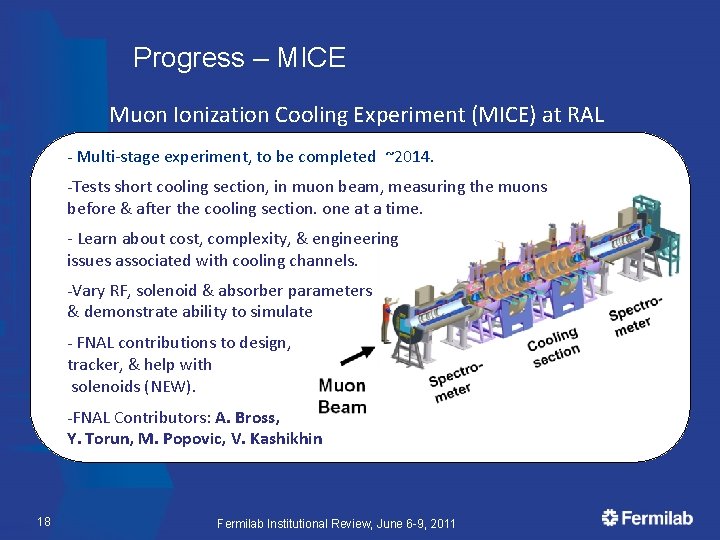
Progress – MICE Muon Ionization Cooling Experiment (MICE) at RAL - Multi-stage experiment, to be completed ~2014. -Tests short cooling section, in muon beam, measuring the muons before & after the cooling section. one at a time. - Learn about cost, complexity, & engineering issues associated with cooling channels. -Vary RF, solenoid & absorber parameters & demonstrate ability to simulate - FNAL contributions to design, tracker, & help with solenoids (NEW). -FNAL Contributors: A. Bross, Y. Torun, M. Popovic, V. Kashikhin 18 Fermilab Institutional Review, June 6 -9, 2011
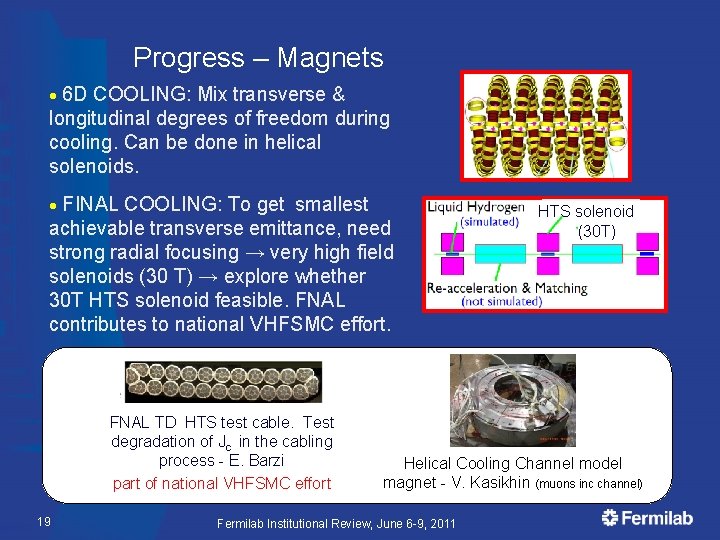
Progress – Magnets 6 D COOLING: Mix transverse & longitudinal degrees of freedom during cooling. Can be done in helical solenoids. · FINAL COOLING: To get smallest achievable transverse emittance, need strong radial focusing → very high field solenoids (30 T) → explore whether 30 T HTS solenoid feasible. FNAL contributes to national VHFSMC effort. · FNAL TD HTS test cable. Test degradation of Jc in the cabling process - E. Barzi part of national VHFSMC effort 19 HTS solenoid (30 T) Helical Cooling Channel model magnet - V. Kasikhin (muons inc channel) Fermilab Institutional Review, June 6 -9, 2011
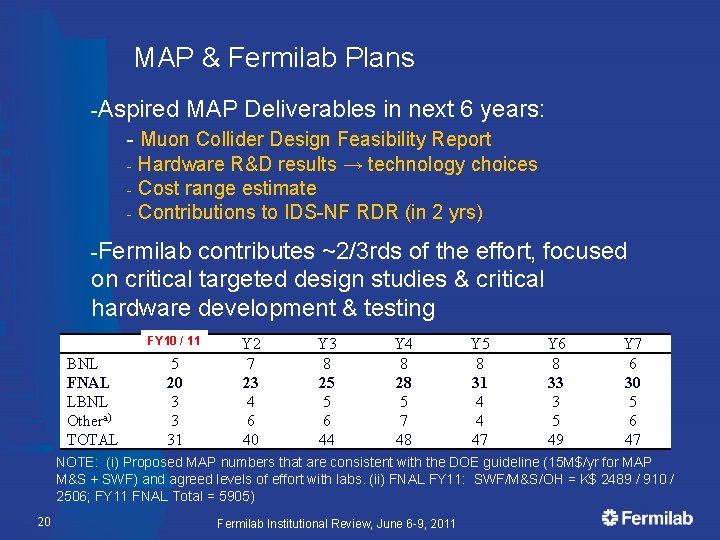
MAP & Fermilab Plans -Aspired MAP Deliverables in next 6 years: - Muon Collider Design Feasibility Report - Hardware R&D results → technology choices - Cost range estimate - Contributions to IDS-NF RDR (in 2 yrs) -Fermilab contributes ~2/3 rds of the effort, focused on critical targeted design studies & critical hardware development & testing FY 10 Y 1/ 11 BNL FNAL LBNL Othera) TOTAL 5 20 3 3 31 Y 2 7 23 4 6 40 Y 3 8 25 5 6 44 Y 4 8 28 5 7 48 Y 5 8 31 4 4 47 Y 6 8 33 3 5 49 Y 7 6 30 5 6 47 NOTE: (i) Proposed MAP numbers that are consistent with the DOE guideline (15 M$/yr for MAP M&S + SWF) and agreed levels of effort with labs. (ii) FNAL FY 11: SWF/M&S/OH = K$ 2489 / 910 / 2506; FY 11 FNAL Total = 5905) 20 Fermilab Institutional Review, June 6 -9, 2011
Conclusion In the last 12 months, MAP has been established, & as the host lab, Fermilab plays a central role. • MAP aspires to making, within a few years, significant progress towards establishing the feasibility of a Muon Collider & contributing to the international Neutrino Factory R&D (IDS-NF RDR in 2 years). • Fermilab’s main contributions are organization, leadership, front-end, cooling channel, and collider ring design, & cooling channel component development & testing. Targeted R&D focused on the critical issues. • Muon Collider design and component development is a challenging, long-term endeavor. The potential payoff is enormous. • 21 Fermilab Institutional Review, June 6 -9, 2011
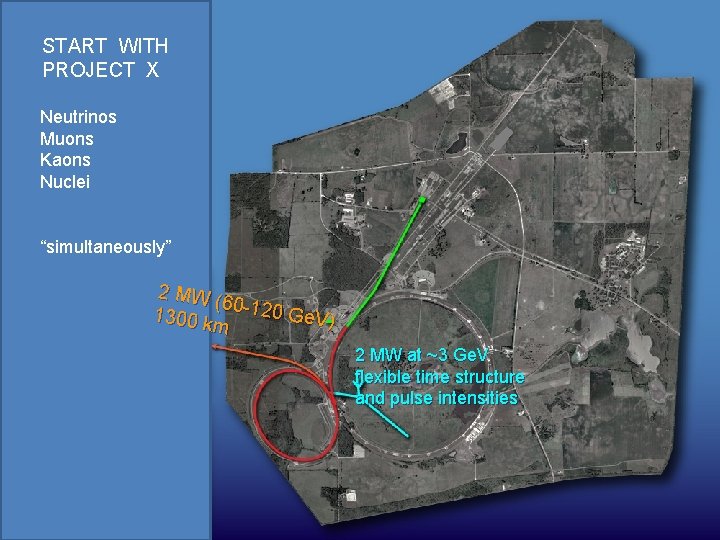
A VISION START WITH PROJECT X Neutrinos Muons Kaons Nuclei “simultaneously” 2 MW (60 -12 0 Ge. V) 1300 k m 2 MW at ~3 Ge. V flexible time structure and pulse intensities STEVE GEER HEPAP MEETING 18 March, 2011 Washington, D. C. 22
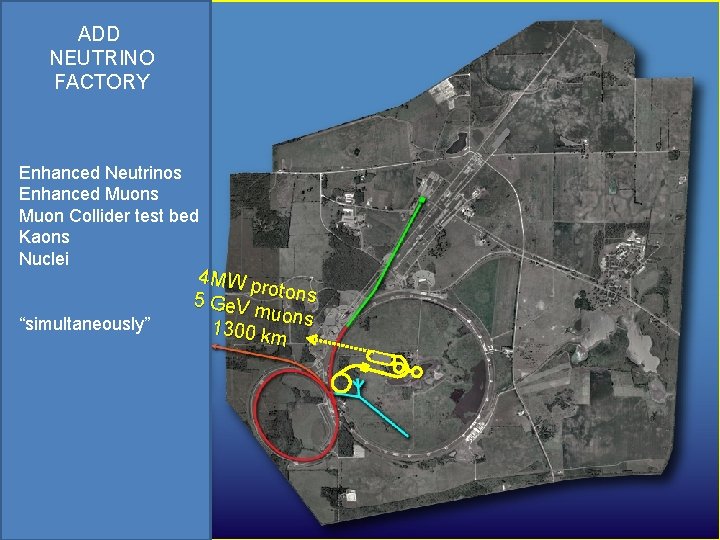
A VISION ADD NEUTRINO FACTORY Enhanced Neutrinos Enhanced Muons Muon Collider test bed Kaons Nuclei “simultaneously” STEVE GEER 4 MW p ro 5 Ge. V tons muons 1300 k m HEPAP MEETING 18 March, 2011 Washington, D. C. 23
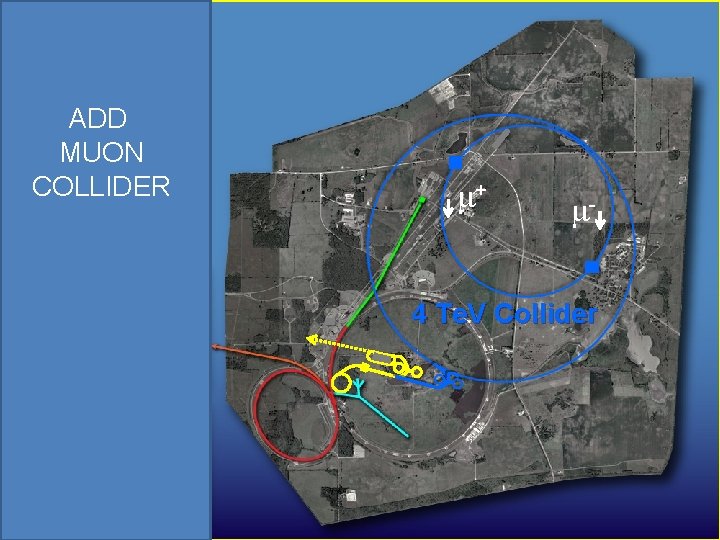
A VISION ADD MUON COLLIDER m+ m- 4 Te. V Collider STEVE GEER HEPAP MEETING 18 March, 2011 Washington, D. C. 24

ADDITIONAL SLIDES 25 Fermilab Institutional Review, June 6 -9, 2011
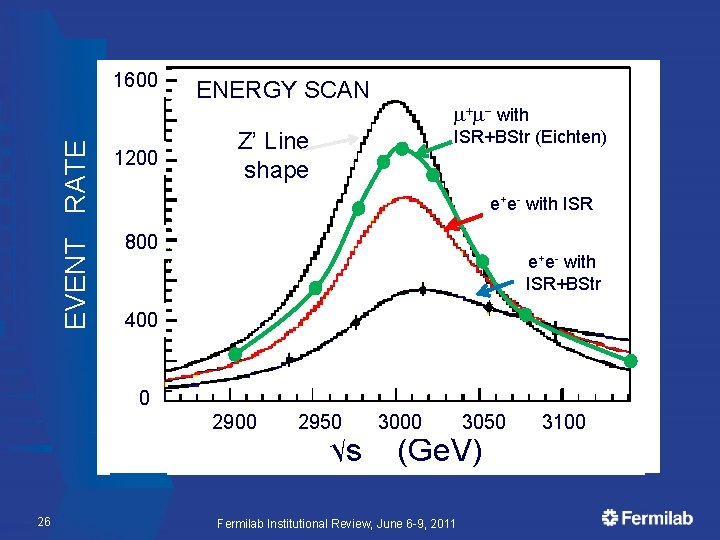
EVENT RATE 1600 1200 ENERGY SCAN m+m- with ISR+BStr (Eichten) Z’ Line shape e+e- with ISR 800 e+e- with ISR+BStr 400 0 2900 26 2950 √s 3000 3050 (Ge. V) Fermilab Institutional Review, June 6 -9, 2011 3100
- Slides: 26