
Munters DOAS Chilled Beams and VRV Scott Mc

Munters DOAS, Chilled Beams and VRV Scott Mc. Ginnis Regional Sales Manager LEED Associate March 7, 2011 Slide 1
Overview ● Chilled Beams and Variable Refrigerant Volume Systems ● Moisture Control ● Equipment
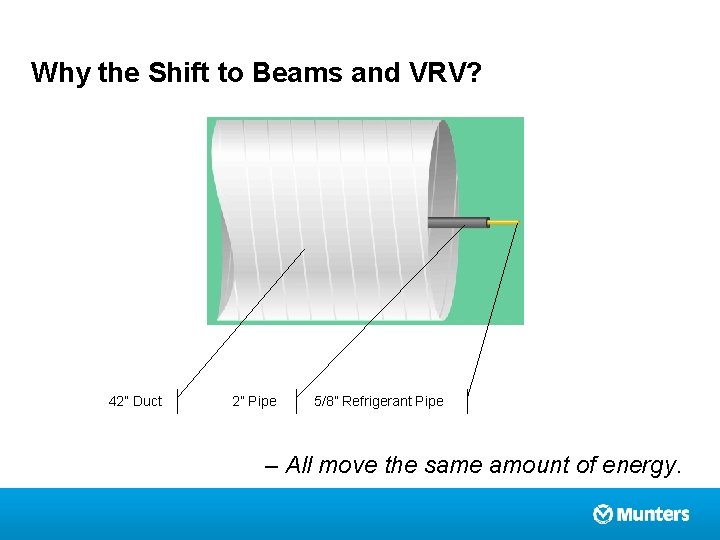
Why the Shift to Beams and VRV? 42” Duct 2” Pipe 5/8” Refrigerant Pipe – All move the same amount of energy.
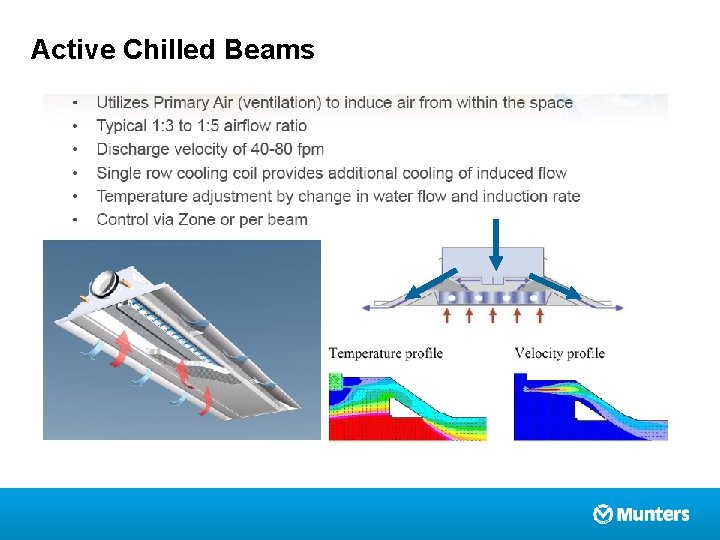
Active Chilled Beams
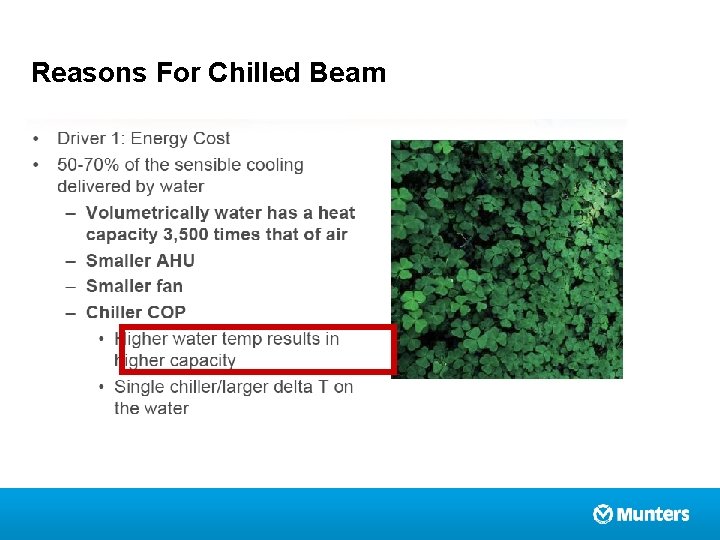
Reasons For Chilled Beam
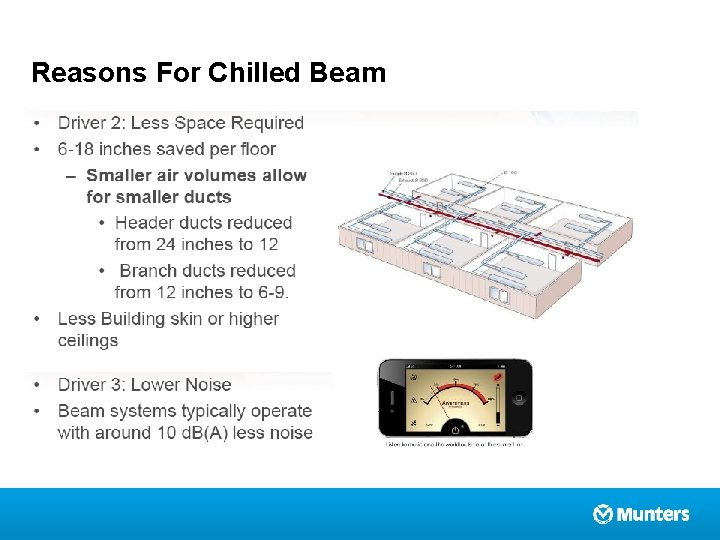
Reasons For Chilled Beam
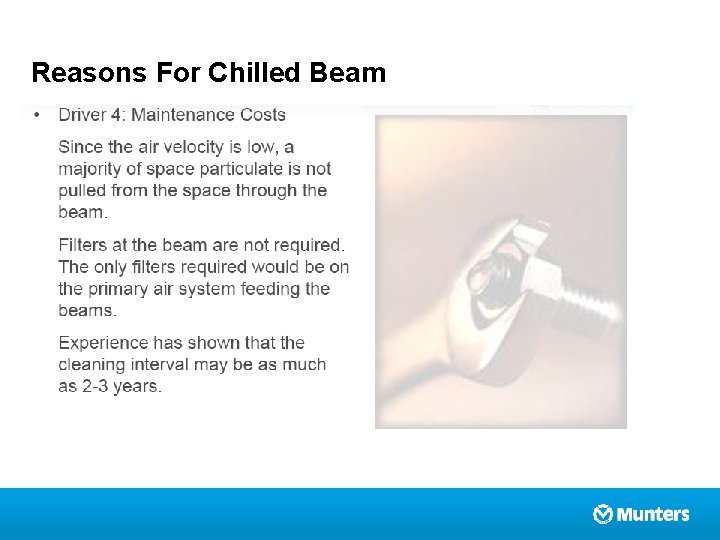
Reasons For Chilled Beam
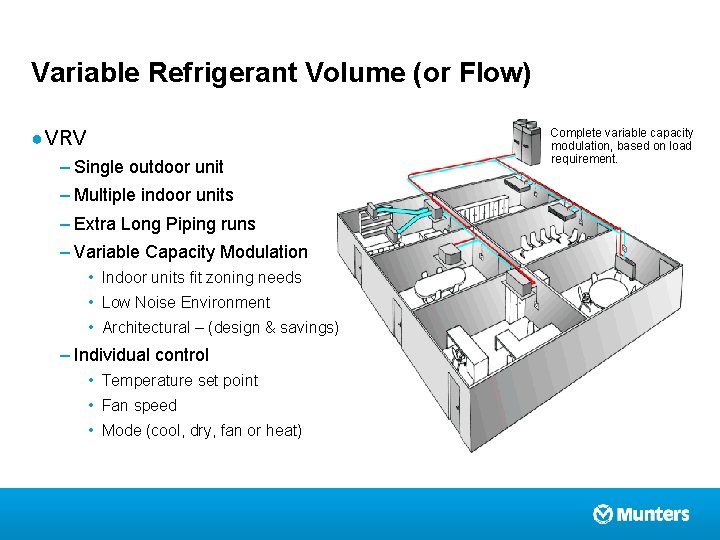
Variable Refrigerant Volume (or Flow) ● VRV – Single outdoor unit – Multiple indoor units – Extra Long Piping runs – Variable Capacity Modulation • Indoor units fit zoning needs • Low Noise Environment • Architectural – (design & savings) – Individual control • Temperature set point • Fan speed • Mode (cool, dry, fan or heat) Complete variable capacity modulation, based on load requirement.
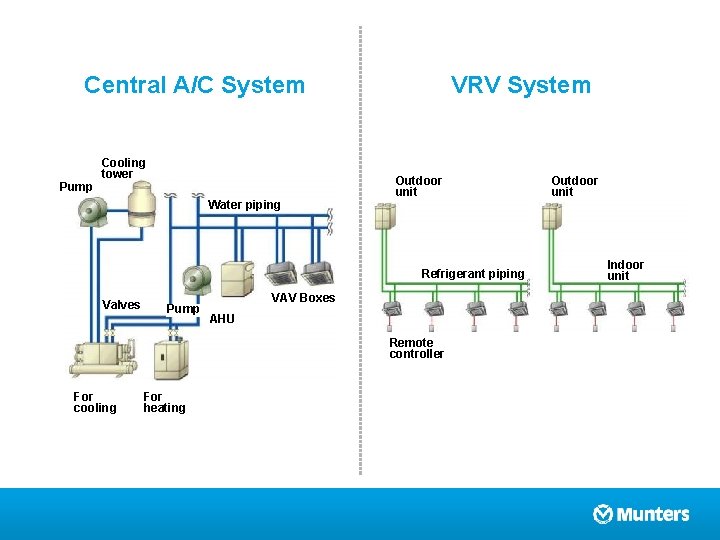
Central A/C System Pump Cooling tower Water piping VRV System Outdoor unit Refrigerant piping Valves Pump VAV Boxes AHU Remote controller For cooling For heating Outdoor unit Indoor unit
Perfect Team ● Chilled Beams must have DOAS Unit to Prime the System – Chilled Beams are Sensible only devises, no latent capacity – Chilled Beams run 58 -60°F water thru pipes in each room, NO DRAIN PAN ● VRV Systems need DOAS Systems – As in all DX systems, most efficient when only doing sensible cooling only – VRV-ness of the system wants to unload when T-Stat is met
Calculating building moisture load is more important Size the DOAS to handle ALL the internal latent load ● Prevents chilled beams from sweating – #1 fear of design engineers I have spoken with – You make quell that fear with Munters – Provides proper space %rh ● Allows VRV systems to operate at most efficient – Prevents condensation within AHUs – Mold grown – Maintenance of wet coils, etc… – Proper space %rh
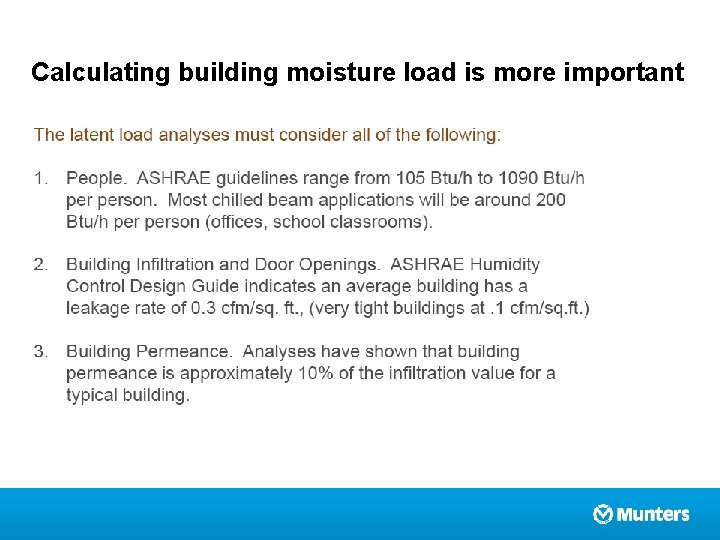
Calculating building moisture load is more important
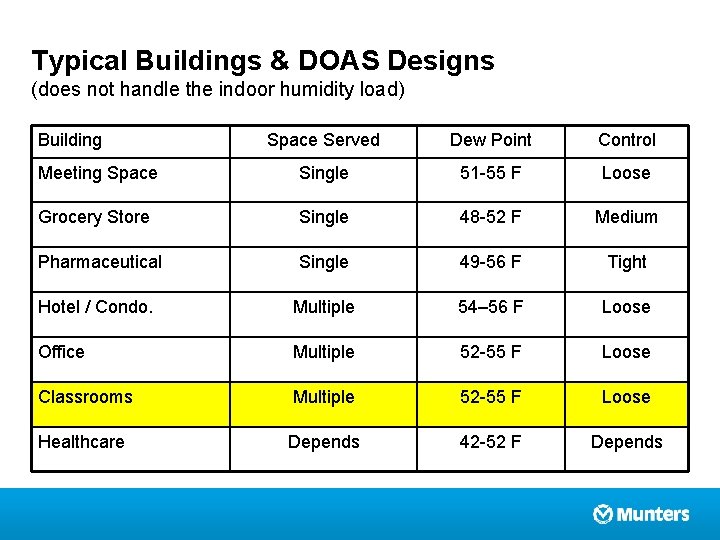
Typical Buildings & DOAS Designs (does not handle the indoor humidity load) Building Space Served Dew Point Control Meeting Space Single 51 -55 F Loose Grocery Store Single 48 -52 F Medium Pharmaceutical Single 49 -56 F Tight Hotel / Condo. Multiple 54– 56 F Loose Office Multiple 52 -55 F Loose Classrooms Multiple 52 -55 F Loose Healthcare Depends 42 -52 F Depends
How dry does the OA need to be? ● ASHRAE shows how to calculate how DRY the OA needs to be in order to control space moisture ● If you want to maintain 75°F at 50%rh, then the space is at 55°F dewpoint ● You need to deliver air drier than 55°F dewpoint
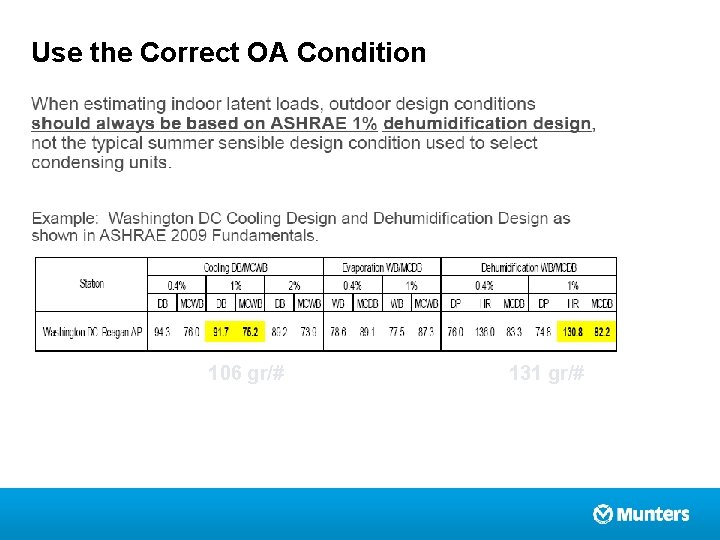
Use the Correct OA Condition 106 gr/# 131 gr/#
Internal People Load vs Ventilation ● Load – QL = 1 person = 200 btu/per ● Ventilation Required – 15 CFM per Person ● Capacity – What dewpoint air at 15 cfm will absorb all the moisture given off by a person sitting at rest?
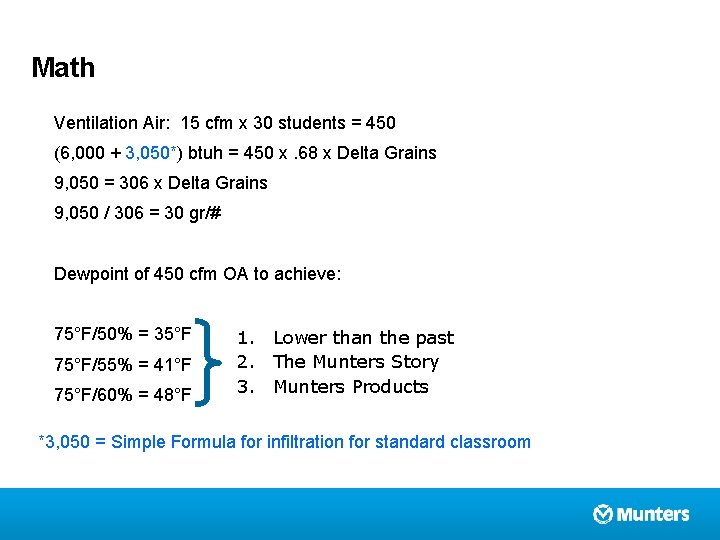
Math Ventilation Air: 15 cfm x 30 students = 450 (6, 000 + 3, 050*) btuh = 450 x. 68 x Delta Grains 9, 050 = 306 x Delta Grains 9, 050 / 306 = 30 gr/# Dewpoint of 450 cfm OA to achieve: 75°F/50% = 35°F 75°F/55% = 41°F 75°F/60% = 48°F 1. Lower than the past 2. The Munters Story 3. Munters Products *3, 050 = Simple Formula for infiltration for standard classroom
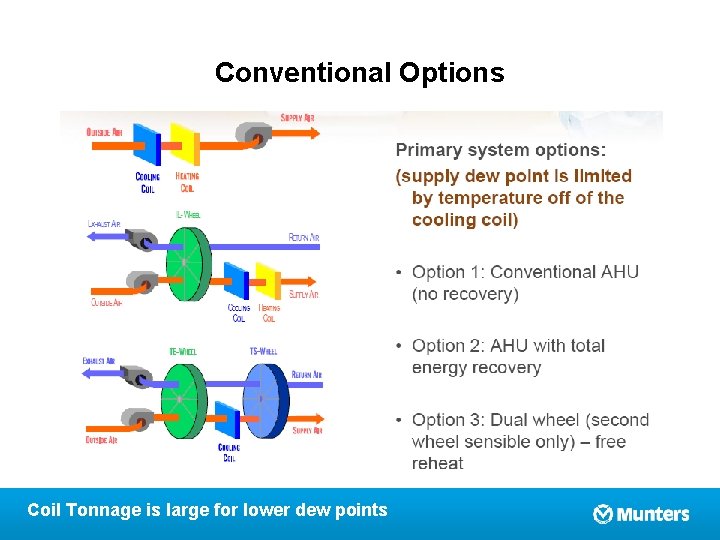
Conventional Options Coil Tonnage is large for lower dew points
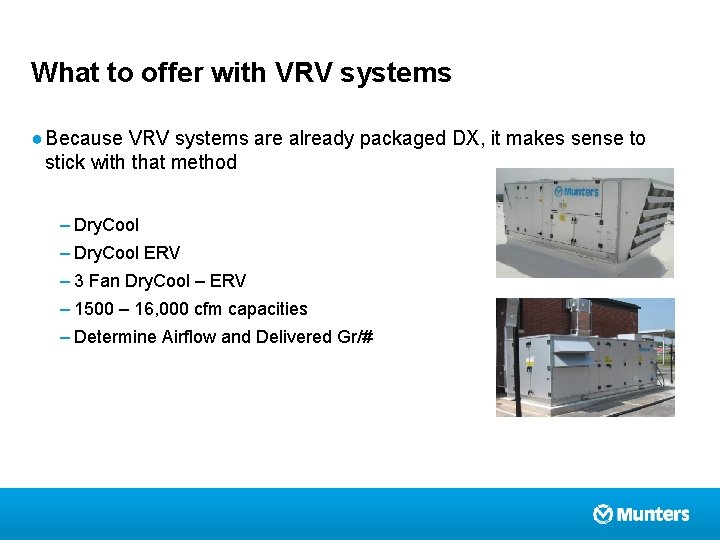
What to offer with VRV systems ● Because VRV systems are already packaged DX, it makes sense to stick with that method – Dry. Cool ERV – 3 Fan Dry. Cool – ERV – 1500 – 16, 000 cfm capacities – Determine Airflow and Delivered Gr/#
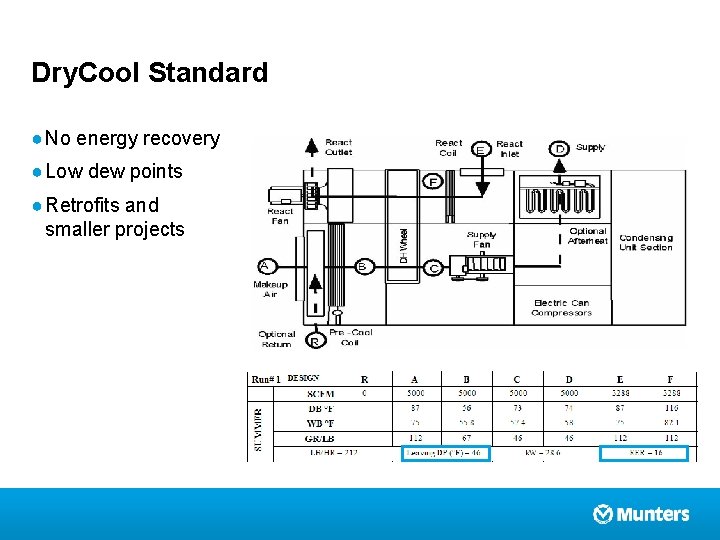
Dry. Cool Standard ● No energy recovery ● Low dew points ● Retrofits and smaller projects
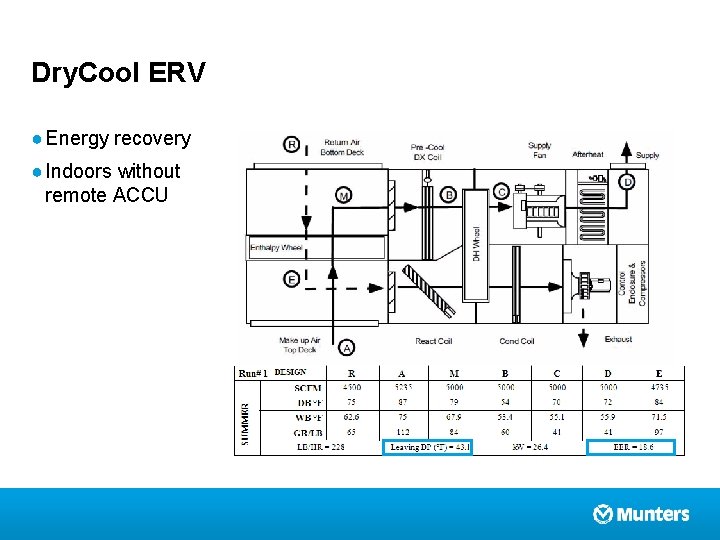
Dry. Cool ERV ● Energy recovery ● Indoors without remote ACCU
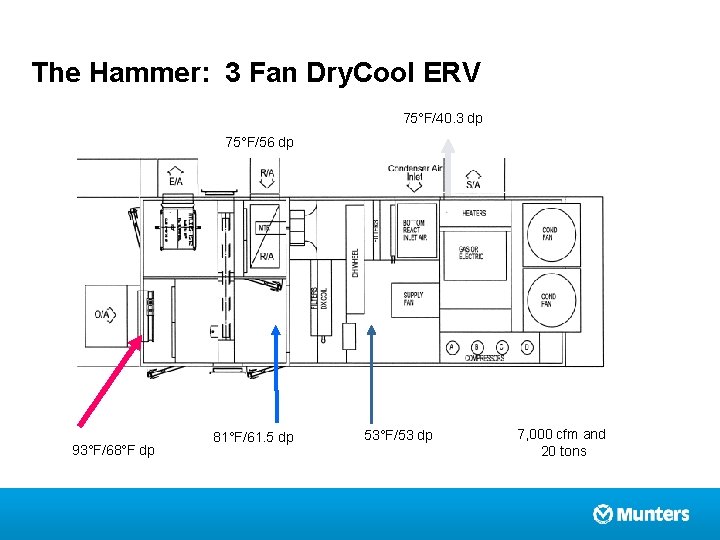
The Hammer: 3 Fan Dry. Cool ERV 75°F/40. 3 dp 75°F/56 dp 93°F/68°F dp 81°F/61. 5 dp 53°F/53 dp 7, 000 cfm and 20 tons
Benefits of Dry. Cool ● Control the space moisture, and thus %rh ● Allow VRV system to operate sensible only. – Most cost efficient way to run – Dry coils – Dry drains – May be able to downsize FCU or DX coil rows/fpi • Decrease PD • Decrease First Cost • Reduce Refrigerant tons ● Dry. Cool system offers highest EERs of any DOAS – Reduced Operating costs
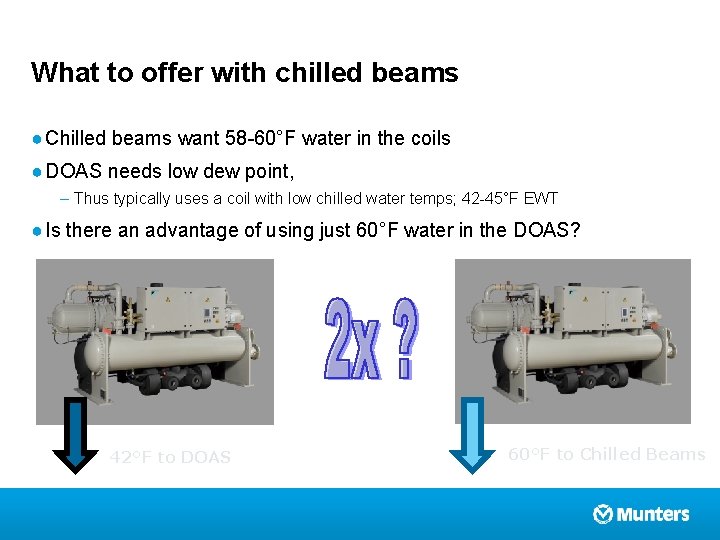
What to offer with chilled beams ● Chilled beams want 58 -60°F water in the coils ● DOAS needs low dew point, – Thus typically uses a coil with low chilled water temps; 42 -45°F EWT ● Is there an advantage of using just 60°F water in the DOAS? 42°F to DOAS 60°F to Chilled Beams
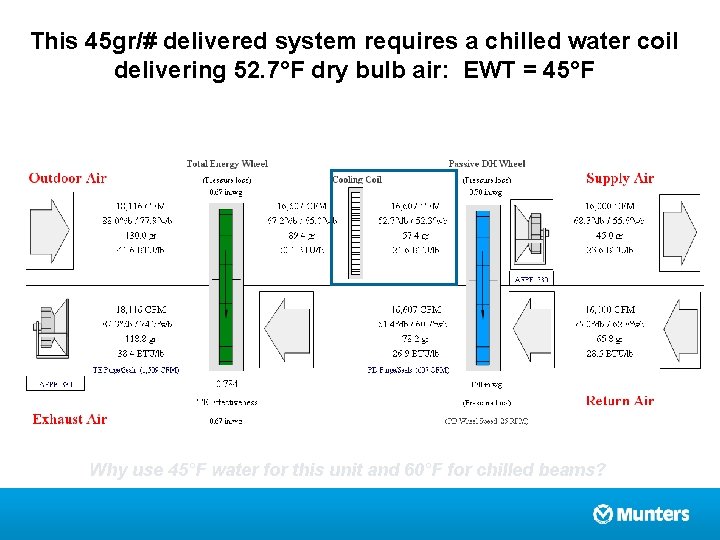
This 45 gr/# delivered system requires a chilled water coil delivering 52. 7°F dry bulb air: EWT = 45°F Why use 45°F water for this unit and 60°F for chilled beams?
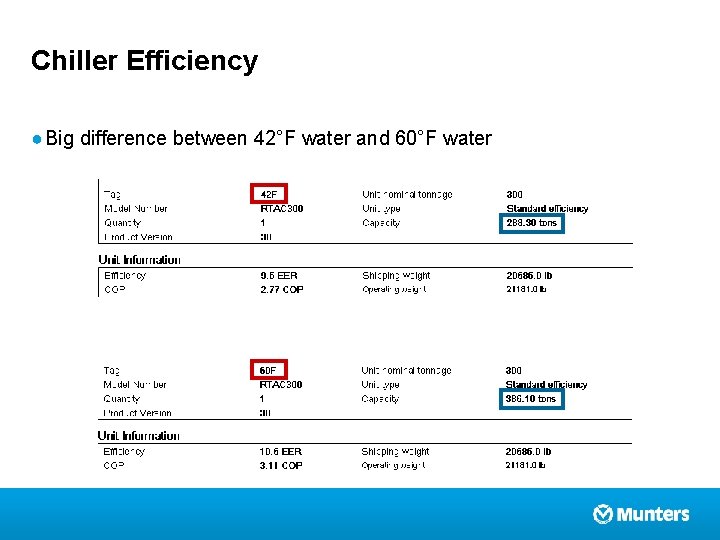
Chiller Efficiency ● Big difference between 42°F water and 60°F water
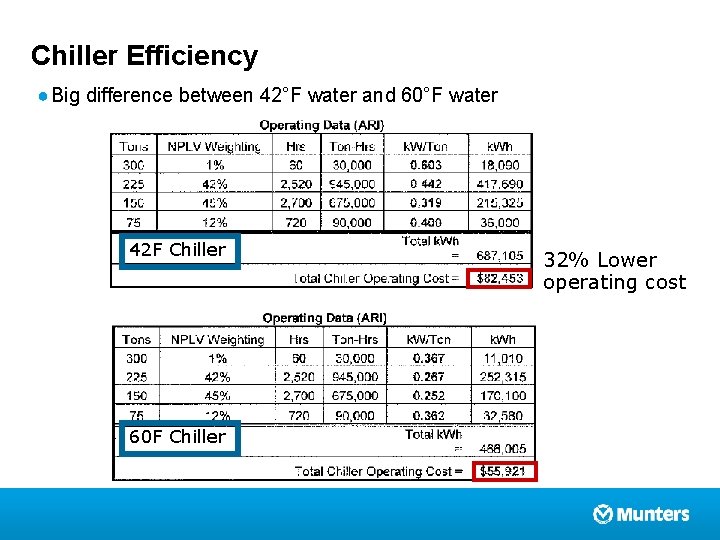
Chiller Efficiency ● Big difference between 42°F water and 60°F water 42 F Chiller 60 F Chiller 32% Lower operating cost
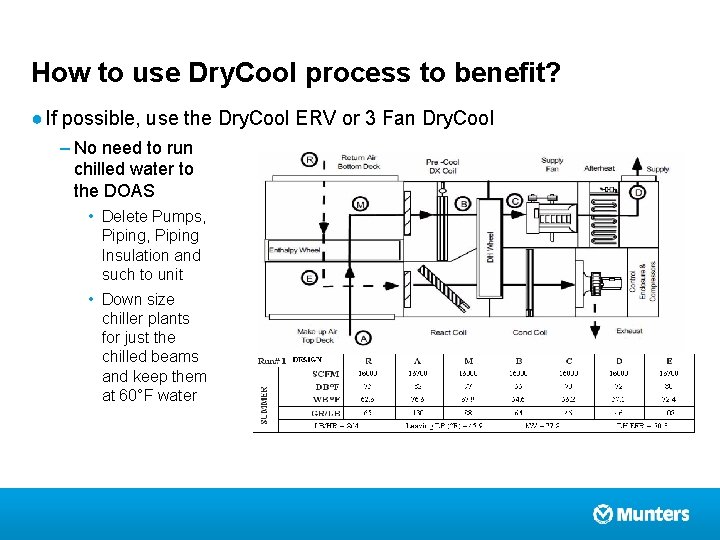
How to use Dry. Cool process to benefit? ● If possible, use the Dry. Cool ERV or 3 Fan Dry. Cool – No need to run chilled water to the DOAS • Delete Pumps, Piping Insulation and such to unit • Down size chiller plants for just the chilled beams and keep them at 60°F water
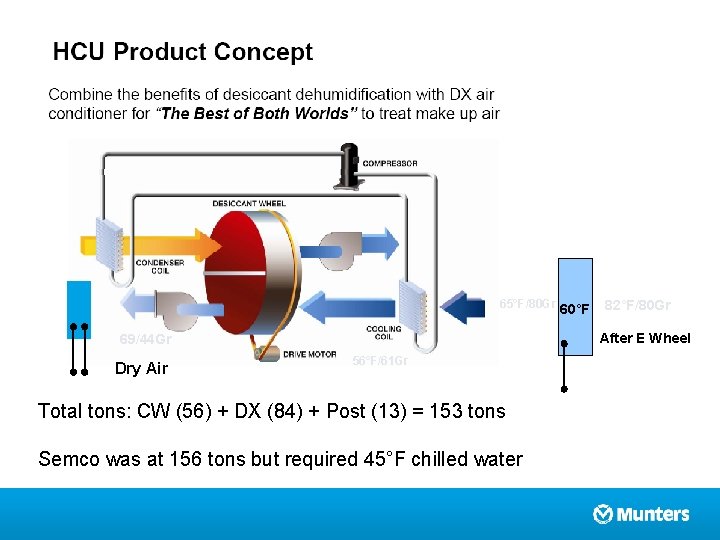
65°F/80 Gr 60°F After E Wheel 69/44 Gr Dry Air 82°F/80 Gr 56°F/61 Gr Total tons: CW (56) + DX (84) + Post (13) = 153 tons Semco was at 156 tons but required 45°F chilled water
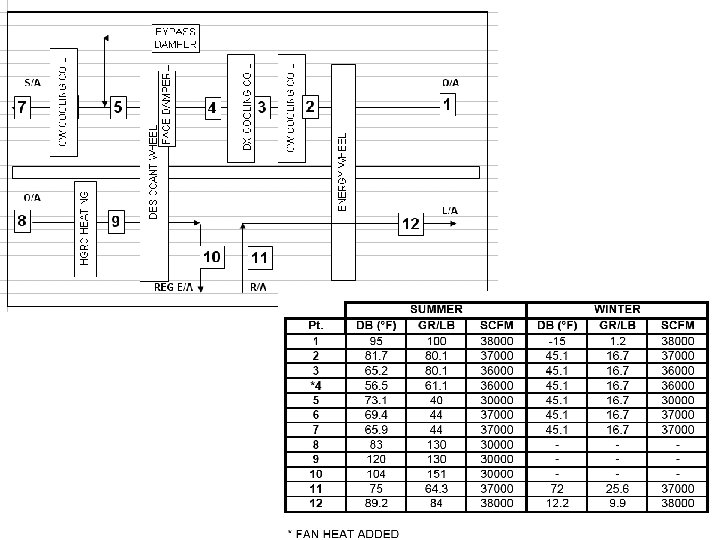
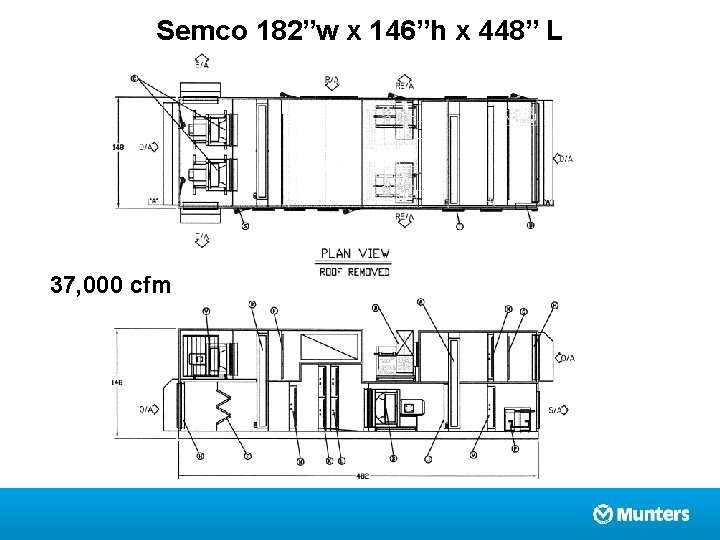
Semco 182”w x 146”h x 448” L 37, 000 cfm
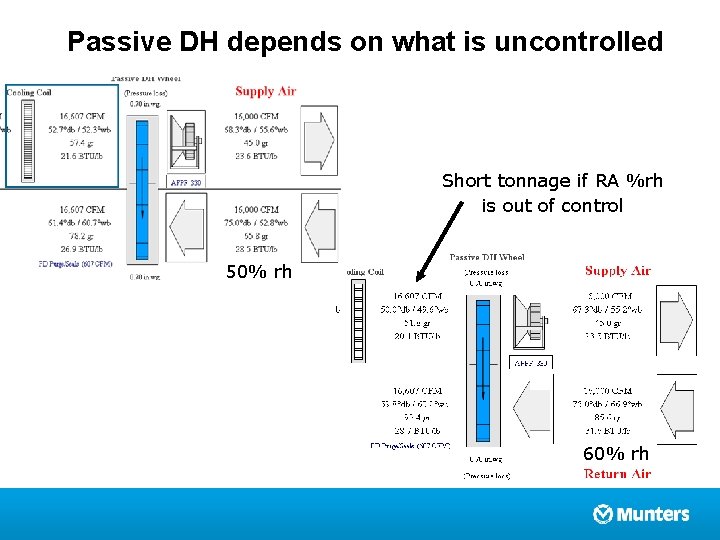
Passive DH depends on what is uncontrolled Short tonnage if RA %rh is out of control 50% rh 60% rh
Plan of action for chilled beam or VRV 1. Help calc latent loads ● ● People, infiltration, permeance Discuss that DOAS equipment should take care of entire latent load 2. Sell Dry. Cool process: We drive the moisture out of the DH wheel ● ● VRV, all packaged DX is similar, less energy Chilled beams ● Show benefits of one simple chiller plant with 58 -60 F water ● ● By using all package DX By using Hybrid of Chilled Water and DX with Dry. Cool 3. Use a standard product if possible ● ● Quicker selection Better price points 4. Talk to factory about custom version to meet the engineers and owners needs ● ● ● Discharge air temps, control Layouts Plates vs. wheels, etc.

Point engineers to the fact that most of our competition is the baseline.
- Slides: 34