
Municipal Solid Waste Sustainable Materials Management S Thorneloe
Municipal Solid Waste – Sustainable Materials Management S. Thorneloe, U. S. EPA Thorneloe. Susan@epa. gov Office of Research and Development National Risk Management Research Laboratory Air Pollution Prevention and Control Division 13 Sept 2013
Sustainable Materials Management • Sustainable materials management (SMM) is the use and reuse of materials in the most productive and sustainable method across the entire life cycle. • SMM conserves resources, reduces waste, slows climate change, and minimizes the environmental impacts of the materials we use. • Use of the municipal solid waste decision support tool (MSW DST) helps communities identify more holistic and sustainable solutions for managing materials once they enter the waste stream 1

Sustainable Materials Management Life-Cycle 2
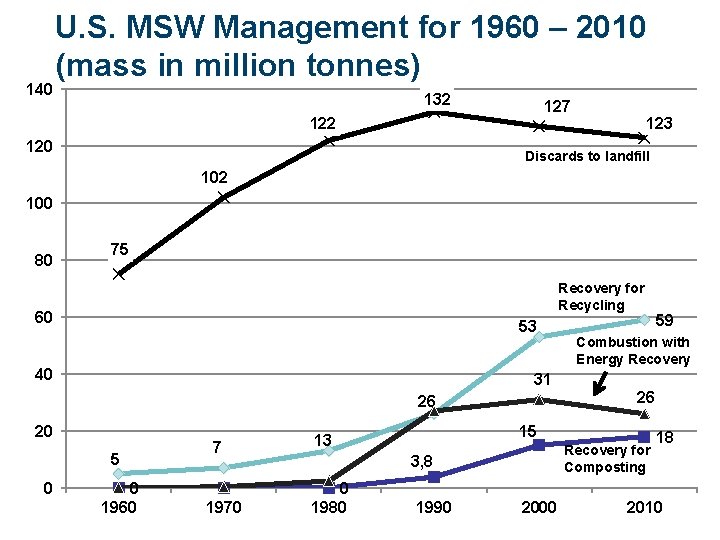
140 U. S. MSW Management for 1960 – 2010 (mass in million tonnes) 132 127 122 120 123 Discards to landfill 102 100 80 75 Recovery for Recycling 60 53 40 20 5 0 Combustion with Energy Recovery 31 26 26 3 59 0 1960 7 1970 15 13 Recovery for Composting 3, 8 0 1980 1990 2000 18 2010
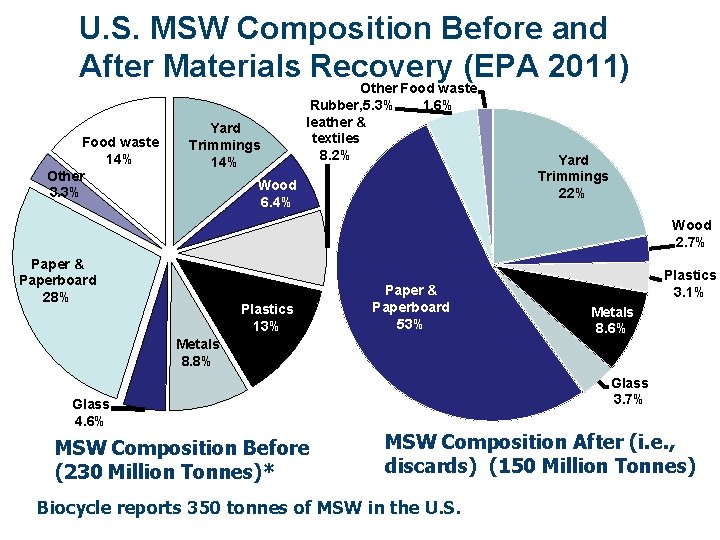
U. S. MSW Composition Before and After Materials Recovery (EPA 2011) Other Food waste 14% Other 3. 3% Yard Trimmings 14% Rubber, 5. 3% leather & textiles 8. 2% 1. 6% Wood 6. 4% Yard Trimmings 22% Wood 2. 7% Paper & Paperboard 28% Plastics 13% Paper & Paperboard 53% Plastics 3. 1% Metals 8. 6% Metals 8. 8% Glass 3. 7% Glass 4. 6% MSW Composition Before (230 Million Tonnes)* 4 MSW Composition After (i. e. , discards) (150 Million Tonnes) Biocycle reports 350 tonnes of MSW in the U. S.
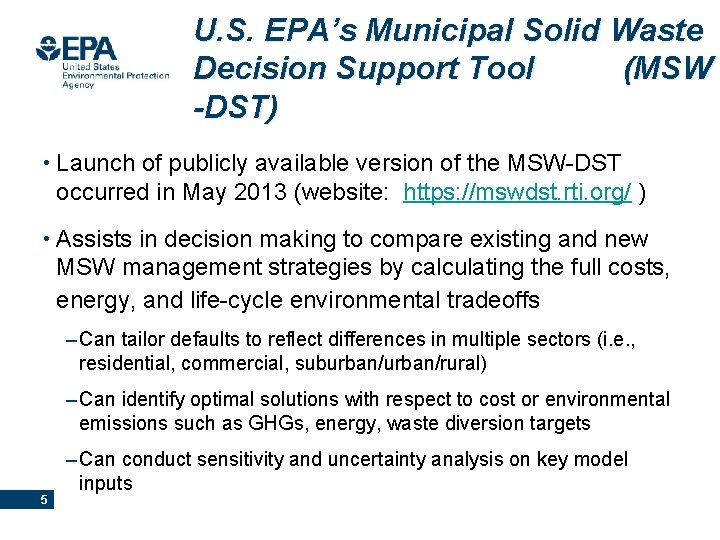
U. S. EPA’s Municipal Solid Waste Decision Support Tool (MSW -DST) • Launch of publicly available version of the MSW DST occurred in May 2013 (website: https: //mswdst. rti. org/ ) • Assists in decision making to compare existing and new MSW management strategies by calculating the full costs, energy, and life cycle environmental tradeoffs – Can tailor defaults to reflect differences in multiple sectors (i. e. , residential, commercial, suburban/rural) – Can identify optimal solutions with respect to cost or environmental emissions such as GHGs, energy, waste diversion targets 5 – Can conduct sensitivity and uncertainty analysis on key model inputs
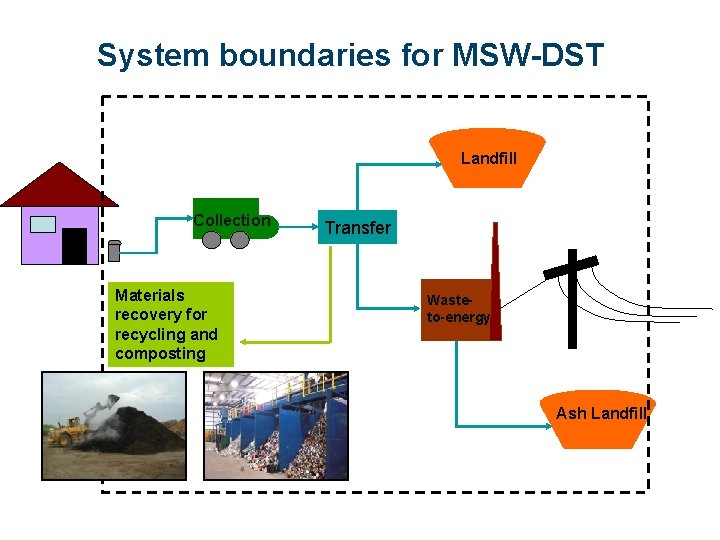
System boundaries for MSW-DST Landfill Collection Materials recovery for recycling and composting Transfer Wasteto-energy Ash Landfill
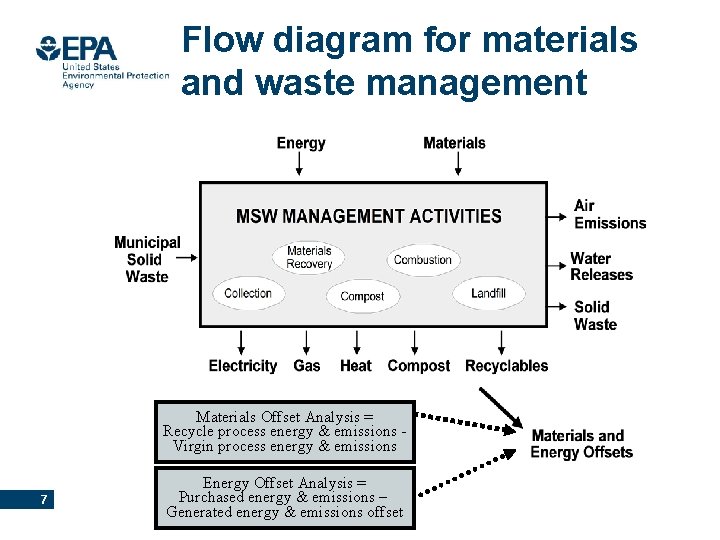
Flow diagram for materials and waste management Materials Offset Analysis = Recycle process energy & emissions Virgin process energy & emissions 7 Energy Offset Analysis = Purchased energy & emissions – Generated energy & emissions offset
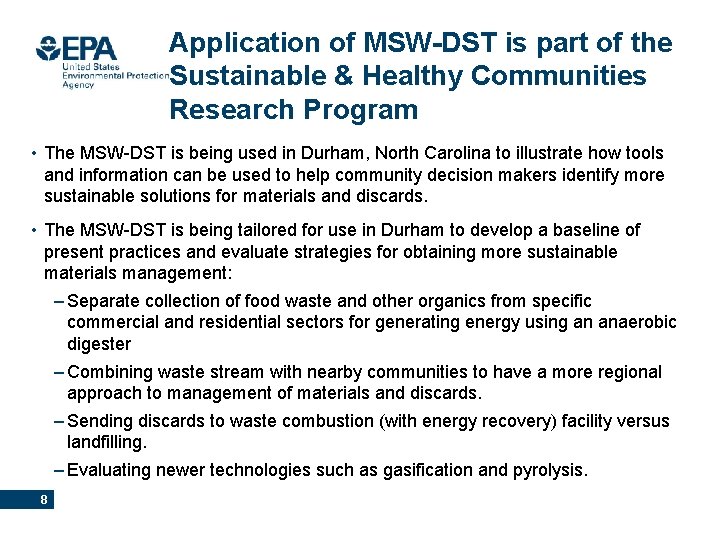
Application of MSW-DST is part of the Sustainable & Healthy Communities Research Program • The MSW DST is being used in Durham, North Carolina to illustrate how tools and information can be used to help community decision makers identify more sustainable solutions for materials and discards. • The MSW DST is being tailored for use in Durham to develop a baseline of present practices and evaluate strategies for obtaining more sustainable materials management: – Separate collection of food waste and other organics from specific commercial and residential sectors for generating energy using an anaerobic digester – Combining waste stream with nearby communities to have a more regional approach to management of materials and discards. – Sending discards to waste combustion (with energy recovery) facility versus landfilling. – Evaluating newer technologies such as gasification and pyrolysis. 8
2009 ES&T publication comparing discards management options • Evaluated range of conditions for U. S. processes to produce electricity or steam from landfill gas to energy (LFGTE) and waste to energy (WTE) • Less variability in calculating emissions for WTE – Design and operation similar across facilities – Dataset is considered excellent • Data on operational performance for 100% of U. S. facilities • Multi pollutant, multi year data for range of constituents from annual performance tests and continuous emissions monitoring • More variability for LFGTE – Difficulty in modeling biological process which has many variables and changes over time – Major data gaps and issues with obtaining data for • area source emissions (i. e. , emissions not collected due to delays and leaks in gas control) • combustion by product emissions (~< 5% of the >2, 000 MSW landfills) [do not have similar requirements for industry supplying data as is done for WTE] – More variability in the design and operation of landfills than with WTE facilities 9 *Source: EPA/ORD : Kaplan, P. O. ; De. Carolis, J. ; Thorneloe, S. (2009) Is It Better to Burn or Bury Waste For Clean Electricity Generation? Environmental Science and Technology , 43, (6), 1711 -1717
Findings from 2009 ES&T Publication • When comparing electricity (k. Wh) per ton of municipal waste, WTE is on average six to eleven times more efficient at recovering energy from wastes than landfills. • For even the most optimistic assumptions about LFGTE, the net life cycle environmental tradeoffs is 2 to 6 times the amount of GHGs compared to WTE. GHGs for WTE ranged from 0. 4 to 1. 4 MTCO 2 e/MW h where as the most aggressive LFGTE scenario is resulted in 2. 3 MTCO 2 e/MWh (landfill carbon storage not included). • In addition, WTE also produces lower NOx emissions than LFGTE, whereas SOx emissions depend on the specific configurations of WTE and LFGTE. 10
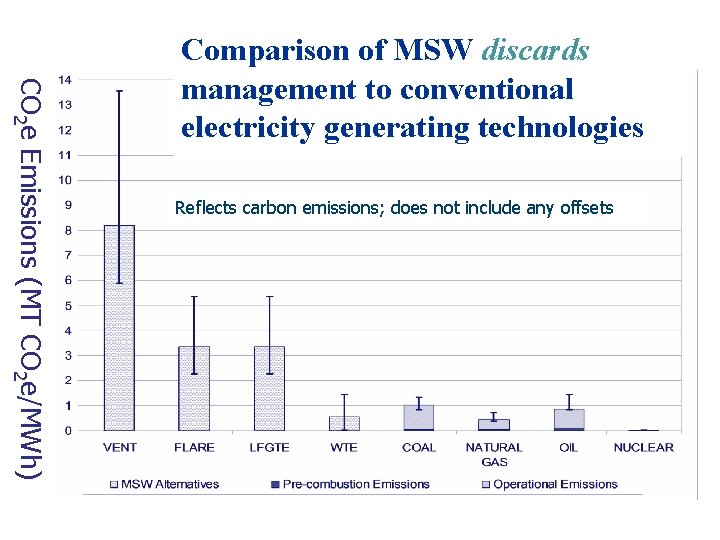
CO 2 e Emissions (MT CO 2 e/MWh) 11 Comparison of MSW discards management to conventional electricity generating technologies Reflects carbon emissions; does not include any offsets
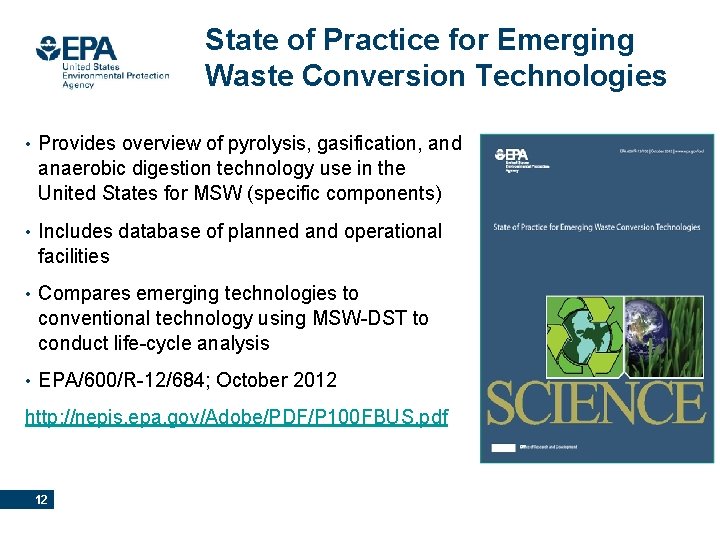
State of Practice for Emerging Waste Conversion Technologies • Provides overview of pyrolysis, gasification, and anaerobic digestion technology use in the United States for MSW (specific components) • Includes database of planned and operational facilities • Compares emerging technologies to conventional technology using MSW DST to conduct life cycle analysis • EPA/600/R 12/684; October 2012 http: //nepis. epa. gov/Adobe/PDF/P 100 FBUS. pdf 12
Identify Tipping Points that Influence Energy and GHG Emissions • Using data from studies of communities that are reaching higher levels of materials recovery to identify tipping points that influence energy and GHG emissions considering – Local infrastructure and policies – Geographical differences in waste composition – Transportation modes, fuels, and distances – Electrical energy grid mixes – Energy prices and renewable energy initiatives – Long term carbon storage – Recycling and composting rates – Recyclables markets and prices – Conversion efficiencies for waste to energy and landfill gas to energy • Goal is to be able to provide recommendations based on data from U. S. communities
Summary § DST helps support broader goals to move towards more sustainable materials management Identifies more efficient waste management options in terms of energy, environmental, and some social aspects such as land usage Provides data needed to benchmark current operations and to identify options to improve environmental performance Provides data to communicate environmental improvements § DST has been used in over 150 studies helping to inform management decisions • Web-accessible DST is available for use; • RTI is caretaker of the MSW-DST; Contact Keith Weitz at kaw@rti. org for copy of MSW-DST or contact me at Thorneloe. Susan@epa. gov 14
Selected list of journal publications • Kaplan, P. O. ; Ranjithan, S. R. ; Barlaz, M. A. (2009) Use of Life Cycle Analysis To Support Solid Waste Management Planning for Delaware. Environmental Science and Technology, 43 (5), 1264 1270. • Kaplan, P. O. ; De. Carolis, J. ; Thorneloe, S. (2009) Is It Better to Burn or Bury Waste For Clean Electricity Generation? Environmental Science and Technology, 43, (6), 1711 1717. • Thorneloe, S. A. ; Weitz, K. ; Jambeck, J. (2007) Application of the U. S. decision support tool for materials and waste management. Waste Management, 27, 1006 1020. • Jambeck, J. , Weitz, K. A. , Solo Gabriele, H. , Townsend, T. , Thorneloe, S. , (2007). CCA treated Wood Disposed in Landfills and Life cycle Trade Offs With Waste to Energy and MSW Landfill Disposal, Waste Management , Vol 27, Issue 8, Life Cycle Assessment in Waste Management. • Kaplan, P. O. , M. A. Barlaz, and S. R. Ranjithan (2004) A Procedure for Life Cycle Based Solid Waste Management with Consideration of Uncertainty. J. of Industrial Ecology. 8(4): 155 172. • Weitz K. A. , Thorneloe S. A. , Nishtala S. R. , Yarkosky S. & Zannes M. (2002) The Impact of Municipal Solid Waste Management on Greenhouse Gas Emissions in the United States, Journal of the Air and Waste Management Association, Vol 52, 1000 1011. 15
Available documentation • Collection Model – Dumas, R. D. and E. M. Curtis, 1998, “A Spreadsheet Framework for Analysis of Costs and Life Cycle Inventory Parameters Associated with Collection of Municipal Solid Waste, ” Internal Project Report, North Carolina State University, Raleigh, NC. (https: //webdstmsw. rti. org/docs/Collection_Model_OCR. pdf ) • Transfer Stations – https: //webdstmsw. rti. org/docs/Transfer_Station_Model_OCR. pdf • Separation of recyclables and discards – Nishtala, S. and E. Solano-Mora, 1997, “Description of the Materials Recovery Facilities Process Model: Design, Cost and Life-Cycle Inventory, ” Project Report, North Carolina State University, Raleigh, NC. (https: //webdstmsw. rti. org/docs/MRF_Model_OCR. pdf ) • Treatment including refuse derived fuel, waste-to-energy, yard- and mixed-waste composting – Nishtala, S. , 1997, “Description of the Refuse Derived Fuel Process Model: Design, Cost and Life Cycle Inventory, ” Project Report, Research Triangle Institute, RTP, NC. – Composting process model: https: //webdstmsw. rti. org/docs/Compost_Model_OCR. pdf – Harrison, K. W. ; Dumas, R. D. ; Barlaz, M. A. ; Nishtala, S. R. , A life cycle inventory model of municipal solid waste combustion. J. Air Waste Manage. Assoc. 2000, 50, 993 1003. • Disposal including traditional and wet landfills and ash landfill 16 – Camobreco, V. ; Ham, R; Barlaz, M; Repa, E. ; Felker, M. ; Rousseau, C. and Rathle, J. Life cycle inventory of a modern municipal solid waste landfill. Waste Manage. Res. 1999. 394 408. – Eleazer, W. E. ; Odle, W. S. ; Wang, Y. S. ; Barlaz, M. A. , Biodegradability of municipal solid waste components in laboratory scale landfills. Environ. Sci. Technol. 1997, 31(3), 911 917. – Sich, B. A. and M. A. Barlaz, 2000, “Calculation of the Cost and Life Cycle Inventory for Waste Disposal in Traditional, Bioreactor and Ash Landfills, ” Project Report, North Carolina State University, Raleigh, NC. (https: //webdstmsw. rti. org/docs/Landfill_Model_OCR. pdf )
Available documentation (Cont. ) • Background process models to account for energy/electricity consumption and offsets, and remanufacturing of recyclables – Dumas, R. D. , 1997, “Energy Consumption and Emissions Related to Electricity and Remanufacturing Processes in a Life Cycle Inventory of Solid Waste Management, ” thesis submitted in partial fulfillment of the M. S. degree, Dept. of Civil Engineering, NC State University. – Energy process model: https: //webdstmsw. rti. org/docs/Energy_Model_OCR. pdf – Remanufacturing process model: https: //webdstmsw. rti. org/docs/Remfg_OCR. pdf • Decision Support Tool, Optimization and Alternative Strategy Generation – Harrison, K. W. ; Dumas, R. D. ; Solano, E. ; Barlaz, M. A. ; Brill, E. D. ; Ranjithan, S. R. A Decision Support System for Development of Alternative Solid Waste Management Strategies with Life Cycle Considerations. ASCE J. of Comput. Civ. Eng. 2001, 15, 44 58. – Solano, E. ; Ranjithan, S. ; Barlaz, M. A. ; Brill, E. D. Life Cycle Based Solid Waste Management 1. Model Development. J. Environ. Engr. 2002, 128, 981 992. – Solano, E. ; Dumas, R. D. ; Harrison, K. W. ; Ranjithan, S. ; Barlaz, M. A. ; Brill, E. D. Life Cycle Based Solid Waste Management 2. Illustrative Applications. J. Environ. Engr. 2002, 128, 993 1005. – Kaplan, P. O. , 2006, “A New Multiple Criteria Decision Making Methodology for Environmental Decision Support, ” Doctoral Dissertation, Dept. of Civil Engineering, North Carolina State University. – Manual: https: //webdstmsw. rti. org/docs/DST_Manual_OCR. pdf – Tool Website: https: //webdstmsw. rti. org/resources. htm • Uncertainty Propagation and Sensitivity Analysis Tools 17 – Kaplan, P. O. , 2001, “Consideration of cost and environmental emissions of solid waste management under conditions of uncertainty, ” MS Thesis, Dept. of Civil Engineering, North Carolina State University. – Kaplan, P. O. ; Barlaz, M. A. ; Ranjithan, S. R. Life Cycle Based Solid Waste Management under Uncertainty. J. Ind. Ecol. 2004, 8, 155 172.
- Slides: 18