
Municipal Solid Waste Management DEPARTMENT OF ENVIRONMENT MINISTRY
- Slides: 29
Municipal Solid Waste Management DEPARTMENT OF ENVIRONMENT MINISTRY OF AGRICULTURE, RURAL DEVELOPMENT AND ENVIRONMENT 2017, NICOSIA
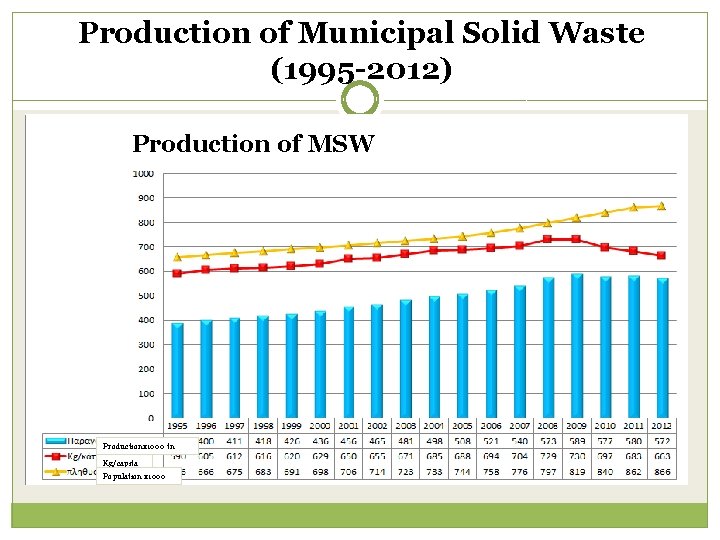
Production of Municipal Solid Waste (1995 -2012) Production of MSW Productionx 1000 tn Kg/capita Population x 1000
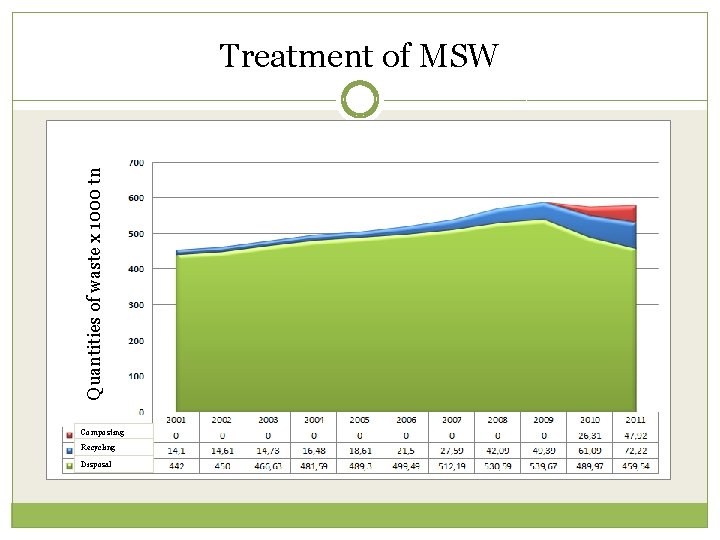
Quantities of waste x 1000 tn Treatment of MSW Composting Recycling Disposal
CURRENT MSW MANAGEMENT SITUATION INFRASTRUCTURE
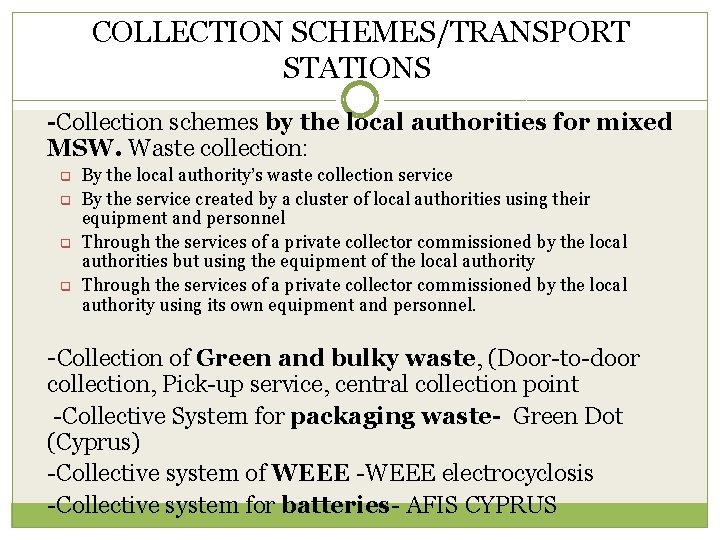
COLLECTION SCHEMES/TRANSPORT STATIONS -Collection schemes by the local authorities for mixed MSW. Waste collection: q q By the local authority’s waste collection service By the service created by a cluster of local authorities using their equipment and personnel Through the services of a private collector commissioned by the local authorities but using the equipment of the local authority Through the services of a private collector commissioned by the local authority using its own equipment and personnel. -Collection of Green and bulky waste, (Door-to-door collection, Pick-up service, central collection point -Collective System for packaging waste- Green Dot (Cyprus) -Collective system of WEEE -WEEE electrocyclosis -Collective system for batteries- AFIS CYPRUS
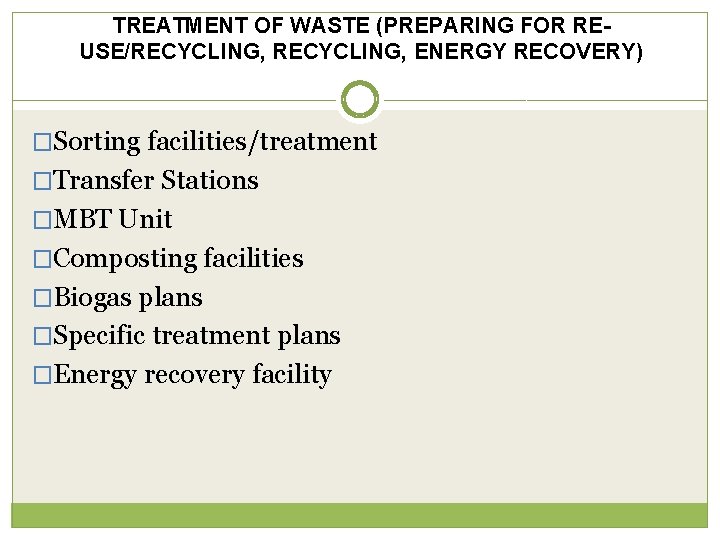
TREATMENT OF WASTE (PREPARING FOR REUSE/RECYCLING, ENERGY RECOVERY) �Sorting facilities/treatment �Transfer Stations �MBT Unit �Composting facilities �Biogas plans �Specific treatment plans �Energy recovery facility
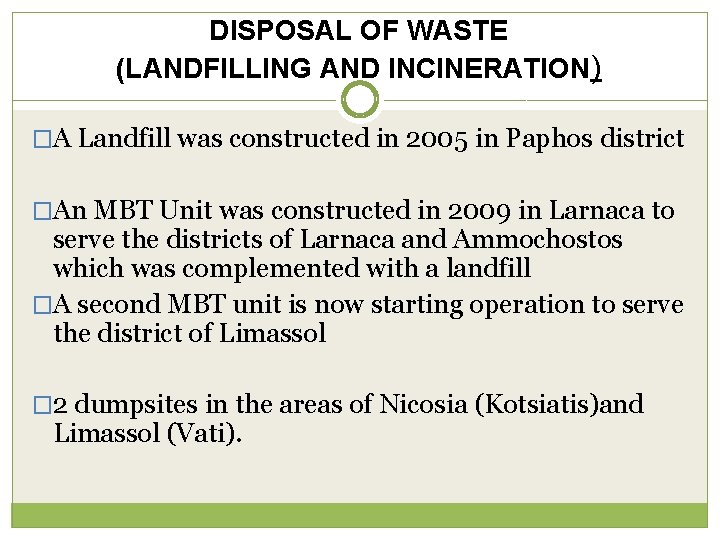
DISPOSAL OF WASTE (LANDFILLING AND INCINERATION) �A Landfill was constructed in 2005 in Paphos district �An MBT Unit was constructed in 2009 in Larnaca to serve the districts of Larnaca and Ammochostos which was complemented with a landfill �A second MBT unit is now starting operation to serve the district of Limassol � 2 dumpsites in the areas of Nicosia (Kotsiatis)and Limassol (Vati).
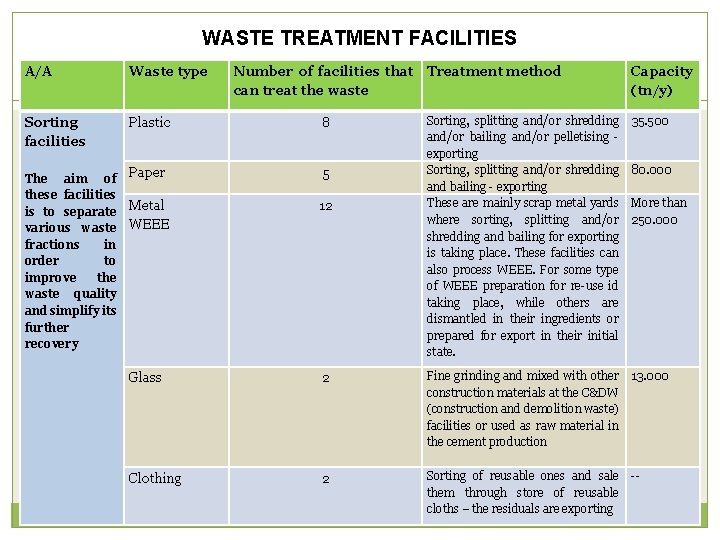
WASTE TREATMENT FACILITIES A/A Waste type Sorting facilities Plastic 8 Paper 5 Metal WEEE 12 Glass 2 Fine grinding and mixed with other 13. 000 construction materials at the C&DW (construction and demolition waste) facilities or used as raw material in the cement production Clothing 2 Sorting of reusable ones and sale -them through store of reusable cloths – the residuals are exporting The aim of these facilities is to separate various waste fractions in order to improve the waste quality and simplify its further recovery Number of facilities that Treatment method can treat the waste Sorting, splitting and/or shredding and/or bailing and/or pelletising - exporting Sorting, splitting and/or shredding and bailing - exporting These are mainly scrap metal yards where sorting, splitting and/or shredding and bailing for exporting is taking place. These facilities can also process WEEE. For some type of WEEE preparation for re-use id taking place, while others are dismantled in their ingredients or prepared for export in their initial state. Capacity (tn/y) 35. 500 80. 000 More than 250. 000
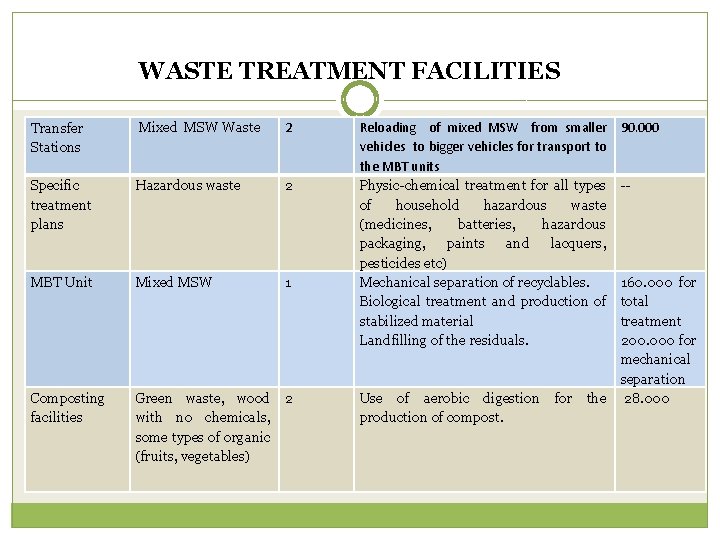
WASTE TREATMENT FACILITIES Transfer Stations Mixed MSW Waste 2 Specific treatment plans Hazardous waste 2 MBT Unit Mixed MSW 1 Composting facilities Green waste, wood 2 with no chemicals, some types of organic (fruits, vegetables) Reloading of mixed MSW from smaller vehicles to bigger vehicles for transport to the MBT units Physic-chemical treatment for all types of household hazardous waste (medicines, batteries, hazardous packaging, paints and lacquers, pesticides etc) Mechanical separation of recyclables. Biological treatment and production of stabilized material Landfilling of the residuals. 90. 000 -- 160. 000 for total treatment 200. 000 for mechanical separation Use of aerobic digestion for the 28. 000 production of compost.
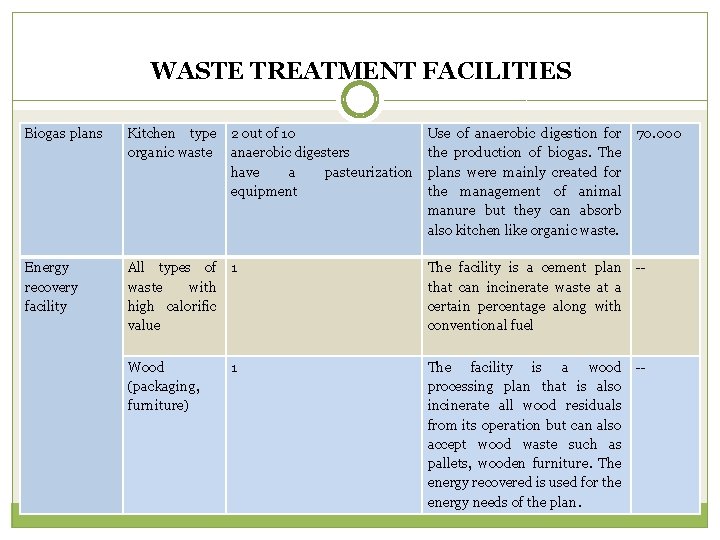
WASTE TREATMENT FACILITIES Biogas plans Kitchen type 2 out of 10 organic waste anaerobic digesters have a pasteurization equipment Use of anaerobic digestion for 70. 000 the production of biogas. The plans were mainly created for the management of animal manure but they can absorb also kitchen like organic waste. Energy recovery facility All types of 1 waste with high calorific value The facility is a cement plan -that can incinerate waste at a certain percentage along with conventional fuel Wood (packaging, furniture) The facility is a wood -processing plan that is also incinerate all wood residuals from its operation but can also accept wood waste such as pallets, wooden furniture. The energy recovered is used for the energy needs of the plan. 1
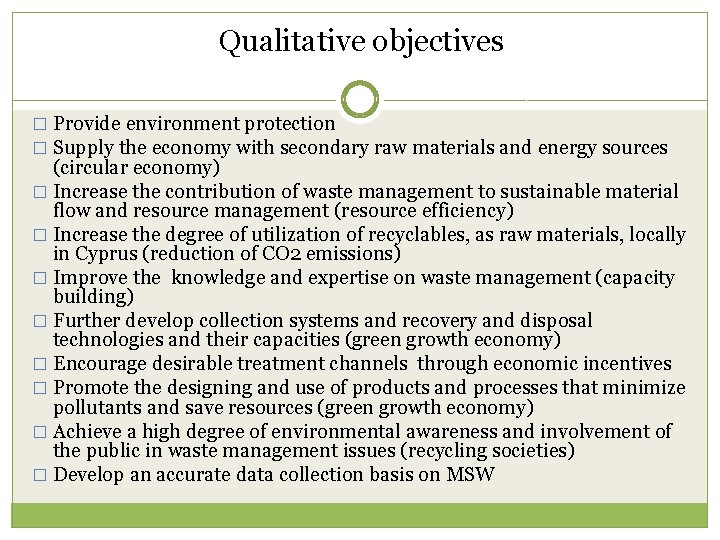
Qualitative objectives � Provide environment protection � Supply the economy with secondary raw materials and energy sources (circular economy) � Increase the contribution of waste management to sustainable material flow and resource management (resource efficiency) � Increase the degree of utilization of recyclables, as raw materials, locally in Cyprus (reduction of CO 2 emissions) � Improve the knowledge and expertise on waste management (capacity building) � Further develop collection systems and recovery and disposal technologies and their capacities (green growth economy) � Encourage desirable treatment channels through economic incentives � Promote the designing and use of products and processes that minimize pollutants and save resources (green growth economy) � Achieve a high degree of environmental awareness and involvement of the public in waste management issues (recycling societies) � Develop an accurate data collection basis on MSW
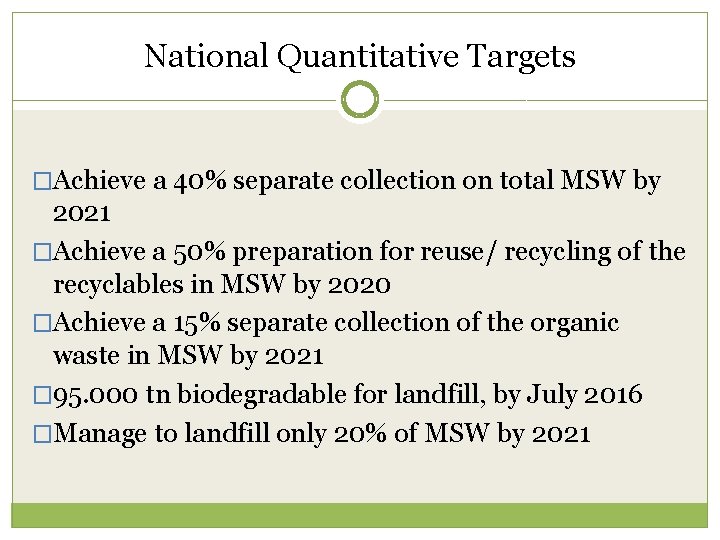
National Quantitative Targets �Achieve a 40% separate collection on total MSW by 2021 �Achieve a 50% preparation for reuse/ recycling of the recyclables in MSW by 2020 �Achieve a 15% separate collection of the organic waste in MSW by 2021 � 95. 000 tn biodegradable for landfill, by July 2016 �Manage to landfill only 20% of MSW by 2021
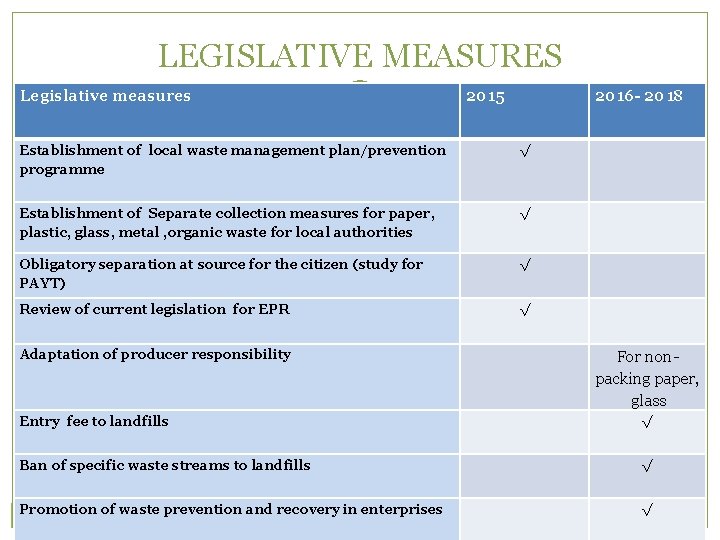
LEGISLATIVE MEASURES Legislative measures 2015 2016 - 2018 Establishment of local waste management plan/prevention programme √ Establishment of Separate collection measures for paper, plastic, glass, metal , organic waste for local authorities √ Obligatory separation at source for the citizen (study for PAYT) √ Review of current legislation for EPR √ Adaptation of producer responsibility Entry fee to landfills Ban of specific waste streams to landfills Promotion of waste prevention and recovery in enterprises For nonpacking paper, glass √ √ √
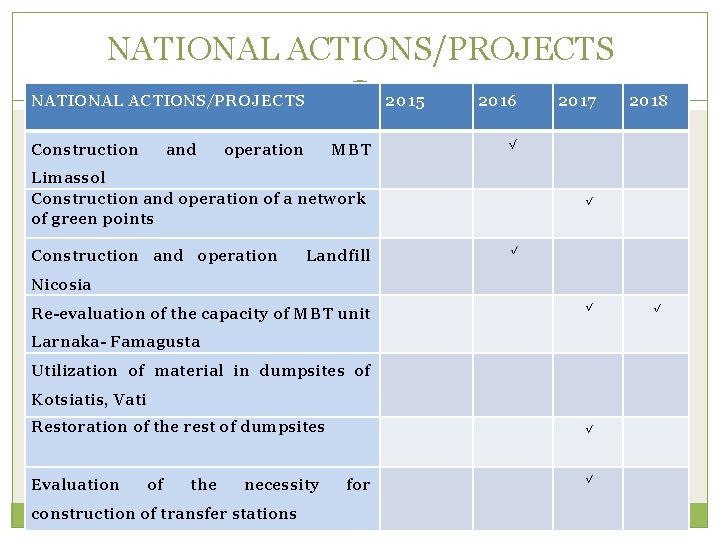
NATIONAL ACTIONS/PROJECTS Construction and 2015 operation MBT Limassol Construction and operation of a network of green points 2016 √ 2018 √ Landfill Re-evaluation of the capacity of MBT unit Construction and operation 2017 √ Nicosia √ Larnaka- Famagusta Utilization of material in dumpsites of Kotsiatis, Vati Restoration of the rest of dumpsites √ Evaluation of the necessity construction of transfer stations for √ √
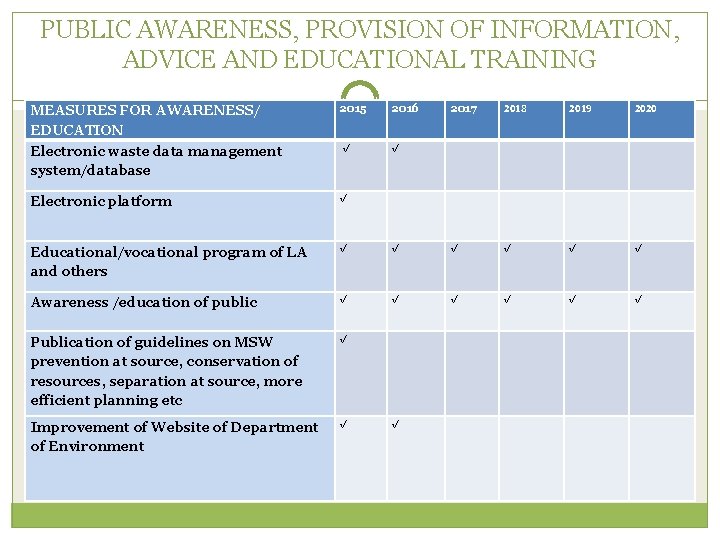
PUBLIC AWARENESS, PROVISION OF INFORMATION, ADVICE AND EDUCATIONAL TRAINING 2018 2019 2020 √ √ √ √ √ MEASURES FOR AWARENESS/ EDUCATION 2015 2016 2017 Electronic waste data management system/database √ √ Electronic platform √ Educational/vocational program of LA and others √ √ Awareness /education of public √ Publication of guidelines on MSW prevention at source, conservation of resources, separation at source, more efficient planning etc Improvement of Website of Department of Environment
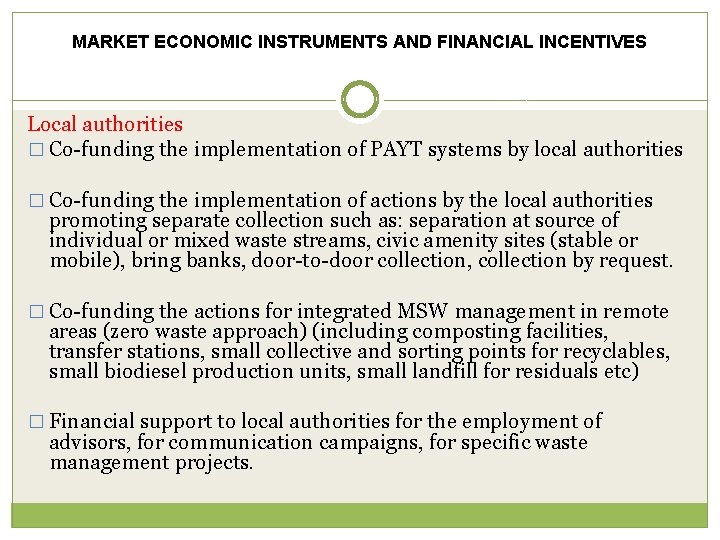
MARKET ECONOMIC INSTRUMENTS AND FINANCIAL INCENTIVES Local authorities � Co-funding the implementation of PAYT systems by local authorities � Co-funding the implementation of actions by the local authorities promoting separate collection such as: separation at source of individual or mixed waste streams, civic amenity sites (stable or mobile), bring banks, door-to-door collection, collection by request. � Co-funding the actions for integrated MSW management in remote areas (zero waste approach) (including composting facilities, transfer stations, small collective and sorting points for recyclables, small biodiesel production units, small landfill for residuals etc) � Financial support to local authorities for the employment of advisors, for communication campaigns, for specific waste management projects.
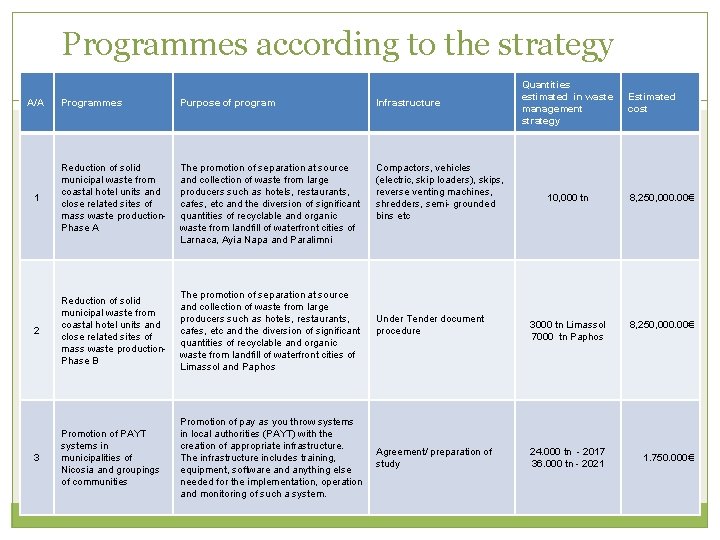
Programmes according to the strategy A/A Programmes Purpose of program Infrastructure 1 Reduction of solid municipal waste from coastal hotel units and close related sites of mass waste production. Phase A The promotion of separation at source and collection of waste from large producers such as hotels, restaurants, cafes, etc and the diversion of significant quantities of recyclable and organic waste from landfill of waterfront cities of Larnaca, Ayia Napa and Paralimni Compactors, vehicles (electric, skip loaders), skips, reverse venting machines, shredders, semi- grounded bins etc 2 Reduction of solid municipal waste from coastal hotel units and close related sites of mass waste production. Phase B The promotion of separation at source and collection of waste from large producers such as hotels, restaurants, cafes, etc and the diversion of significant quantities of recyclable and organic waste from landfill of waterfront cities of Limassol and Paphos 3 Promotion of PAYT systems in municipalities of Nicosia and groupings of communities Promotion of pay as you throw systems in local authorities (PAYT) with the creation of appropriate infrastructure. The infrastructure includes training, equipment, software and anything else needed for the implementation, operation and monitoring of such a system. Under Tender document procedure Agreement/ preparation of study Quantities estimated in waste management strategy Estimated cost 10, 000 tn 8, 250, 000. 00€ 3000 tn Limassol 7000 tn Paphos 8, 250, 000. 00€ 24. 000 tn - 2017 36. 000 tn - 2021 1. 750. 000€
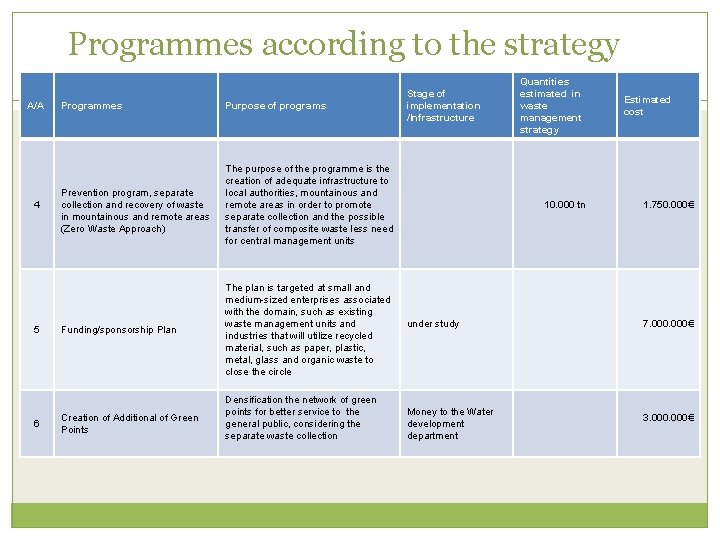
Programmes according to the strategy A/A 4 5 6 Programmes Prevention program, separate collection and recovery of waste in mountainous and remote areas (Zero Waste Approach) Funding/sponsorship Plan Creation of Additional of Green Points Purpose of programs Stage of implementation /Infrastructure The purpose of the programme is the creation of adequate infrastructure to local authorities, mountainous and remote areas in order to promote separate collection and the possible transfer of composite waste less need for central management units The plan is targeted at small and medium-sized enterprises associated with the domain, such as existing waste management units and industries that will utilize recycled material, such as paper, plastic, metal, glass and organic waste to close the circle Densification the network of green points for better service to the general public, considering the separate waste collection Quantities estimated in waste management strategy 10. 000 tn under study Money to the Water development department Estimated cost 1. 750. 000€ 7. 000€ 3. 000€
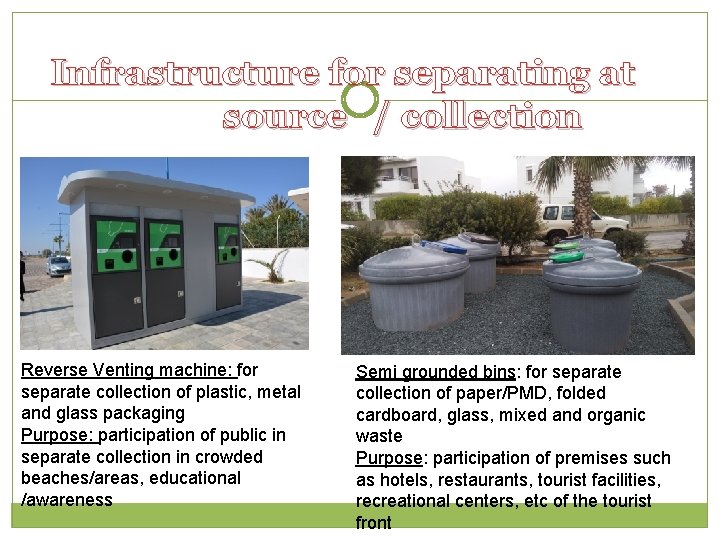
Infrastructure for separating at source / collection Reverse Venting machine: for separate collection of plastic, metal and glass packaging Purpose: participation of public in separate collection in crowded beaches/areas, educational /awareness Semi grounded bins: for separate collection of paper/PMD, folded cardboard, glass, mixed and organic waste Purpose: participation of premises such as hotels, restaurants, tourist facilities, recreational centers, etc of the tourist front
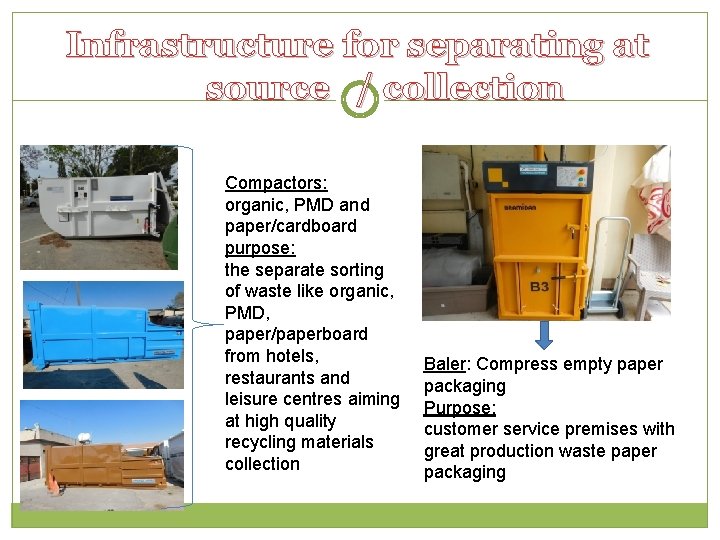
Infrastructure for separating at source / collection Compactors: organic, PMD and paper/cardboard purpose: the separate sorting of waste like organic, PMD, paper/paperboard from hotels, restaurants and leisure centres aiming at high quality recycling materials collection Baler: Compress empty paper packaging Purpose: customer service premises with great production waste paper packaging
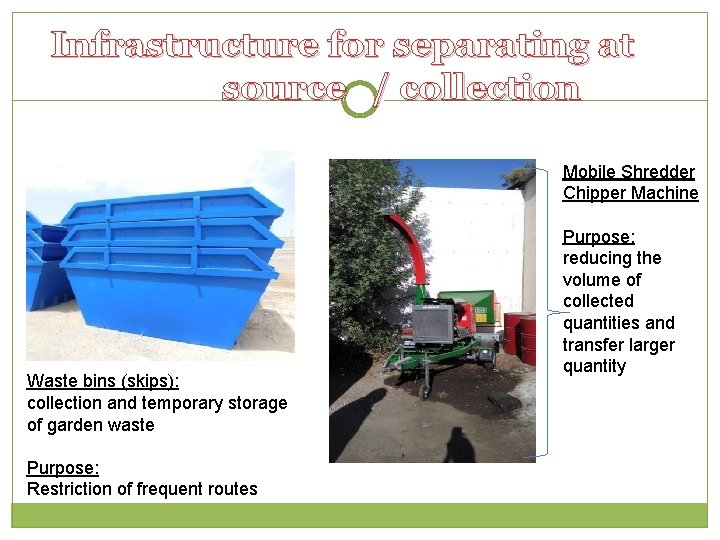
Infrastructure for separating at source / collection Mobile Shredder Chipper Machine Waste bins (skips): collection and temporary storage of garden waste Purpose: Restriction of frequent routes Purpose: reducing the volume of collected quantities and transfer larger quantity
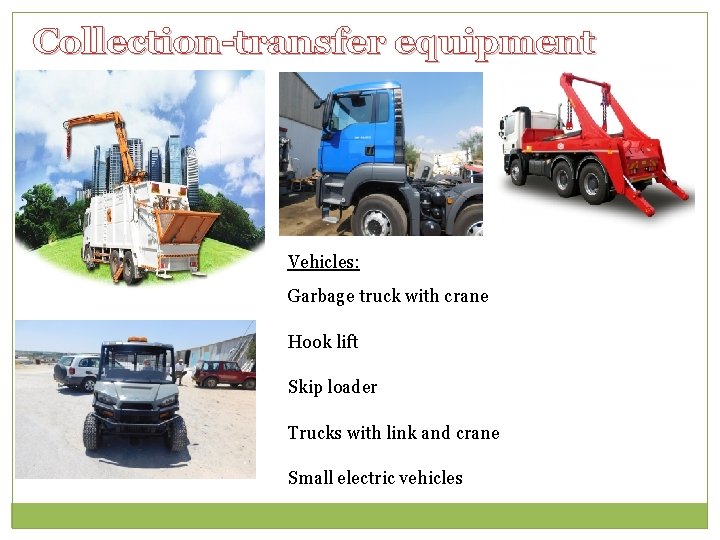
Collection-transfer equipment Vehicles: Garbage truck with crane Hook lift Skip loader Trucks with link and crane Small electric vehicles
MARKET ECONOMIC INSTRUMENTS AND FINANCIAL INCENTIVES Private sector � Financial support for enterprises of specific size and number of employees for implementing and promoting a reduced waste generation and separate collection waste program in their operational cycle. � Financial support the efforts of waste management facilities to increase their capacity or improve the technology used. � Financial support waste facilities for mixed/residual MSW. � Financial support the industries that are including recyclable materials in their production processes.
MARKET ECONOMIC INSTRUMENTS AND FINANCIAL INCENTIVES Public sector �Co-funding the public sector for applying reduced programs and separation at source. General funding �Funding events, competitions and giving grants and awards for best performances on selective collection and/or waste prevention, on local authority, community, school, NGOs, companies, industry and/or individual citizens’ level.
B 2. Life Know Waste Life 13 INF/CY/000919 Awareness raising campaign for the promotion of waste reduction, reuse and recycling in Cyprus 17 June 2014 - 10 August 2017 Budget: € 2. 182. 960 Budget DOE: € 24. 192 www. rethink. com. cy Contribution: Knowledge and experience in technical and scientific issues regarding 3 R Action leader on training of local authorities
B 2. Life Know Waste-After life � 4 district Seminars to local authorities for their role in waste management, good practices and workshops of waste management plans. � 1 seminar in Cyprus Parliament to present the results of Life Know Waste Program and the Waste Management Strategy and National Waste Prevention Program 20152021. � 2 seminar to local authorities, big producers and general public for prevention and management of food waste (kitchen).
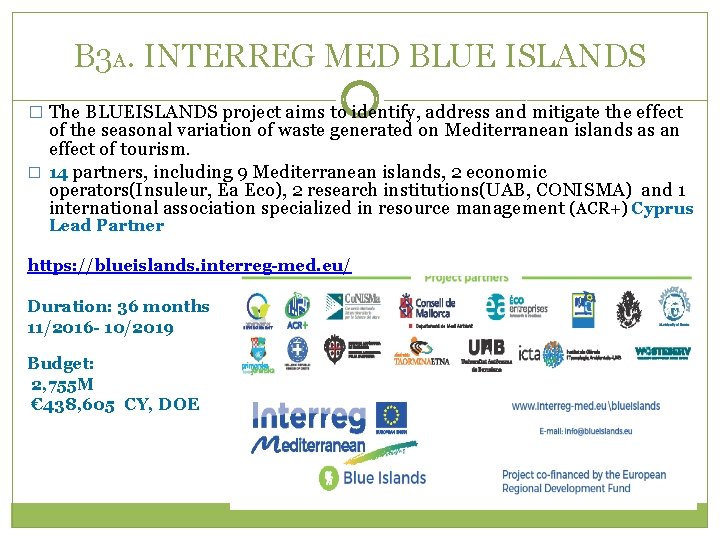
B 3 A. INTERREG MED BLUE ISLANDS � The BLUEISLANDS project aims to identify, address and mitigate the effect � of the seasonal variation of waste generated on Mediterranean islands as an effect of tourism. 14 partners, including 9 Mediterranean islands, 2 economic operators(Insuleur, Ea Eco), 2 research institutions(UAB, CONISMA) and 1 international association specialized in resource management (ACR+) Cyprus Lead Partner https: //blueislands. interreg-med. eu/ Duration: 36 months 11/2016 - 10/2019 Budget: 2, 755Μ € 438, 605 CY, DOE
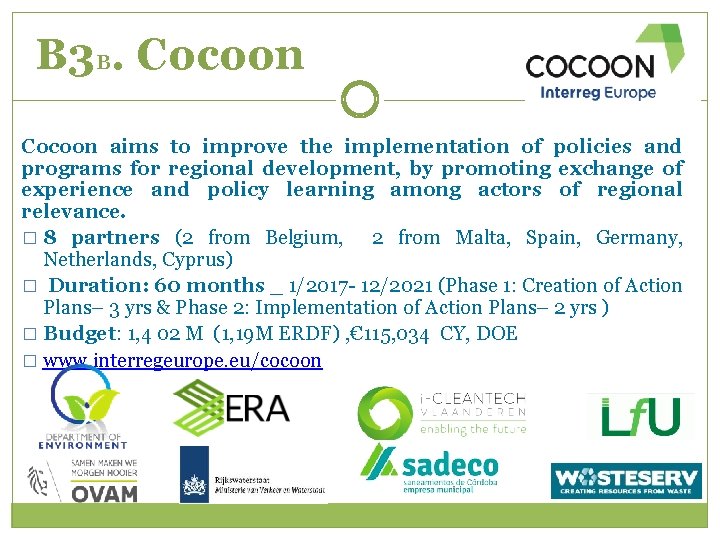
B 3 B. Cocoon aims to improve the implementation of policies and programs for regional development, by promoting exchange of experience and policy learning among actors of regional relevance. � 8 partners (2 from Belgium, 2 from Malta, Spain, Germany, Netherlands, Cyprus) � Duration: 60 months _ 1/2017 - 12/2021 (Phase 1: Creation of Action Plans– 3 yrs & Phase 2: Implementation of Action Plans– 2 yrs ) � Budget: 1, 4 02 Μ (1, 19Μ ERDF) , € 115, 034 CY, DOE � www. interregeurope. eu/cocoon
Thank you! Meropi Samara Miliotou Environment Officer ‘A Tel: 22866240 Fax: 22774945 Ε- mail: mmilioti@environment. moa. gov. cy