
Municipal Budget Process Governmental Procedures and Structure Committee
Municipal Budget Process Governmental Procedures and Structure Committee Taxation and Budget Reform Commission August 10, 2007 By: Diane Reichard, CPA, CGFO
Functions of Budget l l l Within the Finance/Accounting Department or reports to City Manager Prepares revenue forecasts Prepares budget document & CIP Monitors budget spending and position control Grant administration

Key Players
Budget Office • Coordinates all key players • Communicates Council’s goals & priorities • Provides direction to departments • Understands the needs & wants of citizens • Presents document to all
Chief Executive Office • Weekly meetings to understand goals and direction • Establish priorities • Keep calendar moving
Calendar l TRIM Deadlines l l May 31 st – Property appraiser June 30 th – Updated Very important to follow deadlines Budget 95%
Internal Departments • Directors/Liaisons • Understand balance between City Manager directives and available sources • Assisting Departments • Accounting (revenue projections, grants) • Human Resources (employee information) • Planning (Capital Improvement Plan) • Public Works (CIP & infrastructure)
External Departments • Citizens – Advisory groups – Civic organizations • CRA districts • State-revenue estimates
I. III. Develop Your Plan Work Your Plan Present Your Plan, Plan and one thing for sure “Things will change. ”
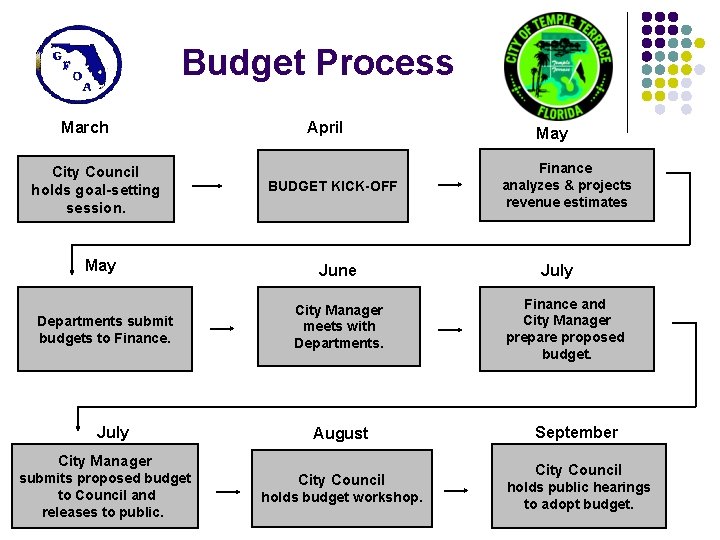
Budget Process March City Council holds goal-setting session. May Departments submit budgets to Finance. July April BUDGET KICK-OFF June City Manager meets with Departments. August City Manager submits proposed budget to Council and releases to public. City Council holds budget workshop. May Finance analyzes & projects revenue estimates July Finance and City Manager prepare proposed budget. September City Council holds public hearings to adopt budget.
I. Develop Your Plan l Deadlines l Budget Responsibility l Details
Deadlines Provide date/ responsible party/ task l Check list l Refer to NACSLB 8. 1 & other guidance l Narratives, numbers, personnel summaries, performance measures, and numbers must align l
Budget Responsibility • Revenue = Appropriation • Fiscal Year = October 1 – September 30 • Compare programs to revenue • Departments are responsible to monitor by category • Personal Services • Operating Expenses • Capital Outlay • Enter line items
Details • Details are important – list with amounts • Personnel - # of positions evaluated • Changes are documented • Plan diligently and plan for change • Monitor monthly • Capital outlay • Specific item and amount • Request to change or add if not in budget • Delayed if funding is tight
II. Work Your Plan • Manage the calendar • Adhere to deadlines • Utilize resources
Manage the Calendar • Stay Focused • Allow time for specific tasks • Depend on those who have information • Revenue projections • Bond documents • Interest Calculations • Debt Service Requirements
Adhere to Deadlines • Beware of changes NOW or LATER • Decide when to STOP
Utilize Resources • Recommended Budget Practices • Internet for example • Budget Policy • Revenue sources • Enterprise funds – outside agencies
III. Present Your Plan Organize thoughts Simple to decipher Easy to understand
Conclusion Budget Function • The way the budget function operates has a wide-ranging effect on the budget itself • 5 Dimensions: • Financial • Planning • Political • Communication • Managerial
Knowledge l l l Government Structure Accounting system Budget Process Operating Departments Legal & Regulatory Impacts
Skills People/Interpersonal l l networking persuasion negotiation interviewing oral/written communication Analytical l l complex problem into parts and solve proficiency with tools and techniques
Ability l Creative/ Innovative l Organize tasks/ juggle priorities l Follow through with commitments l Good judgment (fiscal/policy/political)
- Slides: 24