
MultiView Stereo A Parametric Study Number of images
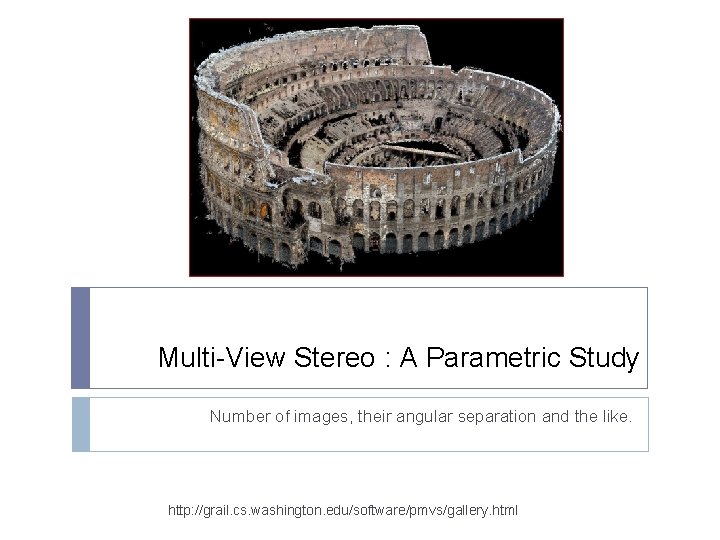
Multi-View Stereo : A Parametric Study Number of images, their angular separation and the like. http: //grail. cs. washington. edu/software/pmvs/gallery. html
What is Multi-View Stereo. Take multiple 2 D (i. e. ordinary) images from different views and convert them into 3 D models. 3 D Surface is generated from point clouds extracted from 2 D images by pairing 2 different images. (i. e. stereo) Useful for Preservation and reconstruction of archeological sites, sculptures. Speeding up creation of 3 D face models for CG Animation purposes. Making better player generated in-game avatars, quicker.
Main objectives. Attempt to generalize, i. e. parameterize, the input requirement by analysis. Mainly considering a time sensitive input acquisition phase. Time available for taking source pictures is presumed to be limited. Post processing and 3 D Structure generation has fewer constraints. Parameters of most importance : Number of images. Angular Separation between two consecutive images.
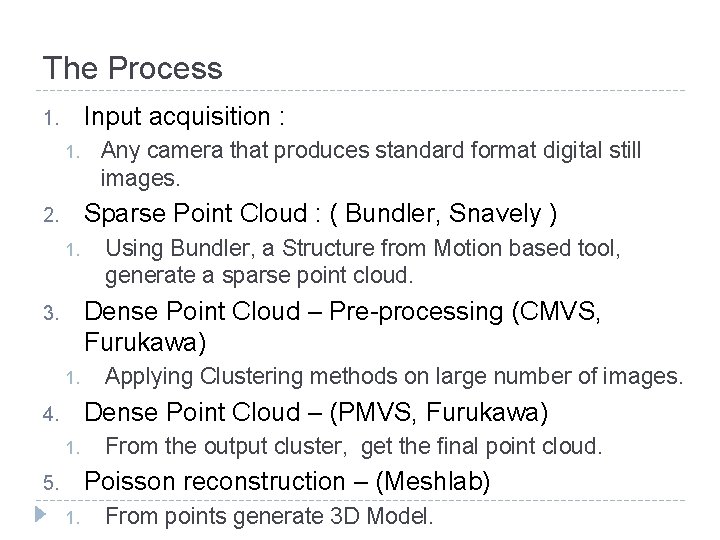
The Process Input acquisition : 1. 1. Any camera that produces standard format digital still images. Sparse Point Cloud : ( Bundler, Snavely ) 2. 1. Using Bundler, a Structure from Motion based tool, generate a sparse point cloud. Dense Point Cloud – Pre-processing (CMVS, Furukawa) 3. 1. Applying Clustering methods on large number of images. Dense Point Cloud – (PMVS, Furukawa) 4. 1. From the output cluster, get the final point cloud. Poisson reconstruction – (Meshlab) 5. 1. From points generate 3 D Model.
What is Bundler? Main purpose is to generate Structure from Motion. Camera Co-ordinates are figured out by using multiple images assumed to be taken in a sequential order. Most prominent features are extracted and given normal directions. (point clouds) Additional usages Ease of inputting Camera Parameters. Processes images and provides a standard output usable by CMVS/PMVS. Sparse Cloud can be used for time-sensitive preview. http: //phototour. cs. washington. edu/bundle r/
CMVS and PMVS Multi-View Stereo : Clustering MVS : Assume stereo vision and pair two images. (i. e. assume they’re taken at the same time) Analyze depth and direction from these views. After computing on numerous pairs, estimate a 3 D model. Useful largely in cases when number of images is large. Speeds up the process for regular number of images. Patch-based MVS : Creates Dense point cloud from input data. Pre-processing reduced when paired with Bundler. http: //grail. cs. washington. edu/software/cm vs/
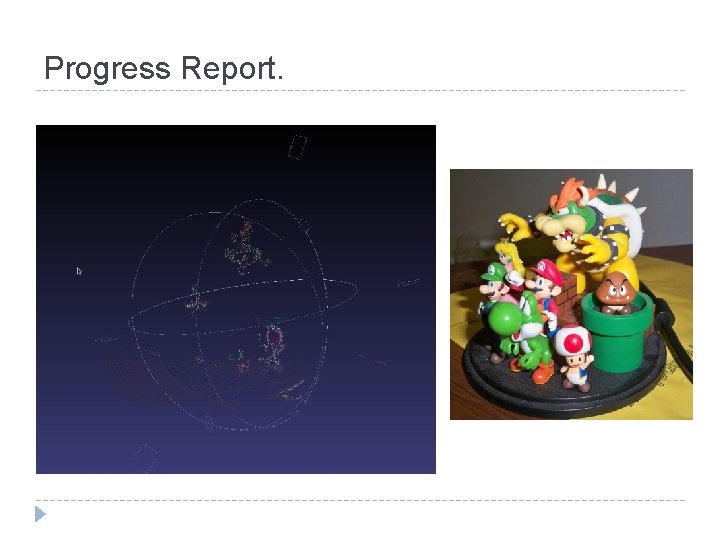
Progress Report.
Progress Report (cont. ) Able to generate average results from 10 images at 5 degree separation. Lighting conditions and other parameters to be tested. Dataset Used : Images taken by self. Plan to use 3 D Photography Dataset http: //www. cs. washington. edu/homes/furukawa/research/mview/ index. html
Extended Goals. Try to put harder constraints on 3 D point cloud generation. Derive a parametric formula based on Vehicular motion, i. e. “What should be the time gap between images” “What should be the angular motion of vehicle around the object of interest” “If path known and fixed, what should be the optimal timing” Try different algorithms cited in Middlebury http: //vision. middlebury. edu/mview
Thank You for Listening. Any Questions?
- Slides: 10