
MultiView Graph Convolutional Network and Its Applications on







- Slides: 18
Multi-View Graph Convolutional Network and Its Applications on Neuroimage Analysis for Parkinson's Disease Decision and Learning Using Multiple Data Sources S 114 Jingyuan(Jay) Chou Weill Cornell Medicine Twitter: @sheryl_zx #AMIA 2018
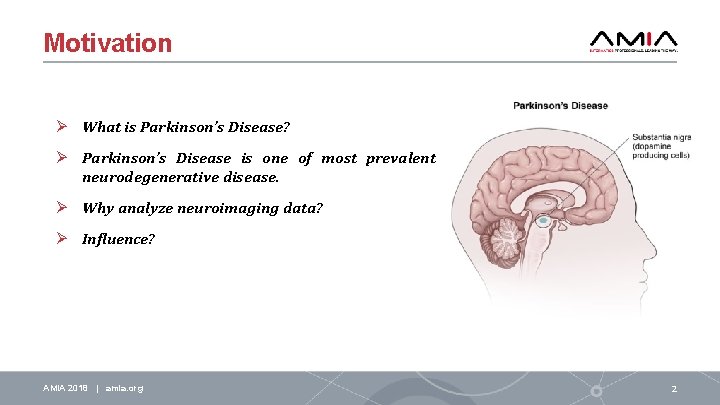
Motivation Ø What is Parkinson’s Disease? Ø Parkinson’s Disease is one of most prevalent neurodegenerative disease. Ø Why analyze neuroimaging data? Ø Influence? AMIA 2018 | amia. org 2
Introduction v Goal: Discriminate early stage Parkinson Cases and Controls. v Data: MRI coordinates, DTI image data from PPMI dataset v Many computational approaches have been developed for neuroimaging analysis v MVGCN, Multi View Graph Convolution Network. v What is Multi View? AMIA 2018 | amia. org 3
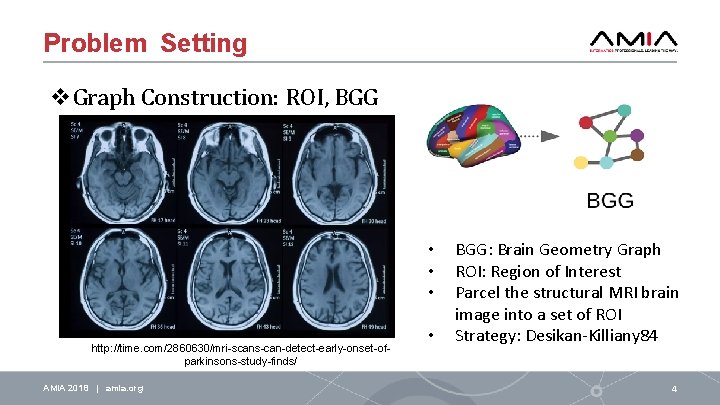
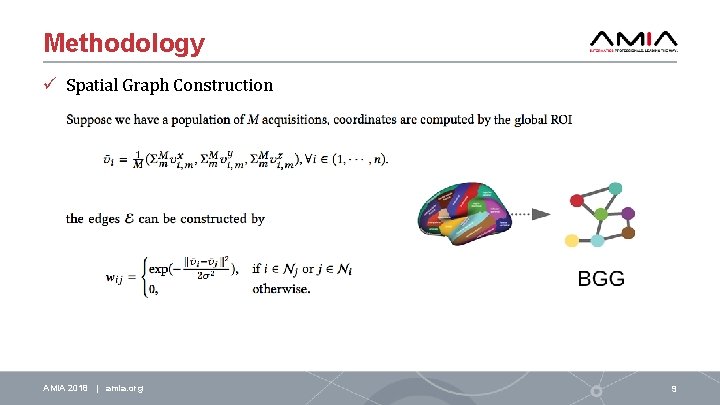
Problem Setting v. Graph Construction: ROI, BGG • • • http: //time. com/2860630/mri-scans-can-detect-early-onset-ofparkinsons-study-finds/ AMIA 2018 | amia. org • BGG: Brain Geometry Graph ROI: Region of Interest Parcel the structural MRI brain image into a set of ROI Strategy: Desikan-Killiany 84 4
Problem Setting v. Feature Construction: BCG • • BCG: Brain Connectivity Graph tractography is a 3 D modeling technique used to visually represent nerve tracts using data collected by diffusion MRI Credit: https: //neurology. msu. edu/Co. Ge. NT/lab/dti AMIA 2018 | amia. org 5
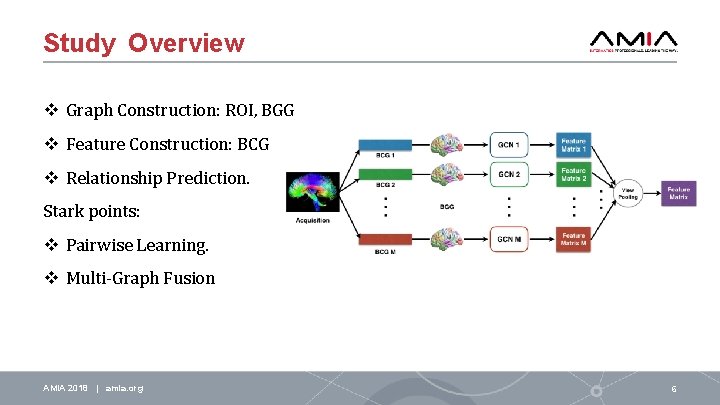
Study Overview v Graph Construction: ROI, BGG v Feature Construction: BCG v Relationship Prediction. Stark points: v Pairwise Learning. v Multi-Graph Fusion AMIA 2018 | amia. org 6
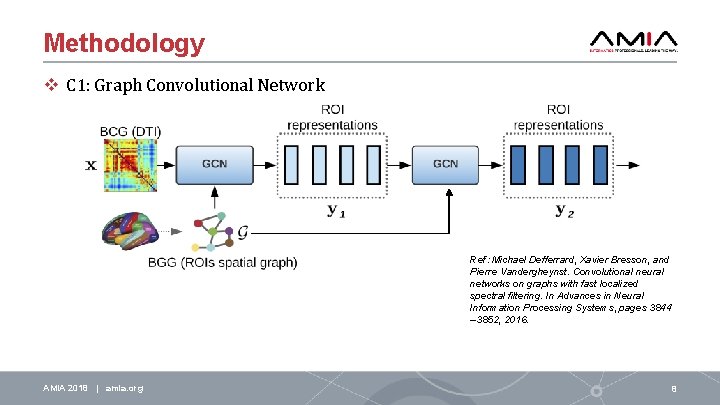
Methodology: Overview Basic Components of the Proposed Neural Network v C 1: Graph Convolutional Network (GCN) v C 2: View Pooling v C 3: Pairwise Matching v C 4: Objective Function Definition: v D 1: BCGs -- Brain Connectivity Graphs (DTI data) v D 2: BGG -- Brain Geometry Graph (ROI coordinates) AMIA 2018 | amia. org 7
Methodology v C 1: Graph Convolutional Network Ref: Michael Defferrard, Xavier Bresson, and Pierre Vandergheynst. Convolutional neural networks on graphs with fast localized spectral filtering. In Advances in Neural Information Processing Systems, pages 3844 – 3852, 2016. AMIA 2018 | amia. org 8
Methodology ü Spatial Graph Construction AMIA 2018 | amia. org 9
Methodology v C 2: View Pooling Two element-wise pooling methods are explored here: ü max pooling ü mean pooling Ref: Hang Su, Subhransu Maji, Evangelos Kalogerakis, and Erik Learned-Miller. Multiview convolutional neural networks for 3 d shape recognition. In Proceedings of the IEEE international conference on computer vision, pages 945– 953, 2015. AMIA 2018 | amia. org 10
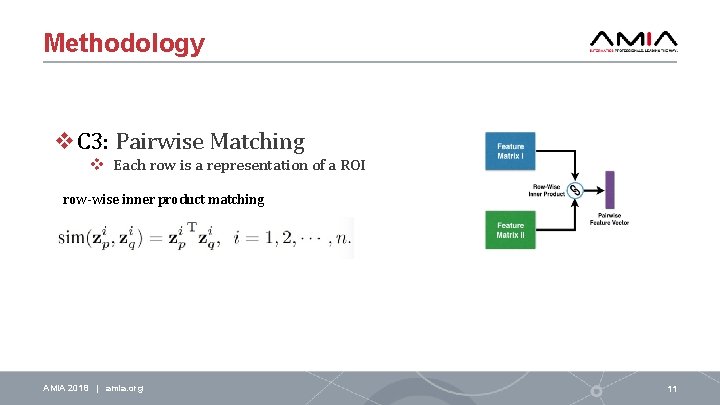
Methodology v. C 3: Pairwise Matching v Each row is a representation of a ROI row-wise inner product matching AMIA 2018 | amia. org 11
Methodology v C 4: Objective Function AMIA 2018 | amia. org 12
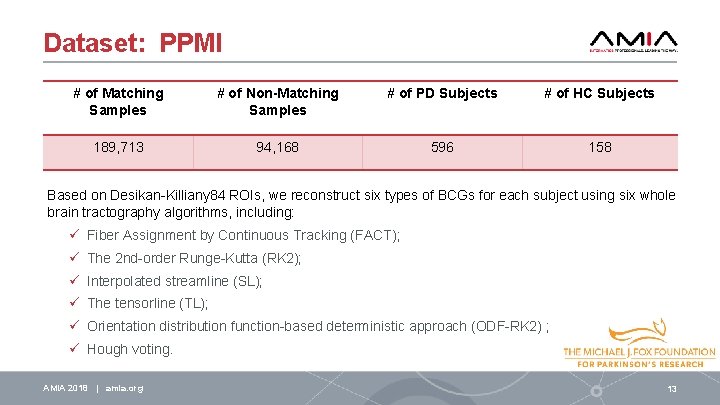
Dataset: PPMI # of Matching Samples # of Non-Matching Samples # of PD Subjects # of HC Subjects 189, 713 94, 168 596 158 Based on Desikan-Killiany 84 ROIs, we reconstruct six types of BCGs for each subject using six whole brain tractography algorithms, including: ü Fiber Assignment by Continuous Tracking (FACT); ü The 2 nd-order Runge-Kutta (RK 2); ü Interpolated streamline (SL); ü The tensorline (TL); ü Orientation distribution function-based deterministic approach (ODF-RK 2) ; ü Hough voting. AMIA 2018 | amia. org 13
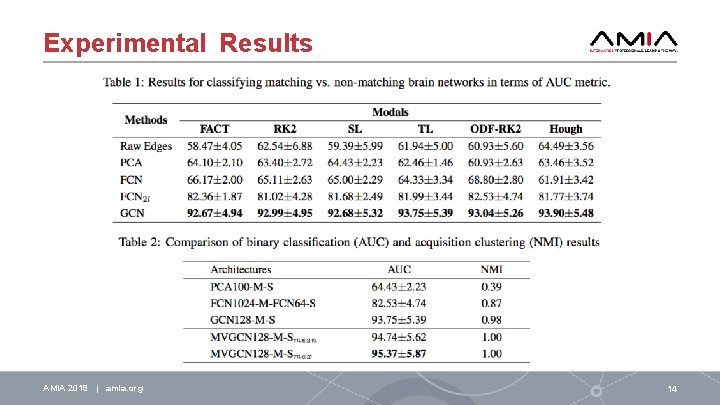
Experimental Results AMIA 2018 | amia. org 14
Learned Similarity: Visualization of DTI acquisition clusters: PD versus Healthy Control AMIA 2018 | amia. org 15
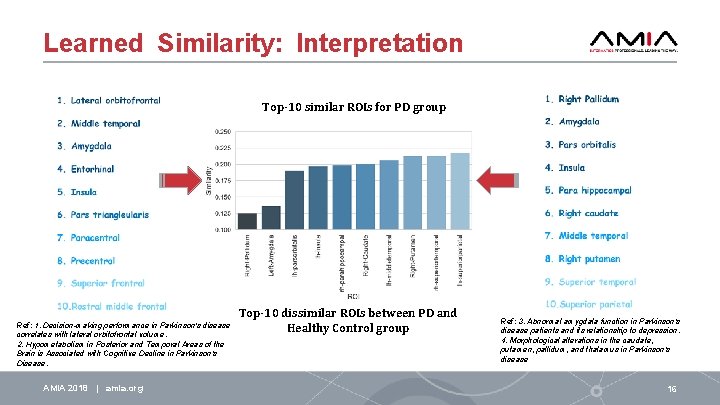
Learned Similarity: Interpretation Top-10 similar ROIs for PD group Ref: 1. Decision-making performance in Parkinson's disease correlates with lateral orbitofrontal volume. 2. Hypometabolism in Posterior and Temporal Areas of the Brain is Associated with Cognitive Decline in Parkinson's Disease. AMIA 2018 | amia. org Top-10 dissimilar ROIs between PD and Healthy Control group Ref: 3. Abnormal amygdala function in Parkinson's disease patients and its relationship to depression. 4. Morphological alterations in the caudate, putamen, pallidum, and thalamus in Parkinson's disease 16
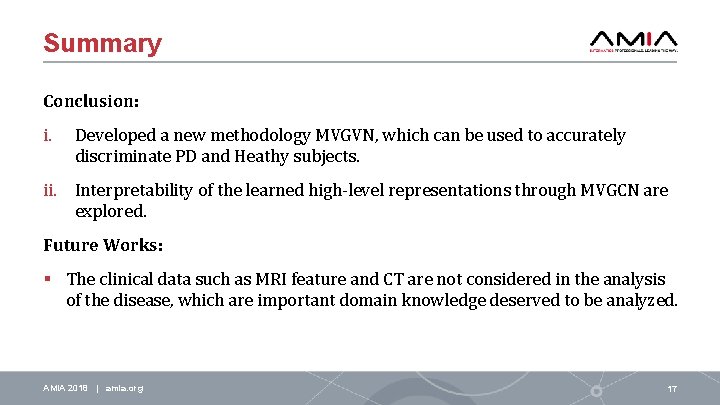
Summary Conclusion: i. Developed a new methodology MVGVN, which can be used to accurately discriminate PD and Heathy subjects. ii. Interpretability of the learned high-level representations through MVGCN are explored. Future Works: § The clinical data such as MRI feature and CT are not considered in the analysis of the disease, which are important domain knowledge deserved to be analyzed. AMIA 2018 | amia. org 17
Thank you! Email me at: jic 2015@med. cornell. edu