
Multivibrator The Opamp Multivibrator is an astable oscillator
Multivibrator The Op-amp Multivibrator is an astable oscillator circuit that generates a rectangular output waveform using an RC timing network connected to the inverting input of the operational amplifier and a voltage divider network connected to the other non-inverting input. Unlike the monostable or bistable, the astable multivibrator has two states, neither of which are stable as it is constantly switching between these two states with the time spent in each state controlled by the charging or discharging of the capacitor through a resistor.

In the op-amp multivibrator circuit the op-amp works as an analogue comparator. An op-amp comparator compares the voltages on its two inputs and gives a positive or negative output depending on whether the input is greater or less than some reference value, VREF. We can take this idea of converting a periodic waveform into a rectangular output one step further by replacing the sinusoidal input with an RC timing circuit connected across the op-amps output. This time, instead of a sinusoidal waveform being used to trigger the op-amp, we can use the capacitors charging voltage, Vc to change the output state of the op-amp as shown.
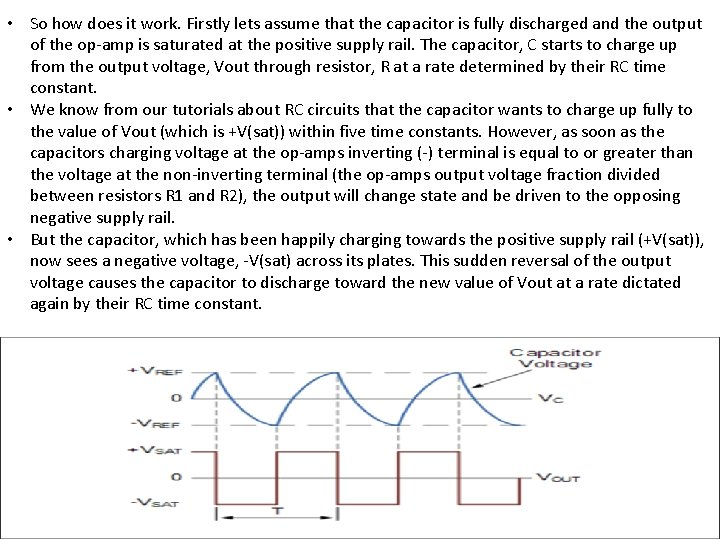
• So how does it work. Firstly lets assume that the capacitor is fully discharged and the output of the op-amp is saturated at the positive supply rail. The capacitor, C starts to charge up from the output voltage, Vout through resistor, R at a rate determined by their RC time constant. • We know from our tutorials about RC circuits that the capacitor wants to charge up fully to the value of Vout (which is +V(sat)) within five time constants. However, as soon as the capacitors charging voltage at the op-amps inverting (-) terminal is equal to or greater than the voltage at the non-inverting terminal (the op-amps output voltage fraction divided between resistors R 1 and R 2), the output will change state and be driven to the opposing negative supply rail. • But the capacitor, which has been happily charging towards the positive supply rail (+V(sat)), now sees a negative voltage, -V(sat) across its plates. This sudden reversal of the output voltage causes the capacitor to discharge toward the new value of Vout at a rate dictated again by their RC time constant.
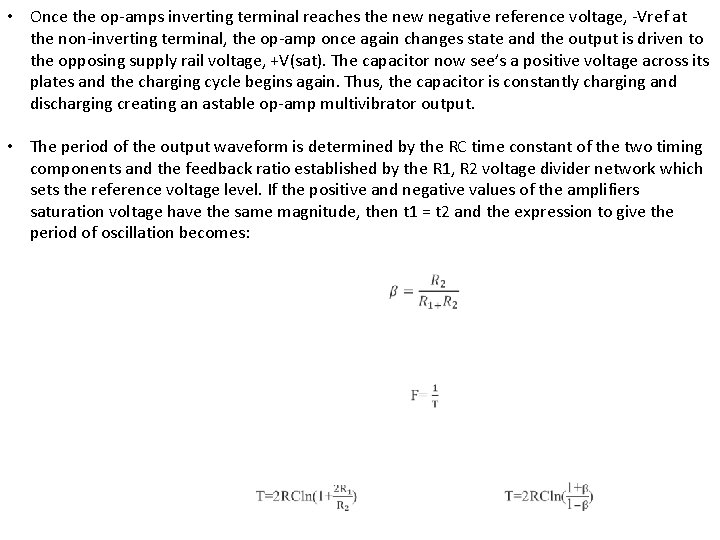
• Once the op-amps inverting terminal reaches the new negative reference voltage, -Vref at the non-inverting terminal, the op-amp once again changes state and the output is driven to the opposing supply rail voltage, +V(sat). The capacitor now see’s a positive voltage across its plates and the charging cycle begins again. Thus, the capacitor is constantly charging and discharging creating an astable op-amp multivibrator output. • The period of the output waveform is determined by the RC time constant of the two timing components and the feedback ratio established by the R 1, R 2 voltage divider network which sets the reference voltage level. If the positive and negative values of the amplifiers saturation voltage have the same magnitude, then t 1 = t 2 and the expression to give the period of oscillation becomes:

Op-amp Multivibrator Example An op-amp multivibrator circuit is constructed using the following components. R 1 = 35 kΩ, R 2 = 30 kΩ, R = 50 kΩ and C = 0. 01 u. F. Calculate the circuits frequency of oscillation. Then the frequency of oscillation is calculated as 1 k. Hz. When β = 0. 462, this frequency can be calculated directly as: ƒ = 1/2 RC. Also when the two feedback resistors are the same, that is R 1 = R 2, the feedback fraction is equal to 3 and the frequency of oscillation becomes: ƒ = 1/2. 2 RC.
- Slides: 5