
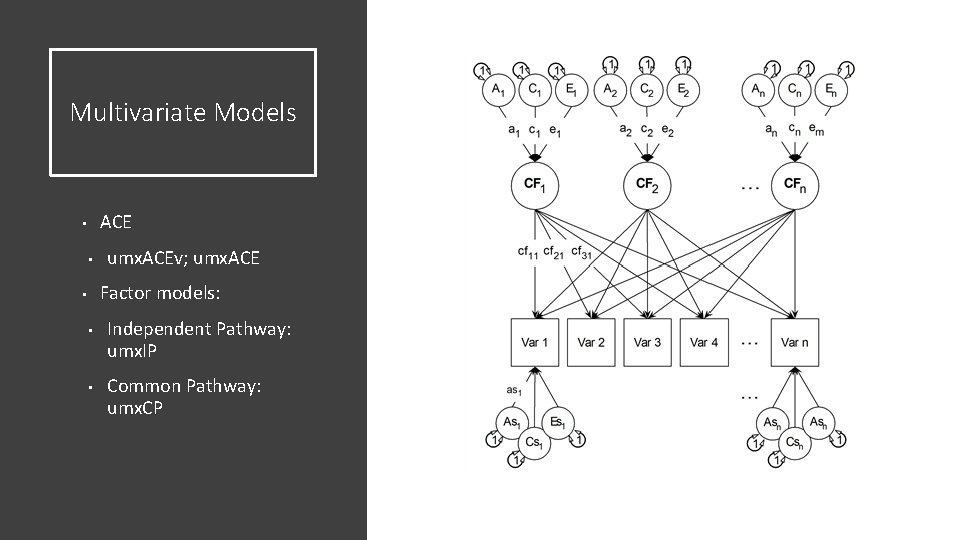
Multivariate Models ACE umx ACEv umx ACE Factor



- Slides: 50
Multivariate Models ACE • • umx. ACEv; umx. ACE Factor models: • • • Independent Pathway: umx. IP Common Pathway: umx. CP
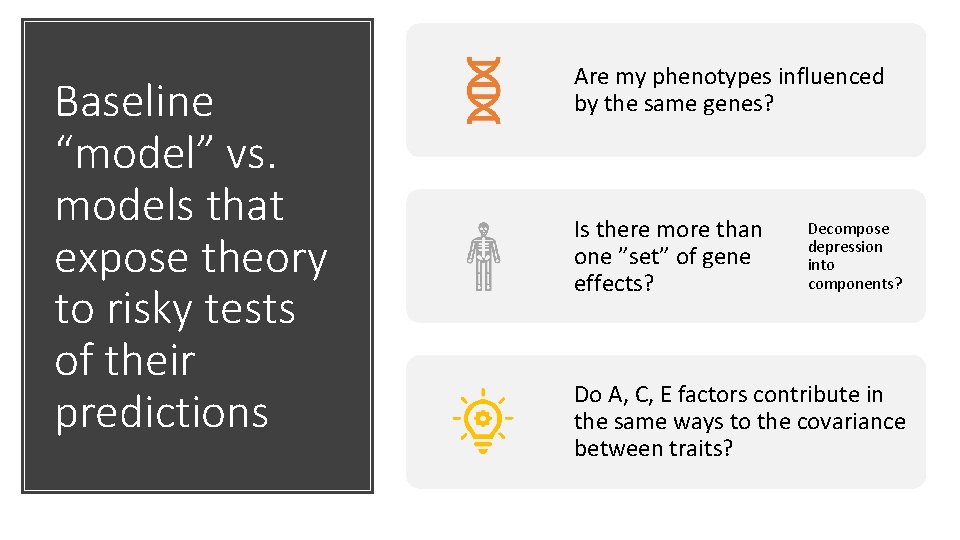
Baseline “model” vs. models that expose theory to risky tests of their predictions Are my phenotypes influenced by the same genes? Is there more than one ”set” of gene effects? Decompose depression into components? Do A, C, E factors contribute in the same ways to the covariance between traits?
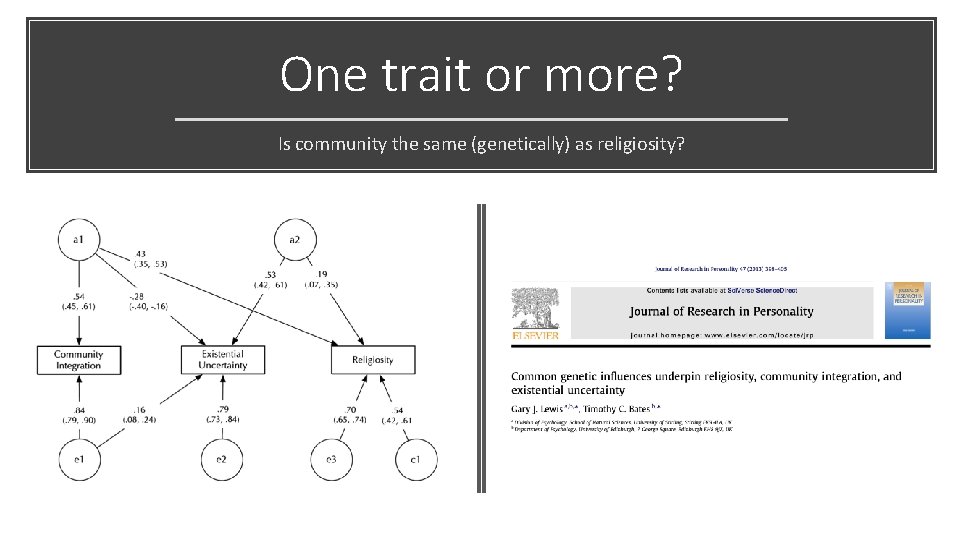
One trait or more? Is community the same (genetically) as religiosity?
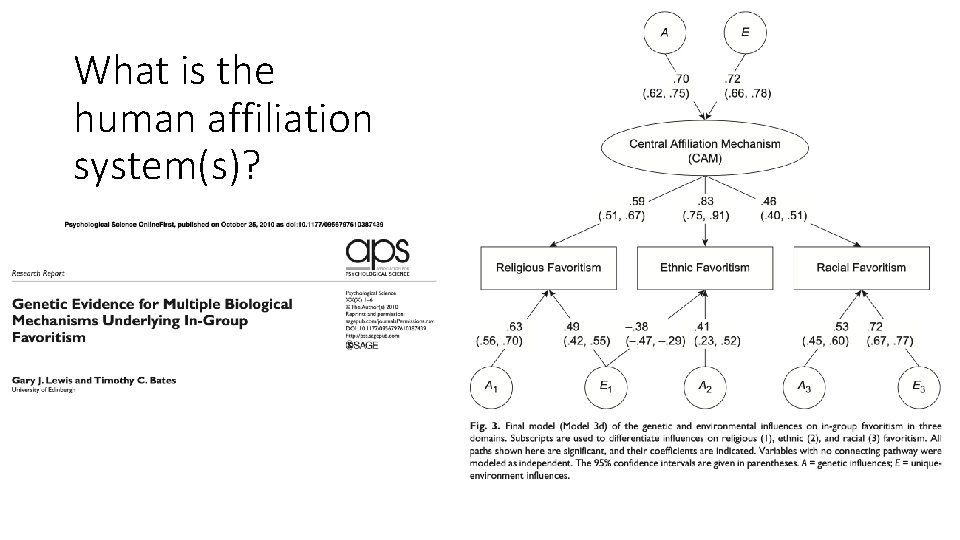
What is the human affiliation system(s)?
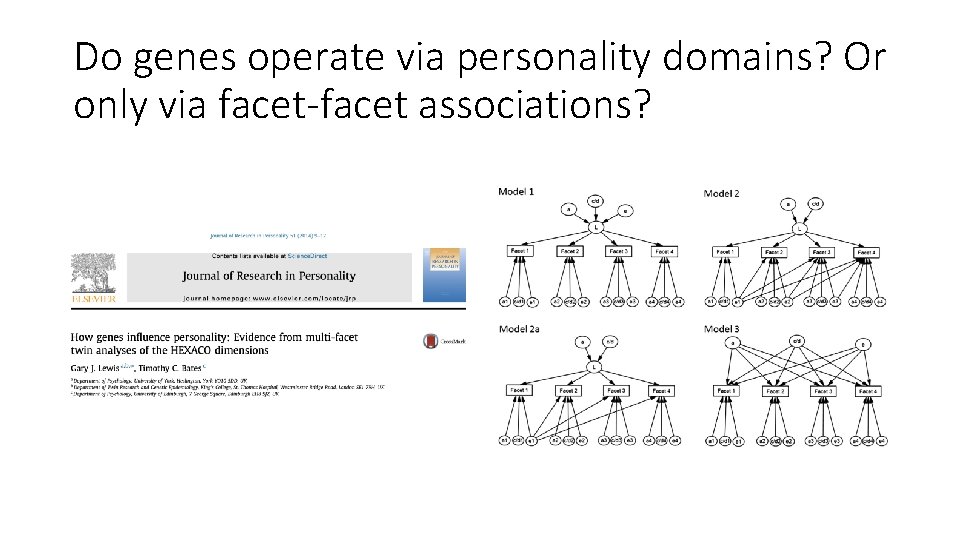
Do genes operate via personality domains? Or only via facet-facet associations?
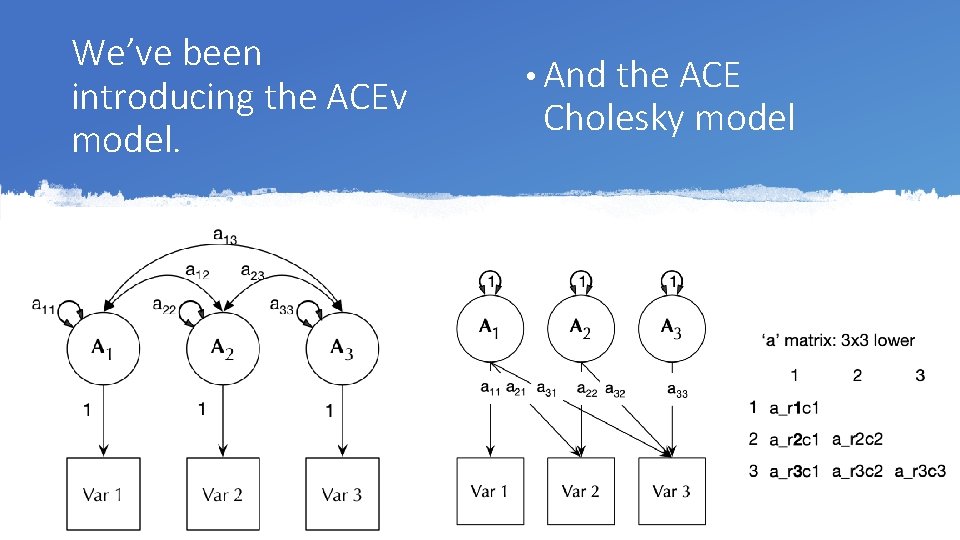
We’ve been introducing the ACEv model. • And the ACE Cholesky model
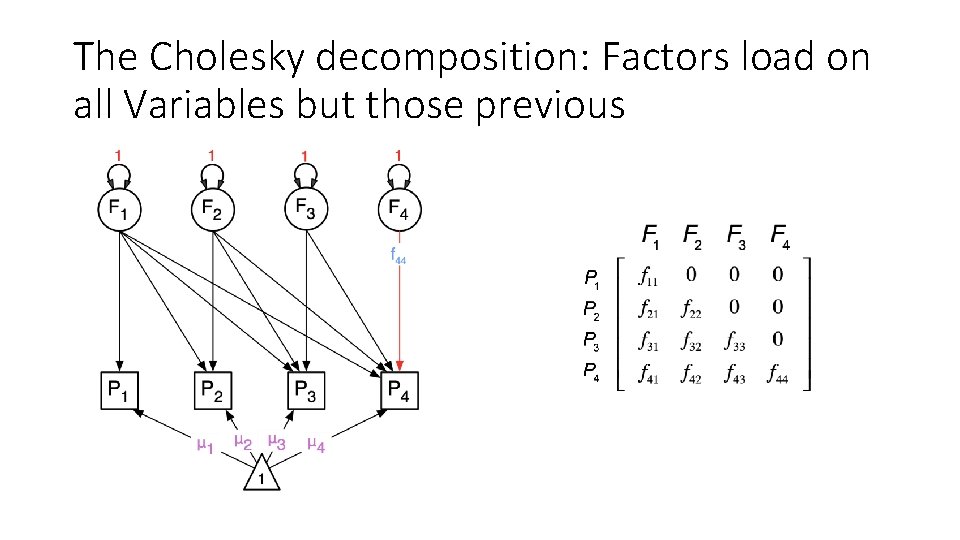
The Cholesky decomposition: Factors load on all Variables but those previous
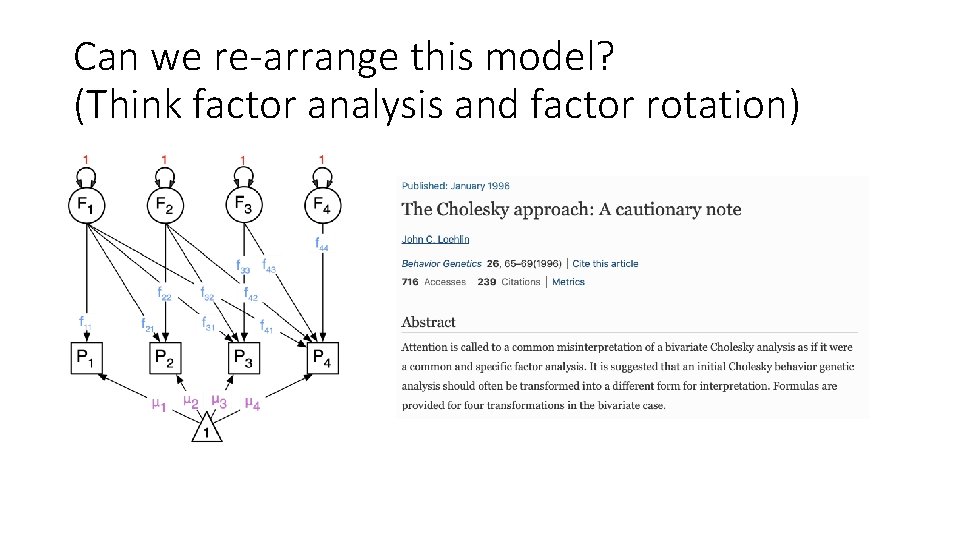
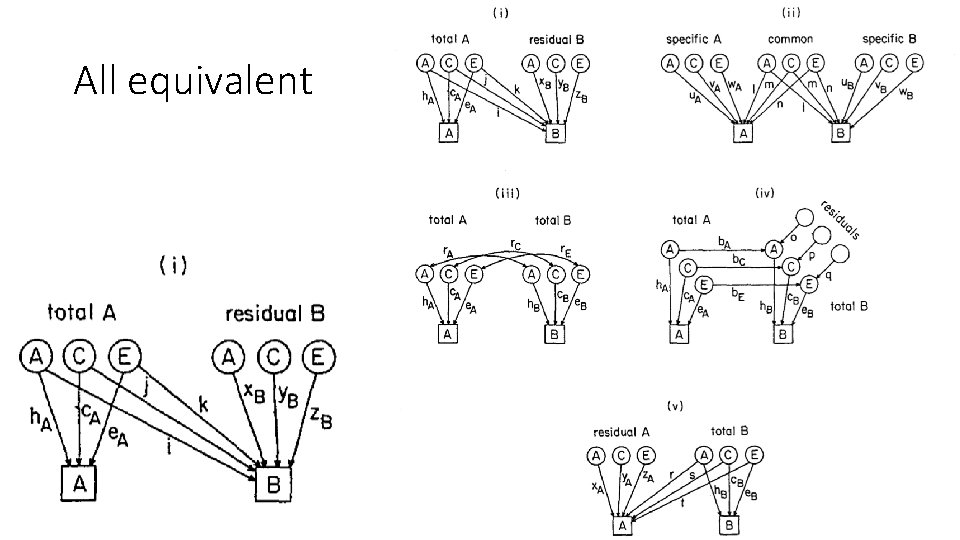
Can we re-arrange this model? (Think factor analysis and factor rotation)
All equivalent
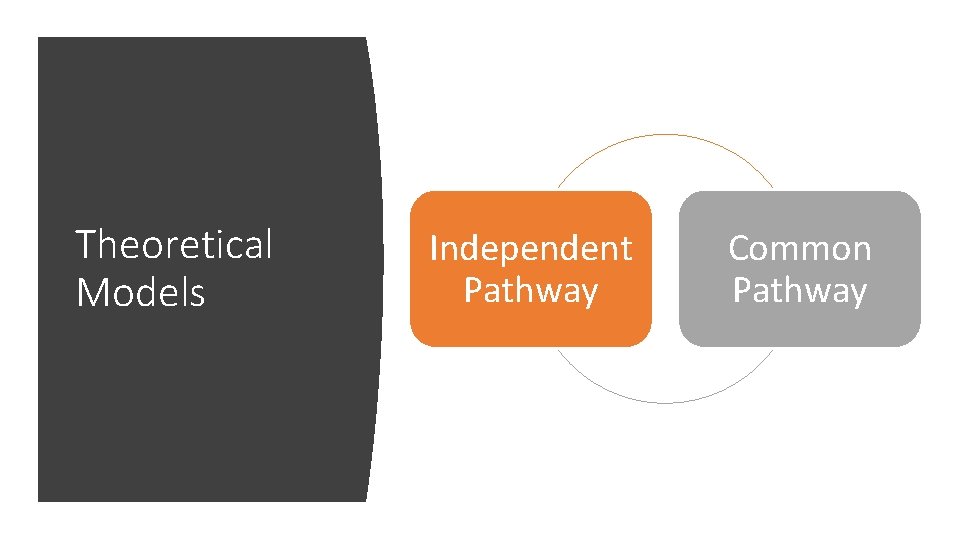
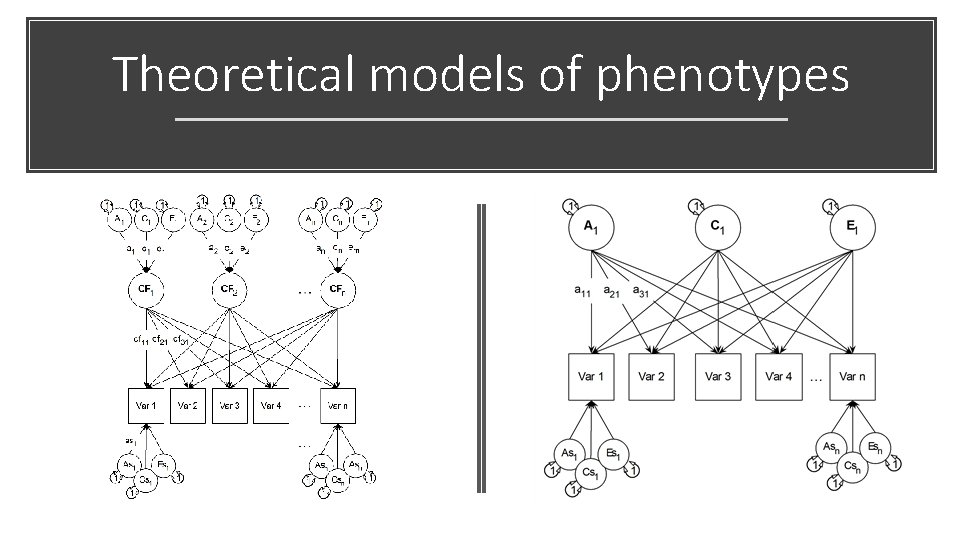
Theoretical Models Independent Pathway Common Pathway
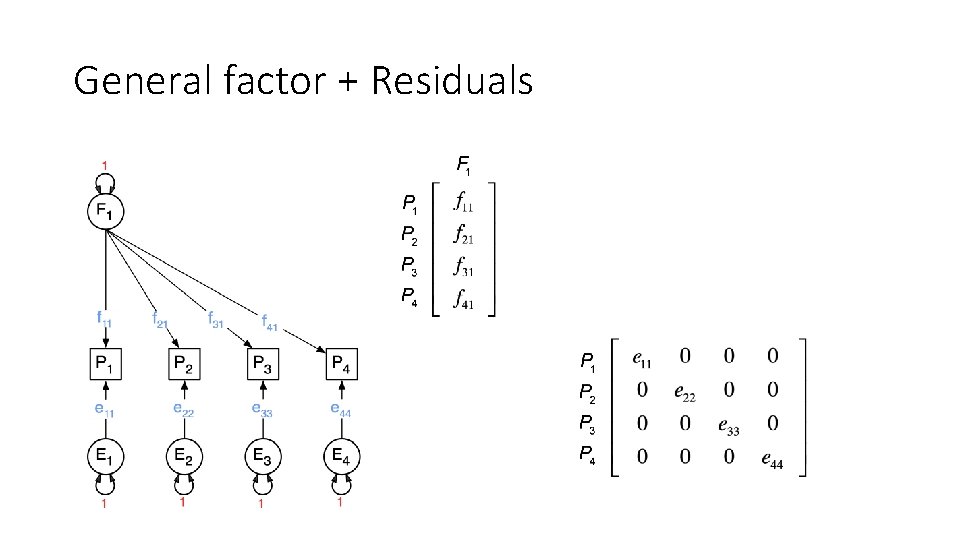
General factor + Residuals
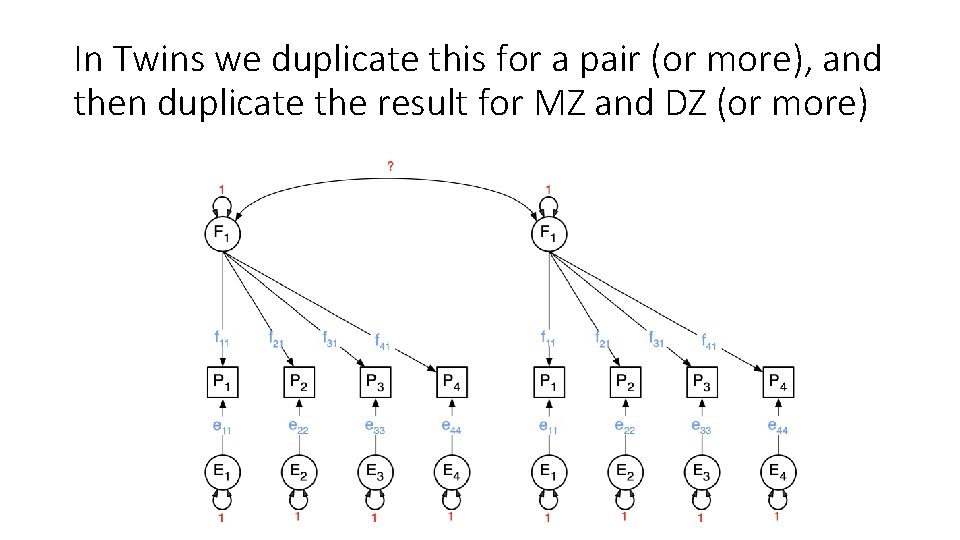
In Twins we duplicate this for a pair (or more), and then duplicate the result for MZ and DZ (or more)
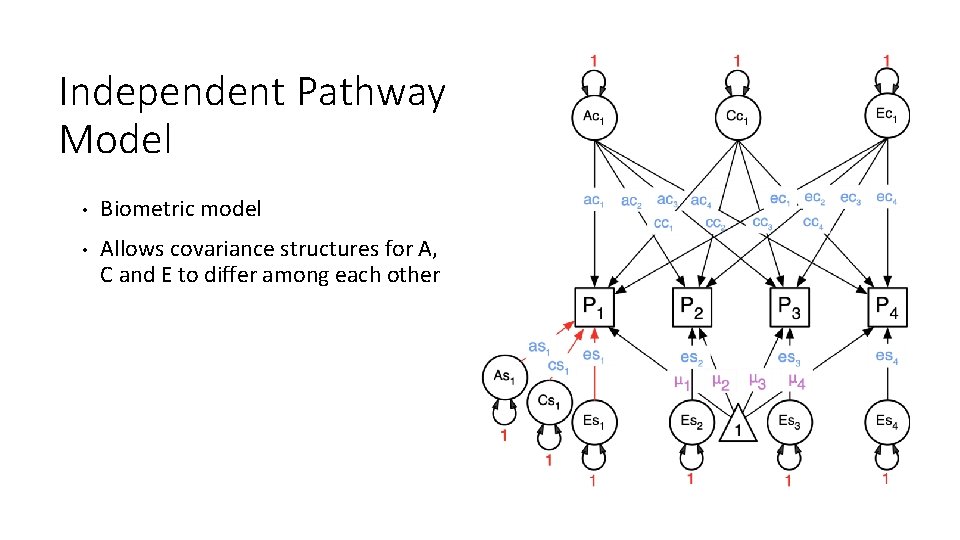
Independent Pathway Model • Biometric model • Allows covariance structures for A, C and E to differ among each other
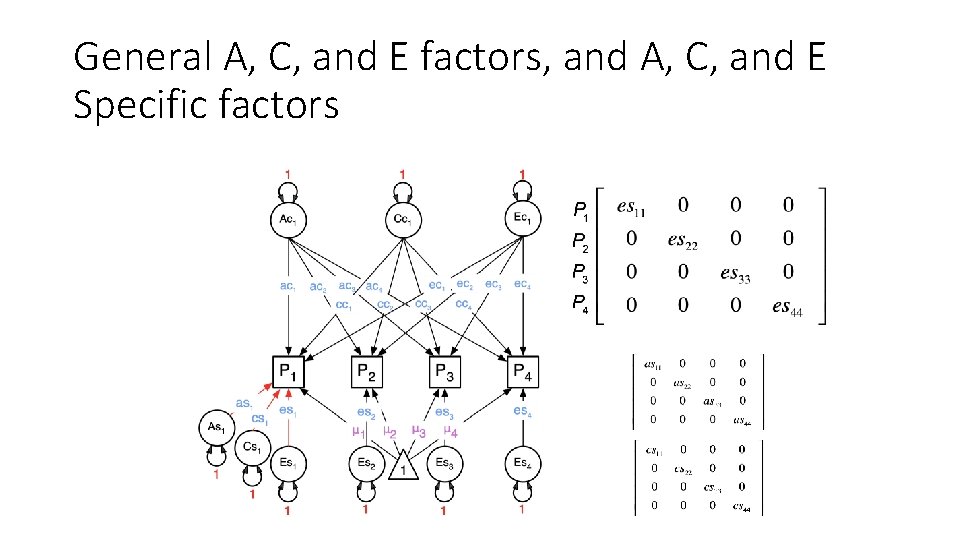
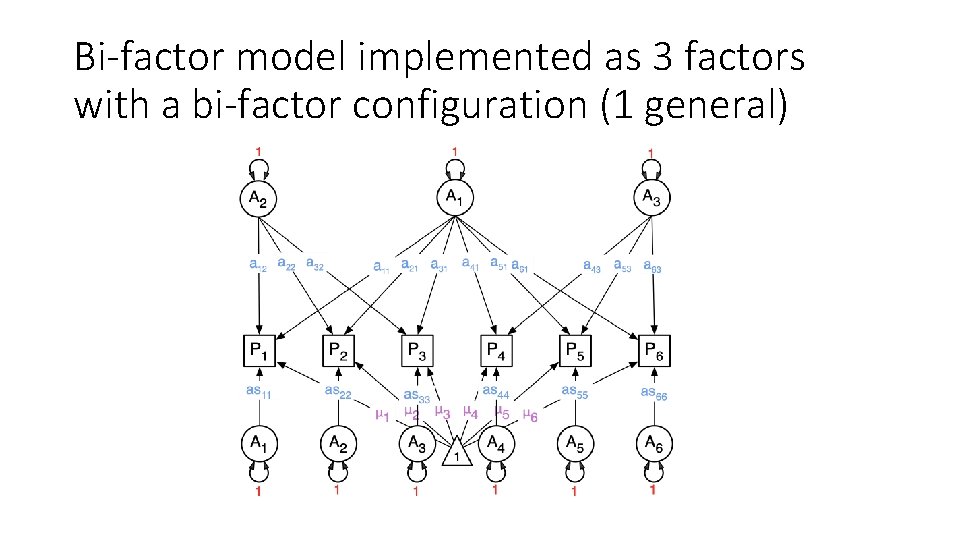
General A, C, and E factors, and A, C, and E Specific factors
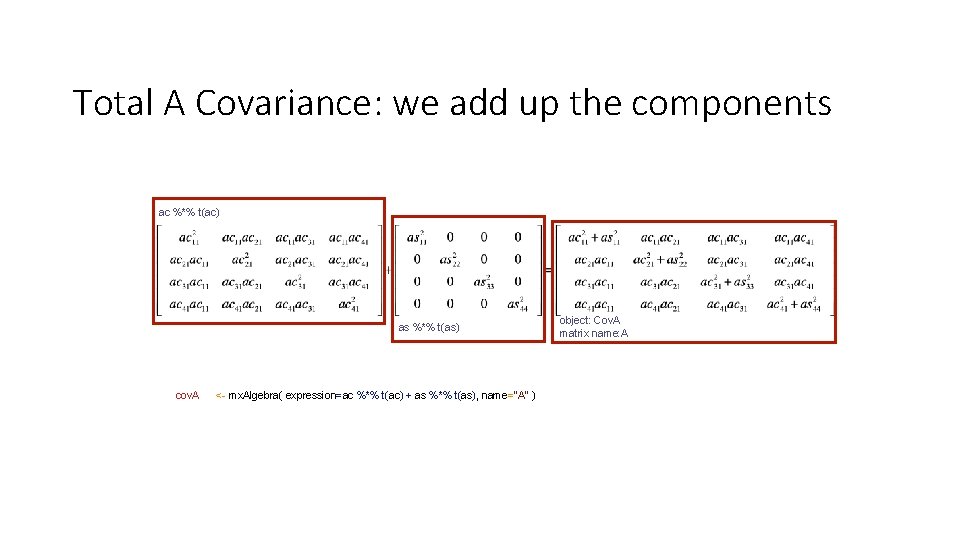
Total A Covariance: we add up the components ac %*% t(ac) as %*% t(as) cov. A <- mx. Algebra( expression=ac %*% t(ac) + as %*% t(as), name="A" ) object: Cov. A matrix name: A
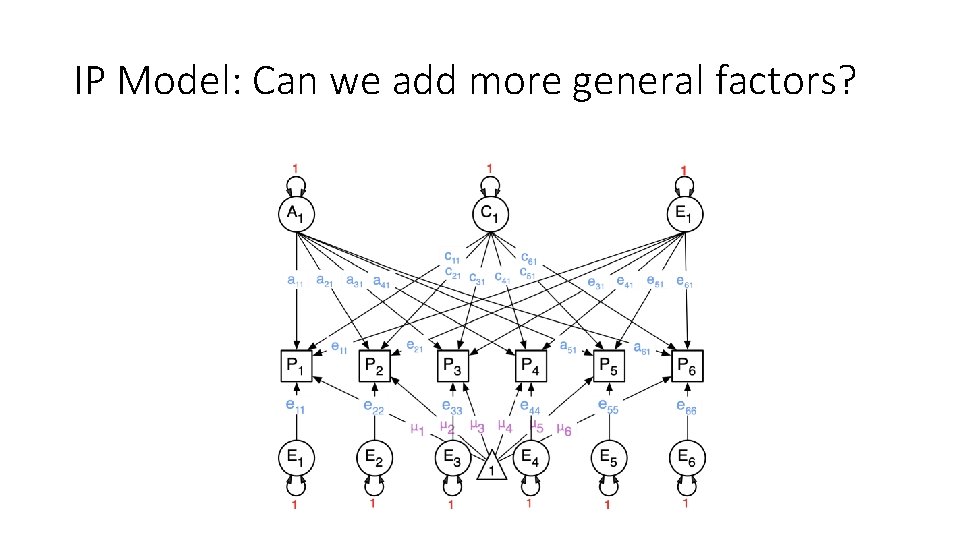
IP Model: Can we add more general factors?
Identification Be careful when adding factors: total parameters per source of variance can not exceed (nv*(nv+1))/2 For a common factor with only 2 indicators the two factor loadings on the latent factor need to be equated OR instead a correlation could be estimated between the residual factors (of the same source of variance) on the two indicators.
Bi-factor model implemented as 3 factors with a bi-factor configuration (1 general)
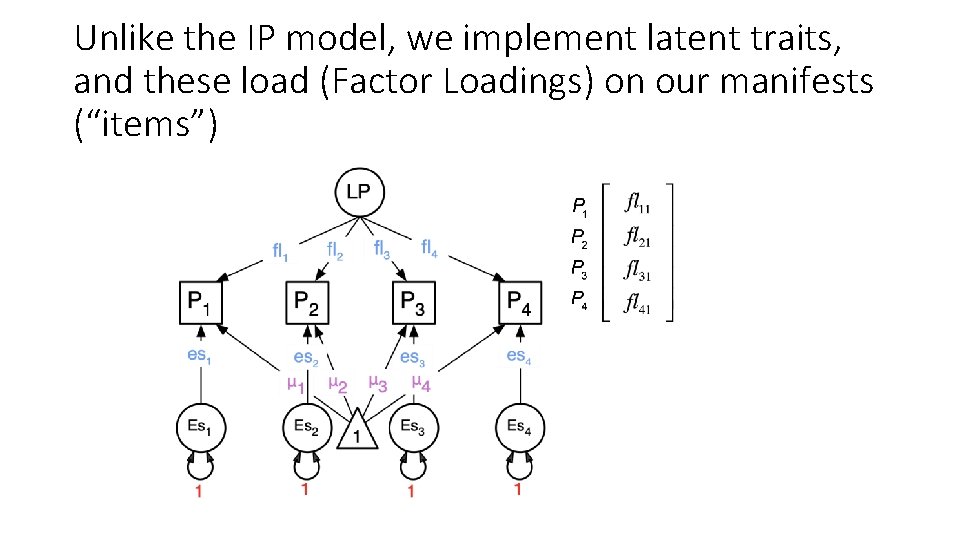
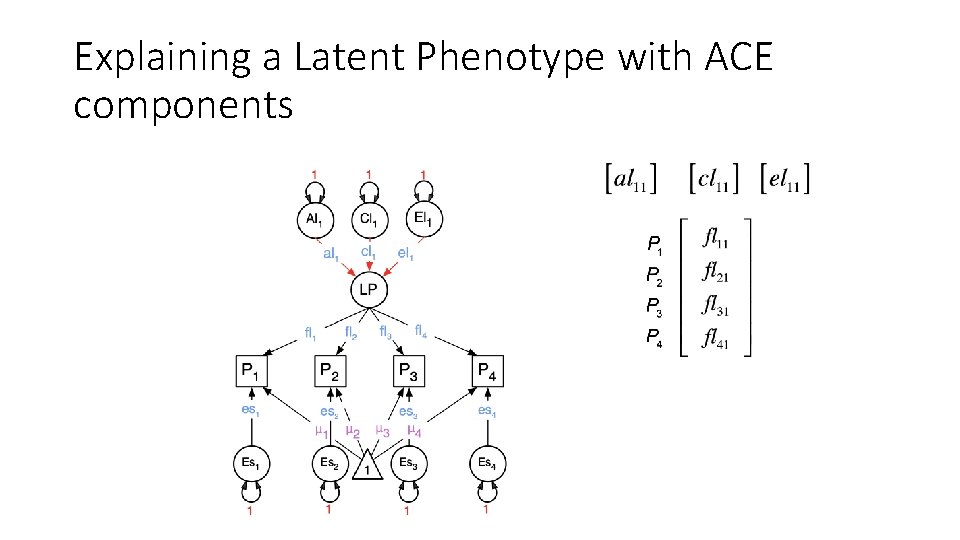
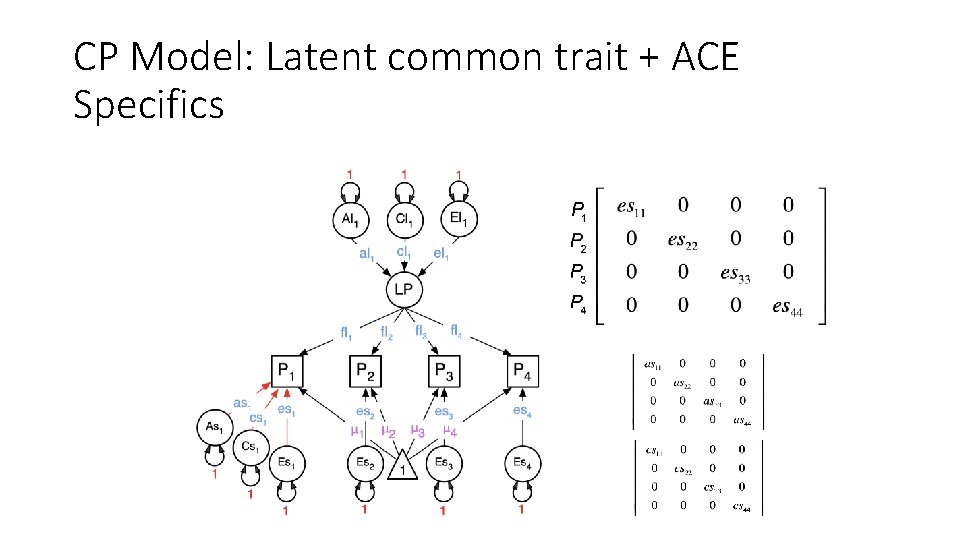
Common Pathway Model Psychometric model Same covariance structure for A, C and E
Unlike the IP model, we implement latent traits, and these load (Factor Loadings) on our manifests (“items”)
Explaining a Latent Phenotype with ACE components
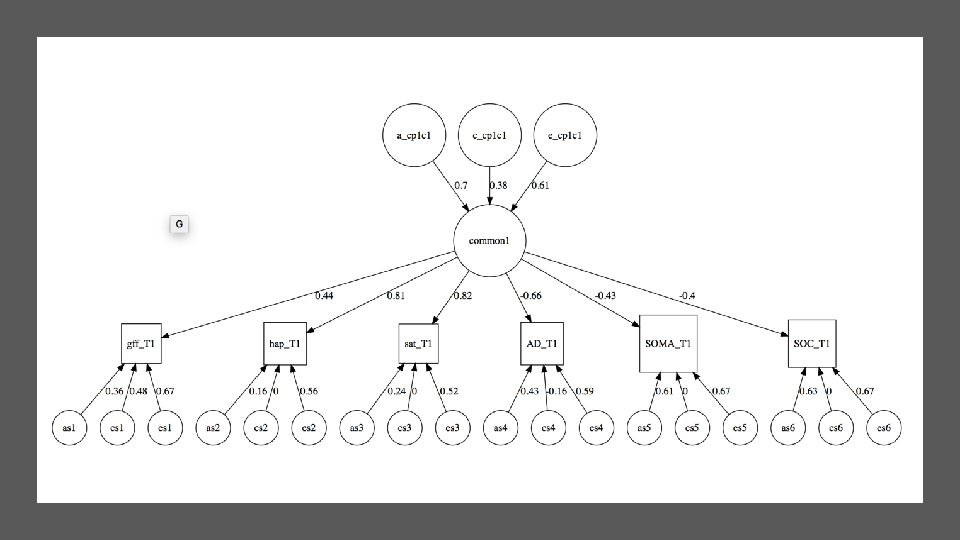
CP Model: Latent common trait + ACE Specifics
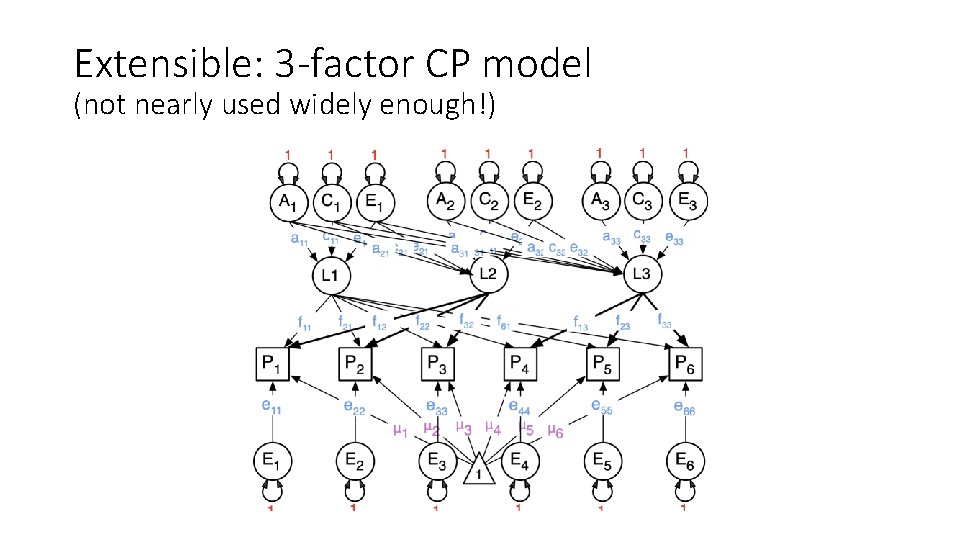
Extensible: 3 -factor CP model (not nearly used widely enough!)
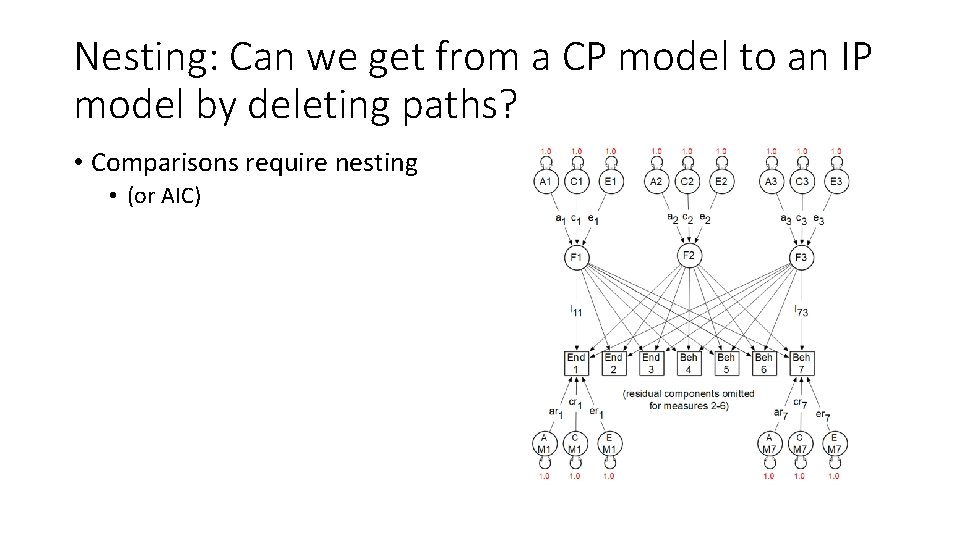
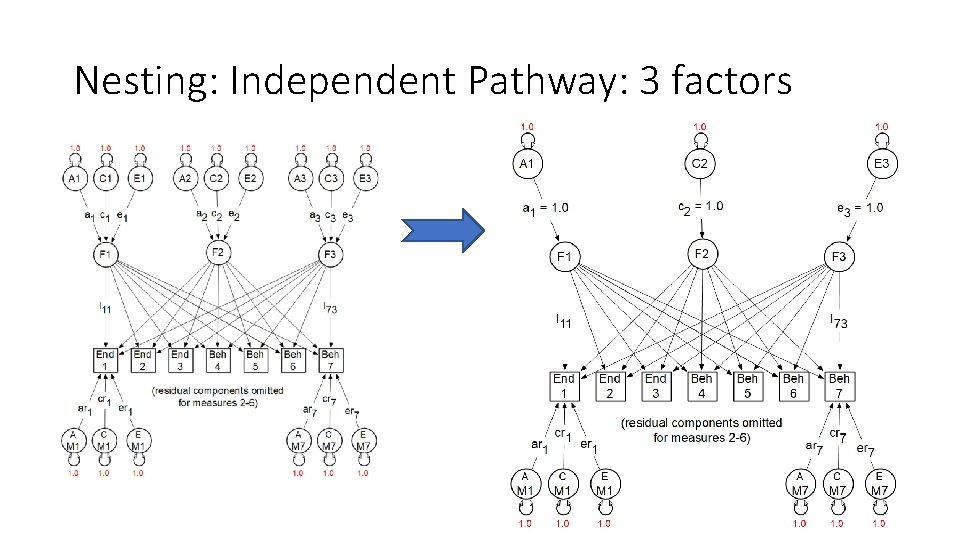
Nesting: Can we get from a CP model to an IP model by deleting paths? • Comparisons require nesting • (or AIC)
Nesting: Independent Pathway: 3 factors
umx. CP & umx. IP practical Timothy C. Bates
Theoretical models of phenotypes
Open. Mx note • Some problems are solved more readily by some optimizers than others. • In this case, SLSQP is often better than CSOLNP • umx_set_optimizer("SLSQP")
umx. CP parameters • umx. CP(name= "CP", sel. DVs, dz. Data, mz. Data, sep, n. Fac = 1) • Other parameters: • free. Lower. A = FALSE, free. Lower. C = FALSE, free. Lower. E = FALSE, correlated. A = FALSE, equate. Means = TRUE, dz. Ar = 0. 5, dz. Cr = 1, add. Std = T, add. CI = TRUE, auto. Run = get. Option("umx_auto_run"), optimizer = NULL
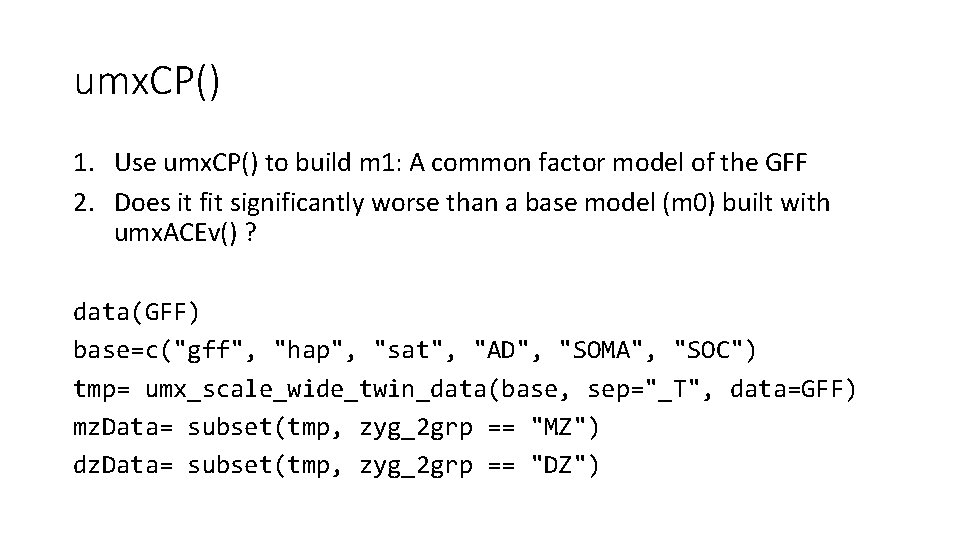
umx. CP() 1. Use umx. CP() to build m 1: A common factor model of the GFF 2. Does it fit significantly worse than a base model (m 0) built with umx. ACEv() ? data(GFF) base=c("gff", "hap", "sat", "AD", "SOMA", "SOC") tmp= umx_scale_wide_twin_data(base, sep="_T", data=GFF) mz. Data= subset(tmp, zyg_2 grp == "MZ") dz. Data= subset(tmp, zyg_2 grp == "DZ")
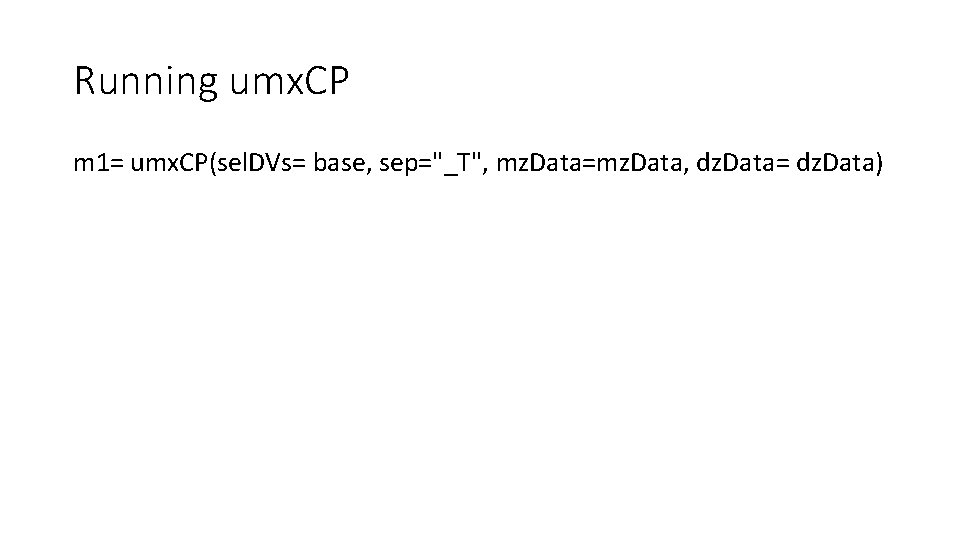
Running umx. CP m 1= umx. CP(sel. DVs= base, sep="_T", mz. Data=mz. Data, dz. Data= dz. Data)
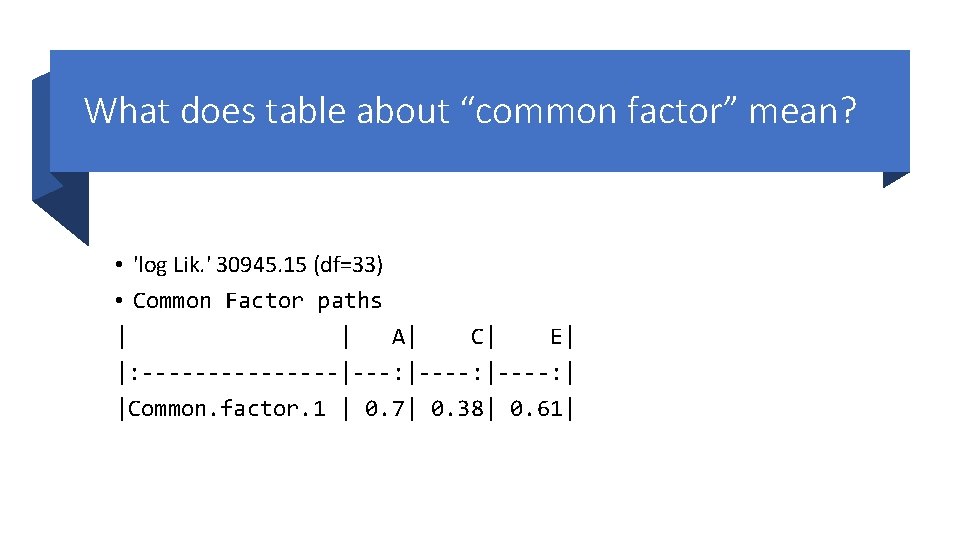
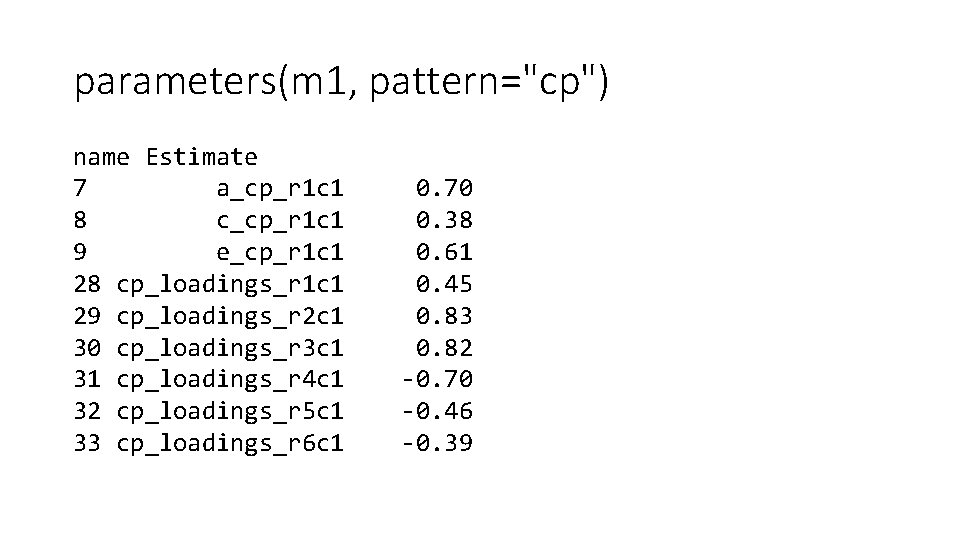
What does table about “common factor” mean? • 'log Lik. ' 30945. 15 (df=33) • Common Factor paths | | A| C| E| |: --------|---: |----: | |Common. factor. 1 | 0. 7| 0. 38| 0. 61|
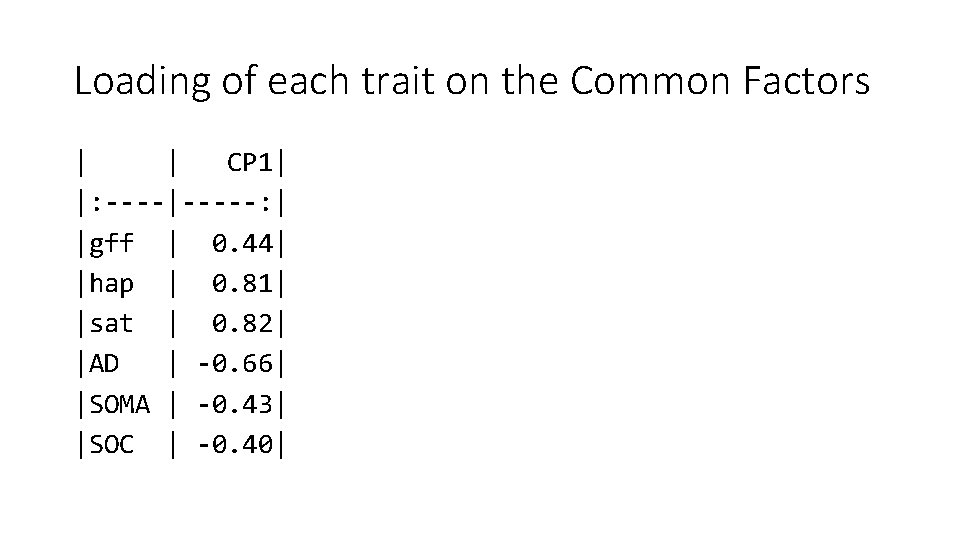
Loading of each trait on the Common Factors | | CP 1| |: ----|-----: | |gff | 0. 44| |hap | 0. 81| |sat | 0. 82| |AD | -0. 66| |SOMA | -0. 43| |SOC | -0. 40|
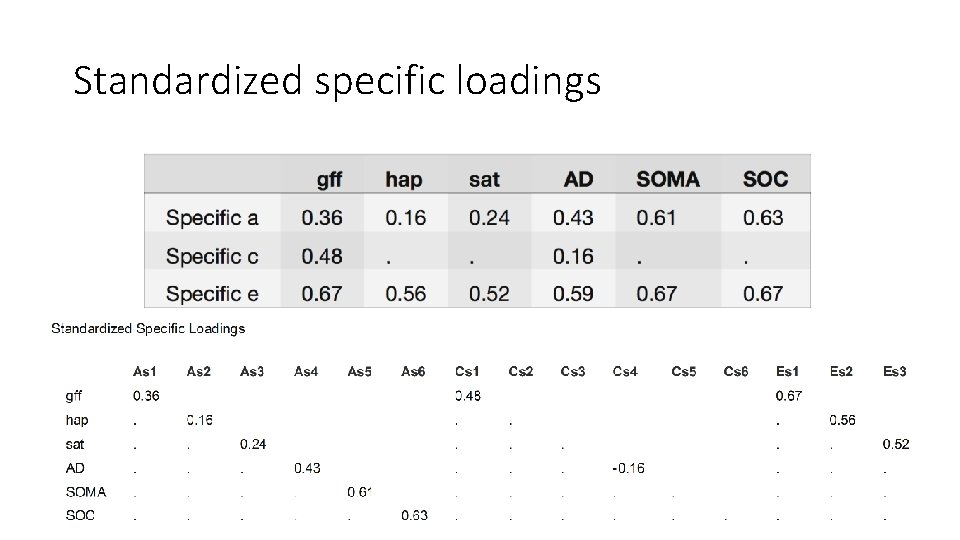
Standardized specific loadings
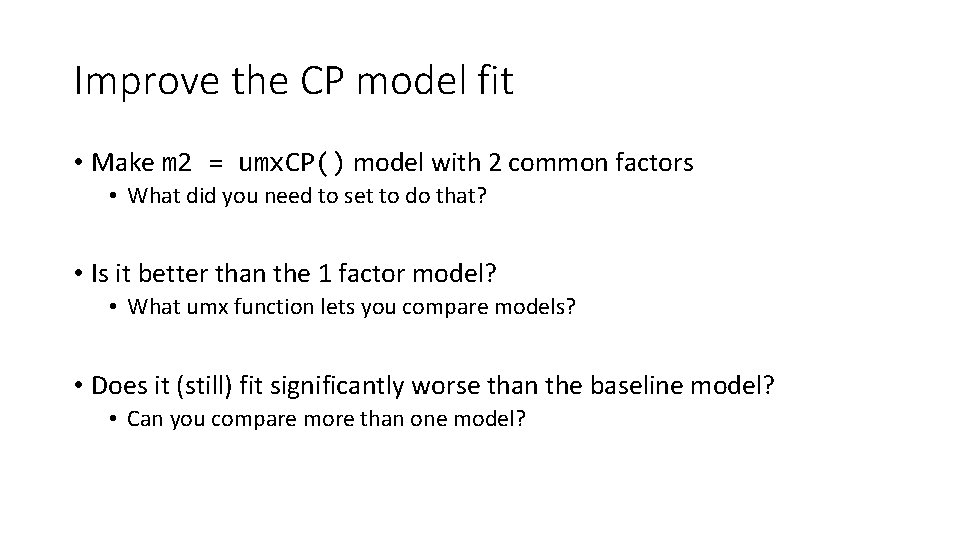
Improve the CP model fit • Make m 2 = umx. CP() model with 2 common factors • What did you need to set to do that? • Is it better than the 1 factor model? • What umx function lets you compare models? • Does it (still) fit significantly worse than the baseline model? • Can you compare more than one model?
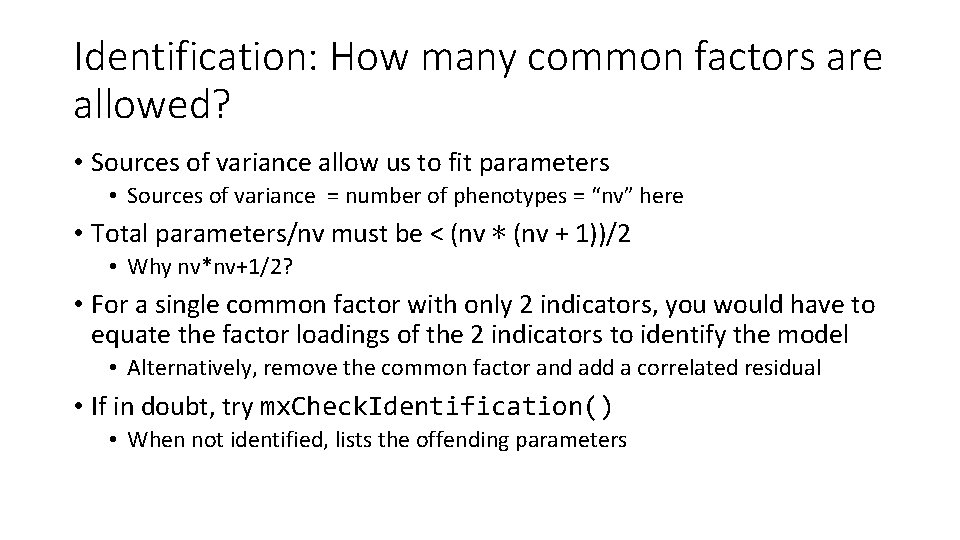
Identification: How many common factors are allowed? • Sources of variance allow us to fit parameters • Sources of variance = number of phenotypes = “nv” here • Total parameters/nv must be < (nv ∗ (nv + 1))/2 • Why nv*nv+1/2? • For a single common factor with only 2 indicators, you would have to equate the factor loadings of the 2 indicators to identify the model • Alternatively, remove the common factor and add a correlated residual • If in doubt, try mx. Check. Identification() • When not identified, lists the offending parameters
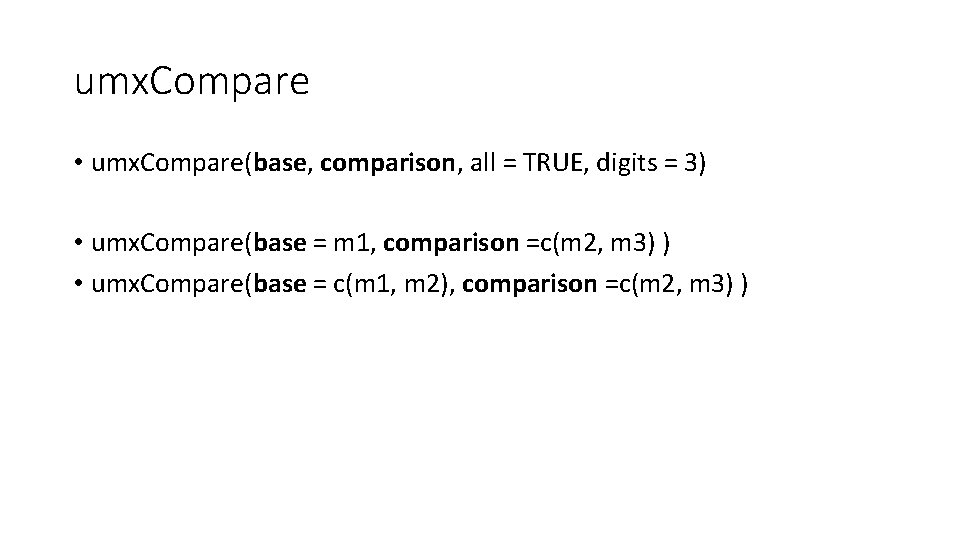
umx. Compare • umx. Compare(base, comparison, all = TRUE, digits = 3) • umx. Compare(base = m 1, comparison =c(m 2, m 3) ) • umx. Compare(base = c(m 1, m 2), comparison =c(m 2, m 3) )
Questions • Is a better AIC higher or lower? • Is AIC -2432 or -1980 to be preferred?
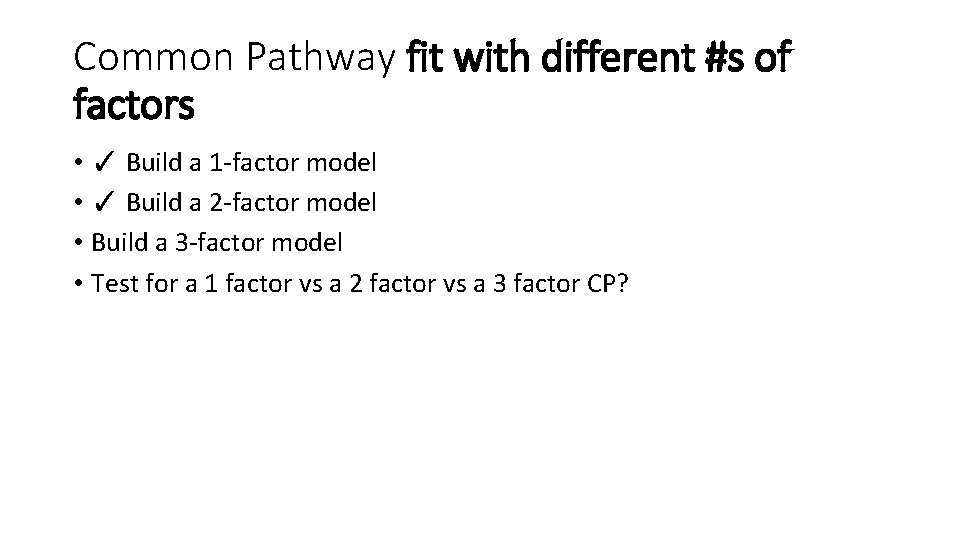
Common Pathway fit with different #s of factors • ✓ Build a 1 -factor model • ✓ Build a 2 -factor model • Build a 3 -factor model • Test for a 1 factor vs a 2 factor vs a 3 factor CP?
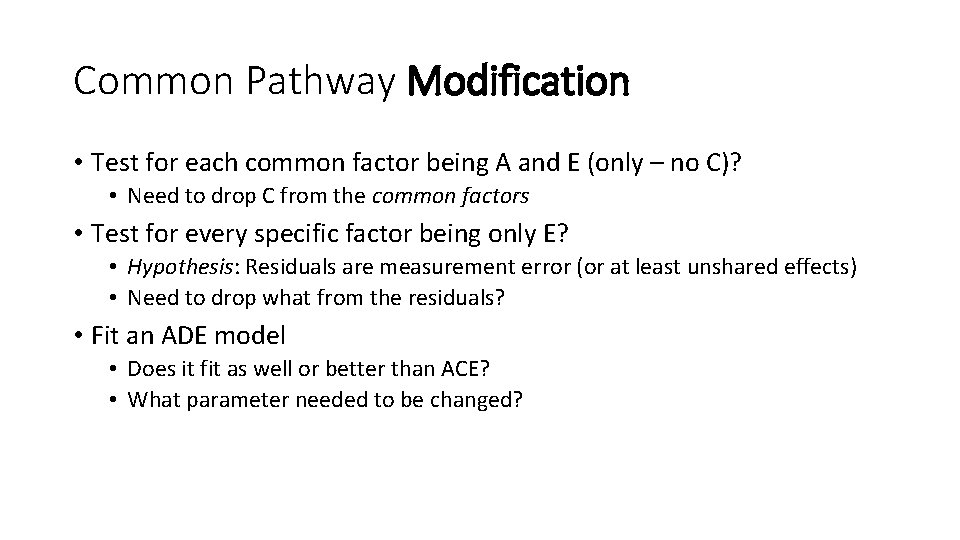
Common Pathway Modification • Test for each common factor being A and E (only – no C)? • Need to drop C from the common factors • Test for every specific factor being only E? • Hypothesis: Residuals are measurement error (or at least unshared effects) • Need to drop what from the residuals? • Fit an ADE model • Does it fit as well or better than ACE? • What parameter needed to be changed?
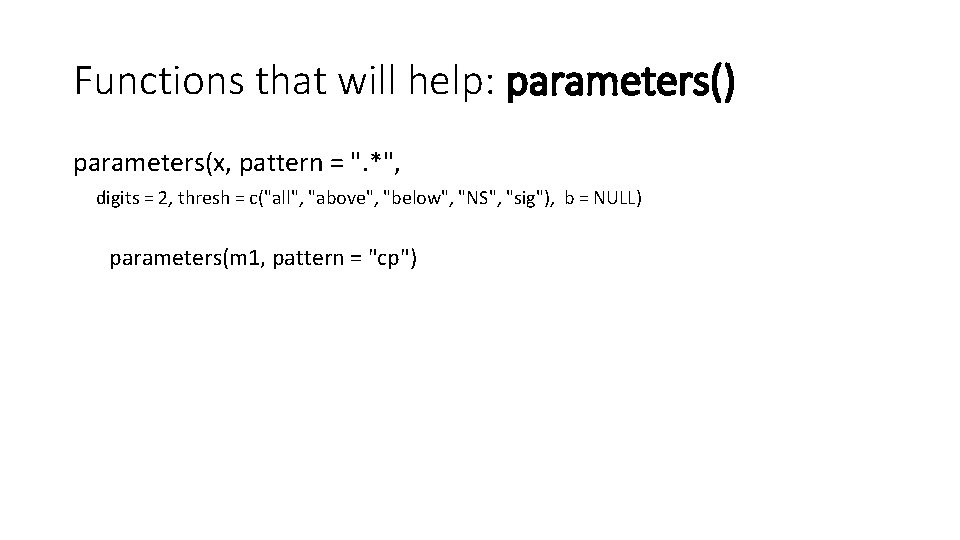
Functions that will help: parameters() parameters(x, pattern = ". *", digits = 2, thresh = c("all", "above", "below", "NS", "sig"), b = NULL) parameters(m 1, pattern = "cp")
parameters(m 1, pattern="cp") name Estimate 7 a_cp_r 1 c 1 8 c_cp_r 1 c 1 9 e_cp_r 1 c 1 28 cp_loadings_r 1 c 1 29 cp_loadings_r 2 c 1 30 cp_loadings_r 3 c 1 31 cp_loadings_r 4 c 1 32 cp_loadings_r 5 c 1 33 cp_loadings_r 6 c 1 0. 70 0. 38 0. 61 0. 45 0. 83 0. 82 -0. 70 -0. 46 -0. 39
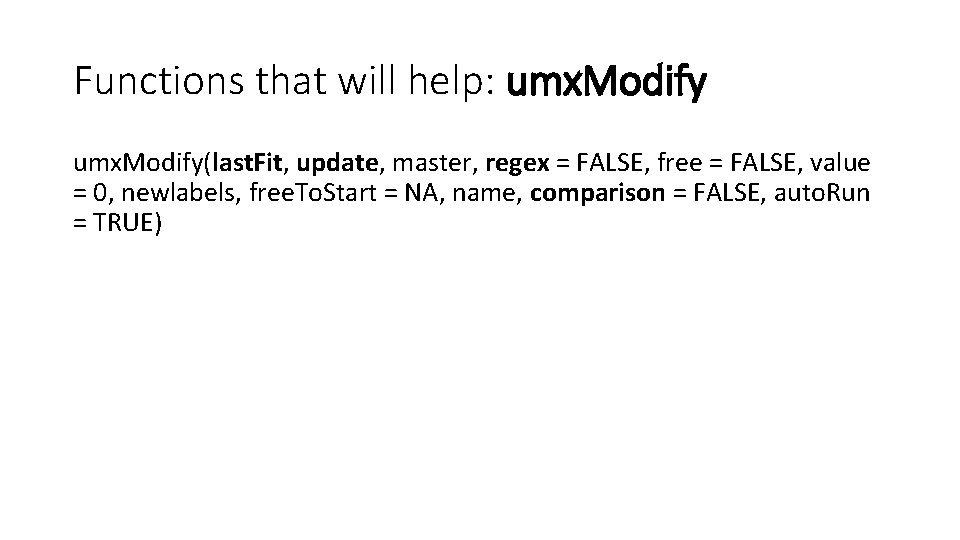
Functions that will help: umx. Modify(last. Fit, update, master, regex = FALSE, free = FALSE, value = 0, newlabels, free. To. Start = NA, name, comparison = FALSE, auto. Run = TRUE)
Common Pathway Modification • Test for each common factor being A and C (only – no E)? • Need to drop E from the common factors
Common Pathway Modification • Test for every specific factor being only E? • Hypothesis: The residuals are measurement error (or at least unshared effects) • Need to drop what from the residuals?
Common Pathway Modification • Fit an ADE model • What parameter needed to be changed? • Does it fit as well or better than ACE?
Common Pathway Modification: AP (advanced placement question) • A friend thinks common environment determines one common factor, while the others are a mixture of A and C • Can you test her hypothesis?
Same again for umx. IP (independent pathway) • Build a 1 factor IP model • ip 1 = umx. IP() • Compare a 1 factor vs a 2 factor vs a 3 factor IP? • Test for each A influence having the same loading? • What does that imply? • Can you test for every specific factor being only E? • Can you fit an ADE model with umx. IP?