
Multivariate deprivation indicator example calculation of Townsend index

- Slides: 9
Multivariate deprivation indicator example: calculation of Townsend index Click to Continue
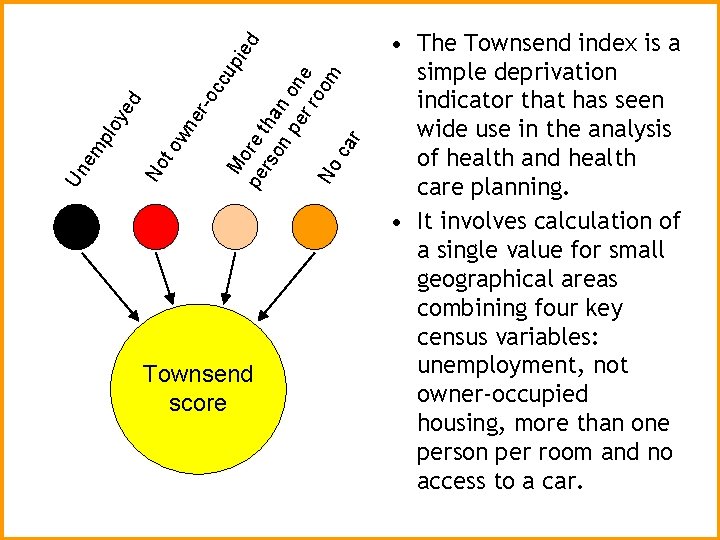
Mo ied pe re rso tha np no er ne ro om No ca r cc up wn er -o to d ye plo Un em No Townsend score • The Townsend index is a simple deprivation indicator that has seen wide use in the analysis of health and health care planning. • It involves calculation of a single value for small geographical areas combining four key census variables: unemployment, not owner-occupied housing, more than one person per room and no access to a car.
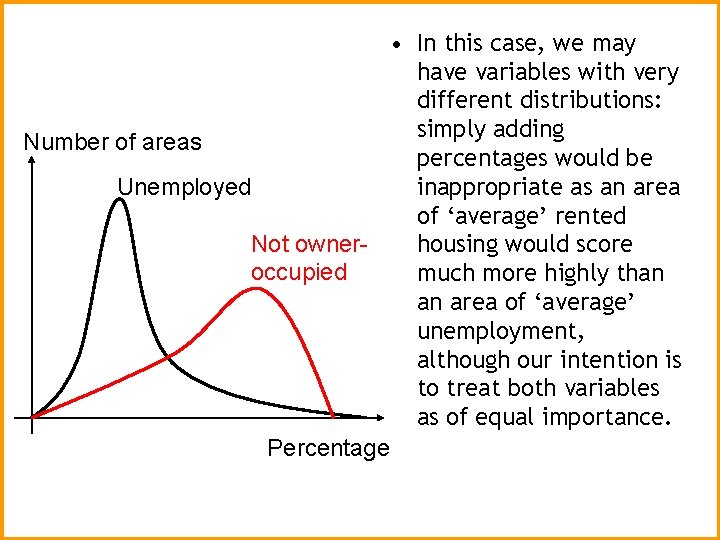
• In this case, we may have variables with very different distributions: simply adding Number of areas percentages would be inappropriate as an area Unemployed of ‘average’ rented Not ownerhousing would score occupied much more highly than an area of ‘average’ unemployment, although our intention is to treat both variables as of equal importance. Percentage
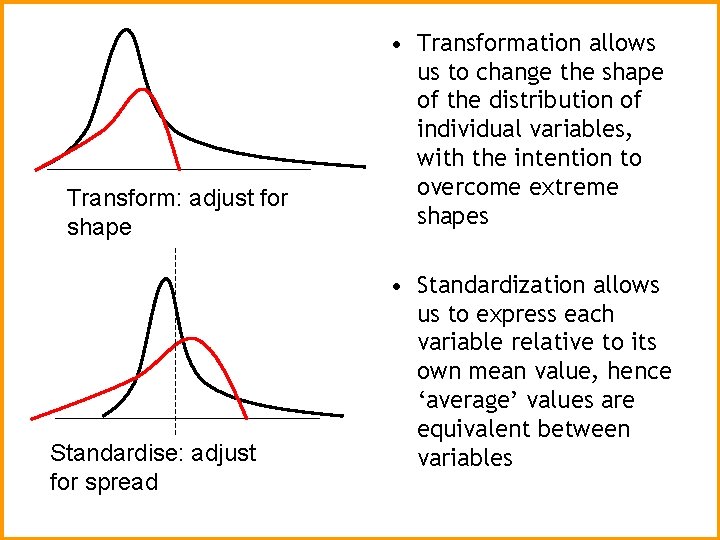
Transform: adjust for shape Standardise: adjust for spread • Transformation allows us to change the shape of the distribution of individual variables, with the intention to overcome extreme shapes • Standardization allows us to express each variable relative to its own mean value, hence ‘average’ values are equivalent between variables
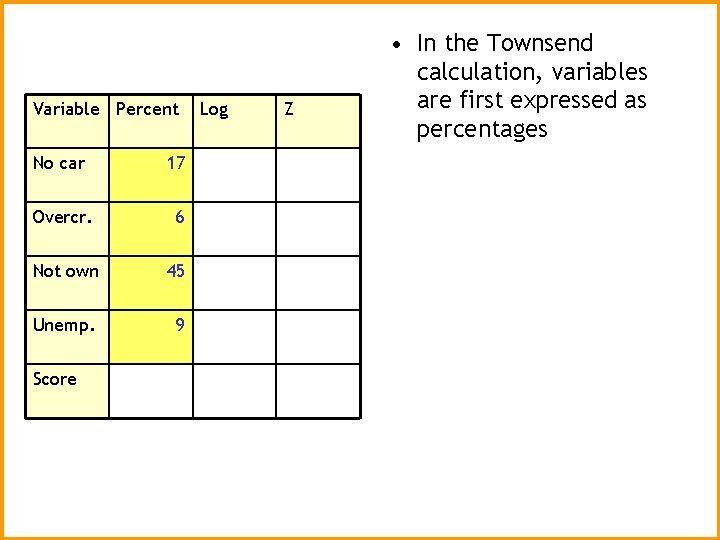
Variable Percent No car 17 Overcr. 6 Not own 45 Unemp. 9 Score Log Z • In the Townsend calculation, variables are first expressed as percentages
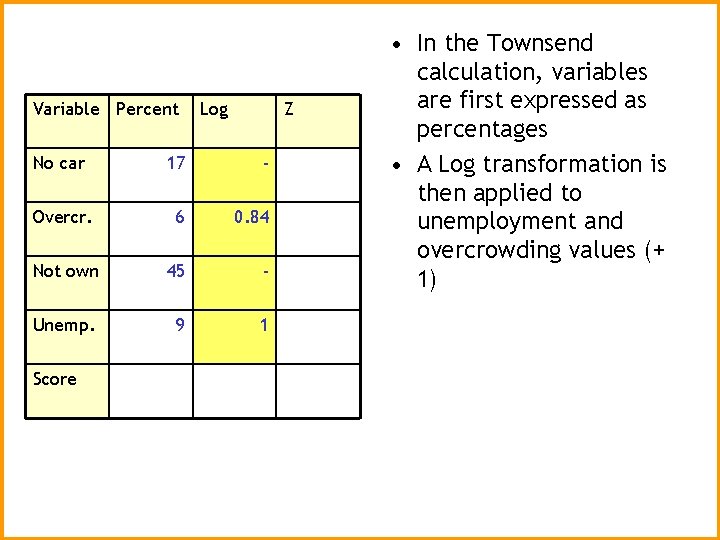
Variable Percent Log Z No car 17 - Overcr. 6 0. 84 Not own 45 - Unemp. 9 1 Score • In the Townsend calculation, variables are first expressed as percentages • A Log transformation is then applied to unemployment and overcrowding values (+ 1)
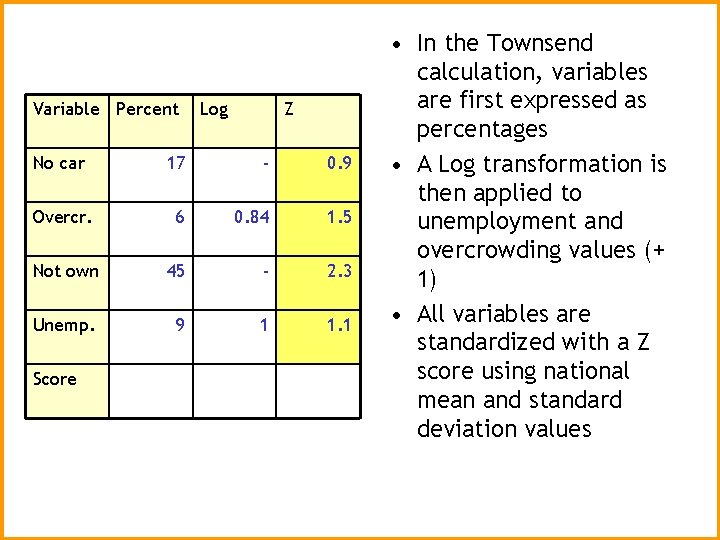
Variable Percent Log Z No car 17 - 0. 9 Overcr. 6 0. 84 1. 5 Not own 45 - 2. 3 Unemp. 9 1 1. 1 Score • In the Townsend calculation, variables are first expressed as percentages • A Log transformation is then applied to unemployment and overcrowding values (+ 1) • All variables are standardized with a Z score using national mean and standard deviation values
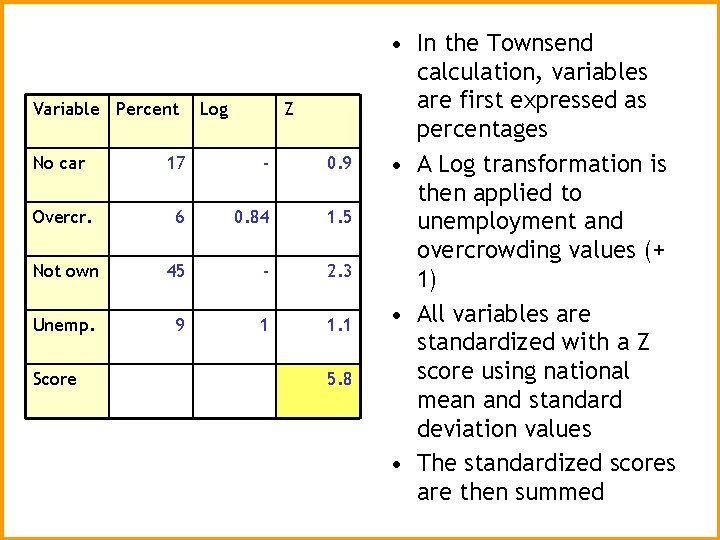
Variable Percent Log Z No car 17 - 0. 9 Overcr. 6 0. 84 1. 5 Not own 45 - 2. 3 Unemp. 9 1 1. 1 Score 5. 8 • In the Townsend calculation, variables are first expressed as percentages • A Log transformation is then applied to unemployment and overcrowding values (+ 1) • All variables are standardized with a Z score using national mean and standard deviation values • The standardized scores are then summed
End of Presentation Scroll down the page to continue