
Multivariate Data Analysis Chapter 6 Multivariate Analysis of

- Slides: 14
Multivariate Data Analysis Chapter 6 – Multivariate Analysis of Variance
What Is Multivariate Analysis of Variance (MANOVA)? n Univariate Procedures For Assessing Group Differences n n n The t Test Analysis of Variance (ANOVA) Multivariate Analysis of Variance (MANOVA) n n The Two-Group Case: Hotelling's T 2 The k-Group Case: MANOVA
Chapter 6 n n n Differences Between MANOVA and Discriminant Analysis A Hypothetical Illustration of MANOVA When Should We Use MANOVA? n n Control of Experimentwide Error Rate Differences Among A Combination of Dependent Variables
A Decision Process for MANOVA n Stage 1: Objectives of MANOVA n Types of Multivariate Questions Suitable for MANOVA n n Multiple Univariate Questions Structured Multivariate Questions Intrinsically Multivariate Questions Selecting the Dependent Measures
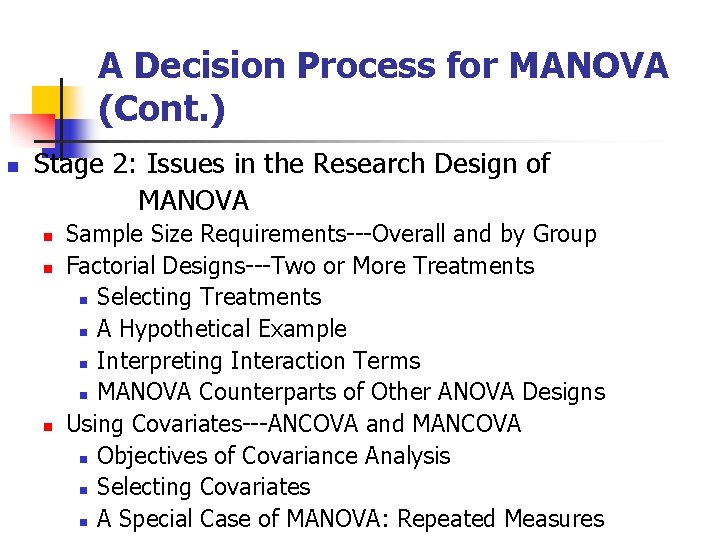
A Decision Process for MANOVA (Cont. ) n Stage 2: Issues in the Research Design of MANOVA n n n Sample Size Requirements---Overall and by Group Factorial Designs---Two or More Treatments n Selecting Treatments n A Hypothetical Example n Interpreting Interaction Terms n MANOVA Counterparts of Other ANOVA Designs Using Covariates---ANCOVA and MANCOVA n Objectives of Covariance Analysis n Selecting Covariates n A Special Case of MANOVA: Repeated Measures
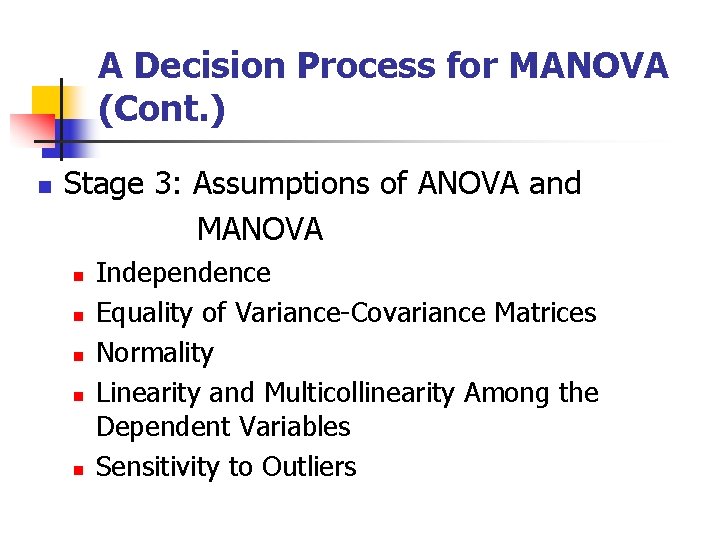
A Decision Process for MANOVA (Cont. ) n Stage 3: Assumptions of ANOVA and MANOVA n n n Independence Equality of Variance-Covariance Matrices Normality Linearity and Multicollinearity Among the Dependent Variables Sensitivity to Outliers
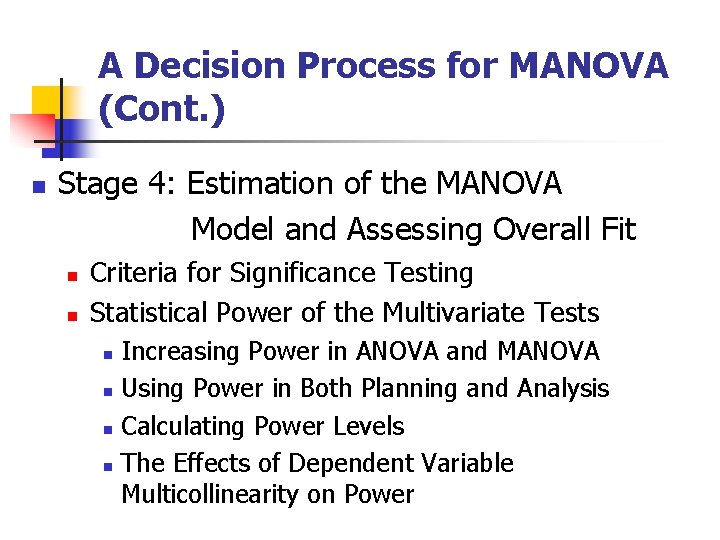
A Decision Process for MANOVA (Cont. ) n Stage 4: Estimation of the MANOVA Model and Assessing Overall Fit n n Criteria for Significance Testing Statistical Power of the Multivariate Tests n n Increasing Power in ANOVA and MANOVA Using Power in Both Planning and Analysis Calculating Power Levels The Effects of Dependent Variable Multicollinearity on Power
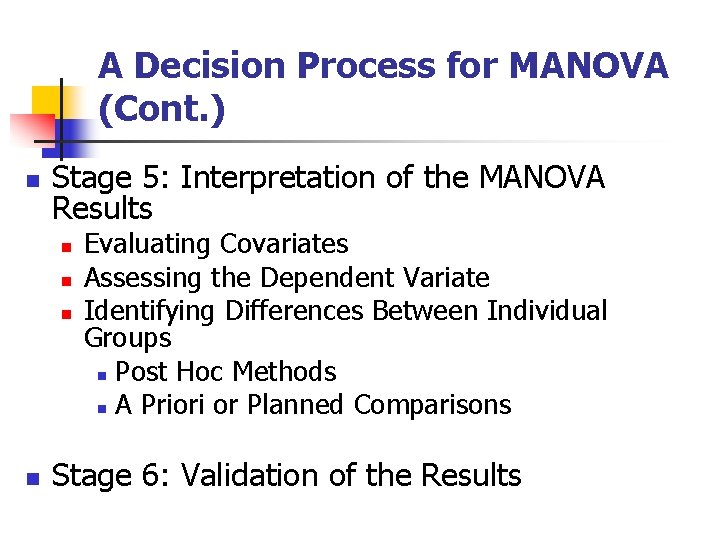
A Decision Process for MANOVA (Cont. ) n Stage 5: Interpretation of the MANOVA Results n n Evaluating Covariates Assessing the Dependent Variate Identifying Differences Between Individual Groups n Post Hoc Methods n A Priori or Planned Comparisons Stage 6: Validation of the Results
Example 1: Difference Between Two Independent Groups n A Univariate Approach: The t Test n n n Stage 1: 2: 3: 4: Objectives of the Analysis Research Design of the ANOVA Assumptions in ANOVA Estimation of the ANOVA Model and Assessing Overall Fit Stage 5: Interpretation of the Results
Example 1: Difference Between Two Independent Groups (Cont. ) n A Multivariate Approach: Hotelling's T 2 n n n Stage 1: 2: 3: 4: Objectives of the MANOVA Research Design of MANOVA Assumptions in MANOVA Estimation of the MANOVA Model and Assessing Overall Fit Stage 5: Interpretation of the Results
Example 2: Difference Between k Independent Groups n A Univariate Approach: k-Groups ANOVA n n n Stage 1: 2: 3: 4: Objectives of the ANOVA Research Design of ANOVA Assumptions in ANOVA Estimation of the ANOVA Model and Assessing Overall Fit Stage 5: Interpretation of the Results
Example 2: Difference Between k Independent Groups (Cont. ) n A Multivariate Approach: k-Groups MANOVA n n n Stage 1: 2: 3: 4: Objectives of the MANOVA Research Design of the MANOVA Assumptions in MANOVA Estimation of the MANOVA Model and Assessing Overall Fit Stage 5: Interpretation of the Results
Example 3: A Factorial Design for MANOVA with Two Independent Variables n n n Stage 1: 2: 3: 4: Objectives of the MANOVA Research Design of the MANOVA Assumptions in MANOVA Estimation of the MANOVA Model and Assessing Overall Fit Stage 5: Interpretation of the Results
Your Assignment