
Multivalent Metal Compounds Many metals are MULTIVALENT meaning
- Slides: 5
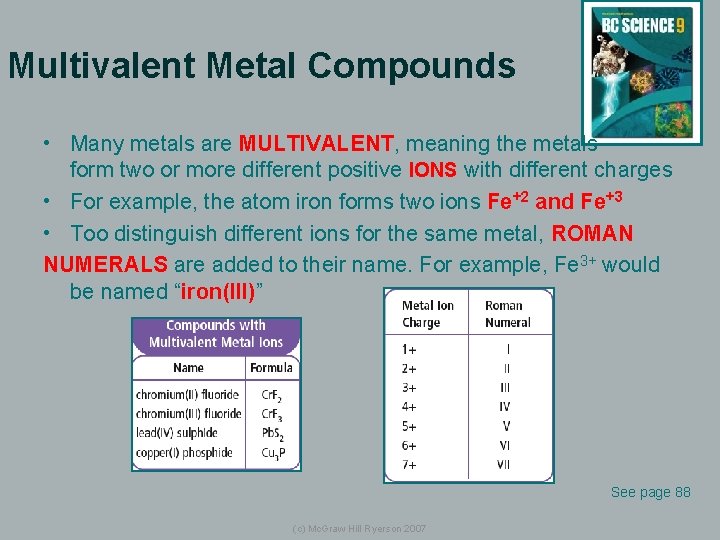
Multivalent Metal Compounds • Many metals are MULTIVALENT, meaning the metals form two or more different positive IONS with different charges • For example, the atom iron forms two ions Fe+2 and Fe+3 • Too distinguish different ions for the same metal, ROMAN NUMERALS are added to their name. For example, Fe 3+ would be named “iron(III)” See page 88 (c) Mc. Graw Hill Ryerson 2007
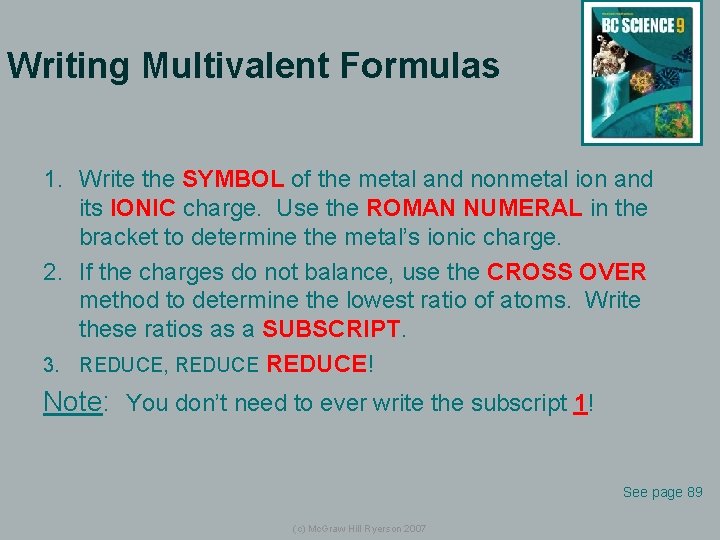
Writing Multivalent Formulas 1. Write the SYMBOL of the metal and nonmetal ion and its IONIC charge. Use the ROMAN NUMERAL in the bracket to determine the metal’s ionic charge. 2. If the charges do not balance, use the CROSS OVER method to determine the lowest ratio of atoms. Write these ratios as a SUBSCRIPT. 3. REDUCE, REDUCE! Note: You don’t need to ever write the subscript 1! See page 89 (c) Mc. Graw Hill Ryerson 2007
Ex: Writing Formulas for Multivalent Metals • EX #1: Iron (III) chloride • EX #2: Gold (III) phosphide • EX #3: Lead (IV) oxide (c) Mc. Graw Hill Ryerson 2007
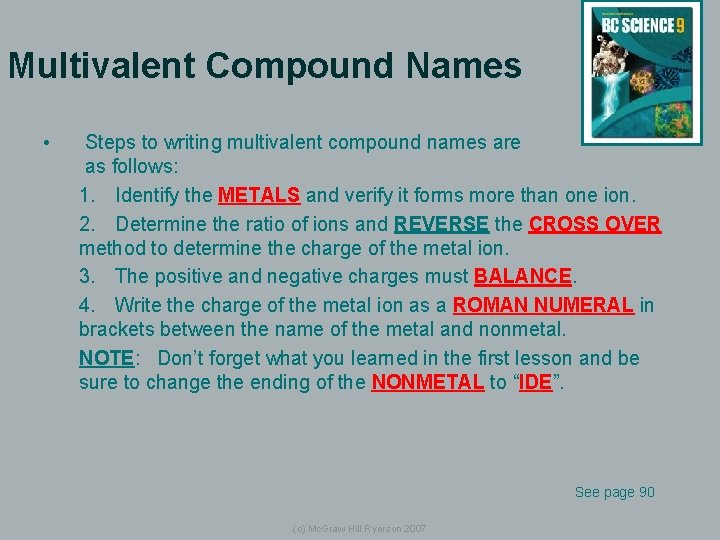
Multivalent Compound Names • Steps to writing multivalent compound names are as follows: 1. Identify the METALS and verify it forms more than one ion. 2. Determine the ratio of ions and REVERSE the CROSS OVER method to determine the charge of the metal ion. 3. The positive and negative charges must BALANCE. 4. Write the charge of the metal ion as a ROMAN NUMERAL in brackets between the name of the metal and nonmetal. NOTE: Don’t forget what you learned in the first lesson and be sure to change the ending of the NONMETAL to “IDE”. See page 90 (c) Mc. Graw Hill Ryerson 2007
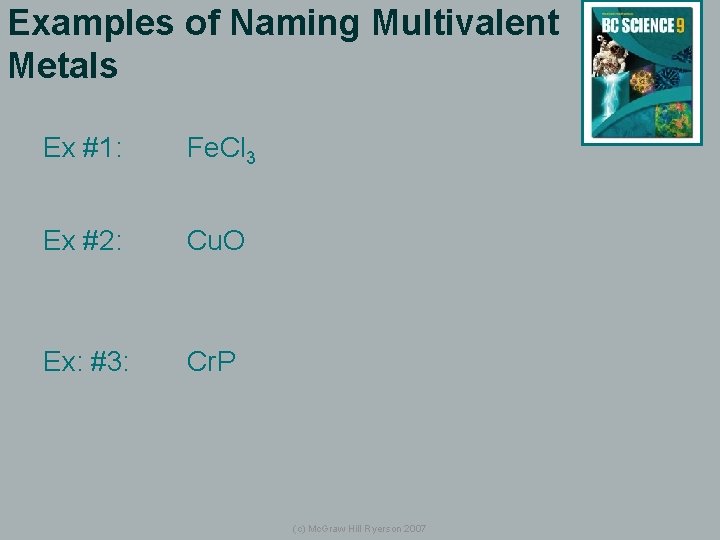
Examples of Naming Multivalent Metals Ex #1: Fe. Cl 3 Ex #2: Cu. O Ex: #3: Cr. P (c) Mc. Graw Hill Ryerson 2007