
MultiTiered System of Supports MTSS 101 Christy Berger
Multi-Tiered System of Supports (MTSS) 101 Christy Berger, Assistant Director of Social, Emotional, and Behavioral Wellness Sarah Larrison, Special Education Specialist @Educate. IN

MTSS Fact or Fib? MTSS addresses only students’ academic performance. T C A F @Educate. IN OR FIB
MTSS Fact or Fib? MTSS puts a greater emphasis on prevention than intervention. T C A F @Educate. IN OR FIB
MTSS Fact or Fib? Providing EL or special education accommodations to students is an example of a Tier 2 intervention. T C A F @Educate. IN OR FIB
MTSS Fact or Fib? MTSS is something students must go through to delay evaluation for special education. T C A F @Educate. IN OR FIB
MTSS Fact or Fib? Progress should be monitored frequently - at least monthly, but ideally weekly or biweekly. T C A F @Educate. IN OR FIB
MTSS Fact or Fib? Students must be referred to participate in MTSS. T C A F @Educate. IN OR FIB
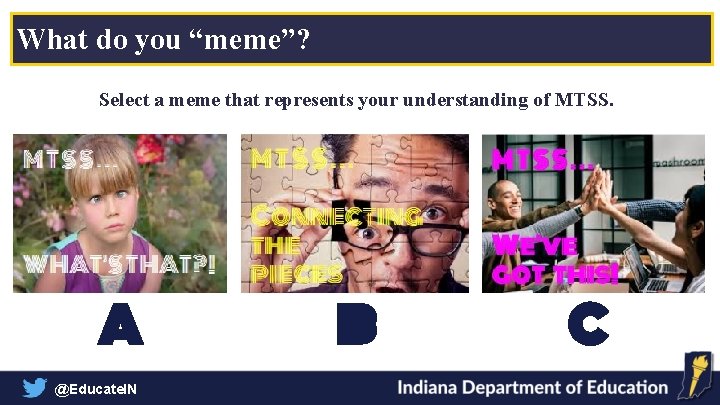
What do you “meme”? Select a meme that represents your understanding of MTSS. A @Educate. IN B C
MTSS Learning Objectives ★ Explore the Indiana Department of Education’s selection of MTSS as the primary structure for teaching and learning. ★ Increase foundational knowledge of MTSS. ★ Recognize the Indiana Department of Education’s supports for MTSS. ★ Understand potential applications of the MTSS framework in the school environment. @Educate. IN
Dr. Mc. Cormick - MTSS Introduction @Educate. IN
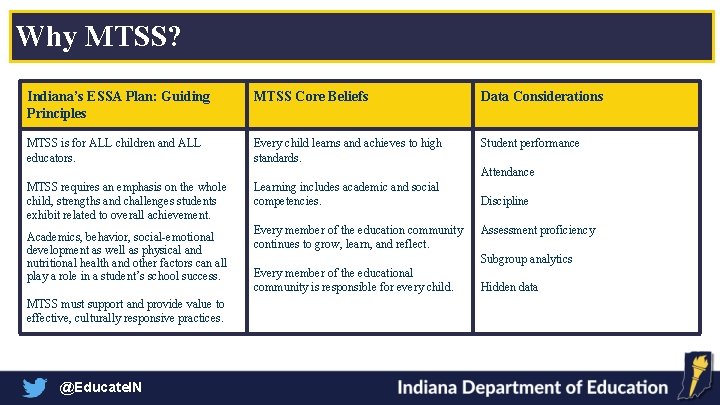
Why MTSS? Indiana’s ESSA Plan: Guiding Principles MTSS Core Beliefs Data Considerations MTSS is for ALL children and ALL educators. Every child learns and achieves to high standards. Student performance MTSS requires an emphasis on the whole child, strengths and challenges students exhibit related to overall achievement. Learning includes academic and social competencies. Attendance Academics, behavior, social-emotional development as well as physical and nutritional health and other factors can all play a role in a student’s school success. MTSS must support and provide value to effective, culturally responsive practices. @Educate. IN Every member of the education community continues to grow, learn, and reflect. Discipline Assessment proficiency Subgroup analytics Every member of the educational community is responsible for every child. Hidden data
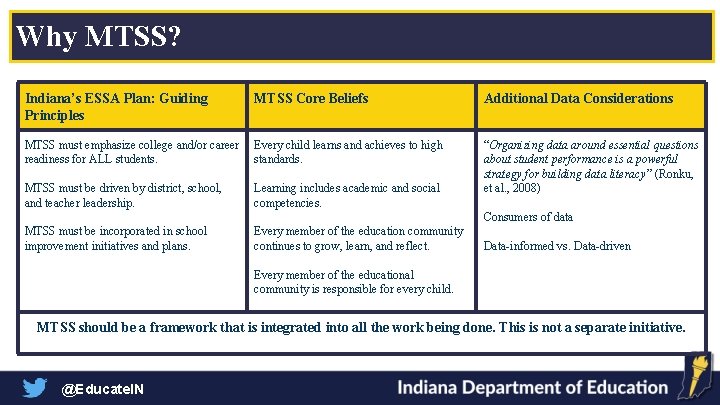
Why MTSS? Indiana’s ESSA Plan: Guiding Principles MTSS Core Beliefs Additional Data Considerations MTSS must emphasize college and/or career readiness for ALL students. Every child learns and achieves to high standards. MTSS must be driven by district, school, and teacher leadership. Learning includes academic and social competencies. “Organizing data around essential questions about student performance is a powerful strategy for building data literacy” (Ronku, et al. , 2008) MTSS must be incorporated in school improvement initiatives and plans. Every member of the education community continues to grow, learn, and reflect. Consumers of data Data-informed vs. Data-driven Every member of the educational community is responsible for every child. MTSS should be a framework that is integrated into all the work being done. This is not a separate initiative. @Educate. IN
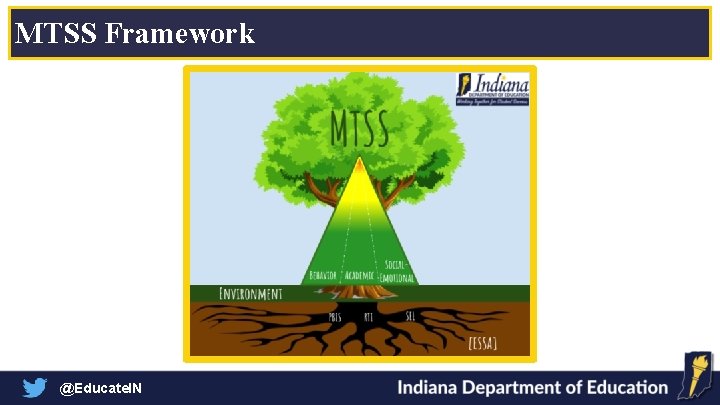
MTSS Framework @Educate. IN
Equity-Based Inclusive Education ● ● ● A school-wide approach to inclusive education, Allocation of resources, Driven by MTSS, Utilizing UDL, Guided by district and school design teams, and Implemented in a manner resulting in gains for all students. @Educate. IN
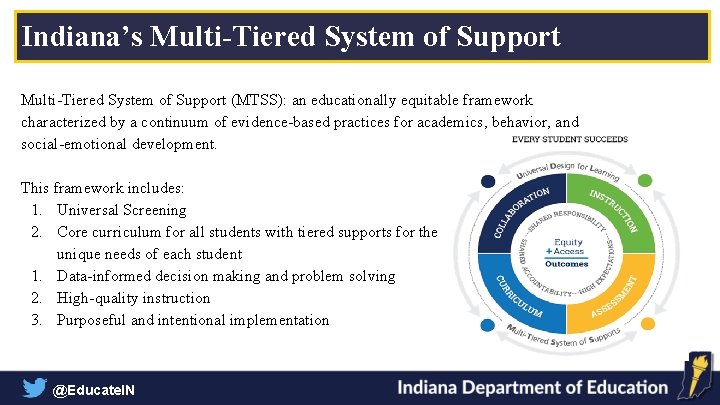
Indiana’s Multi-Tiered System of Support (MTSS): an educationally equitable framework characterized by a continuum of evidence-based practices for academics, behavior, and social-emotional development. This framework includes: 1. Universal Screening 2. Core curriculum for all students with tiered supports for the unique needs of each student 1. Data-informed decision making and problem solving 2. High-quality instruction 3. Purposeful and intentional implementation @Educate. IN
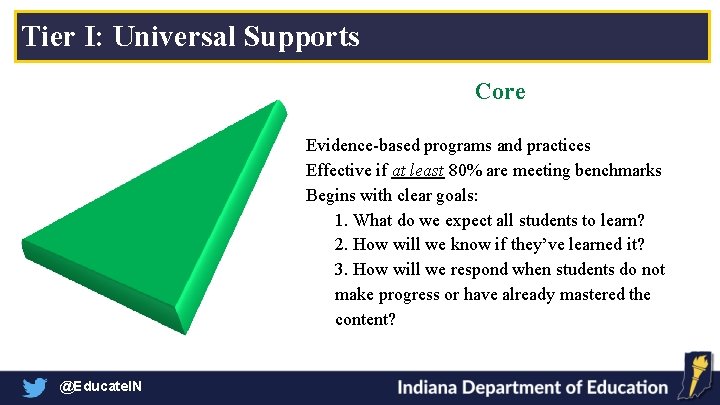
Tier I: Universal Supports Core • Evidence-based programs and practices • Effective if at least 80% are meeting benchmarks • Begins with clear goals: 1. What do we expect all students to learn? 2. How will we know if they’ve learned it? 3. How will we respond when students do not make progress or have already mastered the content? @Educate. IN
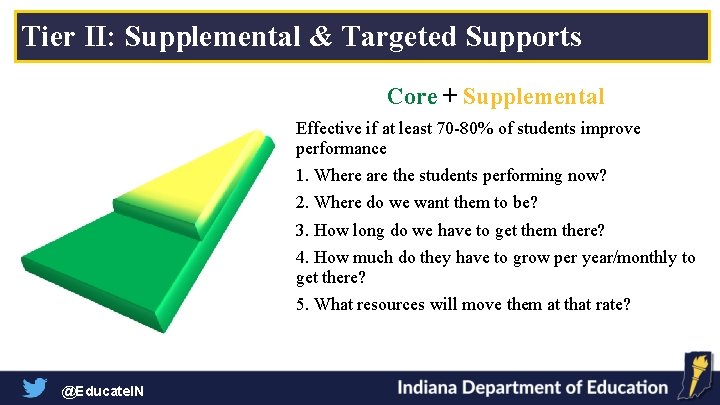
Tier II: Supplemental & Targeted Supports Core + Supplemental Effective if at least 70 -80% of students improve performance 1. Where are the students performing now? 2. Where do we want them to be? 3. How long do we have to get them there? 4. How much do they have to grow per year/monthly to get there? 5. What resources will move them at that rate? @Educate. IN
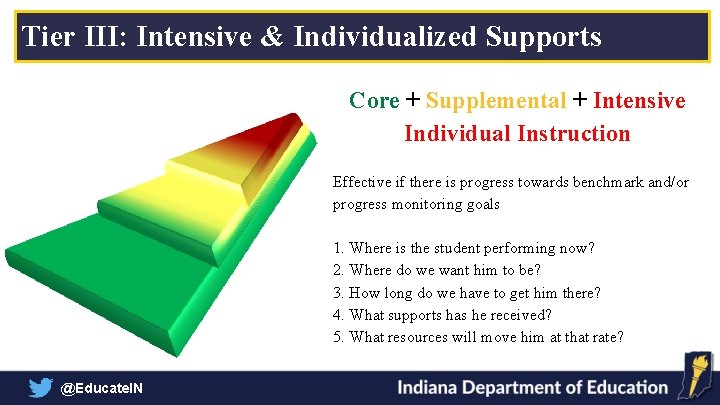
Tier III: Intensive & Individualized Supports Core + Supplemental + Intensive Individual Instruction Effective if there is progress towards benchmark and/or progress monitoring goals 1. Where is the student performing now? 2. Where do we want him to be? 3. How long do we have to get him there? 4. What supports has he received? 5. What resources will move him at that rate? @Educate. IN

Equity-Based Inclusive Practices @Educate. IN
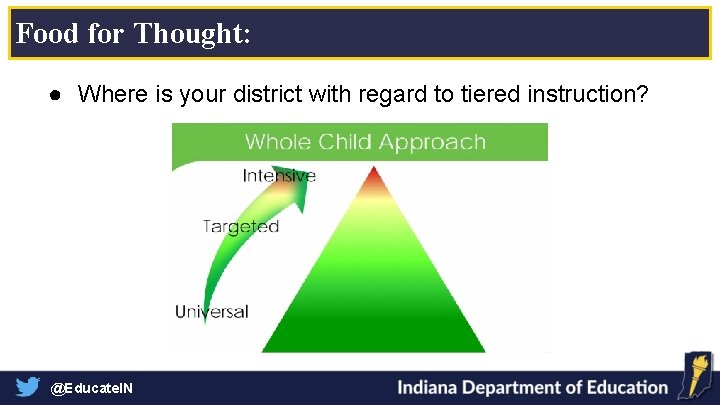
Food for Thought: ● Where is your district with regard to tiered instruction? @Educate. IN
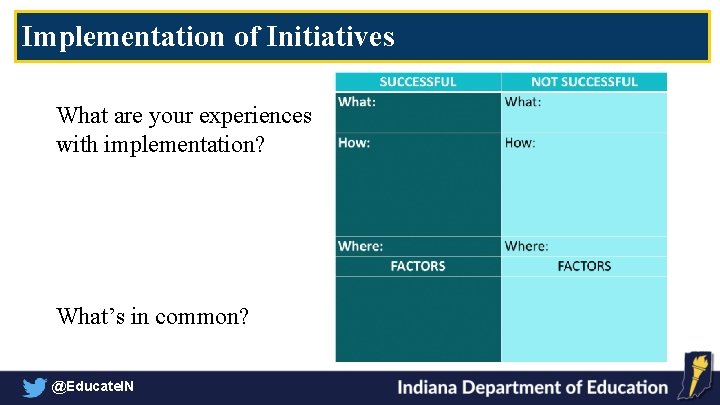
Implementation of Initiatives What are your experiences with implementation? What’s in common? @Educate. IN
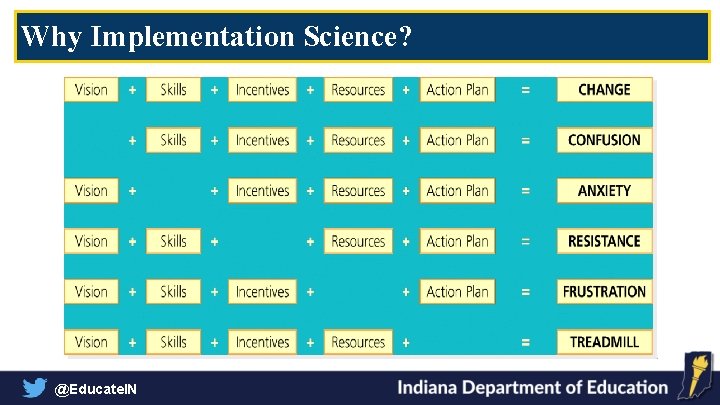
Why Implementation Science? @Educate. IN
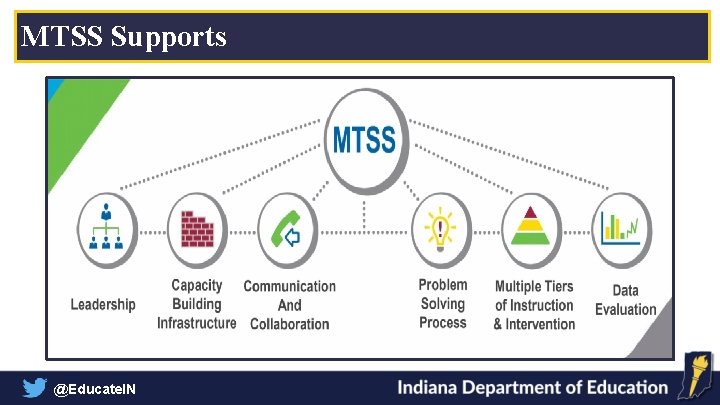
MTSS Supports @Educate. IN
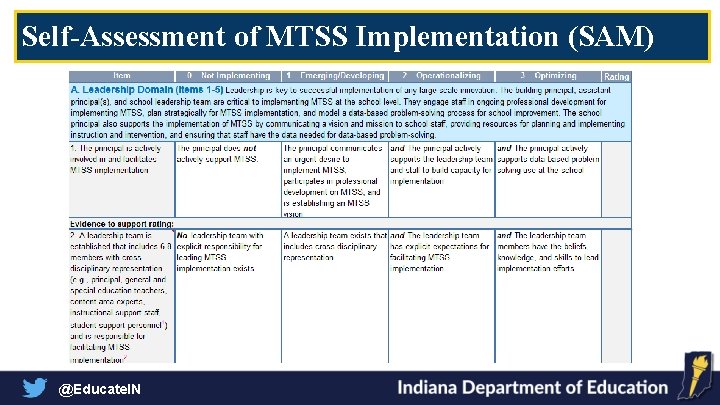
Self-Assessment of MTSS Implementation (SAM) @Educate. IN
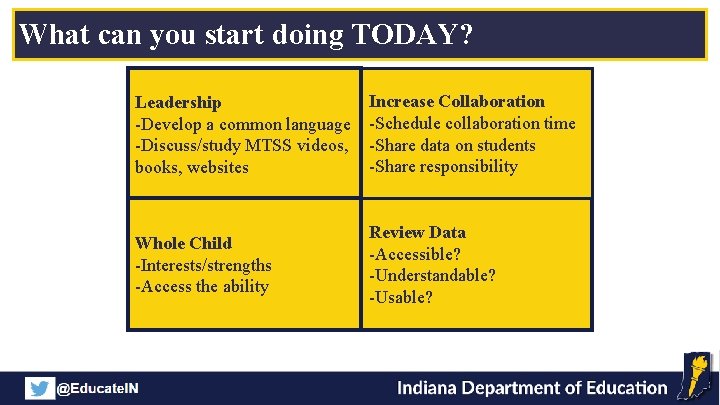
What can you start doing TODAY? Leadership -Develop a common language -Discuss/study MTSS videos, books, websites Increase Collaboration -Schedule collaboration time -Share data on students -Share responsibility Whole Child -Interests/strengths -Access the ability Review Data -Accessible? -Understandable? -Usable?
Indiana Department of Education Resources ★ MTSS website ★ Indiana’s ESSA Plan @Educate. IN
- Slides: 26