
MULTITe V BUNCH COMPRESSOR STUDIES Starting conceptual design
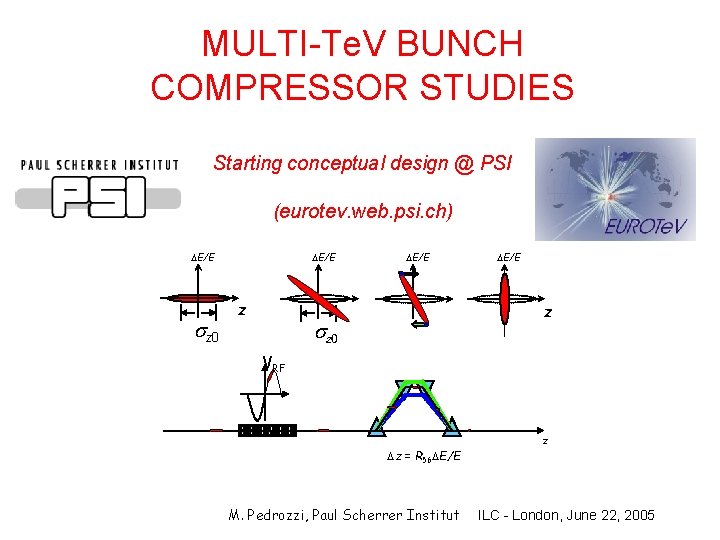
MULTI-Te. V BUNCH COMPRESSOR STUDIES Starting conceptual design @ PSI (eurotev. web. psi. ch) DE/E sz 0 DE/E z sz 0 VRF z Dz = R 56 DE/E M. Pedrozzi, Paul Scherrer Institut ILC - London, June 22, 2005
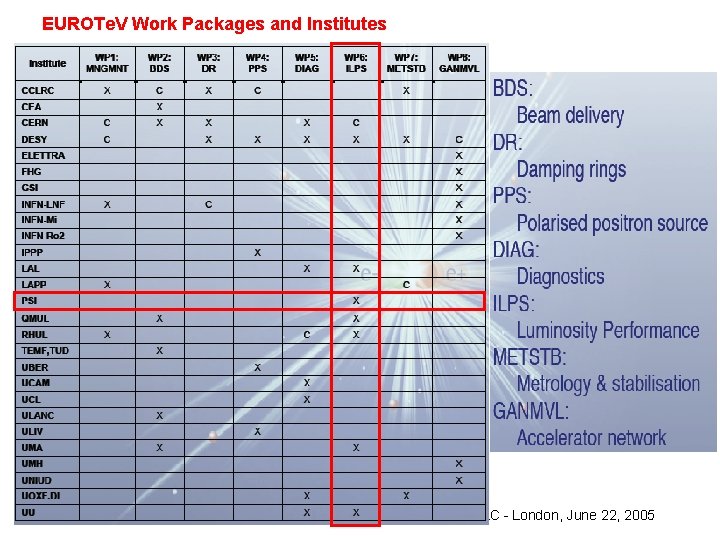
EUROTe. V Work Packages and Institutes ILC - London, June 22, 2005
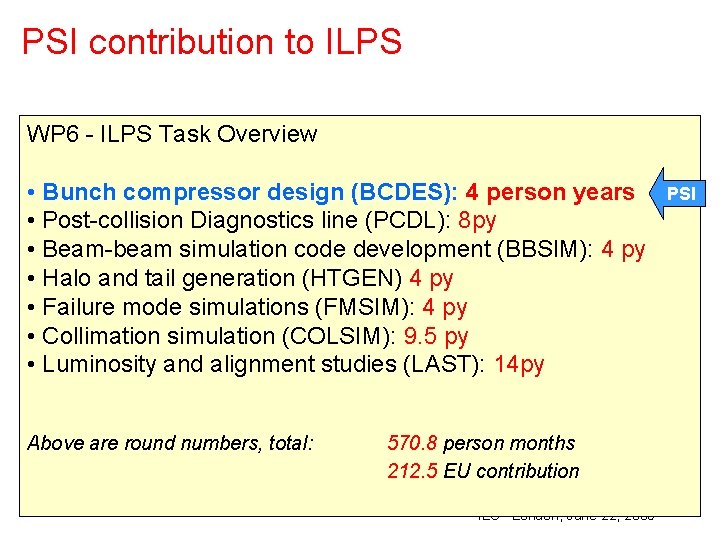
PSI contribution to ILPS WP 6 - ILPS Task Overview • Bunch compressor design (BCDES): 4 person years • Post-collision Diagnostics line (PCDL): 8 py • Beam-beam simulation code development (BBSIM): 4 py • Halo and tail generation (HTGEN) 4 py • Failure mode simulations (FMSIM): 4 py • Collimation simulation (COLSIM): 9. 5 py • Luminosity and alignment studies (LAST): 14 py Above are round numbers, total: 570. 8 person months 212. 5 EU contribution ILC - London, June 22, 2005 PSI
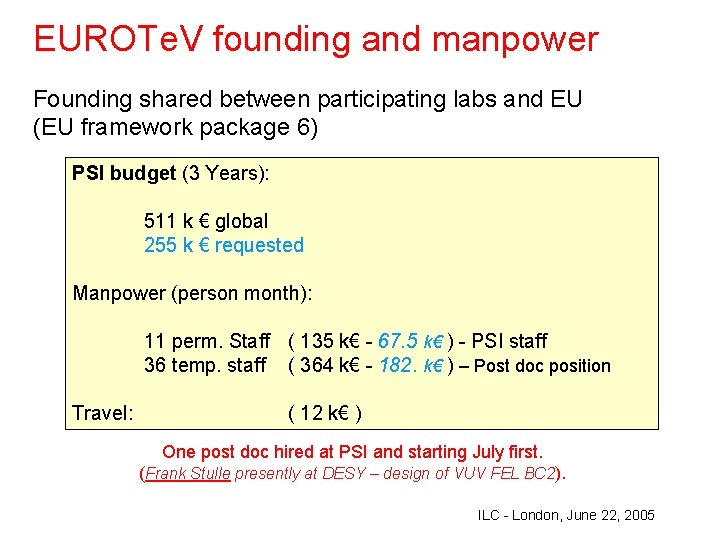
EUROTe. V founding and manpower Founding shared between participating labs and EU (EU framework package 6) PSI budget (3 Years): 511 k € global 255 k € requested Manpower (person month): 11 perm. Staff ( 135 k€ - 67. 5 k€ ) - PSI staff 36 temp. staff ( 364 k€ - 182. k€ ) – Post doc position Travel: ( 12 k€ ) One post doc hired at PSI and starting July first. (Frank Stulle presently at DESY – design of VUV FEL BC 2). ILC - London, June 22, 2005

PSI tasks 1: Design a bunch compressor compatible with multi-Te. V center-of-Mass energies (last compressor stage) Second stage: Cf~8 -9 First stage: Cf~6 ILC - London, June 22, 2005
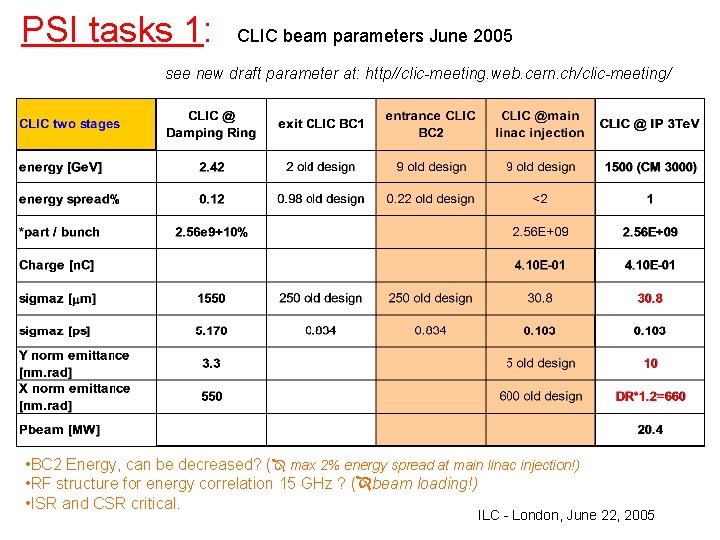
PSI tasks 1: CLIC beam parameters June 2005 see new draft parameter at: http//clic-meeting. web. cern. ch/clic-meeting/ • BC 2 Energy, can be decreased? ( max 2% energy spread at main linac injection!) • RF structure for energy correlation 15 GHz ? ( beam loading!) • ISR and CSR critical. ILC - London, June 22, 2005
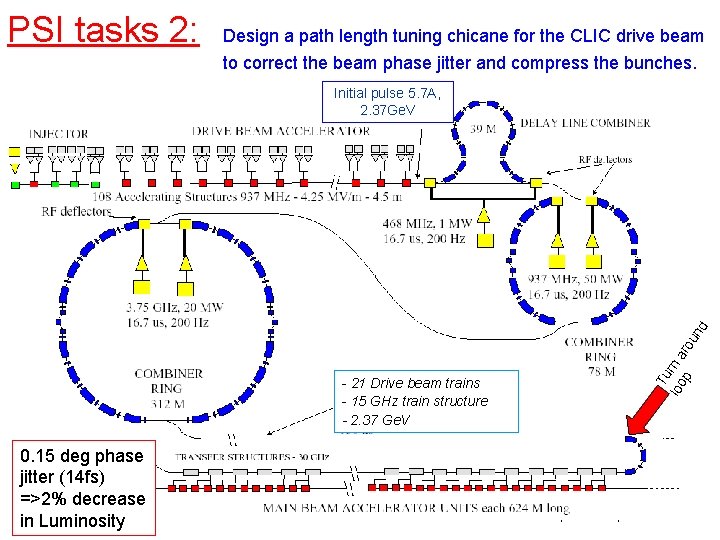
PSI tasks 2: Design a path length tuning chicane for the CLIC drive beam to correct the beam phase jitter and compress the bunches. - 21 Drive beam trains - 15 GHz train structure - 2. 37 Ge. V 0. 15 deg phase jitter (14 fs) =>2% decrease in Luminosity Tu loo rn a ro p un d Initial pulse 5. 7 A, 2. 37 Ge. V ILC - London, June 22, 2005
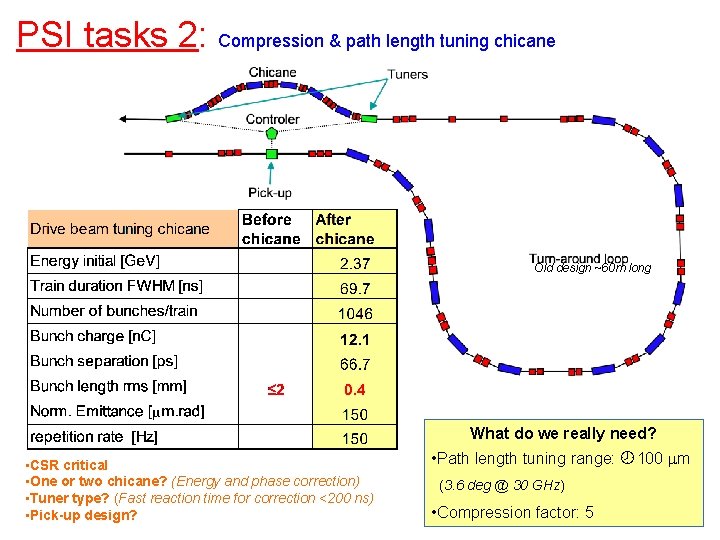
PSI tasks 2: Compression & path length tuning chicane Old design ~60 m long What do we really need? • CSR critical • One or two chicane? (Energy and phase correction) • Tuner type? (Fast reaction time for correction <200 ns) • Pick-up design? • Path length tuning range: 100 m (3. 6 deg @ 30 GHz) • Compression factor: 5 22, 2005 ILC - London, June
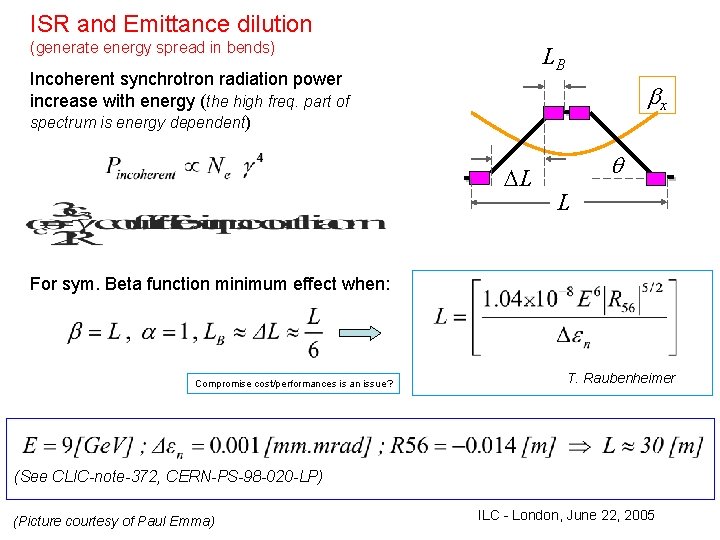
ISR and Emittance dilution (generate energy spread in bends) LB Incoherent synchrotron radiation power increase with energy (the high freq. part of spectrum is energy dependent) bx DL q L For sym. Beta function minimum effect when: Compromise cost/performances is an issue? T. Raubenheimer (See CLIC-note-372, CERN-PS-98 -020 -LP) (Picture courtesy of Paul Emma) ILC - London, June 22, 2005
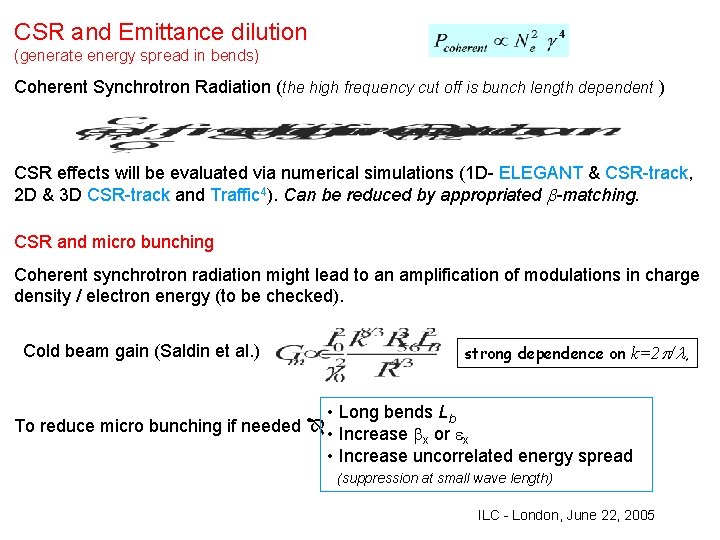
CSR and Emittance dilution (generate energy spread in bends) Coherent Synchrotron Radiation (the high frequency cut off is bunch length dependent ) CSR effects will be evaluated via numerical simulations (1 D- ELEGANT & CSR-track, 2 D & 3 D CSR-track and Traffic 4). Can be reduced by appropriated b-matching. CSR and micro bunching Coherent synchrotron radiation might lead to an amplification of modulations in charge density / electron energy (to be checked). Cold beam gain (Saldin et al. ) strong dependence on k=2 p/l, • Long bends Lb To reduce micro bunching if needed • Increase b or e x x • Increase uncorrelated energy spread (suppression at small wave length) ILC - London, June 22, 2005
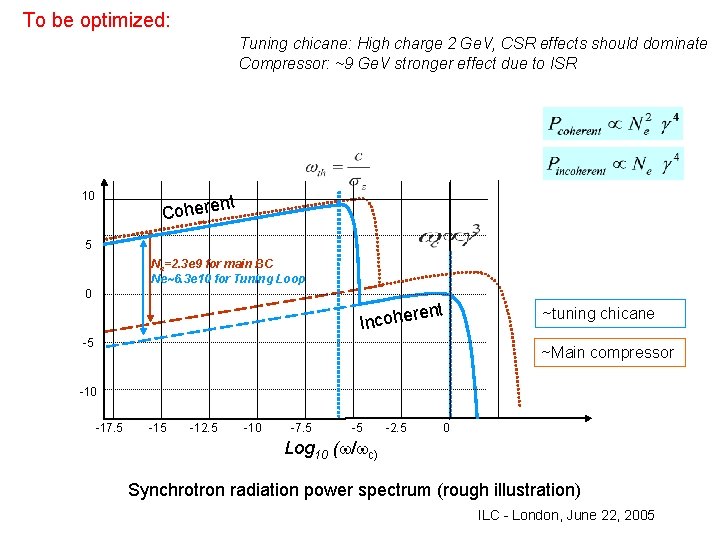
To be optimized: Tuning chicane: High charge 2 Ge. V, CSR effects should dominate Compressor: ~9 Ge. V stronger effect due to ISR 10 t n Cohere 5 Ne=2. 3 e 9 for main BC Ne~6. 3 e 10 for Tuning Loop 0 ent r e h o c In -5 ~tuning chicane ~Main compressor -10 -17. 5 -12. 5 -10 -7. 5 -5 -2. 5 0 Log 10 (w/wc) Synchrotron radiation power spectrum (rough illustration) ILC - London, June 22, 2005
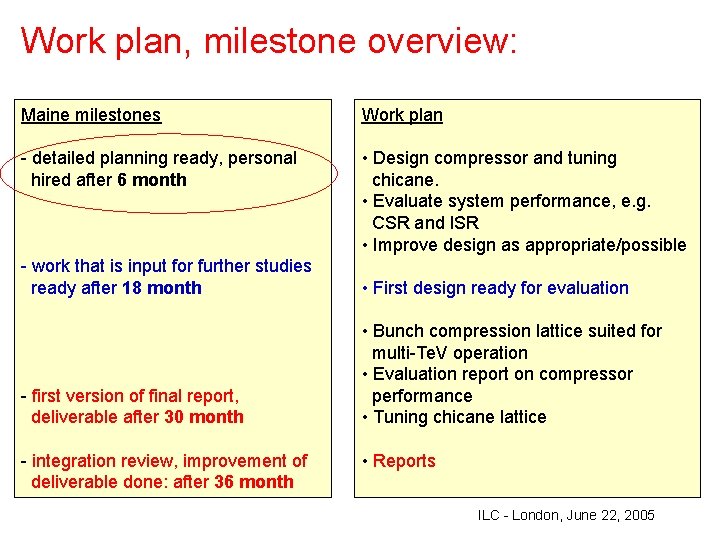
Work plan, milestone overview: Maine milestones Work plan - detailed planning ready, personal hired after 6 month • Design compressor and tuning chicane. • Evaluate system performance, e. g. CSR and ISR • Improve design as appropriate/possible - work that is input for further studies ready after 18 month • First design ready for evaluation - first version of final report, deliverable after 30 month • Bunch compression lattice suited for multi-Te. V operation • Evaluation report on compressor performance • Tuning chicane lattice - integration review, improvement of deliverable done: after 36 month • Reports ILC - London, June 22, 2005
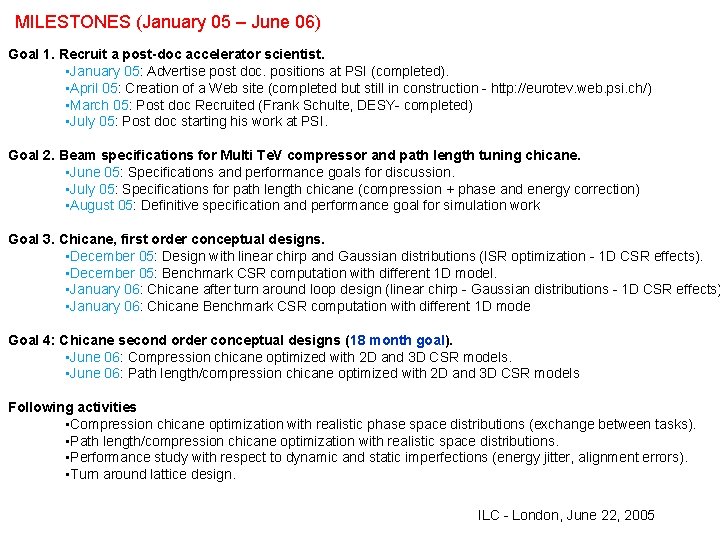
MILESTONES (January 05 – June 06) Goal 1. Recruit a post-doc accelerator scientist. • January 05: Advertise post doc. positions at PSI (completed). • April 05: Creation of a Web site (completed but still in construction - http: //eurotev. web. psi. ch/) • March 05: Post doc Recruited (Frank Schulte, DESY- completed) • July 05: Post doc starting his work at PSI. Goal 2. Beam specifications for Multi Te. V compressor and path length tuning chicane. • June 05: Specifications and performance goals for discussion. • July 05: Specifications for path length chicane (compression + phase and energy correction) • August 05: Definitive specification and performance goal for simulation work Goal 3. Chicane, first order conceptual designs. • December 05: Design with linear chirp and Gaussian distributions (ISR optimization - 1 D CSR effects). • December 05: Benchmark CSR computation with different 1 D model. • January 06: Chicane after turn around loop design (linear chirp - Gaussian distributions - 1 D CSR effects) • January 06: Chicane Benchmark CSR computation with different 1 D mode Goal 4: Chicane second order conceptual designs (18 month goal). • June 06: Compression chicane optimized with 2 D and 3 D CSR models. • June 06: Path length/compression chicane optimized with 2 D and 3 D CSR models Following activities • Compression chicane optimization with realistic phase space distributions (exchange between tasks). • Path length/compression chicane optimization with realistic space distributions. • Performance study with respect to dynamic and static imperfections (energy jitter, alignment errors). • Turn around lattice design. ILC - London, June 22, 2005

ILC - London, June 22, 2005
- Slides: 14