
Multitasking Effects on Persuasion and Comprehension Literature Review
- Slides: 7
Multitasking Effects on Persuasion and Comprehension: Literature Review Presented by Jonathan Mc. Craw COMM 601 Queens University of Charlotte September 13, 2014
Purpose • Summarize the prior research outlined in Jeong and Hwang’s 2012 article in the Journal of Communication: Does Multitasking Increase or Decrease Persuasion? Effects of Multitasking on Comprehension and Counterarguing Jeong, Se-Hoon & Hwang, Yoori (2012). Does Multitasking Increase or Decrease Persuasion? Effects of Multitasking on Comprehension and Counterarguing. Journal of Communication. 62, p. 571 -587. DOI: 10. 1111/j. 1460 -2466. 2012. 01659. x
How often do we multitask, and what are the different types of multitasking? • According to the Middletown Media Studies, 90% of individuals in the United States say they multitask with media in some way (Holmes, et al. 2005) • The authors identify two types of multitasking: media multitasking and multitasking with multiple media. Media multitasking involves a medium used with non-medium activity, while multitasking with multiple media involves two or more media (Jeong & Fishbein, 2007) Example of media multitasking • Watching television while preparing dinner • Doing homework while searching the internet Examples of multitasking with multiple media • Watching television while searching the internet • Reading email while texting
What impact does multitasking have on the persuasive effects of media? Multitasking can: • Reduce the persuasive effects of media by reducing the attention to and comprehension of the content (Collins, 2008) • Increase message acceptance by suppressing counterarguing (Collins, 2008) The following factors may influence the level of impact: • Whether the intent of the message is information comprehension or information acceptance (Baron, et. al, 1973) • Whether the medium of focus is the primary or secondary (Jong, et. al, 2010)
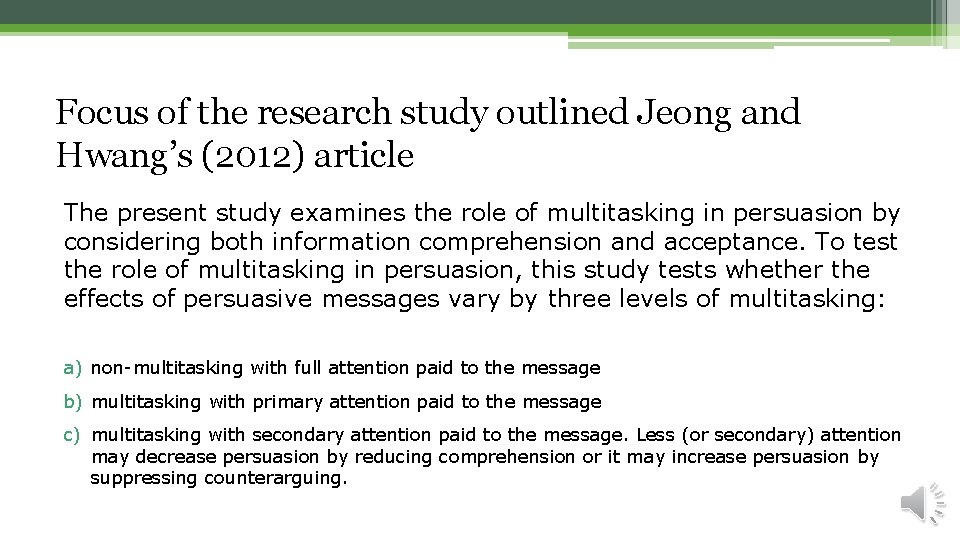
Focus of the research study outlined Jeong and Hwang’s (2012) article The present study examines the role of multitasking in persuasion by considering both information comprehension and acceptance. To test the role of multitasking in persuasion, this study tests whether the effects of persuasive messages vary by three levels of multitasking: a) non-multitasking with full attention paid to the message b) multitasking with primary attention paid to the message c) multitasking with secondary attention paid to the message. Less (or secondary) attention may decrease persuasion by reducing comprehension or it may increase persuasion by suppressing counterarguing.
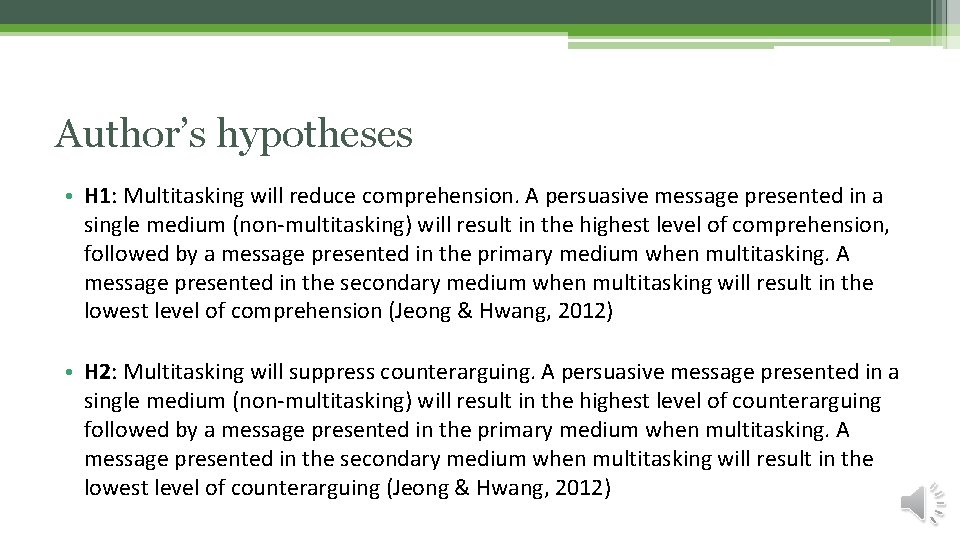
Author’s hypotheses • H 1: Multitasking will reduce comprehension. A persuasive message presented in a single medium (non-multitasking) will result in the highest level of comprehension, followed by a message presented in the primary medium when multitasking. A message presented in the secondary medium when multitasking will result in the lowest level of comprehension (Jeong & Hwang, 2012) • H 2: Multitasking will suppress counterarguing. A persuasive message presented in a single medium (non-multitasking) will result in the highest level of counterarguing followed by a message presented in the primary medium when multitasking. A message presented in the secondary medium when multitasking will result in the lowest level of counterarguing (Jeong & Hwang, 2012)
References Baron, R. S. , Baron, P. , & Miller, N. (1973). The relation between distraction and persuasion. Psychological Bulletin, 80, 310– 323. Collins, R. L. (2008). Media multitasking: Issues posed in measuring the effects of television sexual content exposure. Communication Methods & Measures, 2(1– 2), 65– 79. DOI: 10. 1080/19312450802063255 Holmes, M. E. , Papper, R. A. , Popovich, M. N. , & Bloxham, M. (2005). Middletown media studies II: Concurrent media exposure. Muncie, IN: Ball State University Center for Media Design. Retrieved from http: //www. bsu. edu/cmd/insightresearch. Jeong, S. -H. , & Fishbein, M. (2007). Predictors of multitasking with media: Media factors and audience factors. Media Psychology, 10(3), 364– 384. DOI: 10. 1080/15213260701532948 Jeong, Se-Hoon & Hwang, Yoori (2012). Does Multitasking Increase or Decrease Persuasion? Effects of Multitasking on Comprehension and Counterarguing. Journal of Communication. 62, p. 571 -587. DOI: 10. 1111/j. 1460 -2466. 2012. 01659. x Jeong, S. -H. , Zhang, W. , Fishbein, M. , Davis, E. , Bleakley, A. , Jordan, A. , et al. (2010 ). Multiple media use and multitasking with media among high school and college students: A diary method. In M. B. Hinner (Ed. ), A forum for general and intercultural business communication (Vol. 6, pp. 409– 434). Frankfurt am Main, Germany: Peter Lang.