
Multisystemic Therapy MST Overview Presented by MST Services
Multisystemic Therapy (MST) Overview Presented by MST Services Revised – February 2016 Multisystemic Therapy (MST) Overview 1
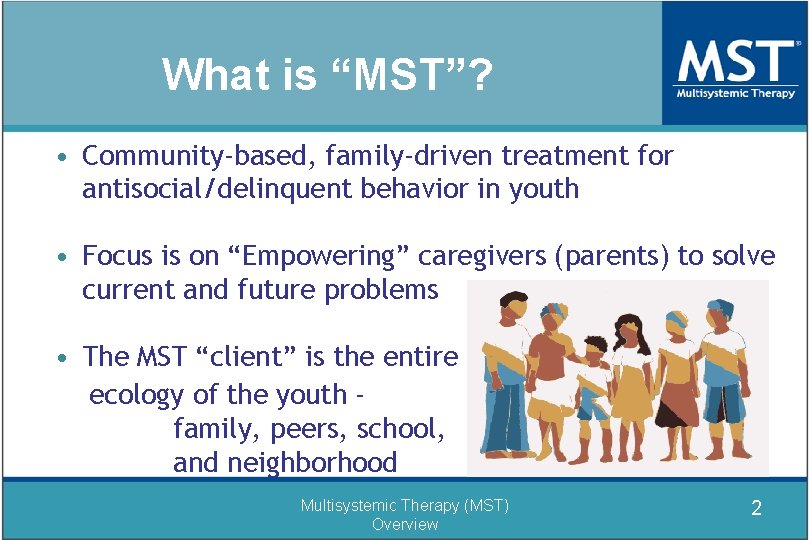
What is “MST”? • Community‐based, family‐driven treatment for antisocial/delinquent behavior in youth • Focus is on “Empowering” caregivers (parents) to solve current and future problems • The MST “client” is the entire ecology of the youth ‐ family, peers, school, and neighborhood Multisystemic Therapy (MST) Overview 2
MST Research and Dissemination Family Services Research Center (FSRC) at the Medical University of South Carolina MST Services MST Institute Licensed and affiliated organizations: MST Network Partner Organizations Local MST Provider Organizations Multisystemic Therapy (MST) Overview 3
MST Presence Around the World Multisystemic Therapy (MST) Overview 4
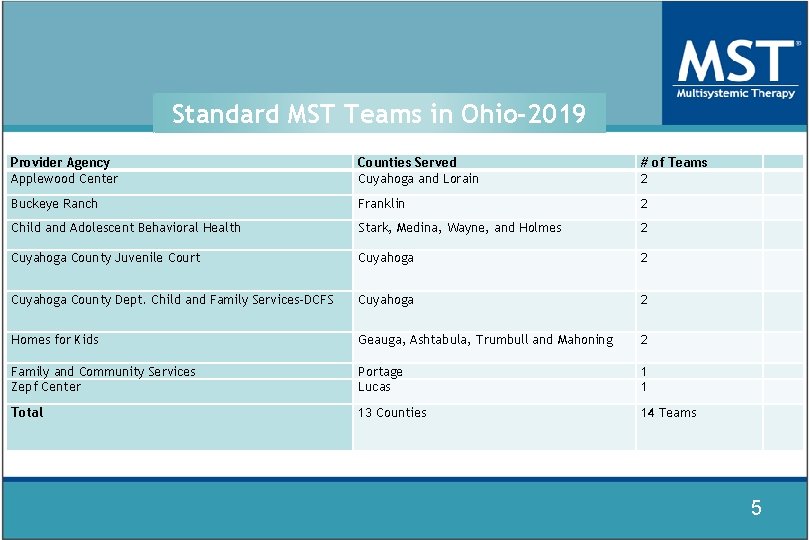
Standard MST Teams in Ohio-2019 Provider Agency Applewood Center Counties Served Cuyahoga and Lorain # of Teams 2 Buckeye Ranch Franklin 2 Child and Adolescent Behavioral Health Stark, Medina, Wayne, and Holmes 2 Cuyahoga County Juvenile Court Cuyahoga 2 Cuyahoga County Dept. Child and Family Services‐DCFS Cuyahoga 2 Homes for Kids Geauga, Ashtabula, Trumbull and Mahoning 2 Family and Community Services Zepf Center Portage Lucas 1 1 Total 13 Counties 14 Teams 5
MST “Champions” & Advocates Multisystemic Therapy (MST) Overview 6
How Does MST Work? Key Points: • Theoretical and Research Underpinnings • Assumptions and MST Theory of Change • How is MST Implemented? Multisystemic Therapy (MST) Overview 7
Theoretical Underpinnings Based on social ecological theory of Uri Bronfenbrenner • Children and adolescents live in a social ecology of interconnected systems that impact their behaviors in direct and indirect ways • These influences act in both directions (they are reciprocal and bi‐directional) Multisystemic Therapy (MST) Overview 8
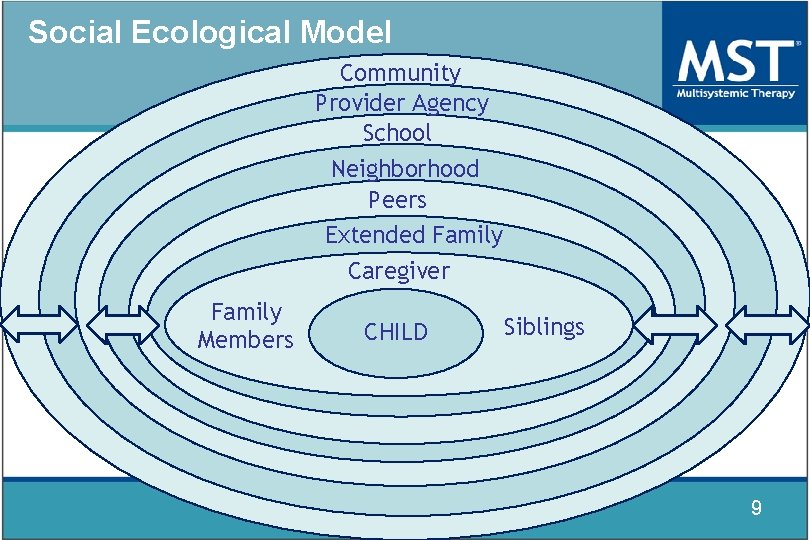
Social Ecological Model Community Provider Agency School Neighborhood Peers Extended Family Caregiver Family Members CHILD Siblings 9
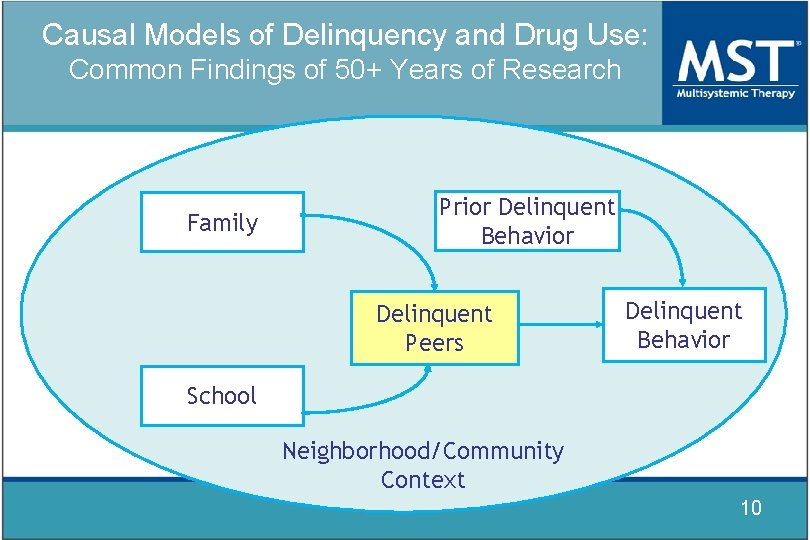
Causal Models of Delinquency and Drug Use: Common Findings of 50+ Years of Research Family Prior Delinquent Behavior Delinquent Peers Delinquent Behavior School Neighborhood/Community Context 10
Delinquency is a Complex Behavior Common findings of 50+ years of research: delinquency and drug use are determined by multiple risk factors: • • • Family (low monitoring, high conflict, etc. ) Peer group (law‐breaking peers, etc. ) School (dropout, low achievement, etc. ) Community ( supports, transiency, etc. ) Individual (low verbal and social skills, etc. ) Multisystemic Therapy (MST) Overview 11
MST Assumptions • Children’s behavior is strongly influenced by their families, friends, and communities (and vice versa) • Families and communities are central and essential partners and collaborators in MST treatment • Caregivers/parents want the best for their children and want them to grow to become productive adults Multisystemic Therapy (MST) Overview 12
MST Assumptions (Cont. ) • Families can live successfully without formal, mandated services • Professional treatment providers should be accountable for achieving outcomes • Science/research provides valuable guidance • And… ** Change can occur quickly ** Multisystemic Therapy (MST) Overview 13
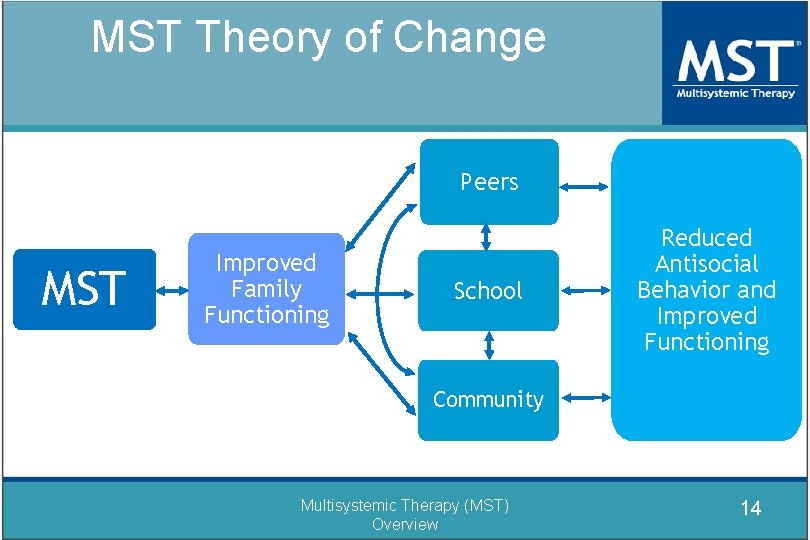
MST Theory of Change Peers MST Improved Family Functioning School Reduced Antisocial Behavior and Improved Functioning Community Multisystemic Therapy (MST) Overview 14
How is MST Implemented? Intervention strategies: MST draws from research ‐based treatment techniques • • Behavior therapy Parent management training Cognitive behavior therapy Pragmatic family therapies ‐ Structural Family Therapy ‐ Strategic Family Therapy • Pharmacological interventions (e. g. , for ADHD) Multisystemic Therapy (MST) Overview 15
How is MST Implemented? (Cont. ) • Single therapist working intensively with 4 to 6 families at a time • 3 to 5 months is the typical treatment time (4 months on average across cases) • Work is done in the community, home, school, and neighborhood: removes barriers to service access • Team of 2 to 4 therapists plus a supervisor • 24 hr. / 7 day week team availability: on‐call system Multisystemic Therapy (MST) Overview 16
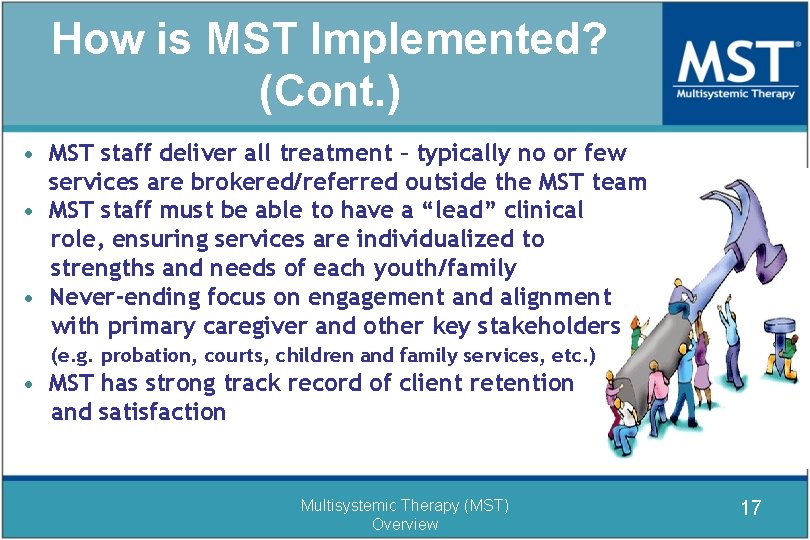
How is MST Implemented? (Cont. ) • MST staff deliver all treatment – typically no or few services are brokered/referred outside the MST team • MST staff must be able to have a “lead” clinical role, ensuring services are individualized to strengths and needs of each youth/family • Never-ending focus on engagement and alignment with primary caregiver and other key stakeholders (e. g. probation, courts, children and family services, etc. ) • MST has strong track record of client retention and satisfaction Multisystemic Therapy (MST) Overview 17
MST’s Research Heritage Key Points: • 35+ years of Science • Consistent Outcomes • Role of Model Adherence • Implementation Research Findings Multisystemic Therapy (MST) Overview 18
35+ Years of Science 55 Published Outcome, Benchmarking, and Implementation Studies Including 25 randomized trials and 28 independent evaluations (yielding >100 peer-reviewed journal articles) • 16 with serious juvenile offenders ‐ 7 independent studies • 11 with adolescents with serious conduct problems -10 independent studies Multisystemic Therapy (MST) Overview 19
35+ Years of Science 55 Published Outcome, Benchmarking, and Implementation Studies (cont’d) • • • 2 with substance abusing or dependent juvenile offenders (MST-Substance Abuse) 3 with juvenile sexual offenders (MST-Problem Sexual Behavior) 3 with youths presenting serious emotional disturbance (MST-Psychiatric) 3 with maltreating families (MST-Child Abuse and Neglect) 6 with adolescents with chronic health care conditions (MST-Health Care) Diabetes, obesity, HIV, asthma 13 implementation studies Complete list of MST outcome studies: www. mstservices. com/files/outcomestudies. pdf Multisystemic Therapy (MST) Overview 20
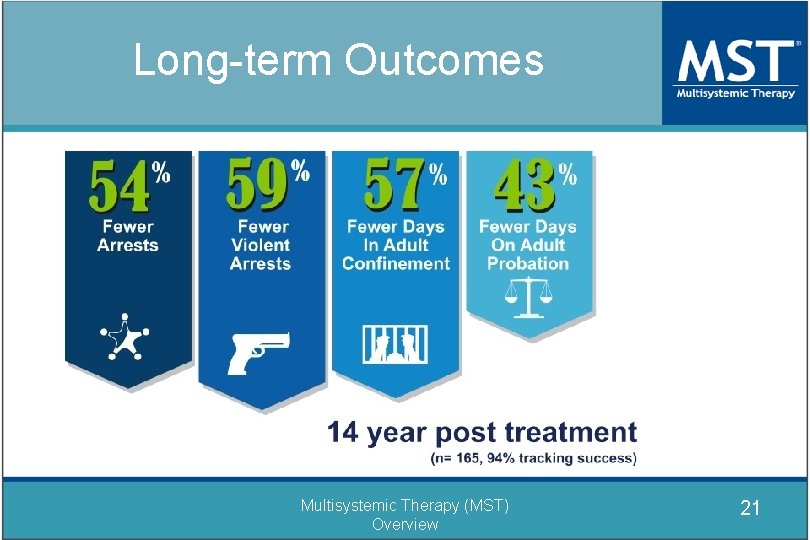
Long-term Outcomes Multisystemic Therapy (MST) Overview 21
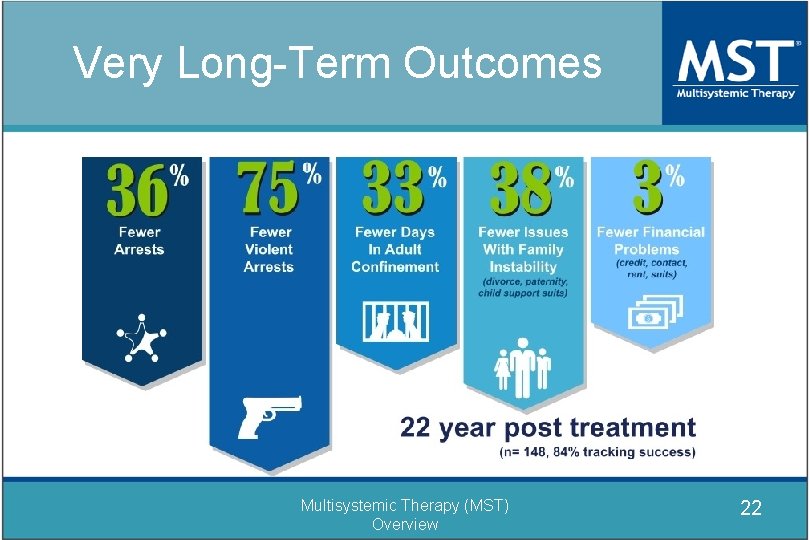
Very Long-Term Outcomes Multisystemic Therapy (MST) Overview 22
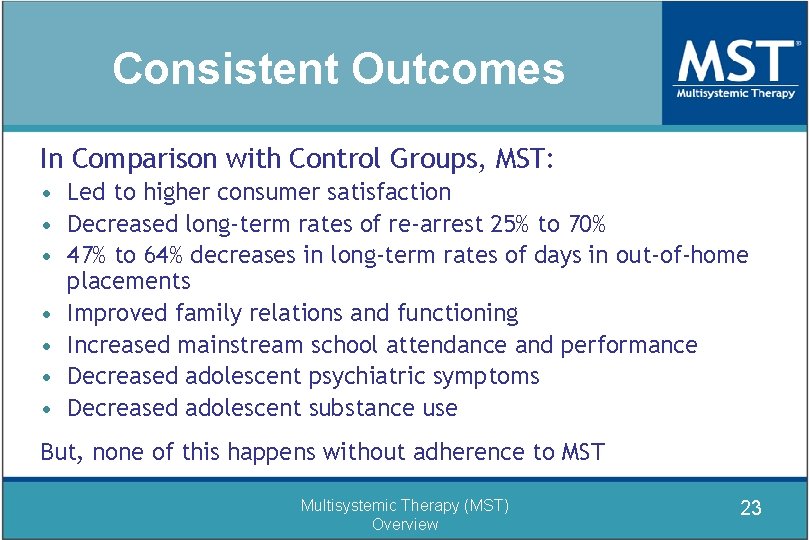
Consistent Outcomes In Comparison with Control Groups, MST: • Led to higher consumer satisfaction • Decreased long‐term rates of re‐arrest 25% to 70% • 47% to 64% decreases in long‐term rates of days in out‐of‐home placements • Improved family relations and functioning • Increased mainstream school attendance and performance • Decreased adolescent psychiatric symptoms • Decreased adolescent substance use But, none of this happens without adherence to MST Multisystemic Therapy (MST) Overview 23
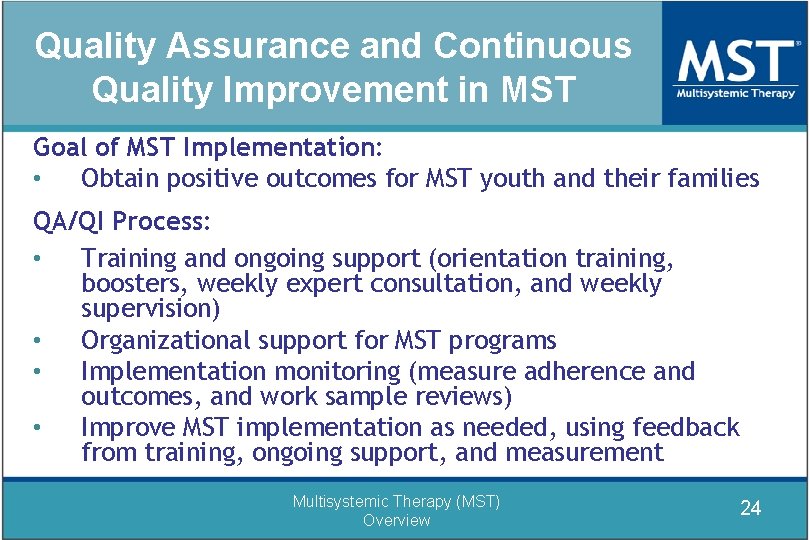
Quality Assurance and Continuous Quality Improvement in MST Goal of MST Implementation: • Obtain positive outcomes for MST youth and their families QA/QI Process: • Training and ongoing support (orientation training, boosters, weekly expert consultation, and weekly supervision) • Organizational support for MST programs • Implementation monitoring (measure adherence and outcomes, and work sample reviews) • Improve MST implementation as needed, using feedback from training, ongoing support, and measurement Multisystemic Therapy (MST) Overview 24
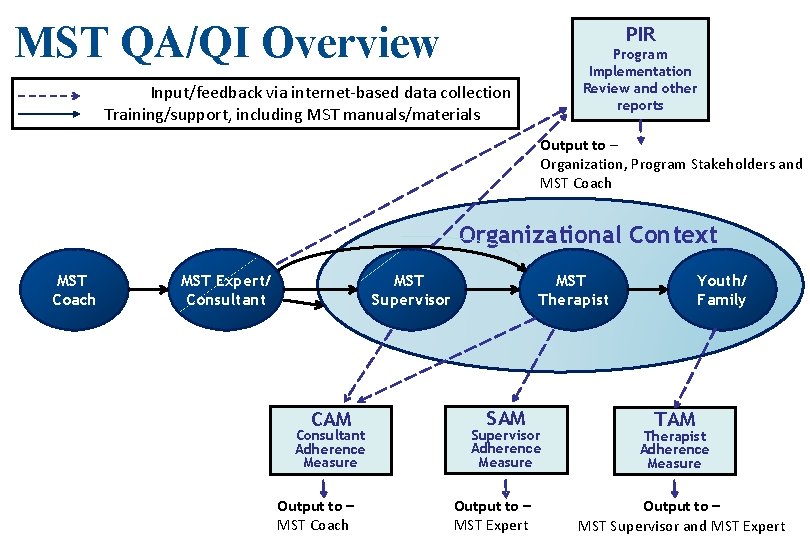
MST QA/QI Overview PIR Program Implementation Review and other reports Input/feedback via internet-based data collection Training/support, including MST manuals/materials Output to – Organization, Program Stakeholders and MST Coach Organizational Context MST Coach MST Expert/ Consultant MST Supervisor CAM Consultant Adherence Measure Output to – MST Coach MST Therapist SAM Supervisor Adherence Measure Output to – MST Expert Youth/ Family TAM Therapist Adherence Measure Output to – 25 MST Supervisor and MST Expert
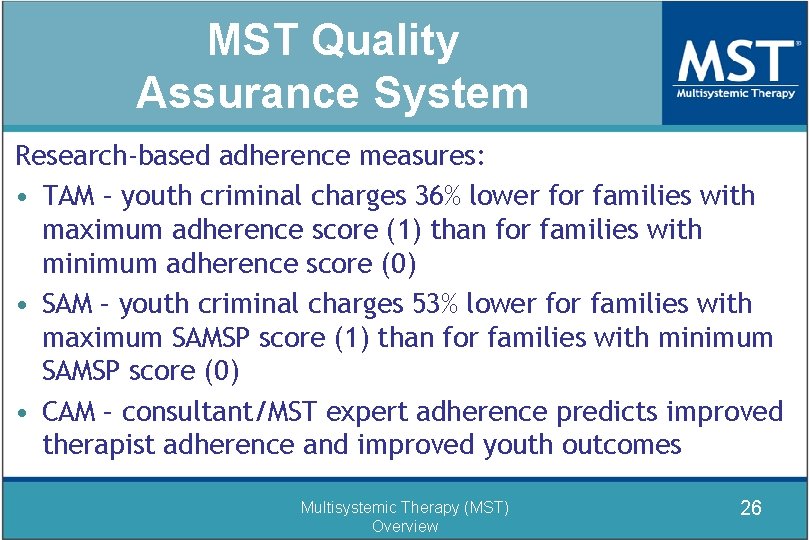
MST Quality Assurance System Research‐based adherence measures: • TAM – youth criminal charges 36% lower for families with maximum adherence score (1) than for families with minimum adherence score (0) • SAM – youth criminal charges 53% lower for families with maximum SAMSP score (1) than for families with minimum SAMSP score (0) • CAM – consultant/MST expert adherence predicts improved therapist adherence and improved youth outcomes Multisystemic Therapy (MST) Overview 26
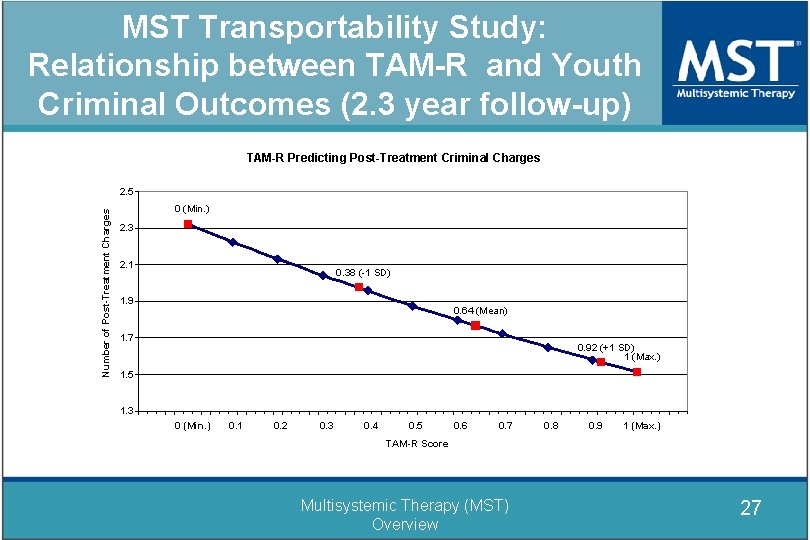
MST Transportability Study: Relationship between TAM-R and Youth Criminal Outcomes (2. 3 year follow-up) TAM-R Predicting Post-Treatment Criminal Charges Number of Post-Treatment Charges 2. 5 0 (Min. ) 2. 3 2. 1 0. 38 (-1 SD) 1. 9 0. 64 (Mean) 1. 7 0. 92 (+1 SD) 1 (Max. ) 1. 5 1. 3 0 (Min. ) 0. 1 0. 2 0. 3 0. 4 0. 5 0. 6 0. 7 0. 8 0. 9 1 (Max. ) TAM-R Score Multisystemic Therapy (MST) Overview 27
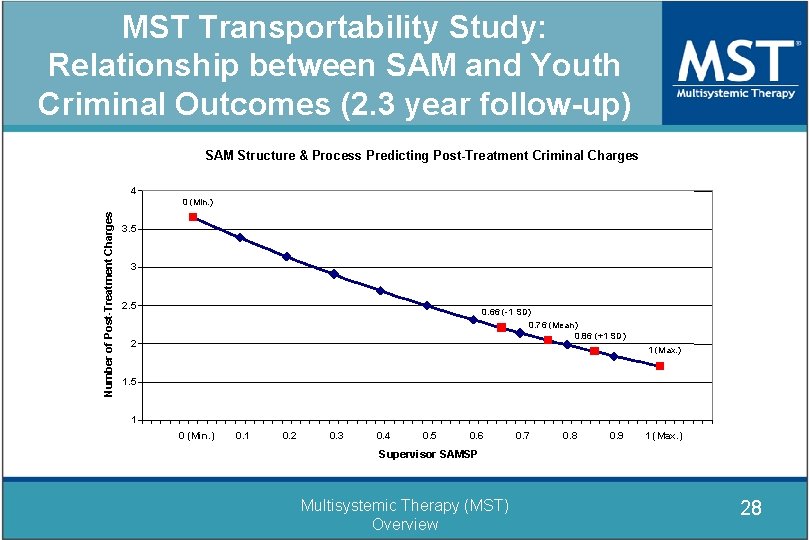
MST Transportability Study: Relationship between SAM and Youth Criminal Outcomes (2. 3 year follow-up) SAM Structure & Process Predicting Post-Treatment Criminal Charges 4 Number of Post-Treatment Charges 0 (Min. ) 3. 5 3 2. 5 0. 66 (-1 SD) 0. 76 (Mean) 0. 86 (+1 SD) 2 1 (Max. ) 1. 5 1 0 (Min. ) 0. 1 0. 2 0. 3 0. 4 0. 5 0. 6 0. 7 0. 8 0. 9 1 (Max. ) Supervisor SAMSP Multisystemic Therapy (MST) Overview 28

Questions? Thank you for your time and attention mag 19@case. edu www. mstservices. com Multisystemic Therapy (MST) Overview 29
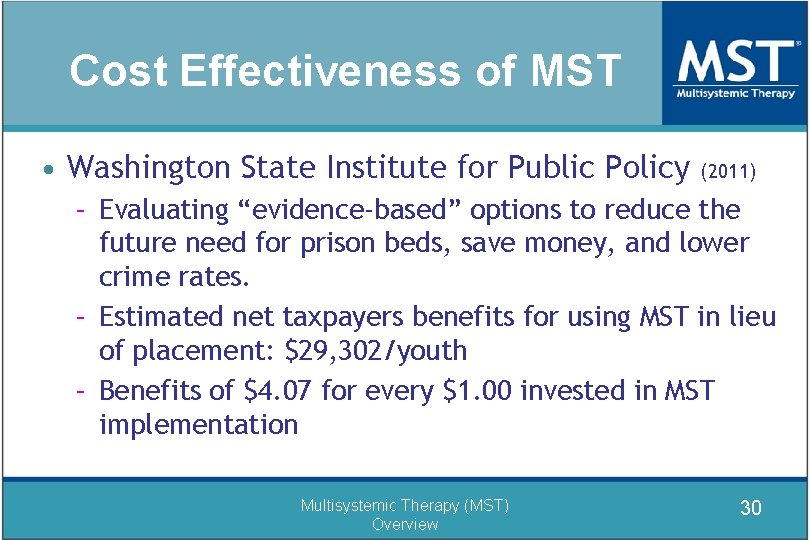
Cost Effectiveness of MST • Washington State Institute for Public Policy (2011) – Evaluating “evidence‐based” options to reduce the future need for prison beds, save money, and lower crime rates. – Estimated net taxpayers benefits for using MST in lieu of placement: $29, 302/youth – Benefits of $4. 07 for every $1. 00 invested in MST implementation Multisystemic Therapy (MST) Overview 30
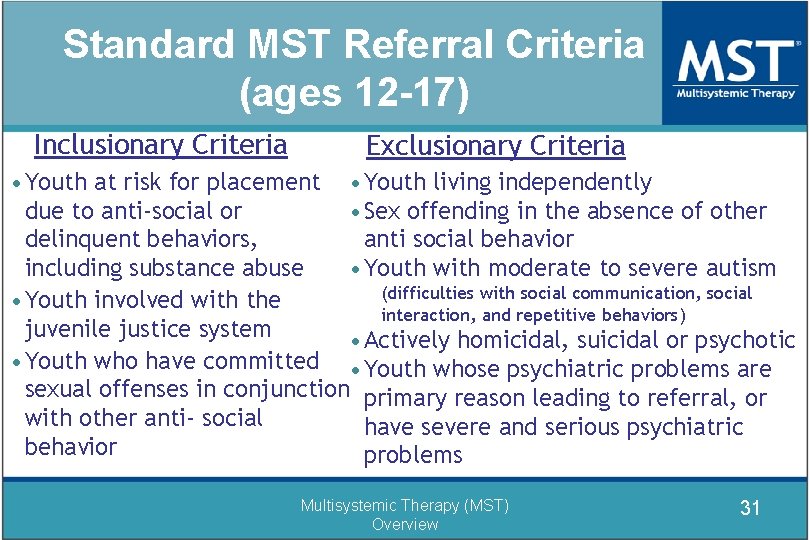
Standard MST Referral Criteria (ages 12 -17) Inclusionary Criteria Exclusionary Criteria • Youth at risk for placement • Youth living independently due to anti‐social or • Sex offending in the absence of other delinquent behaviors, anti social behavior including substance abuse • Youth with moderate to severe autism (difficulties with social communication, social • Youth involved with the interaction, and repetitive behaviors) juvenile justice system • Actively homicidal, suicidal or psychotic • Youth who have committed • Youth whose psychiatric problems are sexual offenses in conjunction primary reason leading to referral, or with other anti‐ social have severe and serious psychiatric behavior problems Multisystemic Therapy (MST) Overview 31
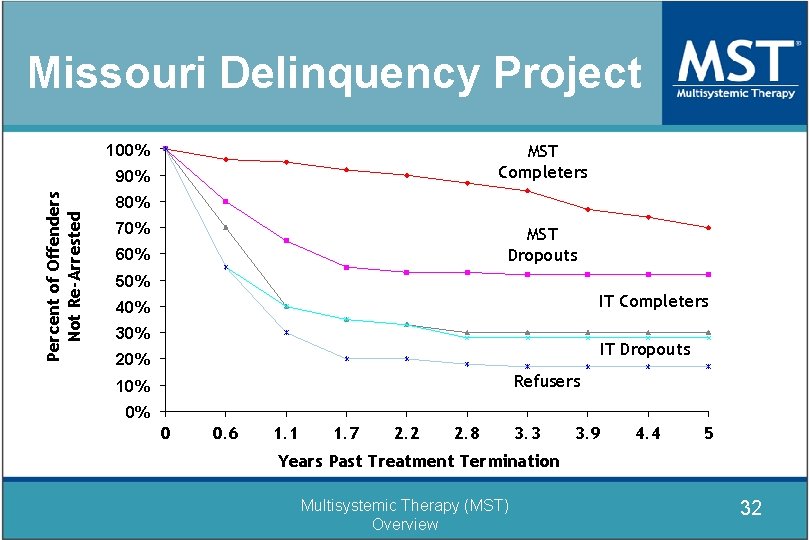
Missouri Delinquency Project 100% MST Completers Percent of Offenders Not Re-Arrested 90% 80% 70% MST Dropouts 60% 50% IT Completers 40% 30% IT Dropouts 20% Refusers 10% 0% 0 0. 6 1. 1 1. 7 2. 2 2. 8 3. 3 3. 9 4. 4 5 Years Past Treatment Termination Multisystemic Therapy (MST) Overview 32
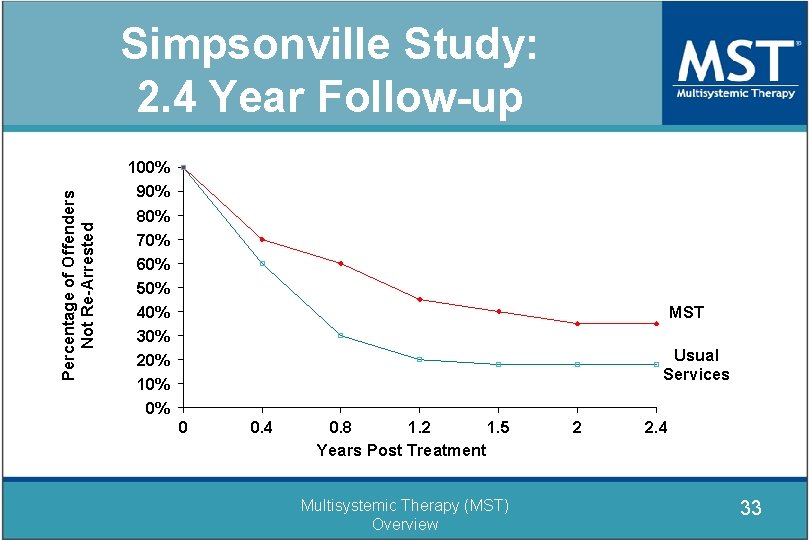
Percentage of Offenders Not Re-Arrested Simpsonville Study: 2. 4 Year Follow-up 100% 90% 80% 70% 60% 50% 40% 30% 20% 10% 0% MST Usual Services 0 0. 4 0. 8 1. 2 1. 5 Years Post Treatment Multisystemic Therapy (MST) Overview 2 2. 4 33
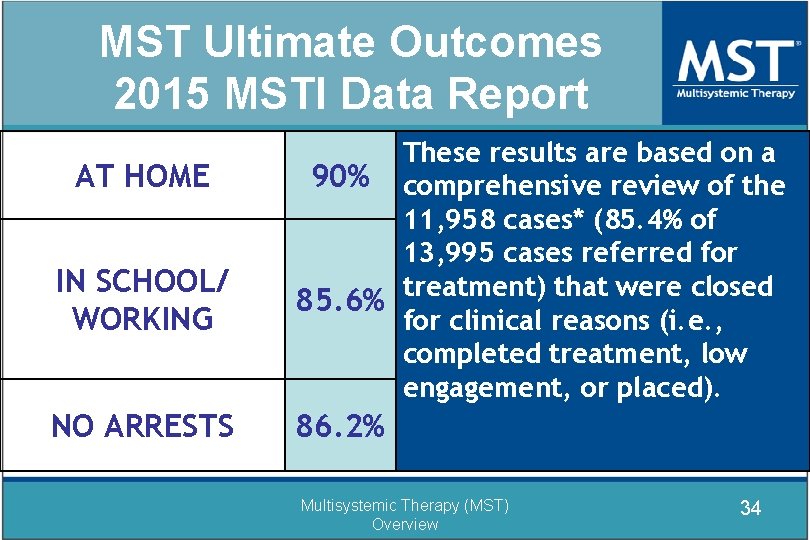
MST Ultimate Outcomes 2015 MSTI Data Report AT HOME IN SCHOOL/ WORKING NO ARRESTS These results are based on a 90% comprehensive review of the 11, 958 cases* (85. 4% of 13, 995 cases referred for treatment) that were closed 85. 6% for clinical reasons (i. e. , completed treatment, low engagement, or placed). 86. 2% Multisystemic Therapy (MST) Overview 34
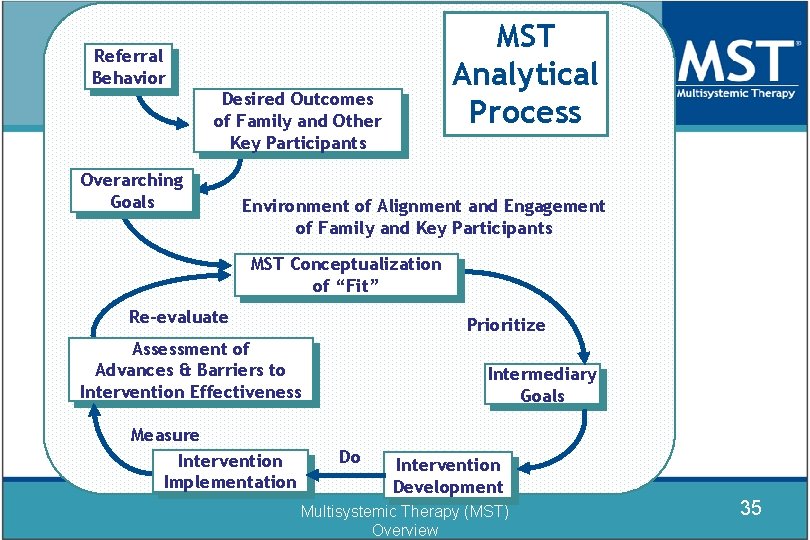
MST Analytical Process Referral Behavior Desired Outcomes of Family and Other Key Participants Overarching Goals Environment of Alignment and Engagement of Family and Key Participants MST Conceptualization of “Fit” Re-evaluate Prioritize Assessment of Advances & Barriers to Intervention Effectiveness Measure Intervention Implementation Intermediary Goals Do Intervention Development Multisystemic Therapy (MST) Overview 35
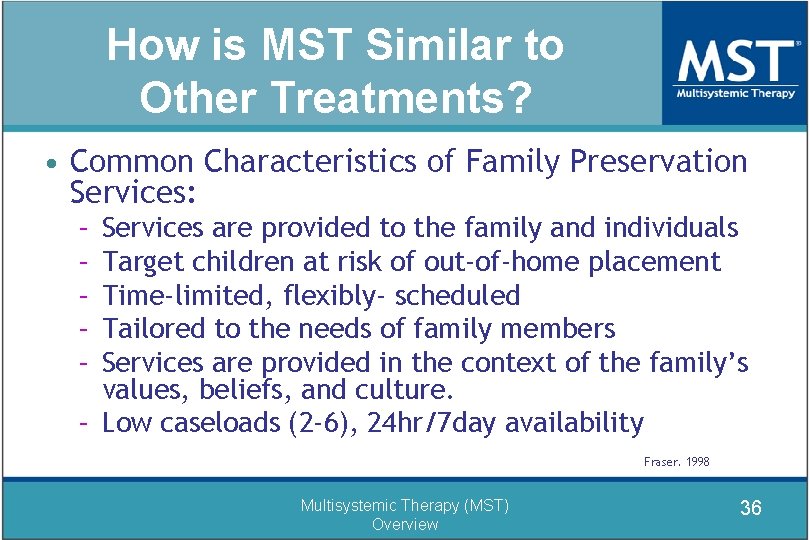
How is MST Similar to Other Treatments? • Common Characteristics of Family Preservation Services: – – – Services are provided to the family and individuals Target children at risk of out‐of‐home placement Time‐limited, flexibly‐ scheduled Tailored to the needs of family members Services are provided in the context of the family’s values, beliefs, and culture. – Low caseloads (2‐ 6), 24 hr/7 day availability Fraser. 1998 Multisystemic Therapy (MST) Overview 36
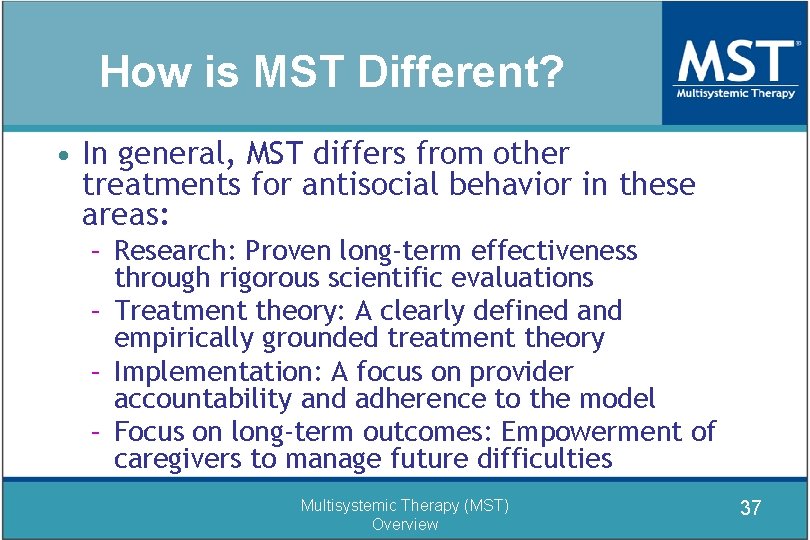
How is MST Different? • In general, MST differs from other treatments for antisocial behavior in these areas: – Research: Proven long‐term effectiveness through rigorous scientific evaluations – Treatment theory: A clearly defined and empirically grounded treatment theory – Implementation: A focus on provider accountability and adherence to the model – Focus on long‐term outcomes: Empowerment of caregivers to manage future difficulties Multisystemic Therapy (MST) Overview 37
- Slides: 37