
Multistage Transistor Amplifiers Introduction The output from a

- Slides: 20
Multistage Transistor Amplifiers
Introduction �The output from a single amplifier is generally insufficient to drive an output device. In other words, the gain of a single amplifier is inadequate for practical purposes. Consequently, additional amplification over two or three stages is necessary.
�To achieve this, the output of each amplifier is coupled in some way to the input of the next stage. The resulting system is referred to as the multistage amplifier. In fact, a multistage amplifier consists of single amplifiers in which output of first stage is connected to the input of the second stage through a suitable coupling device and so on.
Depending upon the coupling device used, multistage amplifiers are classified as: �(i) R-C coupled amplifiers �(ii)Transformer amplifiers �(iii) coupled Direct coupled amplifiers.
R-C coupled amplifiers �The R-C coupled amplifiers employ R-C coupling and are generally used for voltage amplification because of very little distortion.
Transformer coupled amplifiers �The transformer coupled amplifiers employ transformer coupling and are generally used for power amplification because transformer permits excellent impedance matching.
Direct coupled amplifiers �in direct coupled amplifiers, one stage is directly coupled to the next stage without any intervening coupling device. Such type of coupling is used for amplifying extremely low frequency signals because the electrical sizes of capacitors and transformers become very large at extremely low frequencies.
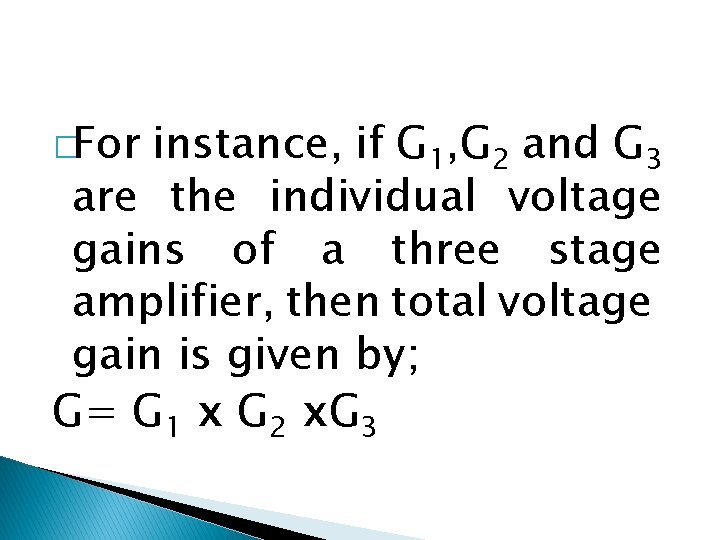
Important Terms Gain It is the ratio of output electrical quantity to the input of the amplifier. Accordingly; it can be current gain, voltage or power. The gain of a multistage amplifier is equal to the product of gains of individual stages.
�For instance, if G 1, G 2 and G 3 are the individual voltage gains of a three stage amplifier, then total voltage gain is given by; G= G 1 x G 2 x. G 3
The gain of an amplifier can be expressed as a number or in decibel. The latter method is the practical way of expressing the gain of an amplifier. It is because the unit ‘decibel’ is a logarithmic unit and tallies with human ear response.
Frequency response �It is the curve between voltage gain and signal frequency of an amplifier. The gain of the amplifier changes with signal frequency because the values of capacitive and inductive reactance of the circuit elements change with the frequency.
�An amplifier is said to have good frequency response if the gain remains uniform over a considerable range of signal frequency.
�The frequency response of R-C coupling is excellent because gain remains constant over the audio frequency (i. e. 20 Hz to 20 KHz) range. On the other hand, the frequency response of a transformer coupling is poor i. e
�. its gain varies considerably with frequency. It is for this reason that transformer coupling is not used in the initial stages of a multistage amplifier.
�its gain varies considerably with frequency. It is for this reason that transformer coupling is not used in the initial stages of a multistage amplifier.
�An amplifier is said to have good frequency response if the gain remains uniform over a considerable range of signal frequency.
Bandwidth �. The range of frequency over which the voltage gain is equal to or greater than 70. 7% of maximum gain is called “bandwidth”.
�There are two frequencies, called ‘lower cut-off’ and ‘upper cut-off’ frequency at which gain is exactly 70. 7% of maximum gain. If these values are represented by f 1 and f 2 respectively, then ‘bandwidth’ = f 1 to f 2. For distortion less amplification, it is important that signal frequency range must be within the bandwidth of the amplifier.
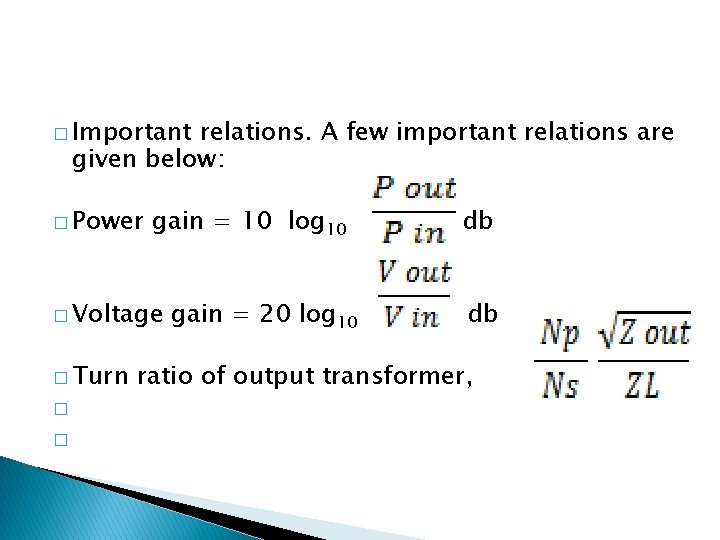
� Important relations. A few important relations are given below: � Power gain = 10 log 10 � Voltage � Turn � � gain = 20 log 10 db db ratio of output transformer,