
Multistack Stepper Motor q Multistack variablereluctancetype stepper motors
Multistack Stepper Motor q Multistack variable-reluctance-type stepper motors are widely used to give smaller step sizes. q The motor is divided along its axial length into magnetically isolated sections ("stacks"), and each of these sections can be excited by a separate winding ("phase"). q Three-phase arrangements are most common, but motors with up to seven stacks and phases are available.
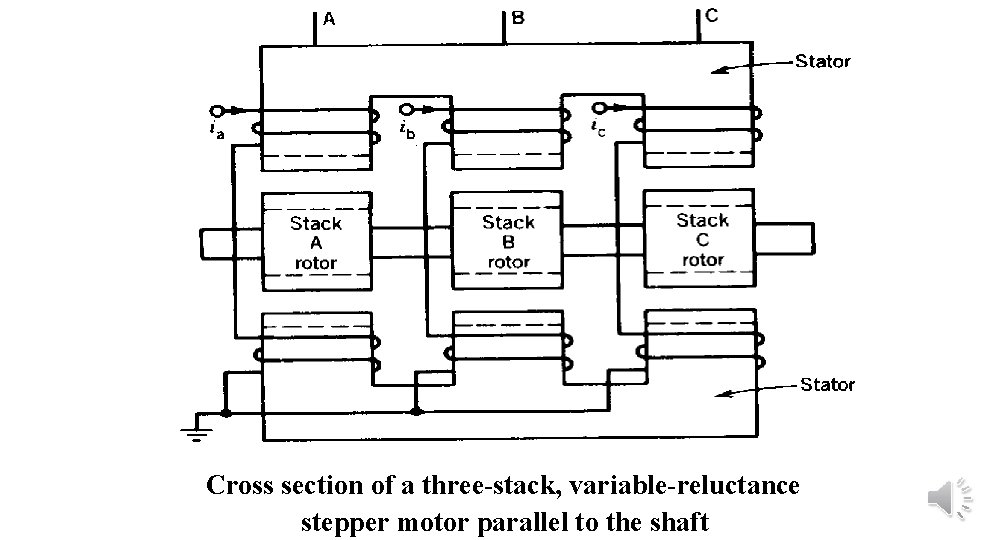
Cross section of a three-stack, variable-reluctance stepper motor parallel to the shaft
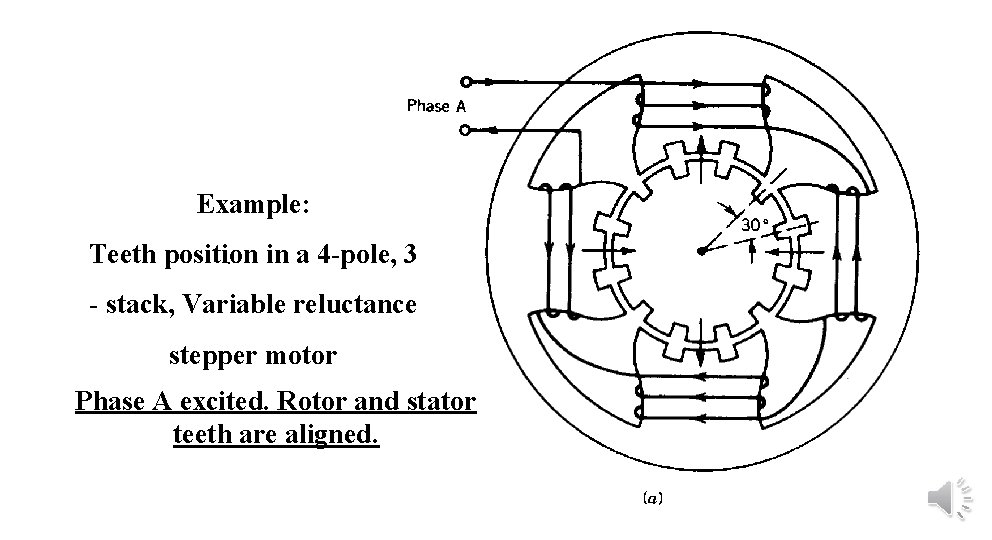
Example: Teeth position in a 4 -pole, 3. - stack, Variable reluctance stepper motor Phase A excited. Rotor and stator teeth are aligned.
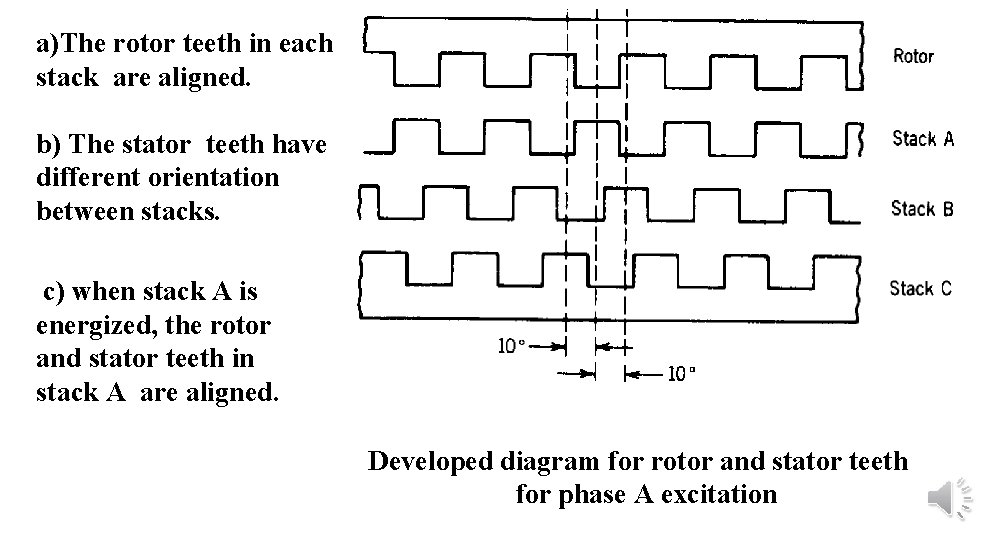
a)The rotor teeth in each stack are aligned. b) The stator teeth have different orientation between stacks. c) when stack A is energized, the rotor and stator teeth in stack A are aligned. Developed diagram for rotor and stator teeth for phase A excitation
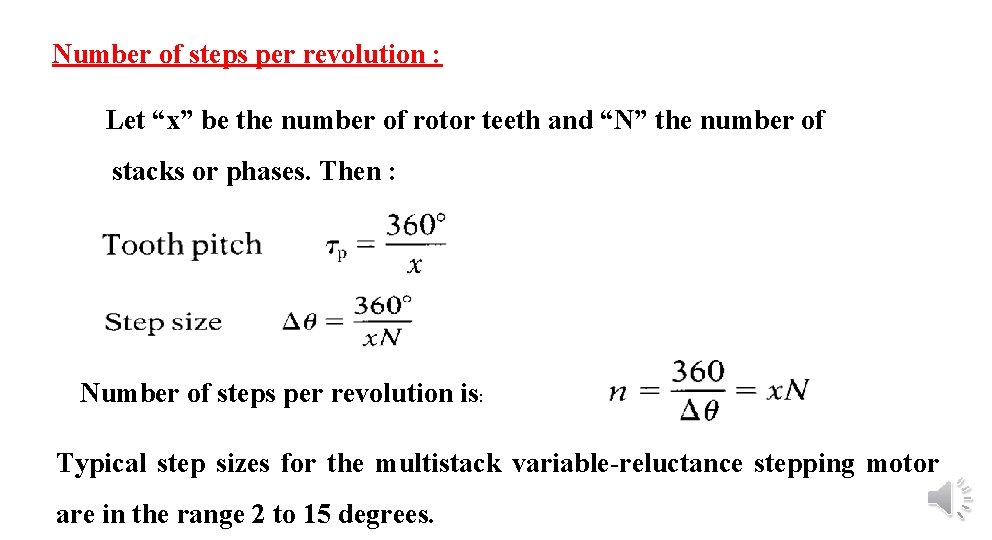
Number of steps per revolution : Let “x” be the number of rotor teeth and “N” the number of stacks or phases. Then : Number of steps per revolution is: Typical step sizes for the multistack variable-reluctance stepping motor are in the range 2 to 15 degrees.
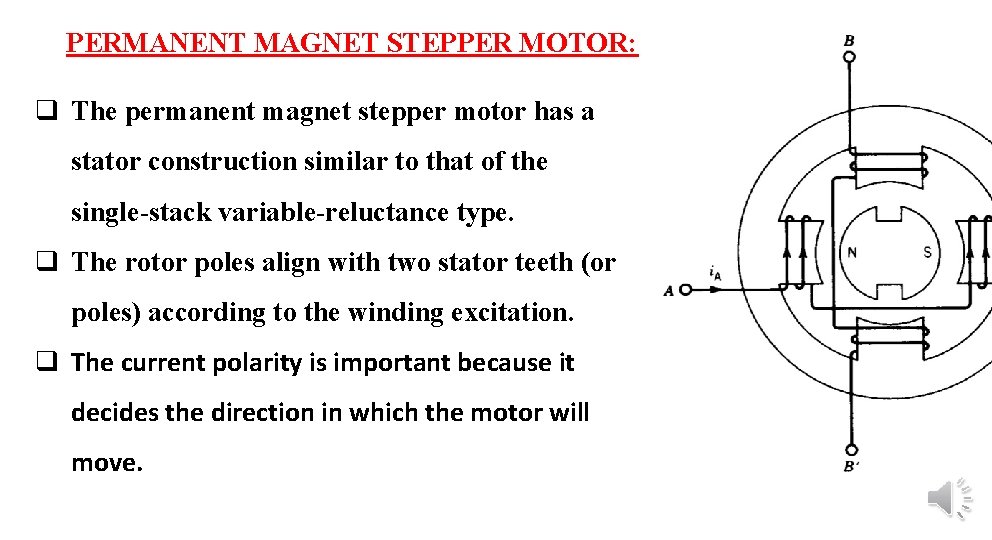
PERMANENT MAGNET STEPPER MOTOR: q The permanent magnet stepper motor has a stator construction similar to that of the single-stack variable-reluctance type. q The rotor poles align with two stator teeth (or poles) according to the winding excitation. q The current polarity is important because it decides the direction in which the motor will move.
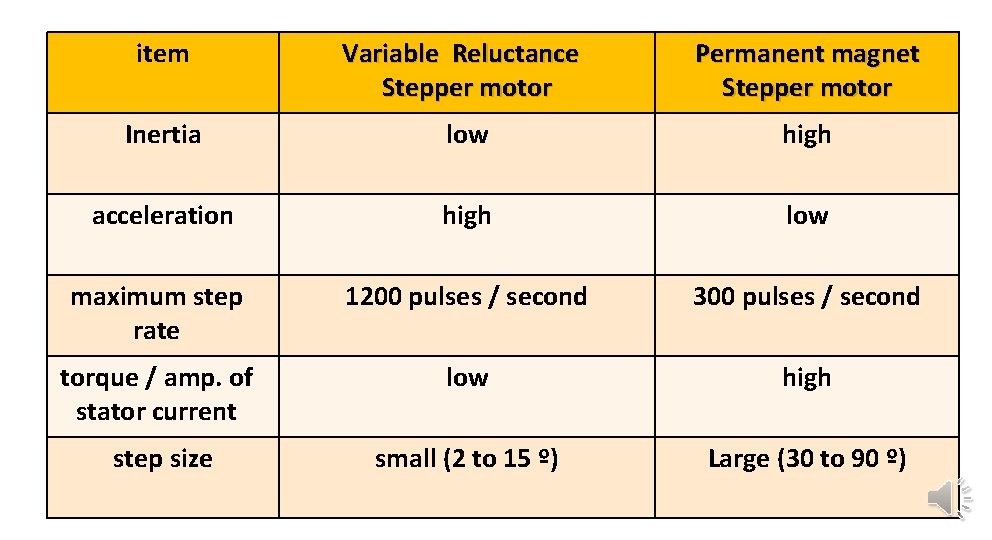
item Variable Reluctance Stepper motor Permanent magnet Stepper motor Inertia low high acceleration high low maximum step rate 1200 pulses / second 300 pulses / second torque / amp. of stator current low high step size small (2 to 15 º) Large (30 to 90 º)
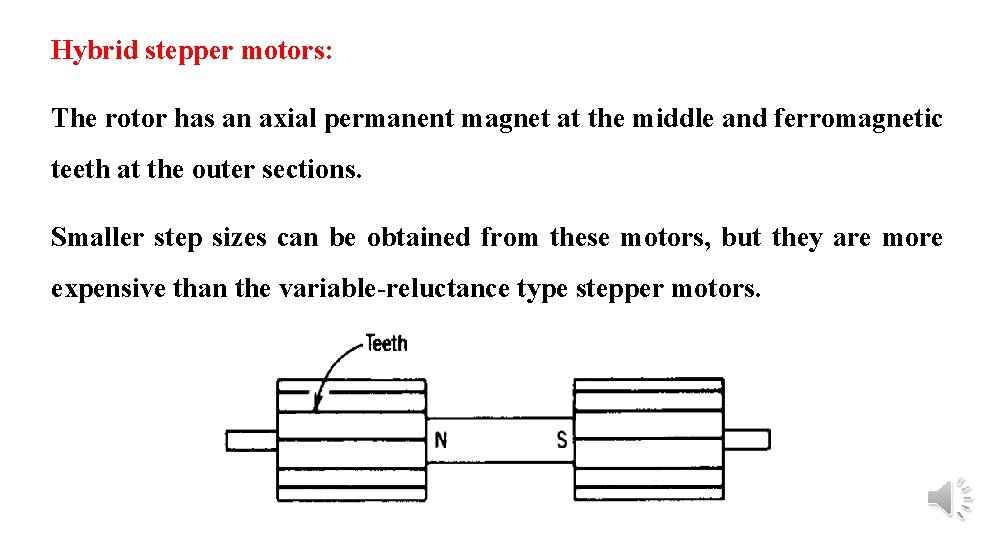
Hybrid stepper motors: The rotor has an axial permanent magnet at the middle and ferromagnetic teeth at the outer sections. Smaller step sizes can be obtained from these motors, but they are more expensive than the variable-reluctance type stepper motors.
DRIVE CIRCUITS: q The command signals for a stepper motor are normally obtained from low power logic circuits. q A typical variable-reluctance stepper motor producing a torque of 1. 2 N. m has a rated winding excitation of 5 V and 3 A. q power amplification stages are required between the low-power command signals and the high-power stepper motors. q The phase currents need only be switched on or off and current polarity is irrelevant for torque production.
q Permanent magnet stepper motors require two phases, and the current polarity is important. Unipolar Drive Circuit: q The following figure shows a simple unipolar drive circuit suitable for a three-phase variable-reluctance stepper motor. q Each phase winding is excited by a separate drive circuit. q A phase winding is excited by applying a control signal to the base of the transistor. q The control signal may require several stages of amplification before it attains the required current level for the base of the transistor.
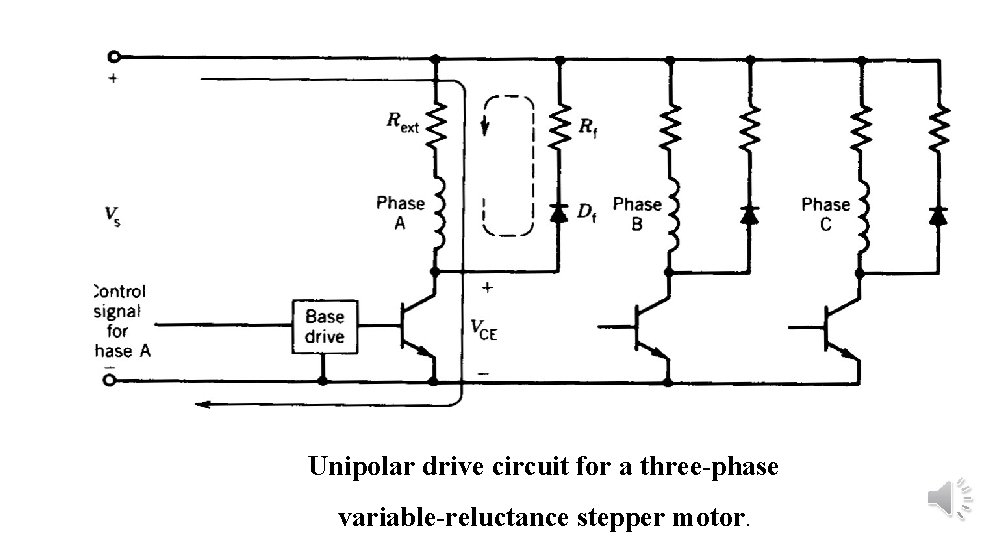
Unipolar drive circuit for a three-phase variable-reluctance stepper motor.
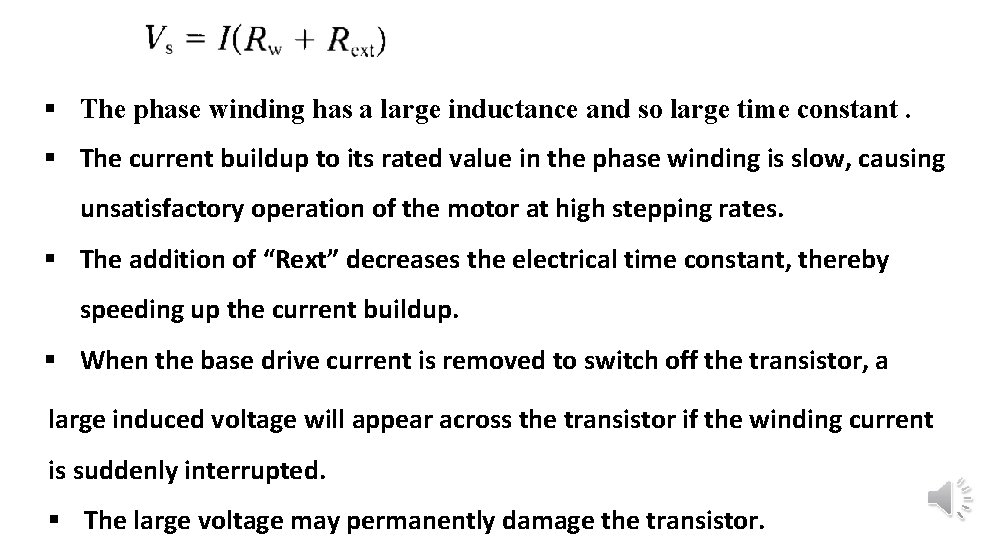
§ The phase winding has a large inductance and so large time constant. § The current buildup to its rated value in the phase winding is slow, causing unsatisfactory operation of the motor at high stepping rates. § The addition of “Rext” decreases the electrical time constant, thereby speeding up the current buildup. § When the base drive current is removed to switch off the transistor, a large induced voltage will appear across the transistor if the winding current is suddenly interrupted. § The large voltage may permanently damage the transistor.
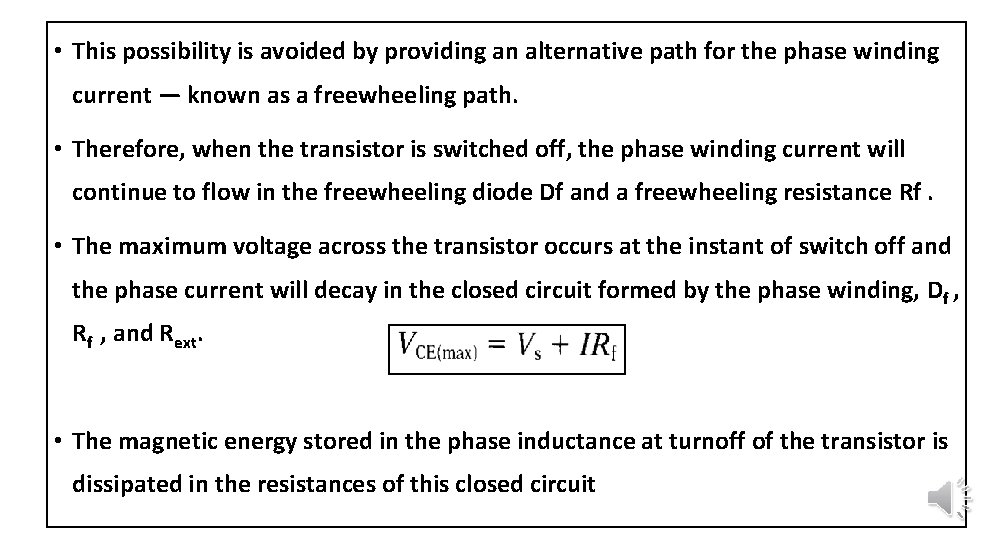
• This possibility is avoided by providing an alternative path for the phase winding current — known as a freewheeling path. • Therefore, when the transistor is switched off, the phase winding current will continue to flow in the freewheeling diode Df and a freewheeling resistance Rf. • The maximum voltage across the transistor occurs at the instant of switch off and the phase current will decay in the closed circuit formed by the phase winding, Df , Rf , and Rext. • The magnetic energy stored in the phase inductance at turnoff of the transistor is dissipated in the resistances of this closed circuit
Example A 3 -phase variable-reluctance stepper motor has the following parameters: Rw = 1 Ω Lw = 30 m. H, average phase winding inductance I = 3 A, rated winding current Design a simple unipolar drive circuit such that the electrical time constant is 2 msec at phase turn-on and 1 msec at turnoff. The stepping rate is 300 steps per second.
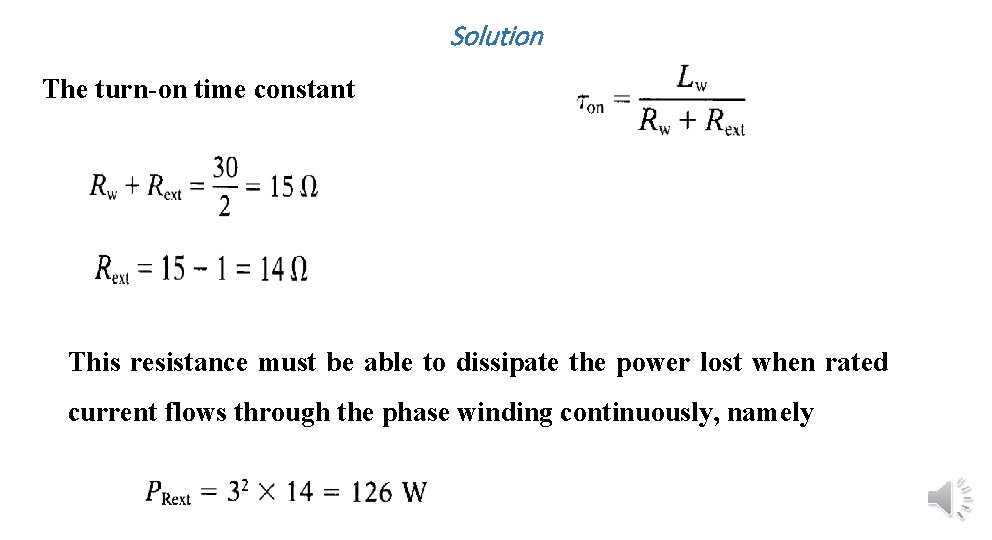
Solution The turn-on time constant This resistance must be able to dissipate the power lost when rated current flows through the phase winding continuously, namely
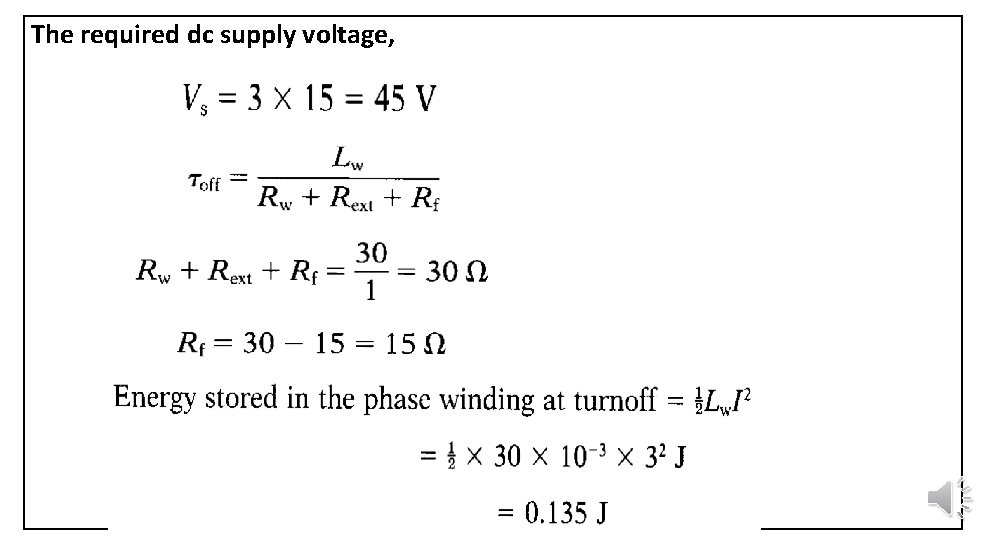
The required dc supply voltage,
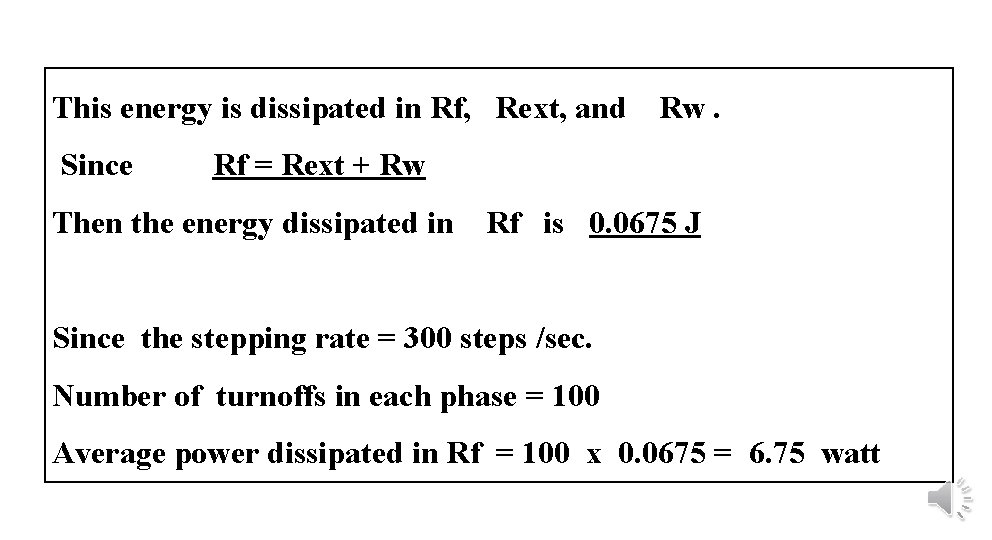
This energy is dissipated in Rf, Rext, and Since Rw. Rf = Rext + Rw Then the energy dissipated in Rf is 0. 0675 J Since the stepping rate = 300 steps /sec. Number of turnoffs in each phase = 100 Average power dissipated in Rf = 100 x 0. 0675 = 6. 75 watt
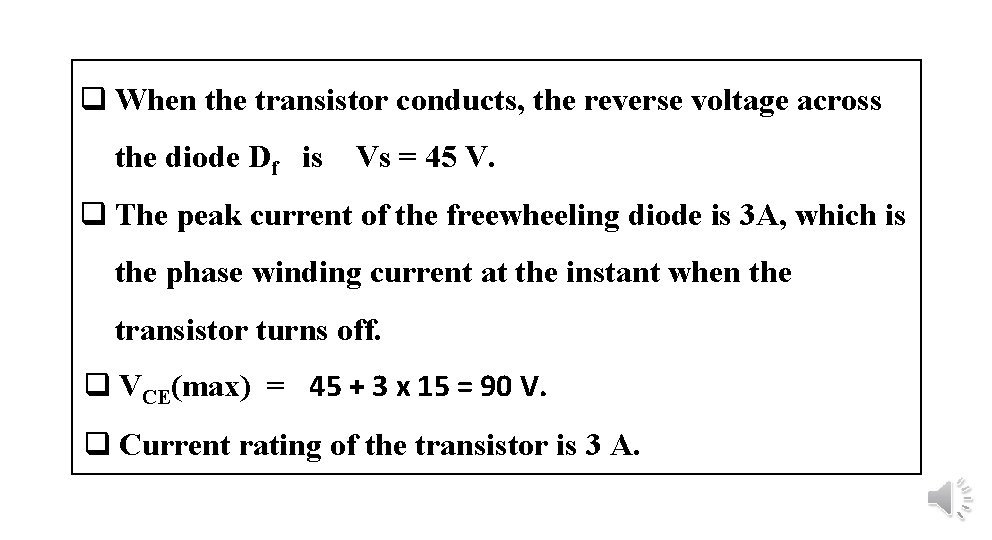
q When the transistor conducts, the reverse voltage across the diode Df is Vs = 45 V. q The peak current of the freewheeling diode is 3 A, which is the phase winding current at the instant when the transistor turns off. q VCE(max) = 45 + 3 x 15 = 90 V. q Current rating of the transistor is 3 A.
- Slides: 18