
Multispectral Image Invariant to Illumination Colour Strength and

- Slides: 25
Multispectral Image Invariant to Illumination Colour, Strength, and Shading Mark S. Drew and Amin Yazdani Salekdeh School of Computing Science, Simon Fraser University, Vancouver, BC, Canada {mark/ayazdani}@cs. sfu. ca
Table of Contents Introduction RGB Illumination Invariant Multispectral Image Formation Synthetic Multispectral Images Measured Multispectral Images Conclusion 2
Introduction Invariant Images – RGB: Information from one pixel, with calibration Information from all pixels – use entropy New Multispectral data: Information from one pixel without calibration, but knowledge of narrowband sensors peak wavelengths 3
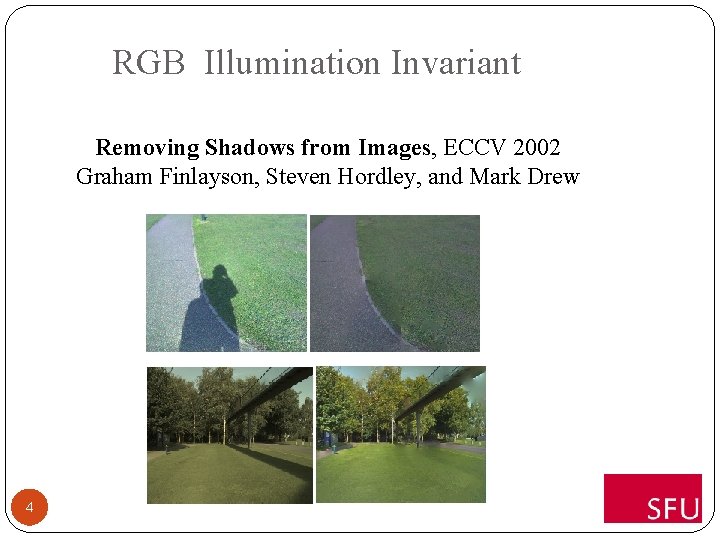
RGB Illumination Invariant Removing Shadows from Images, ECCV 2002 Graham Finlayson, Steven Hordley, and Mark Drew 4
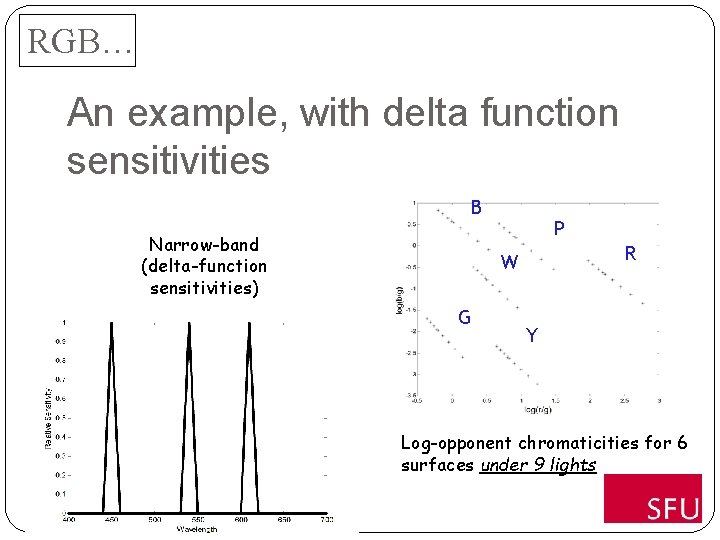
RGB… An example, with delta function sensitivities B Narrow-band (delta-function sensitivities) P R W G Y Log-opponent chromaticities for 6 surfaces under 9 lights
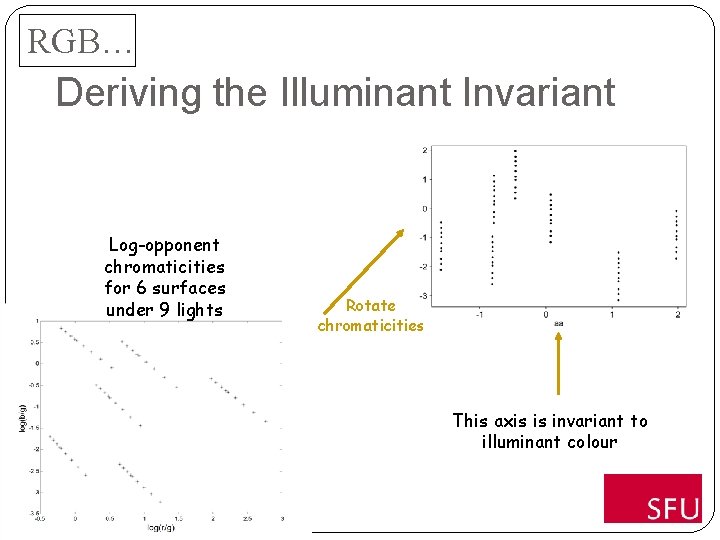
RGB… Deriving the Illuminant Invariant Log-opponent chromaticities for 6 surfaces under 9 lights Rotate chromaticities This axis is invariant to illuminant colour
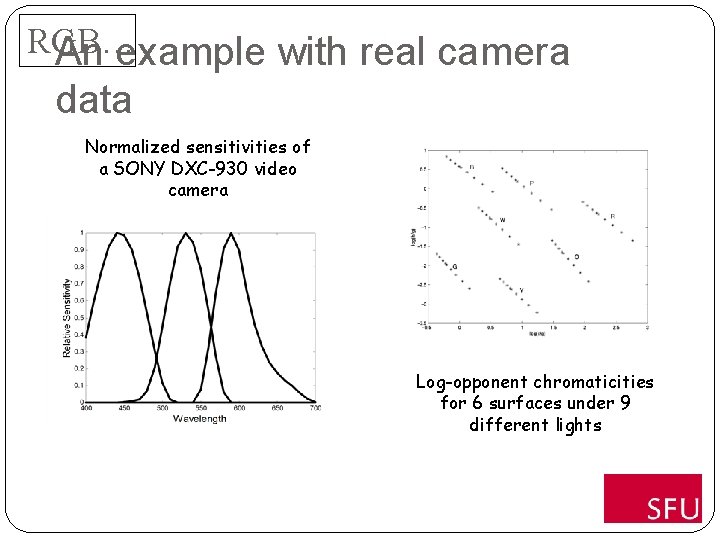
RGB… An example with real camera data Normalized sensitivities of a SONY DXC-930 video camera Log-opponent chromaticities for 6 surfaces under 9 different lights
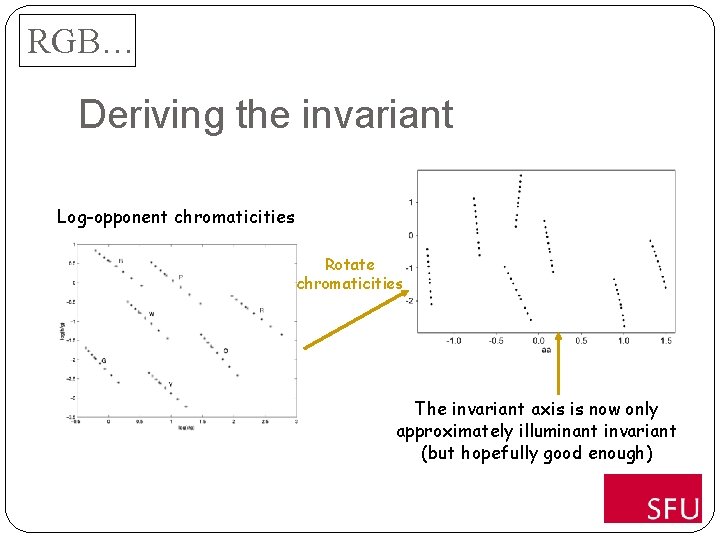
RGB… Deriving the invariant Log-opponent chromaticities Rotate chromaticities The invariant axis is now only approximately illuminant invariant (but hopefully good enough)
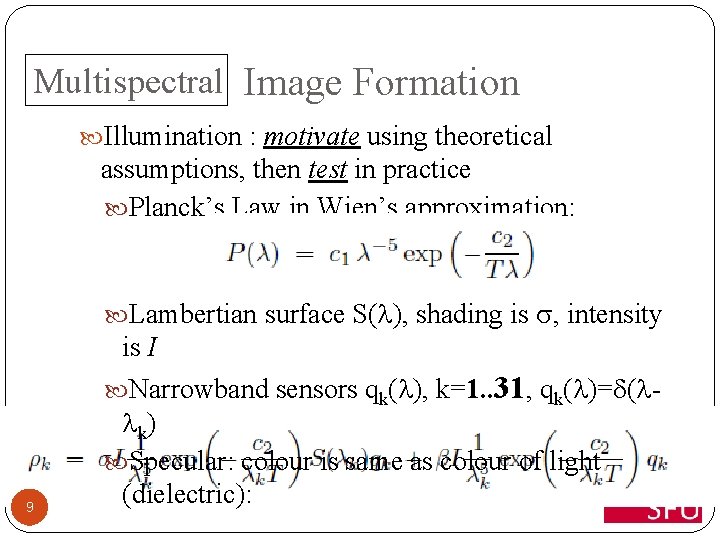
Multispectral Image Formation Illumination : motivate using theoretical assumptions, then test in practice Planck’s Law in Wien’s approximation: Lambertian surface S( ), shading is , intensity 9 is I Narrowband sensors qk( ), k=1. . 31, qk( )= ( k) Specular: colour is same as colour of light (dielectric):
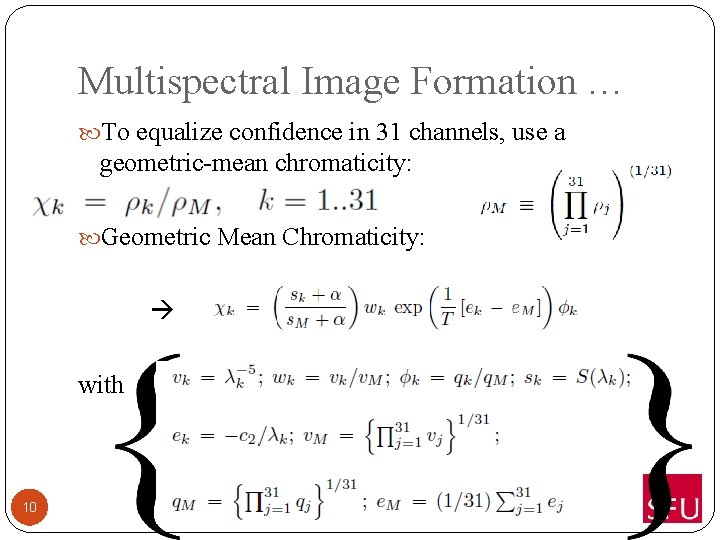
Multispectral Image Formation … To equalize confidence in 31 channels, use a geometric-mean chromaticity: Geometric Mean Chromaticity: with 10
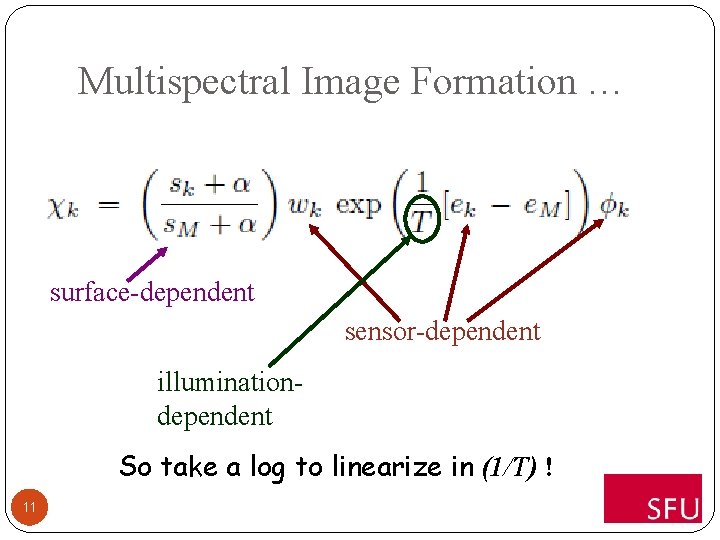
Multispectral Image Formation … surface-dependent sensor-dependent illuminationdependent So take a log to linearize in (1/T) ! 11
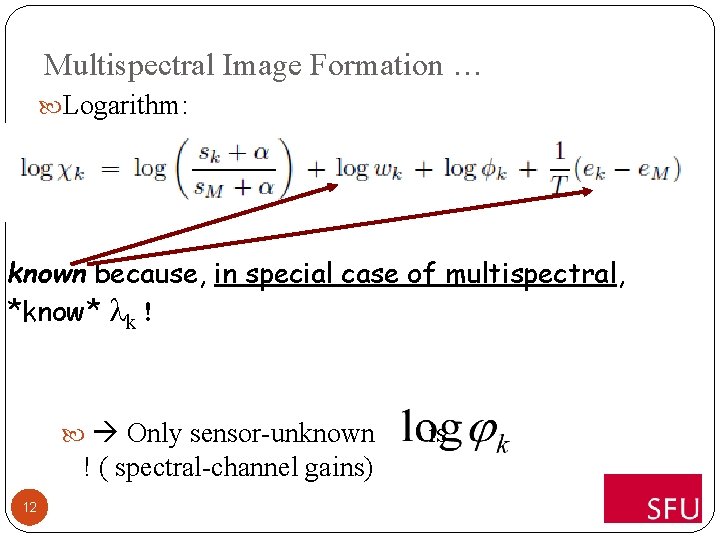
Multispectral Image Formation … Logarithm: known because, in special case of multispectral, *know* k ! Only sensor-unknown ! ( spectral-channel gains) 12 is
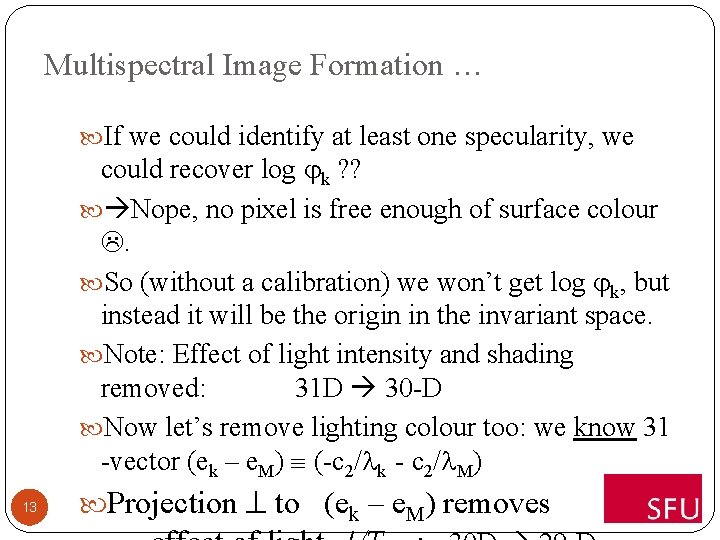
Multispectral Image Formation … If we could identify at least one specularity, we could recover log k ? ? Nope, no pixel is free enough of surface colour . So (without a calibration) we won’t get log k, but instead it will be the origin in the invariant space. Note: Effect of light intensity and shading removed: 31 D 30 -D Now let’s remove lighting colour too: we know 31 -vector (ek – e. M) (-c 2/ k - c 2/ M) 13 Projection to (ek – e. M) removes
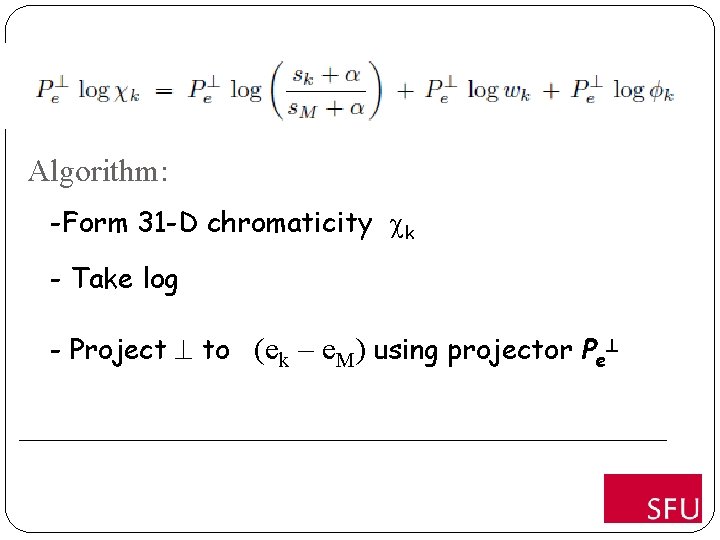
Algorithm: -Form 31 -D chromaticity k - Take log - Project to (ek – e. M) using projector Pe
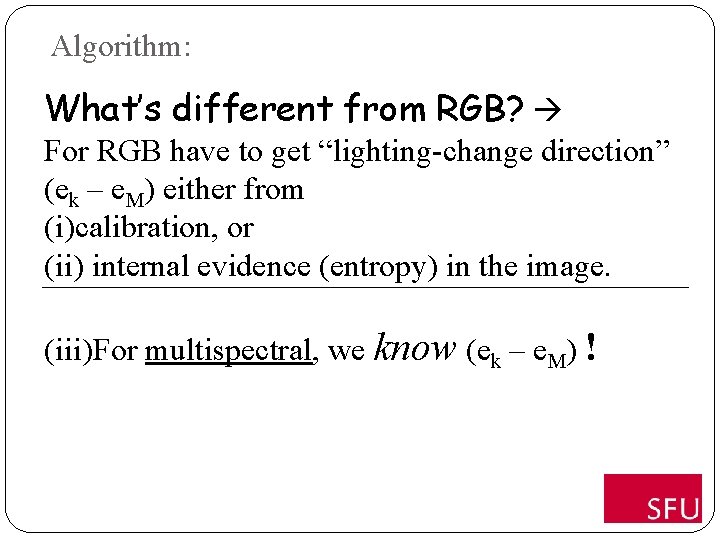
Algorithm: What’s different from RGB? For RGB have to get “lighting-change direction” (ek – e. M) either from (i)calibration, or (ii) internal evidence (entropy) in the image. (iii)For multispectral, we know (ek – e. M) !
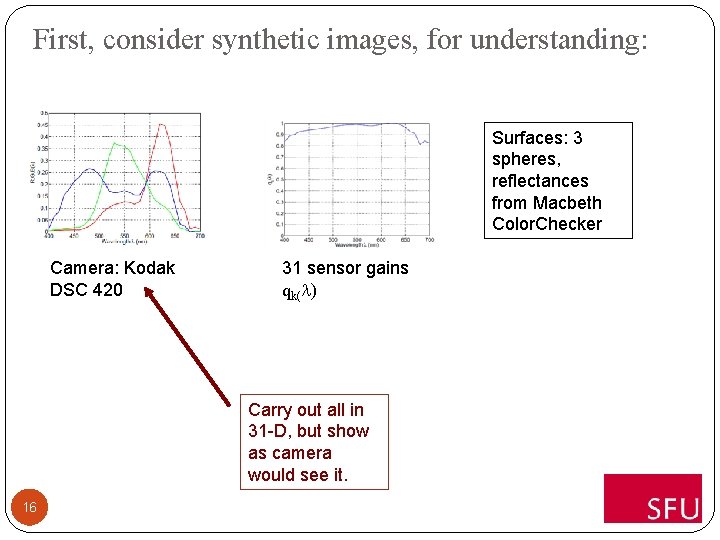
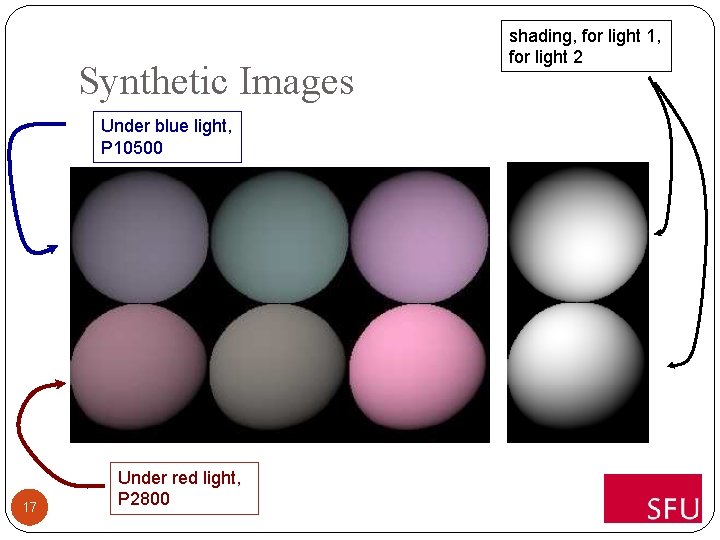
First, consider synthetic images, for understanding: Surfaces: 3 spheres, reflectances from Macbeth Color. Checker Camera: Kodak DSC 420 31 sensor gains qk( ) Carry out all in 31 -D, but show as camera would see it. 16
Synthetic Images Under blue light, P 10500 17 Under red light, P 2800 shading, for light 1, for light 2
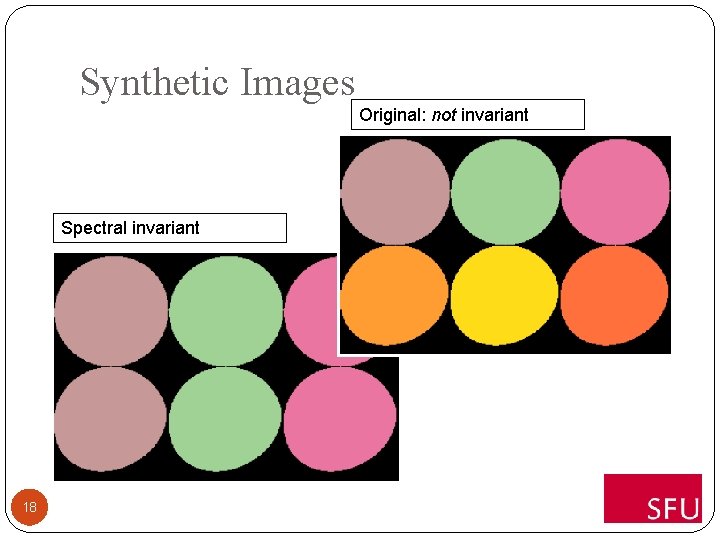
Synthetic Images Original: not invariant Spectral invariant 18
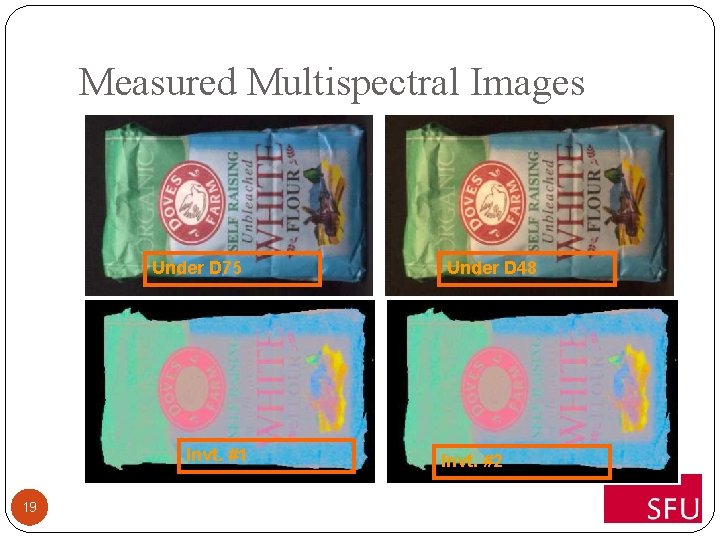
Measured Multispectral Images Under D 75 Invt. #1 19 Under D 48 Invt. #2
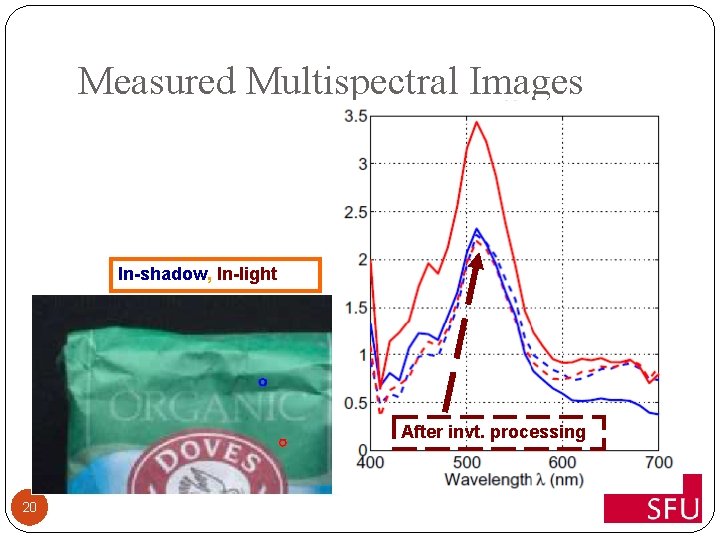
Measured Multispectral Images In-shadow, In-light After invt. processing 20
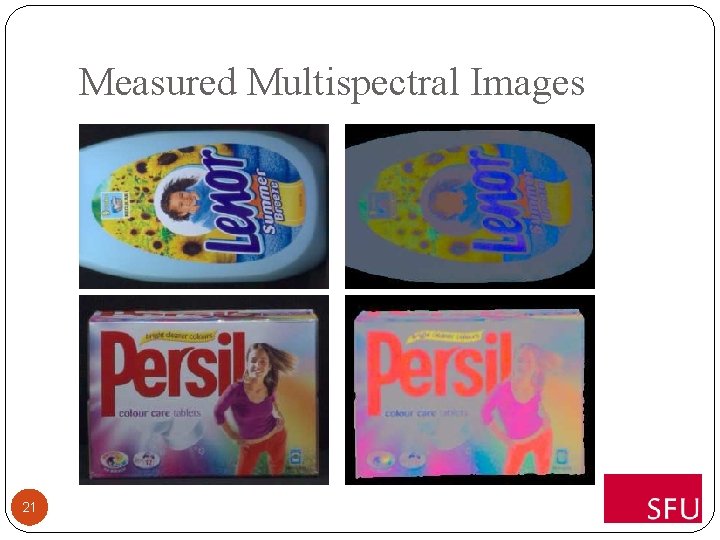
Measured Multispectral Images 21
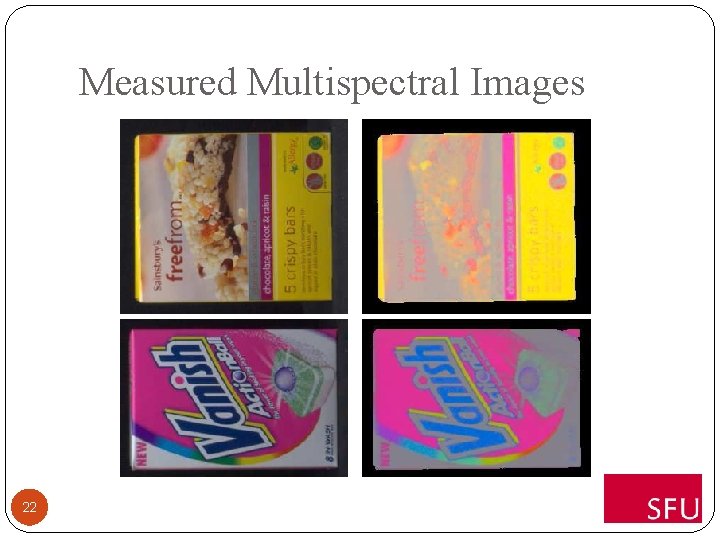
Measured Multispectral Images 22
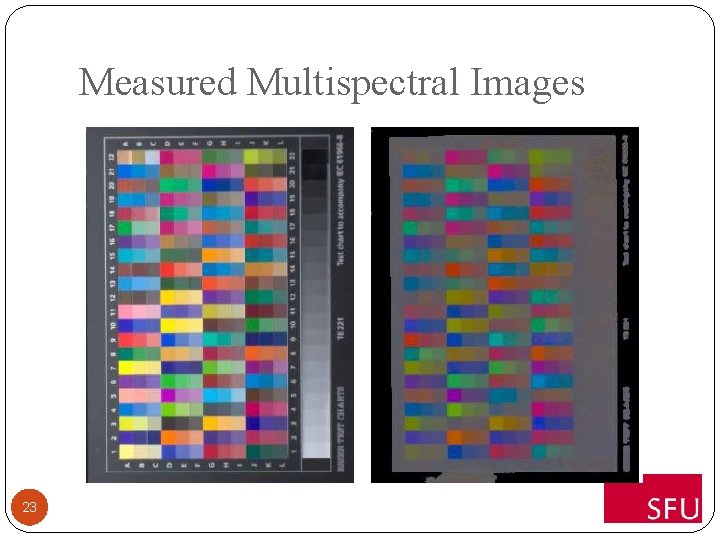
Measured Multispectral Images 23
Conclusion A novel method for producing illumination invariant, multispectral image Successful in removing effects of Illuminant strength, colour, and shading • Next: removing shadows from 24 remote-sensing data.
Thanks! Funding: Natural Sciences and Engineering Research Council of Canada 25 Multispectral Images Invariant to Illumination Colour, Strength and Shading