
Multispectral and Surface Sampling approach to Gold Exploration
- Slides: 34
Multispectral and Surface Sampling approach to Gold Exploration in Marble Bar, Australia Kevin D. Box Advisor: Dr. Jay Parish GEOG 596 A Second Spring Semester
General Outline • Project Objective • Background – – Criteria for economic success Deposit Type Deposition Area of interest • Methodology – Data – Work flow – Ratios • Potential Exploration Targets • Moving Forward
Project Objective • Utilize remote sensing techniques to identify potential gold bearing conglomerates within the Marble Bar Basin. • Actively explore targets, identified from remote sensing, using field work and surface sampling to validate success and failures of remote sensing in exploration.
Background • Economic Gold Deposits – Grade • Must be high enough to warrant mining – Tons • Must have enough gold to warrant mining – Geometry • Deposit must be large enough to warrant cost of mill and extraction methods – Depth • With excessive depth comes excessive waste and cost The four combined factors create a formula that is the primary criteria for whether a deposit can economically be mined at a profit. Many deposits do not meet these criteria to be economically profitable.
Gold Deposits • Disseminated – Very fine grained gold dispersed through the rocks. Large deposits and usually low grade but still economically feasible. • Carlin, Nevada • Cripple Creek, Colorado • Homestake, South Dakota • Vein (Lode) – High grade concentration as a result of hydrothermal solutions being forced through faults or fractures. Very high concentrations within a tight space. • Sleeper, Nevada • Mother Lode, California
Gold Deposits • Placer – Gold deposition as a result of weathering and being moved by water. These are usually formed with alluvial and beach systems. • California Gold Rush • Klondike, Canada • Nome, Alaska • Paleoplacer – “Old” placers. Old placers that have been fossilized into rock. Deposited in a sheet and can be kilometers long. Gold can be disseminated and crystalline. • Witwatersrand, South Africa – 1. 5 billion ounces – Over 4 km deep
Paleoplacer Gold Origin • Multiple Theories – – Placer Model • Occurred during orogenic formation – Hydrothermal Model • Sediments were deposited and fluids were hydrothermally pumped into the sediment seams then compressed to reform as rock – Microbial Model • BUGS! – Gold concentrations in seawater during the time of deposition could have ranged from 4 – 40 ppb (compared to today of 4 ppt) – Microbes play a role in exhaling gold from seawater and creating pyrite in the process. Also could explain the formation of the high grade carbon leaders in the Witwatersrand deposit
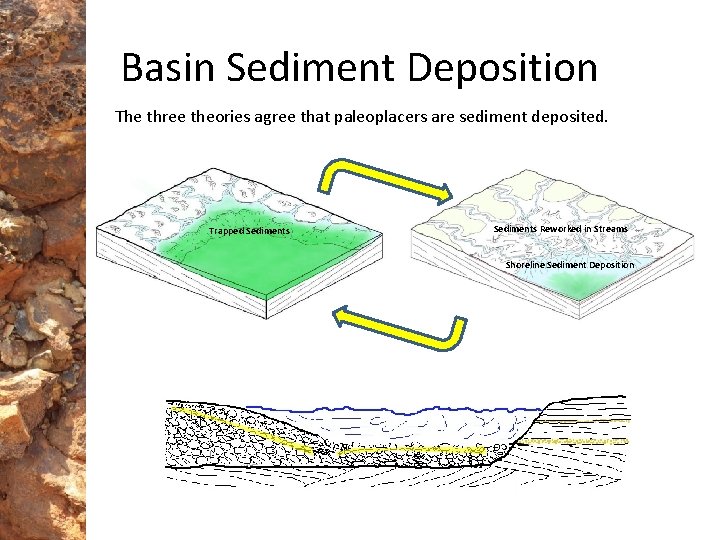
Basin Sediment Deposition The three theories agree that paleoplacers are sediment deposited. Trapped Sediments Reworked in Streams Shoreline Sediment Deposition
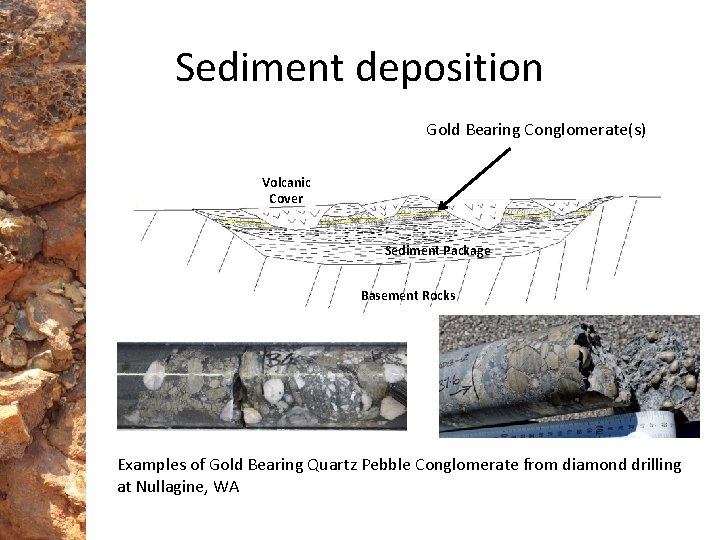
Sediment deposition Gold Bearing Conglomerate(s) Volcanic Cover Sediment Package Basement Rocks Examples of Gold Bearing Quartz Pebble Conglomerate from diamond drilling at Nullagine, WA
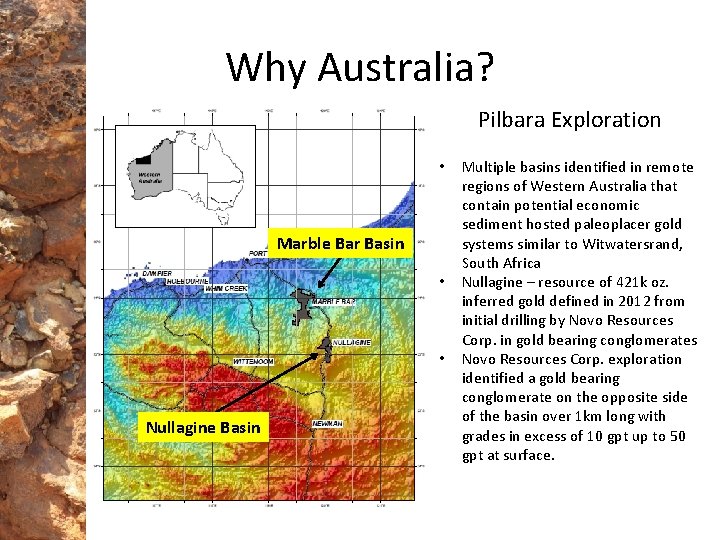
Why Australia? Pilbara Exploration • Marble Bar Basin • • Nullagine Basin Multiple basins identified in remote regions of Western Australia that contain potential economic sediment hosted paleoplacer gold systems similar to Witwatersrand, South Africa Nullagine – resource of 421 k oz. inferred gold defined in 2012 from initial drilling by Novo Resources Corp. in gold bearing conglomerates Novo Resources Corp. exploration identified a gold bearing conglomerate on the opposite side of the basin over 1 km long with grades in excess of 10 gpt up to 50 gpt at surface.
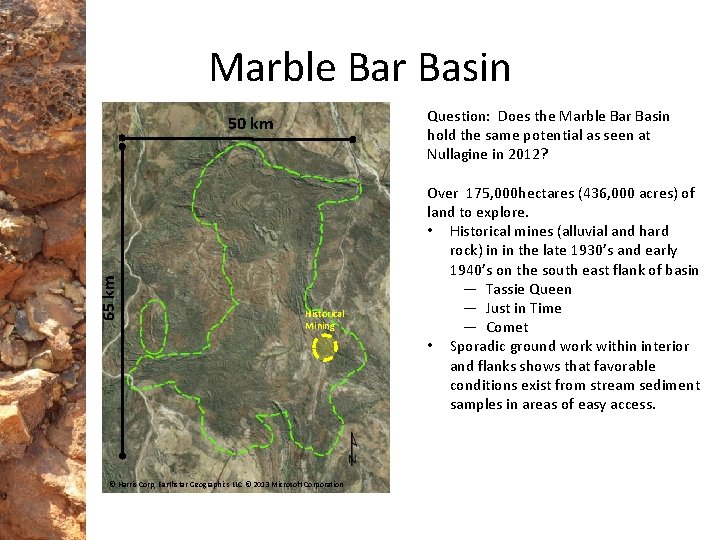
Marble Bar Basin Question: Does the Marble Bar Basin hold the same potential as seen at Nullagine in 2012? 65 km 50 km Historical Mining © Harris Corp, Earthstar Geographics LLC © 2013 Microsoft Corporation Over 175, 000 hectares (436, 000 acres) of land to explore. • Historical mines (alluvial and hard rock) in in the late 1930’s and early 1940’s on the south east flank of basin — Tassie Queen — Just in Time — Comet • Sporadic ground work within interior and flanks shows that favorable conditions exist from stream sediment samples in areas of easy access.
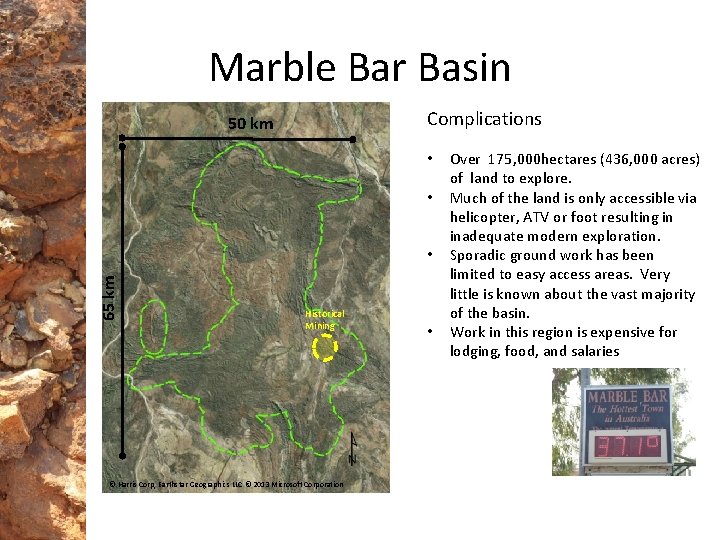
Marble Bar Basin Complications 50 km • • 65 km • Historical Mining © Harris Corp, Earthstar Geographics LLC © 2013 Microsoft Corporation • Over 175, 000 hectares (436, 000 acres) of land to explore. Much of the land is only accessible via helicopter, ATV or foot resulting in inadequate modern exploration. Sporadic ground work has been limited to easy access areas. Very little is known about the vast majority of the basin. Work in this region is expensive for lodging, food, and salaries
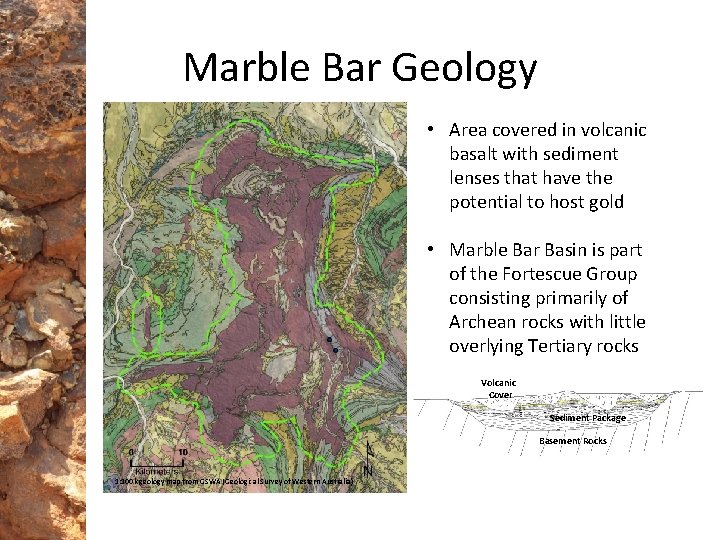
Marble Bar Geology • Area covered in volcanic basalt with sediment lenses that have the potential to host gold • Marble Bar Basin is part of the Fortescue Group consisting primarily of Archean rocks with little overlying Tertiary rocks Volcanic Cover Sediment Package Basement Rocks 1: 100 k geology map from GSWA (Geological Survey of Western Australia)
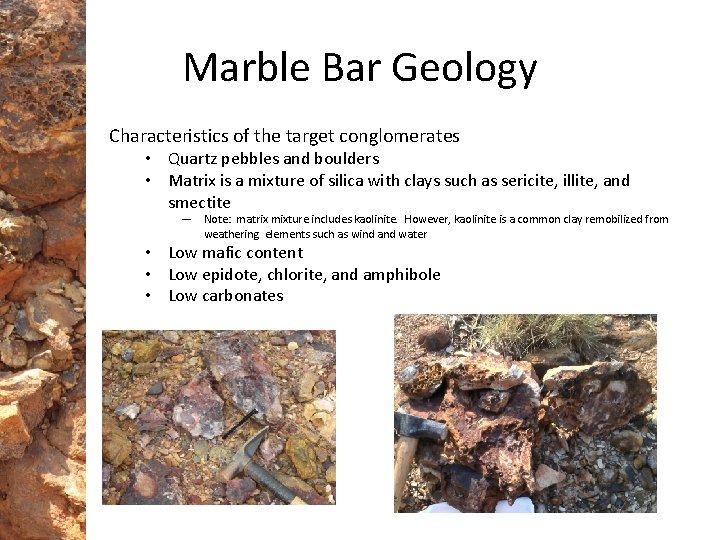
Marble Bar Geology Characteristics of the target conglomerates • Quartz pebbles and boulders • Matrix is a mixture of silica with clays such as sericite, illite, and smectite — Note: matrix mixture includes kaolinite. However, kaolinite is a common clay remobilized from weathering elements such as wind and water • Low mafic content • Low epidote, chlorite, and amphibole • Low carbonates
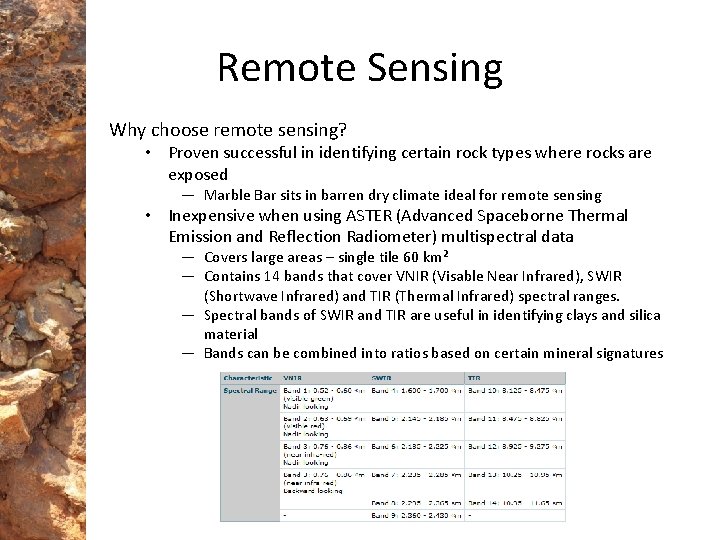
Remote Sensing Why choose remote sensing? • Proven successful in identifying certain rock types where rocks are exposed — Marble Bar sits in barren dry climate ideal for remote sensing • Inexpensive when using ASTER (Advanced Spaceborne Thermal Emission and Reflection Radiometer) multispectral data — Covers large areas – single tile 60 km² — Contains 14 bands that cover VNIR (Visable Near Infrared), SWIR (Shortwave Infrared) and TIR (Thermal Infrared) spectral ranges. — Spectral bands of SWIR and TIR are useful in identifying clays and silica material — Bands can be combined into ratios based on certain mineral signatures
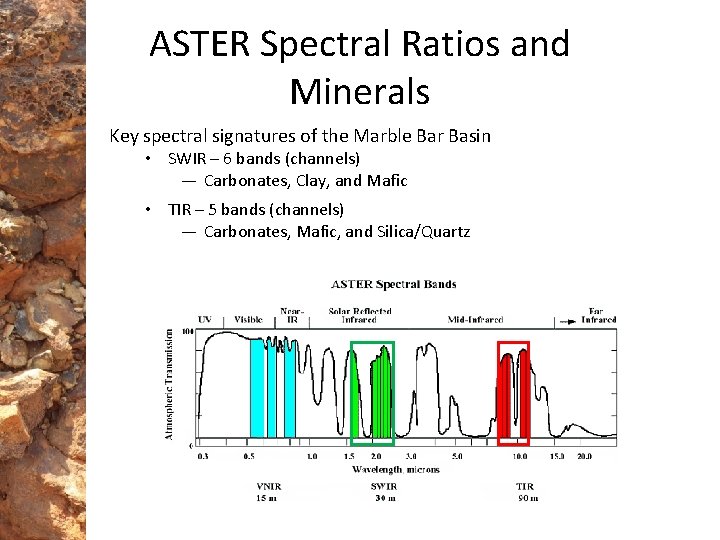
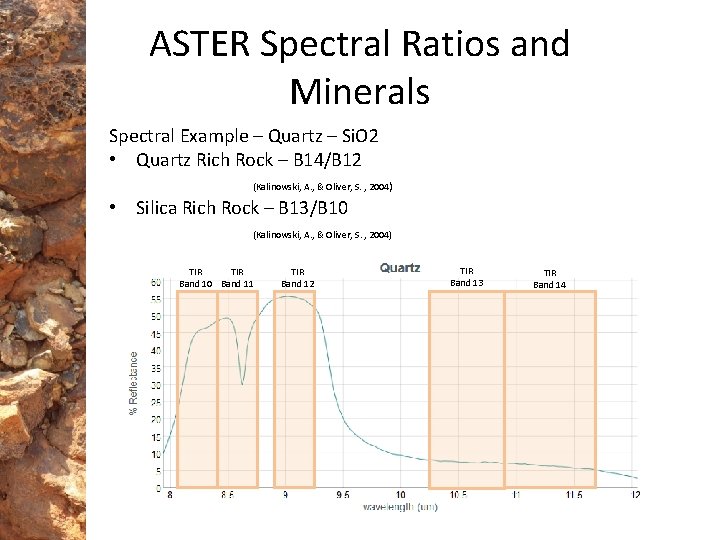
ASTER Spectral Ratios and Minerals Key spectral signatures of the Marble Bar Basin • SWIR – 6 bands (channels) — Carbonates, Clay, and Mafic • TIR – 5 bands (channels) — Carbonates, Mafic, and Silica/Quartz
ASTER Spectral Ratios and Minerals Spectral Example – Quartz – Si. O 2 • Quartz Rich Rock – B 14/B 12 (Kalinowski, A. , & Oliver, S. , 2004) • Silica Rich Rock – B 13/B 10 (Kalinowski, A. , & Oliver, S. , 2004) TIR Band 10 Band 11 TIR Band 12 TIR Band 13 TIR Band 14
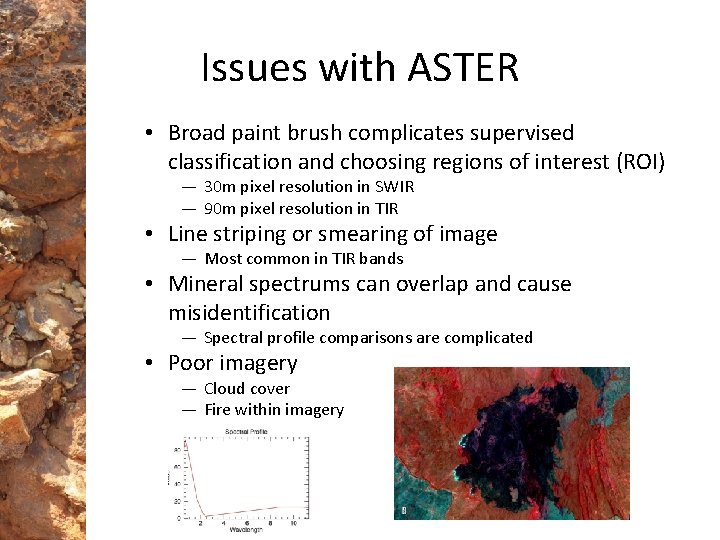
Issues with ASTER • Broad paint brush complicates supervised classification and choosing regions of interest (ROI) — 30 m pixel resolution in SWIR — 90 m pixel resolution in TIR • Line striping or smearing of image — Most common in TIR bands • Mineral spectrums can overlap and cause misidentification — Spectral profile comparisons are complicated • Poor imagery — Cloud cover — Fire within imagery
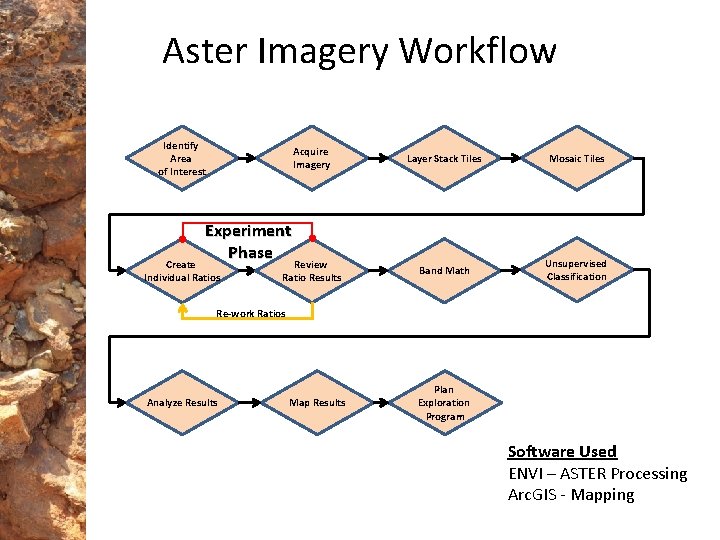
Aster Imagery Workflow Identify Area of Interest Acquire Imagery Layer Stack Tiles Mosaic Tiles Review Ratio Results Band Math Unsupervised Classification Experiment Phase Create Individual Ratios Re-work Ratios Analyze Results Map Results Plan Exploration Program Software Used ENVI – ASTER Processing Arc. GIS - Mapping
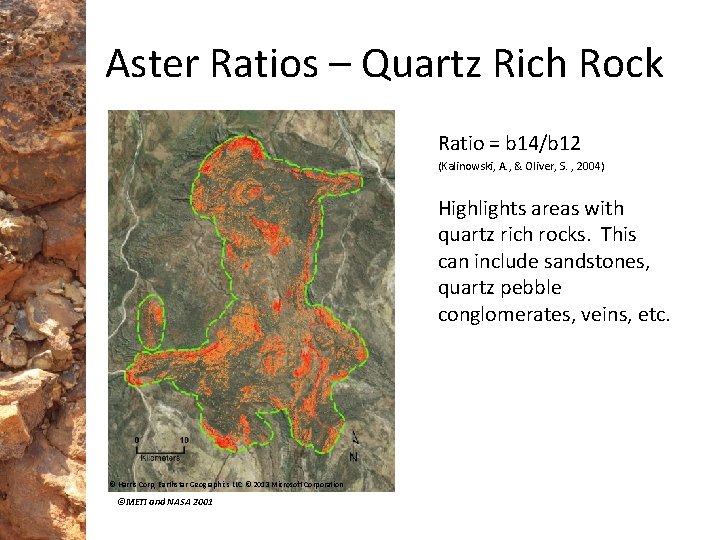
Aster Ratios – Quartz Rich Rock Ratio = b 14/b 12 (Kalinowski, A. , & Oliver, S. , 2004) Highlights areas with quartz rich rocks. This can include sandstones, quartz pebble conglomerates, veins, etc. © Harris Corp, Earthstar Geographics LLC © 2013 Microsoft Corporation ©METI and NASA 2001
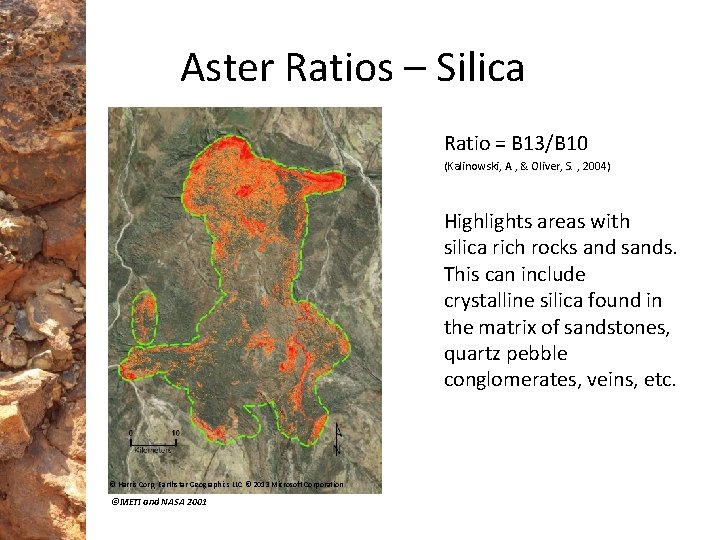
Aster Ratios – Silica Ratio = B 13/B 10 (Kalinowski, A. , & Oliver, S. , 2004) Highlights areas with silica rich rocks and sands. This can include crystalline silica found in the matrix of sandstones, quartz pebble conglomerates, veins, etc. © Harris Corp, Earthstar Geographics LLC © 2013 Microsoft Corporation ©METI and NASA 2001
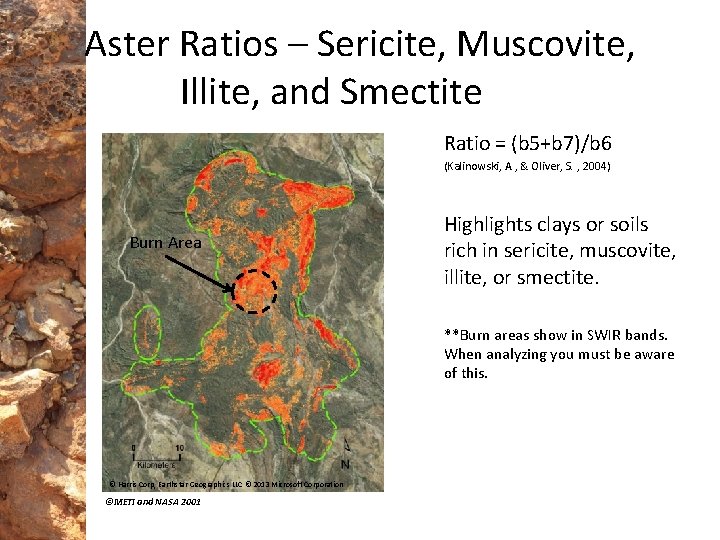
Aster Ratios – Sericite, Muscovite, Illite, and Smectite Ratio = (b 5+b 7)/b 6 (Kalinowski, A. , & Oliver, S. , 2004) Burn Area Highlights clays or soils rich in sericite, muscovite, illite, or smectite. **Burn areas show in SWIR bands. When analyzing you must be aware of this. © Harris Corp, Earthstar Geographics LLC © 2013 Microsoft Corporation ©METI and NASA 2001
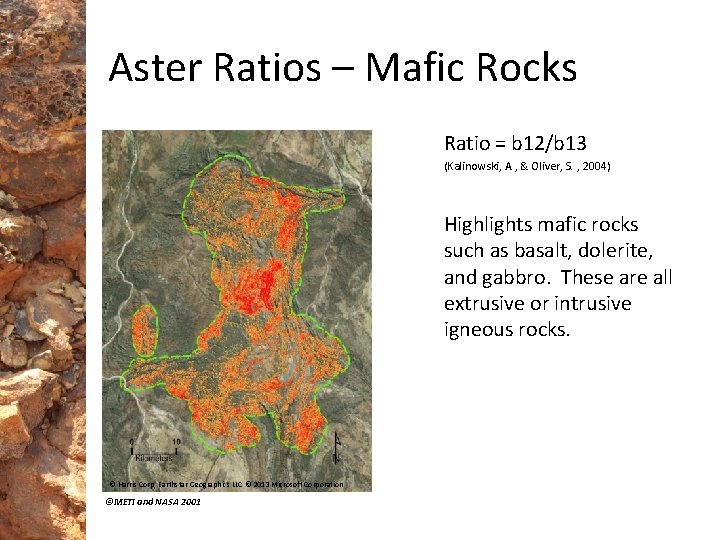
Aster Ratios – Mafic Rocks Ratio = b 12/b 13 (Kalinowski, A. , & Oliver, S. , 2004) Highlights mafic rocks such as basalt, dolerite, and gabbro. These are all extrusive or intrusive igneous rocks. © Harris Corp, Earthstar Geographics LLC © 2013 Microsoft Corporation ©METI and NASA 2001
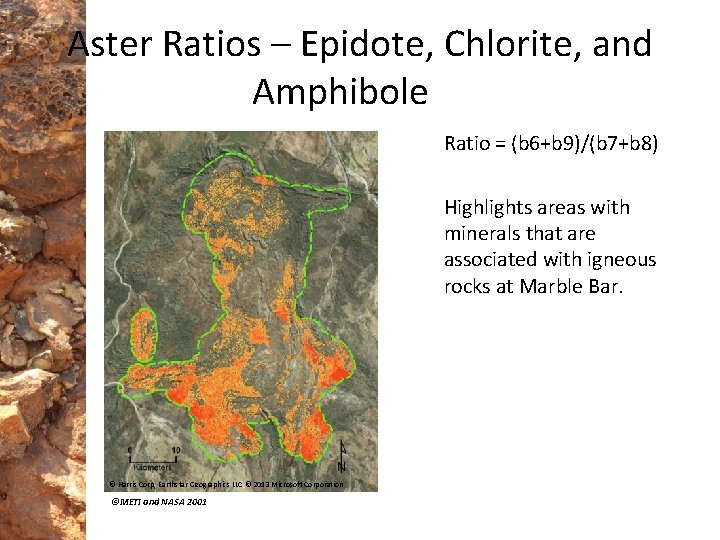
Aster Ratios – Epidote, Chlorite, and Amphibole Ratio = (b 6+b 9)/(b 7+b 8) Highlights areas with minerals that are associated with igneous rocks at Marble Bar. © Harris Corp, Earthstar Geographics LLC © 2013 Microsoft Corporation ©METI and NASA 2001
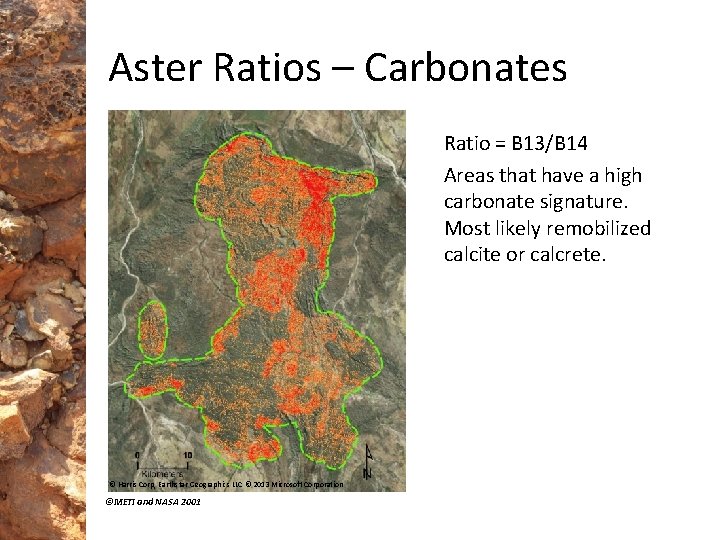
Aster Ratios – Carbonates Ratio = B 13/B 14 Areas that have a high carbonate signature. Most likely remobilized calcite or calcrete. © Harris Corp, Earthstar Geographics LLC © 2013 Microsoft Corporation ©METI and NASA 2001
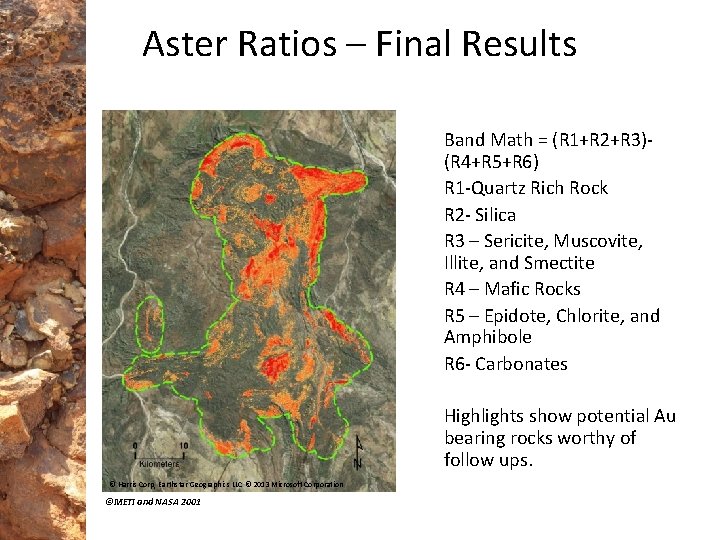
Aster Ratios – Final Results Band Math = (R 1+R 2+R 3)(R 4+R 5+R 6) R 1 -Quartz Rich Rock R 2 - Silica R 3 – Sericite, Muscovite, Illite, and Smectite R 4 – Mafic Rocks R 5 – Epidote, Chlorite, and Amphibole R 6 - Carbonates Highlights show potential Au bearing rocks worthy of follow ups. © Harris Corp, Earthstar Geographics LLC © 2013 Microsoft Corporation ©METI and NASA 2001
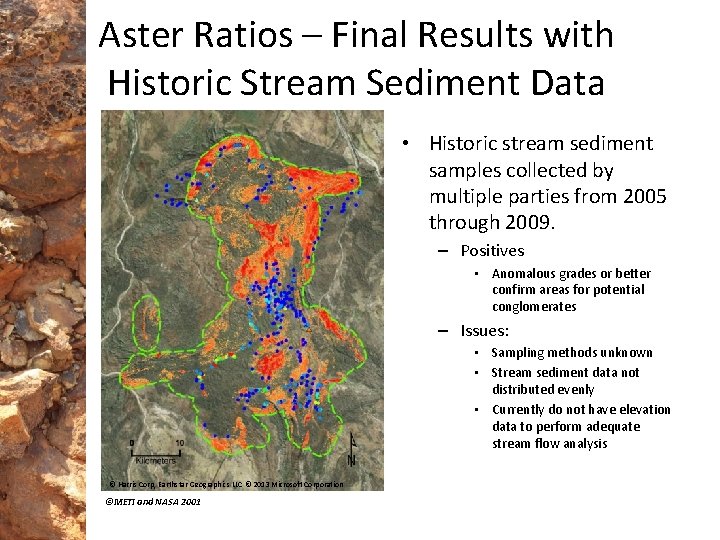
Aster Ratios – Final Results with Historic Stream Sediment Data • Historic stream sediment samples collected by multiple parties from 2005 through 2009. – Positives • Anomalous grades or better confirm areas for potential conglomerates – Issues: • Sampling methods unknown • Stream sediment data not distributed evenly • Currently do not have elevation data to perform adequate stream flow analysis © Harris Corp, Earthstar Geographics LLC © 2013 Microsoft Corporation ©METI and NASA 2001
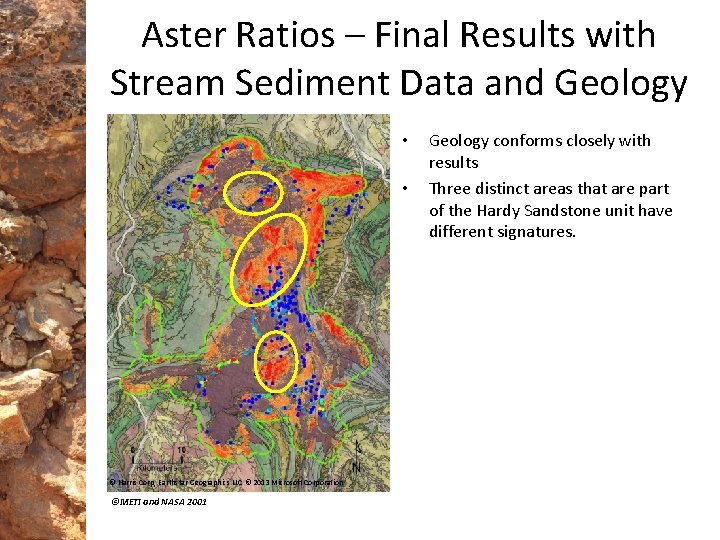
Aster Ratios – Final Results with Stream Sediment Data and Geology • • © Harris Corp, Earthstar Geographics LLC © 2013 Microsoft Corporation ©METI and NASA 2001 Geology conforms closely with results Three distinct areas that are part of the Hardy Sandstone unit have different signatures.
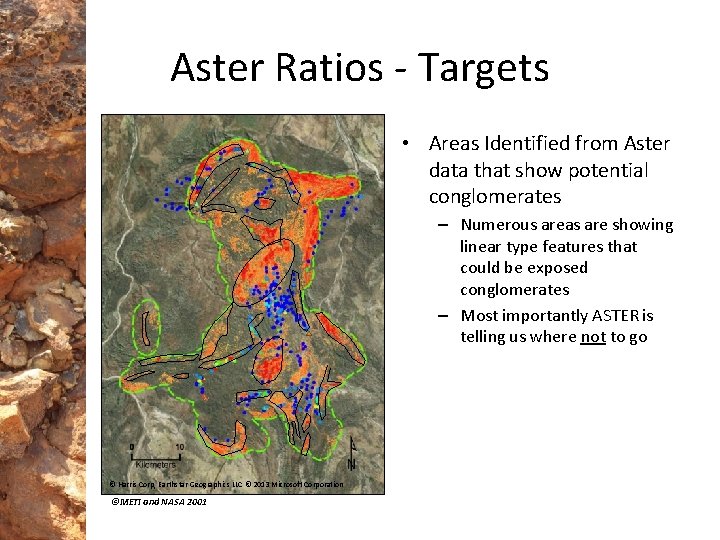
Aster Ratios - Targets • Areas Identified from Aster data that show potential conglomerates – Numerous areas are showing linear type features that could be exposed conglomerates – Most importantly ASTER is telling us where not to go © Harris Corp, Earthstar Geographics LLC © 2013 Microsoft Corporation ©METI and NASA 2001
Additional Items or Work • Acquire DEM better than 30 m resolution – Stream flow analysis to get a better understanding of the sources for the stream sediment samples • Continue to work with ASTER data throughout project – Ground work will reveal better information on modifying ASTER ratios • Acquire aerial multispectral data for additional analysis – Collect training sites during field work – Better resolution allowing for detailed spectral signature work
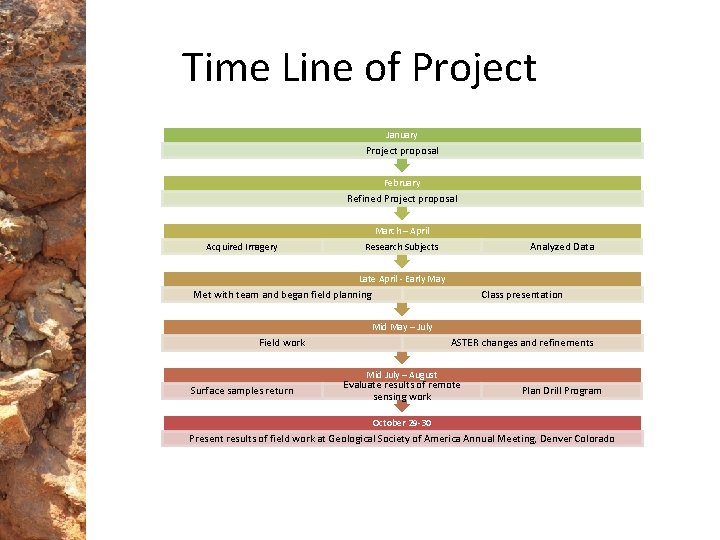
Time Line of Project January Project proposal February Refined Project proposal March – April Acquired Imagery Analyzed Data Research Subjects Late April - Early May Met with team and began field planning Class presentation Mid May – July Field work ASTER changes and refinements Mid July – August Surface samples return Evaluate results of remote sensing work Plan Drill Program October 29 -30 Present results of field work at Geological Society of America Annual Meeting, Denver Colorado
Acknowledgements • Dr. Jay Parish – Penn State Advisor • Dr. Quinton Hennigh • Novo Resources Corp. – Funding and use of data
References The ASTER L 1 B data was purchased through the online Data Pool at the Earth Remote Sensing Data Analysis Center (ERSDAC), (https: //ims. aster. ersdac. jspacesystems. or. jp/ims/html/Mai. Menu/Main. Menu. html). Department of Resources, Energy, and Tourism. (2013) Aster Spectral Bands. Retrieved 29 April 2013 from ASTER - Advanced Spaceborne Thermal Emission and Reflection Radiometer http: //www. ga. gov. au/earth-observation/satellitesand-sensors/aster-radiometer. html Hennigh, Dr. Quinton. (2013, April 30). Personal Interview Regarding Paleoplacer Deposits and the Witswatersrand Deposit. (K. Box, Interviewer) Kalinowski, A. , & Oliver, S. (2004, October). ASTER Mineral Index Processing Manual. Retrieved February 26, 2013, from Australian Government Geoscience Australia: http: //www. ga. gov. au/image_cache/GA 7833. pdf Rajesh, H. M. (2004, June 28). Application of remote sensing and GIS in mineral resource mapping - An overview. Retrieved February 26, 2013, from J-STAGE - Japan Science and Technology Information Aggregator, Electronic: https: //www. jstage. jst. go. jp/article/jmps/99/3/99_3_83/_pdf van der Meer, F. D. , van der Werff, H. M. , van Ruitenbeek, F. J. , Hecker, C. A. , Bakker, W. H. , Noomen, M. F. , et al. (2011, August 10). Multi- and Hyperspectral geologic remote sensing: A review. Retrieved March 27, 2013, from University of OULU Dashboard: https: //wiki. oulu. fi/download/attachments/26687239/van-der-Meer-et-al-2012 IJAEOG. pdf? version=1&modification. Date=1352876317000 Agar, B. (n. d. ). ASTER Alteration and Mineral Mapping; Las Pampas, Cajamarca, Peru. Retrieved February 26, 2013, from ASTER Altera: http: //www. bygmining. com/pdf/ASTER%20 Mineral%20 Mapping. pdf
Questions?