
Multispecialty Group Practice Leveraging Integration Partnership and Physician
- Slides: 24
Multispecialty Group Practice Leveraging Integration, Partnership and Physician Responsibility to Deliver Performance A 60 Year Journey, With No End in Sight March 31 2011 Copyright © 2011 Kaiser Permanente Sharon Levine, M. D. Associate Executive Director The Permanente Medical Group
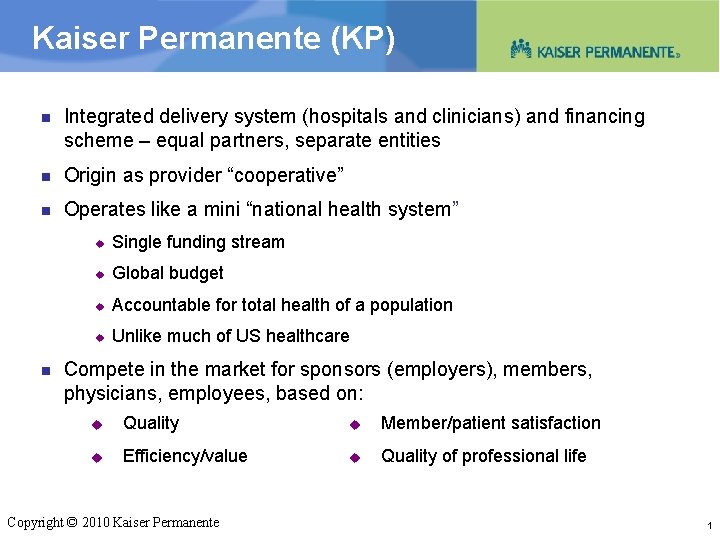
Kaiser Permanente (KP) n Integrated delivery system (hospitals and clinicians) and financing scheme – equal partners, separate entities n Origin as provider “cooperative” n Operates like a mini “national health system” n u Single funding stream u Global budget u Accountable for total health of a population u Unlike much of US healthcare Compete in the market for sponsors (employers), members, physicians, employees, based on: u Quality u Member/patient satisfaction u Efficiency/value u Quality of professional life Copyright © 2010 Kaiser Permanente 1
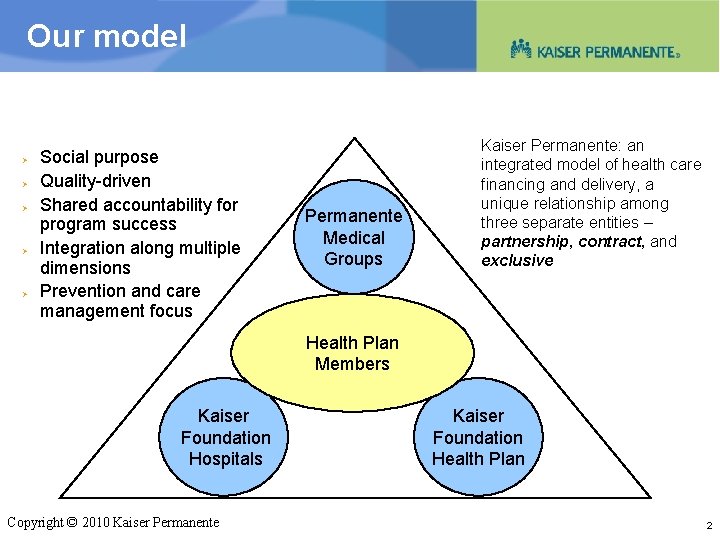
Our model Ø Ø Ø Social purpose Quality-driven Shared accountability for program success Integration along multiple dimensions Prevention and care management focus Permanente Medical Groups Kaiser Permanente: an integrated model of health care financing and delivery, a unique relationship among three separate entities – partnership, contract, and exclusive Health Plan Members Kaiser Foundation Hospitals Copyright © 2010 Kaiser Permanente Kaiser Foundation Health Plan 2
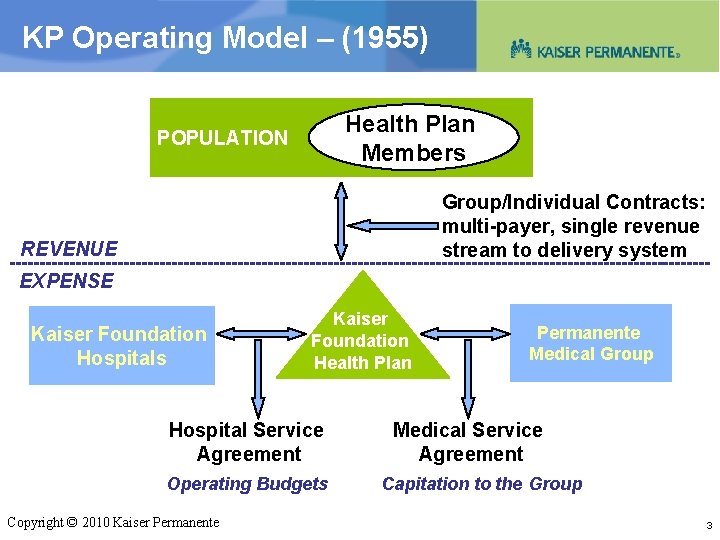
KP Operating Model – (1955) Health Plan Members POPULATION Group/Individual Contracts: multi-payer, single revenue stream to delivery system REVENUE ----------------------------------------------------------- EXPENSE Kaiser Foundation Hospitals Kaiser Foundation Health Plan Hospital Service Agreement Operating Budgets Copyright © 2010 Kaiser Permanente Medical Group Medical Service Agreement Capitation to the Group 3
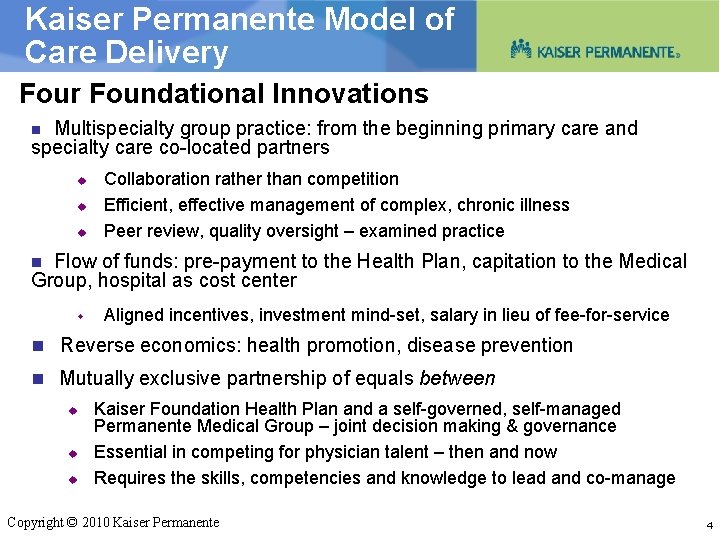
Kaiser Permanente Model of Care Delivery Four Foundational Innovations Multispecialty group practice: from the beginning primary care and specialty care co-located partners n u u u Collaboration rather than competition Efficient, effective management of complex, chronic illness Peer review, quality oversight – examined practice Flow of funds: pre-payment to the Health Plan, capitation to the Medical Group, hospital as cost center n w Aligned incentives, investment mind-set, salary in lieu of fee-for-service n Reverse economics: health promotion, disease prevention n Mutually exclusive partnership of equals between u u u Kaiser Foundation Health Plan and a self-governed, self-managed Permanente Medical Group – joint decision making & governance Essential in competing for physician talent – then and now Requires the skills, competencies and knowledge to lead and co-manage Copyright © 2010 Kaiser Permanente 4
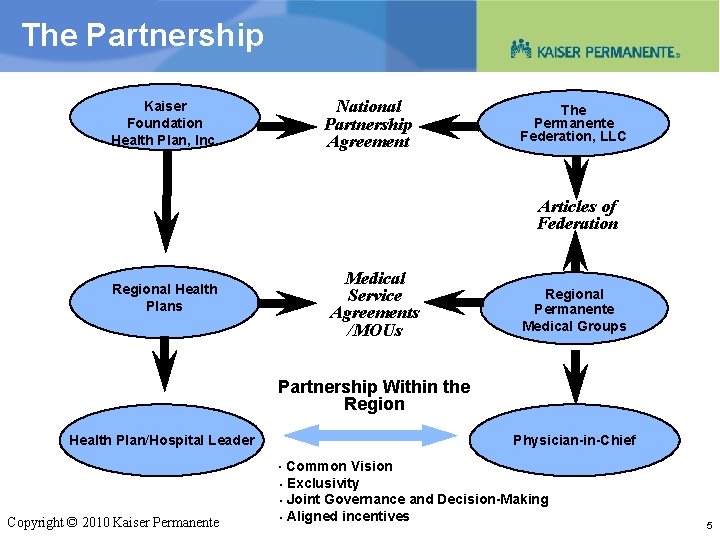
The Partnership National Partnership Agreement Kaiser Foundation Health Plan, Inc. The Permanente Federation, LLC Articles of Federation Medical Service Agreements /MOUs Regional Health Plans Regional Permanente Medical Groups Partnership Within the Region Health Plan/Hospital Leader Physician-in-Chief Common Vision • Exclusivity • Joint Governance and Decision-Making • Aligned incentives • Copyright © 2010 Kaiser Permanente 5
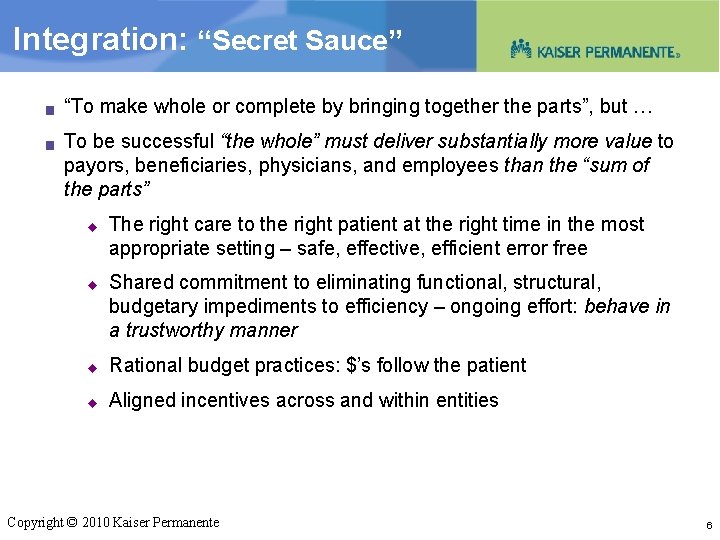
Integration: “Secret Sauce” g g “To make whole or complete by bringing together the parts”, but … To be successful “the whole” must deliver substantially more value to payors, beneficiaries, physicians, and employees than the “sum of the parts” u u The right care to the right patient at the right time in the most appropriate setting – safe, effective, efficient error free Shared commitment to eliminating functional, structural, budgetary impediments to efficiency – ongoing effort: behave in a trustworthy manner u Rational budget practices: $’s follow the patient u Aligned incentives across and within entities Copyright © 2010 Kaiser Permanente 6
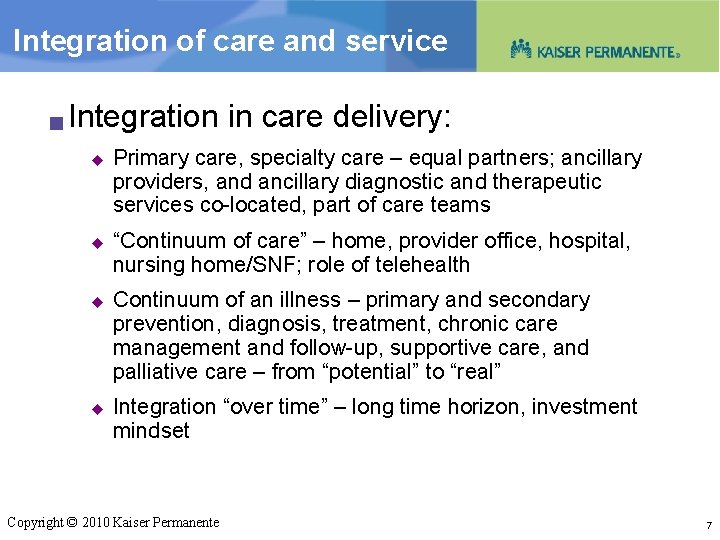
Integration of care and service g Integration in care delivery: u u Primary care, specialty care – equal partners; ancillary providers, and ancillary diagnostic and therapeutic services co-located, part of care teams “Continuum of care” – home, provider office, hospital, nursing home/SNF; role of telehealth Continuum of an illness – primary and secondary prevention, diagnosis, treatment, chronic care management and follow-up, supportive care, and palliative care – from “potential” to “real” Integration “over time” – long time horizon, investment mindset Copyright © 2010 Kaiser Permanente 7
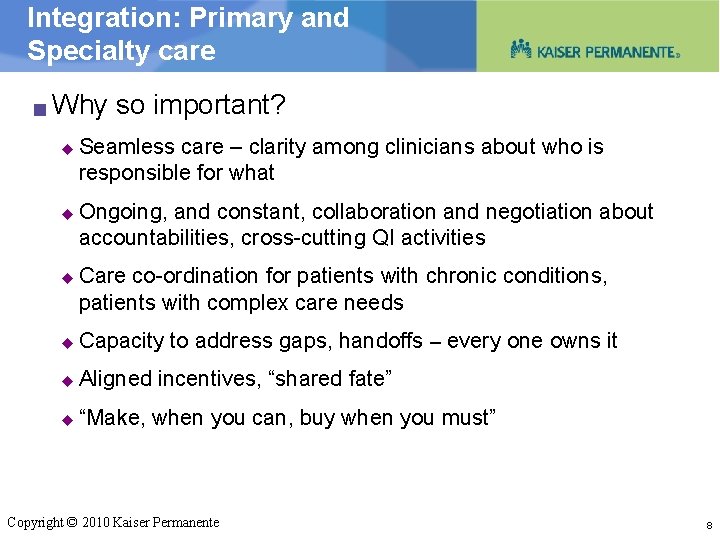
Integration: Primary and Specialty care g Why so important? u u u Seamless care – clarity among clinicians about who is responsible for what Ongoing, and constant, collaboration and negotiation about accountabilities, cross-cutting QI activities Care co-ordination for patients with chronic conditions, patients with complex care needs u Capacity to address gaps, handoffs – every one owns it u Aligned incentives, “shared fate” u “Make, when you can, buy when you must” Copyright © 2010 Kaiser Permanente 8
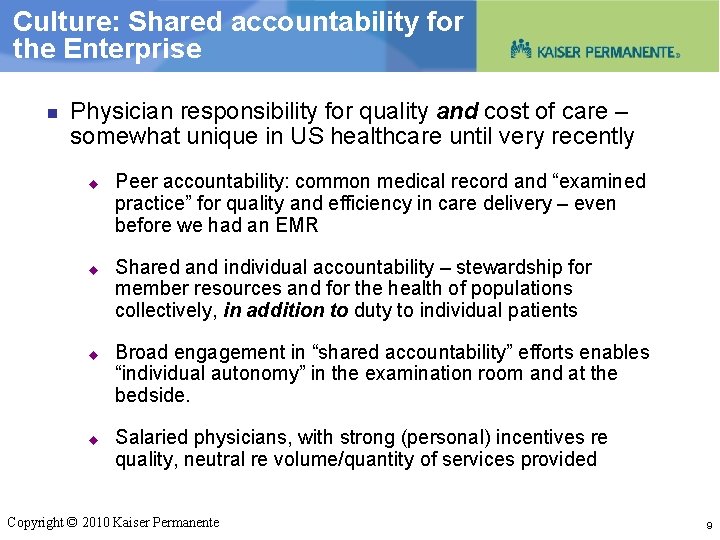
Culture: Shared accountability for the Enterprise n Physician responsibility for quality and cost of care – somewhat unique in US healthcare until very recently u u Peer accountability: common medical record and “examined practice” for quality and efficiency in care delivery – even before we had an EMR Shared and individual accountability – stewardship for member resources and for the health of populations collectively, in addition to duty to individual patients Broad engagement in “shared accountability” efforts enables “individual autonomy” in the examination room and at the bedside. Salaried physicians, with strong (personal) incentives re quality, neutral re volume/quantity of services provided Copyright © 2010 Kaiser Permanente 9
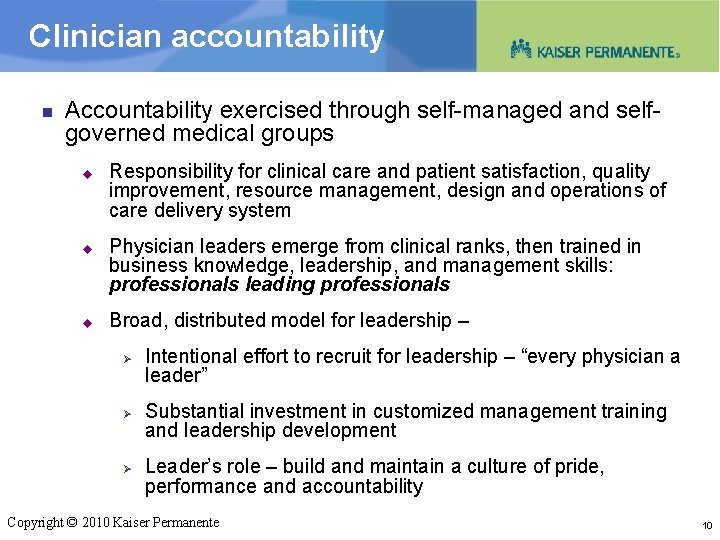
Clinician accountability n Accountability exercised through self-managed and selfgoverned medical groups u u u Responsibility for clinical care and patient satisfaction, quality improvement, resource management, design and operations of care delivery system Physician leaders emerge from clinical ranks, then trained in business knowledge, leadership, and management skills: professionals leading professionals Broad, distributed model for leadership – Ø Ø Ø Intentional effort to recruit for leadership – “every physician a leader” Substantial investment in customized management training and leadership development Leader’s role – build and maintain a culture of pride, performance and accountability Copyright © 2010 Kaiser Permanente 10
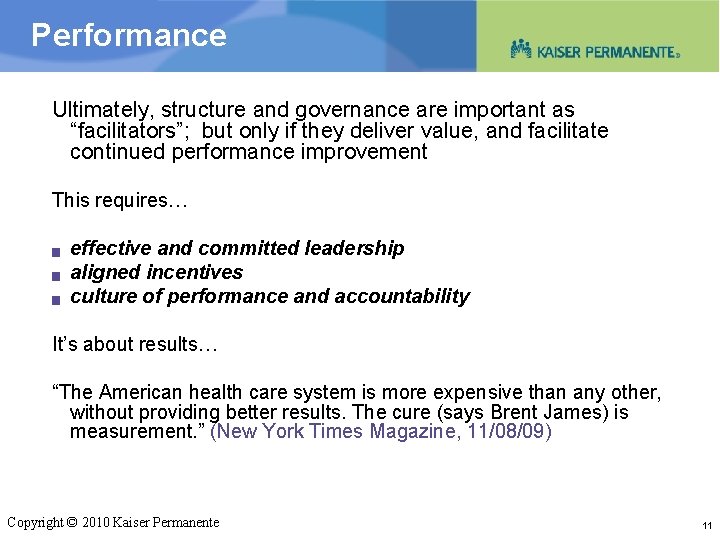
Performance Ultimately, structure and governance are important as “facilitators”; but only if they deliver value, and facilitate continued performance improvement This requires… g g g effective and committed leadership aligned incentives culture of performance and accountability It’s about results… “The American health care system is more expensive than any other, without providing better results. The cure (says Brent James) is measurement. ” (New York Times Magazine, 11/08/09) Copyright © 2010 Kaiser Permanente 11
Data that drives performance g g The “cure”… advanced clinical and management information systems “Revealing reports” – gap identification “Data that drives” performance improvement – clear, actionable, timely A delivery system willing to, and capable of, using the data for rapid cycle improvement team-based, clinician-led process redesign Copyright © 2010 Kaiser Permanente 12
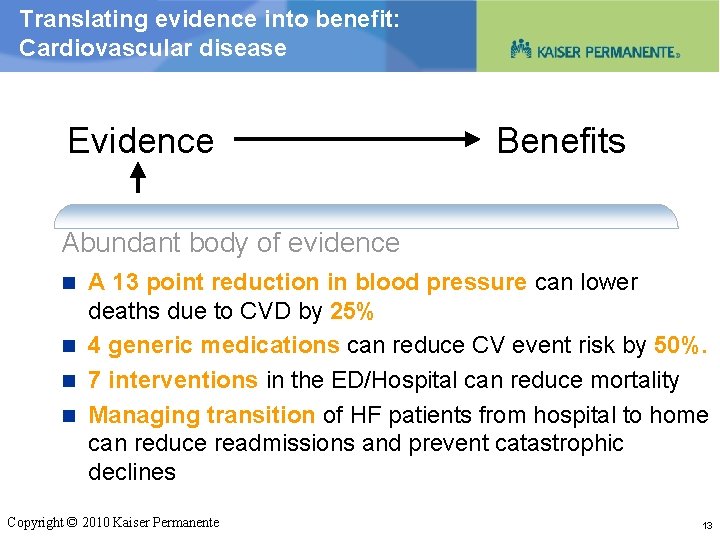
Translating evidence into benefit: Cardiovascular disease Evidence Benefits Abundant body of evidence A 13 point reduction in blood pressure can lower deaths due to CVD by 25% n 4 generic medications can reduce CV event risk by 50%. n 7 interventions in the ED/Hospital can reduce mortality n Managing transition of HF patients from hospital to home can reduce readmissions and prevent catastrophic declines n Copyright © 2010 Kaiser Permanente 13
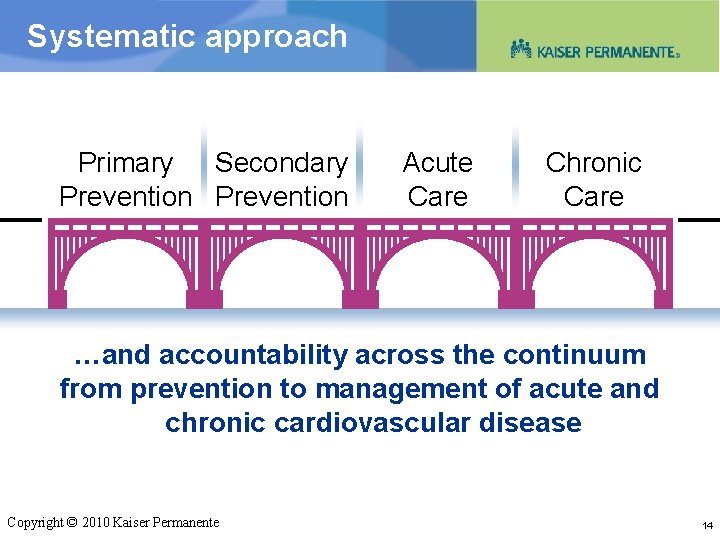
Systematic approach Primary Secondary Prevention Acute Care Chronic Care …and accountability across the continuum from prevention to management of acute and chronic cardiovascular disease Copyright © 2010 Kaiser Permanente 14
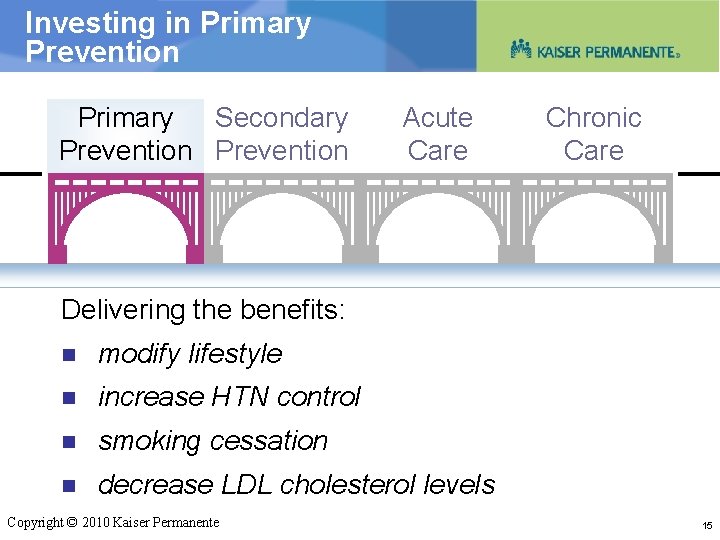
Investing in Primary Prevention Primary Secondary Prevention Acute Care Chronic Care Delivering the benefits: n modify lifestyle n increase HTN control n smoking cessation n decrease LDL cholesterol levels Copyright © 2010 Kaiser Permanente 15
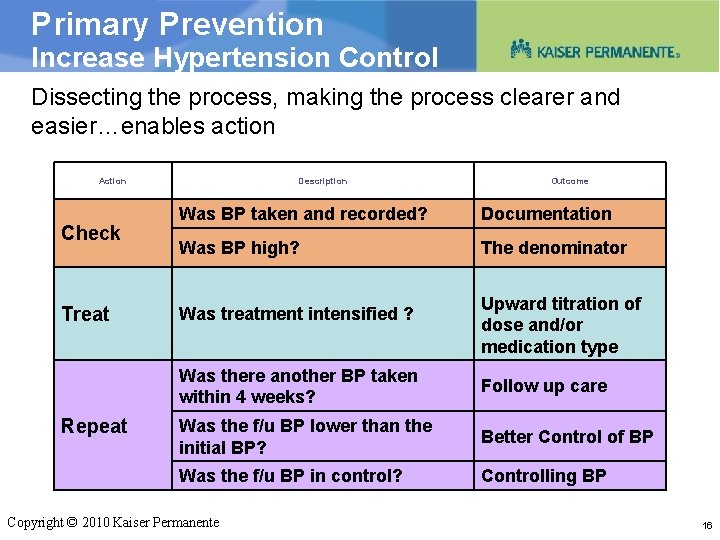
Primary Prevention Increase Hypertension Control Dissecting the process, making the process clearer and easier…enables action Action Check Treat Repeat Description Outcome Was BP taken and recorded? Documentation Was BP high? The denominator Was treatment intensified ? Upward titration of dose and/or medication type Was there another BP taken within 4 weeks? Follow up care Was the f/u BP lower than the initial BP? Better Control of BP Was the f/u BP in control? Controlling BP Copyright © 2010 Kaiser Permanente 16
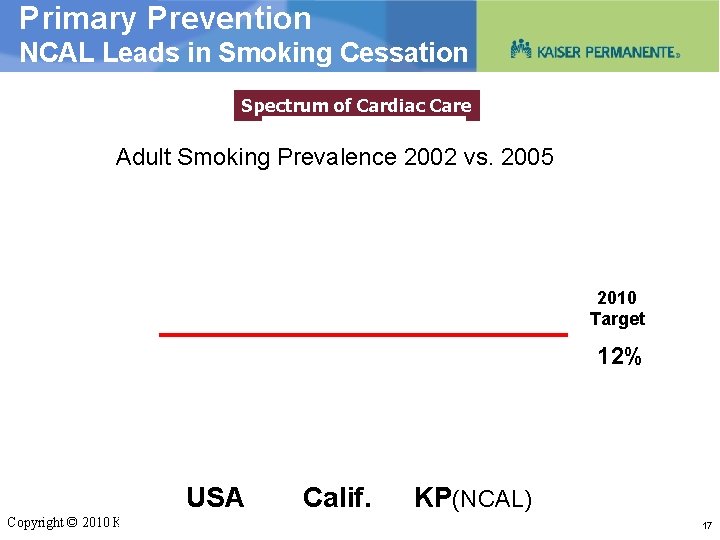
Primary Prevention NCAL Leads in Smoking Cessation Spectrum of Cardiac Care Adult Smoking Prevalence 2002 vs. 2005 2010 Target 12% USA Copyright © 2010 Kaiser Permanente Calif. KP(NCAL) 17
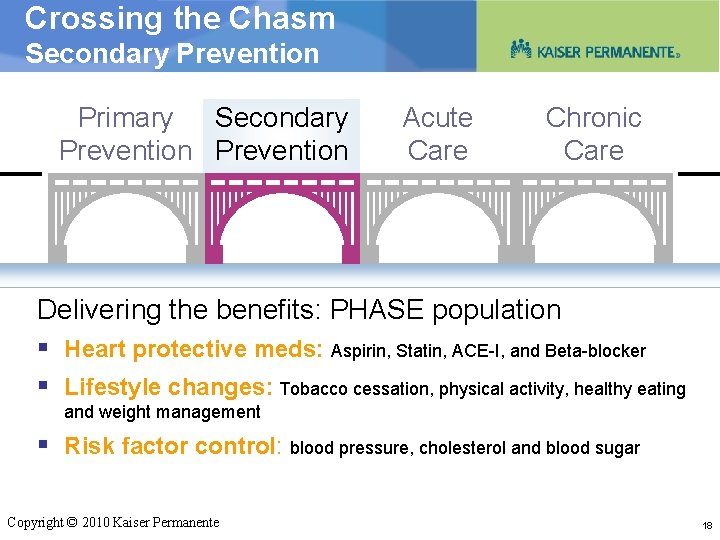
Crossing the Chasm Secondary Prevention Primary Secondary Prevention Acute Care Chronic Care Delivering the benefits: PHASE population § Heart protective meds: Aspirin, Statin, ACE-I, and Beta-blocker § Lifestyle changes: Tobacco cessation, physical activity, healthy eating and weight management § Risk factor control: blood pressure, cholesterol and blood sugar Copyright © 2010 Kaiser Permanente 18
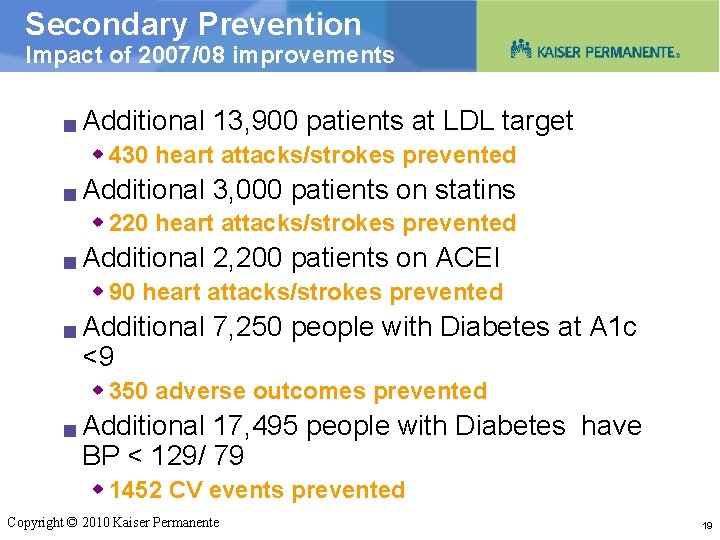
Secondary Prevention Impact of 2007/08 improvements g Additional 13, 900 patients at LDL target w 430 heart attacks/strokes prevented g Additional 3, 000 patients on statins w 220 heart attacks/strokes prevented g Additional 2, 200 patients on ACEI w 90 heart attacks/strokes prevented g Additional 7, 250 people with Diabetes at A 1 c <9 w 350 adverse outcomes prevented g Additional 17, 495 people with Diabetes have BP < 129/ 79 w 1452 CV events prevented Copyright © 2010 Kaiser Permanente 19
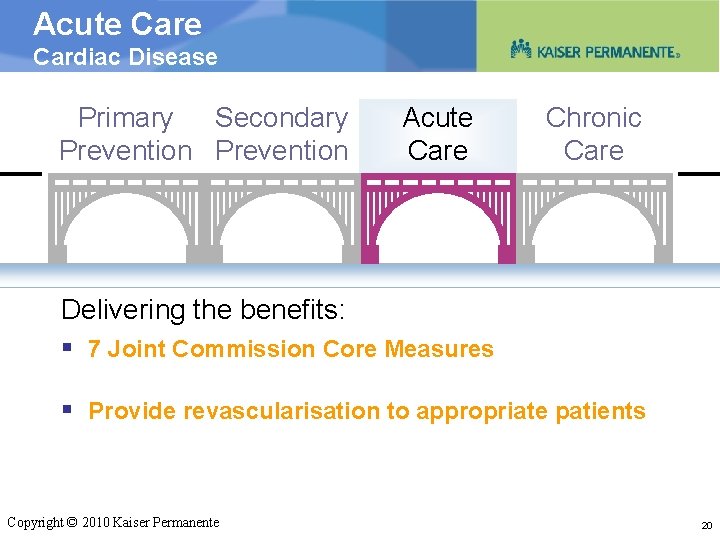
Acute Cardiac Disease Primary Secondary Prevention Acute Care Chronic Care Delivering the benefits: § 7 Joint Commission Core Measures § Provide revascularisation to appropriate patients Copyright © 2010 Kaiser Permanente 20
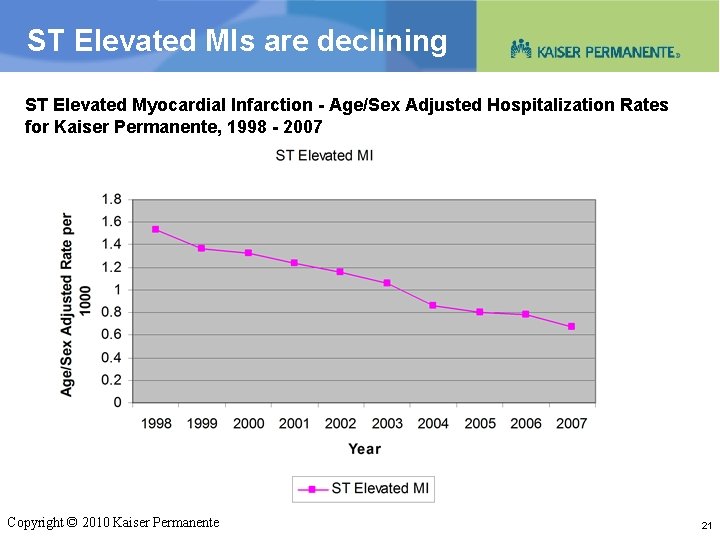
ST Elevated MIs are declining ST Elevated Myocardial Infarction - Age/Sex Adjusted Hospitalization Rates for Kaiser Permanente, 1998 - 2007 Copyright © 2010 Kaiser Permanente 21
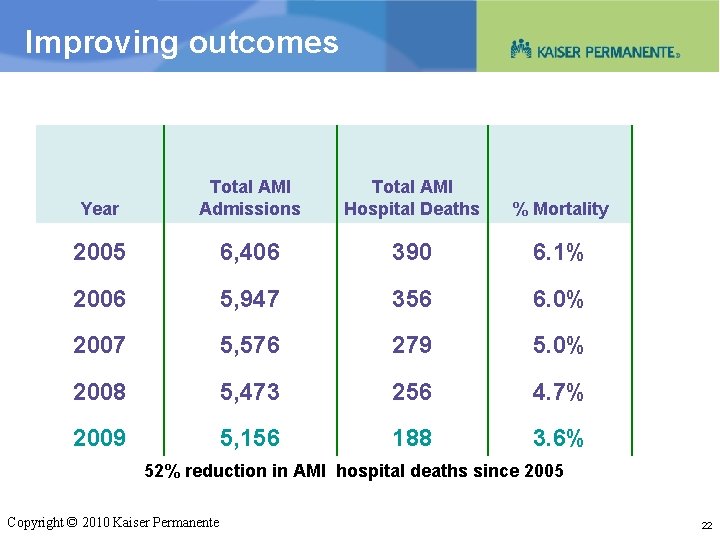
Improving outcomes Year Total AMI Admissions Total AMI Hospital Deaths % Mortality 2005 6, 406 390 6. 1% 2006 5, 947 356 6. 0% 2007 5, 576 279 5. 0% 2008 5, 473 256 4. 7% 2009 5, 156 188 3. 6% 52% reduction in AMI hospital deaths since 2005 Copyright © 2010 Kaiser Permanente 22
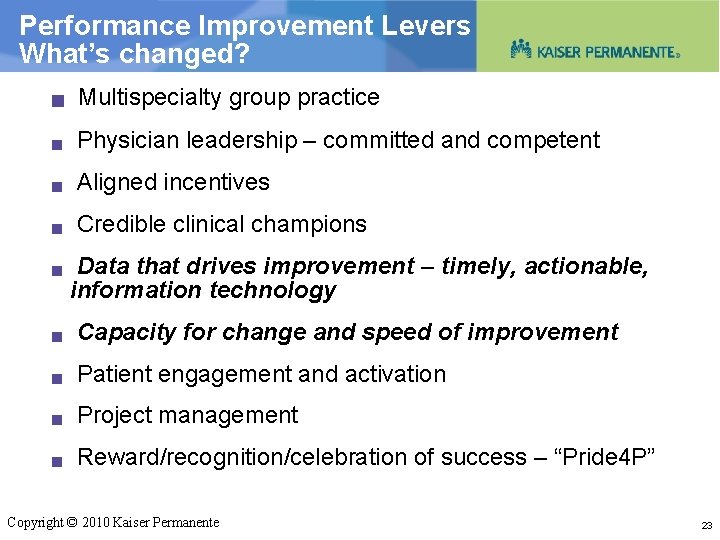
Performance Improvement Levers What’s changed? g Multispecialty group practice g Physician leadership – committed and competent g Aligned incentives g Credible clinical champions g Data that drives improvement – timely, actionable, information technology g Capacity for change and speed of improvement g Patient engagement and activation g Project management g Reward/recognition/celebration of success – “Pride 4 P” Copyright © 2010 Kaiser Permanente 23