
Multiscale Models of Selectivity of Calcium Channels crucial









- Slides: 76
Multiscale Models of Selectivity of Calcium Channels crucial to the Physiology of Nerve and Muscle 1
Mathematics describes only a tiny part of life, But Mathematics* Creates our Standard of Living *e. g. , electricity, computers, fluid dynamics, optics, structural mechanics, …. 2
How can we use mathematics to describe biological systems? I believe Some biology can be described by Physics and Mathematics “as usual” 3
From Structure ANATOMY to Function PHYSIOLOGY using fundamental physical laws PHYSIOLOGY 4
Multiscale MATHEMATICAL Analysis has rarely been possible until now Can be done for Caclium Channels 5
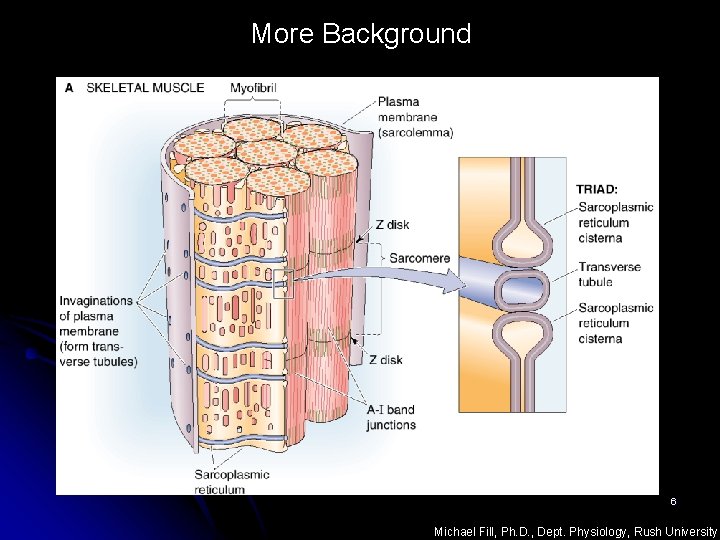
More Background 6 Michael Fill, Ph. D. , Dept. Physiology, Rush University
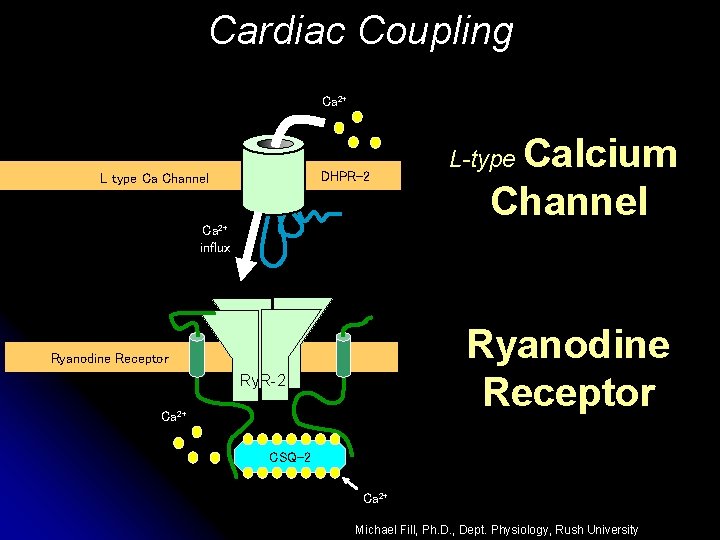
Cardiac Coupling Ca 2+ DHPR-2 L type Ca Channel Ca 2+ influx Calcium Channel L-type Ryanodine Receptor Ry. R-2 Ca 2+ CSQ-2 Ca 2+ Michael Fill, Ph. D. , Dept. Physiology, Rush University
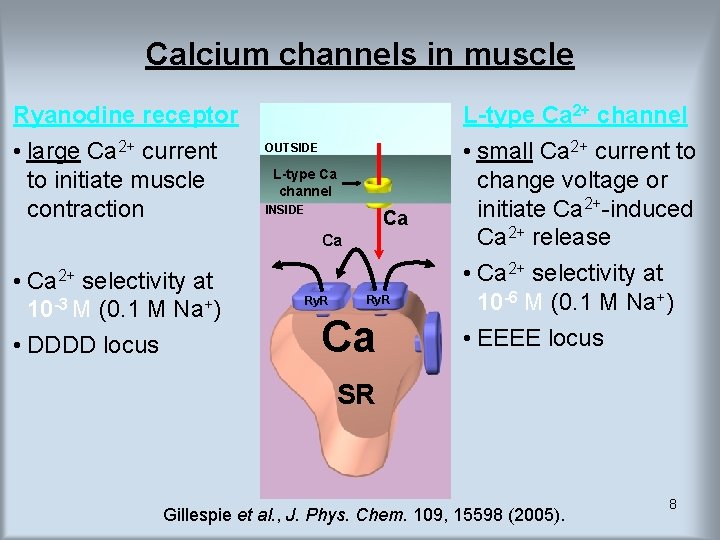
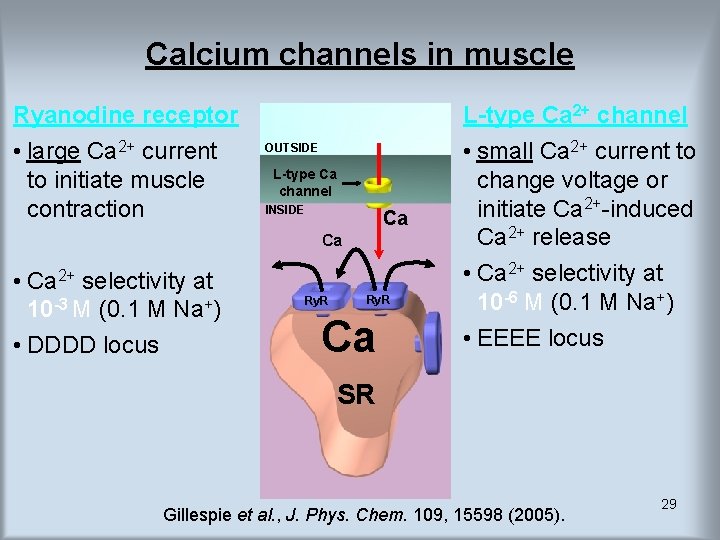
Calcium channels in muscle Ryanodine receptor • large Ca 2+ current to initiate muscle contraction OUTSIDE L-type Ca channel INSIDE Ca Ca • Ca 2+ selectivity at 10 -3 M (0. 1 M Na+) • DDDD locus Ry. R Ca L-type Ca 2+ channel • small Ca 2+ current to change voltage or initiate Ca 2+-induced Ca 2+ release • Ca 2+ selectivity at 10 -6 M (0. 1 M Na+) • EEEE locus SR Gillespie et al. , J. Phys. Chem. 109, 15598 (2005). 8
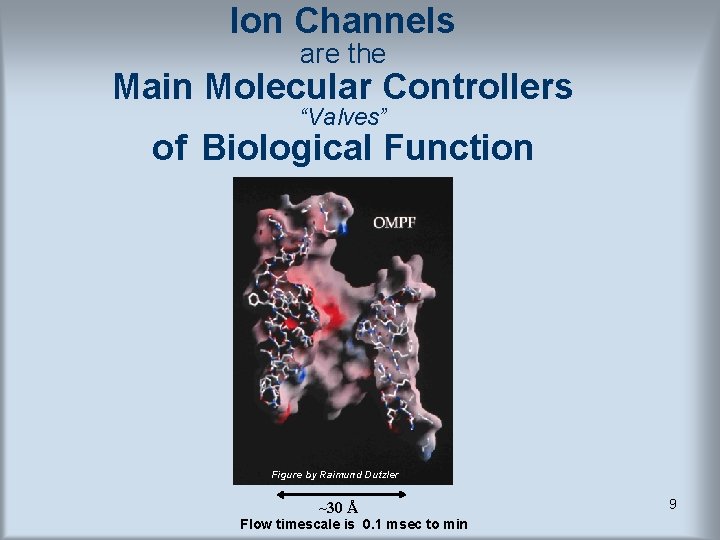
Ion Channels are the Main Molecular Controllers “Valves” of Biological Function Figure by Raimund Dutzler ~30 Å Flow timescale is 0. 1 msec to min 9
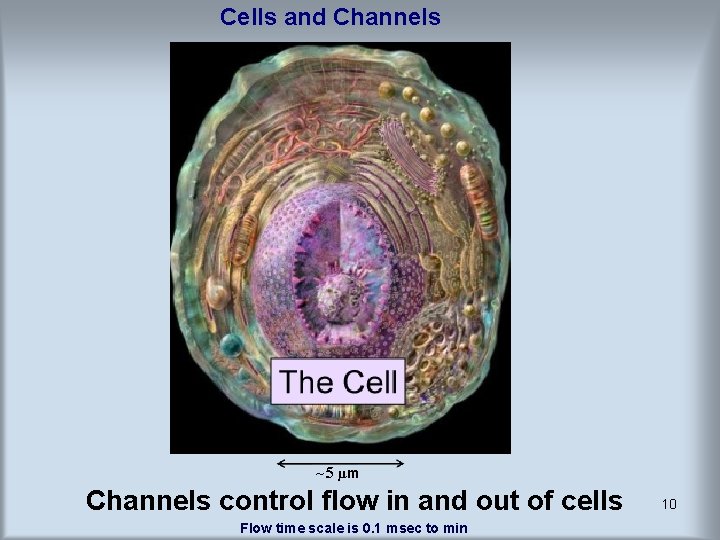
Cells and Channels ~ 5 µm Channels control flow in and out of cells Flow time scale is 0. 1 msec to min 10
Ion Channels are • Biomolecular Valves, Stochastic Sensing … Hagan Bayley • Platform for Multi-Scale Technology • Simple enough to allow physical analysis of biological function • Controllers of many biological functions in health and disease • Substantial fraction of all drugs work on channels • Thousands scientists work on Ion Channels every day Thousands of scientists study channels every day 11
Ion Channels are Controllers of Biological Function • All signalling in the nervous system • Coordination of muscle contraction, including heart. Heart = Unintelligent Design … Denis Noble • Regulation of secretion and transport • Control of protein movement inside cells • One transporter for every molecule of special interest • Channelopathies … Fran Ashcroft Thousands of scientists study channels every day 12
Ion Channels are Multiscale Devices Atomic Control of Macroscopic Flows Ion Channels are Engineering Devices 13
Ion Channels are Devices Channels control flow of Charged Spheres Channels have Simple Invariant Structure on the biological time scale. Why can’t we predict the movement of Charged Spheres through a Hole? What is the Device Equation of a Channel? Physics of Ionic Movement under biological conditions is MUCH SIMPLER than the physics of Fluids, Plasmas, or Semiconductors, Fluids, plasmas, and semiconductors can be computed more or less perfectly. 14
Where do we start? Trajectories of Charges in an Electric Field Trajectories allow Boundary Conditions and Theory of Stochastic Processes 15
James Clerk Maxwell “I only count molecules …. , avoiding all personal enquiries which would only get me into trouble. ” Slightly rephrased from Royal Society of London, 1879, Archives no. 188 in Maxwell on Heat and Statistical Mechanics, Garber, Brush and Everitt, 1995 16
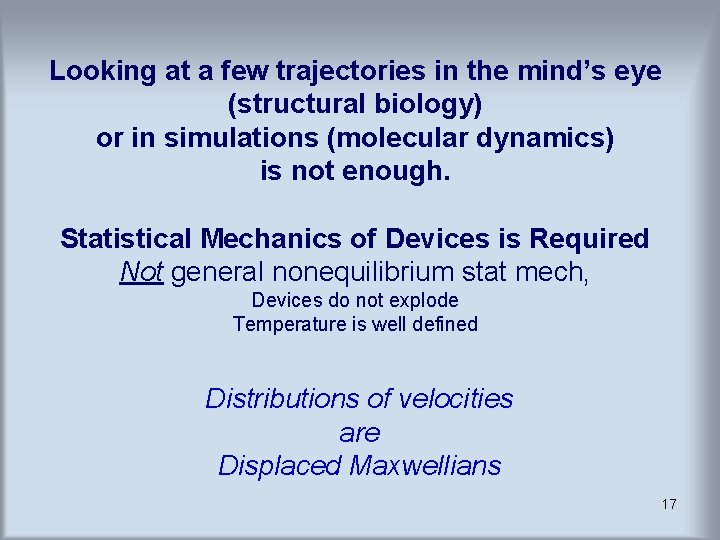
Looking at a few trajectories in the mind’s eye (structural biology) or in simulations (molecular dynamics) is not enough. Statistical Mechanics of Devices is Required Not general nonequilibrium stat mech, Devices do not explode Temperature is well defined Distributions of velocities are Displaced Maxwellians 17
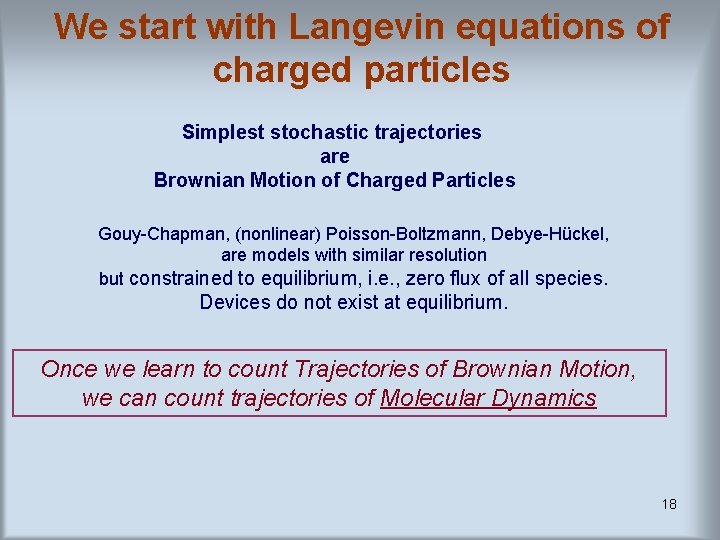
We start with Langevin equations of charged particles Simplest stochastic trajectories are Brownian Motion of Charged Particles Gouy-Chapman, (nonlinear) Poisson-Boltzmann, Debye-Hückel, are models with similar resolution but constrained to equilibrium, i. e. , zero flux of all species. Devices do not exist at equilibrium. Once we learn to count Trajectories of Brownian Motion, we can count trajectories of Molecular Dynamics 18
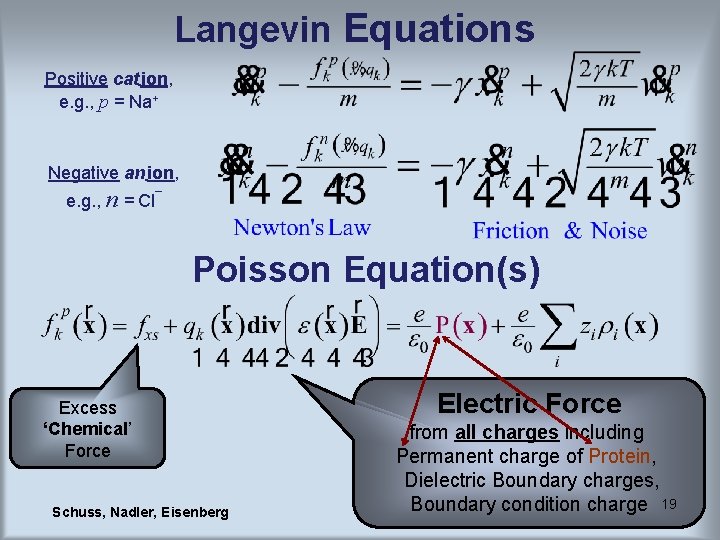
Langevin Equations Positive cat ion, e. g. , p = Na+ Negative an ion, e. g. , n = Cl¯ Poisson Equation(s) Excess ‘Chemical’ Force Schuss, Nadler, Eisenberg Electric Force from all charges including Permanent charge of Protein, Dielectric Boundary charges, Boundary condition charge 19
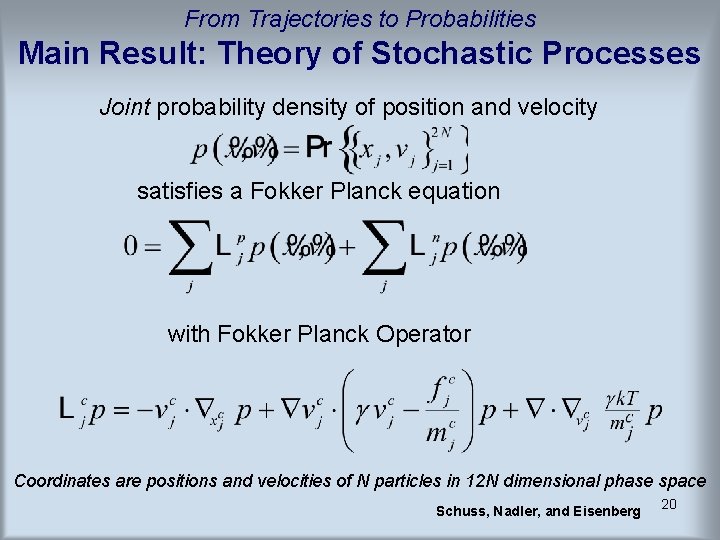
From Trajectories to Probabilities Main Result: Theory of Stochastic Processes Joint probability density of position and velocity satisfies a Fokker Planck equation with Fokker Planck Operator Coordinates are positions and velocities of N particles in 12 N dimensional phase space Schuss, Nadler, and Eisenberg 20
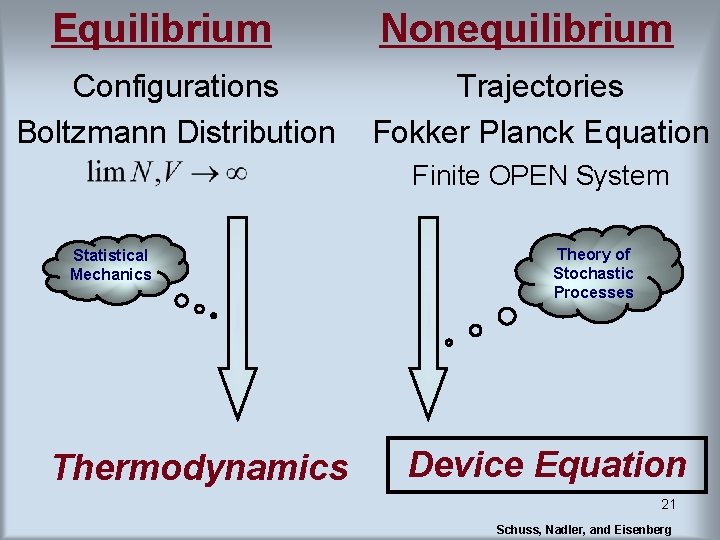
Equilibrium Configurations Boltzmann Distribution Nonequilibrium Trajectories Fokker Planck Equation Finite OPEN System Statistical Mechanics Thermodynamics Theory of Stochastic Processes Device Equation 21 Schuss, Nadler, and Eisenberg
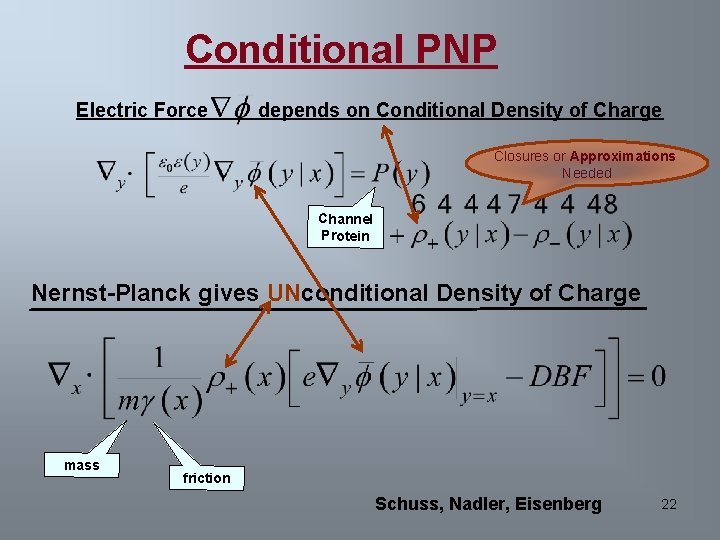
Conditional PNP Electric Force depends on Conditional Density of Charge Closures or Approximations Needed Channel Protein Nernst-Planck gives UNconditional Density of Charge mass friction Schuss, Nadler, Eisenberg 22
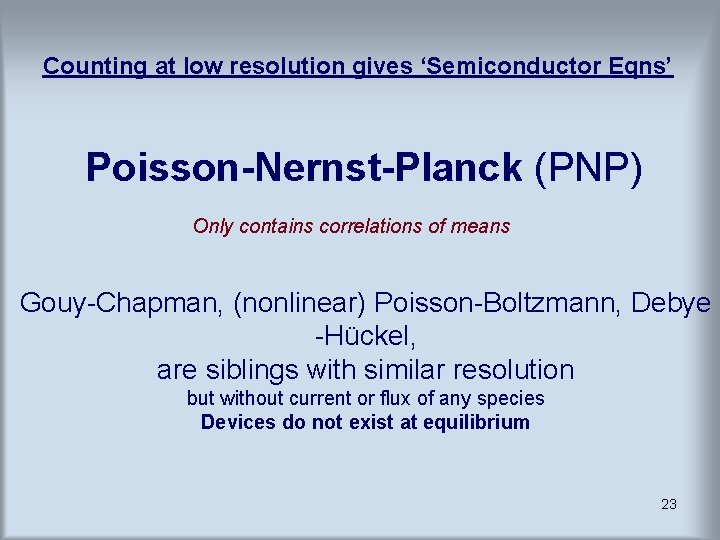
Counting at low resolution gives ‘Semiconductor Eqns’ Poisson-Nernst-Planck (PNP) Only contains correlations of means Gouy-Chapman, (nonlinear) Poisson-Boltzmann, Debye -Hückel, are siblings with similar resolution but without current or flux of any species Devices do not exist at equilibrium 23
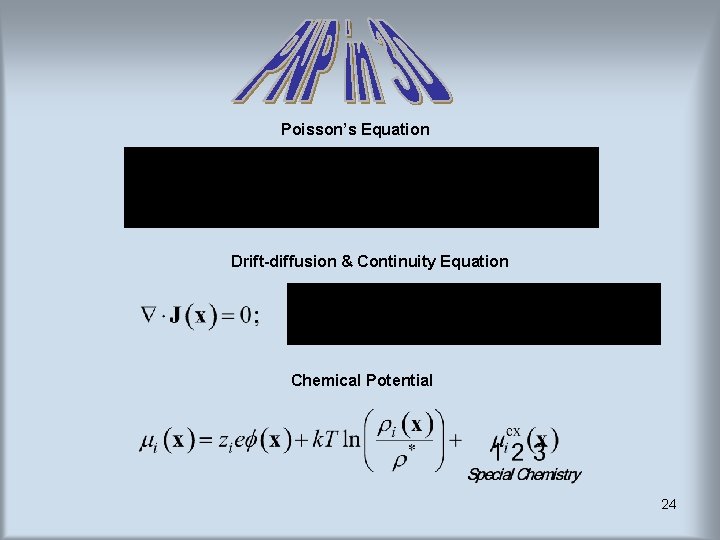
Poisson’s Equation Drift-diffusion & Continuity Equation Chemical Potential 24
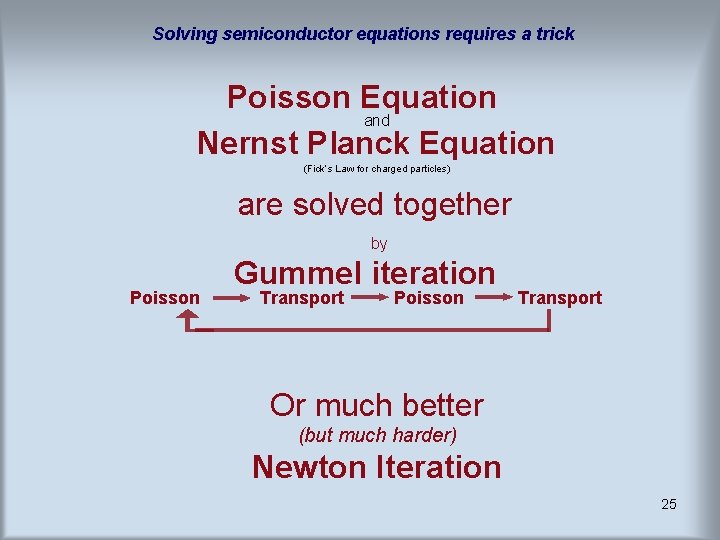
Solving semiconductor equations requires a trick Poisson Equation and Nernst Planck Equation (Fick’s Law for charged particles) are solved together by Poisson Gummel iteration Transport Poisson Transport Or much better (but much harder) Newton Iteration 25
How do we check theory? Compare with Biological Function! Our task is to Discover & Understand, Control & Improve Biological Function Inverse Proble m 26
Biological function of most channels is to allow and Control Flux of Ions Our task is to Discover, Understand, Control and Improve that flux Ion Channels are Biological Devices 27
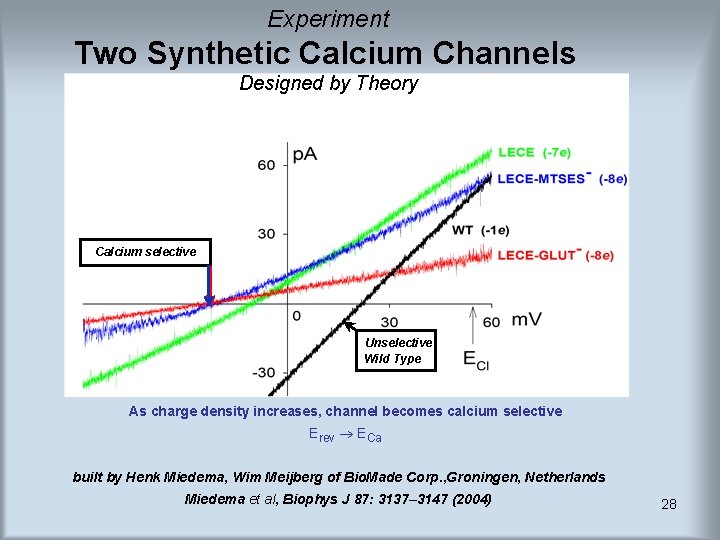
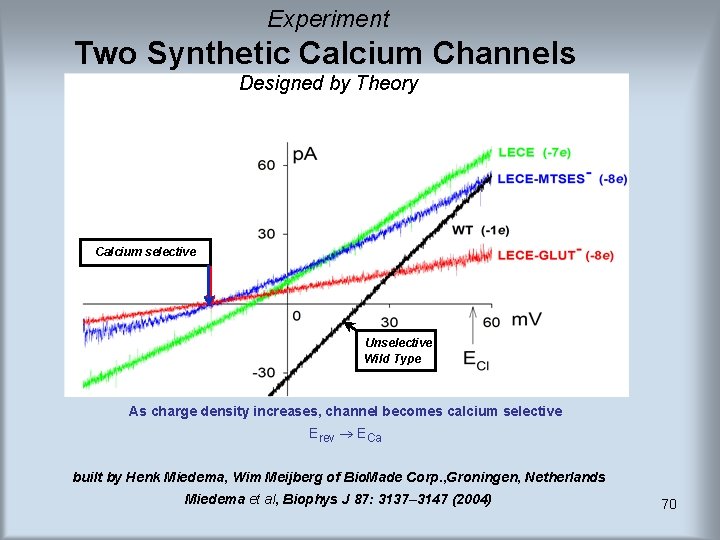
Experiment Two Synthetic Calcium Channels Designed by Theory Calcium selective Unselective Wild Type As charge density increases, channel becomes calcium selective Erev ECa built by Henk Miedema, Wim Meijberg of Bio. Made Corp. , Groningen, Netherlands Miedema et al, Biophys J 87: 3137– 3147 (2004) 28
Calcium channels in muscle Ryanodine receptor • large Ca 2+ current to initiate muscle contraction OUTSIDE L-type Ca channel INSIDE Ca Ca • Ca 2+ selectivity at 10 -3 M (0. 1 M Na+) • DDDD locus Ry. R Ca L-type Ca 2+ channel • small Ca 2+ current to change voltage or initiate Ca 2+-induced Ca 2+ release • Ca 2+ selectivity at 10 -6 M (0. 1 M Na+) • EEEE locus SR Gillespie et al. , J. Phys. Chem. 109, 15598 (2005). 29
Electrodiffusion of charged, hard spheres Putting in Correlations by Hand 30
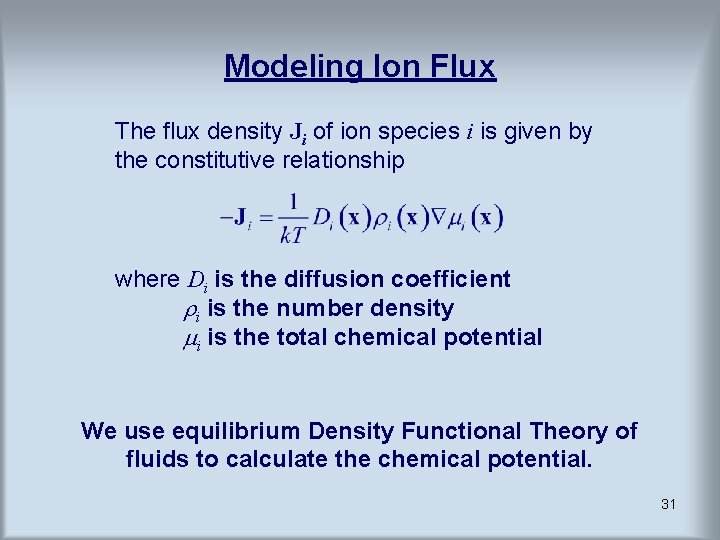
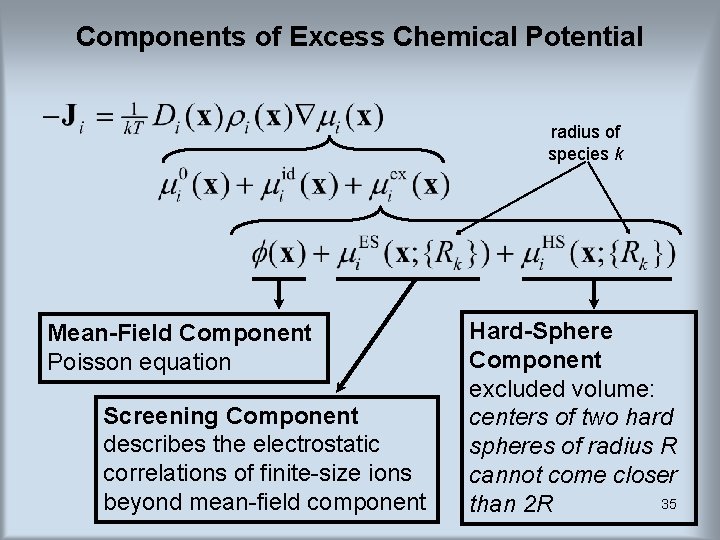
Modeling Ion Flux The flux density Ji of ion species i is given by the constitutive relationship where Di is the diffusion coefficient i is the number density i is the total chemical potential We use equilibrium Density Functional Theory of fluids to calculate the chemical potential. 31
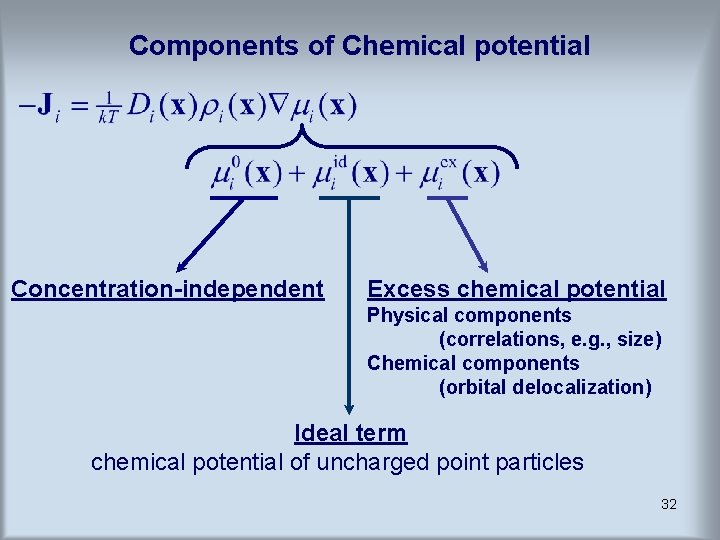
Components of Chemical potential Concentration-independent Excess chemical potential Physical components (correlations, e. g. , size) Chemical components (orbital delocalization) Ideal term chemical potential of uncharged point particles 32
The Excess Chemical Potential Density Functional Theory* is the state-of-the-art in theories of inhomogeneous fluids (including electrolytes). • DFT computes thermodynamic quantities of confined fluids in equilibrium (e. g. , average concentration profiles, surface tension). • electrolytes, colloids, polymers • one of a few theories used for inhomogeneous fluids • 100’s of papers a year use DFT of fluids. • DFT is ideal for channels because selectivity filters confine ions in a small geometry. *Fundamental measure theory of Rosenfeld, … then Roth 33
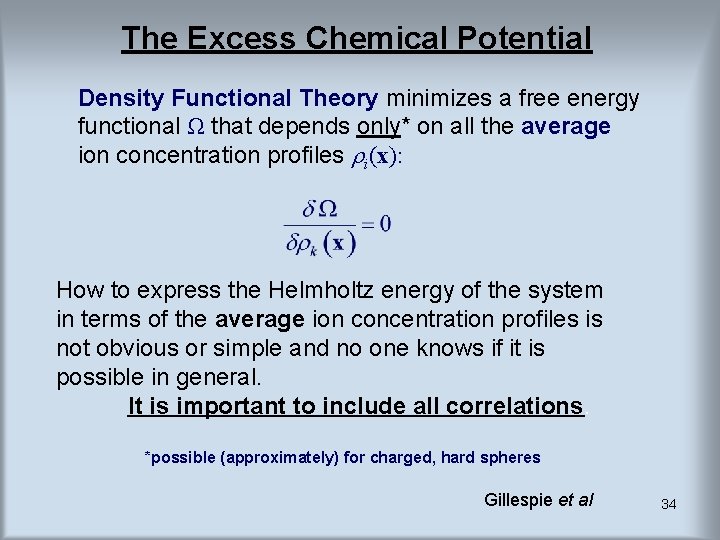
The Excess Chemical Potential Density Functional Theory minimizes a free energy functional Ω that depends only* on all the average ion concentration profiles i(x): How to express the Helmholtz energy of the system in terms of the average ion concentration profiles is not obvious or simple and no one knows if it is possible in general. It is important to include all correlations. *possible (approximately) for charged, hard spheres Gillespie et al 34
Components of Excess Chemical Potential radius of species k Mean-Field Component Poisson equation Screening Component describes the electrostatic correlations of finite-size ions beyond mean-field component Hard-Sphere Component excluded volume: centers of two hard spheres of radius R cannot come closer 35 than 2 R
Application to the Ryanodine Receptor D. Gillespie et al. , J. Phys. Chem. 109, 15598 (2005). 36
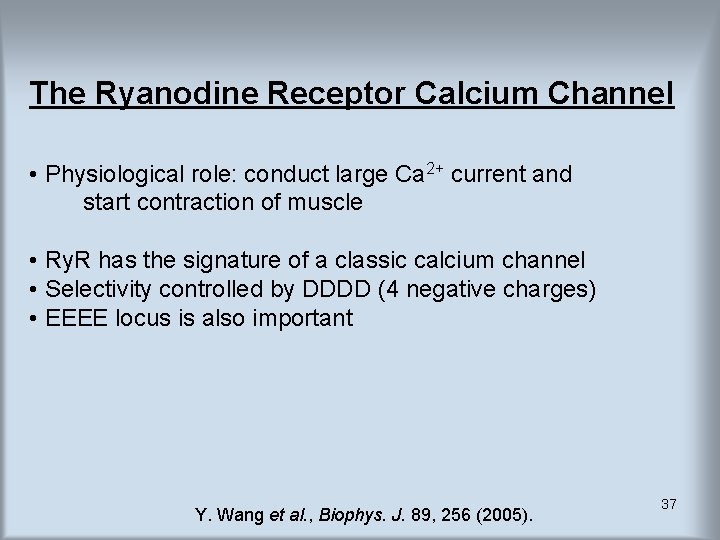
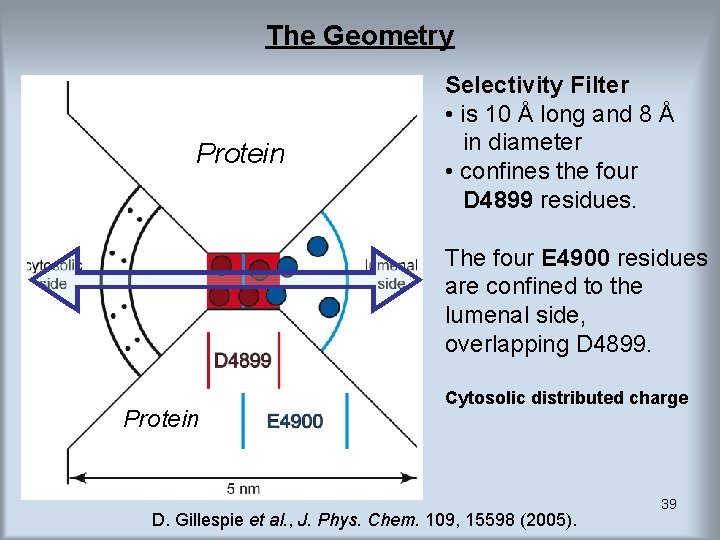
The Ryanodine Receptor Calcium Channel • Physiological role: conduct large Ca 2+ current and start contraction of muscle • Ry. R has the signature of a classic calcium channel • Selectivity controlled by DDDD (4 negative charges) • EEEE locus is also important Y. Wang et al. , Biophys. J. 89, 256 (2005). 37
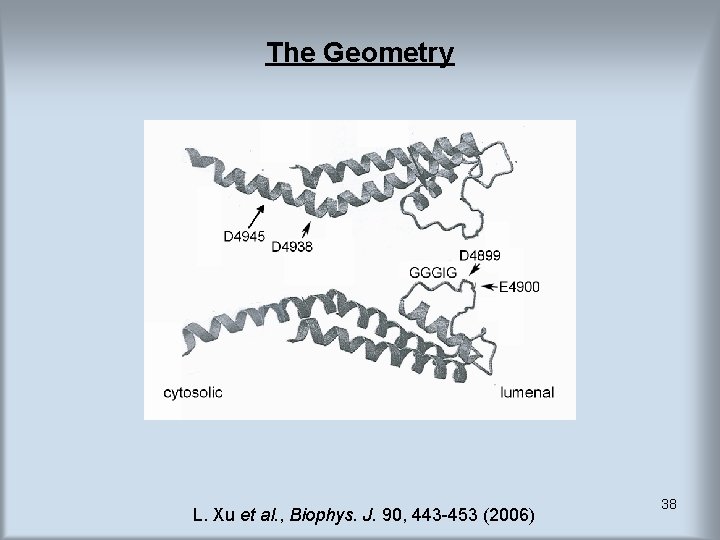
The Geometry L. Xu et al. , Biophys. J. 90, 443 -453 (2006) 38
The Geometry Protein Selectivity Filter • is 10 Å long and 8 Å in diameter • confines the four D 4899 residues. The four E 4900 residues are confined to the lumenal side, overlapping D 4899. Protein Cytosolic distributed charge D. Gillespie et al. , J. Phys. Chem. 109, 15598 (2005). 39
Our Approach • Use a few select data points to compute input parameters. • channel structure (e. g. , E 4900 location) • ion diffusion coefficients in selectivity filter • Let theory predict all the other data points. >50 data curves, growing all the time thanks to Le. Xu! D. Gillespie et al. , J. Phys. Chem. 109, 15598 (2005). 40
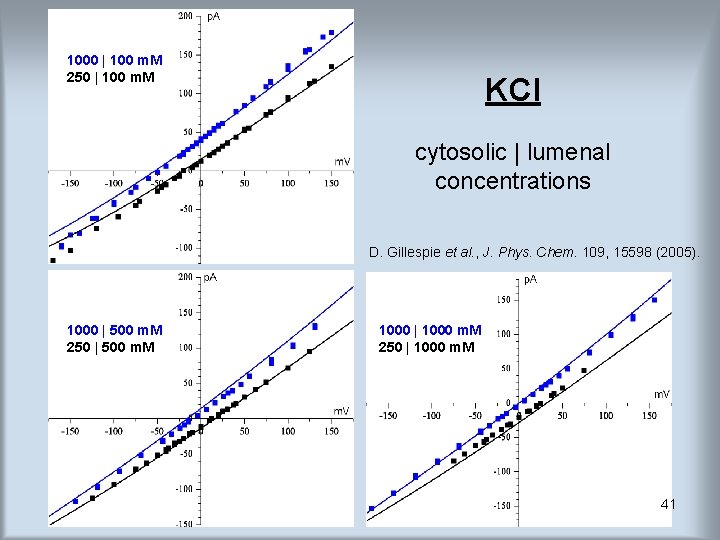
1000 | 100 m. M 250 | 100 m. M KCl cytosolic | lumenal concentrations D. Gillespie et al. , J. Phys. Chem. 109, 15598 (2005). 1000 | 500 m. M 250 | 500 m. M 1000 | 1000 m. M 250 | 1000 m. M 41
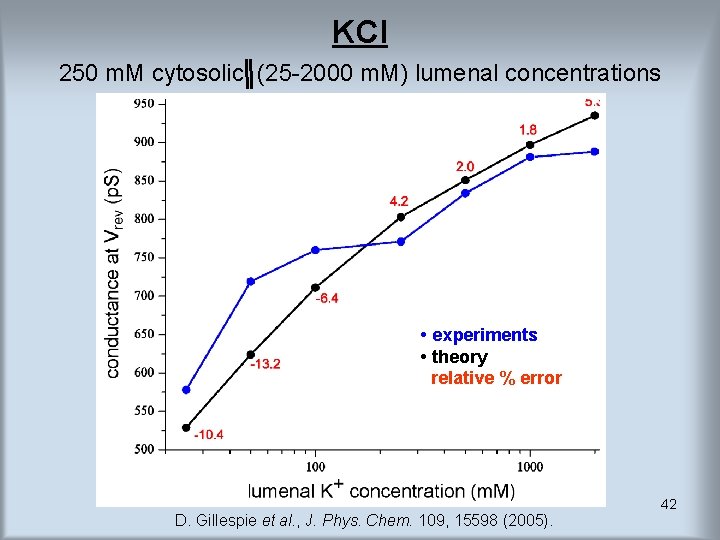
KCl 250 m. M cytosolic (25 -2000 m. M) lumenal concentrations • experiments • theory relative % error D. Gillespie et al. , J. Phys. Chem. 109, 15598 (2005). 42
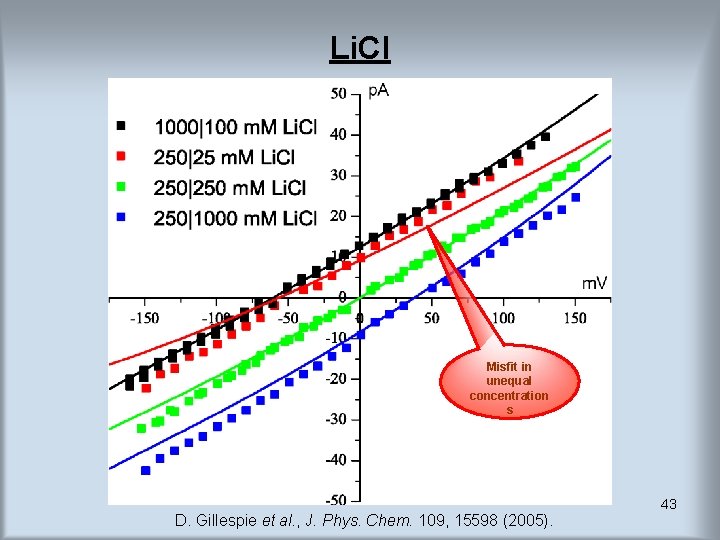
Li. Cl Misfit in unequal concentration s D. Gillespie et al. , J. Phys. Chem. 109, 15598 (2005). 43
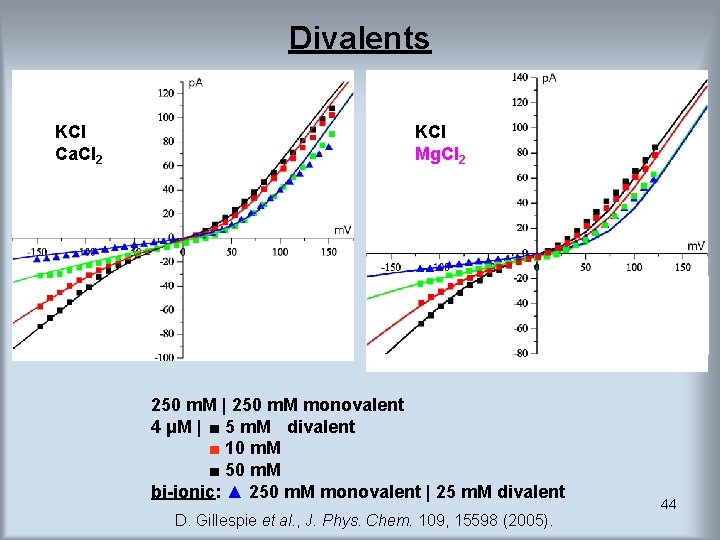
Divalents KCl Ca. Cl 2 KCl Mg. Cl 2 250 m. M | 250 m. M monovalent 4 μM | ■ 5 m. M divalent ■ 10 m. M ■ 50 m. M bi-ionic: ▲ 250 m. M monovalent | 25 m. M divalent D. Gillespie et al. , J. Phys. Chem. 109, 15598 (2005). 44
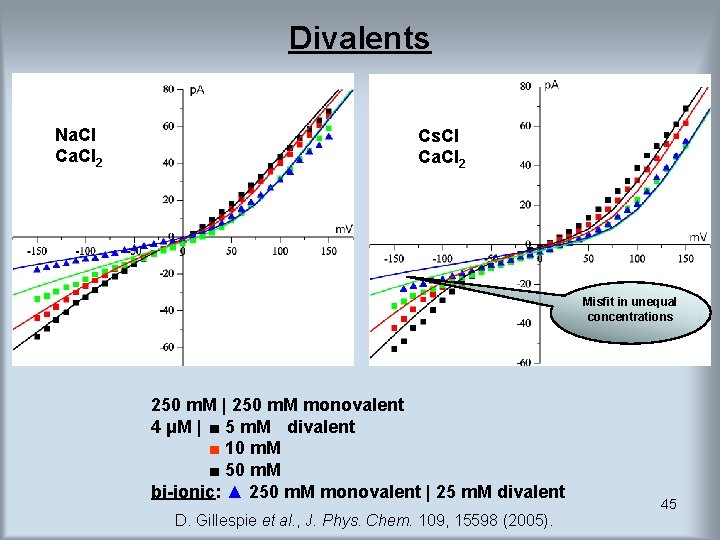
Divalents Na. Cl Ca. Cl 2 Cs. Cl Ca. Cl 2 Misfit in unequal concentrations 250 m. M | 250 m. M monovalent 4 μM | ■ 5 m. M divalent ■ 10 m. M ■ 50 m. M bi-ionic: ▲ 250 m. M monovalent | 25 m. M divalent D. Gillespie et al. , J. Phys. Chem. 109, 15598 (2005). 45
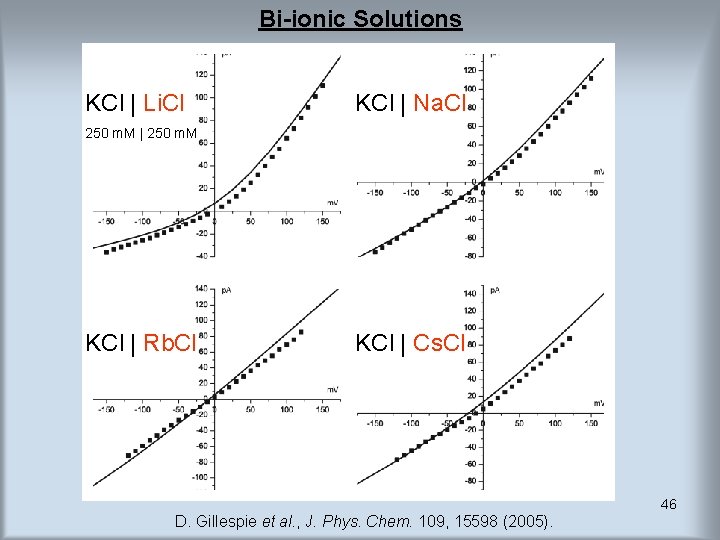
Bi-ionic Solutions KCl | Li. Cl KCl | Na. Cl 250 m. M | 250 m. M KCl | Rb. Cl KCl | Cs. Cl 46 D. Gillespie et al. , J. Phys. Chem. 109, 15598 (2005).
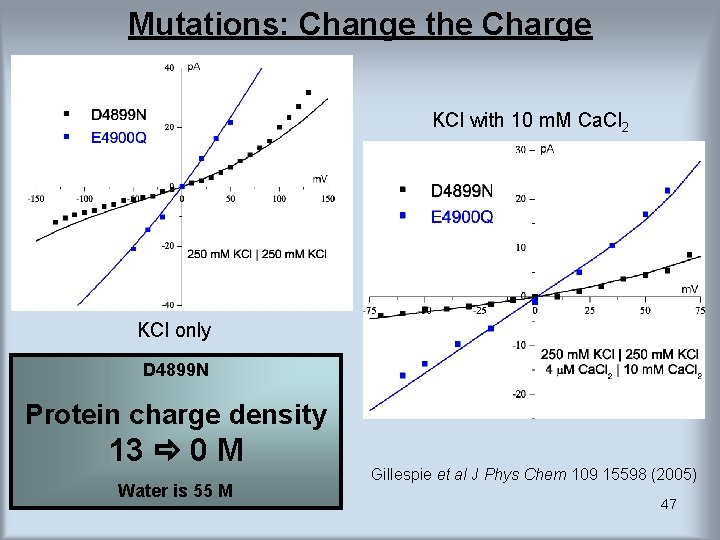
Mutations: Change the Charge KCl with 10 m. M Ca. Cl 2 KCl only D 4899 N Protein charge density 13 0 M Water is 55 M Gillespie et al J Phys Chem 109 15598 (2005) 47
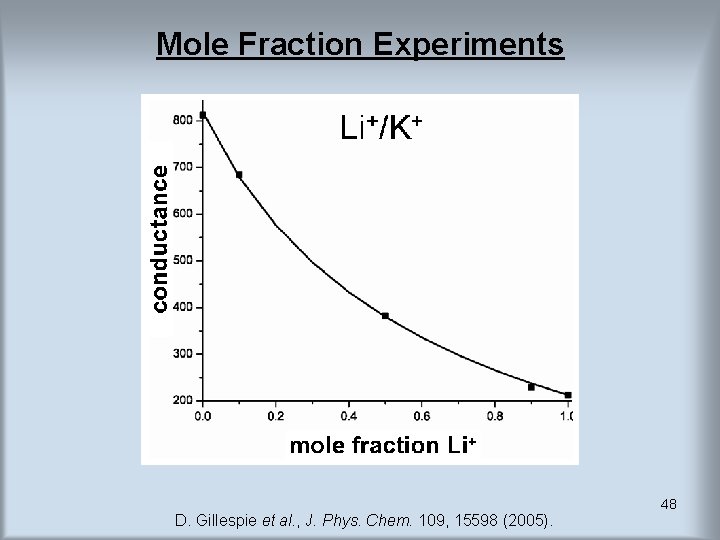
Mole Fraction Experiments D. Gillespie et al. , J. Phys. Chem. 109, 15598 (2005). 48
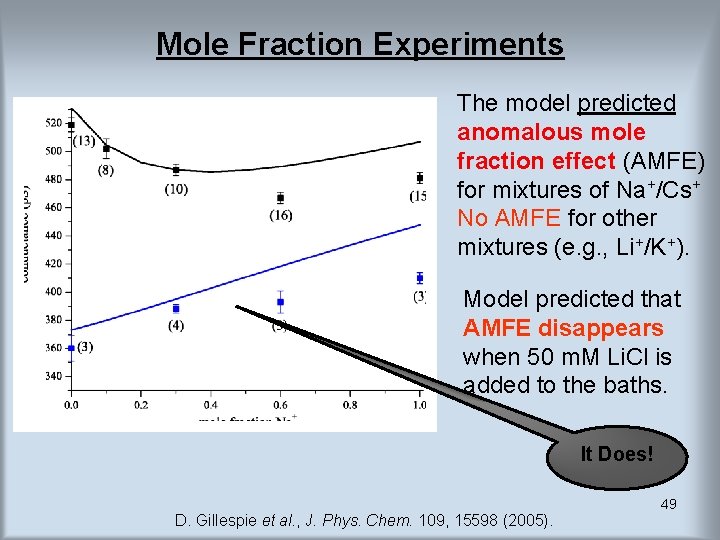
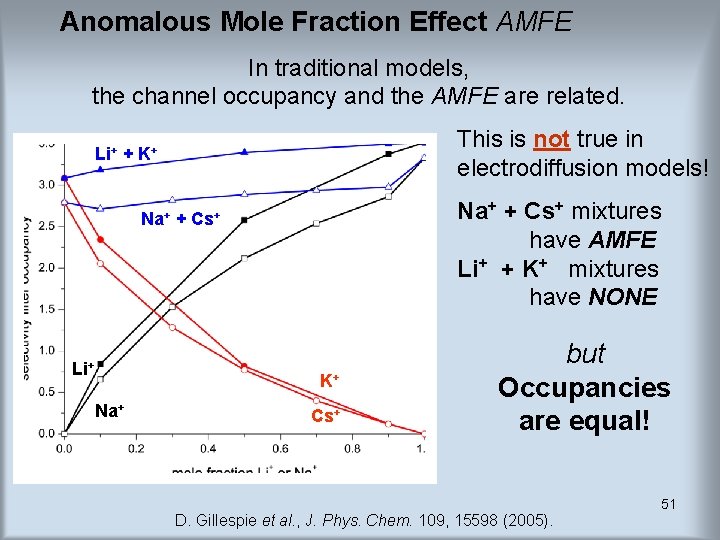
Mole Fraction Experiments The model predicted anomalous mole fraction effect (AMFE) for mixtures of Na+/Cs+ No AMFE for other mixtures (e. g. , Li+/K+). Model predicted that AMFE disappears when 50 m. M Li. Cl is added to the baths. It Does! D. Gillespie et al. , J. Phys. Chem. 109, 15598 (2005). 49
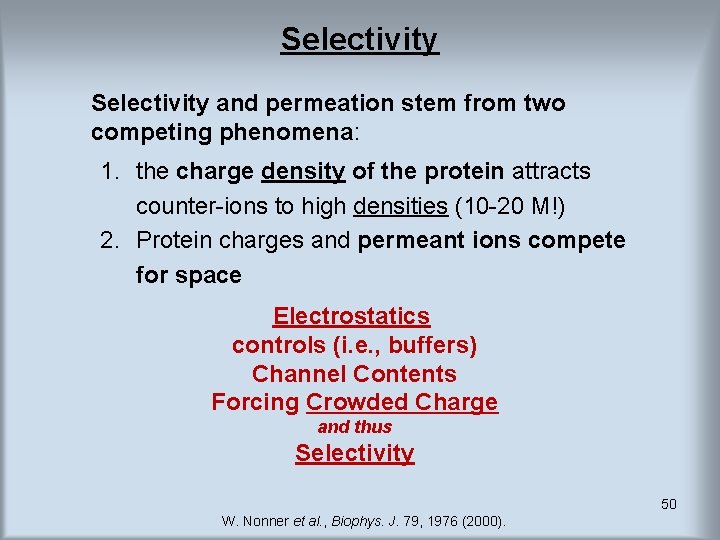
Selectivity and permeation stem from two competing phenomena: 1. the charge density of the protein attracts counter-ions to high densities (10 -20 M!) 2. Protein charges and permeant ions compete for space Electrostatics controls (i. e. , buffers) Channel Contents Forcing Crowded Charge and thus Selectivity 50 W. Nonner et al. , Biophys. J. 79, 1976 (2000).
Anomalous Mole Fraction Effect AMFE In traditional models, the channel occupancy and the AMFE are related. Li+ + Na+ Li+ Na+ This is not true in electrodiffusion models! K+ + Na+ + Cs+ mixtures have AMFE Li+ + K+ mixtures have NONE Cs+ K+ Cs+ but Occupancies are equal! D. Gillespie et al. , J. Phys. Chem. 109, 15598 (2005). 51
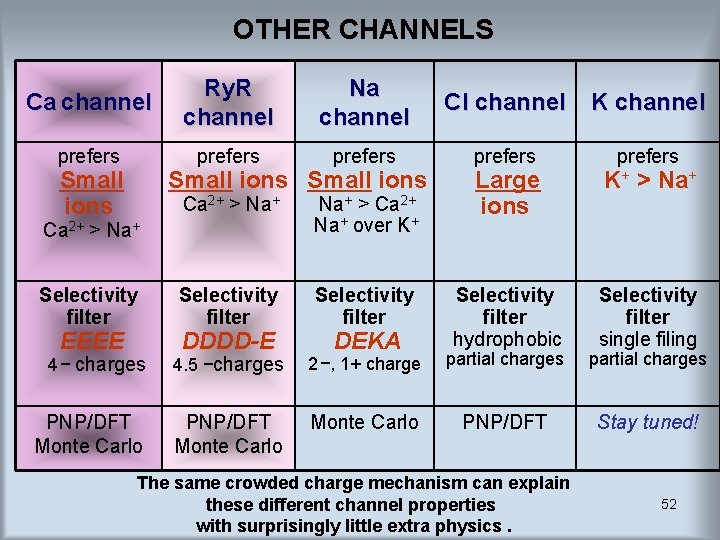
OTHER CHANNELS Ca channel Ry. R channel Na channel Cl channel K channel prefers prefers Ca 2+ > Na+ > Ca 2+ Na+ over K+ Selectivity filter 4 − charges 4. 5 −charges 2 −, 1+ charge partial charges PNP/DFT Monte Carlo PNP/DFT Stay tuned! Small ions Ca 2+ > Na+ Selectivity filter EEEE DDDD-E DEKA Large ions K+ > Na+ Selectivity filter hydrophobic Selectivity filter single filing The same crowded charge mechanism can explain these different channel properties with surprisingly little extra physics. 52
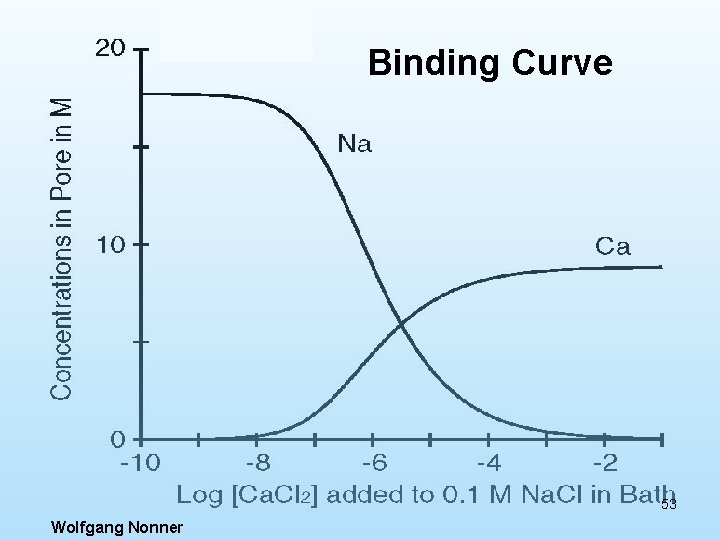
Binding Curve 53 Wolfgang Nonner
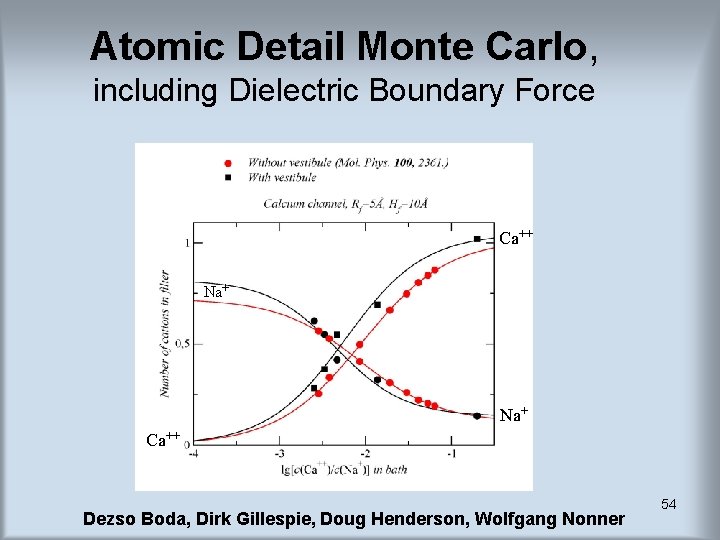
Atomic Detail Monte Carlo, including Dielectric Boundary Force Ca++ Na+ Ca++ Dezso Boda, Dirk Gillespie, Doug Henderson, Wolfgang Nonner 54
Selectivity comes from Crowding Other Properties of Ion Channels are likely to involve more subtle physics including orbital delocalization and chemical binding Selectivity apparently does not! Nonner and Eisenberg 55
Ionic Selectivity in Protein Channels Crowded Charge Mechanism Simplest Version: MSA How qualitatively does Crowded Charge give Selectivity? (Real answer is the equations, of course. ) 56
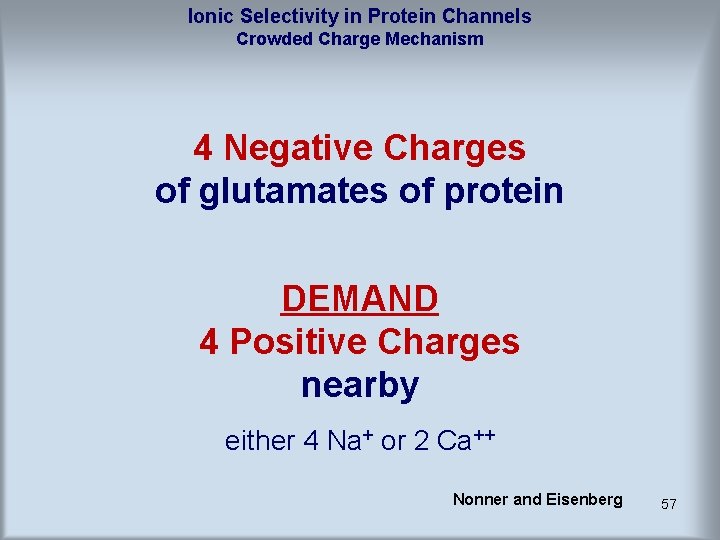
Ionic Selectivity in Protein Channels Crowded Charge Mechanism 4 Negative Charges of glutamates of protein DEMAND 4 Positive Charges nearby either 4 Na+ or 2 Ca++ Nonner and Eisenberg 57
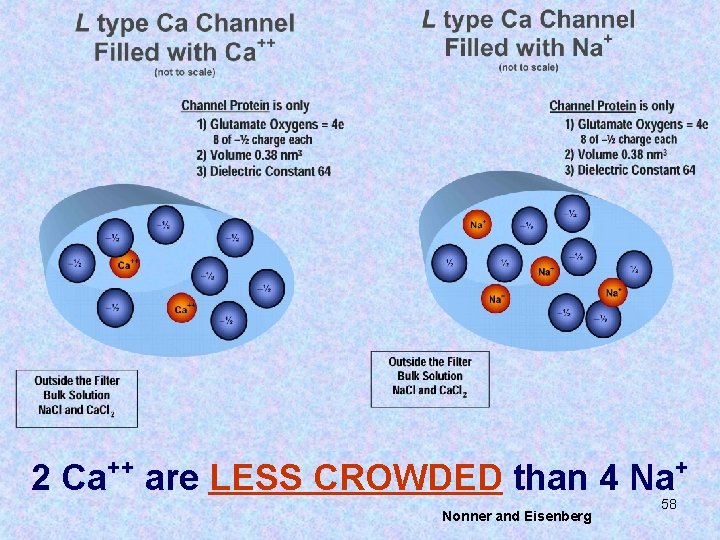
2 Ca ++ are LESS CROWDED than 4 Na Nonner and Eisenberg + 58
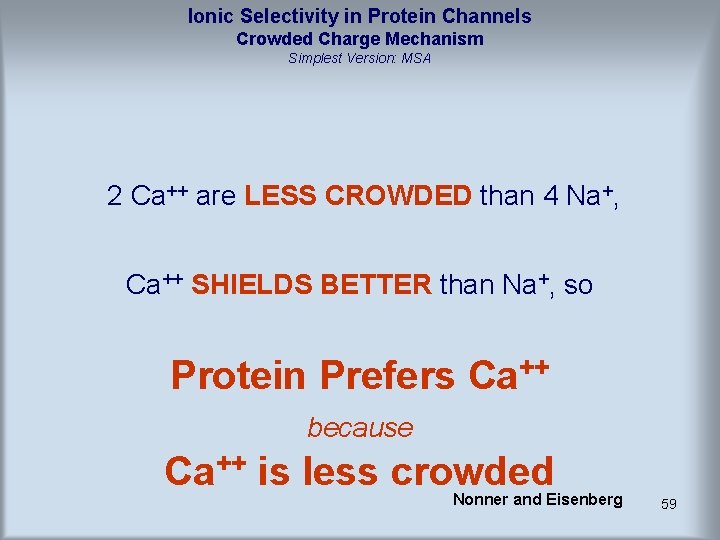
Ionic Selectivity in Protein Channels Crowded Charge Mechanism Simplest Version: MSA 2 Ca++ are LESS CROWDED than 4 Na+, Ca++ SHIELDS BETTER than Na+, so Protein Prefers Ca++ because Ca++ is less crowded Nonner and Eisenberg 59
What does the protein do? Selectivity arises from Electrostatics and Crowding of Charge Certain MEASURES of structure are Powerful DETERMINANTS of Function e. g. , Volume, Dielectric Coefficient, etc. Precise Arrangement of Atoms is not involved in the model, to first order. Nonner and Eisenberg 60
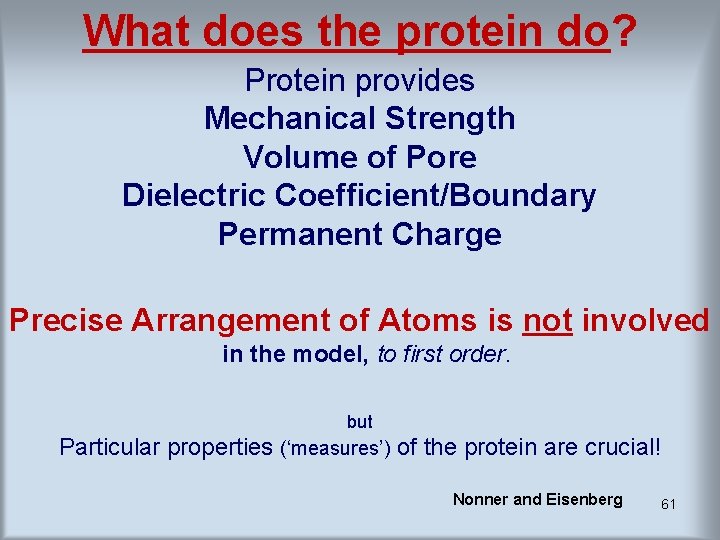
What does the protein do? Protein provides Mechanical Strength Volume of Pore Dielectric Coefficient/Boundary Permanent Charge Precise Arrangement of Atoms is not involved in the model, to first order. but Particular properties (‘measures’) of the protein are crucial! Nonner and Eisenberg 61
Implications for Traditional Biochemistry focuses on Particular locations of atoms 62
Traditional Biochemistry assumes Rate Constants Independent of Concentration & Conditions 63
Implications for Traditional Biochemistry (more or less) Ignores the Electric Field 64
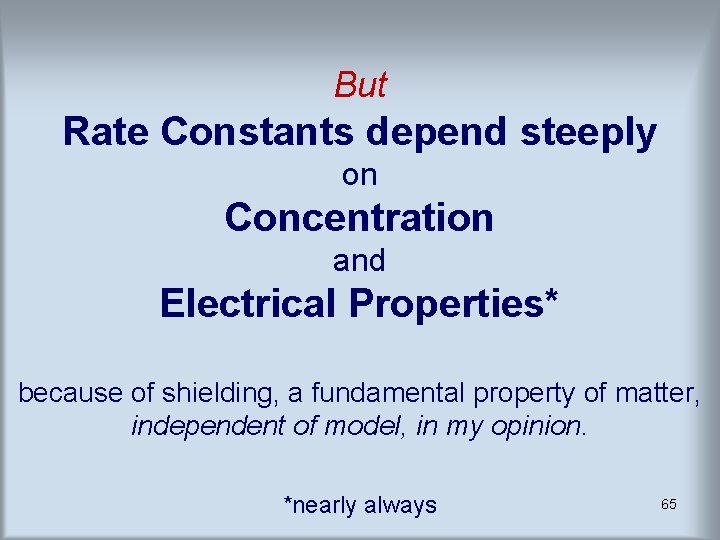
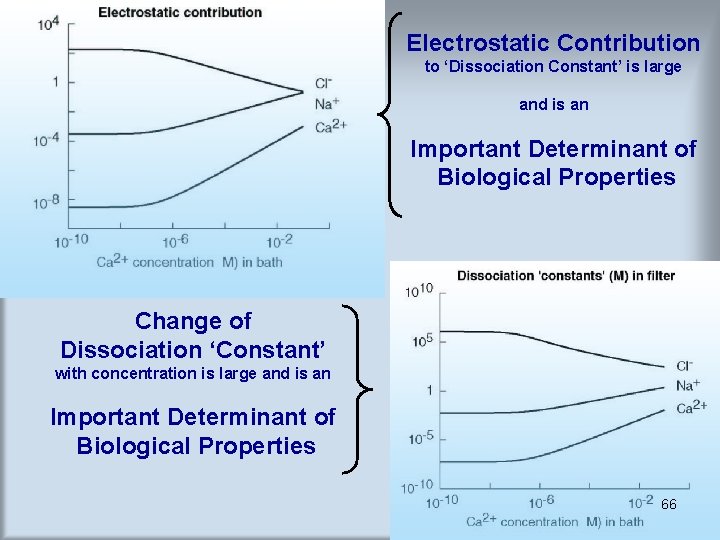
But Rate Constants depend steeply on Concentration and Electrical Properties* because of shielding, a fundamental property of matter, independent of model, in my opinion. *nearly always 65
Electrostatic Contribution to ‘Dissociation Constant’ is large and is an Important Determinant of Biological Properties Change of Dissociation ‘Constant’ with concentration is large and is an Important Determinant of Biological Properties 66
Mathematics of Ion Channels is Interesting, Feasible, and Important 67
Mathematics of Ion Channels is Interesting, Feasible, and Important 68
Mathematics of Ion Channels is Interesting, Feasible, and Important and it works! 69
Experiment Two Synthetic Calcium Channels Designed by Theory Calcium selective Unselective Wild Type As charge density increases, channel becomes calcium selective Erev ECa built by Henk Miedema, Wim Meijberg of Bio. Made Corp. , Groningen, Netherlands Miedema et al, Biophys J 87: 3137– 3147 (2004) 70
Details of DFT 71
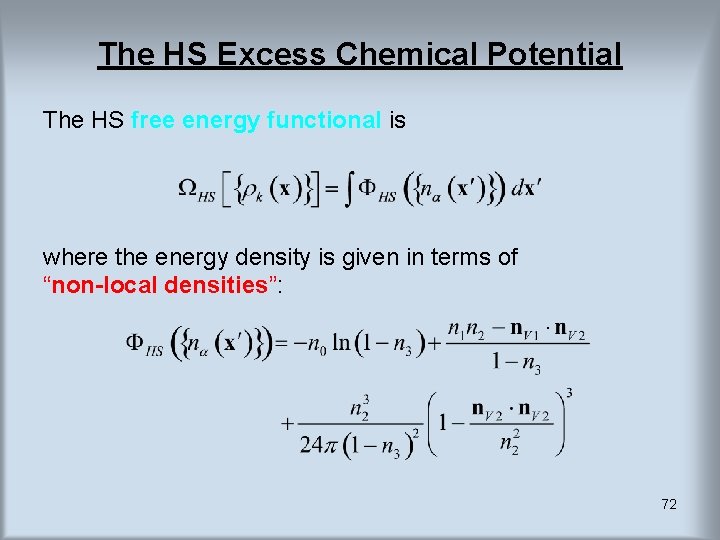
The HS Excess Chemical Potential The HS free energy functional is where the energy density is given in terms of “non-local densities”: 72
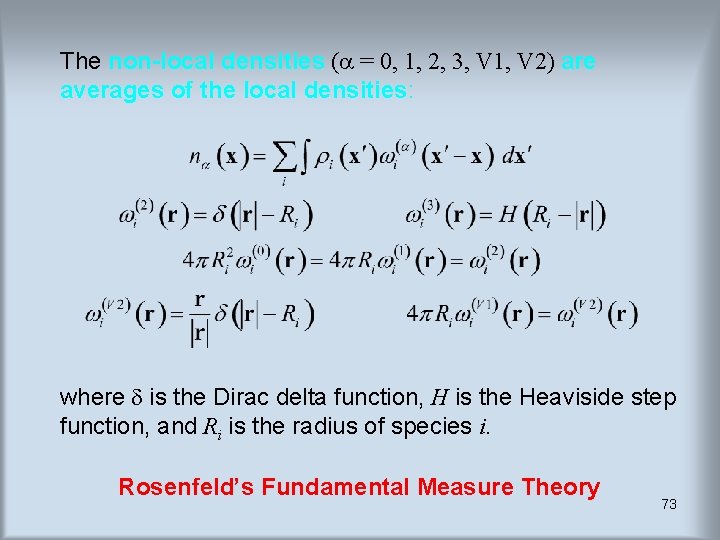
The non-local densities ( = 0, 1, 2, 3, V 1, V 2) are averages of the local densities: where is the Dirac delta function, H is the Heaviside step function, and Ri is the radius of species i. Rosenfeld’s Fundamental Measure Theory 73
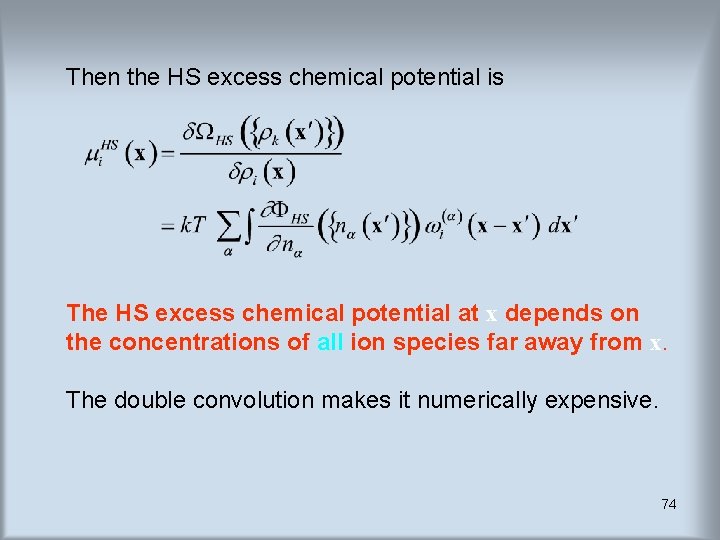
Then the HS excess chemical potential is The HS excess chemical potential at x depends on the concentrations of all ion species far away from x. The double convolution makes it numerically expensive. 74
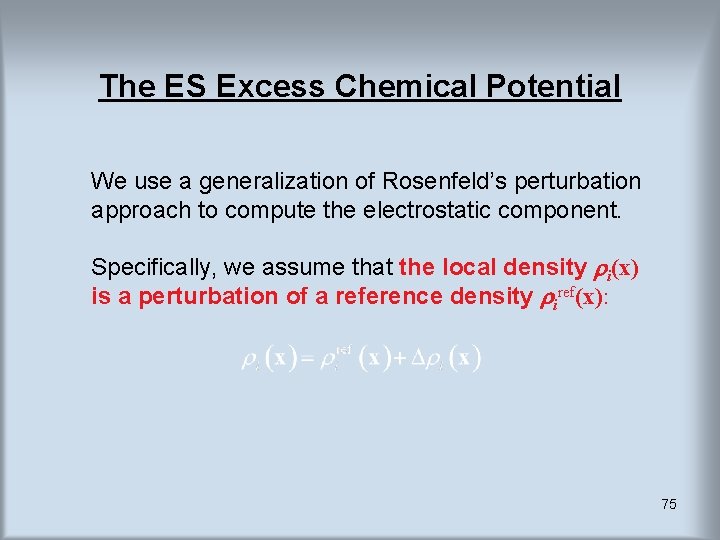
The ES Excess Chemical Potential We use a generalization of Rosenfeld’s perturbation approach to compute the electrostatic component. Specifically, we assume that the local density i(x) is a perturbation of a reference density iref(x): 75
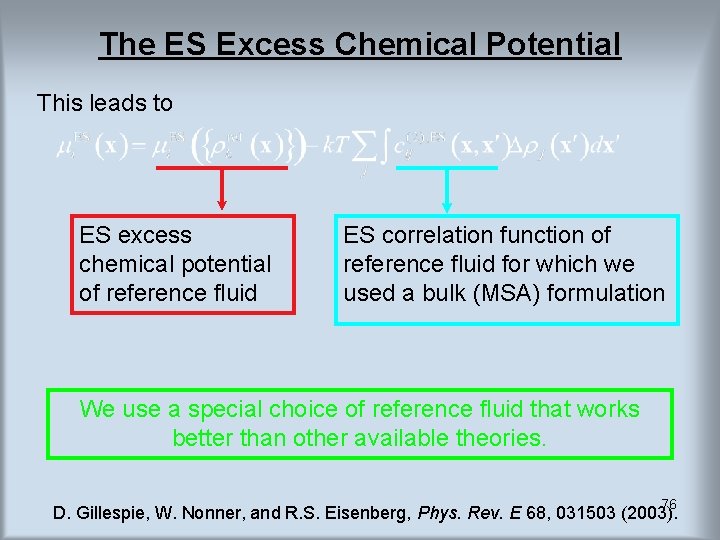
The ES Excess Chemical Potential This leads to ES excess chemical potential of reference fluid ES correlation function of reference fluid for which we used a bulk (MSA) formulation We use a special choice of reference fluid that works better than other available theories. 76 D. Gillespie, W. Nonner, and R. S. Eisenberg, Phys. Rev. E 68, 031503 (2003).