
Multiscale CTbased computational modeling of obstructive pulmonary diseases
Multiscale CT-based computational modeling of obstructive pulmonary diseases Andrey Golov Moscow Institute of Physics and Technology VIII-th conference, working group on mathematical models and numerical methods in biomathematics, October 31 – November 3, 2016 1

The respiratory system Trachea-bronchial tree 2
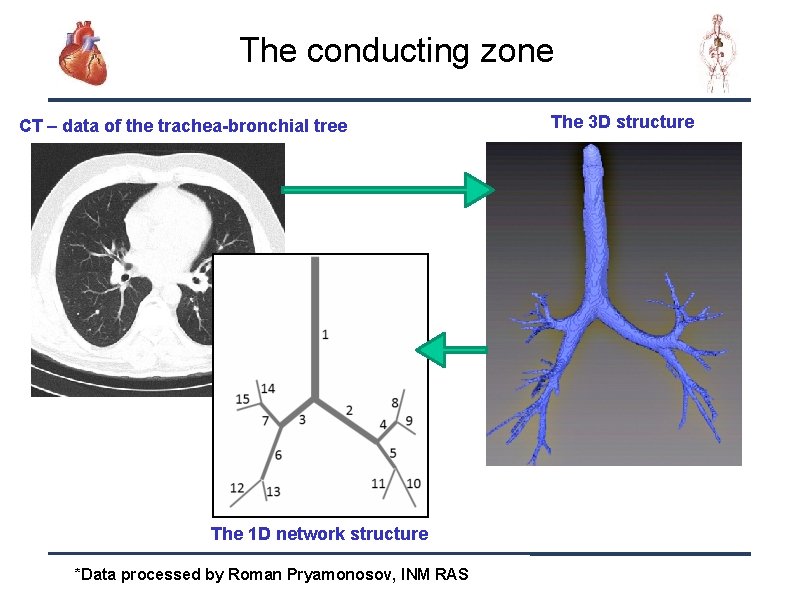
The conducting zone CT – data of the trachea-bronchial tree The 3 D structure The 1 D network structure *Data processed by Roman Pryamonosov, INM RAS 3

The conducting zone (1 D-model) 1) The law of conservation of mass 2) The law of conservation of momentum 3) The equation of state 4) The input to the nasopharynx region S. Simakov, A. Kholodov. Computational study of oxygen concentration in human blood under low frequency disturbances. Mat. Mod. Comp. Sim. , 1 (2009), 3– 295. 4

The conducting zone (1 D Model, boundary condition) - All bifurcation are dichotomous 1) The mass conservation condition 2) The Bernoulli’s theorem 3) Compatibility conditions along characteristics 5
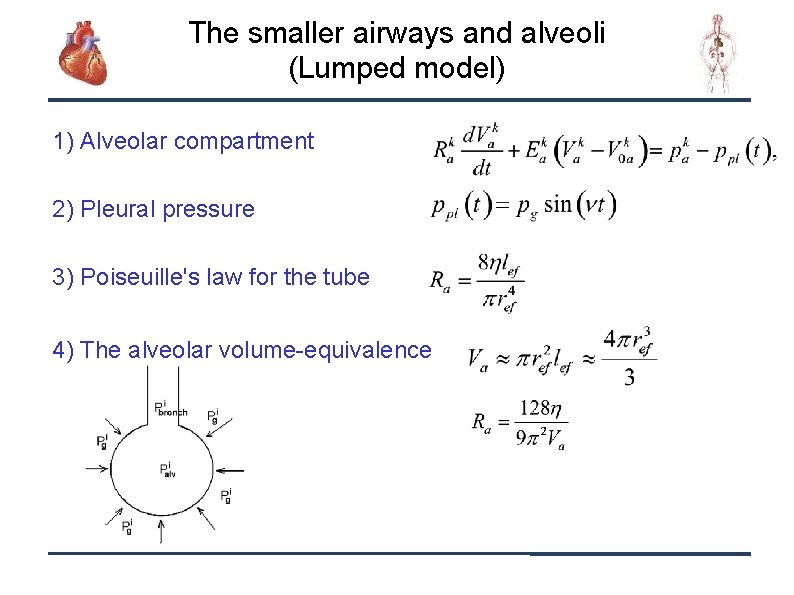
The smaller airways and alveoli (Lumped model) 1) Alveolar compartment 2) Pleural pressure 3) Poiseuille's law for the tube 4) The alveolar volume-equivalence 6
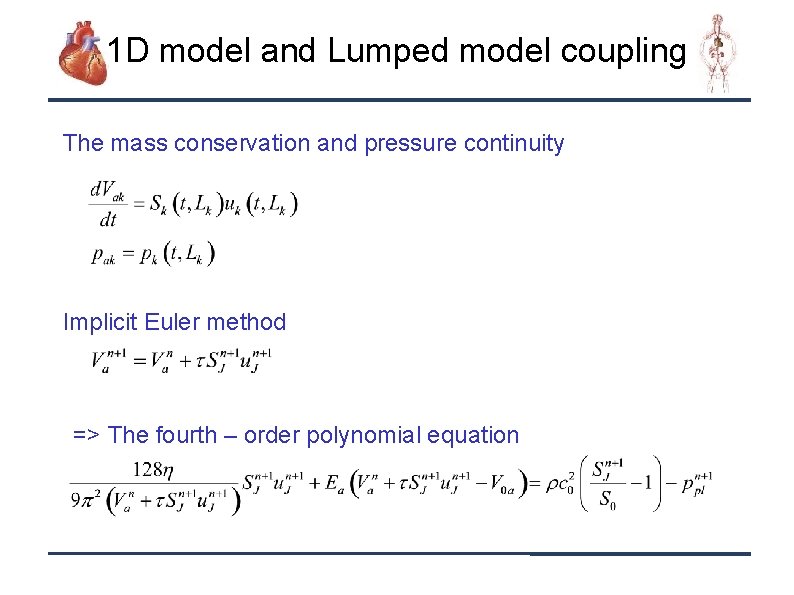
1 D model and Lumped model coupling The mass conservation and pressure continuity Implicit Euler method => The fourth – order polynomial equation 7
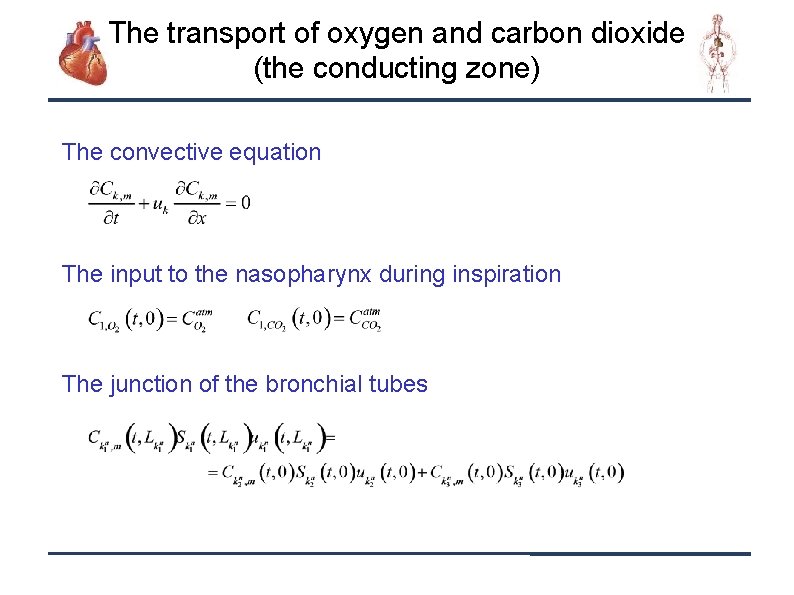
The transport of oxygen and carbon dioxide (the conducting zone) The convective equation The input to the nasopharynx during inspiration The junction of the bronchial tubes 8
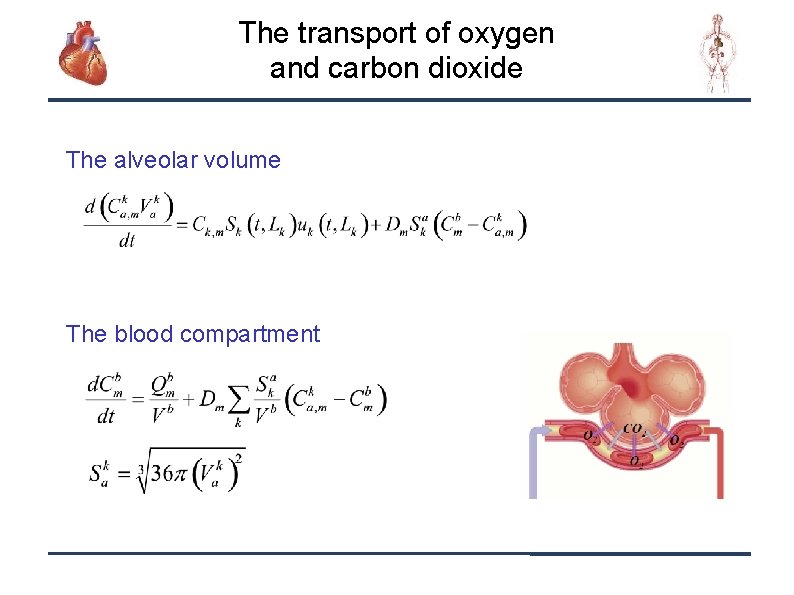
The transport of oxygen and carbon dioxide The alveolar volume The blood compartment 9
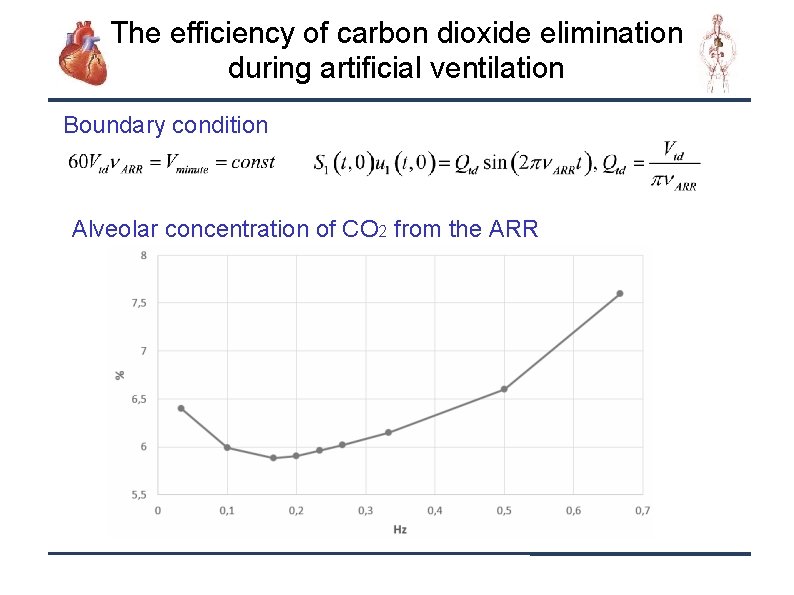
The efficiency of carbon dioxide elimination during artificial ventilation Boundary condition Alveolar concentration of CO 2 from the ARR 10
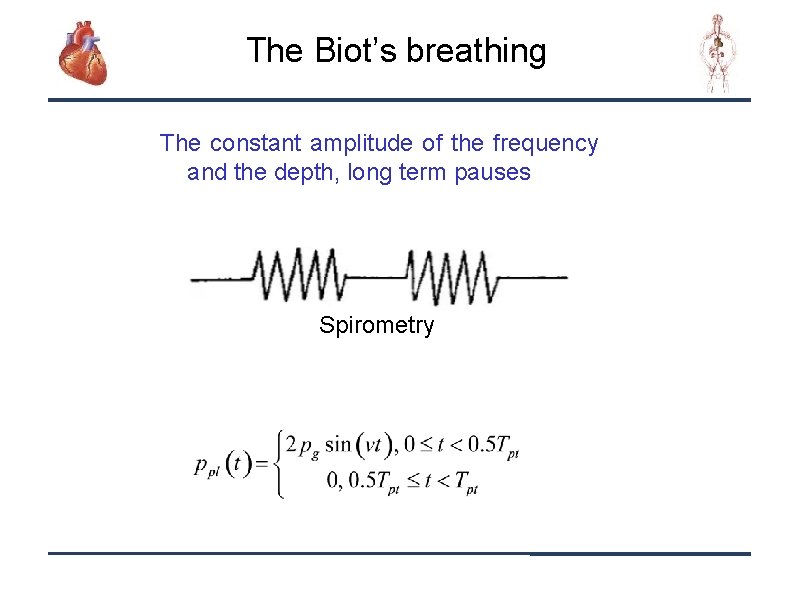
The Biot’s breathing The constant amplitude of the frequency and the depth, long term pauses Spirometry 11
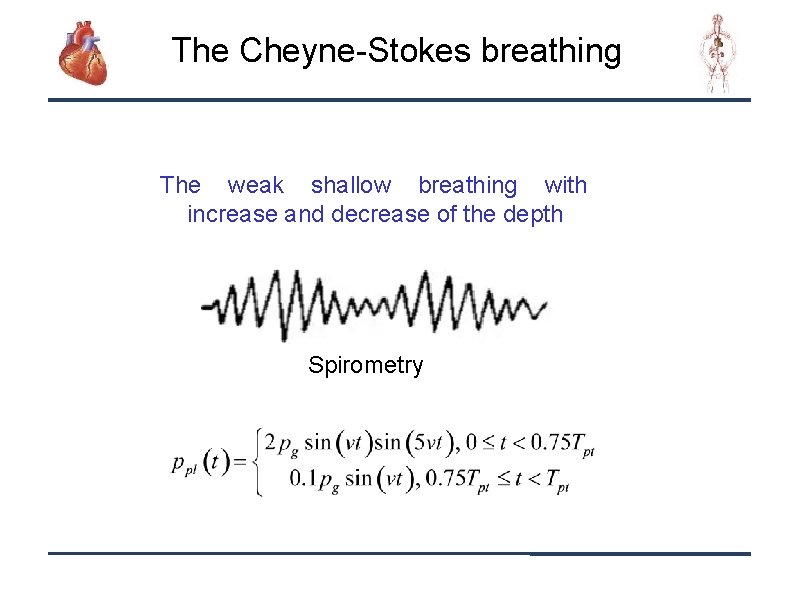
The Cheyne-Stokes breathing The weak shallow breathing with increase and decrease of the depth Spirometry 12
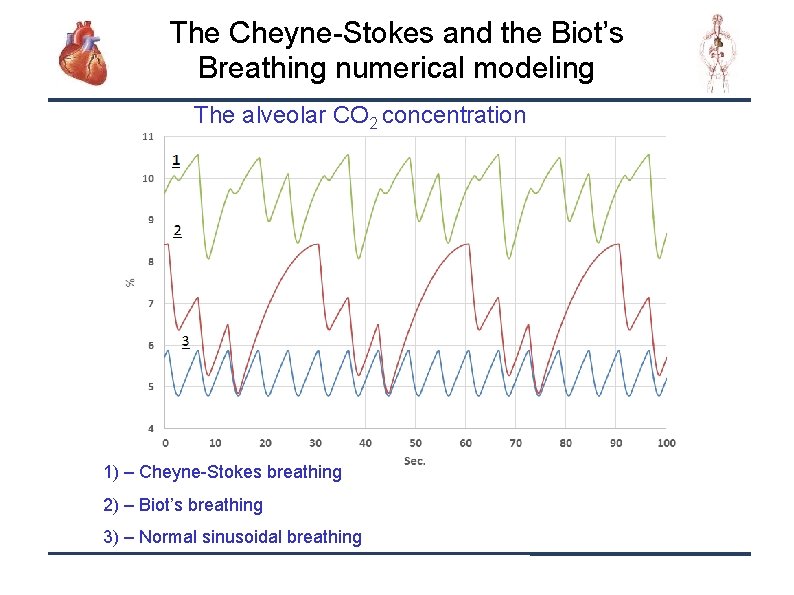
The Cheyne-Stokes and the Biot’s Breathing numerical modeling The alveolar CO 2 concentration 1) – Cheyne-Stokes breathing 2) – Biot’s breathing 3) – Normal sinusoidal breathing 13
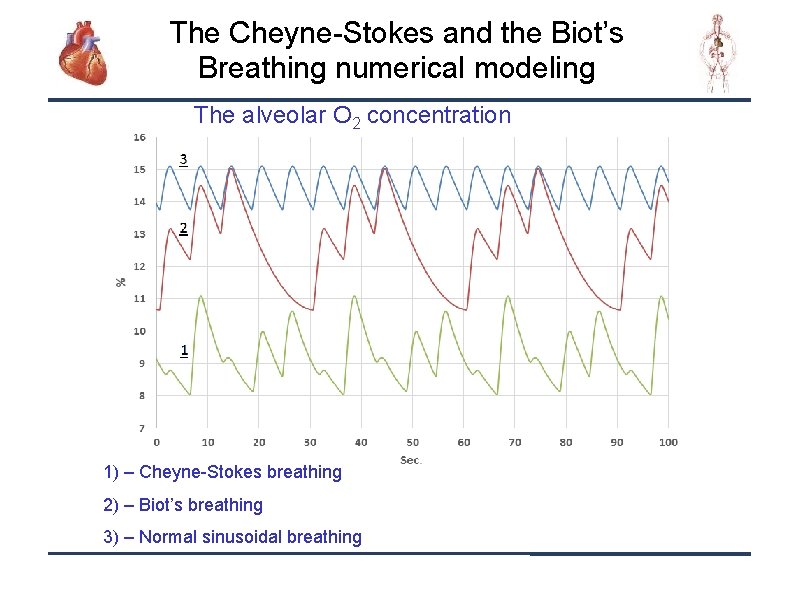
The Cheyne-Stokes and the Biot’s Breathing numerical modeling The alveolar O 2 concentration 1) – Cheyne-Stokes breathing 2) – Biot’s breathing 3) – Normal sinusoidal breathing 14
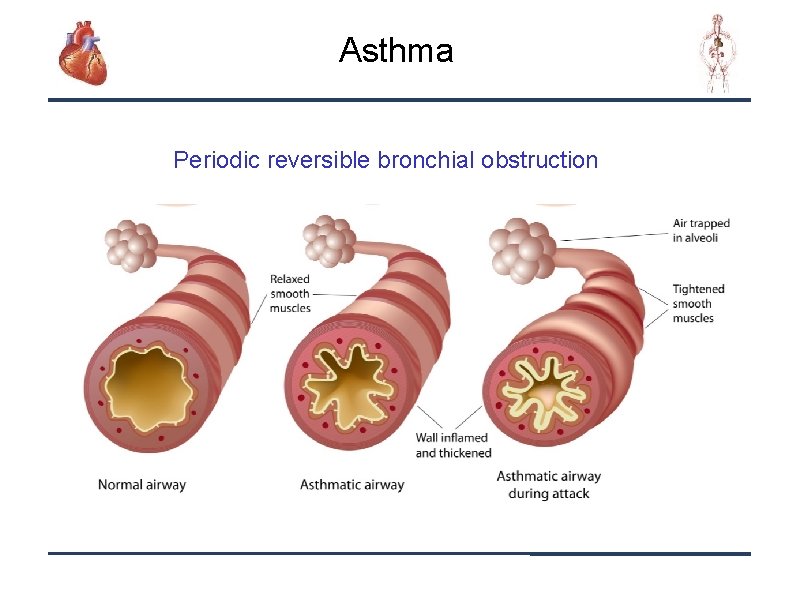
Asthma Periodic reversible bronchial obstruction 15
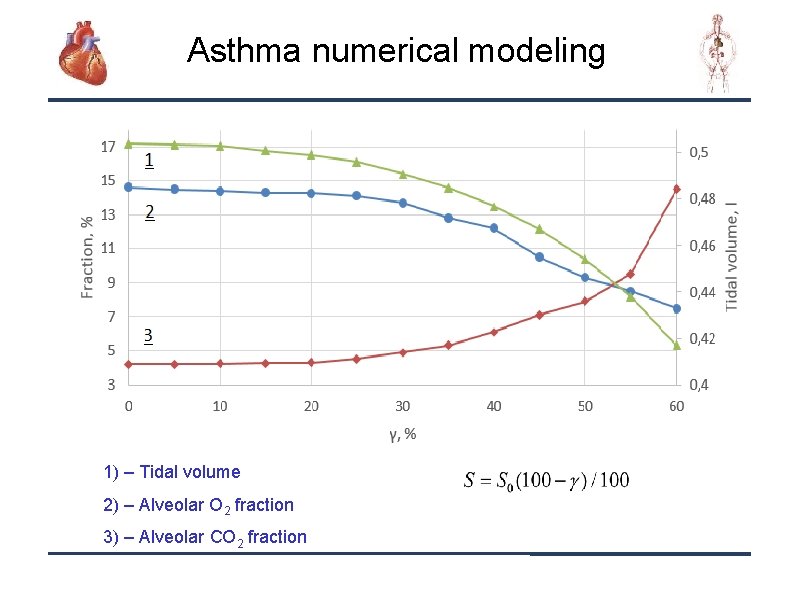
Asthma numerical modeling 1) – Tidal volume 2) – Alveolar O 2 fraction 3) – Alveolar CO 2 fraction 16
Conclusion - The coupled 0 D-1 D model of lungs ventilation was developed - An automatic 1 D reconstruction of the trachea-bronchial tree structure from 3 D CT-data was used - The efficiency of carbon dioxide elimination during artificial ventilation was investigated - Pathological breathing patterns (Biot’s and Cheyne. Stokes) was simulated - The asthma attack was simulated 17
Future work - Acid-base balance equations in blood - Lungs ventilation and cardiac output regulation by blood composition deviation - Implementation to cyber biological systems for remote-real time monitoring of patient respiration 18
Thank you for listening! 19
- Slides: 19