
Multipurpose scintillation materials for detection of different types



- Slides: 14
Multi-purpose scintillation materials for detection of different types of ionizing radiation in experimental physics, medical imaging and other applications Georgy Dosovitskiy, on behalf of NRC “Kurchatov institute” – IREA Institute of Chemical Reagents and High Purity Chemical Substances of NRC «Kurchatov Institute» george. dos@gmail. com 07/11/2019, CERN National research center “Kurchatov institute”
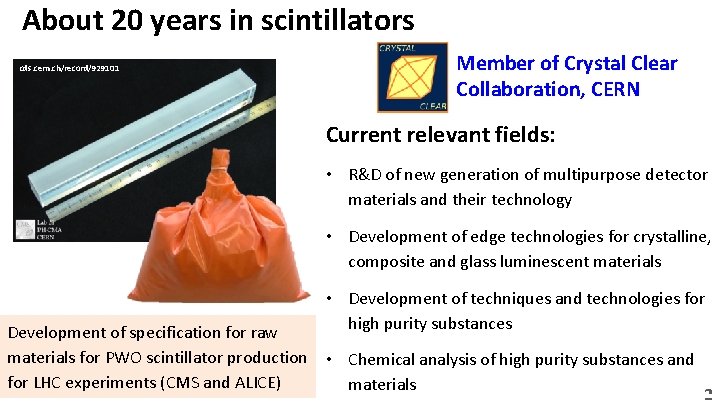
About 20 years in scintillators cds. cern. ch/record/929101 Member of Crystal Clear Collaboration, CERN Current relevant fields: • R&D of new generation of multipurpose detector materials and their technology • Development of edge technologies for crystalline, composite and glass luminescent materials • Development of techniques and technologies for high purity substances Development of specification for raw materials for PWO scintillator production • Chemical analysis of high purity substances and for LHC experiments (CMS and ALICE) materials 2
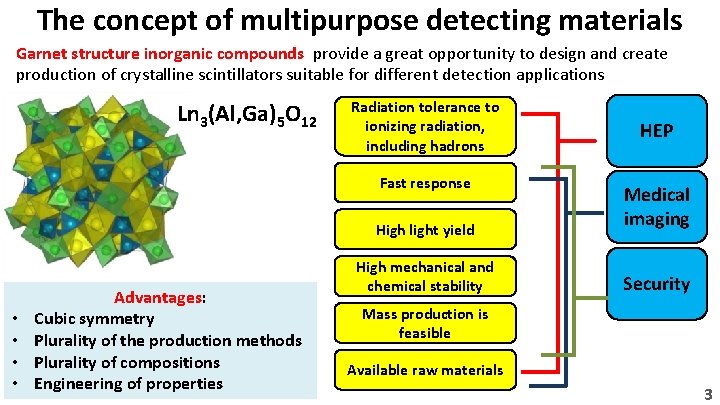
The concept of multipurpose detecting materials Garnet structure inorganic compounds provide a great opportunity to design and create production of crystalline scintillators suitable for different detection applications Ln 3(Al, Ga)5 O 12 Radiation tolerance to ionizing radiation, including hadrons Fast response High light yield • • Advantages: Cubic symmetry Plurality of the production methods Plurality of compositions Engineering of properties High mechanical and chemical stability HEP Medical imaging Security Mass production is feasible Available raw materials 3
Funding sources acknowledgement R&D federal program (FCP IR) of Ministry of Science and Education of Russian Federation No 14. 576. 21. 0006 dated 17. 06. 2014 – on LED phosphors No 14. 625. 21. 0033 dated 27. 10. 2015 – on ceramic scintillators No 14. 625. 21. 0040 dated 29. 09. 2016 – on 3 D printing using ceramics «Megagrant» of Government of Russian Federation, contract No 14. W 03. 31. 0004 dated 20. 02. 2017 New generation of inorganic scintillators and detectors based on them for neutron detection in a broad energy range Leading scientist – Mikhail Korzhik Hosting organization – NRC “Kurchatov institute” + internal research projects A set of different projects, making input into development of the core direction 4
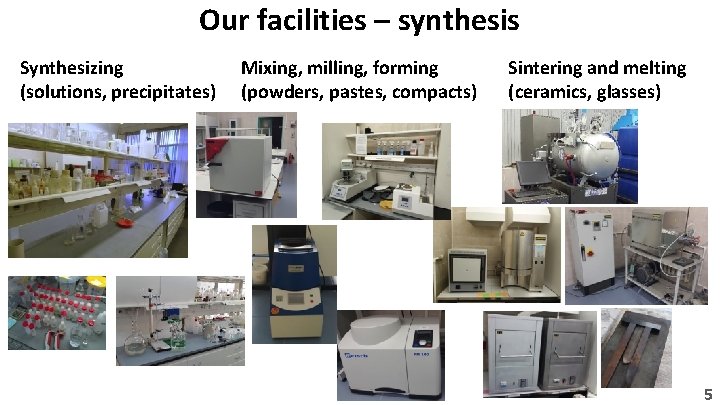
Our facilities – synthesis Synthesizing (solutions, precipitates) Mixing, milling, forming (powders, pastes, compacts) Sintering and melting (ceramics, glasses) 5
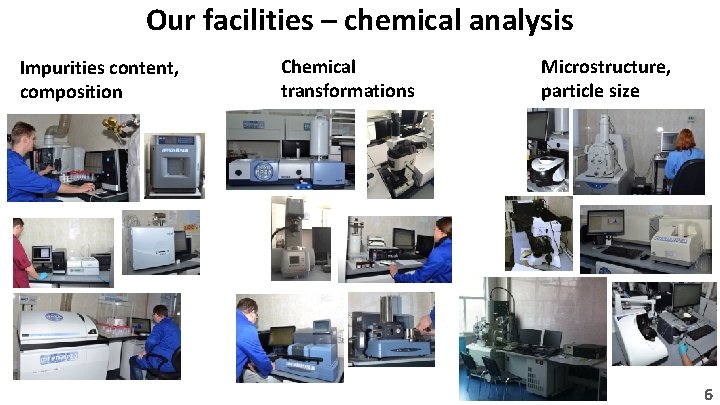
Our facilities – chemical analysis Impurities content, composition Chemical transformations Microstructure, particle size 6
Our facilities – scintillation measurements World-class scintillation measurements set-up is built with “Megagrant” support Time-resolved spectrofluorimeter: – Pico. Quant Fluoro. Time 250 shipment is in progress Scintillation light yield measurements: – Pulse height spectra registration Scintillation decay kinetics measurements: – Start-stop scheme NIM standard – based equipment + numerous collaborators from CCC members for performance evaluation tests 7
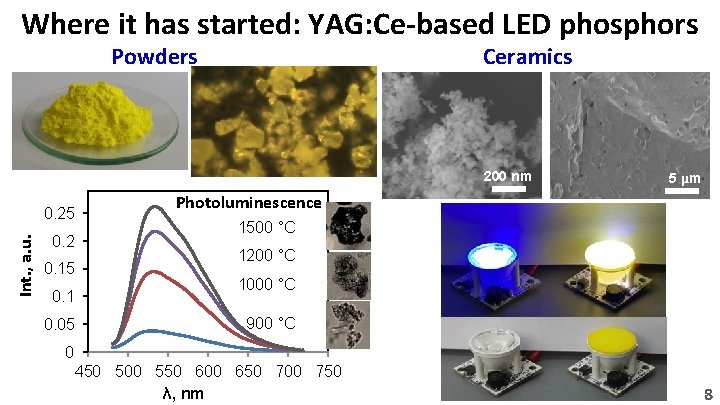
Where it has started: YAG: Ce-based LED phosphors Powders Ceramics 200 nm Int. , a. u. 0. 25 0. 2 0. 15 0. 1 0. 05 5 μm Photoluminescence 1500 °C 1200 °C 1000 °C 900 °C 0 450 500 550 600 650 700 750 λ, nm 8
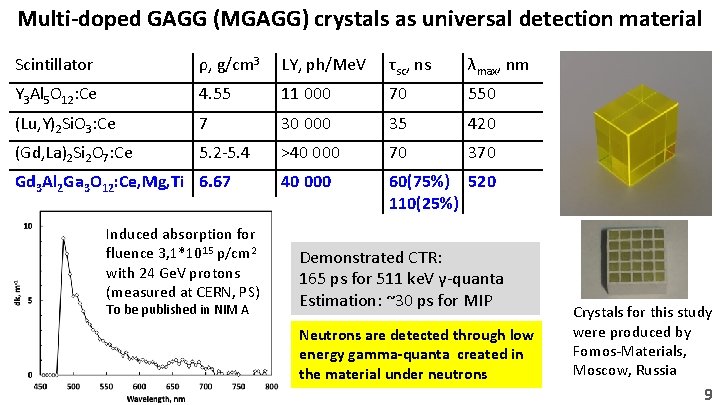
Multi-doped GAGG (MGAGG) crystals as universal detection material Scintillator ρ, g/cm 3 LY, ph/Me. V τsc, ns λmax, nm Y 3 Al 5 O 12: Ce 4. 55 11 000 70 550 (Lu, Y)2 Si. O 3: Ce 7 30 000 35 420 (Gd, La)2 Si 2 O 7: Ce 5. 2 -5. 4 >40 000 70 370 40 000 60(75%) 520 110(25%) Gd 3 Al 2 Ga 3 O 12: Ce, Mg, Ti 6. 67 Induced absorption for fluence 3, 1*1015 p/cm 2 with 24 Ge. V protons (measured at CERN, PS) To be published in NIM A Demonstrated CTR: 165 ps for 511 ke. V γ-quanta Estimation: ~30 ps for MIP Neutrons are detected through low energy gamma-quanta created in the material under neutrons Crystals for this study were produced by Fomos-Materials, Moscow, Russia 9
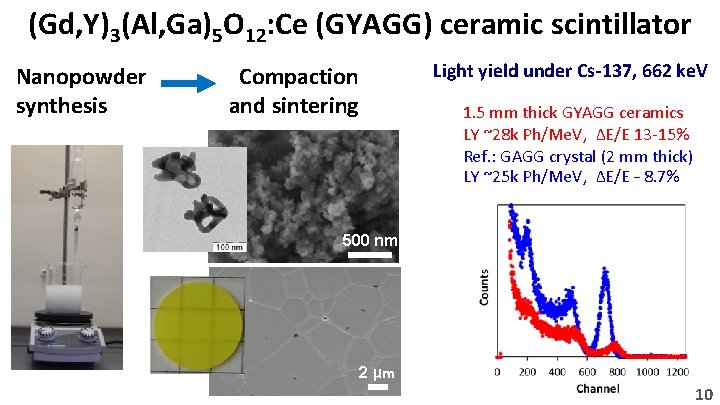
(Gd, Y)3(Al, Ga)5 O 12: Ce (GYAGG) ceramic scintillator Nanopowder synthesis Light yield under Cs-137, 662 ke. V Compaction and sintering 1. 5 mm thick GYAGG ceramics LY ~28 k Ph/Me. V, ΔE/E 13 -15% Ref. : GAGG crystal (2 mm thick) LY ~25 k Ph/Me. V, ΔE/E – 8. 7% 500 nm 2 µm 10
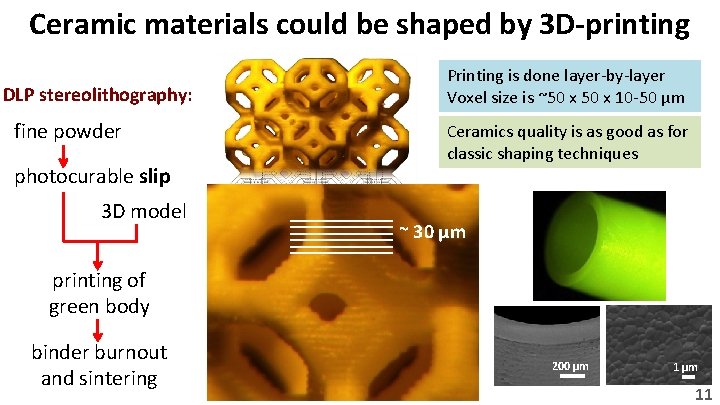
Ceramic materials could be shaped by 3 D-printing DLP stereolithography: fine powder photocurable slip 3 D model Printing is done layer-by-layer Voxel size is ~50 x 10 -50 μm Ceramics quality is as good as for classic shaping techniques ~ 30 μm printing of green body binder burnout and sintering 200 μm 11
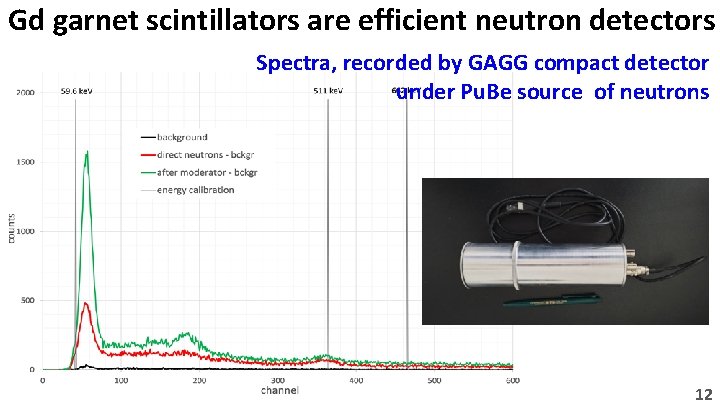
Gd garnet scintillators are efficient neutron detectors Spectra, recorded by GAGG compact detector under Pu. Be source of neutrons 12
Some more interesting areas RL, intensity, a. u. Ce 3+ and Tb 3+ activated glasses for neutron detection Development of high purity compounds: Raw materials for Potassium dihydrogen liquid scintillators phosphate for KDP crystals Tb content BGO (ref. ) λ, nm 3 D-printing of powder loaded polymers for composite and ceramic materials obtaining 13
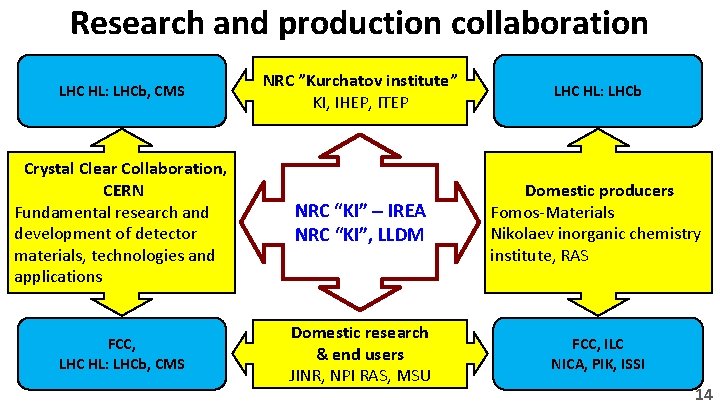
Research and production collaboration NRC ”Kurchatov institute” KI, IHEP, ITEP LHC HL: LHCb Crystal Clear Collaboration, CERN Fundamental research and development of detector materials, technologies and applications NRC “KI” – IREA NRC “KI”, LLDM Domestic producers Fomos-Materials Nikolaev inorganic chemistry institute, RAS FCC, LHC HL: LHCb, CMS Domestic research & end users JINR, NPI RAS, MSU FCC, ILC NICA, PIK, ISSI LHC HL: LHCb, CMS 14