
MULTIPRESSURE SYSTEMS Compound compression Prof Dr M M
- Slides: 9
MULTIPRESSURE SYSTEMS: Compound compression Prof. Dr. M. M. Nasr Mechanical Power and Energy Dept.
MULTIPRESSURE SYSTEMS • • • a) Multi-compression systems: The single-stage beyond compression ratio 8 is not efficient. b) Multi-evaporator systems: The system which has two evaporators operating at different temperatures is common in industrial refrigeration. c) Cascade systems: This system is employed to obtain temperatures of -40 to -80°C or ultra-low temperatures lower than them using two kinds of refrigerants having different temperature characteristics.
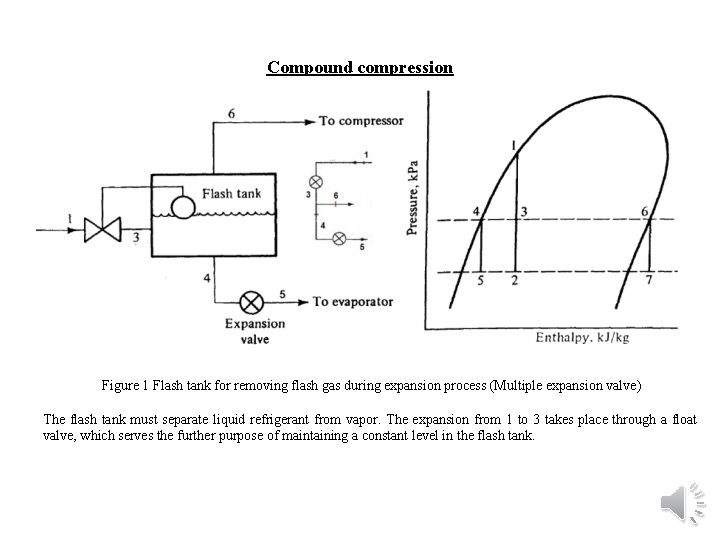
Compound compression Figure 1 Flash tank for removing flash gas during expansion process (Multiple expansion valve) The flash tank must separate liquid refrigerant from vapor. The expansion from 1 to 3 takes place through a float valve, which serves the further purpose of maintaining a constant level in the flash tank.
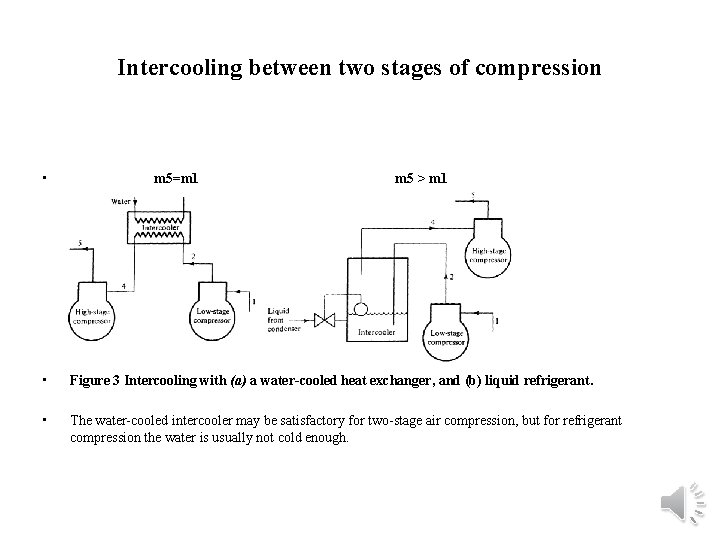
Intercooling between two stages of compression • m 5=m 1 m 5 > m 1 • Figure 3 Intercooling with (a) a water-cooled heat exchanger, and (b) liquid refrigerant. • The water-cooled intercooler may be satisfactory for two-stage air compression, but for refrigerant compression the water is usually not cold enough.
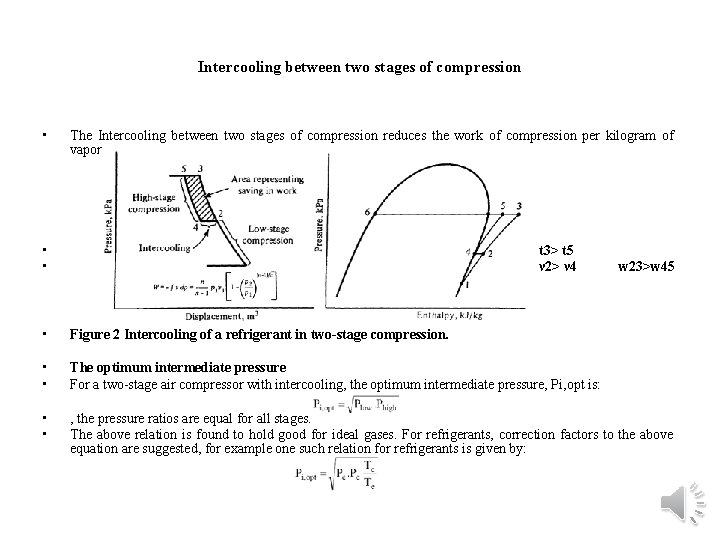
Intercooling between two stages of compression • The Intercooling between two stages of compression reduces the work of compression per kilogram of vapor • • t 3> t 5 ν 2> ν 4 w 23>w 45 • Figure 2 Intercooling of a refrigerant in two-stage compression. • • The optimum intermediate pressure For a two-stage air compressor with intercooling, the optimum intermediate pressure, Pi, opt is: • • , the pressure ratios are equal for all stages. The above relation is found to hold good for ideal gases. For refrigerants, correction factors to the above equation are suggested, for example one such relation for refrigerants is given by:
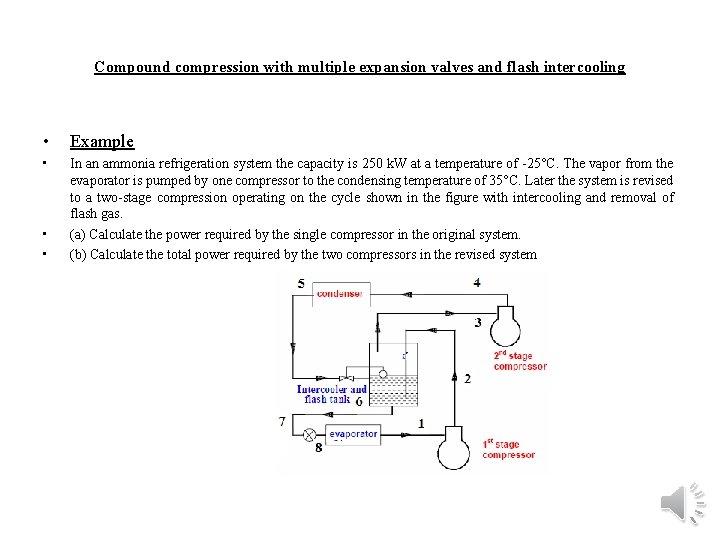
Compound compression with multiple expansion valves and flash intercooling • Example • In an ammonia refrigeration system the capacity is 250 k. W at a temperature of -25°C. The vapor from the evaporator is pumped by one compressor to the condensing temperature of 35°C. Later the system is revised to a two-stage compression operating on the cycle shown in the figure with intercooling and removal of flash gas. (a) Calculate the power required by the single compressor in the original system. (b) Calculate the total power required by the two compressors in the revised system • •
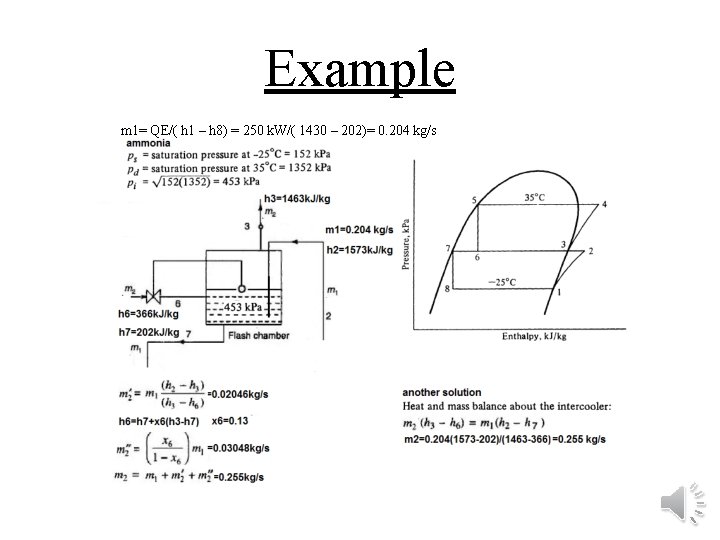
Example m 1= QE/( h 1 – h 8) = 250 k. W/( 1430 – 202)= 0. 204 kg/s
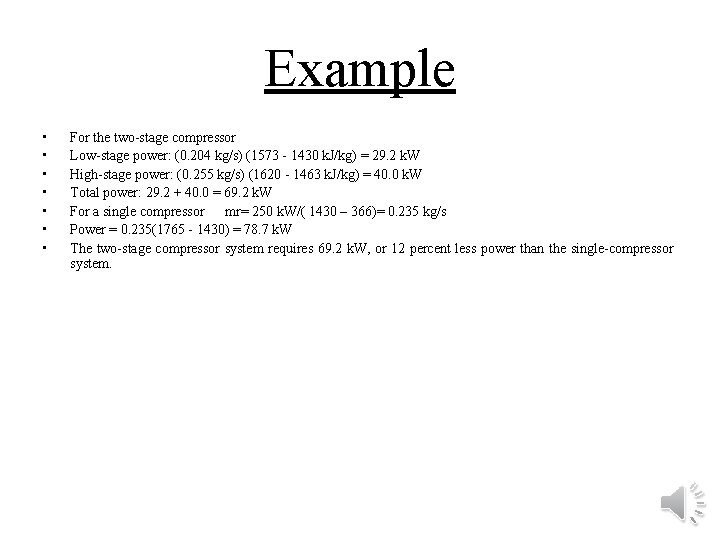
Example • • For the two-stage compressor Low-stage power: (0. 204 kg/s) (1573 - 1430 k. J/kg) = 29. 2 k. W High-stage power: (0. 255 kg/s) (1620 - 1463 k. J/kg) = 40. 0 k. W Total power: 29. 2 + 40. 0 = 69. 2 k. W For a single compressor mr= 250 k. W/( 1430 – 366)= 0. 235 kg/s Power = 0. 235(1765 - 1430) = 78. 7 k. W The two-stage compressor system requires 69. 2 k. W, or 12 percent less power than the single-compressor system.
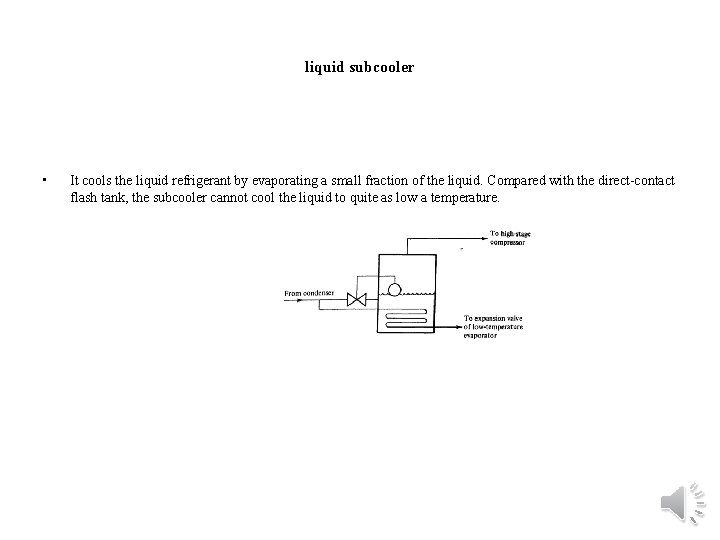
liquid subcooler • It cools the liquid refrigerant by evaporating a small fraction of the liquid. Compared with the direct-contact flash tank, the subcooler cannot cool the liquid to quite as low a temperature.