
Multiplying Conjugates The following pairs of binomials are

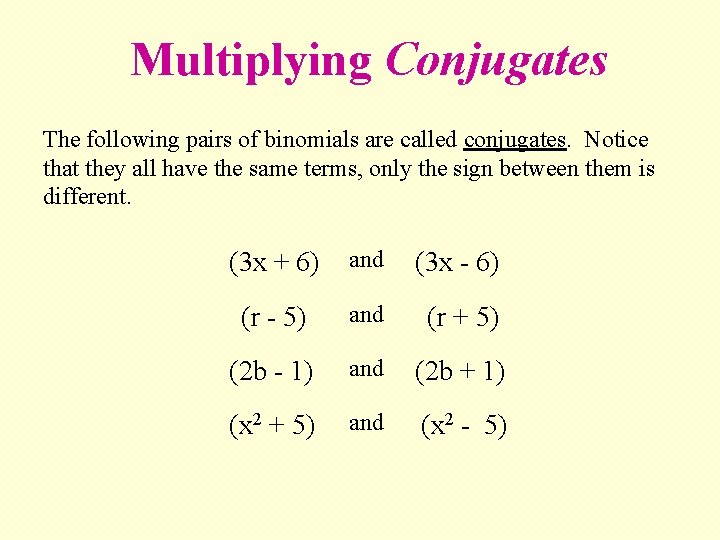
Multiplying Conjugates The following pairs of binomials are called conjugates. Notice that they all have the same terms, only the sign between them is different. (3 x + 6) and (3 x - 6) (r - 5) and (r + 5) (2 b - 1) and (2 b + 1) (x 2 + 5) and (x 2 - 5)
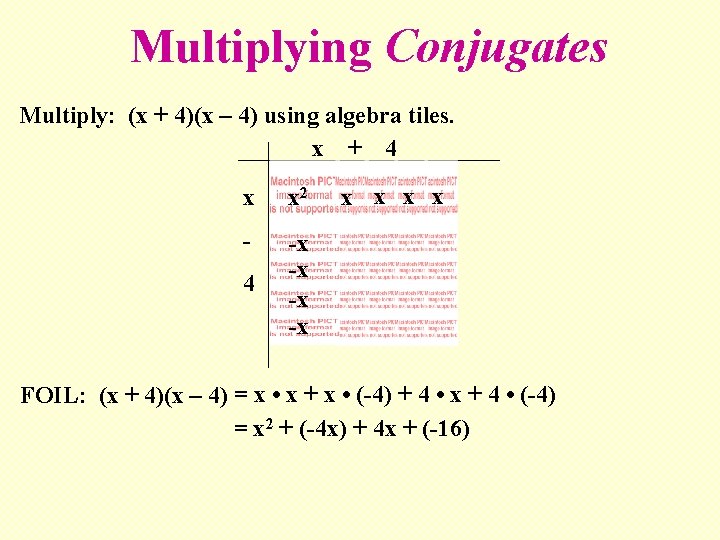
Multiplying Conjugates Multiply: (x + 4)(x – 4) using algebra tiles. x + 4 x x 2 - -x -x 4 x x FOIL: (x + 4)(x – 4) = x • x + x • (-4) + 4 • x + 4 • (-4) = x 2 + (-4 x) + 4 x + (-16)
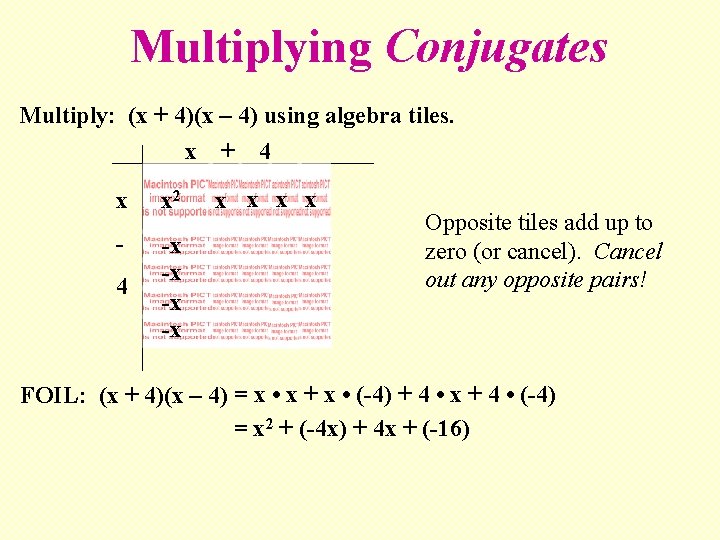
Multiplying Conjugates Multiply: (x + 4)(x – 4) using algebra tiles. x + 4 x x 2 - -x -x 4 x x Opposite tiles add up to zero (or cancel). Cancel out any opposite pairs! FOIL: (x + 4)(x – 4) = x • x + x • (-4) + 4 • x + 4 • (-4) = x 2 + (-4 x) + 4 x + (-16)
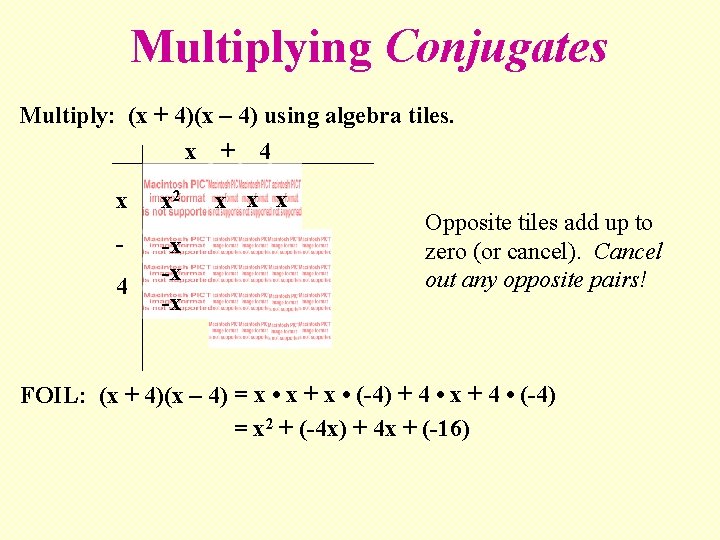
Multiplying Conjugates Multiply: (x + 4)(x – 4) using algebra tiles. x + 4 x x 2 - -x -x -x 4 x x x Opposite tiles add up to zero (or cancel). Cancel out any opposite pairs! FOIL: (x + 4)(x – 4) = x • x + x • (-4) + 4 • x + 4 • (-4) = x 2 + (-4 x) + 4 x + (-16)
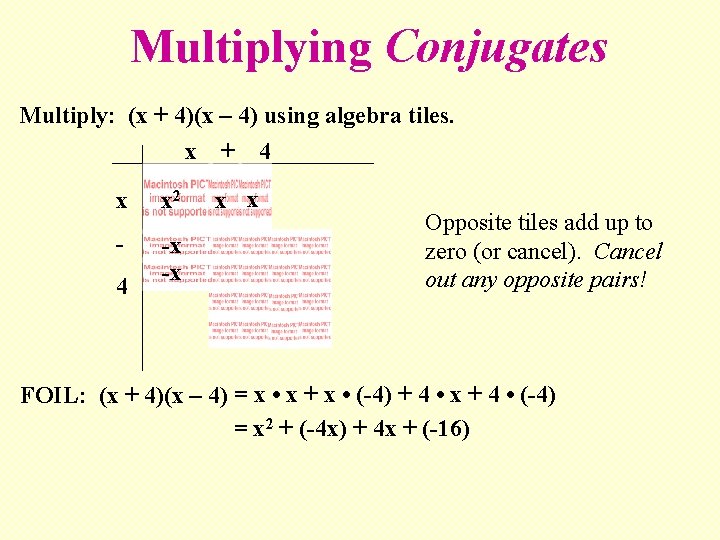
Multiplying Conjugates Multiply: (x + 4)(x – 4) using algebra tiles. x + 4 x x 2 - -x -x 4 x x Opposite tiles add up to zero (or cancel). Cancel out any opposite pairs! FOIL: (x + 4)(x – 4) = x • x + x • (-4) + 4 • x + 4 • (-4) = x 2 + (-4 x) + 4 x + (-16)
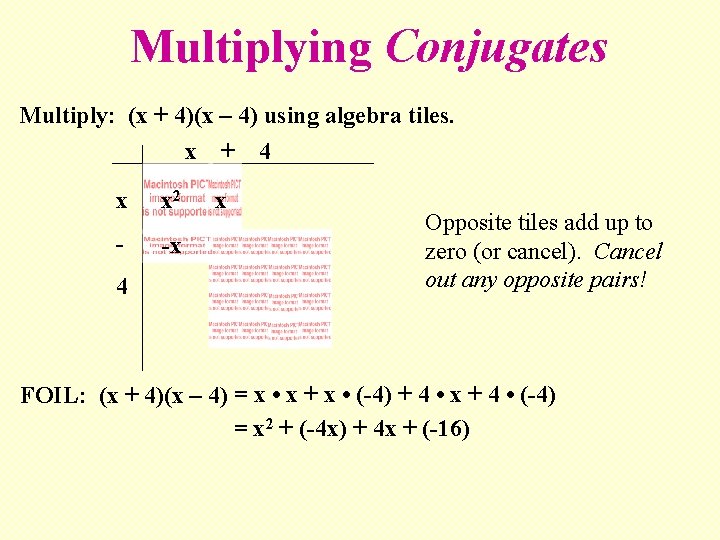
Multiplying Conjugates Multiply: (x + 4)(x – 4) using algebra tiles. x + 4 x x 2 - -x 4 x Opposite tiles add up to zero (or cancel). Cancel out any opposite pairs! FOIL: (x + 4)(x – 4) = x • x + x • (-4) + 4 • x + 4 • (-4) = x 2 + (-4 x) + 4 x + (-16)
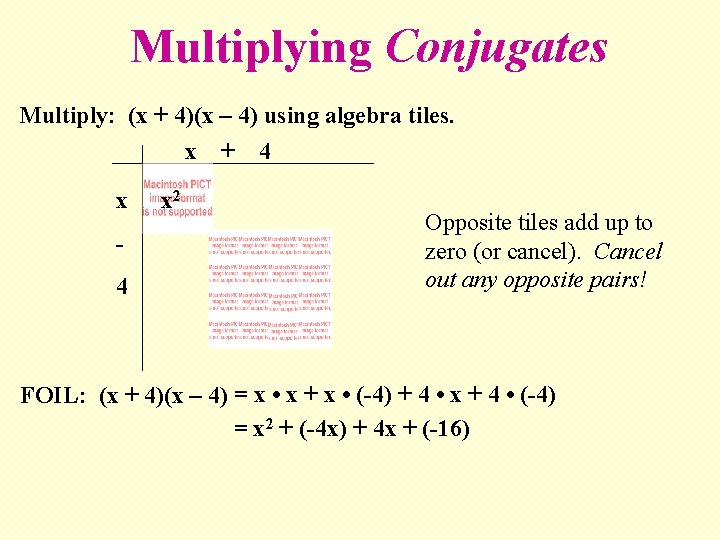
Multiplying Conjugates Multiply: (x + 4)(x – 4) using algebra tiles. x + 4 x 2 Opposite tiles add up to zero (or cancel). Cancel out any opposite pairs! FOIL: (x + 4)(x – 4) = x • x + x • (-4) + 4 • x + 4 • (-4) = x 2 + (-4 x) + 4 x + (-16)
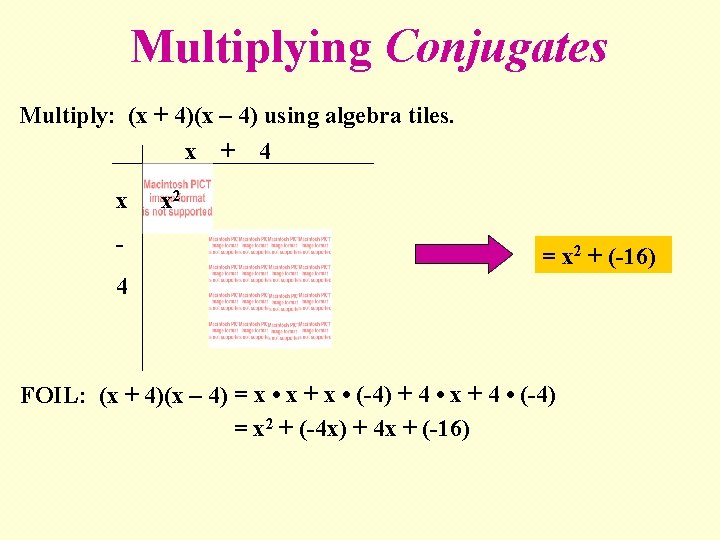
Multiplying Conjugates Multiply: (x + 4)(x – 4) using algebra tiles. x + 4 x - x 2 = x 2 + (-16) 4 FOIL: (x + 4)(x – 4) = x • x + x • (-4) + 4 • x + 4 • (-4) = x 2 + (-4 x) + 4 x + (-16)
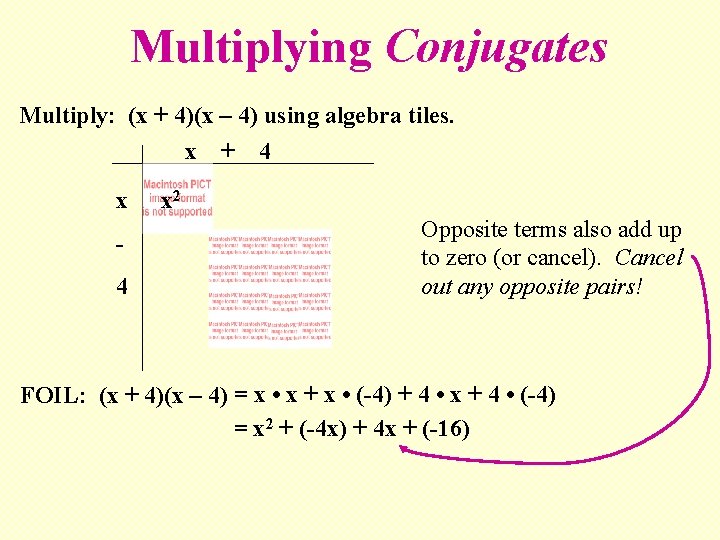
Multiplying Conjugates Multiply: (x + 4)(x – 4) using algebra tiles. x + 4 x 2 Opposite terms also add up to zero (or cancel). Cancel out any opposite pairs! FOIL: (x + 4)(x – 4) = x • x + x • (-4) + 4 • x + 4 • (-4) = x 2 + (-4 x) + 4 x + (-16)
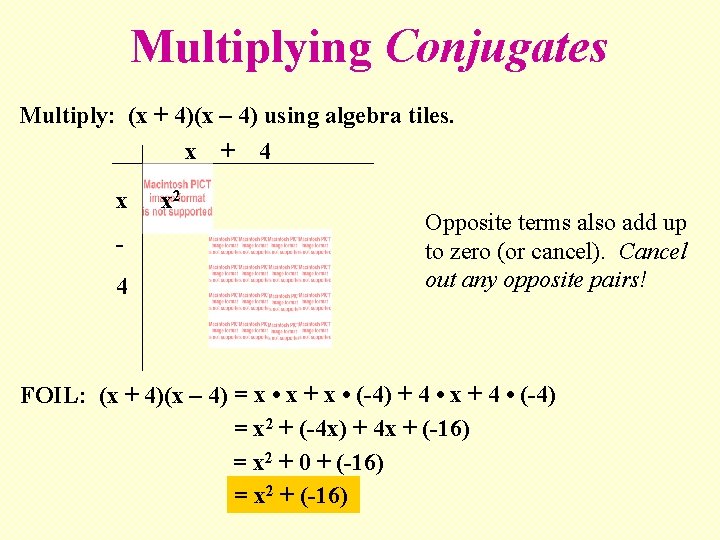
Multiplying Conjugates Multiply: (x + 4)(x – 4) using algebra tiles. x + 4 x 2 Opposite terms also add up to zero (or cancel). Cancel out any opposite pairs! FOIL: (x + 4)(x – 4) = x • x + x • (-4) + 4 • x + 4 • (-4) = x 2 + (-4 x) + 4 x + (-16) = x 2 + 0 + (-16) = x 2 + (-16)
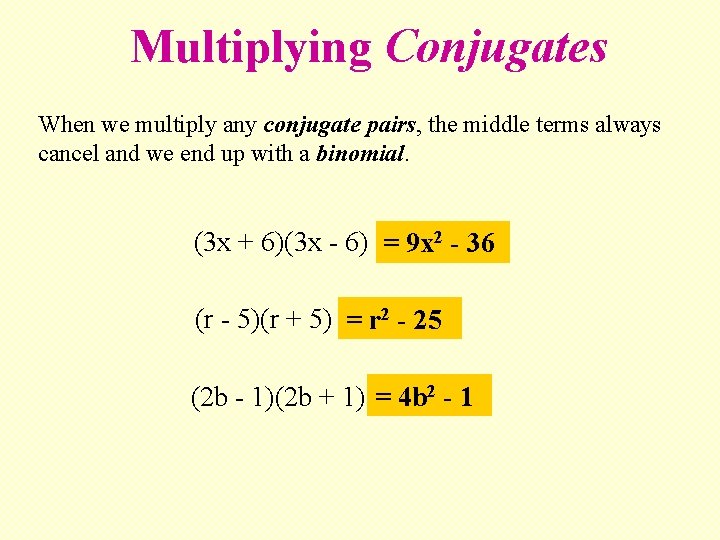
Multiplying Conjugates When we multiply any conjugate pairs, the middle terms always cancel and we end up with a binomial. (3 x + 6)(3 x - 6) = 9 x 2 - 36 (r - 5)(r + 5) = r 2 - 25 (2 b - 1)(2 b + 1) = 4 b 2 - 1
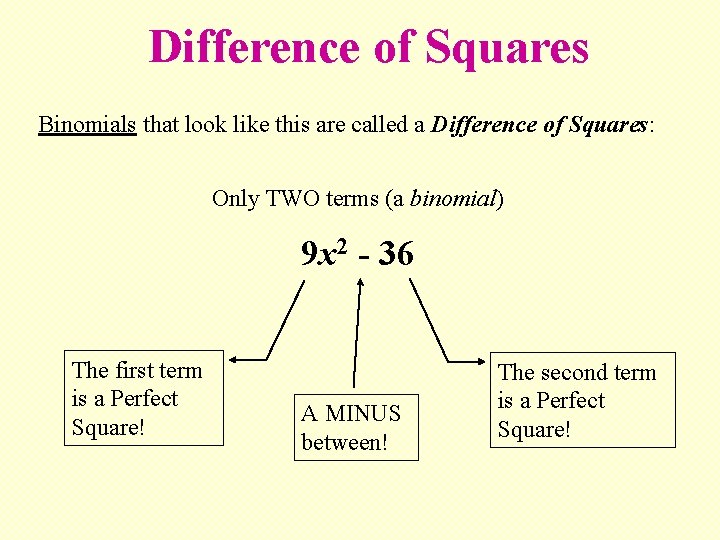
Difference of Squares Binomials that look like this are called a Difference of Squares: Only TWO terms (a binomial) 9 x 2 - 36 The first term is a Perfect Square! A MINUS between! The second term is a Perfect Square!
Factor a Difference of Squares: A Difference of Squares! A Conjugate Pair!
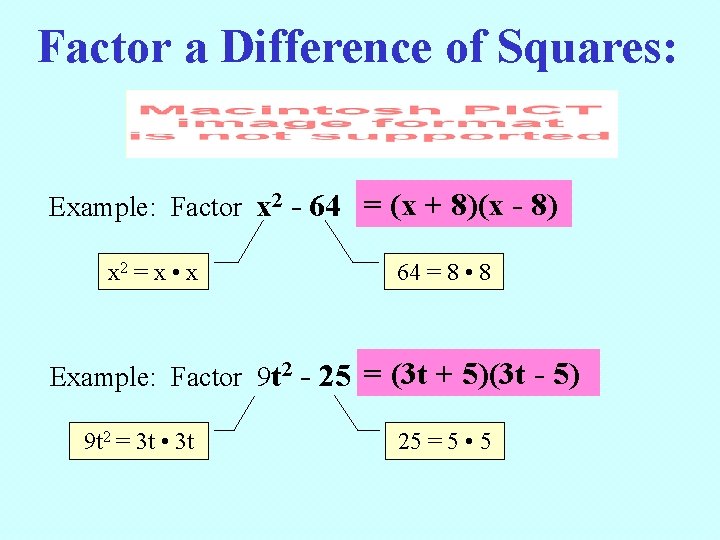
Factor a Difference of Squares: Example: Factor x 2 - 64 = (x + 8)(x - 8) x 2 = x • x 64 = 8 • 8 Example: Factor 9 t 2 - 25 = (3 t + 5)(3 t - 5) 9 t 2 = 3 t • 3 t 25 = 5 • 5
A Sum of Squares? A Sum of Squares, like x 2 + 64, can NOT be factored! It is a PRIME polynomial.
Practice Factor each polynomial. 1) x 2 - 81 2) r 2 - 100 3) 16 - a 2 4) 9 a 2 - 16 5) 16 x 2 - 1
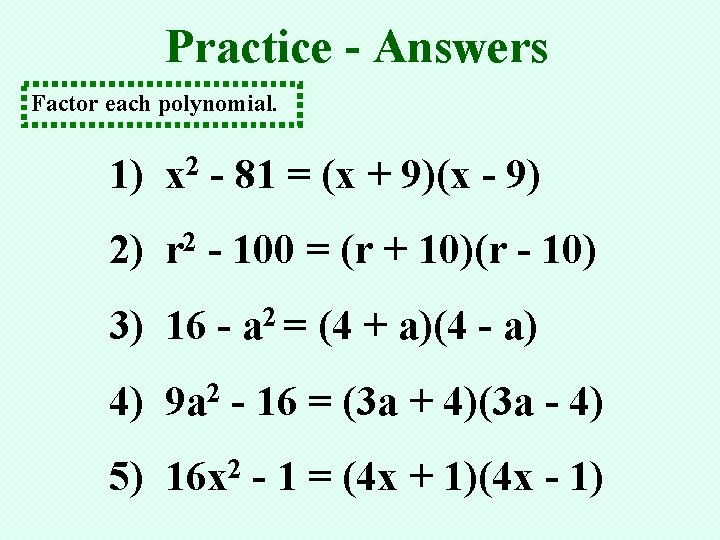
Practice - Answers Factor each polynomial. 1) x 2 - 81 = (x + 9)(x - 9) 2) r 2 - 100 = (r + 10)(r - 10) 3) 16 - a 2 = (4 + a)(4 - a) 4) 9 a 2 - 16 = (3 a + 4)(3 a - 4) 5) 16 x 2 - 1 = (4 x + 1)(4 x - 1)
- Slides: 18