
Multiplying Binomials Section 8 3 Part 1 2
Multiplying Binomials Section 8 -3 Part 1 & 2
Goals Goal Rubric • To multiply two binomials or a binomial by a trinomial. Level 1 – Know the goals. Level 2 – Fully understand the goals. Level 3 – Use the goals to solve simple problems. Level 4 – Use the goals to solve more advanced problems. Level 5 – Adapts and applies the goals to different and more complex problems.
Vocabulary • None
Multiplying Polynomials 3 Methods for multiplying polynomials 1. Using the Distributive Property • Can be used to multiply any two polynomials 2. Using a Table or The Box Method • Can be used to multiply any two polynomials 3. Using FOIL • Can only be used to multiply two binomials
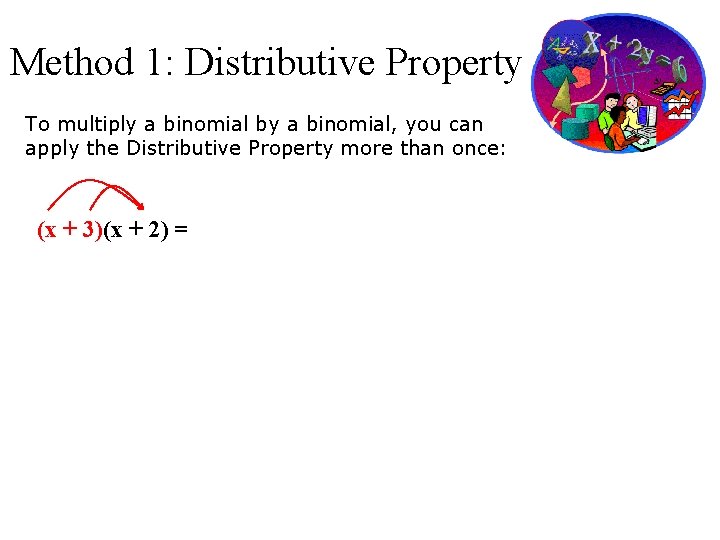
Method 1: Distributive Property To multiply a binomial by a binomial, you can apply the Distributive Property more than once: (x + 3)(x + 2) =
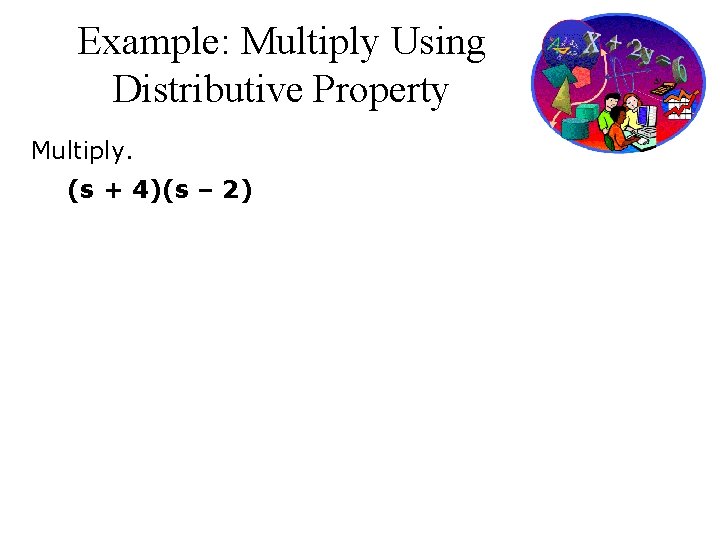
Example: Multiply Using Distributive Property Multiply. (s + 4)(s – 2)
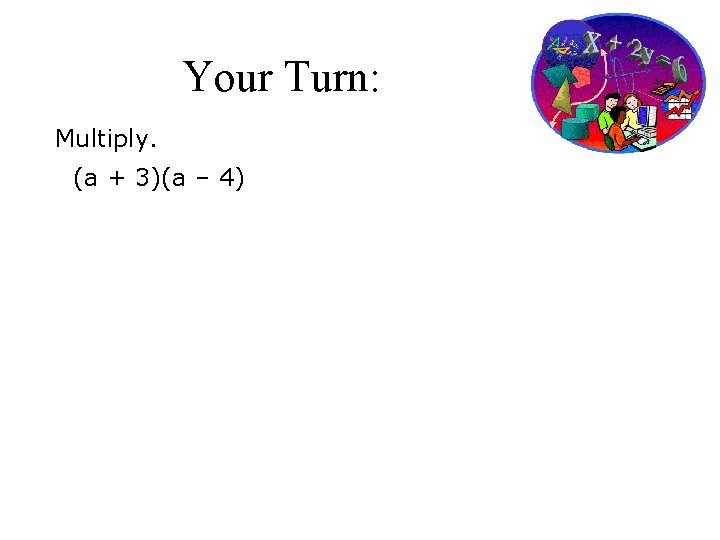
Your Turn: Multiply. (a + 3)(a – 4)

Your Turn: Multiply. (y + 8)(y – 4)
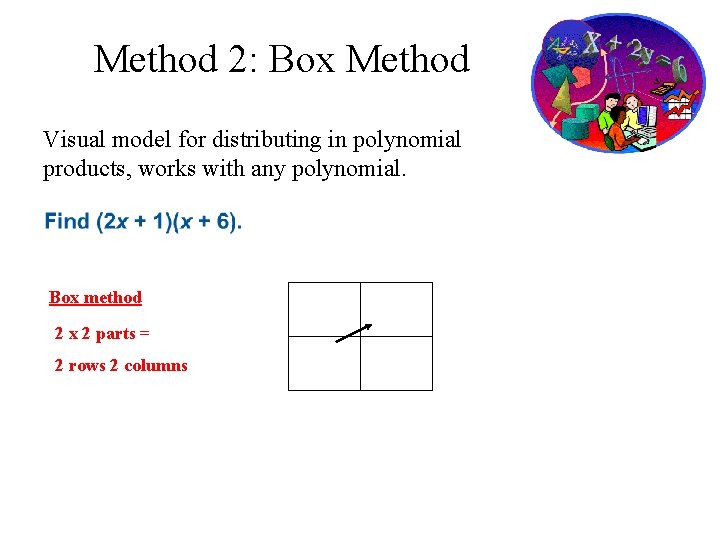
Method 2: Box Method Visual model for distributing in polynomial products, works with any polynomial. Box method 2 x 2 parts = 2 rows 2 columns
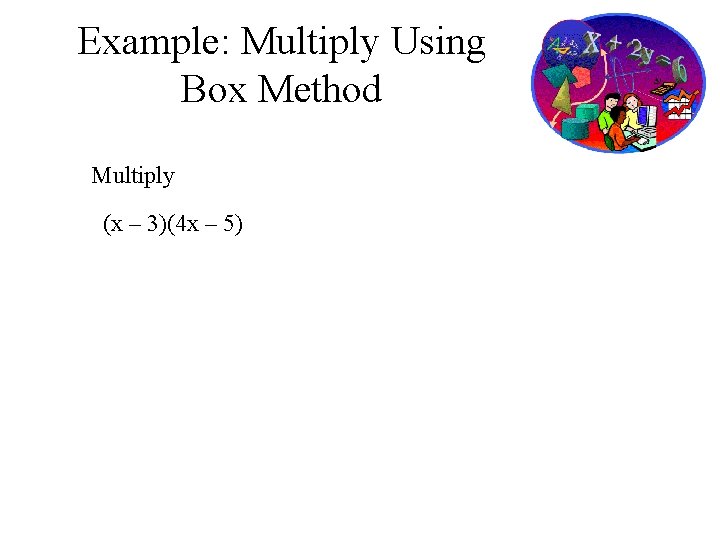
Example: Multiply Using Box Method Multiply (x – 3)(4 x – 5)
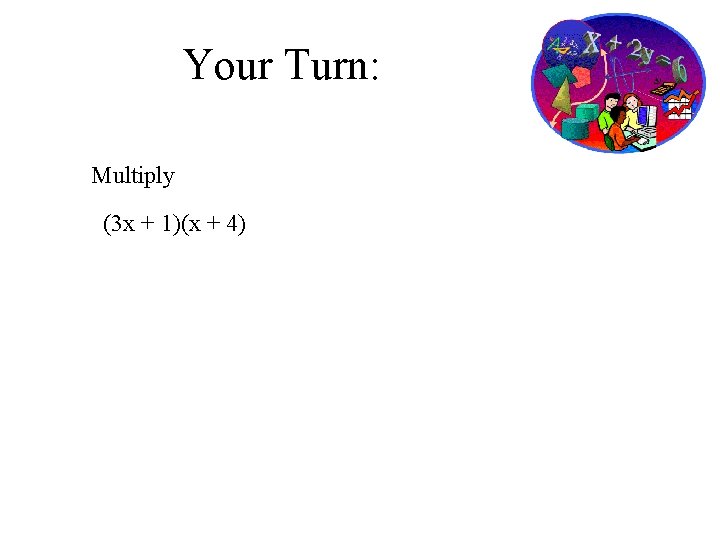
Your Turn: Multiply (3 x + 1)(x + 4)
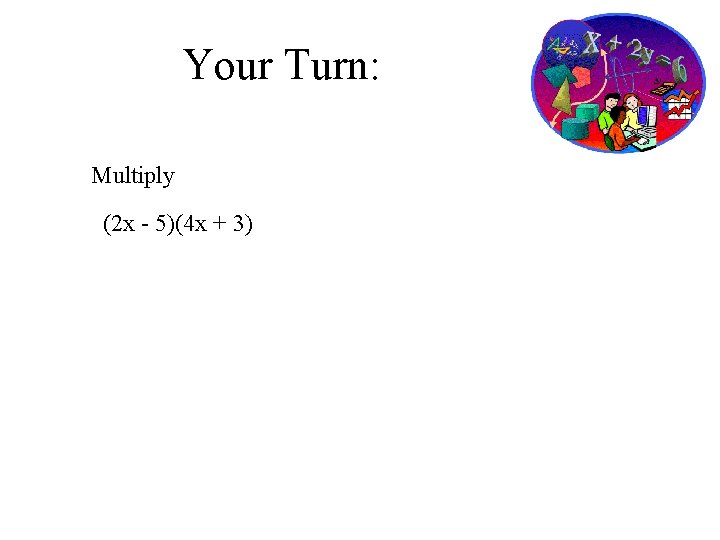
Your Turn: Multiply (2 x - 5)(4 x + 3)
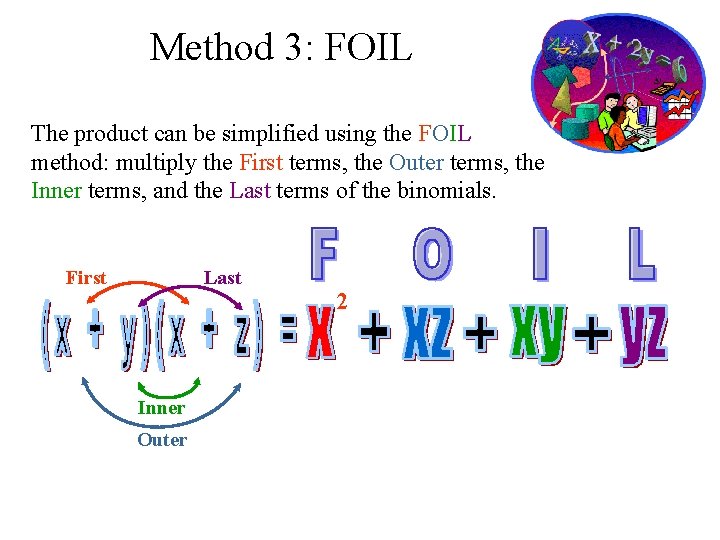
Method 3: FOIL The product can be simplified using the FOIL method: multiply the First terms, the Outer terms, the Inner terms, and the Last terms of the binomials. First Last Inner Outer 2
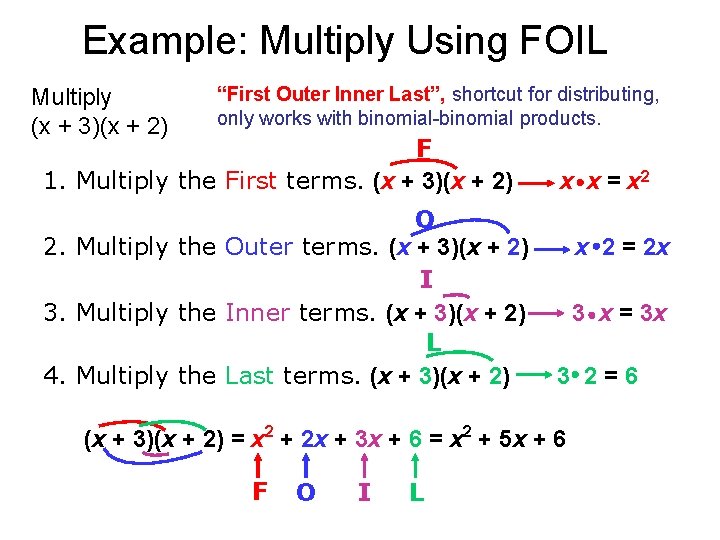
Multiplying Polynomials 7 -7 Example: Multiply Using Multiply (x + 3)(x + 2) FOIL “First Outer Inner Last”, shortcut for distributing, only works with binomial-binomial products. F 1. Multiply the First terms. (x + 3)(x + 2) O 2. Multiply the Outer terms. (x + 3)(x + 2) I 3. Multiply the Inner terms. (x + 3)(x + 2) L 4. Multiply the Last terms. (x + 3)(x + 2) x x = x 2 x 2 = 2 x 3 x = 3 x 3 2 = 6 (x + 3)(x + 2) = x 2 + 2 x + 3 x + 6 = x 2 + 5 x + 6 F Holt Algebra 1 O I L
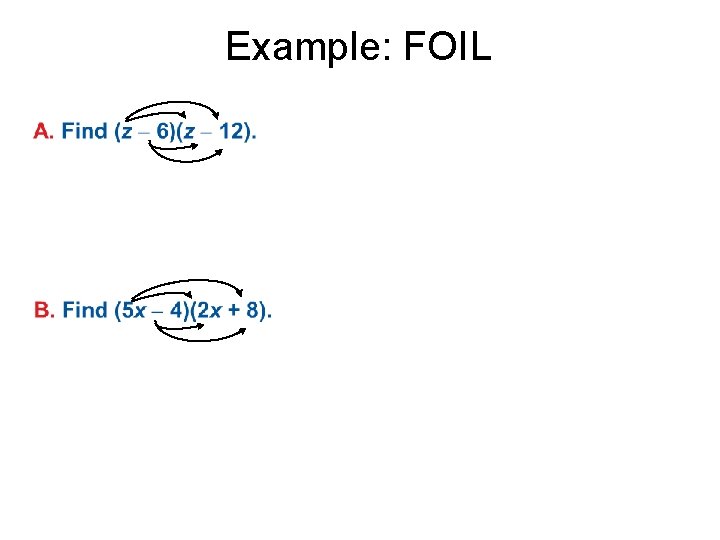
Example: FOIL
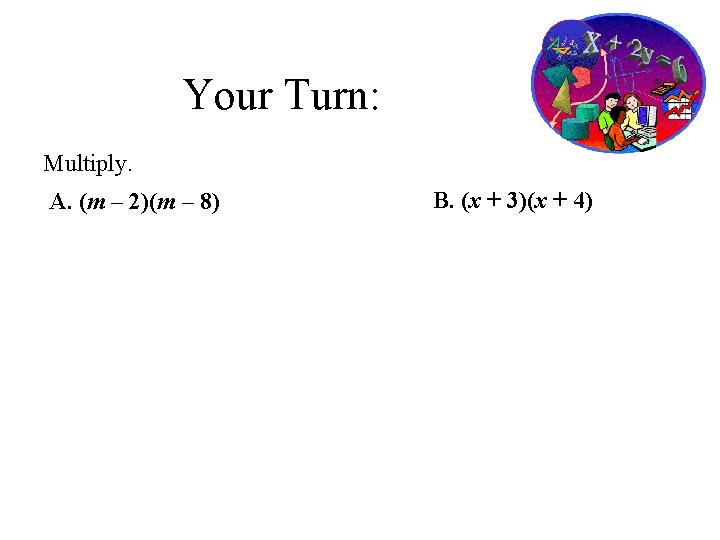
Your Turn: Multiply. A. (m – 2)(m – 8) B. (x + 3)(x + 4)
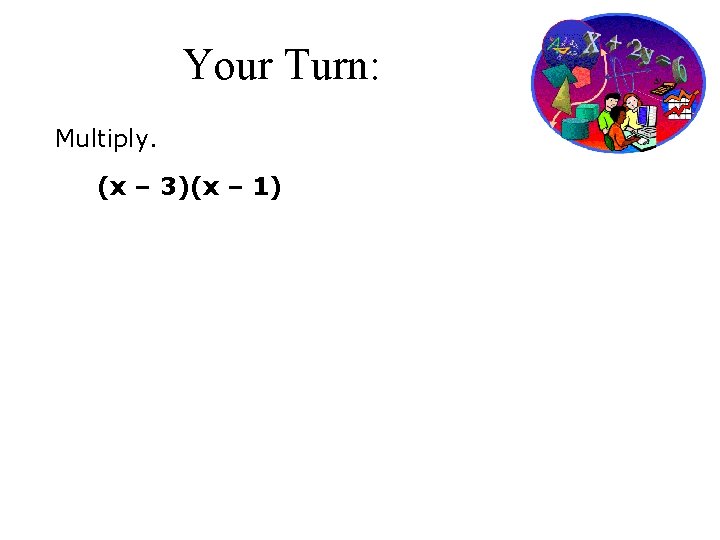
Your Turn: Multiply. (x – 3)(x – 1)
Your Turn: Multiply. (2 a – b 2)(a + 4 b 2)
To multiply polynomials with more than two terms, you can use the Distributive Property several times. Multiply (5 x + 3) by (2 x 2 + 10 x – 6):
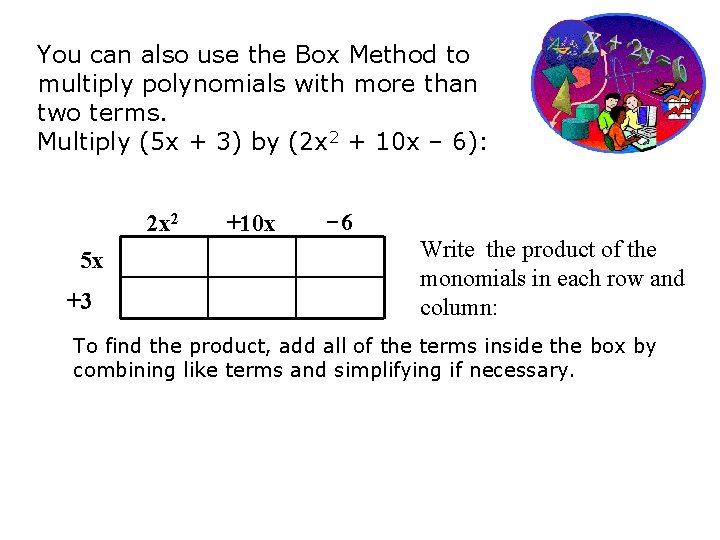
You can also use the Box Method to multiply polynomials with more than two terms. Multiply (5 x + 3) by (2 x 2 + 10 x – 6): 2 x 2 5 x +3 +10 x – 6 Write the product of the monomials in each row and column: To find the product, add all of the terms inside the box by combining like terms and simplifying if necessary.
Example: Multiply. (x – 5)(x 2 + 4 x – 6)
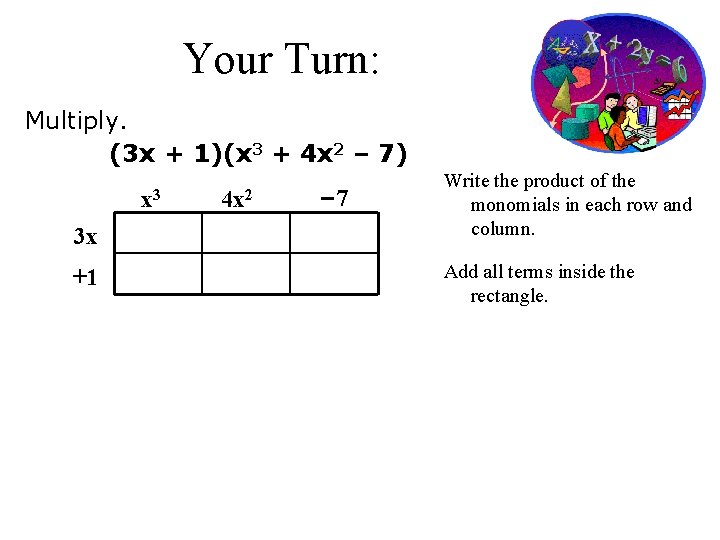
Your Turn: Multiply. (3 x + 1)(x 3 + 4 x 2 – 7) x 3 3 x +1 4 x 2 – 7 Write the product of the monomials in each row and column. Add all terms inside the rectangle.
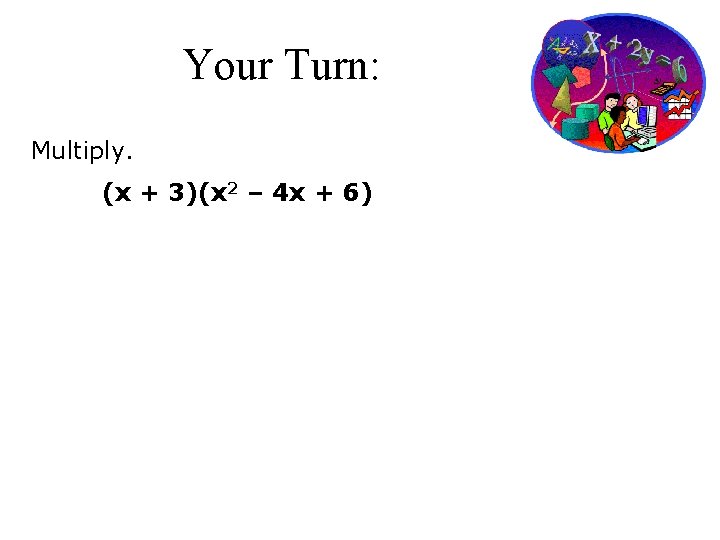
Your Turn: Multiply. (x + 3)(x 2 – 4 x + 6)
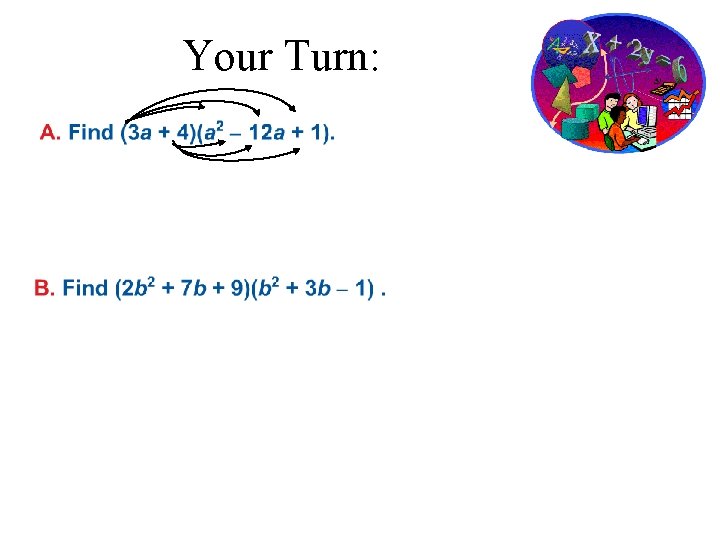
Your Turn:
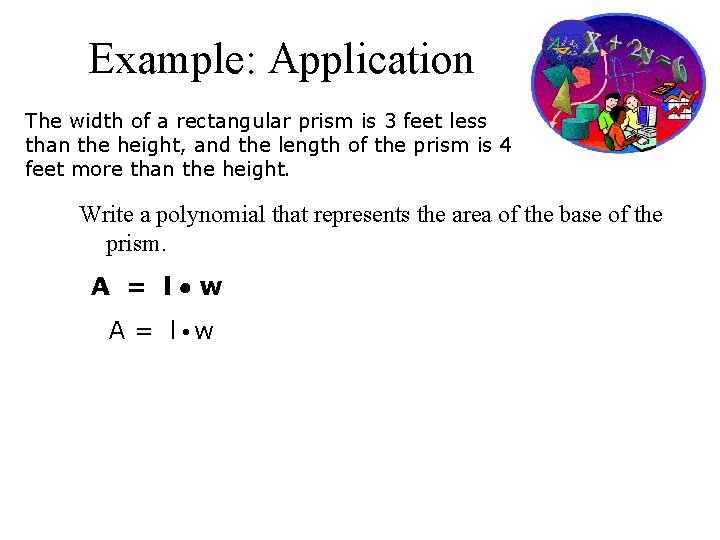
Example: Application The width of a rectangular prism is 3 feet less than the height, and the length of the prism is 4 feet more than the height. Write a polynomial that represents the area of the base of the prism. A = l w
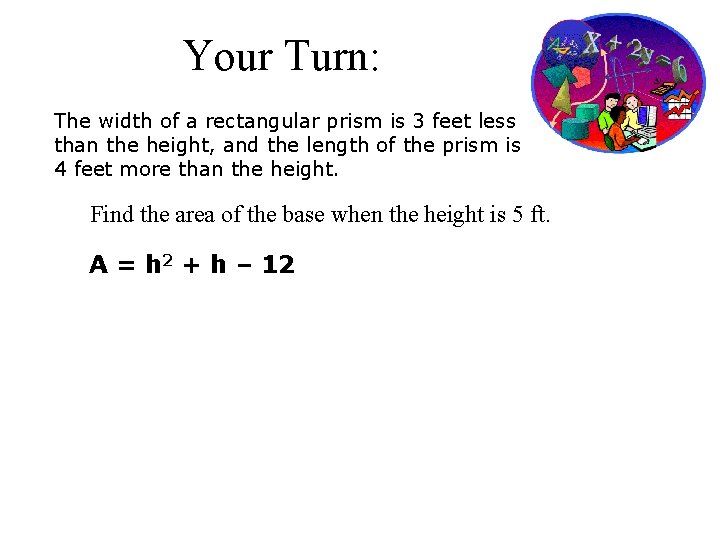
Your Turn: The width of a rectangular prism is 3 feet less than the height, and the length of the prism is 4 feet more than the height. Find the area of the base when the height is 5 ft. A = h 2 + h – 12
- Slides: 26