
Multiplying a Fraction and a Whole Number November
Multiplying a Fraction and a Whole Number November 21. 2013
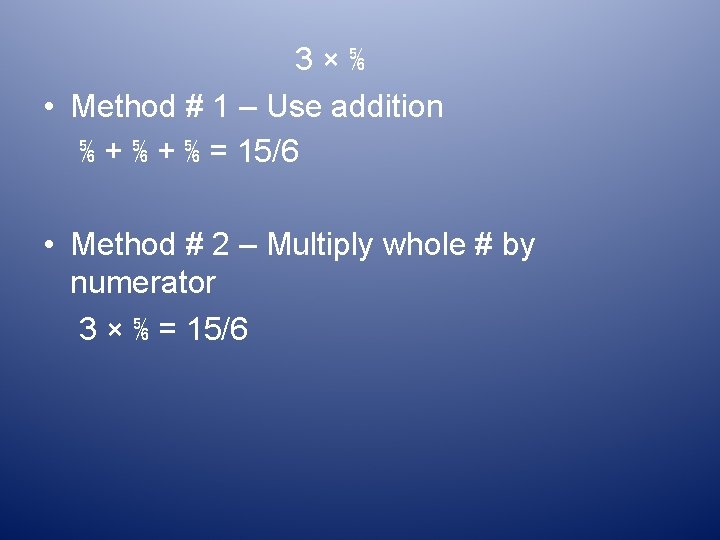
3×⅚ • Method # 1 – Use addition ⅚ + ⅚ = 15/6 • Method # 2 – Multiply whole # by numerator 3 × ⅚ = 15/6
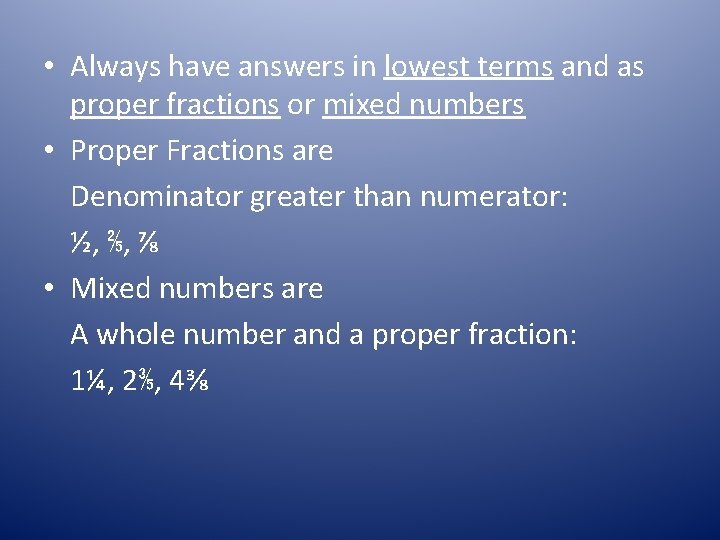
• Always have answers in lowest terms and as proper fractions or mixed numbers • Proper Fractions are Denominator greater than numerator: ½, ⅖, ⅞ • Mixed numbers are A whole number and a proper fraction: 1¼, 2⅗, 4⅜
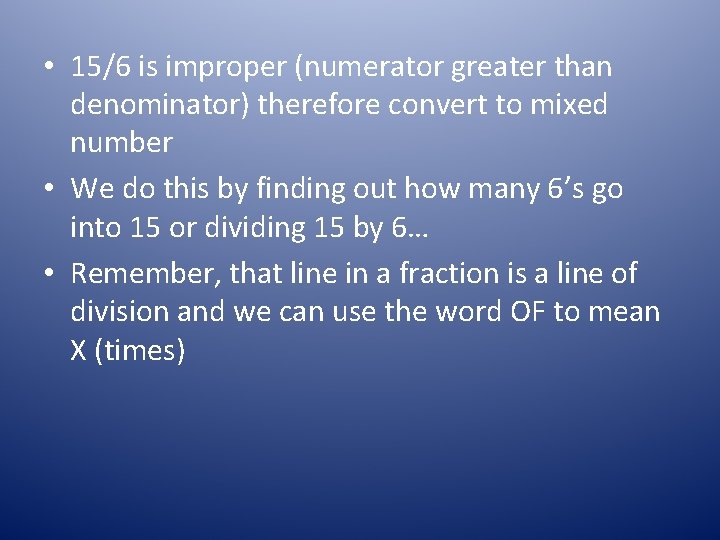
• 15/6 is improper (numerator greater than denominator) therefore convert to mixed number • We do this by finding out how many 6’s go into 15 or dividing 15 by 6… • Remember, that line in a fraction is a line of division and we can use the word OF to mean X (times)
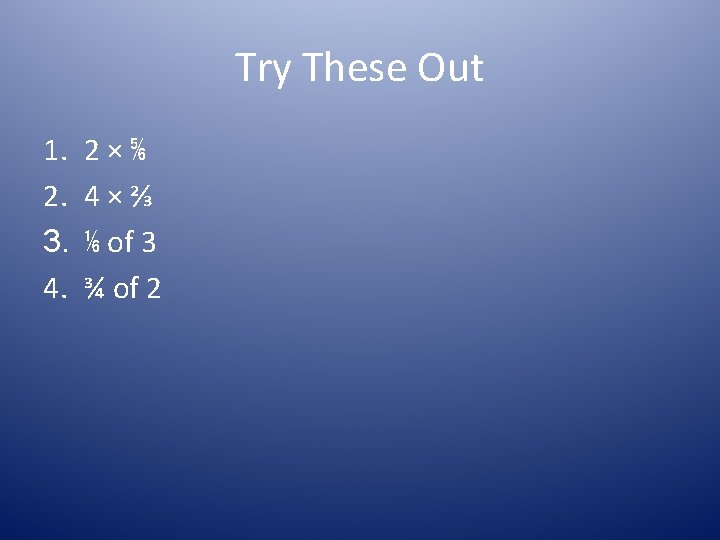
Try These Out 1. 2. 3. 4. 2×⅚ 4×⅔ ⅙ of 3 ¾ of 2
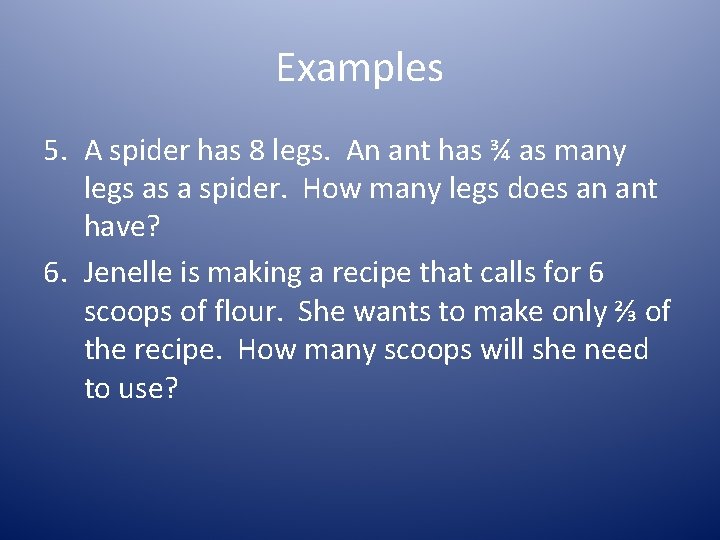
Examples 5. A spider has 8 legs. An ant has ¾ as many legs as a spider. How many legs does an ant have? 6. Jenelle is making a recipe that calls for 6 scoops of flour. She wants to make only ⅔ of the recipe. How many scoops will she need to use?
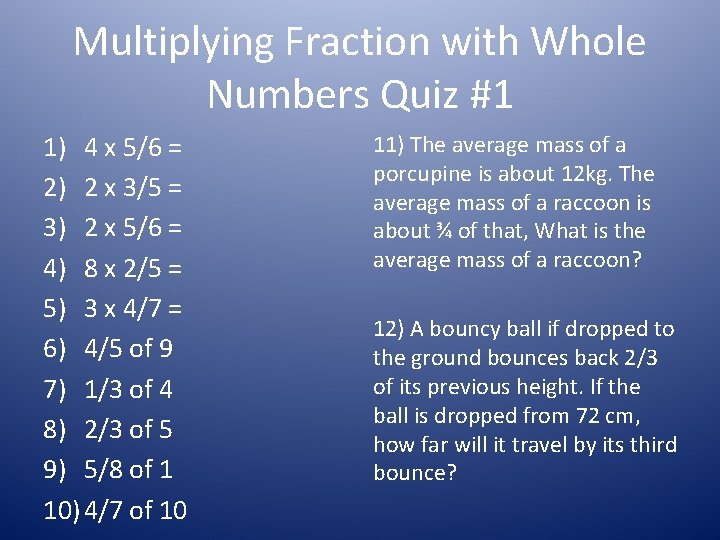
Multiplying Fraction with Whole Numbers Quiz #1 1) 4 x 5/6 = 2) 2 x 3/5 = 3) 2 x 5/6 = 4) 8 x 2/5 = 5) 3 x 4/7 = 6) 4/5 of 9 7) 1/3 of 4 8) 2/3 of 5 9) 5/8 of 1 10) 4/7 of 10 11) The average mass of a porcupine is about 12 kg. The average mass of a raccoon is about ¾ of that, What is the average mass of a raccoon? 12) A bouncy ball if dropped to the ground bounces back 2/3 of its previous height. If the ball is dropped from 72 cm, how far will it travel by its third bounce?
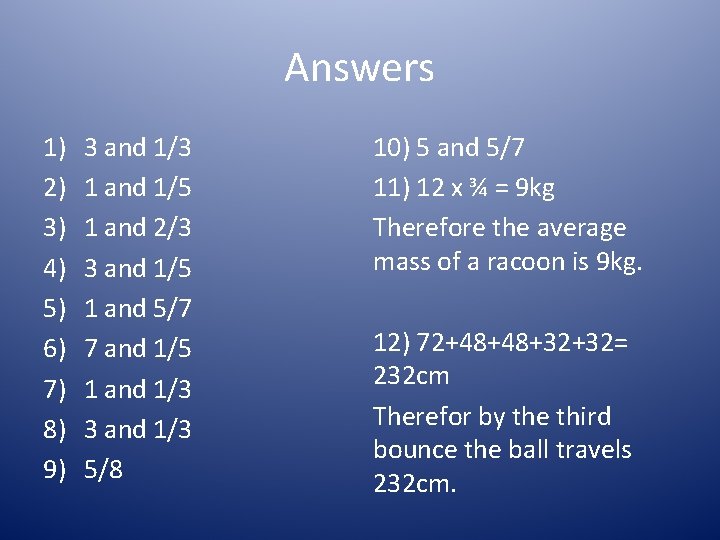
Answers 1) 2) 3) 4) 5) 6) 7) 8) 9) 3 and 1/3 1 and 1/5 1 and 2/3 3 and 1/5 1 and 5/7 7 and 1/5 1 and 1/3 3 and 1/3 5/8 10) 5 and 5/7 11) 12 x ¾ = 9 kg Therefore the average mass of a racoon is 9 kg. 12) 72+48+48+32+32= 232 cm Therefor by the third bounce the ball travels 232 cm.
- Slides: 8