
Multiplicity Distributions in DIS at HERA Preliminary Examination
Multiplicity Distributions in DIS at HERA Preliminary Examination Michele Sumstine University of Wisconsin Dec. 19, 2002 Multiplicity Study, Michele Sumstine, U. Wisconsin Preliminary Exam, December 19, 2002 - 1
Outline Introduction HERA and ZEUS Kinematics Parton Shower & Hadronization Models Universality of Hadron Production Data Selection & Simulation of ZEUS Data Mean Charged Multiplicity vs. Effective Mass Summary and Plan Multiplicity Study, Michele Sumstine, U. Wisconsin Preliminary Exam, December 19, 2002 - 2
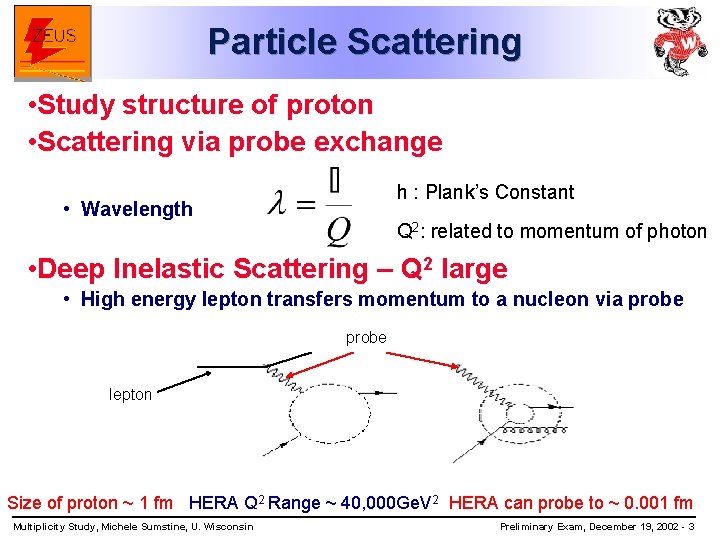
Particle Scattering • Study structure of proton • Scattering via probe exchange h : Plank’s Constant • Wavelength Q 2: related to momentum of photon • Deep Inelastic Scattering – Q 2 large • High energy lepton transfers momentum to a nucleon via probe lepton Size of proton ~ 1 fm HERA Q 2 Range ~ 40, 000 Ge. V 2 HERA can probe to ~ 0. 001 fm Multiplicity Study, Michele Sumstine, U. Wisconsin Preliminary Exam, December 19, 2002 - 3
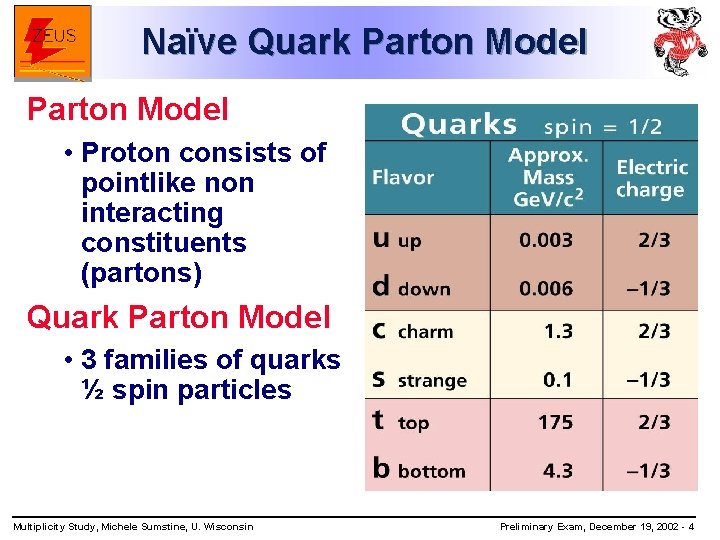
Naïve Quark Parton Model • Proton consists of pointlike non interacting constituents (partons) Quark Parton Model • 3 families of quarks ½ spin particles Multiplicity Study, Michele Sumstine, U. Wisconsin Preliminary Exam, December 19, 2002 - 4

QCD Theory QCD Quantum Chromodynamics • • Strong force couples to color and is mediated by the gluon Gluon permits momentum exchange between quarks Gluons create quarks through pair production Color confinement: free partons are not observed, only colorless objects -hadrons • Parton distribution function (PDF) gives probability of finding parton with given momentum within proton (experimentally determined) Multiplicity Study, Michele Sumstine, U. Wisconsin Preliminary Exam, December 19, 2002 - 5
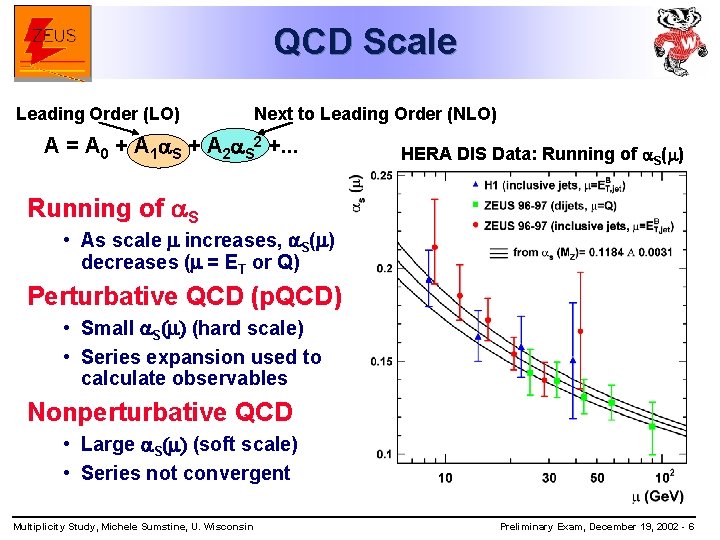
QCD Scale Leading Order (LO) Next to Leading Order (NLO) A = A 0 + A 1 S + A 2 S 2 +. . . HERA DIS Data: Running of S(m) Running of S • As scale m increases, S(m) decreases (m = ET or Q) Perturbative QCD (p. QCD) • Small S(m) (hard scale) • Series expansion used to calculate observables Nonperturbative QCD • Large S(m) (soft scale) • Series not convergent Multiplicity Study, Michele Sumstine, U. Wisconsin Preliminary Exam, December 19, 2002 - 6

From Partons to Hadrons hard scattering parton showers hadronization · Hard scattering: large scale (short distance) perturbative process · Parton showers: initial QCD radiation of partons from initial partons · Hadronization: colorless hadrons produced from colored partons soft process (large distance) - not perturbatively calculable phenomenological models and experimental input Multiplicity Study, Michele Sumstine, U. Wisconsin Preliminary Exam, December 19, 2002 - 7
Multiplicity and Energy Flow ·The hard scattering process determines the initial distribution of energy · Parton Shower + Hadronization determine the number of charged particles produced · Measure mean number of charged particles produced, (mean charged multiplicity, <nch>), versus the energy available for production of final state hadrons, study the mechanisms of hard scattering, parton showers and hadronization · p. QCD & universality of the hadronization process can be tested by comparison with data from e+e- and hadron colliders. Multiplicity Study, Michele Sumstine, U. Wisconsin Preliminary Exam, December 19, 2002 - 8
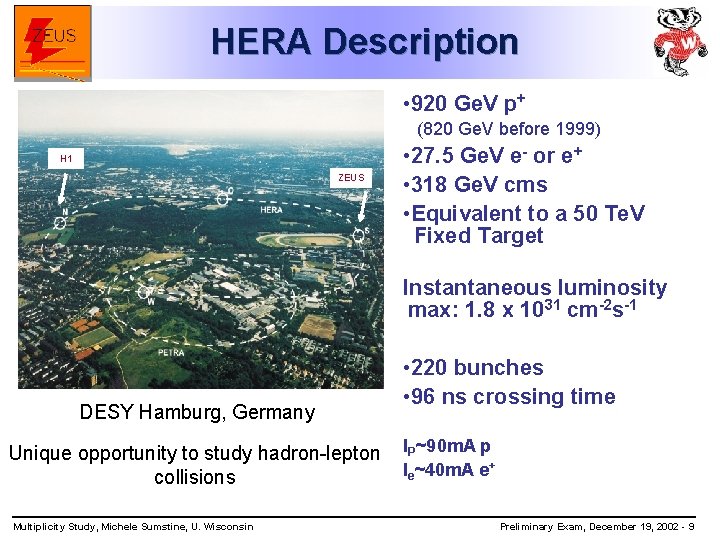
HERA Description • 920 Ge. V p+ (820 Ge. V before 1999) H 1 ZEUS • 27. 5 Ge. V e- or e+ • 318 Ge. V cms • Equivalent to a 50 Te. V Fixed Target Instantaneous luminosity max: 1. 8 x 1031 cm-2 s-1 DESY Hamburg, Germany • 220 bunches • 96 ns crossing time Unique opportunity to study hadron-lepton IP~90 m. A p Ie~40 m. A e+ collisions Multiplicity Study, Michele Sumstine, U. Wisconsin Preliminary Exam, December 19, 2002 - 9
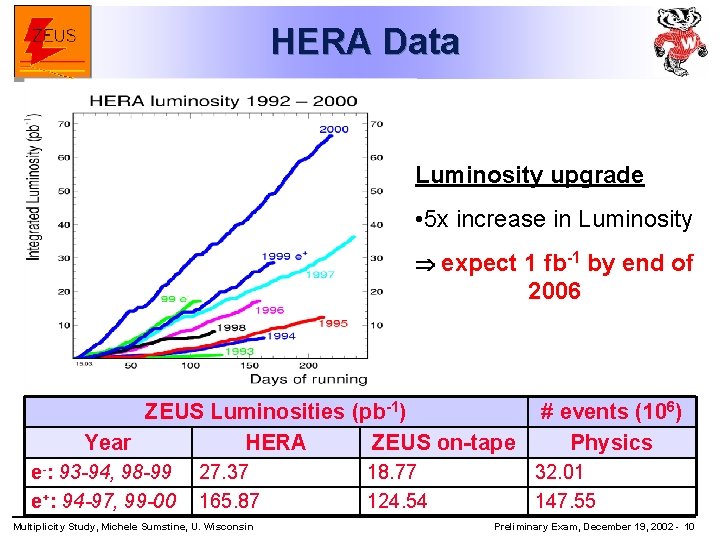
HERA Data Luminosity upgrade • 5 x increase in Luminosity expect 1 fb-1 by end of 2006 ZEUS Luminosities (pb-1) Year HERA ZEUS on-tape e-: 93 -94, 98 -99 e+: 94 -97, 99 -00 27. 37 165. 87 Multiplicity Study, Michele Sumstine, U. Wisconsin 18. 77 124. 54 # events (106) Physics 32. 01 147. 55 Preliminary Exam, December 19, 2002 - 10
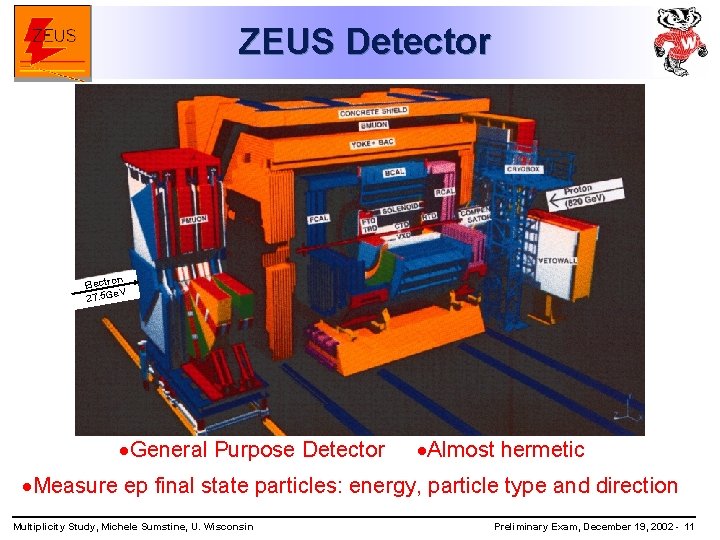
ZEUS Detector n Electro V 27. 5 Ge ·General Purpose Detector ·Almost hermetic ·Measure ep final state particles: energy, particle type and direction Multiplicity Study, Michele Sumstine, U. Wisconsin Preliminary Exam, December 19, 2002 - 11
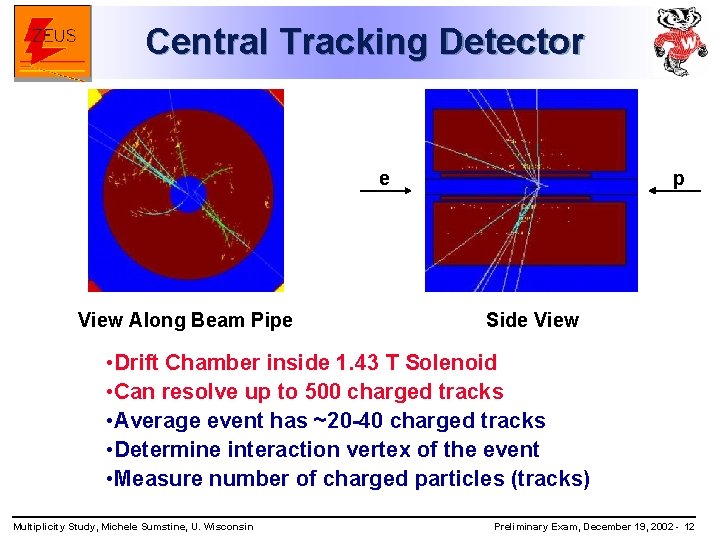
Central Tracking Detector e View Along Beam Pipe p Side View • Drift Chamber inside 1. 43 T Solenoid • Can resolve up to 500 charged tracks • Average event has ~20 -40 charged tracks • Determine interaction vertex of the event • Measure number of charged particles (tracks) Multiplicity Study, Michele Sumstine, U. Wisconsin Preliminary Exam, December 19, 2002 - 12
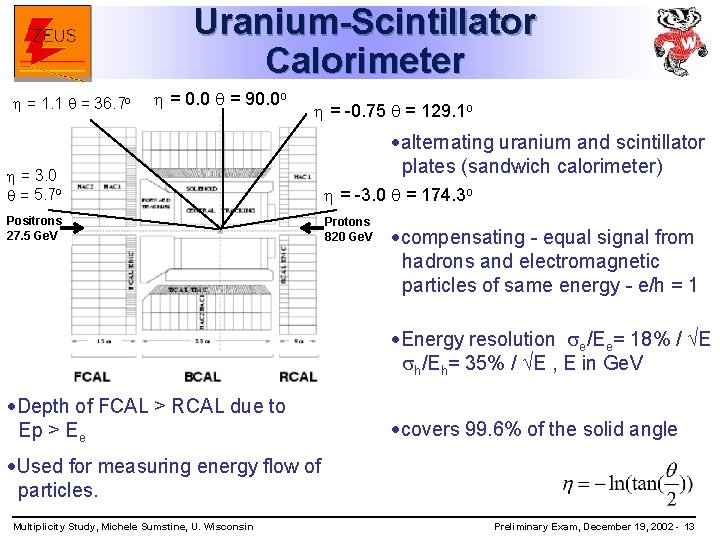
Uranium-Scintillator Calorimeter = 1. 1 = 36. 7 o = 0. 0 = 90. 0 o = -0. 75 = 129. 1 o ·alternating uranium and scintillator plates (sandwich calorimeter) = 3. 0 = 5. 7 o = -3. 0 = 174. 3 o Positrons 27. 5 Ge. V Protons 820 Ge. V ·compensating - equal signal from hadrons and electromagnetic particles of same energy - e/h = 1 ·Energy resolution e/Ee= 18% / E h/Eh= 35% / E , E in Ge. V ·Depth of FCAL > RCAL due to Ep > Ee ·covers 99. 6% of the solid angle ·Used for measuring energy flow of particles. Multiplicity Study, Michele Sumstine, U. Wisconsin Preliminary Exam, December 19, 2002 - 13
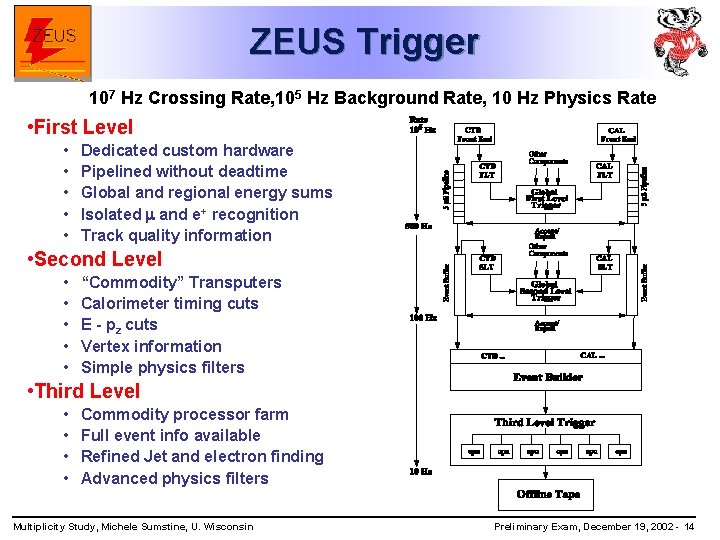
ZEUS Trigger 107 Hz Crossing Rate, 105 Hz Background Rate, 10 Hz Physics Rate • First Level • • • Dedicated custom hardware Pipelined without deadtime Global and regional energy sums Isolated m and e+ recognition Track quality information • Second Level • • • “Commodity” Transputers Calorimeter timing cuts E - pz cuts Vertex information Simple physics filters • Third Level • • Commodity processor farm Full event info available Refined Jet and electron finding Advanced physics filters Multiplicity Study, Michele Sumstine, U. Wisconsin Preliminary Exam, December 19, 2002 - 14
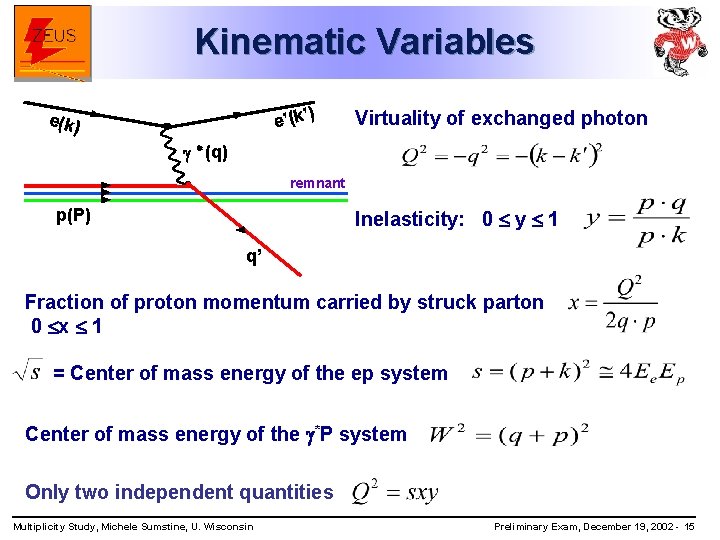
Kinematic Variables e’(k’) e(k) Virtuality of exchanged photon (q) remnant p(P) Inelasticity: 0 y 1 q’ Fraction of proton momentum carried by struck parton 0 x 1 = Center of mass energy of the ep system Center of mass energy of the *P system Only two independent quantities Multiplicity Study, Michele Sumstine, U. Wisconsin Preliminary Exam, December 19, 2002 - 15
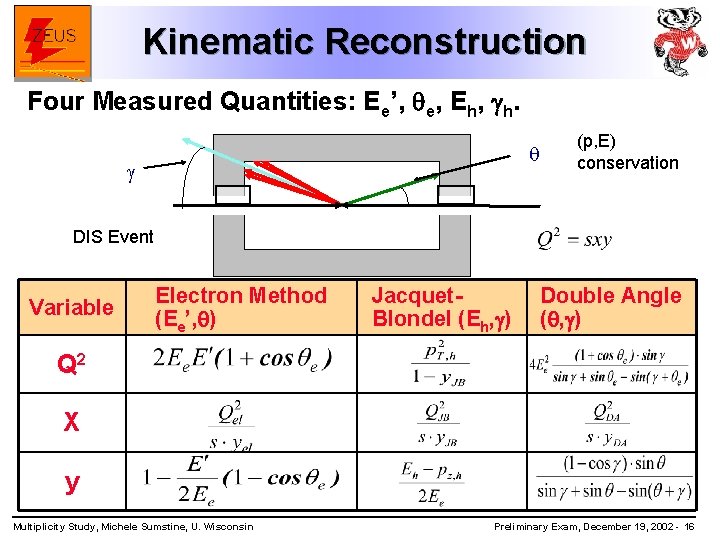
Kinematic Reconstruction Four Measured Quantities: Ee’, e, Eh, h. (p, E) conservation DIS Event Variable Electron Method (Ee’, ) Jacquet. Blondel (Eh, ) Double Angle ( , ) Q 2 X y Multiplicity Study, Michele Sumstine, U. Wisconsin Preliminary Exam, December 19, 2002 - 16
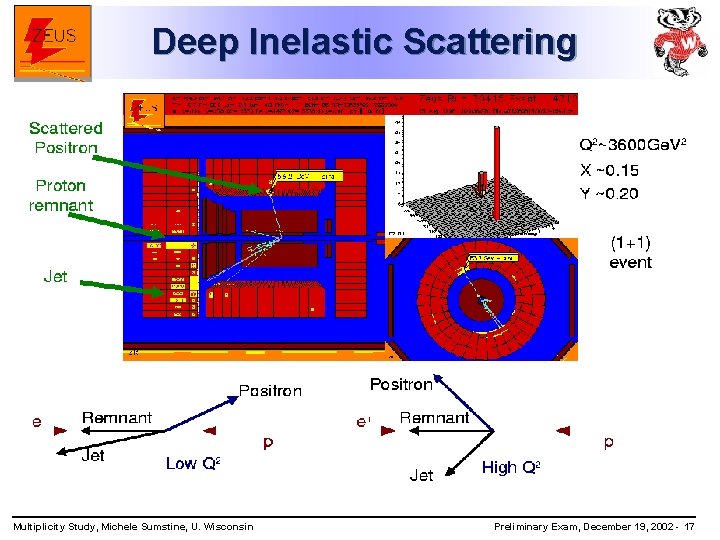
Deep Inelastic Scattering Multiplicity Study, Michele Sumstine, U. Wisconsin Preliminary Exam, December 19, 2002 - 17
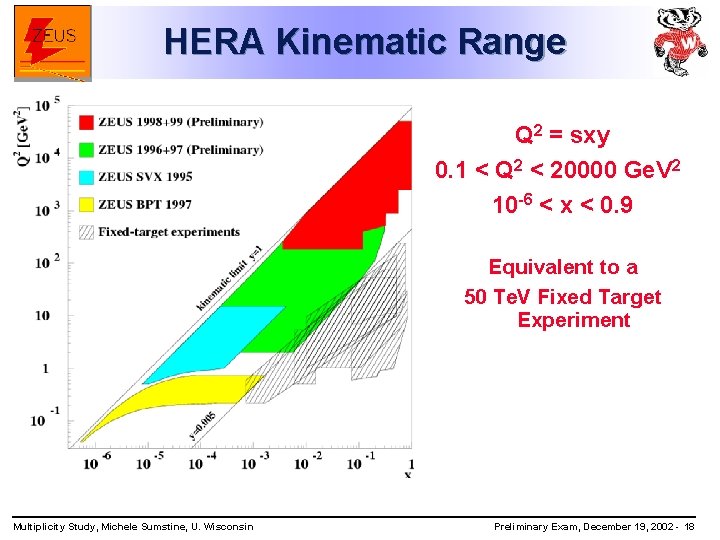
HERA Kinematic Range Q 2 = sxy 0. 1 < Q 2 < 20000 Ge. V 2 10 -6 < x < 0. 9 Equivalent to a 50 Te. V Fixed Target Experiment Multiplicity Study, Michele Sumstine, U. Wisconsin Preliminary Exam, December 19, 2002 - 18
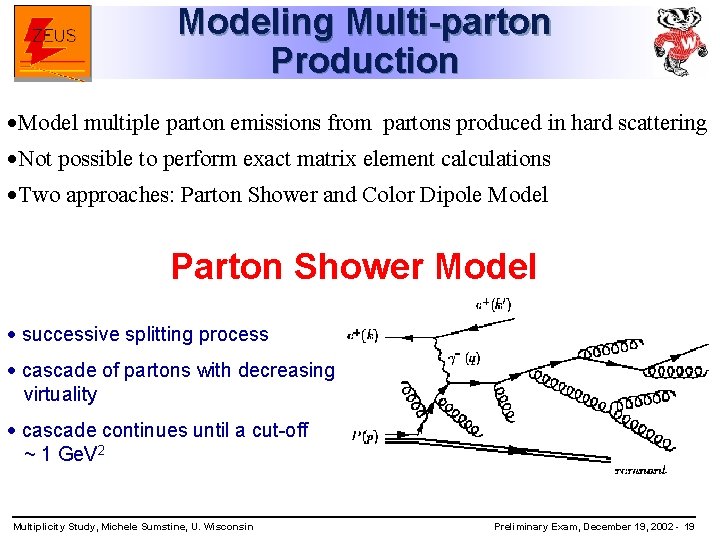
Modeling Multi-parton Production ·Model multiple parton emissions from partons produced in hard scattering ·Not possible to perform exact matrix element calculations ·Two approaches: Parton Shower and Color Dipole Model Parton Shower Model · successive splitting process · cascade of partons with decreasing virtuality · cascade continues until a cut-off ~ 1 Ge. V 2 Multiplicity Study, Michele Sumstine, U. Wisconsin Preliminary Exam, December 19, 2002 - 19
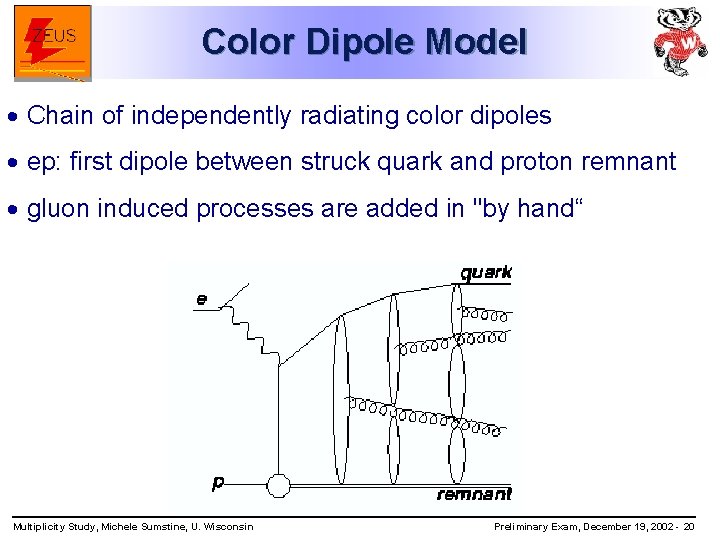
Color Dipole Model · Chain of independently radiating color dipoles · ep: first dipole between struck quark and proton remnant · gluon induced processes are added in "by hand“ Multiplicity Study, Michele Sumstine, U. Wisconsin Preliminary Exam, December 19, 2002 - 20
Hadronization Models • Use phenomenological models because these processes aren’t calculable in p. QCD – low scale • Lund String Model and Cluster Fragmentation Models • Start at low cut-off scale – set of partons from parton shower transformed into colorless hadrons • Local parton-hadron duality • Long distance process involving small momentum transfers • Hadron level flow of momentum and quantum numbers follows parton level • Flavor of quark initiating a jet found in a hadron near jet axis Multiplicity Study, Michele Sumstine, U. Wisconsin Preliminary Exam, December 19, 2002 - 21
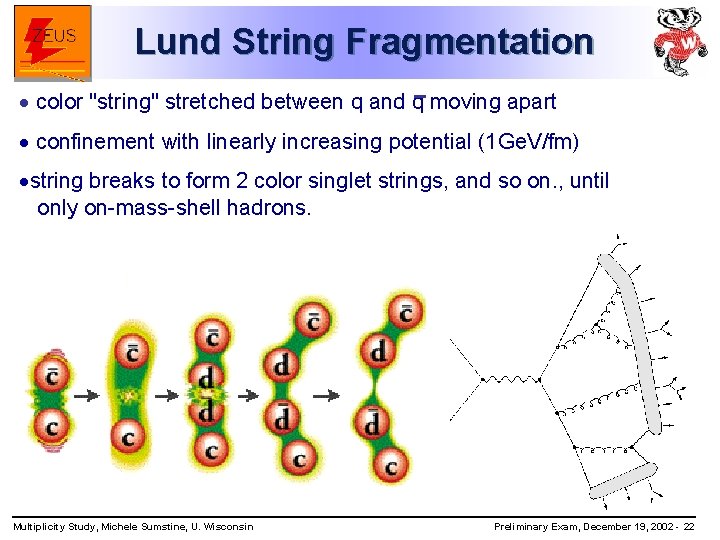
Lund String Fragmentation · color "string" stretched between q and q moving apart · confinement with linearly increasing potential (1 Ge. V/fm) ·string breaks to form 2 color singlet strings, and so on. , until only on-mass-shell hadrons. Multiplicity Study, Michele Sumstine, U. Wisconsin Preliminary Exam, December 19, 2002 - 22
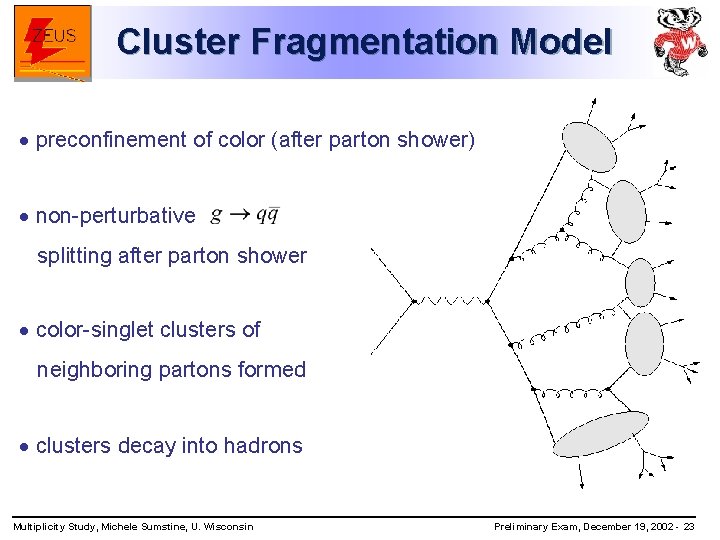
Cluster Fragmentation Model · preconfinement of color (after parton shower) · non-perturbative splitting after parton shower · color-singlet clusters of neighboring partons formed · clusters decay into hadrons Multiplicity Study, Michele Sumstine, U. Wisconsin Preliminary Exam, December 19, 2002 - 23
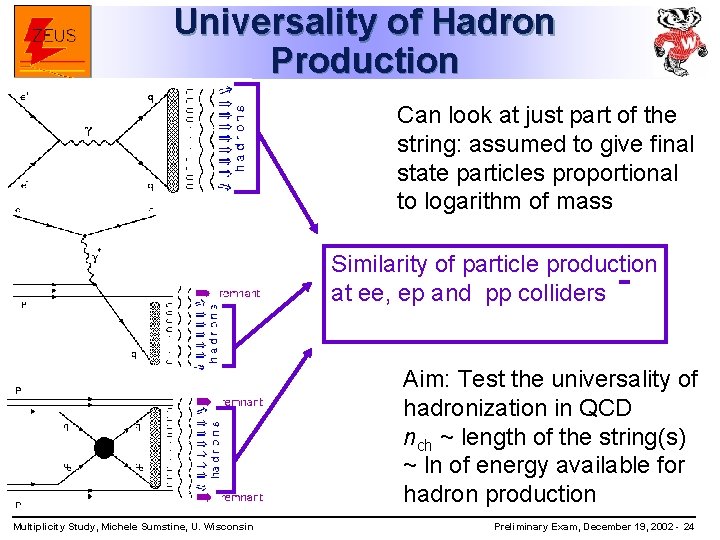
Universality of Hadron Production Can look at just part of the string: assumed to give final state particles proportional to logarithm of mass Similarity of particle production at ee, ep and pp colliders Aim: Test the universality of hadronization in QCD nch ~ length of the string(s) ~ ln of energy available for hadron production Multiplicity Study, Michele Sumstine, U. Wisconsin Preliminary Exam, December 19, 2002 - 24
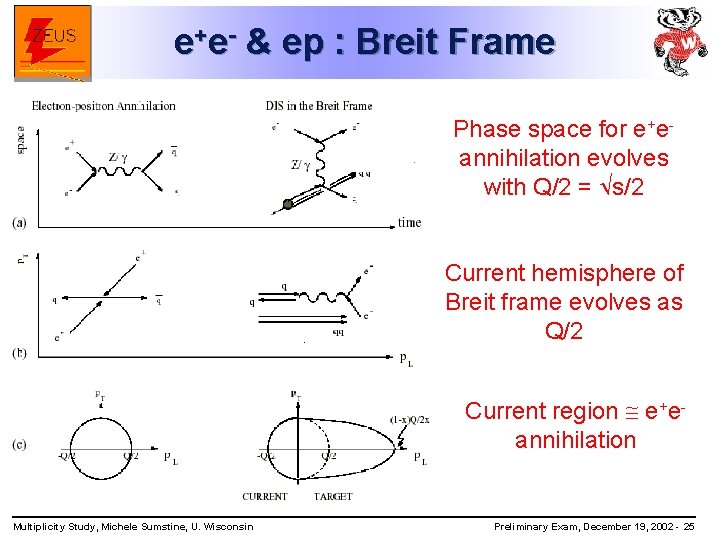
e+e- & ep : Breit Frame Phase space for e+e- annihilation evolves with Q/2 = s/2 Current hemisphere of Breit frame evolves as Q/2 Current region e+e- annihilation Multiplicity Study, Michele Sumstine, U. Wisconsin Preliminary Exam, December 19, 2002 - 25
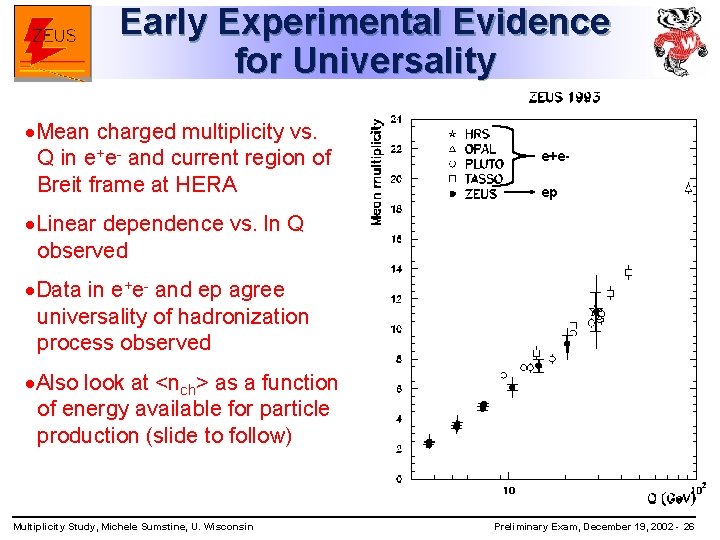
Early Experimental Evidence for Universality ·Mean charged multiplicity vs. Q in e+e- and current region of Breit frame at HERA e+eep ·Linear dependence vs. ln Q observed ·Data in e+e- and ep agree universality of hadronization process observed ·Also look at <nch> as a function of energy available for particle production (slide to follow) Multiplicity Study, Michele Sumstine, U. Wisconsin Preliminary Exam, December 19, 2002 - 26
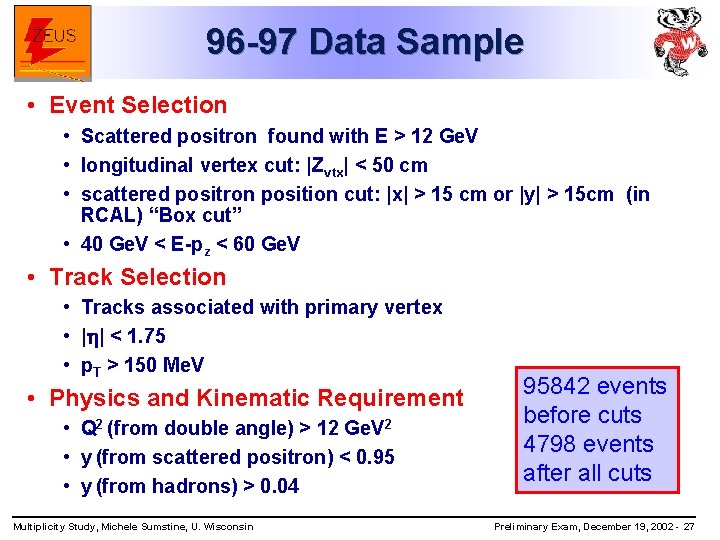
96 -97 Data Sample • Event Selection • Scattered positron found with E > 12 Ge. V • longitudinal vertex cut: |Zvtx| < 50 cm • scattered positron position cut: |x| > 15 cm or |y| > 15 cm (in RCAL) “Box cut” • 40 Ge. V < E-pz < 60 Ge. V • Track Selection • Tracks associated with primary vertex • | | < 1. 75 • p. T > 150 Me. V • Physics and Kinematic Requirement • Q 2 (from double angle) > 12 Ge. V 2 • y (from scattered positron) < 0. 95 • y (from hadrons) > 0. 04 Multiplicity Study, Michele Sumstine, U. Wisconsin 95842 events before cuts 4798 events after all cuts Preliminary Exam, December 19, 2002 - 27
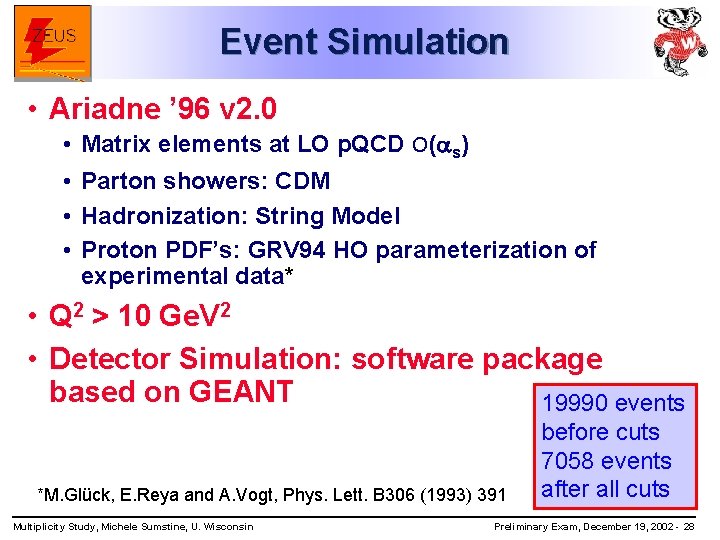
Event Simulation • Ariadne ’ 96 v 2. 0 • Matrix elements at LO p. QCD O( s) • Parton showers: CDM • Hadronization: String Model • Proton PDF’s: GRV 94 HO parameterization of experimental data* • Q 2 > 10 Ge. V 2 • Detector Simulation: software package based on GEANT 19990 events *M. Glück, E. Reya and A. Vogt, Phys. Lett. B 306 (1993) 391 Multiplicity Study, Michele Sumstine, U. Wisconsin before cuts 7058 events after all cuts Preliminary Exam, December 19, 2002 - 28
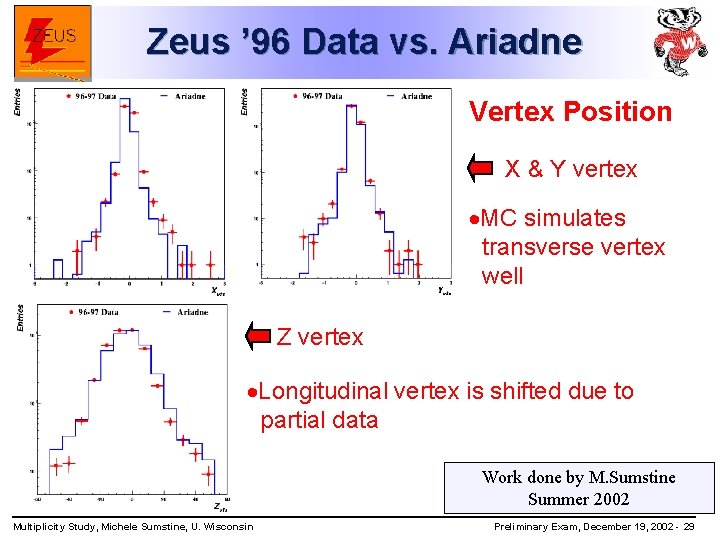
Zeus ’ 96 Data vs. Ariadne Vertex Position X & Y vertex ·MC simulates transverse vertex well Z vertex ·Longitudinal vertex is shifted due to partial data Work done by M. Sumstine Summer 2002 Multiplicity Study, Michele Sumstine, U. Wisconsin Preliminary Exam, December 19, 2002 - 29
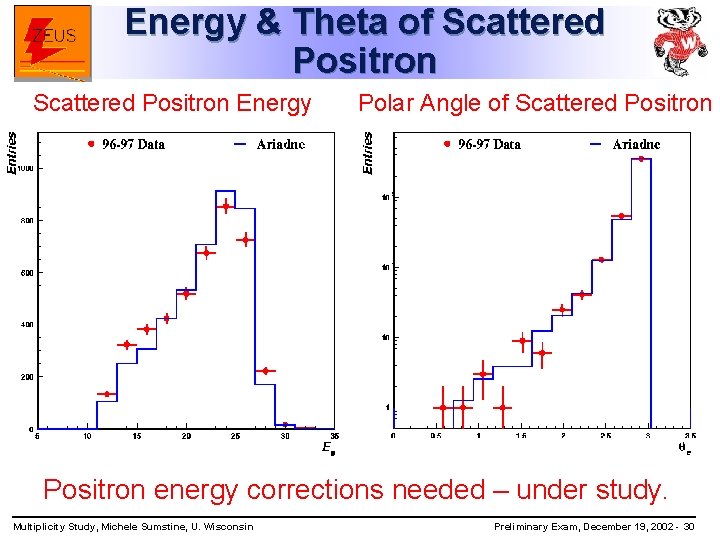
Energy & Theta of Scattered Positron Energy Polar Angle of Scattered Positron Ariadne ’ 96 -’ 97 Data Positron energy corrections needed – under study. Multiplicity Study, Michele Sumstine, U. Wisconsin Preliminary Exam, December 19, 2002 - 30
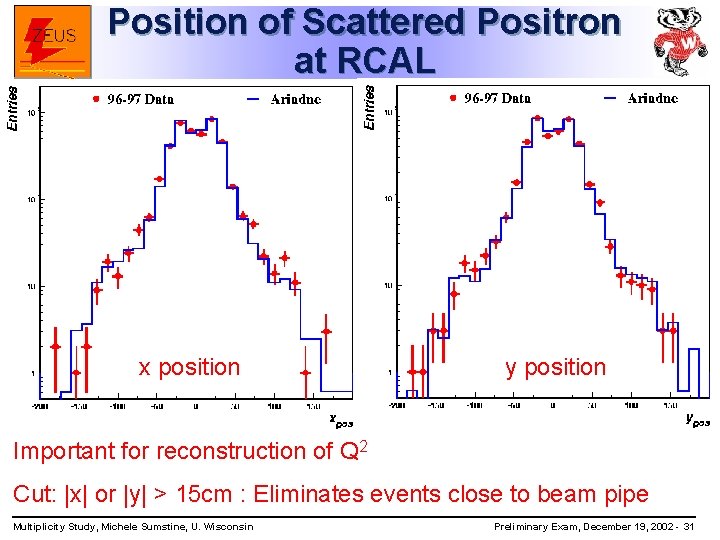
Position of Scattered Positron at RCAL x position y position Important for reconstruction of Q 2 Cut: |x| or |y| > 15 cm : Eliminates events close to beam pipe Multiplicity Study, Michele Sumstine, U. Wisconsin Preliminary Exam, December 19, 2002 - 31
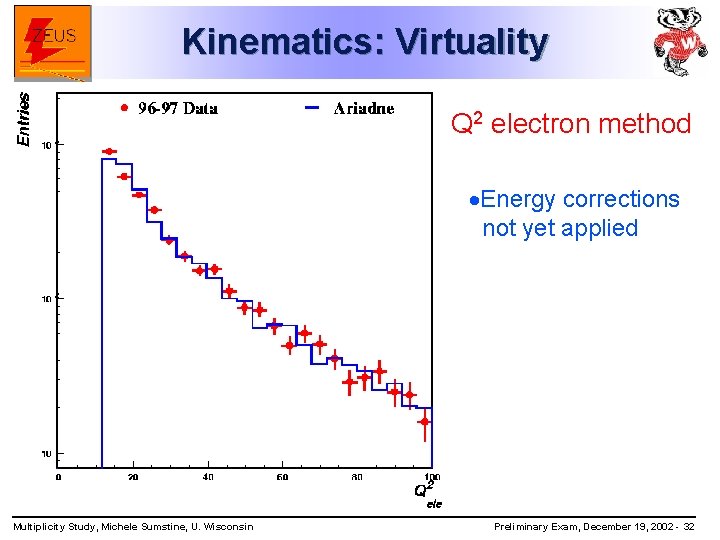
Kinematics: Virtuality Q 2 electron method ·Energy corrections not yet applied Multiplicity Study, Michele Sumstine, U. Wisconsin Preliminary Exam, December 19, 2002 - 32
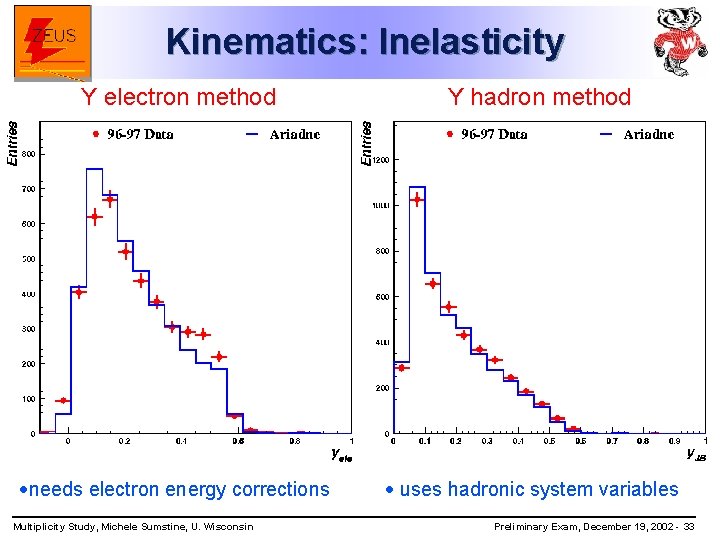
Kinematics: Inelasticity Y electron method ·needs electron energy corrections Multiplicity Study, Michele Sumstine, U. Wisconsin Y hadron method · uses hadronic system variables Preliminary Exam, December 19, 2002 - 33
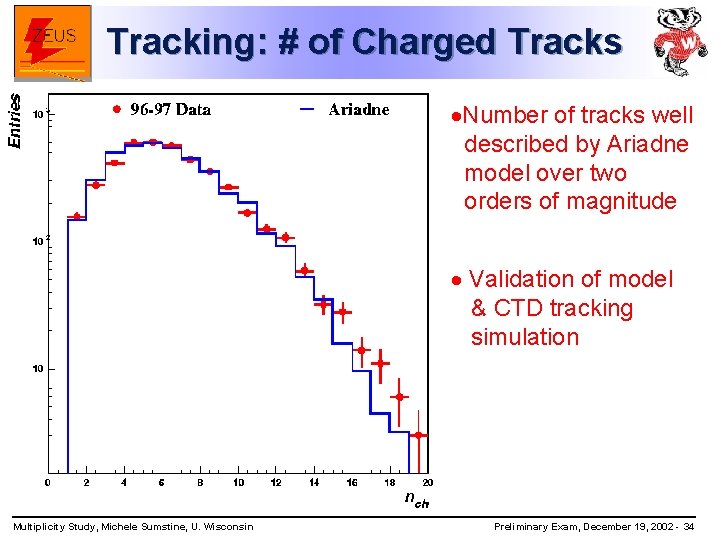
Tracking: # of Charged Tracks ·Number of tracks well described by Ariadne model over two orders of magnitude · Validation of model & CTD tracking simulation Multiplicity Study, Michele Sumstine, U. Wisconsin Preliminary Exam, December 19, 2002 - 34
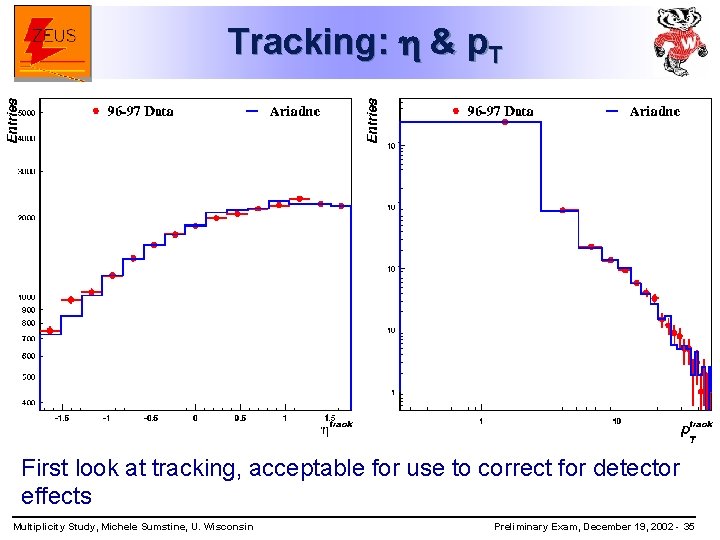
Tracking: & p. T First look at tracking, acceptable for use to correct for detector effects Multiplicity Study, Michele Sumstine, U. Wisconsin Preliminary Exam, December 19, 2002 - 35
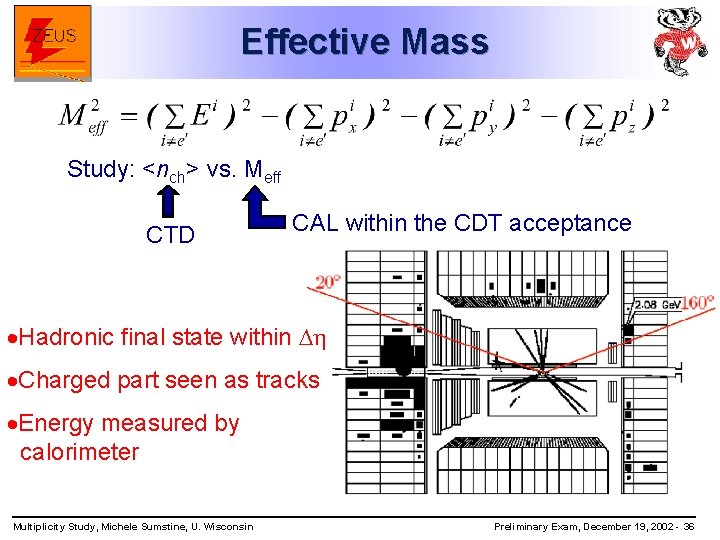
Effective Mass Study: <nch> vs. Meff CTD CAL within the CDT acceptance ·Hadronic final state within ·Charged part seen as tracks ·Energy measured by calorimeter Multiplicity Study, Michele Sumstine, U. Wisconsin Preliminary Exam, December 19, 2002 - 36
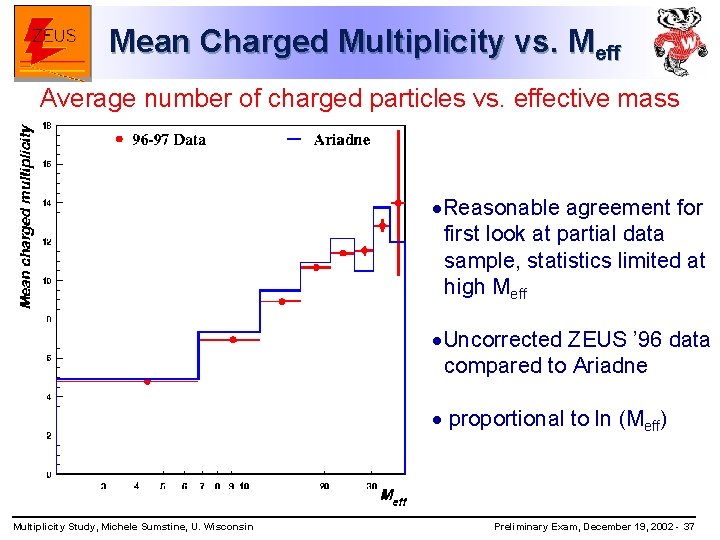
Mean Charged Multiplicity vs. Meff Average number of charged particles vs. effective mass ·Reasonable agreement for first look at partial data sample, statistics limited at high Meff ·Uncorrected ZEUS ’ 96 data compared to Ariadne · proportional to ln (Meff) Multiplicity Study, Michele Sumstine, U. Wisconsin Preliminary Exam, December 19, 2002 - 37
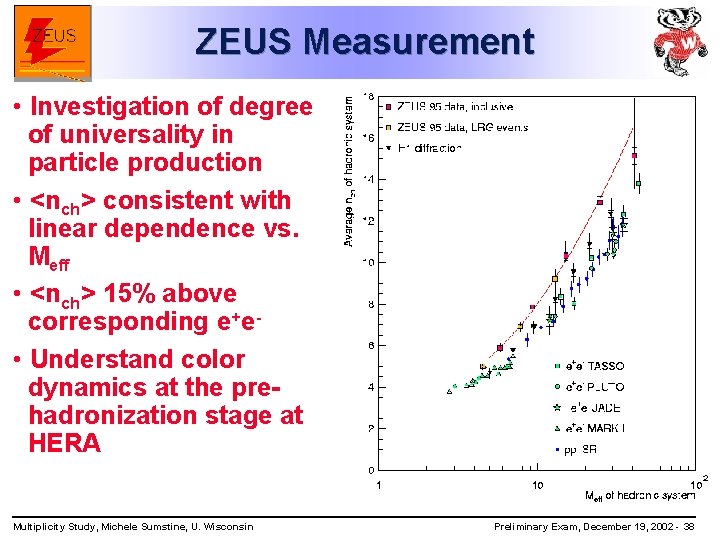
ZEUS Measurement • Investigation of degree of universality in particle production • <nch> consistent with linear dependence vs. Meff • <nch> 15% above corresponding e+e • Understand color dynamics at the pre- hadronization stage at HERA Multiplicity Study, Michele Sumstine, U. Wisconsin Preliminary Exam, December 19, 2002 - 38
Summary • First look at Multiplicity Distributions in DIS at HERA using 1996 data • DIS data sample compared to p. QCD + parton showers + hadronization models predictions • Event kinematics and tracking well understood and simulated Plan • Increase statistics of data and simulation events • include all 96 and 97 data • Investigate diffractive effects • Measure multiplicities vs. Q^2 in the current and target region of the Breit frame • Measure momentum spectra • Compare different models for parton showers and hadronization to data • Evaluate systematic uncertainties Multiplicity Study, Michele Sumstine, U. Wisconsin Preliminary Exam, December 19, 2002 - 39
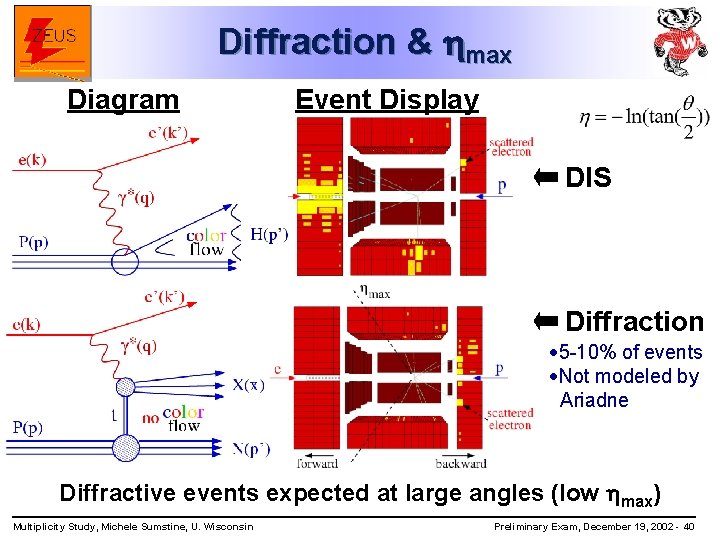
Diffraction & max Diagram Event Display DIS Diffraction · 5 -10% of events ·Not modeled by Ariadne Diffractive events expected at large angles (low max) Multiplicity Study, Michele Sumstine, U. Wisconsin Preliminary Exam, December 19, 2002 - 40
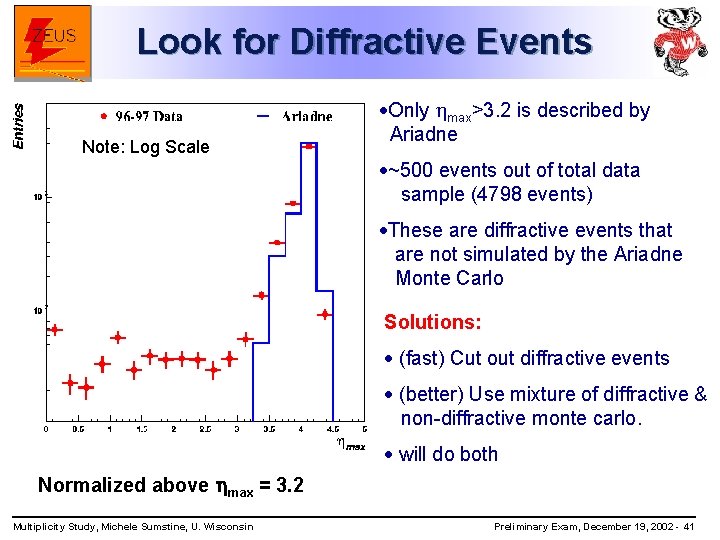
Look for Diffractive Events Note: Log Scale ·Only max>3. 2 is described by Ariadne ·~500 events out of total data sample (4798 events) ·These are diffractive events that are not simulated by the Ariadne Monte Carlo Solutions: · (fast) Cut out diffractive events · (better) Use mixture of diffractive & non-diffractive monte carlo. · will do both Normalized above max = 3. 2 Multiplicity Study, Michele Sumstine, U. Wisconsin Preliminary Exam, December 19, 2002 - 41
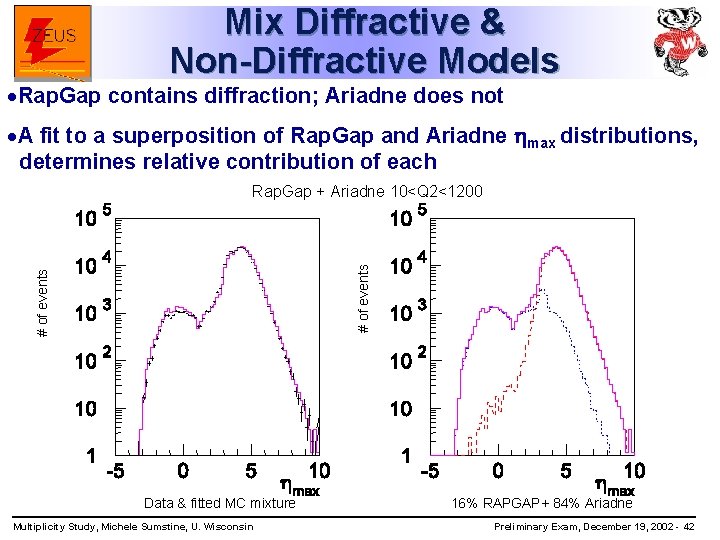
Mix Diffractive & Non-Diffractive Models ·Rap. Gap contains diffraction; Ariadne does not ·A fit to a superposition of Rap. Gap and Ariadne max distributions, determines relative contribution of each # of events Rap. Gap + Ariadne 10<Q 2<1200 Data & fitted MC mixture Multiplicity Study, Michele Sumstine, U. Wisconsin 16% RAPGAP+ 84% Ariadne Preliminary Exam, December 19, 2002 - 42
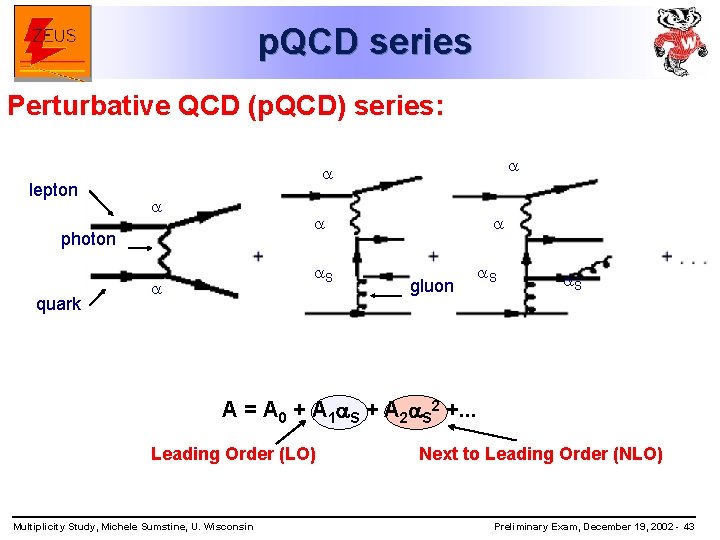
p. QCD series Perturbative QCD (p. QCD) series: lepton photon quark S gluon S S A = A 0 + A 1 S + A 2 S 2 +. . . Leading Order (LO) Multiplicity Study, Michele Sumstine, U. Wisconsin Next to Leading Order (NLO) Preliminary Exam, December 19, 2002 - 43
- Slides: 43