
Multiplication Progression YR to Y 6 YR Objectives

Multiplication Progression YR to Y 6
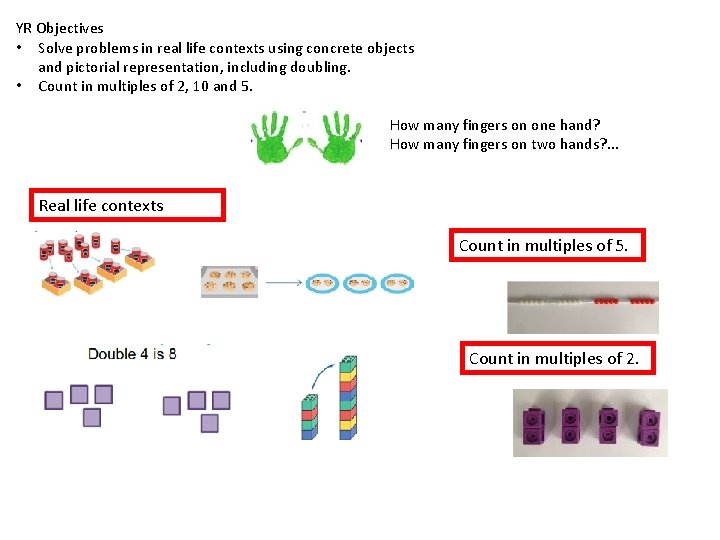
YR Objectives • Solve problems in real life contexts using concrete objects and pictorial representation, including doubling. • Count in multiples of 2, 10 and 5. How many fingers on one hand? How many fingers on two hands? . . . Real life contexts Count in multiples of 5. Count in multiples of 2.

Y 1 Objectives • Equal groups • Calculate the answer using concrete objects, pictorial representations and arrays, showing repeated addition. • Doubling Non-statutory: • Grouping and sharing small quantities • Make connections between arrays, number patterns, and counting in 2 s, 5 s and 10 s. Counting in twos Make equal groups, add them and show repeated addition in concrete and pictorial representations. Real life contexts Doubling on ten frames using real life objects
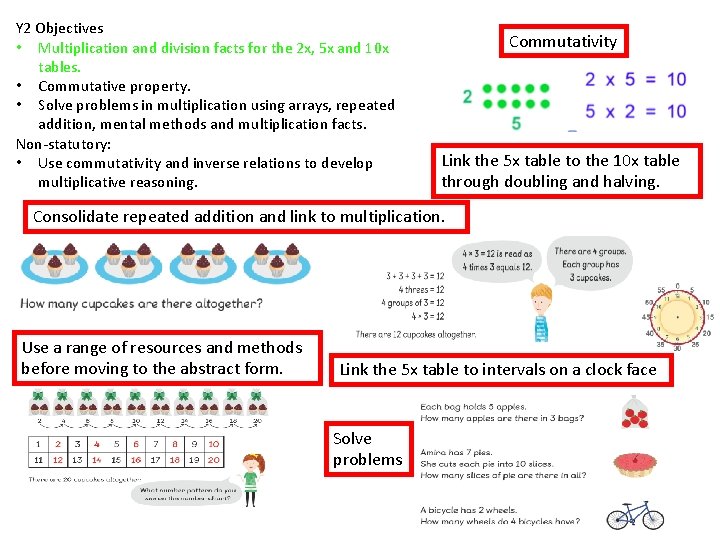
Y 2 Objectives • Multiplication and division facts for the 2 x, 5 x and 10 x tables. • Commutative property. • Solve problems in multiplication using arrays, repeated addition, mental methods and multiplication facts. Non-statutory: • Use commutativity and inverse relations to develop multiplicative reasoning. Commutativity Link the 5 x table to the 10 x table through doubling and halving. Consolidate repeated addition and link to multiplication. Use a range of resources and methods before moving to the abstract form. Link the 5 x table to intervals on a clock face Solve problems
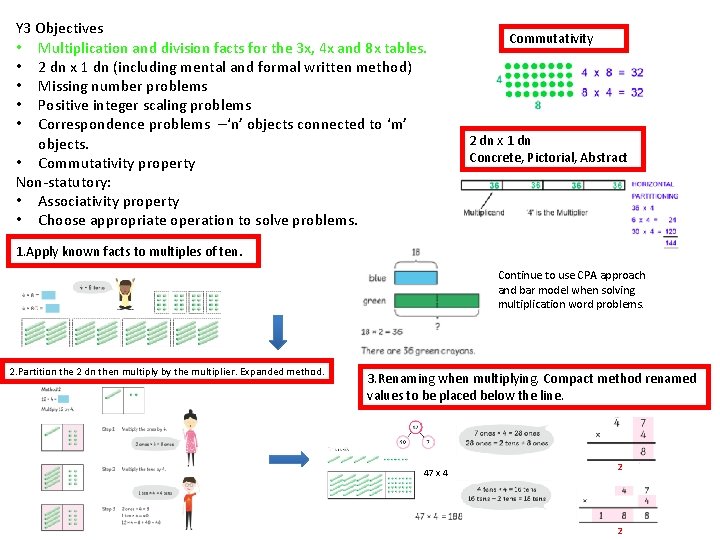
Y 3 Objectives • Multiplication and division facts for the 3 x, 4 x and 8 x tables. • 2 dn x 1 dn (including mental and formal written method) • Missing number problems • Positive integer scaling problems • Correspondence problems –‘n’ objects connected to ‘m’ objects. • Commutativity property Non-statutory: • Associativity property • Choose appropriate operation to solve problems. Commutativity 2 dn x 1 dn Concrete, Pictorial, Abstract 1. Apply known facts to multiples of ten. Continue to use CPA approach and bar model when solving multiplication word problems. 2. Partition the 2 dn then multiply by the multiplier. Expanded method. 3. Renaming when multiplying. Compact method renamed values to be placed below the line. 47 x 4 2 2

Y 4 Objectives Use the terms multiplicand multiplier. • Multiplication facts up to 12 x • Multiply by 0 and 1. • 1 dn x 1 dn • 2 dn x 1 dn • 3 dn x 1 dn • Factor pairs and commutativity 2 dn or 3 dn x 1 dn • Solving problems –scaling and correspondence. Continue to use CPA approach Non-statutory: • Derive related facts (If 6 x 4 = 24, 6 x 400 = 2400( • Distributive and Associative Laws 2 dn or 3 dn x 1 dn Move from the expanded to the compact method. Expanded Compact 1 3 3
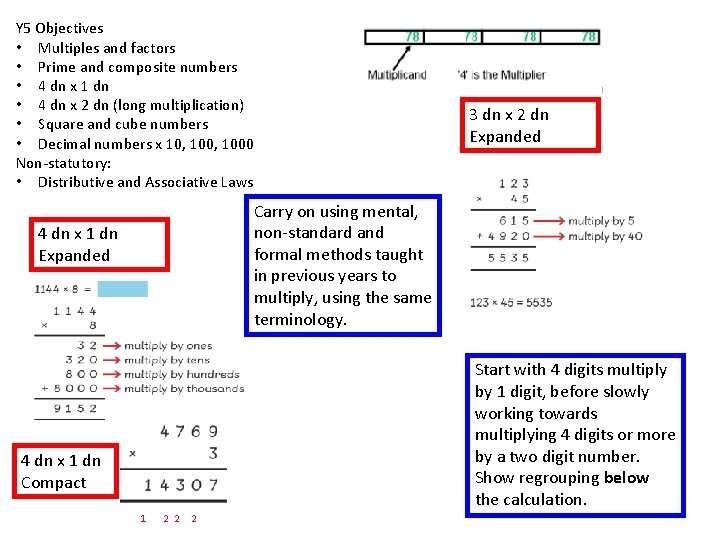
Y 5 Objectives • Multiples and factors • Prime and composite numbers • 4 dn x 1 dn • 4 dn x 2 dn (long multiplication) • Square and cube numbers • Decimal numbers x 10, 1000 Non-statutory: • Distributive and Associative Laws 3 dn x 2 dn Expanded Carry on using mental, non-standard and formal methods taught in previous years to multiply, using the same terminology. 4 dn x 1 dn Expanded Start with 4 digits multiply by 1 digit, before slowly working towards multiplying 4 digits or more by a two digit number. Show regrouping below the calculation. 4 dn x 1 dn Compact 1 2 2 2
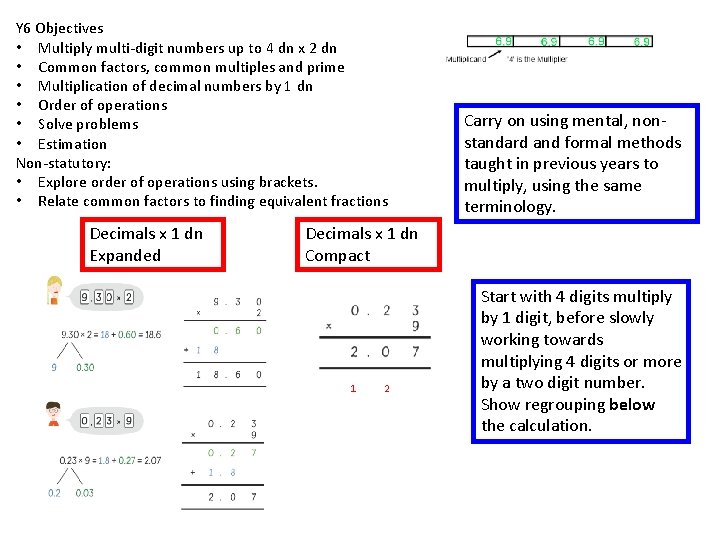
Y 6 Objectives • Multiply multi-digit numbers up to 4 dn x 2 dn • Common factors, common multiples and prime • Multiplication of decimal numbers by 1 dn • Order of operations • Solve problems • Estimation Non-statutory: • Explore order of operations using brackets. • Relate common factors to finding equivalent fractions Decimals x 1 dn Expanded Carry on using mental, nonstandard and formal methods taught in previous years to multiply, using the same terminology. Decimals x 1 dn Compact 1 2 Start with 4 digits multiply by 1 digit, before slowly working towards multiplying 4 digits or more by a two digit number. Show regrouping below the calculation.
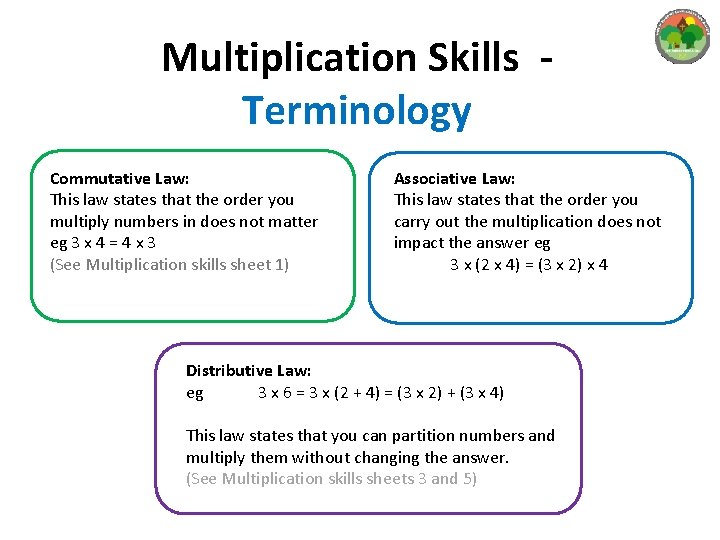
Multiplication Skills Terminology Commutative Law: This law states that the order you multiply numbers in does not matter eg 3 x 4 = 4 x 3 (See Multiplication skills sheet 1) Associative Law: This law states that the order you carry out the multiplication does not impact the answer eg 3 x (2 x 4) = (3 x 2) x 4 Distributive Law: eg 3 x 6 = 3 x (2 + 4) = (3 x 2) + (3 x 4) This law states that you can partition numbers and multiply them without changing the answer. (See Multiplication skills sheets 3 and 5)
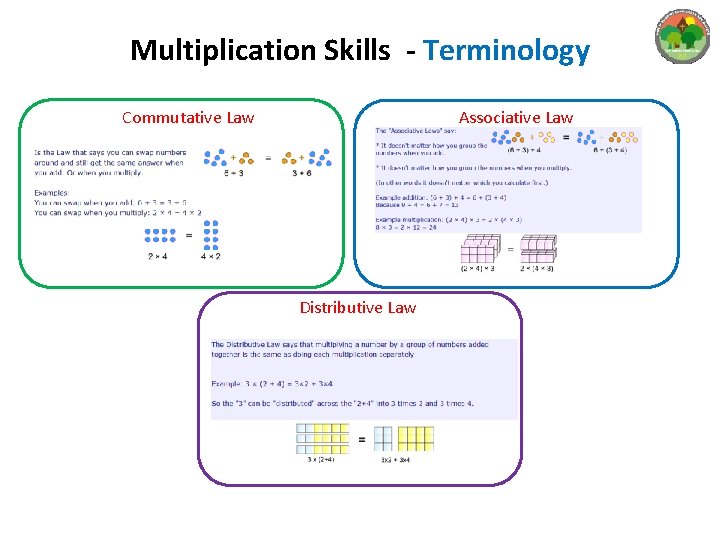
Multiplication Skills - Terminology Commutative Law Associative Law Distributive Law
- Slides: 11