
Multiplication Division By the end of Year 3

Multiplication & Division • By the end of Year 3, children should be able to recall and use multiplication and division facts for the 3, 4 and 8 multiplication tables • By the end of Year 4, children should be able to recall multiplication and division facts for multiplication tables up to 12 × 12 • By the end of Year 5, children should be able to apply knowledge of multiplication and division (find factors, multiples, prime and composite numbers, square numbers) • By the end of Year 6, children have developed mathematical fluency and apply multiplication and division facts in more complex problems and calculations
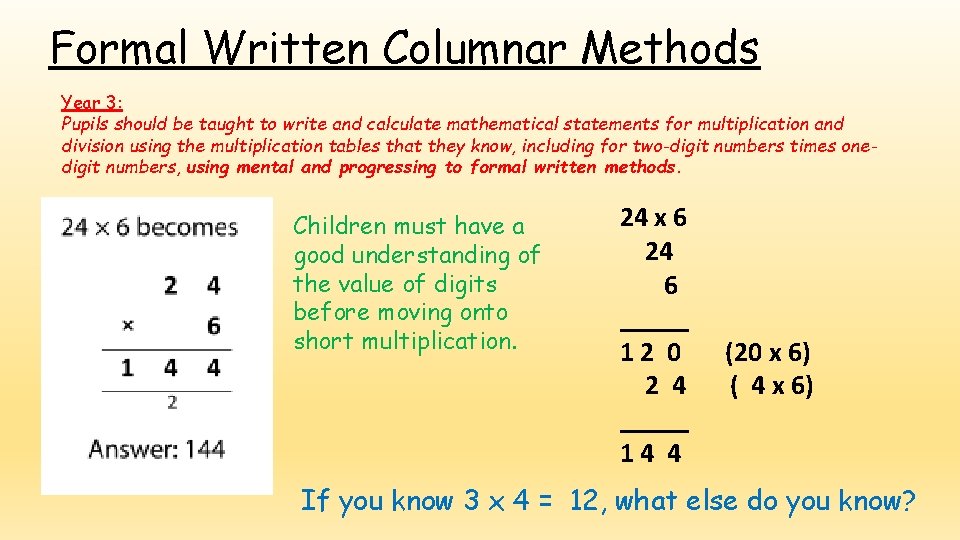
Formal Written Columnar Methods Year 3: Pupils should be taught to write and calculate mathematical statements for multiplication and division using the multiplication tables that they know, including for two-digit numbers times onedigit numbers, using mental and progressing to formal written methods. Children must have a good understanding of the value of digits before moving onto short multiplication. 24 x 6 24 6 _____ 12 0 2 4 _____ 14 4 (20 x 6) ( 4 x 6) If you know 3 x 4 = 12, what else do you know?
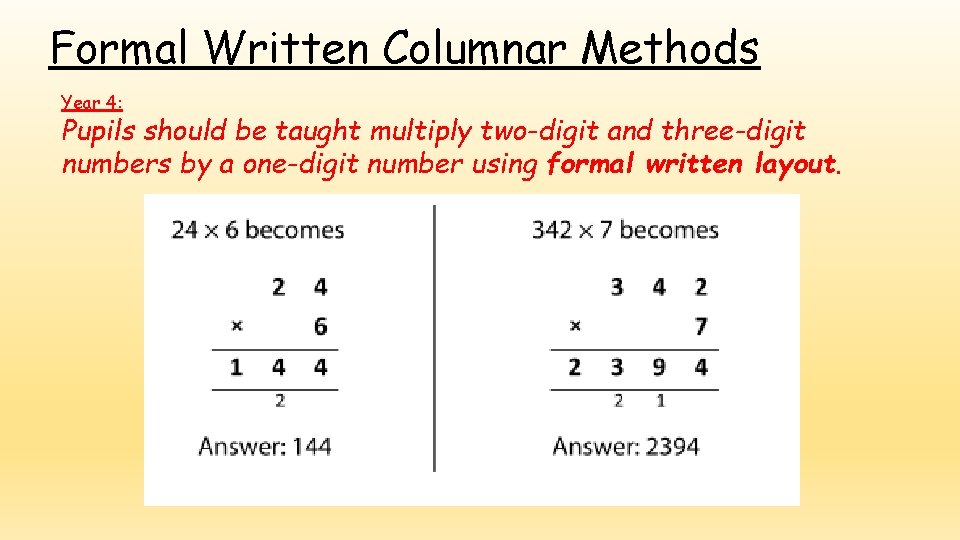
Formal Written Columnar Methods Year 4: Pupils should be taught multiply two-digit and three-digit numbers by a one-digit number using formal written layout.

Formal Written Columnar Methods Year 5: Pupils should be taught to multiply numbers up to 4 digits by a one- or two-digit number using a formal written method, including long multiplication for two-digit numbers.

Formal Written Columnar Methods Year 6: Pupils should be taught to multiply multi-digit numbers up to 4 digits by a two-digit whole number using the formal written method of long multiplication. Give it a go! 3478 x 14 = = 48 692
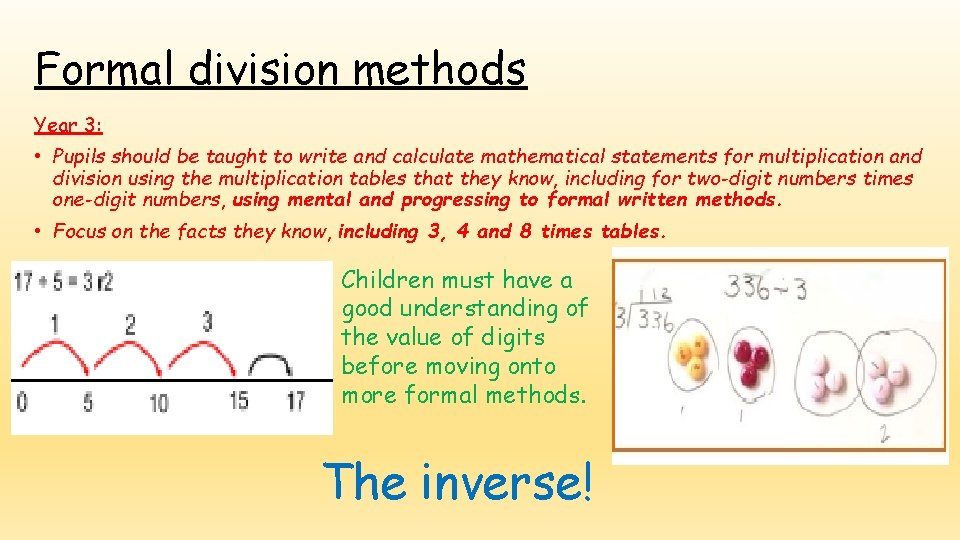
Formal division methods Year 3: • Pupils should be taught to write and calculate mathematical statements for multiplication and division using the multiplication tables that they know, including for two-digit numbers times one-digit numbers, using mental and progressing to formal written methods. • Focus on the facts they know, including 3, 4 and 8 times tables. Children must have a good understanding of the value of digits before moving onto more formal methods. The inverse!
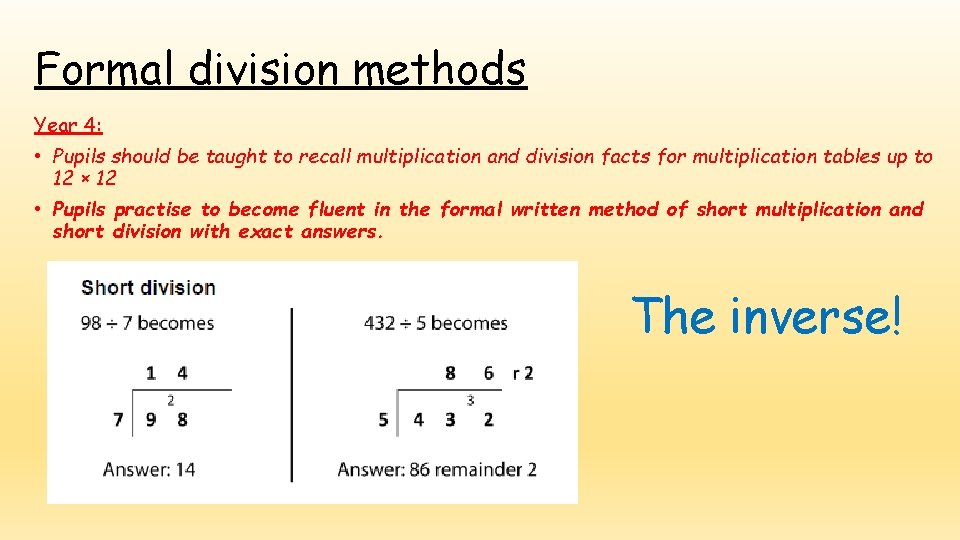
Formal division methods Year 4: • Pupils should be taught to recall multiplication and division facts for multiplication tables up to 12 × 12 • Pupils practise to become fluent in the formal written method of short multiplication and short division with exact answers. The inverse!
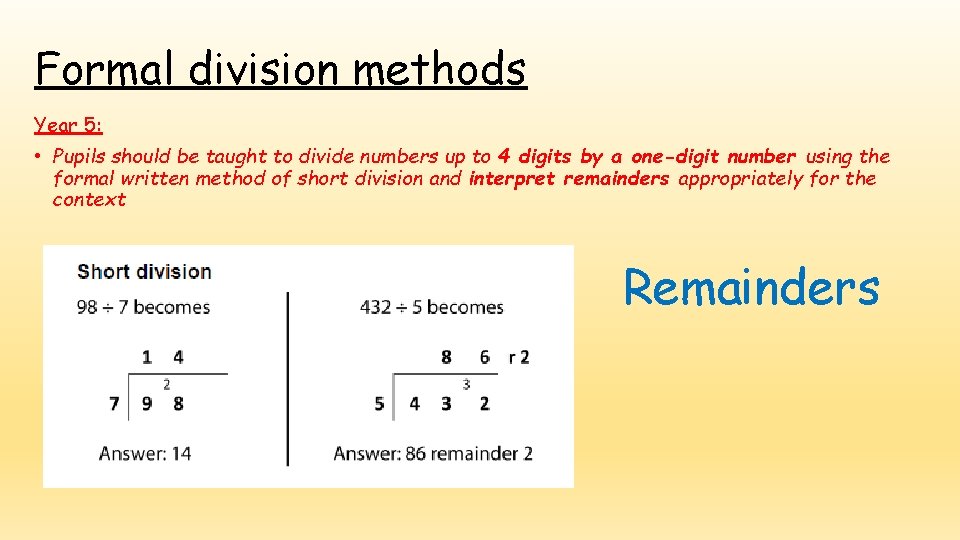
Formal division methods Year 5: • Pupils should be taught to divide numbers up to 4 digits by a one-digit number using the formal written method of short division and interpret remainders appropriately for the context Remainders
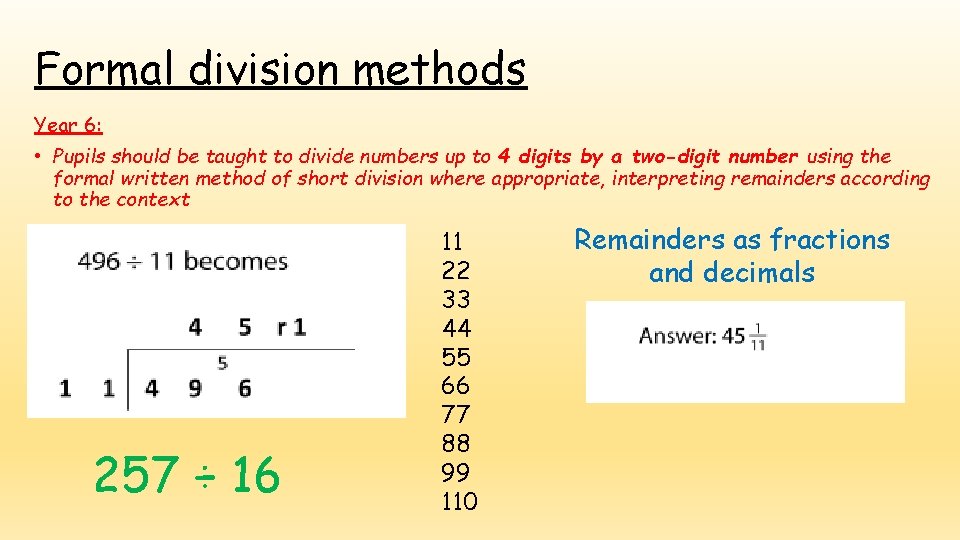
Formal division methods Year 6: • Pupils should be taught to divide numbers up to 4 digits by a two-digit number using the formal written method of short division where appropriate, interpreting remainders according to the context 257 ÷ 16 11 22 33 44 55 66 77 88 99 110 Remainders as fractions and decimals
- Slides: 9