
Multiplication and Division Times tables and factors Objectives
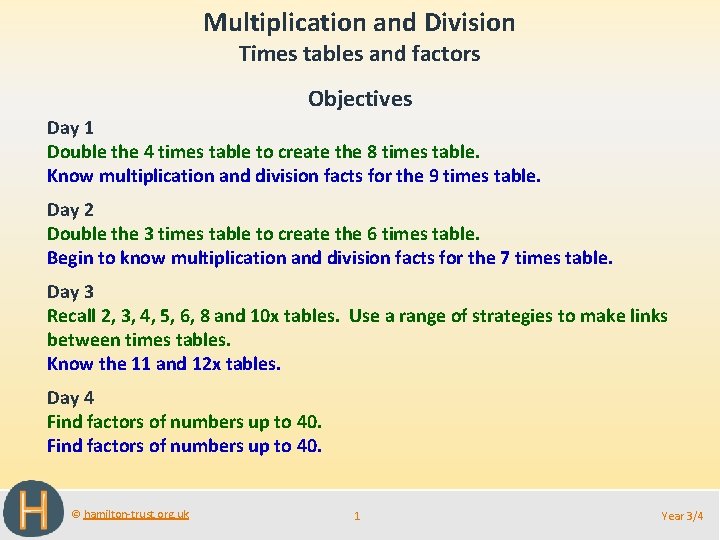
Multiplication and Division Times tables and factors Objectives Day 1 Double the 4 times table to create the 8 times table. Know multiplication and division facts for the 9 times table. Day 2 Double the 3 times table to create the 6 times table. Begin to know multiplication and division facts for the 7 times table. Day 3 Recall 2, 3, 4, 5, 6, 8 and 10 x tables. Use a range of strategies to make links between times tables. Know the 11 and 12 x tables. Day 4 Find factors of numbers up to 40. © hamilton-trust. org. uk 1 Year 3/4
Multiplication and Division Times tables and factors Short Mental Workouts Day 1 4 times table Day 2 Ping Pong Day 3 Division facts for 3 times table Day 4 Place value addition chains © hamilton-trust. org. uk 2 Year 3/4
Multiplication and Division Times tables and factors Short Mental Workout 4 times table © hamilton-trust. org. uk 3 Year 3/4
Multiplication and Division Times tables and factors Short Mental Workout Ping Pong © hamilton-trust. org. uk 4 Year 3/4
Multiplication and Division Times tables and factors Short Mental Workout Division facts for 3 times table © hamilton-trust. org. uk 5 Year 3/4
Multiplication and Division Times tables and factors Short Mental Workout Place value addition chains © hamilton-trust. org. uk 6 Year 3/4
Multiplication and Division Times tables and factors Objectives Day 1 Double the 4 times table to create the 8 times table. Know multiplication and division facts for the 9 times table. © hamilton-trust. org. uk 7 Year 3/4
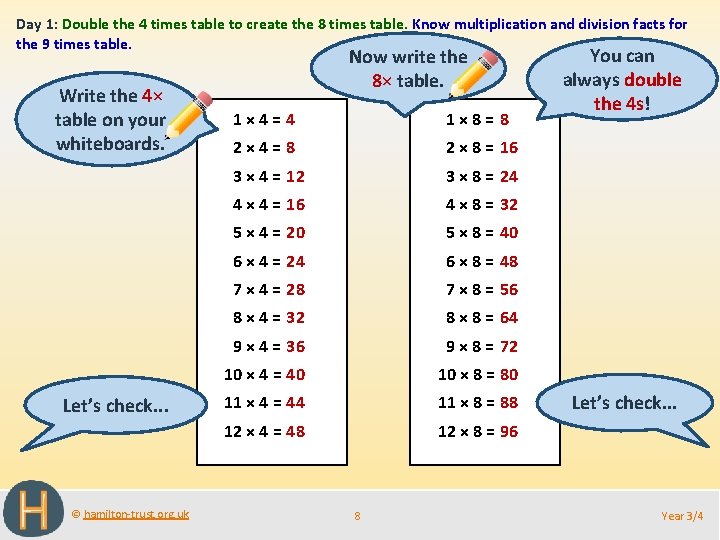
Day 1: Double the 4 times table to create the 8 times table. Know multiplication and division facts for the 9 times table. Write the 4× table on your whiteboards. Let’s check. . . © hamilton-trust. org. uk Now write the 8× table. 1× 4= 4 1× 8= 8 2× 4= 8 2 × 8 = 16 3 × 4 = 12 3 × 8 = 24 4 × 4 = 16 4 × 8 = 32 5 × 4 = 20 5 × 8 = 40 6 × 4 = 24 6 × 8 = 48 7 × 4 = 28 7 × 8 = 56 8 × 4 = 32 8 × 8 = 64 9 × 4 = 36 9 × 8 = 72 10 × 4 = 40 10 × 8 = 80 11 × 4 = 44 11 × 8 = 88 12 × 4 = 48 12 × 8 = 96 8 You can always double the 4 s! Let’s check. . . Year 3/4
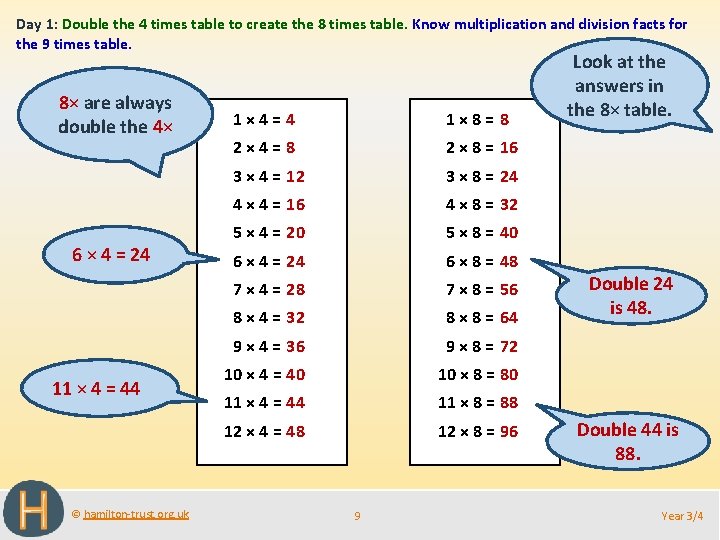
Day 1: Double the 4 times table to create the 8 times table. Know multiplication and division facts for the 9 times table. 8× are always double the 4× 6 × 4 = 24 11 × 4 = 44 © hamilton-trust. org. uk 1× 4= 4 1× 8= 8 2× 4= 8 2 × 8 = 16 3 × 4 = 12 3 × 8 = 24 4 × 4 = 16 4 × 8 = 32 5 × 4 = 20 5 × 8 = 40 6 × 4 = 24 6 × 8 = 48 7 × 4 = 28 7 × 8 = 56 8 × 4 = 32 8 × 8 = 64 9 × 4 = 36 9 × 8 = 72 10 × 4 = 40 10 × 8 = 80 11 × 4 = 44 11 × 8 = 88 12 × 4 = 48 12 × 8 = 96 9 Look at the answers in the 8× table. Double 24 is 48. Double 44 is 88. Year 3/4
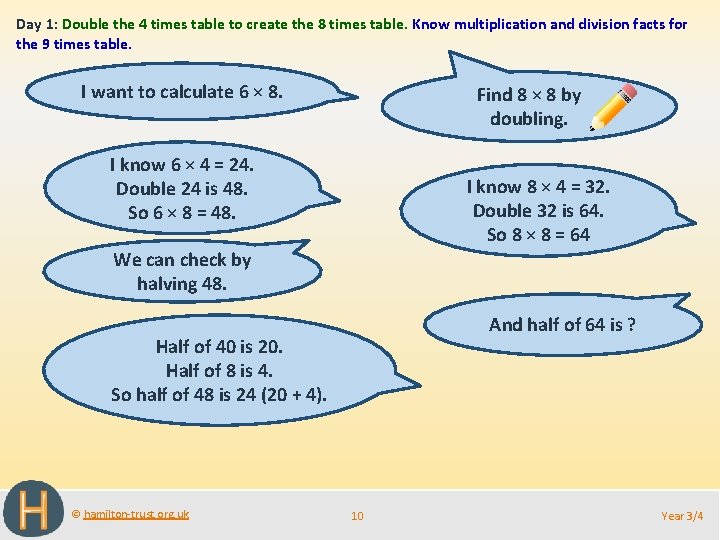
Day 1: Double the 4 times table to create the 8 times table. Know multiplication and division facts for the 9 times table. I want to calculate 6 × 8. Find 8 × 8 by doubling. I know 6 × 4 = 24. Double 24 is 48. So 6 × 8 = 48. I know 8 × 4 = 32. Double 32 is 64. So 8 × 8 = 64 We can check by halving 48. And half of 64 is ? Half of 40 is 20. Half of 8 is 4. So half of 48 is 24 (20 + 4). © hamilton-trust. org. uk 10 Year 3/4
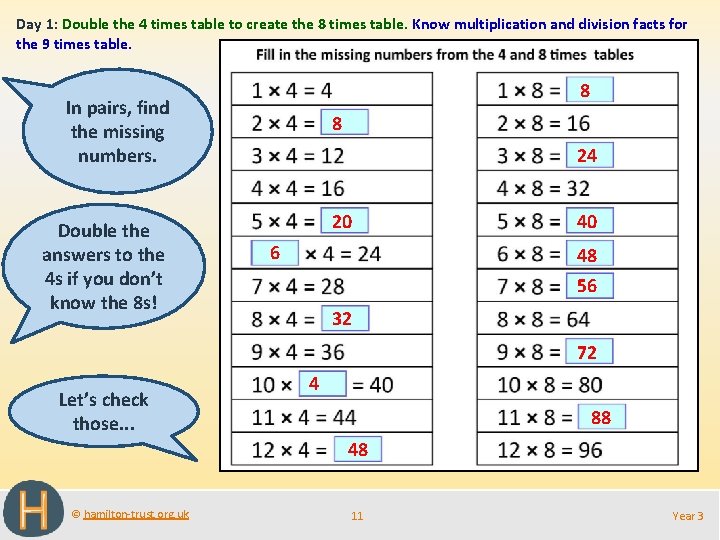
Day 1: Double the 4 times table to create the 8 times table. Know multiplication and division facts for the 9 times table. 8 In pairs, find the missing numbers. Double the answers to the 4 s if you don’t know the 8 s! 8 24 20 6 40 48 56 32 72 Let’s check those. . . 4 88 48 © hamilton-trust. org. uk 11 Year 3
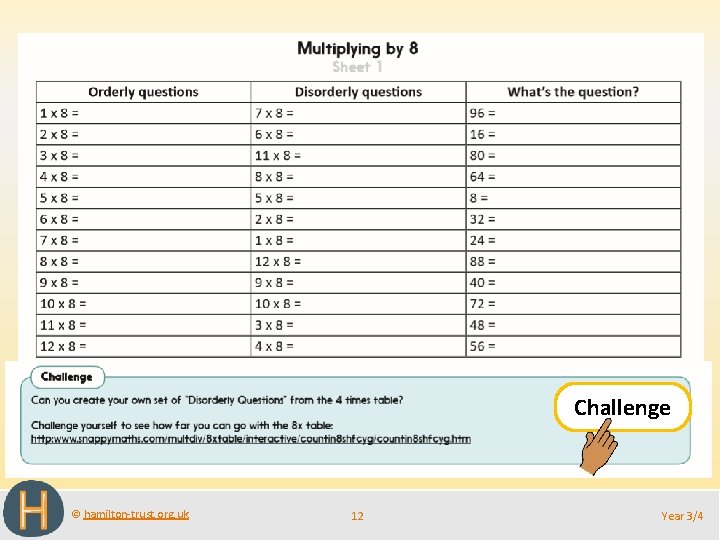
Challenge © hamilton-trust. org. uk 12 Year 3/4
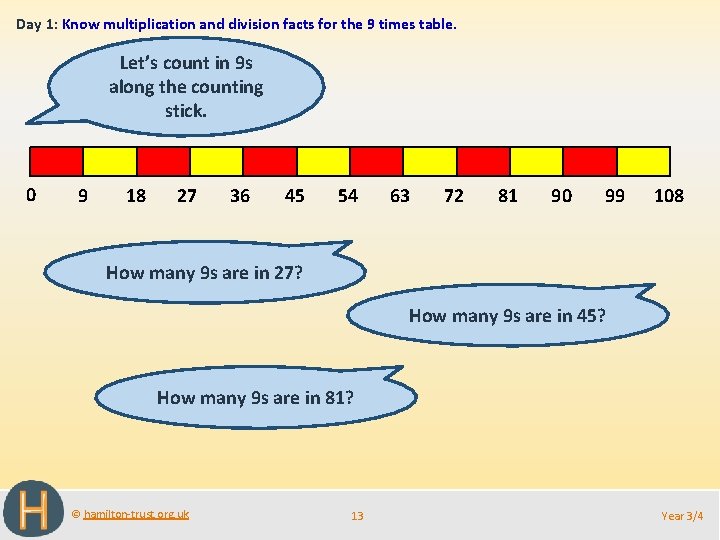
Day 1: Know multiplication and division facts for the 9 times table. Let’s count in 9 s along the counting stick. 0 9 18 27 36 45 54 63 72 81 90 99 108 How many 9 s are in 27? How many 9 s are in 45? How many 9 s are in 81? © hamilton-trust. org. uk 13 Year 3/4
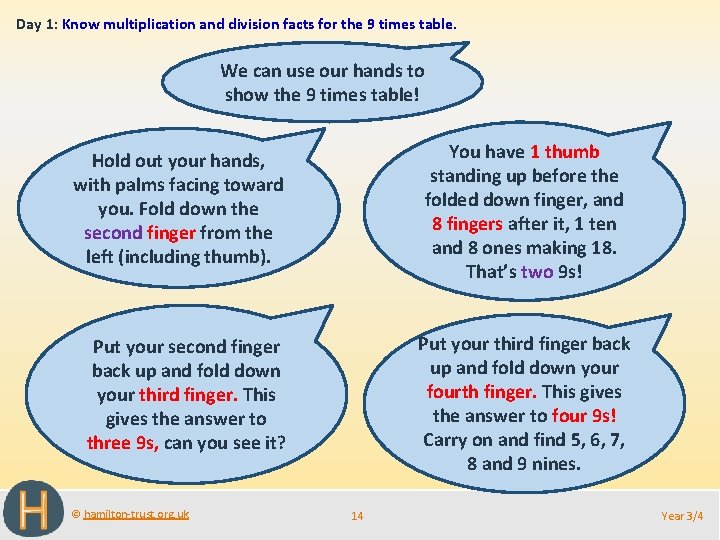
Day 1: Know multiplication and division facts for the 9 times table. We can use our hands to show the 9 times table! You have 1 thumb standing up before the folded down finger, and 8 fingers after it, 1 ten and 8 ones making 18. That’s two 9 s! Hold out your hands, with palms facing toward you. Fold down the second finger from the left (including thumb). Put your third finger back up and fold down your fourth finger. This gives the answer to four 9 s! Carry on and find 5, 6, 7, 8 and 9 nines. Put your second finger back up and fold down your third finger. This gives the answer to three 9 s, can you see it? © hamilton-trust. org. uk 14 Year 3/4
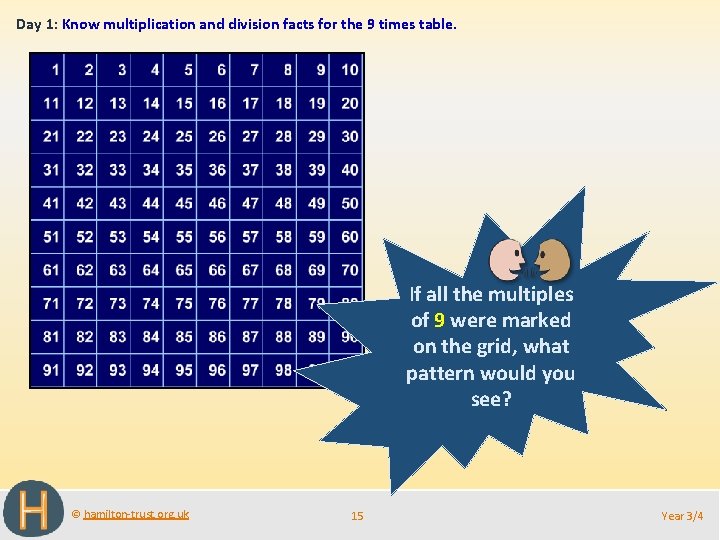
Day 1: Know multiplication and division facts for the 9 times table. If all the multiples of 9 were marked on the grid, what pattern would you see? © hamilton-trust. org. uk 15 Year 3/4
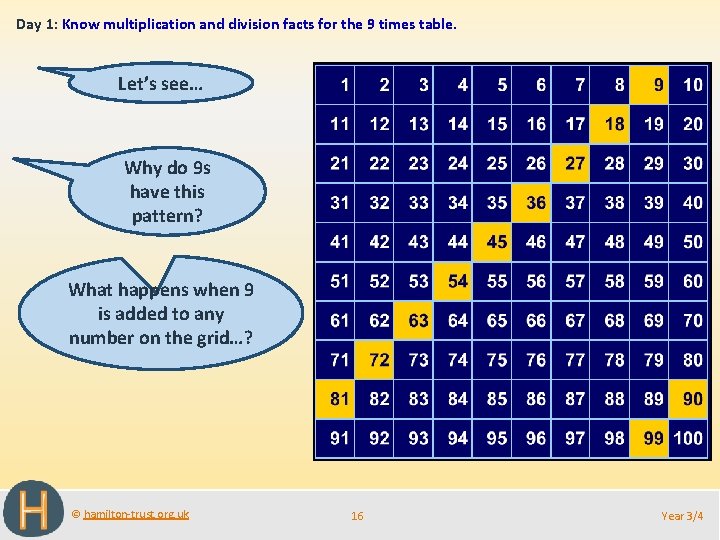
Day 1: Know multiplication and division facts for the 9 times table. Let’s see… Why do 9 s have this pattern? What happens when 9 is added to any number on the grid…? © hamilton-trust. org. uk 16 Year 3/4
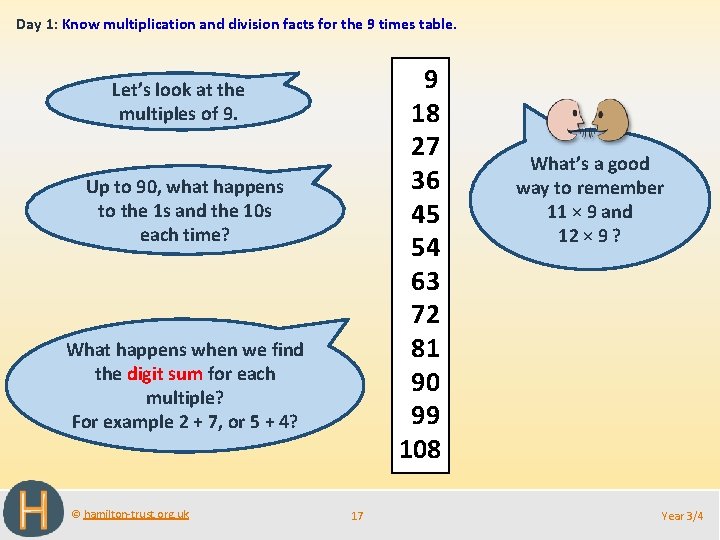
Day 1: Know multiplication and division facts for the 9 times table. 9 18 27 36 45 54 63 72 81 90 99 108 Let’s look at the multiples of 9. Up to 90, what happens to the 1 s and the 10 s each time? What happens when we find the digit sum for each multiple? For example 2 + 7, or 5 + 4? © hamilton-trust. org. uk 17 What’s a good way to remember 11 × 9 and 12 × 9 ? Year 3/4
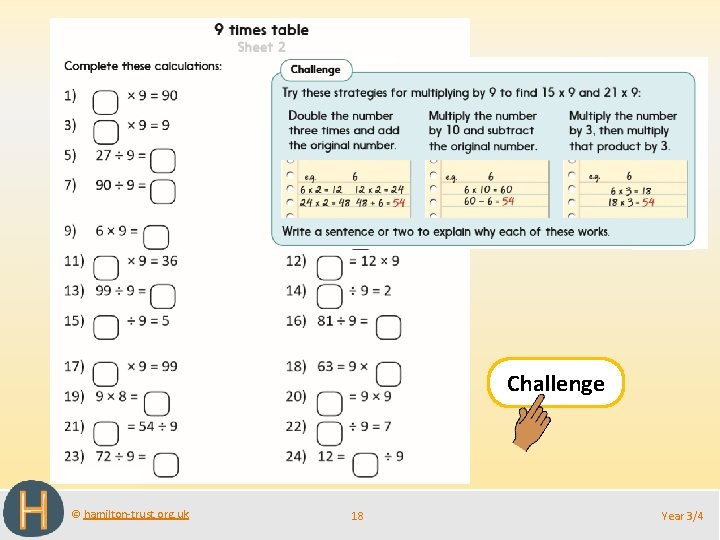
Challenge © hamilton-trust. org. uk 18 Year 3/4
Multiplication and Division Times tables and factors Objectives Day 2 Double the 3 times table to create the 6 times table. Begin to know multiplication and division facts for the 7 times table. © hamilton-trust. org. uk 19 Year 3/4
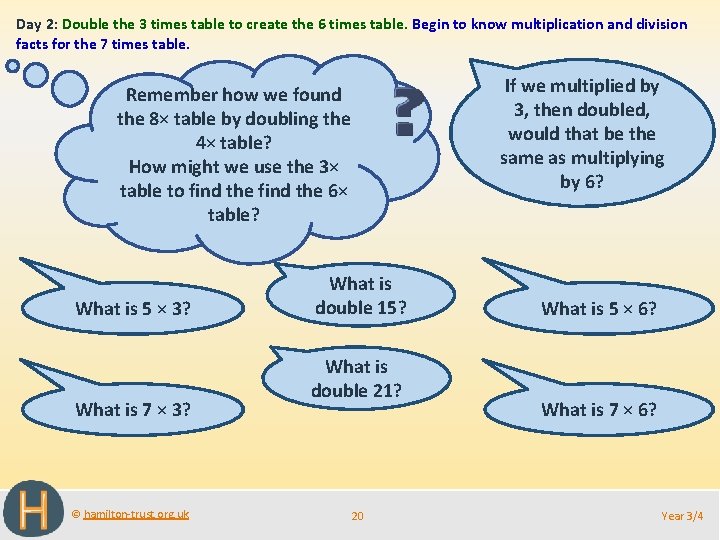
Day 2: Double the 3 times table to create the 6 times table. Begin to know multiplication and division facts for the 7 times table. If we multiplied by 3, then doubled, would that be the same as multiplying by 6? Remember how we found the 8× table by doubling the 4× table? How might we use the 3× table to find the 6× table? What is 5 × 3? What is 7 × 3? © hamilton-trust. org. uk What is double 15? What is double 21? 20 What is 5 × 6? What is 7 × 6? Year 3/4
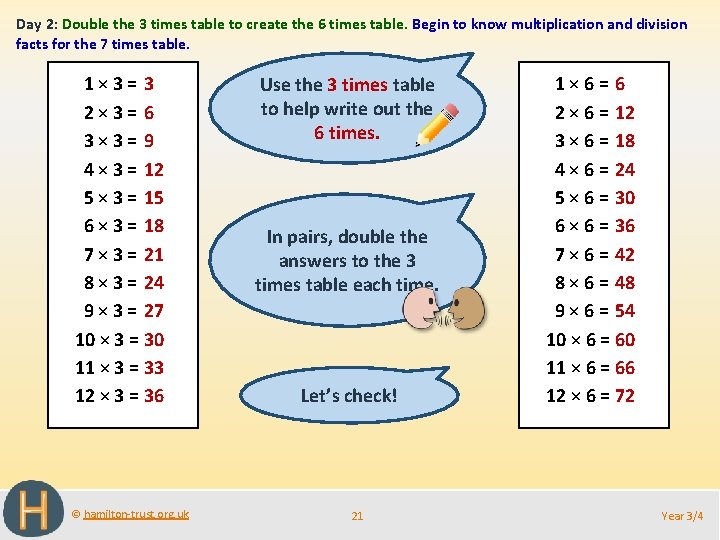
Day 2: Double the 3 times table to create the 6 times table. Begin to know multiplication and division facts for the 7 times table. 1× 3= 3 2× 3= 6 3× 3= 9 4 × 3 = 12 5 × 3 = 15 6 × 3 = 18 7 × 3 = 21 8 × 3 = 24 9 × 3 = 27 10 × 3 = 30 11 × 3 = 33 12 × 3 = 36 © hamilton-trust. org. uk Use the 3 times table to help write out the 6 times. In pairs, double the answers to the 3 times table each time. Let’s check! 21 1× 6= 6 2 × 6 = 12 3 × 6 = 18 4 × 6 = 24 5 × 6 = 30 6 × 6 = 36 7 × 6 = 42 8 × 6 = 48 9 × 6 = 54 10 × 6 = 60 11 × 6 = 66 12 × 6 = 72 Year 3/4
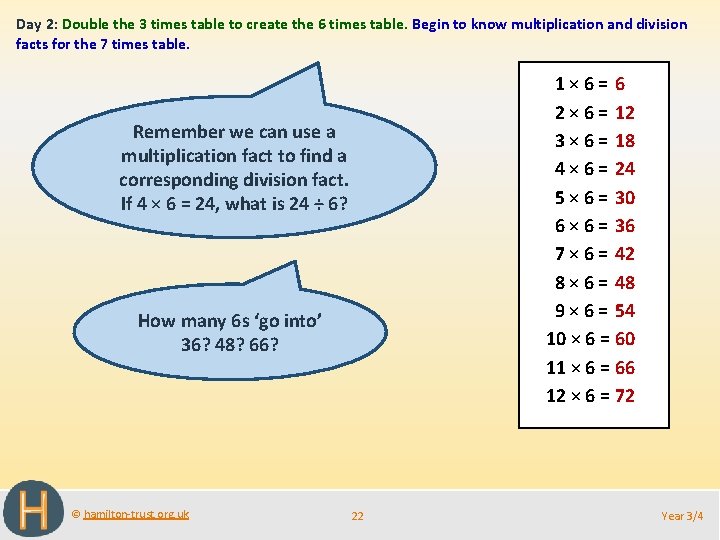
Day 2: Double the 3 times table to create the 6 times table. Begin to know multiplication and division facts for the 7 times table. 1× 6= 6 2 × 6 = 12 3 × 6 = 18 4 × 6 = 24 5 × 6 = 30 6 × 6 = 36 7 × 6 = 42 8 × 6 = 48 9 × 6 = 54 10 × 6 = 60 11 × 6 = 66 12 × 6 = 72 Remember we can use a multiplication fact to find a corresponding division fact. If 4 × 6 = 24, what is 24 ÷ 6? How many 6 s ‘go into’ 36? 48? 66? © hamilton-trust. org. uk 22 Year 3/4
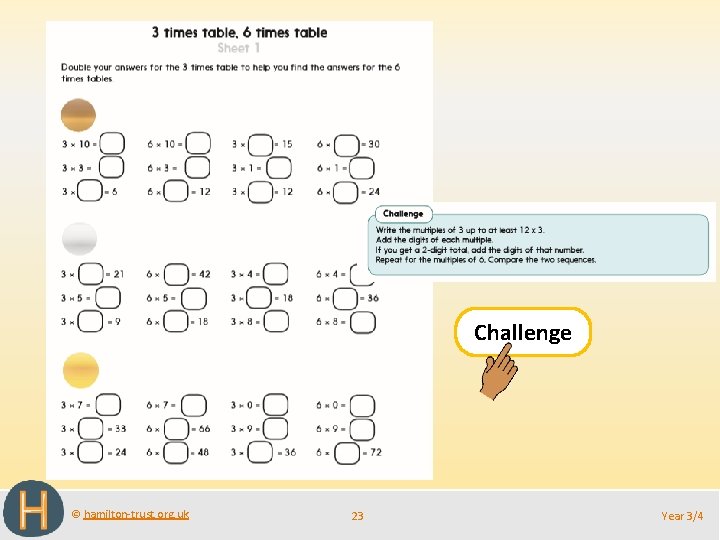
Challenge © hamilton-trust. org. uk 23 Year 3/4
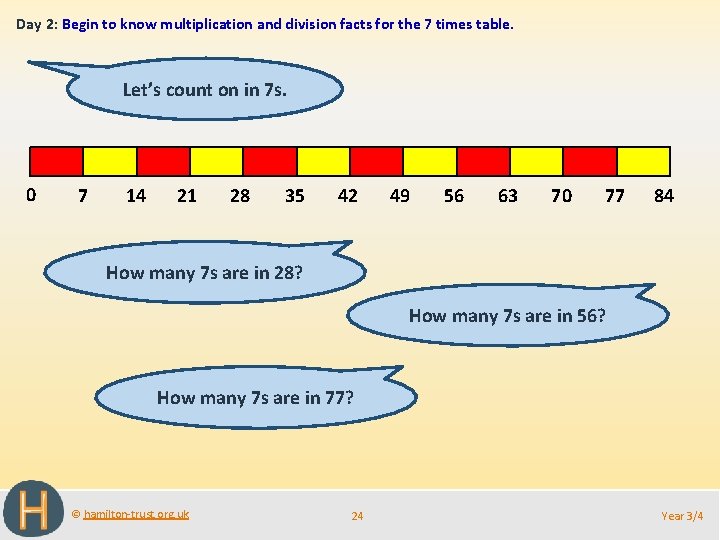
Day 2: Begin to know multiplication and division facts for the 7 times table. Let’s count on in 7 s. 0 7 14 21 28 35 42 49 56 63 70 77 84 How many 7 s are in 28? How many 7 s are in 56? How many 7 s are in 77? © hamilton-trust. org. uk 24 Year 3/4
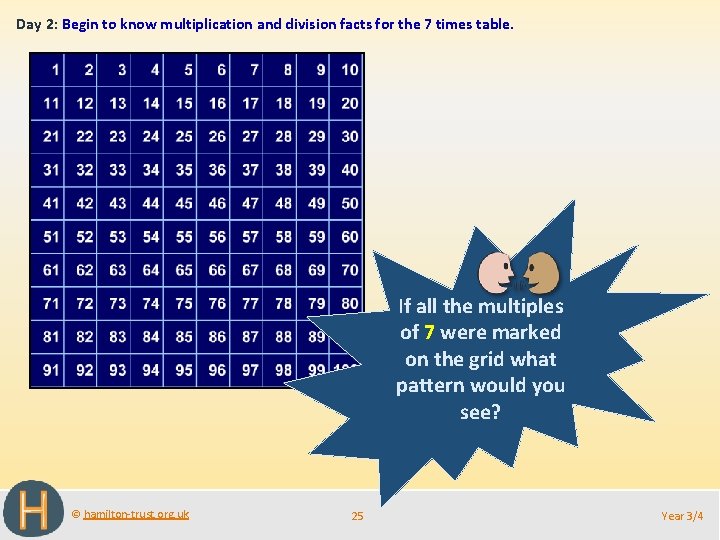
Day 2: Begin to know multiplication and division facts for the 7 times table. If all the multiples of 7 were marked on the grid what pattern would you see? © hamilton-trust. org. uk 25 Year 3/4
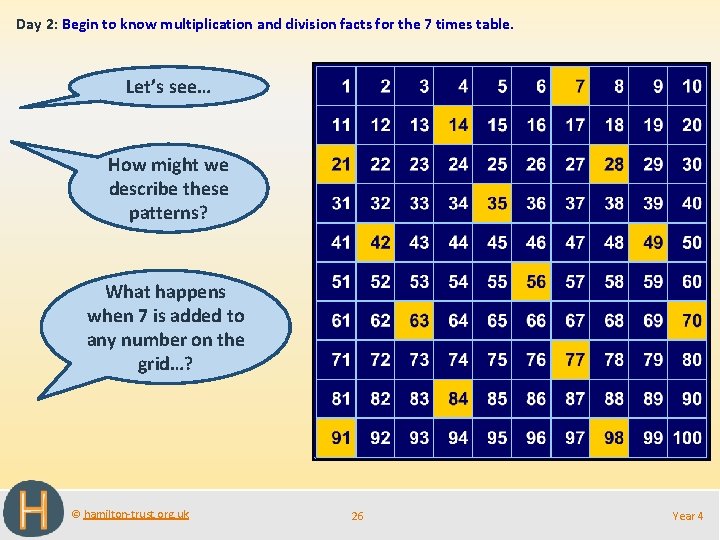
Day 2: Begin to know multiplication and division facts for the 7 times table. Let’s see… How might we describe these patterns? What happens when 7 is added to any number on the grid…? © hamilton-trust. org. uk 26 Year 4
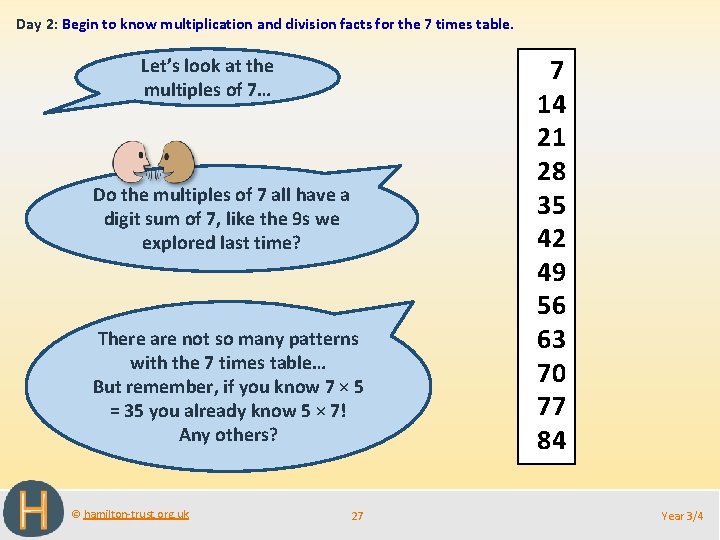
Day 2: Begin to know multiplication and division facts for the 7 times table. Let’s look at the multiples of 7… Do the multiples of 7 all have a digit sum of 7, like the 9 s we explored last time? There are not so many patterns with the 7 times table… But remember, if you know 7 × 5 = 35 you already know 5 × 7! Any others? © hamilton-trust. org. uk 27 7 14 21 28 35 42 49 56 63 70 77 84 Year 3/4
Challenge © hamilton-trust. org. uk 28 Year 3/4
Multiplication and Division Times tables and factors Objectives Day 3 Year 3: Recall 2, 3, 4, 5, 6, 8 and 10× tables. Use a range of strategies to make links between times tables. Year 4: Know the 11× and 12× tables. © hamilton-trust. org. uk 29 Year 3/4
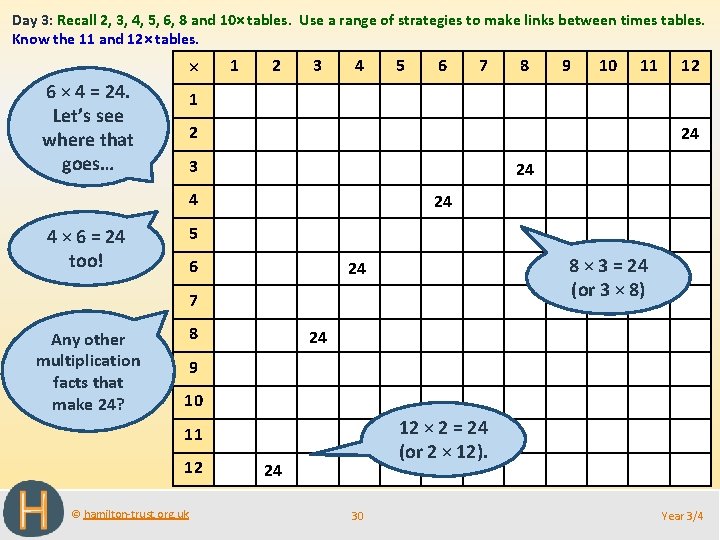
Day 3: Recall 2, 3, 4, 5, 6, 8 and 10× tables. Use a range of strategies to make links between times tables. Know the 11 and 12× tables. × 6 × 4 = 24. Let’s see where that goes… 1 2 3 4 5 6 7 9 10 11 12 1 2 24 3 24 4 24 5 4 × 6 = 24 too! 6 8 × 3 = 24 (or 3 × 8) 24 7 Any other multiplication facts that make 24? 8 8 24 9 10 12 × 2 = 24 (or 2 × 12). 11 12 © hamilton-trust. org. uk 24 30 Year 3/4
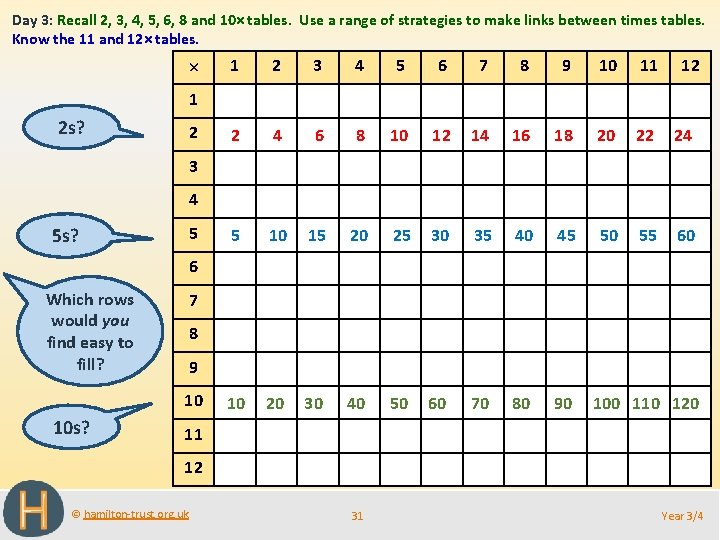
Day 3: Recall 2, 3, 4, 5, 6, 8 and 10× tables. Use a range of strategies to make links between times tables. Know the 11 and 12× tables. × 1 2 3 4 5 6 7 8 9 10 11 12 2 4 6 8 10 12 14 16 18 20 22 24 5 10 15 20 25 30 35 40 45 50 55 60 10 20 30 40 50 60 70 80 90 1 2 s? 2 3 4 5 5 s? 6 Which rows would you find easy to fill? 7 8 9 10 10 s? 100 110 120 11 12 © hamilton-trust. org. uk 31 Year 3/4
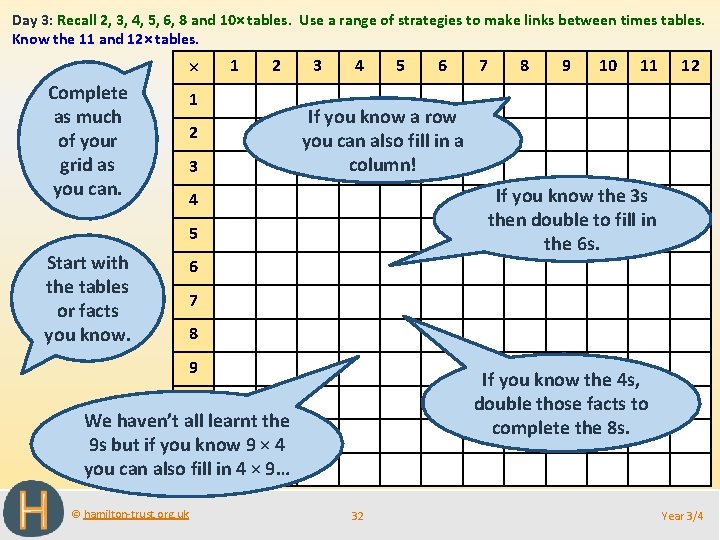
Day 3: Recall 2, 3, 4, 5, 6, 8 and 10× tables. Use a range of strategies to make links between times tables. Know the 11 and 12× tables. × Complete as much of your grid as you can. 1 2 3 3 4 6 7 8 9 10 11 12 If you know a row you can also fill in a column! If you know the 3 s then double to fill in the 6 s. 4 5 Start with the tables or facts you know. 5 6 7 8 9 If you know the 4 s, double those facts to complete the 8 s. 10 We haven’t all learnt the 11 9 s but if you know 9 × 4 you can also 12 fill in 4 × 9… © hamilton-trust. org. uk 32 Year 3/4
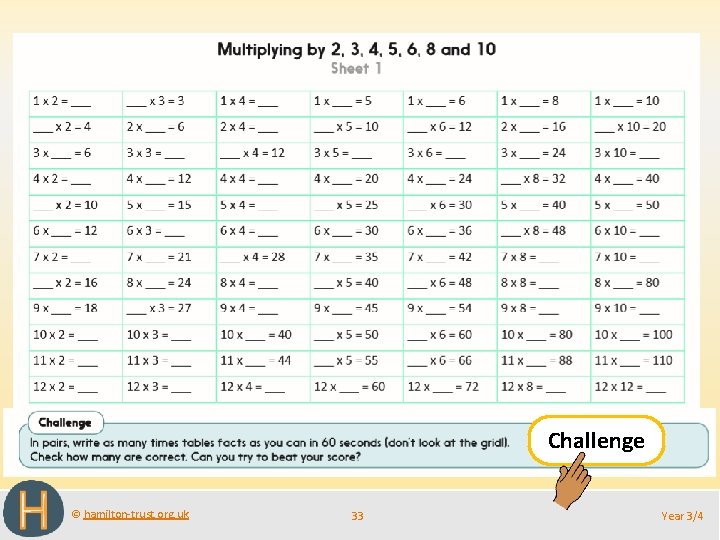
Challenge © hamilton-trust. org. uk 33 Year 3/4
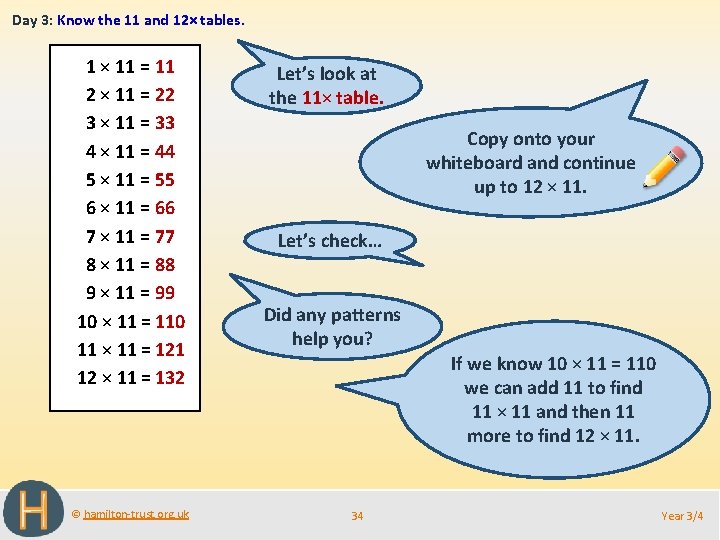
Day 3: Know the 11 and 12× tables. 1 × 11 = 11 2 × 11 = 22 3 × 11 = 33 4 × 11 = 44 5 × 11 = 55 6 × 11 = 66 7 × 11 = 77 8 × 11 = 88 9 × 11 = 99 10 × 11 = 110 11 × 11 = 121 12 × 11 = 132 © hamilton-trust. org. uk Let’s look at the 11× table. Copy onto your whiteboard and continue up to 12 × 11. Let’s check… Did any patterns help you? If we know 10 × 11 = 110 we can add 11 to find 11 × 11 and then 11 more to find 12 × 11. 34 Year 3/4
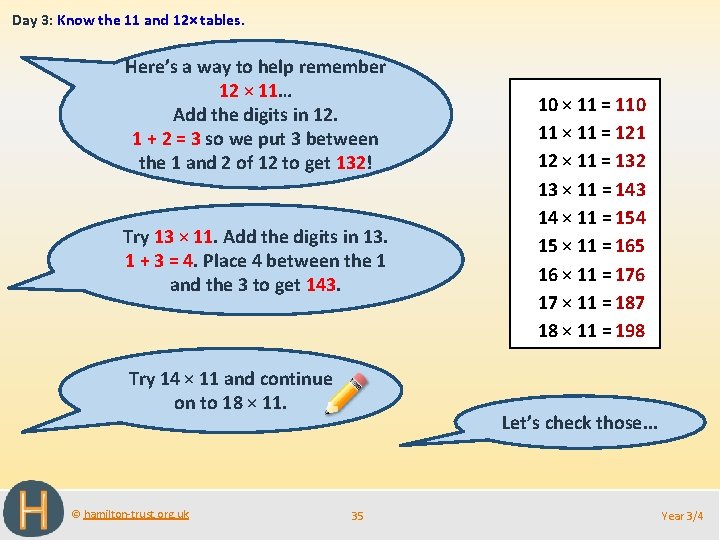
Day 3: Know the 11 and 12× tables. Here’s a way to help remember 12 × 11… Add the digits in 12. 1 + 2 = 3 so we put 3 between the 1 and 2 of 12 to get 132! Try 13 × 11. Add the digits in 13. 1 + 3 = 4. Place 4 between the 1 and the 3 to get 143. Try 14 × 11 and continue on to 18 × 11. © hamilton-trust. org. uk 10 × 11 = 110 11 × 11 = 121 12 × 11 = 132 13 × 11 = 143 14 × 11 = 154 15 × 11 = 165 16 × 11 = 176 17 × 11 = 187 18 × 11 = 198 Let’s check those. . . 35 Year 3/4
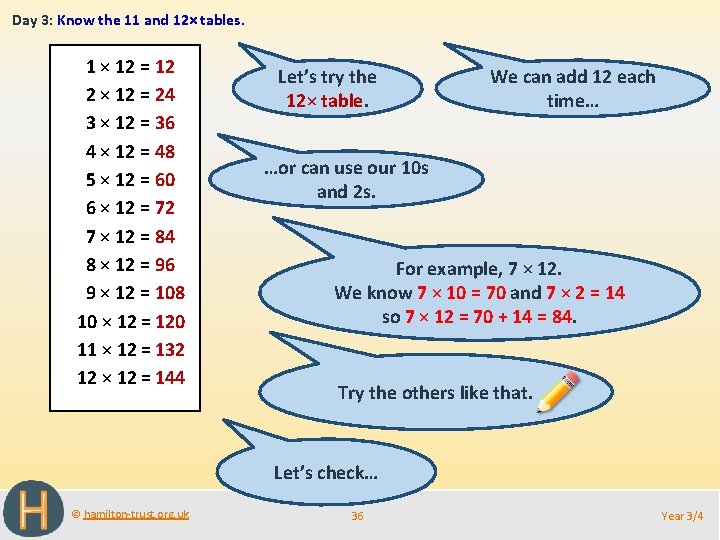
Day 3: Know the 11 and 12× tables. 1 × 12 = 12 2 × 12 = 24 3 × 12 = 36 4 × 12 = 48 5 × 12 = 60 6 × 12 = 72 7 × 12 = 84 8 × 12 = 96 9 × 12 = 108 10 × 12 = 120 11 × 12 = 132 12 × 12 = 144 Let’s try the 12× table. We can add 12 each time… …or can use our 10 s and 2 s. For example, 7 × 12. We know 7 × 10 = 70 and 7 × 2 = 14 so 7 × 12 = 70 + 14 = 84. Try the others like that. Let’s check… © hamilton-trust. org. uk 36 Year 3/4
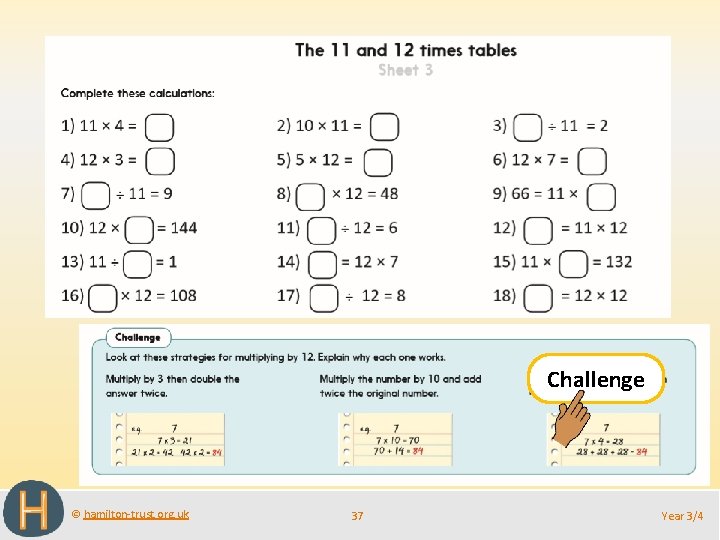
Challenge © hamilton-trust. org. uk 37 Year 3/4
Multiplication and Division Times tables and factors Objectives Day 4 Find factors of numbers up to 40. © hamilton-trust. org. uk 38 Year 3/4
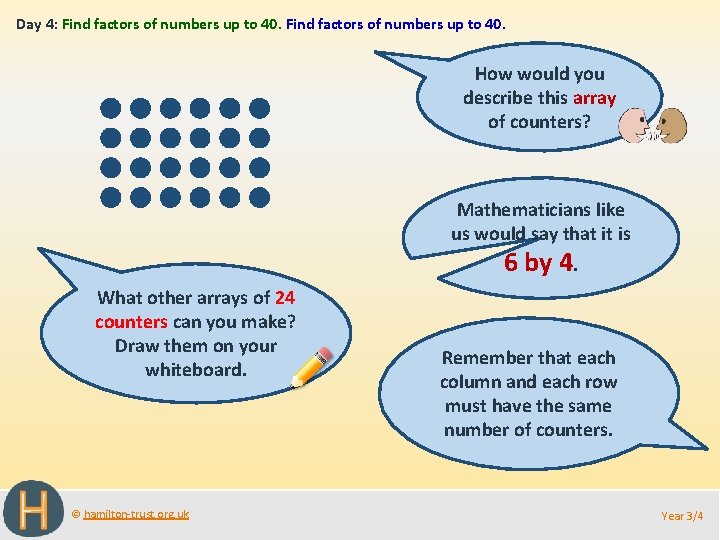
Day 4: Find factors of numbers up to 40. How would you describe this array of counters? Mathematicians like us would say that it is 6 by 4. What other arrays of 24 counters can you make? Draw them on your whiteboard. © hamilton-trust. org. uk Remember that each column and each row must have the same number of counters. Year 3/4
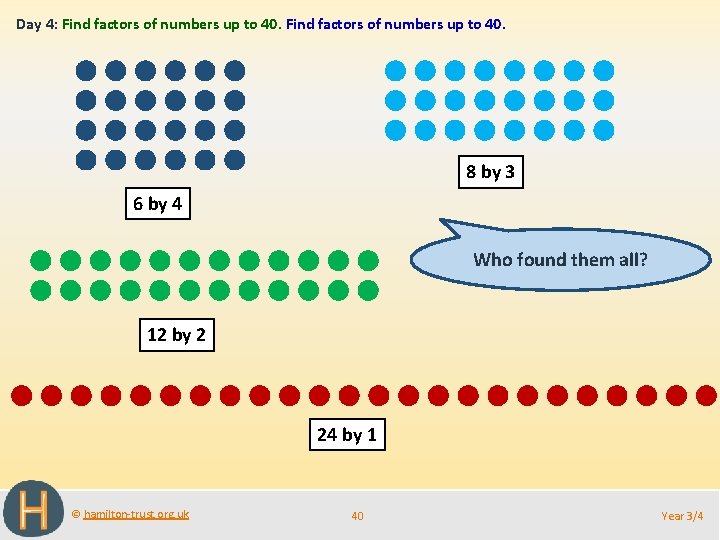
Day 4: Find factors of numbers up to 40. 8 by 3 6 by 4 Who found them all? 12 by 2 24 by 1 © hamilton-trust. org. uk 40 Year 3/4
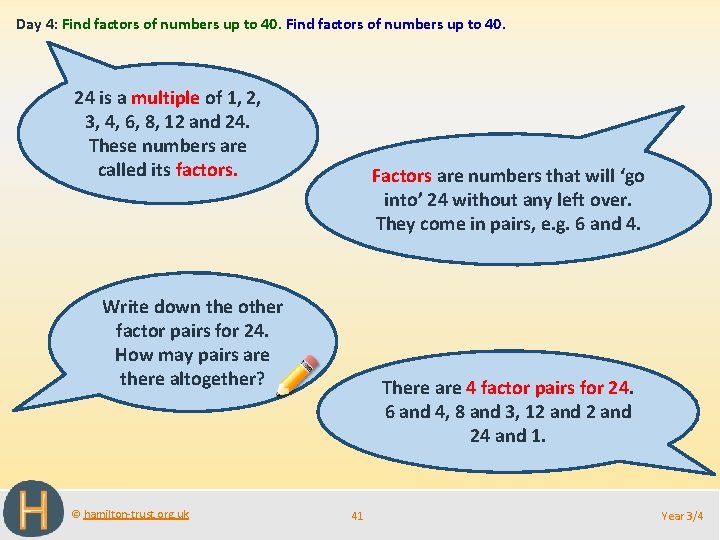
Day 4: Find factors of numbers up to 40. 24 is a multiple of 1, 2, 3, 4, 6, 8, 12 and 24. These numbers are called its factors. Factors are numbers that will ‘go into’ 24 without any left over. They come in pairs, e. g. 6 and 4. Write down the other factor pairs for 24. How may pairs are there altogether? © hamilton-trust. org. uk There are 4 factor pairs for 24. 6 and 4, 8 and 3, 12 and 24 and 1. 41 Year 3/4
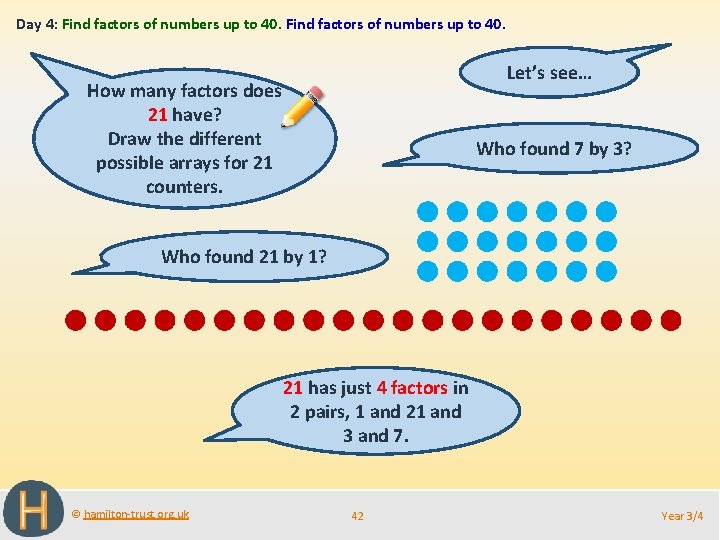
Day 4: Find factors of numbers up to 40. Let’s see… How many factors does 21 have? Draw the different possible arrays for 21 counters. Who found 7 by 3? Who found 21 by 1? 21 has just 4 factors in 2 pairs, 1 and 21 and 3 and 7. © hamilton-trust. org. uk 42 Year 3/4
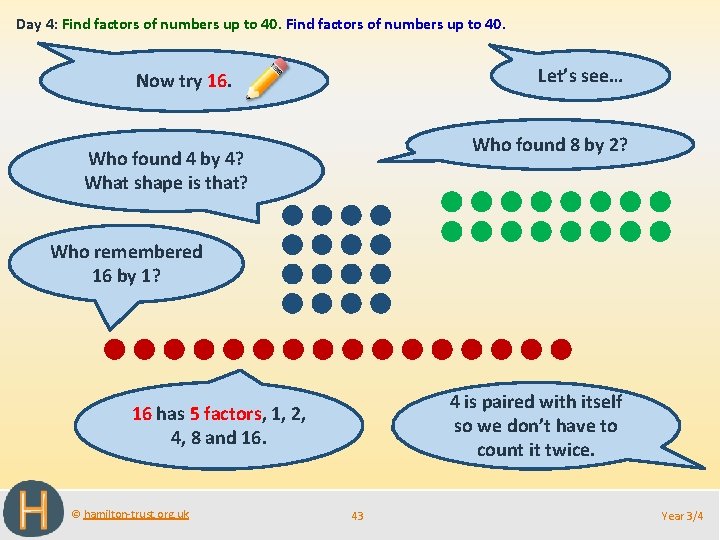
Day 4: Find factors of numbers up to 40. Let’s see… Now try 16. Who found 8 by 2? Who found 4 by 4? What shape is that? Who remembered 16 by 1? 4 is paired with itself so we don’t have to count it twice. 16 has 5 factors, 1, 2, 4, 8 and 16. © hamilton-trust. org. uk 43 Year 3/4
Investigation Use ‘Multiples Grid’ from NRICH: https: //nrich. maths. org/5429 What do the shaded numbers on a 100 square have in common? Children apply knowledge of tables facts and divisibility. © hamilton-trust. org. uk 44
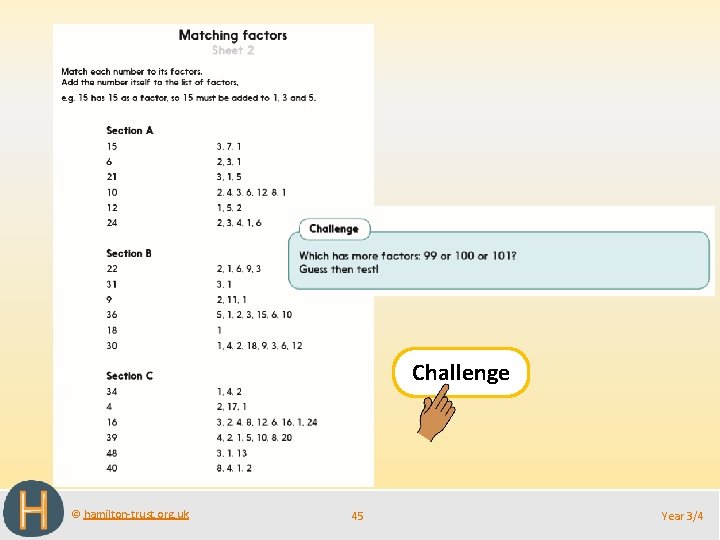
Challenge © hamilton-trust. org. uk 45 Year 3/4
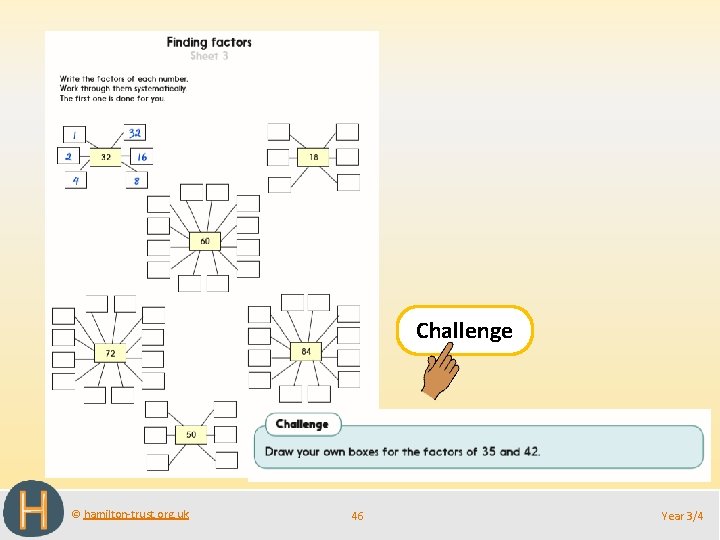
Challenge © hamilton-trust. org. uk 46 Year 3/4
Multiplication and Division Times tables and factors Well Done! You’ve completed this unit. Objectives Day 1 Double the 4 times table to create the 8 times table. Know multiplication and division facts for the 9 times table. Day 2 Double the 3 times table to create the 6 times table. Begin to know multiplication and division facts for the 7 times table. Day 3 Recall 2, 3, 4, 5, 6, 8 and 10 x tables. Use a range of strategies to make links between times tables. Know the 11 and 12 x tables. Day 4 Find factors of numbers up to 40. © hamilton-trust. org. uk 47 Year 3/4
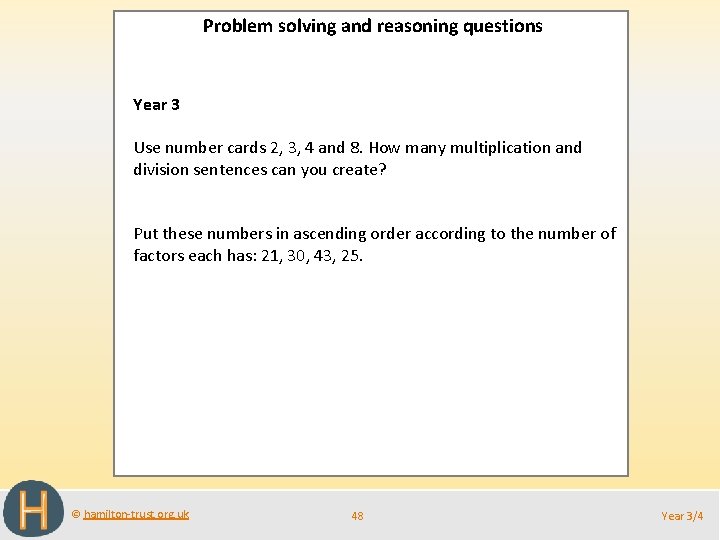
Problem solving and reasoning questions Year 3 Use number cards 2, 3, 4 and 8. How many multiplication and division sentences can you create? Put these numbers in ascending order according to the number of factors each has: 21, 30, 43, 25. © hamilton-trust. org. uk 48 Year 3/4
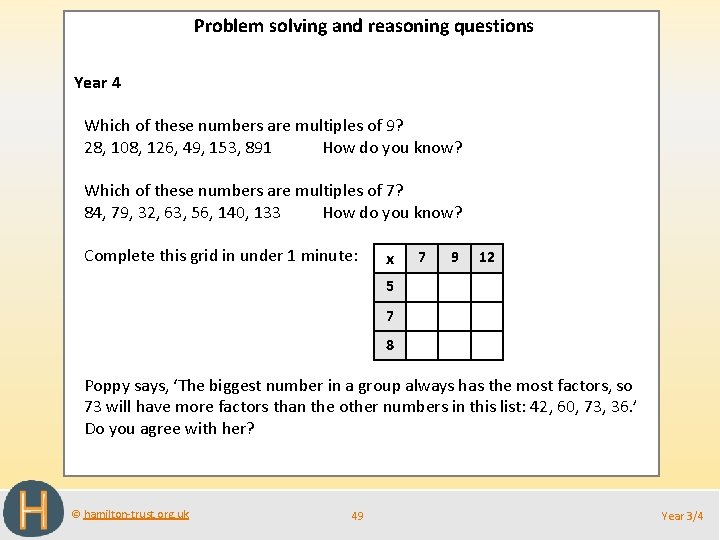
Problem solving and reasoning questions Year 4 Which of these numbers are multiples of 9? 28, 108, 126, 49, 153, 891 How do you know? Which of these numbers are multiples of 7? 84, 79, 32, 63, 56, 140, 133 How do you know? Complete this grid in under 1 minute: x 7 9 12 5 7 8 Poppy says, ‘The biggest number in a group always has the most factors, so 73 will have more factors than the other numbers in this list: 42, 60, 73, 36. ’ Do you agree with her? © hamilton-trust. org. uk 49 Year 3/4
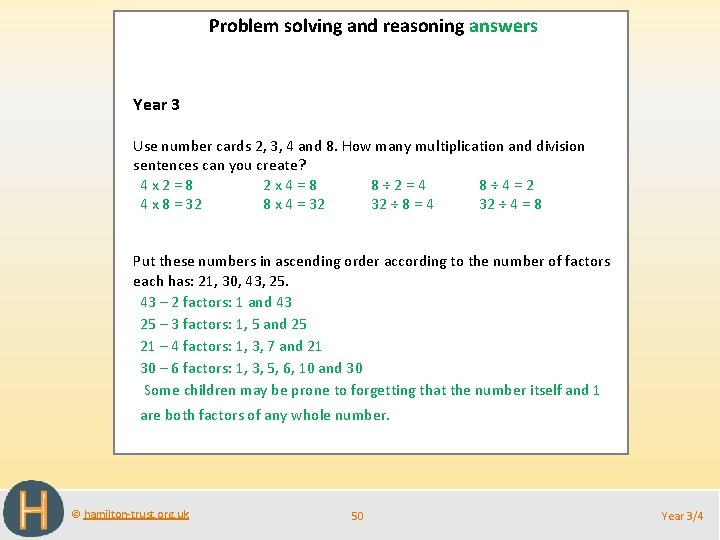
Problem solving and reasoning answers Year 3 Use number cards 2, 3, 4 and 8. How many multiplication and division sentences can you create? 4 x 2=8 2 x 4=8 8÷ 2=4 8÷ 4=2 4 x 8 = 32 8 x 4 = 32 32 ÷ 8 = 4 32 ÷ 4 = 8 Put these numbers in ascending order according to the number of factors each has: 21, 30, 43, 25. 43 – 2 factors: 1 and 43 25 – 3 factors: 1, 5 and 25 21 – 4 factors: 1, 3, 7 and 21 30 – 6 factors: 1, 3, 5, 6, 10 and 30 Some children may be prone to forgetting that the number itself and 1 are both factors of any whole number. © hamilton-trust. org. uk 50 Year 3/4
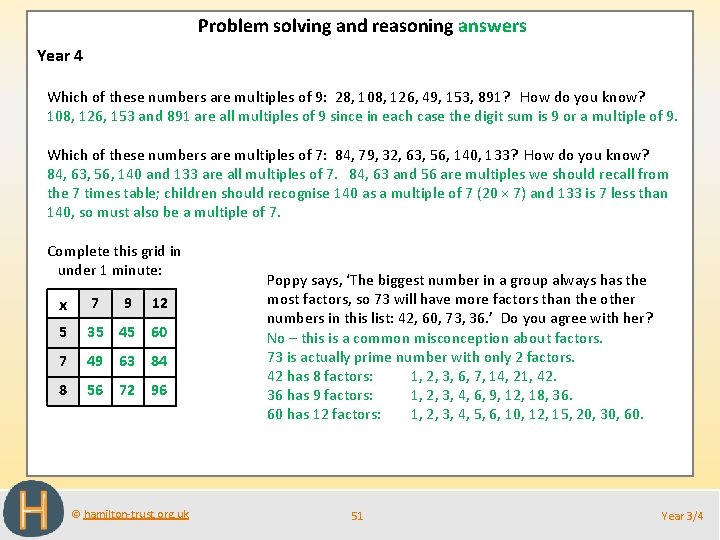
Problem solving and reasoning answers Year 4 Which of these numbers are multiples of 9: 28, 108, 126, 49, 153, 891? How do you know? 108, 126, 153 and 891 are all multiples of 9 since in each case the digit sum is 9 or a multiple of 9. Which of these numbers are multiples of 7: 84, 79, 32, 63, 56, 140, 133? How do you know? 84, 63, 56, 140 and 133 are all multiples of 7. 84, 63 and 56 are multiples we should recall from the 7 times table; children should recognise 140 as a multiple of 7 (20 × 7) and 133 is 7 less than 140, so must also be a multiple of 7. Complete this grid in under 1 minute: x 7 9 12 5 35 45 60 7 49 63 84 8 56 72 96 © hamilton-trust. org. uk Poppy says, ‘The biggest number in a group always has the most factors, so 73 will have more factors than the other numbers in this list: 42, 60, 73, 36. ’ Do you agree with her? No – this is a common misconception about factors. 73 is actually prime number with only 2 factors. 42 has 8 factors: 1, 2, 3, 6, 7, 14, 21, 42. 36 has 9 factors: 1, 2, 3, 4, 6, 9, 12, 18, 36. 60 has 12 factors: 1, 2, 3, 4, 5, 6, 10, 12, 15, 20, 30, 60. 51 Year 3/4
- Slides: 51