
Multiplication and Division Revision of 2 x 5
- Slides: 27
Multiplication and Division Revision of 2 x, 5 x and 10 x tables: x and ÷ Objectives Day 1 Revise the 5 x times table, including division facts. Understand commutativity. Day 2 Revise the 2 x times table, focusing on division facts. Understand the inverse relation between division and multiplication. Day 3 Revise and know the 2 x, 5 x and 10 x times tables, including division facts. Understand the language of multiples of a number, e. g. multiples of 10. © hamilton-trust. org. uk 1 Year 3
Multiplication and Division Revision of 2 x, 5 x and 10 x tables: x and ÷ Starters Suggested for Day 1 Count in 5 s and 10 s to at least 100 (simmering skills) Day 2 Count in 2 s (pre-requisite skills) Day 3 2, 5 and 10 times tables (pre-requisite skills) © hamilton-trust. org. uk 2 Year 3
Multiplication and Division Revision of 2 x, 5 x and 10 x tables: x and ÷ Starter Count in 5 s and 10 s to at least 100 © hamilton-trust. org. uk 3 Year 3
Multiplication and Division Revision of 2 x, 5 x and 10 x tables: x and ÷ Starter Count in 2 s © hamilton-trust. org. uk 4 Year 3
Multiplication and Division Revision of 2 x, 5 x and 10 x tables: x and ÷ Starter 2, 5 and 10 times tables © hamilton-trust. org. uk 5 Year 3
Multiplication and Division Revision of 2 x, 5 x and 10 x tables: x and ÷ Objectives Day 1 Revise the 5 x times table, including division facts. Understand commutativity. © hamilton-trust. org. uk 6 Year 3
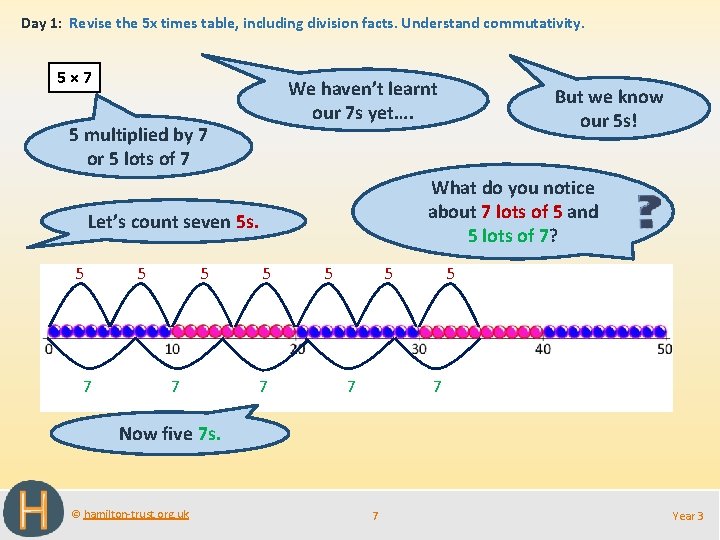
Day 1: Revise the 5 x times table, including division facts. Understand commutativity. 5× 7 We haven’t learnt our 7 s yet…. 5 multiplied by 7 or 5 lots of 7 What do you notice about 7 lots of 5 and 5 lots of 7? Let’s count seven 5 s. 5 7 5 5 7 But we know our 5 s! 5 7 5 7 Now five 7 s. © hamilton-trust. org. uk 7 Year 3
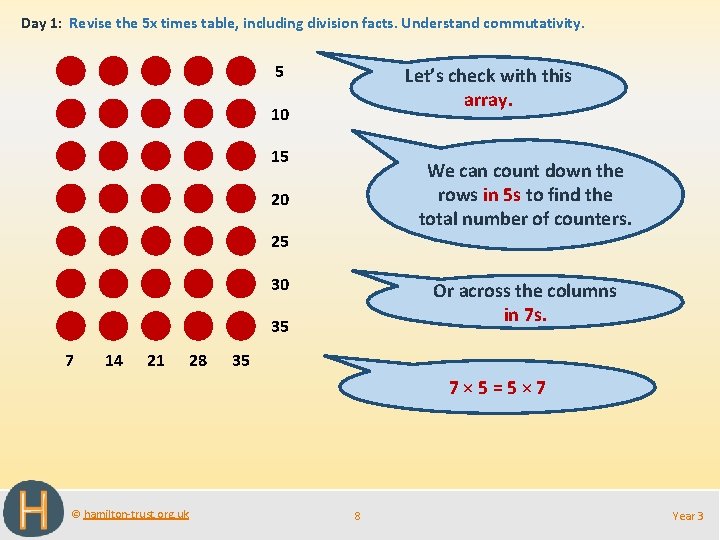
Day 1: Revise the 5 x times table, including division facts. Understand commutativity. 5 Let’s check with this array. 10 15 We can count down the rows in 5 s to find the total number of counters. 20 25 30 Or across the columns in 7 s. 35 7 14 21 28 35 7× 5=5× 7 © hamilton-trust. org. uk 8 Year 3
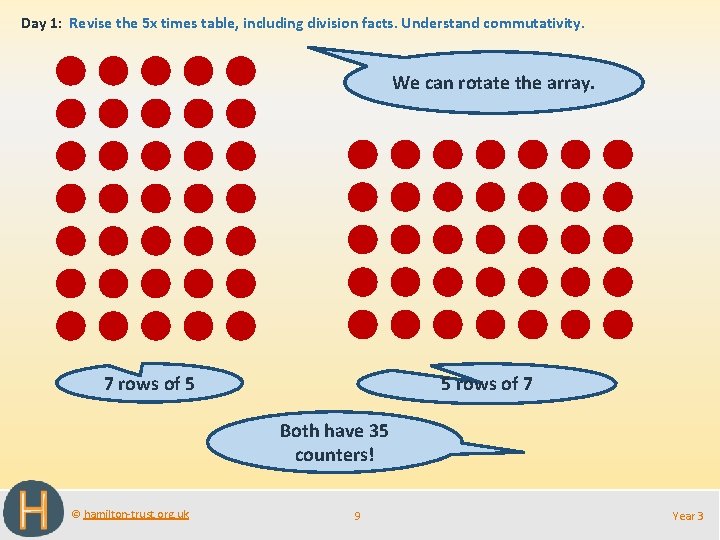
Day 1: Revise the 5 x times table, including division facts. Understand commutativity. We can rotate the array. 7 rows of 5 5 rows of 7 Both have 35 counters! © hamilton-trust. org. uk 9 Year 3
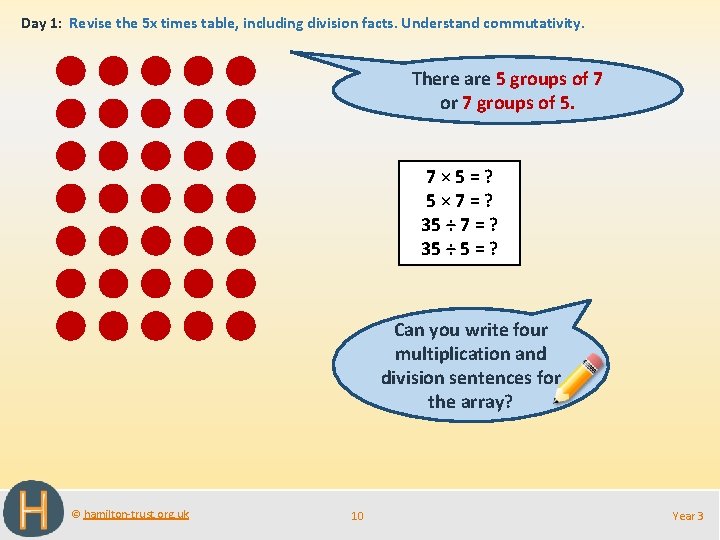
Day 1: Revise the 5 x times table, including division facts. Understand commutativity. There are 5 groups of 7 or 7 groups of 5. 7× 5=? 5× 7=? 35 ÷ 7 = ? 35 ÷ 5 = ? Can you write four multiplication and division sentences for the array? © hamilton-trust. org. uk 10 Year 3
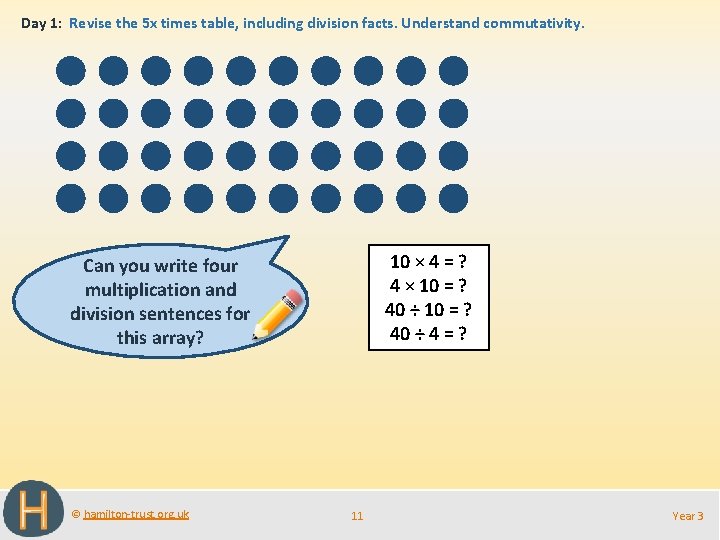
Day 1: Revise the 5 x times table, including division facts. Understand commutativity. 10 × 4 = ? 4 × 10 = ? 40 ÷ 4 = ? Can you write four multiplication and division sentences for this array? © hamilton-trust. org. uk 11 Year 3
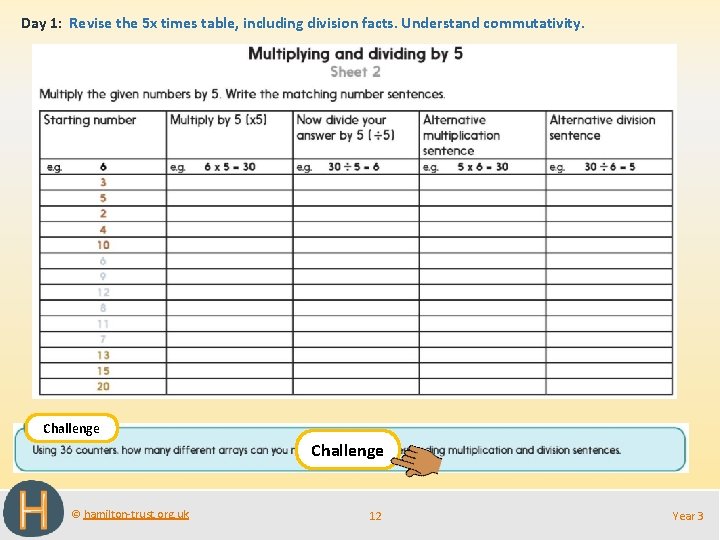
Day 1: Revise the 5 x times table, including division facts. Understand commutativity. Challenge © hamilton-trust. org. uk 12 Year 3
Multiplication and Division Revision of 2 x, 5 x and 10 x tables: x and ÷ Objectives Day 2 Revise the 2 x times table, focusing on division facts. Understand the inverse relation between division and multiplication. © hamilton-trust. org. uk 13 Year 3
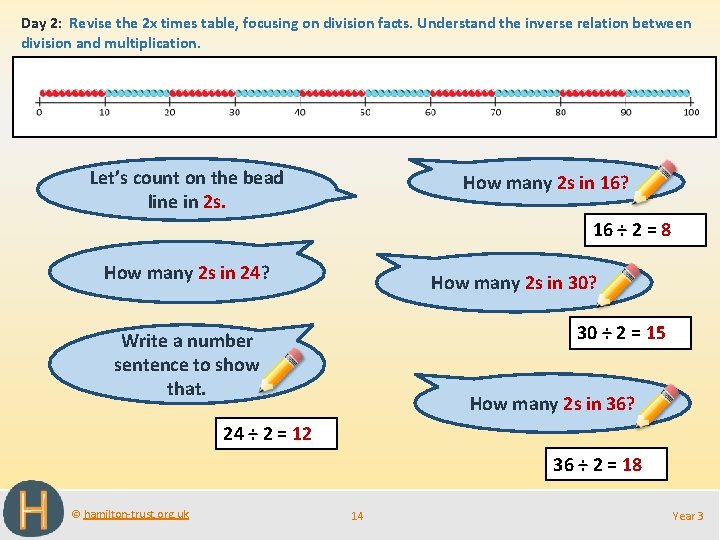
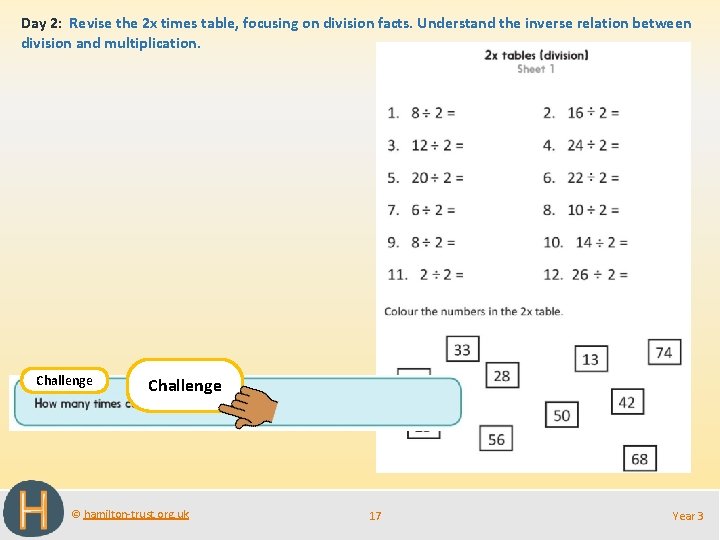
Day 2: Revise the 2 x times table, focusing on division facts. Understand the inverse relation between division and multiplication. Let’s count on the bead line in 2 s. How many 2 s in 16? 16 ÷ 2 = 8 How many 2 s in 24? How many 2 s in 30? 30 ÷ 2 = 15 Write a number sentence to show that. How many 2 s in 36? 24 ÷ 2 = 12 36 ÷ 2 = 18 © hamilton-trust. org. uk 14 Year 3
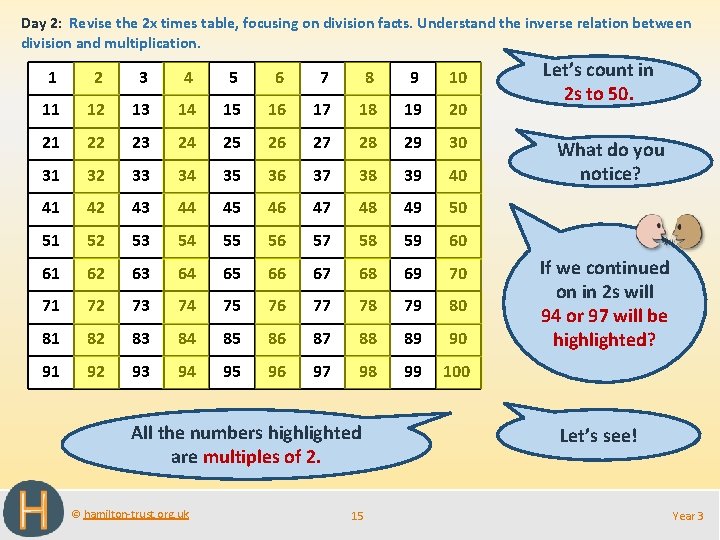
Day 2: Revise the 2 x times table, focusing on division facts. Understand the inverse relation between division and multiplication. 1 2 3 4 5 6 7 8 9 10 11 12 13 14 15 16 17 18 19 20 21 22 23 24 25 26 27 28 29 30 31 32 33 34 35 36 37 38 39 40 41 42 43 44 45 46 47 48 49 50 51 52 53 54 55 56 57 58 59 60 61 62 63 64 65 66 67 68 69 70 71 72 73 74 75 76 77 78 79 80 81 82 83 84 85 86 87 88 89 90 91 92 93 94 95 96 97 98 99 100 All the numbers highlighted are multiples of 2. © hamilton-trust. org. uk 15 Let’s count in 2 s to 50. What do you notice? If we continued on in 2 s will 94 or 97 will be highlighted? Let’s see! Year 3
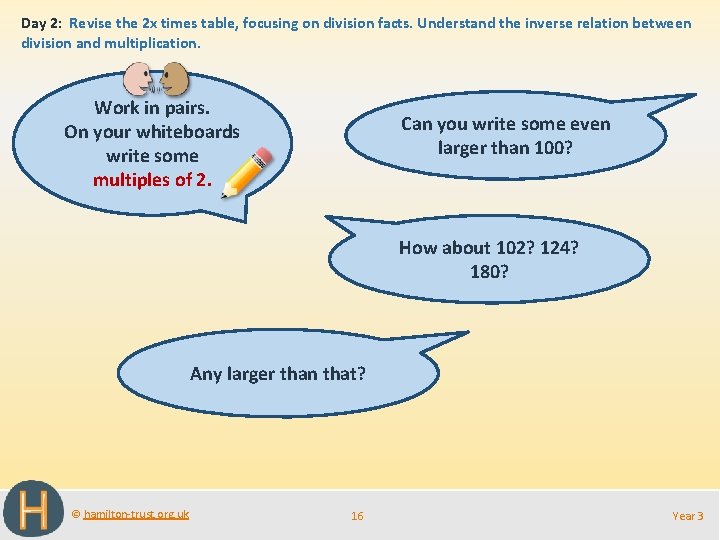
Day 2: Revise the 2 x times table, focusing on division facts. Understand the inverse relation between division and multiplication. Work in pairs. On your whiteboards write some multiples of 2. Can you write some even larger than 100? How about 102? 124? 180? Any larger than that? © hamilton-trust. org. uk 16 Year 3
Day 2: Revise the 2 x times table, focusing on division facts. Understand the inverse relation between division and multiplication. Challenge © hamilton-trust. org. uk 17 Year 3
Multiplication and Division Revision of 2 x, 5 x and 10 x tables: x and ÷ Objectives Day 3 Revise and know the 2 x, 5 x and 10 x times tables, including division facts. Understand the language of multiples of a number, e. g. multiples of 10. © hamilton-trust. org. uk 18 Year 3
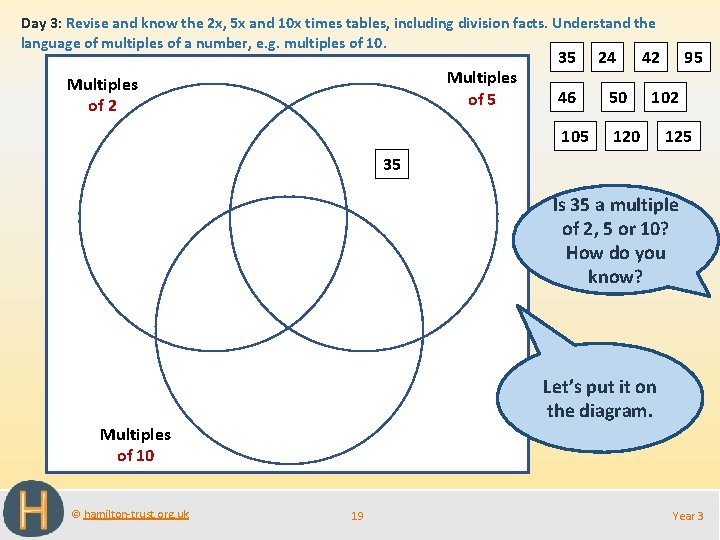
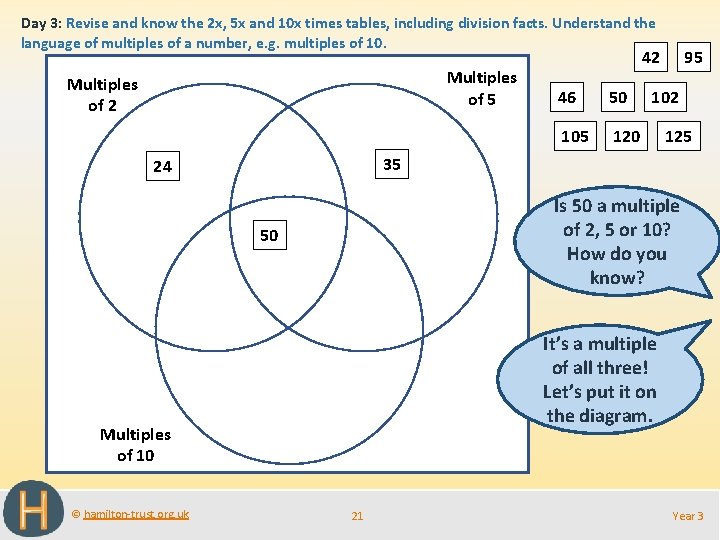
Day 3: Revise and know the 2 x, 5 x and 10 x times tables, including division facts. Understand the language of multiples of a number, e. g. multiples of 10. Multiples of 5 Multiples of 2 35 24 46 50 105 120 42 95 102 125 35 Is 35 a multiple of 2, 5 or 10? How do you know? Let’s put it on the diagram. Multiples of 10 © hamilton-trust. org. uk 19 Year 3
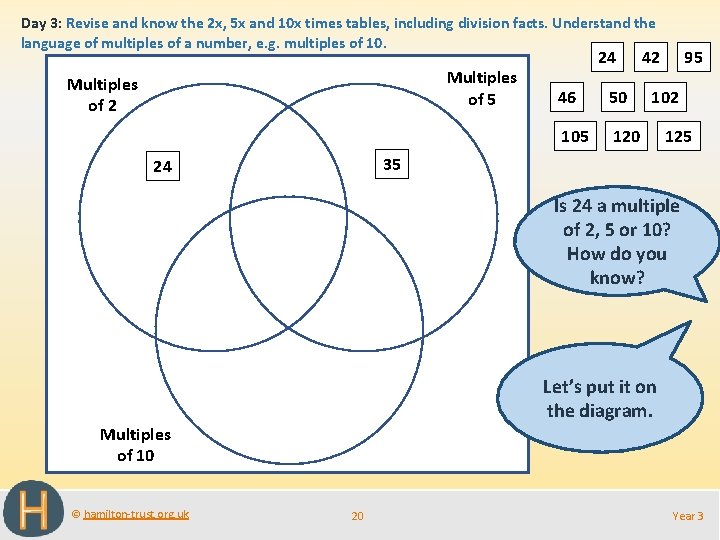
Day 3: Revise and know the 2 x, 5 x and 10 x times tables, including division facts. Understand the language of multiples of a number, e. g. multiples of 10. Multiples of 5 Multiples of 2 24 46 50 105 120 42 95 102 125 35 24 Is 24 a multiple of 2, 5 or 10? How do you know? Let’s put it on the diagram. Multiples of 10 © hamilton-trust. org. uk 20 Year 3
Day 3: Revise and know the 2 x, 5 x and 10 x times tables, including division facts. Understand the language of multiples of a number, e. g. multiples of 10. Multiples of 5 Multiples of 2 46 50 105 120 95 102 125 35 24 Is 50 a multiple of 2, 5 or 10? How do you know? 50 It’s a multiple of all three! Let’s put it on the diagram. Multiples of 10 © hamilton-trust. org. uk 42 21 Year 3
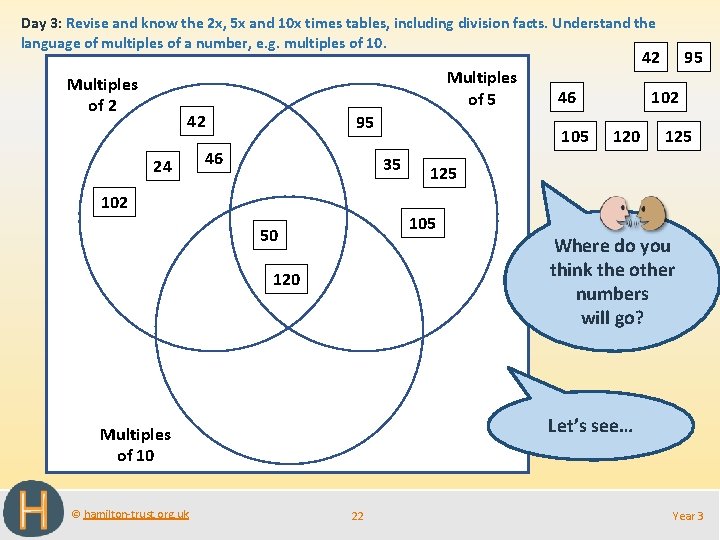
Day 3: Revise and know the 2 x, 5 x and 10 x times tables, including division facts. Understand the language of multiples of a number, e. g. multiples of 10. Multiples of 5 Multiples of 2 42 24 95 46 120 102 120 125 Where do you think the other numbers will go? Let’s see… Multiples of 10 © hamilton-trust. org. uk 95 125 105 50 46 105 35 102 42 22 Year 3
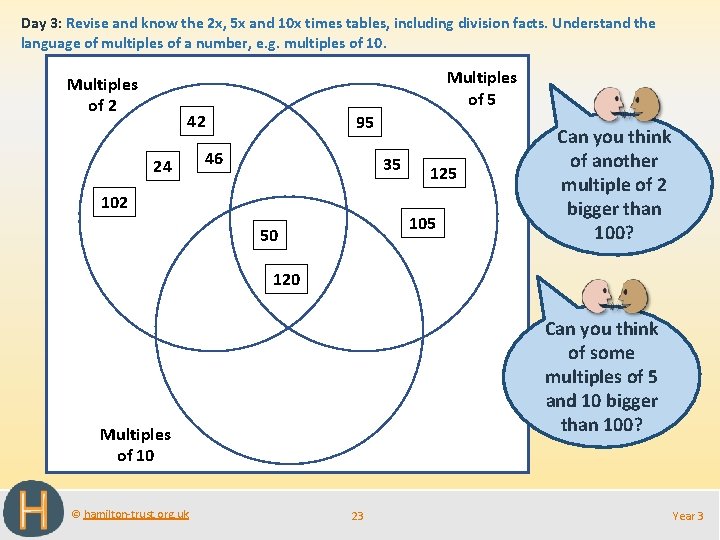
Day 3: Revise and know the 2 x, 5 x and 10 x times tables, including division facts. Understand the language of multiples of a number, e. g. multiples of 10. Multiples of 5 Multiples of 2 42 24 95 46 35 102 125 105 50 Can you think of another multiple of 2 bigger than 100? 120 Can you think of some multiples of 5 and 10 bigger than 100? Multiples of 10 © hamilton-trust. org. uk 23 Year 3
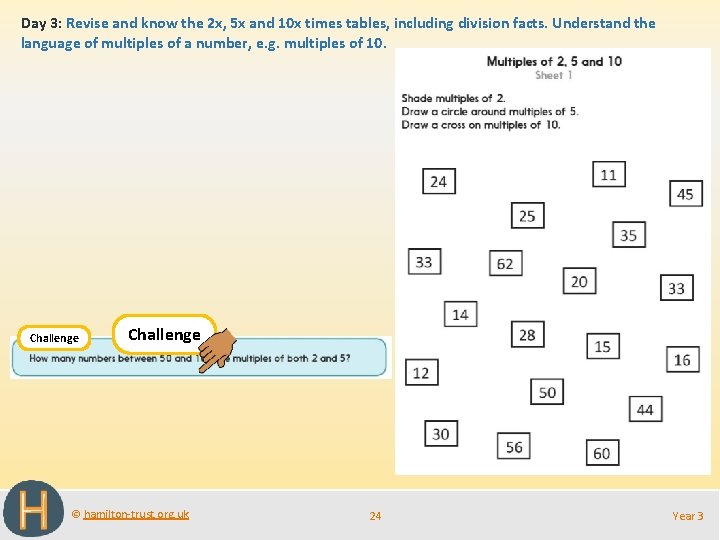
Day 3: Revise and know the 2 x, 5 x and 10 x times tables, including division facts. Understand the language of multiples of a number, e. g. multiples of 10. Challenge © hamilton-trust. org. uk 24 Year 3
Multiplication and Division Revision of 2 x, 5 x and 10 x tables: x and ÷ Well Done! You’ve completed this unit. Objectives Day 1 Revise the 5 x times table, including division facts. Understand commutativity. Day 2 Revise the 2 x times table, focusing on division facts. Understand the inverse relation between division and multiplication. Day 3 Revise and know the 2 x, 5 x and 10 x times tables, including division facts. Understand the language of multiples of a number, e. g. multiples of 10. © hamilton-trust. org. uk 25 Year 3
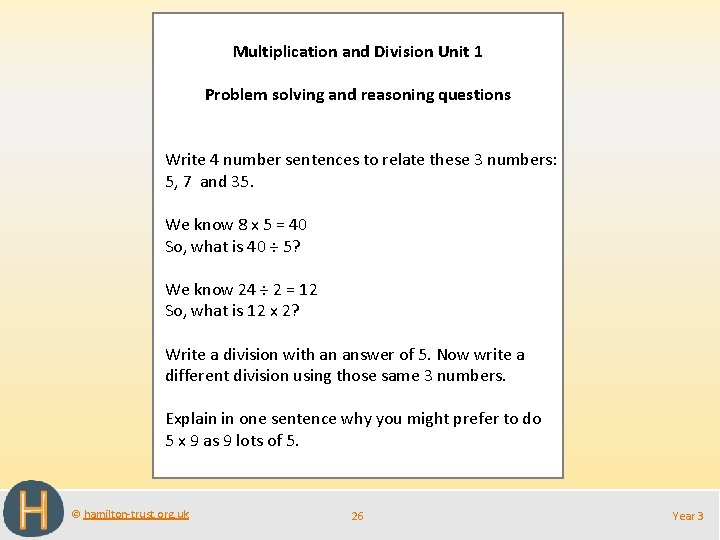
Multiplication and Division Unit 1 Problem solving and reasoning questions Write 4 number sentences to relate these 3 numbers: 5, 7 and 35. We know 8 x 5 = 40 So, what is 40 ÷ 5? We know 24 ÷ 2 = 12 So, what is 12 x 2? Write a division with an answer of 5. Now write a different division using those same 3 numbers. Explain in one sentence why you might prefer to do 5 x 9 as 9 lots of 5. © hamilton-trust. org. uk 26 Year 3
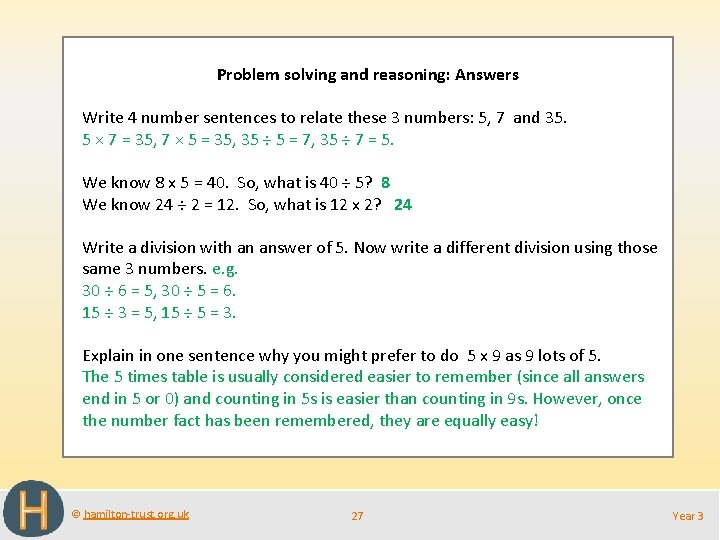
Problem solving and reasoning: Answers Write 4 number sentences to relate these 3 numbers: 5, 7 and 35. 5 × 7 = 35, 7 × 5 = 35, 35 ÷ 5 = 7, 35 ÷ 7 = 5. We know 8 x 5 = 40. So, what is 40 ÷ 5? 8 We know 24 ÷ 2 = 12. So, what is 12 x 2? 24 Write a division with an answer of 5. Now write a different division using those same 3 numbers. e. g. 30 ÷ 6 = 5, 30 ÷ 5 = 6. 15 ÷ 3 = 5, 15 ÷ 5 = 3. Explain in one sentence why you might prefer to do 5 x 9 as 9 lots of 5. The 5 times table is usually considered easier to remember (since all answers end in 5 or 0) and counting in 5 s is easier than counting in 9 s. However, once the number fact has been remembered, they are equally easy! © hamilton-trust. org. uk 27 Year 3