
Multiple UAV Collision Avoidance with Realistic UAV Models


- Slides: 15
Multiple UAV Collision Avoidance with Realistic UAV Models Joel George and Debasish Ghose Guidance, Control, and Decision Systems Laboratory (GCDSL) Department of Aerospace Engineering, Indian Institute of Science, Bangalore India 560012.
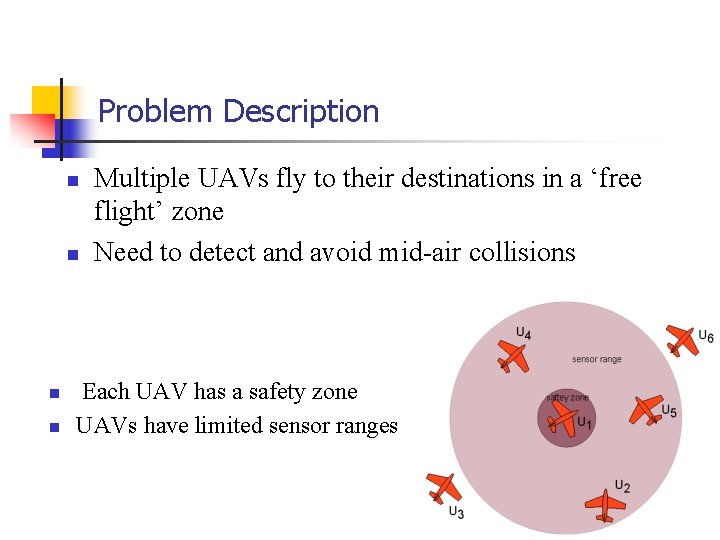
Problem Description n n Multiple UAVs fly to their destinations in a ‘free flight’ zone Need to detect and avoid mid-air collisions Each UAV has a safety zone UAVs have limited sensor ranges
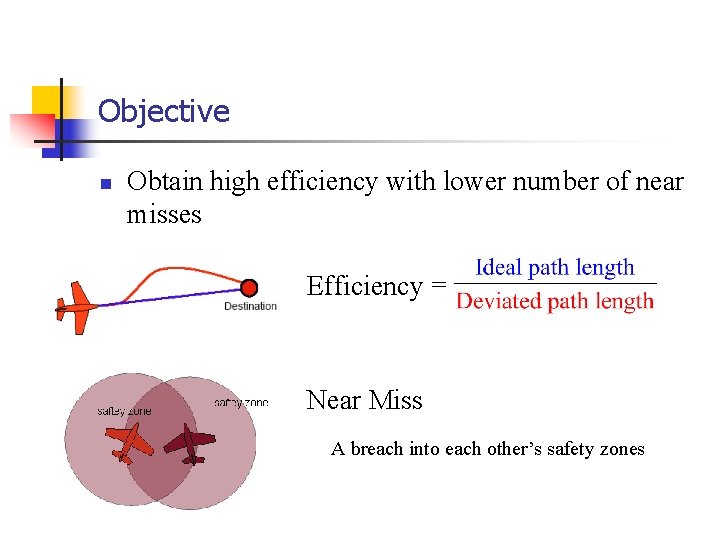
Objective n Obtain high efficiency with lower number of near misses Efficiency = Near Miss A breach into each other’s safety zones
Assumptions n n Positions and velocities of other UAVs within the sensor range are known 6 Degree of Freedom UAV model
Solution approach n Multiple UAV collision avoidance by handling pair wise conflict Thesis When a UAV encounters multiple conflicts, it does a maneuver to avoid a near miss with the ‘most threatful’ neighbor. Every UAV doing so, in a multiple UAV conflict scenario, will result in a high efficiency with lower number of near misses.
Solution approach (continued) Deciding the ‘most threatful’ neighbor and the desired collision avoidance maneuver Most threatful neighbor (of a UAV U): A UAV in the sensor range of U with which U has a projected near miss and the least time-to-go for that near miss to occur. Collision avoidance maneuver: Turn in a direction that will increase the Line-of-Sight (LOS) rate between the UAVs.
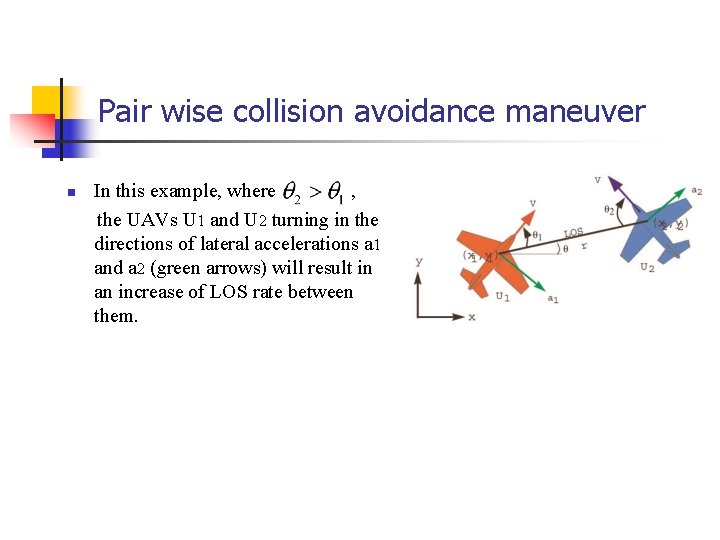
Pair wise collision avoidance maneuver n In this example, where , the UAVs U 1 and U 2 turning in the directions of lateral accelerations a 1 and a 2 (green arrows) will result in an increase of LOS rate between them.
Realistic UAV Model n n UAV of span 1. 4224 m, weighing 1. 56 kg Stability and control derivatives from Aviones A UAV flight simulator developed by the Brigham Young University (an open source software) Available: http: //aviones. sourceforge. net/
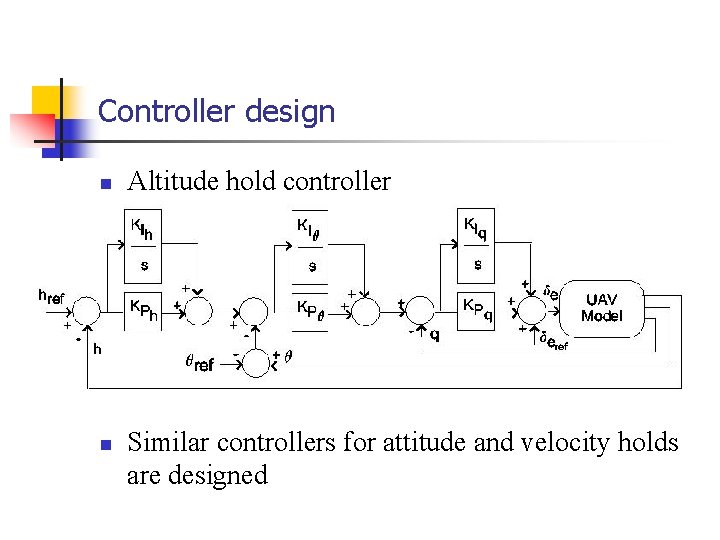
Controller design n Controllers designed through successive loop closure Separate controllers for holding altitude, attitude, and velocity PI controllers with parameters tuned manually
Controller design n n Altitude hold controller Similar controllers for attitude and velocity holds are designed
Controller response Response of UAV model (with controller) to a 3 -2 -1 -1 bank angle command The plots of system state response: bank angle ( ), height (h), and velocity (V), and the control demands: aileron deflection ( ), elevator deflection ( ), and throttle ( ). Demanded bank angle is shown in dotted lines.
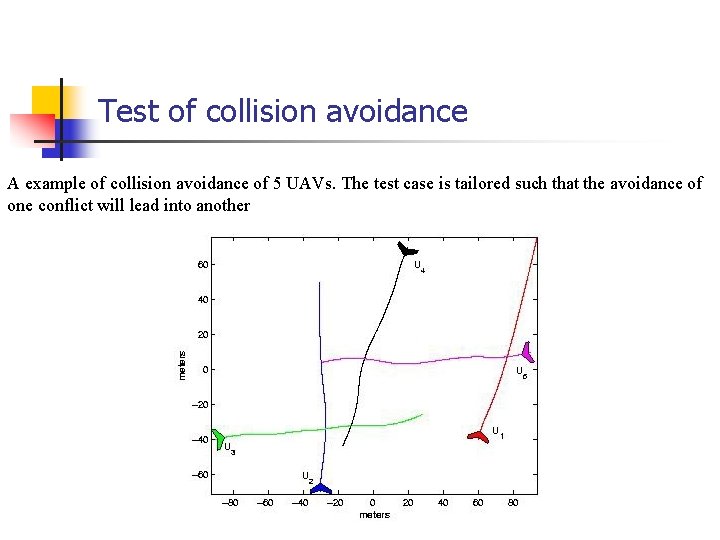
Test of collision avoidance A example of collision avoidance of 5 UAVs. The test case is tailored such that the avoidance of one conflict will lead into another
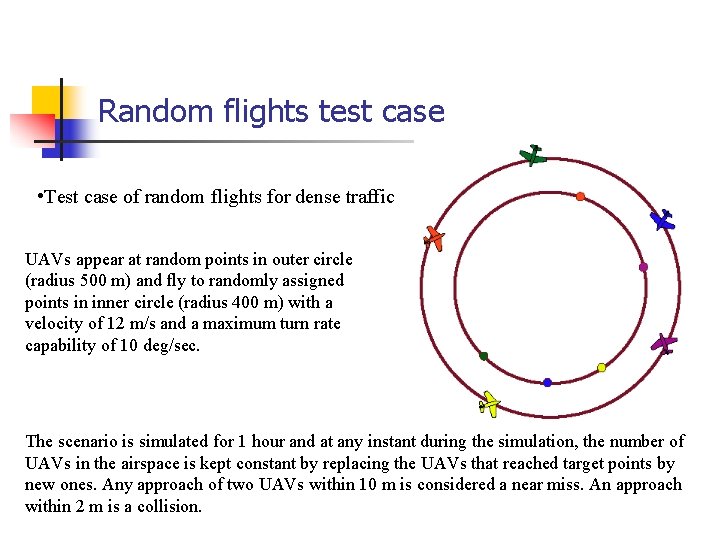
Random flights test case • Test case of random flights for dense traffic UAVs appear at random points in outer circle (radius 500 m) and fly to randomly assigned points in inner circle (radius 400 m) with a velocity of 12 m/s and a maximum turn rate capability of 10 deg/sec. The scenario is simulated for 1 hour and at any instant during the simulation, the number of UAVs in the airspace is kept constant by replacing the UAVs that reached target points by new ones. Any approach of two UAVs within 10 m is considered a near miss. An approach within 2 m is a collision.
Results of the random flight test case No. of UAVs 20 40 60 without collision avoidance with collision avoidance Near Misses Efficiency 218. 1 899. 1 2027. 9 100 100 0. 1 1. 6 1. 4 96. 15 89. 17 89. 11
Summary n n Gave a collision avoidance algorithm, for multiple UAV scenarios, that gives a good performance – low near misses and high efficiency Designed PI controllers for a realistic UAV model using successive loop closure Tested the collision avoidance algorithm on this realistic UAV model augmented with the designed controller Results showed a good performance of the algorithm