
Multiple Sequences Alignment KaLok Ng Dept of Bioinformatics

Multiple Sequences Alignment Ka-Lok Ng Dept. of Bioinformatics Asia University
Outline • • • Multiple sequence alignment (MSA) Progressive Alignment Profile Progressive Alignment (Clustal. W) Scoring Multiple Alignments Entropy Sum of Pairs Alignment

Multiple versus Alignment • Up until Alignment now we have only tried. Pairwise to align two sequences. • What about more than two? And what for? • A faint similarity between two sequences becomes significant if present in many • Multiple alignments can reveal subtle similarities that pairwise alignments do not reveal
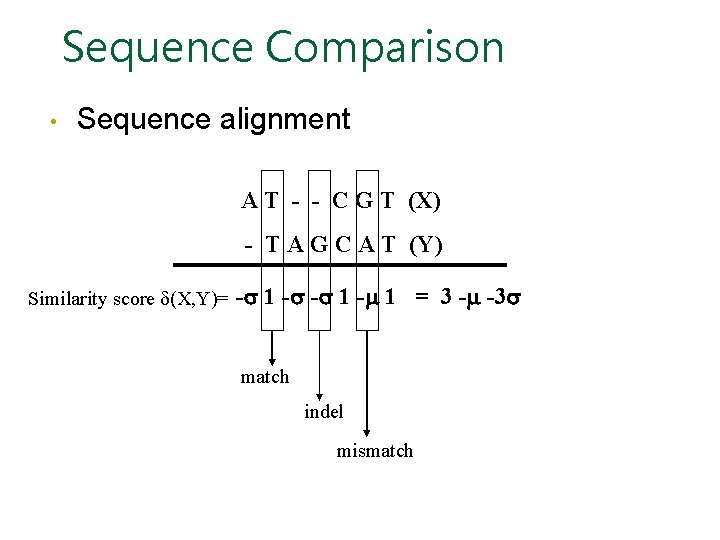
Sequence Comparison • Sequence alignment A T - - C G T (X) - T A G C A T (Y) Similarity score (X, Y)= - 1 - 1 = 3 - -3 match indel mismatch
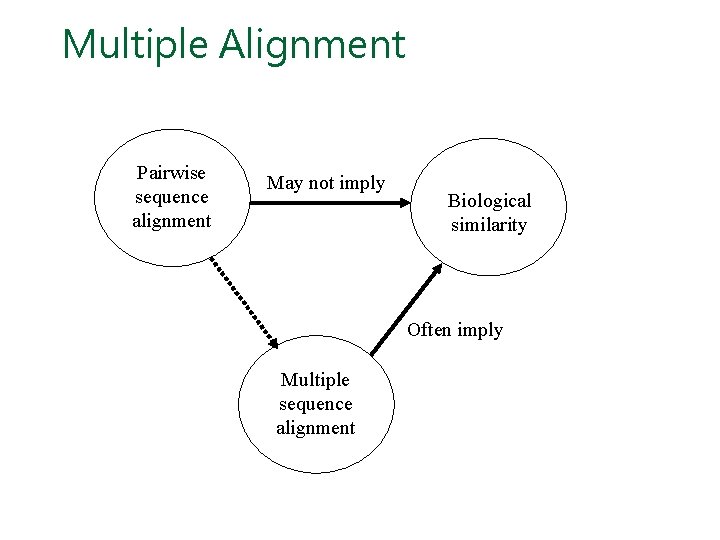
Multiple Alignment Pairwise sequence alignment May not imply Biological similarity Often imply Multiple sequence alignment
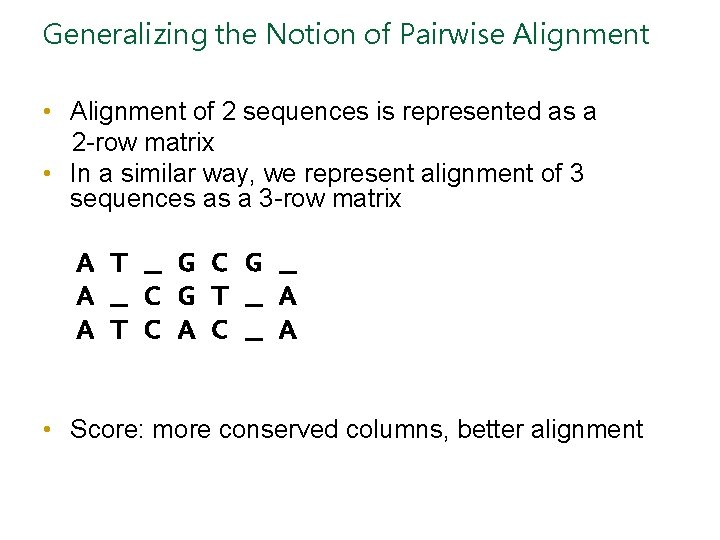
Generalizing the Notion of Pairwise Alignment • Alignment of 2 sequences is represented as a 2 -row matrix • In a similar way, we represent alignment of 3 sequences as a 3 -row matrix A T _ G C G _ A _ C G T _ A A T C A C _ A • Score: more conserved columns, better alignment
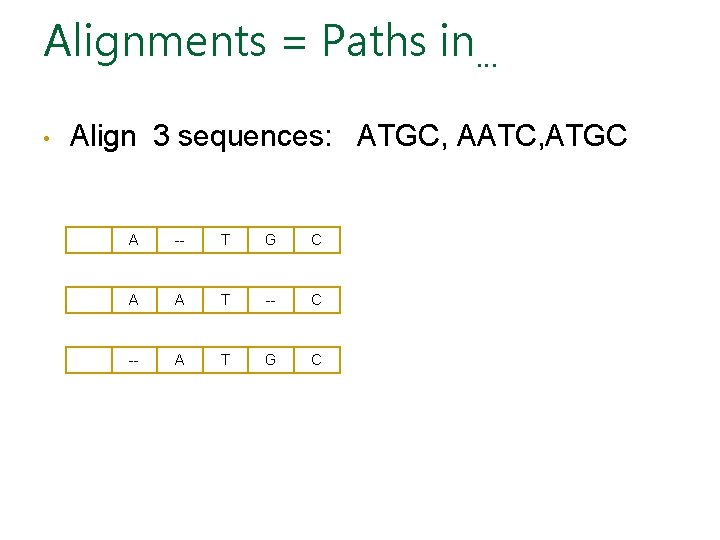
Alignments = Paths in… • Align 3 sequences: ATGC, AATC, ATGC A -- T G C A A T -- C -- A T G C
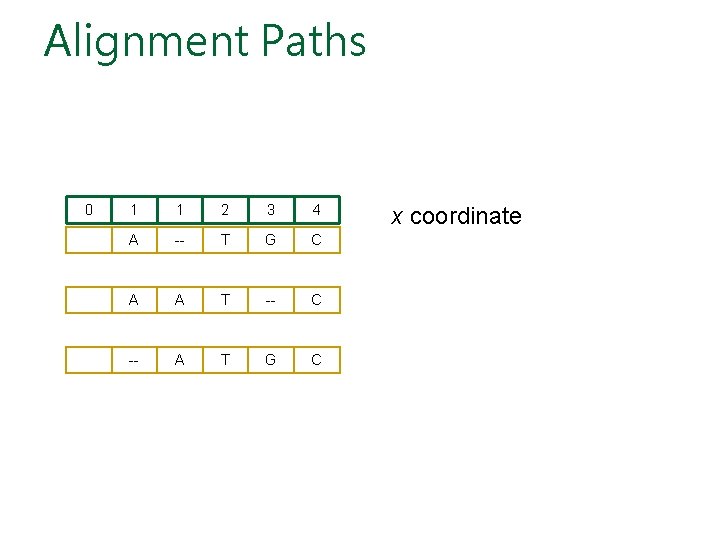
Alignment Paths 0 1 1 2 3 4 A -- T G C A A T -- C -- A T G C x coordinate
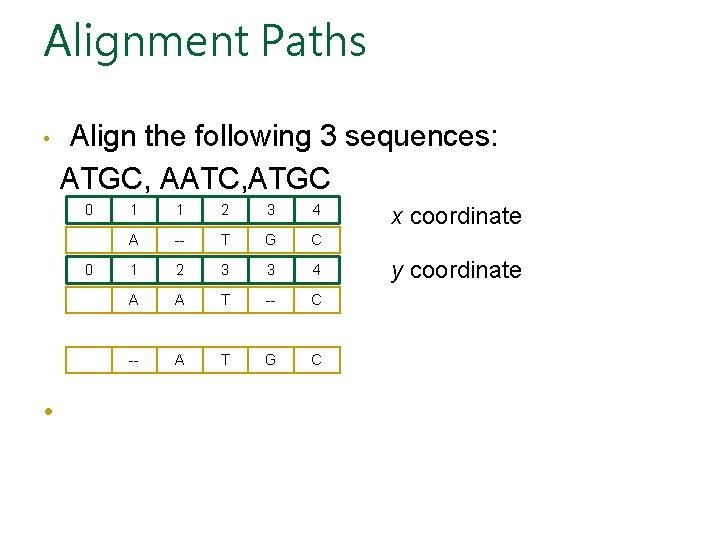
Alignment Paths • Align the following 3 sequences: ATGC, AATC, ATGC 0 0 • 1 1 2 3 4 A -- T G C 1 2 3 3 4 A A T -- C -- A T G C x coordinate y coordinate
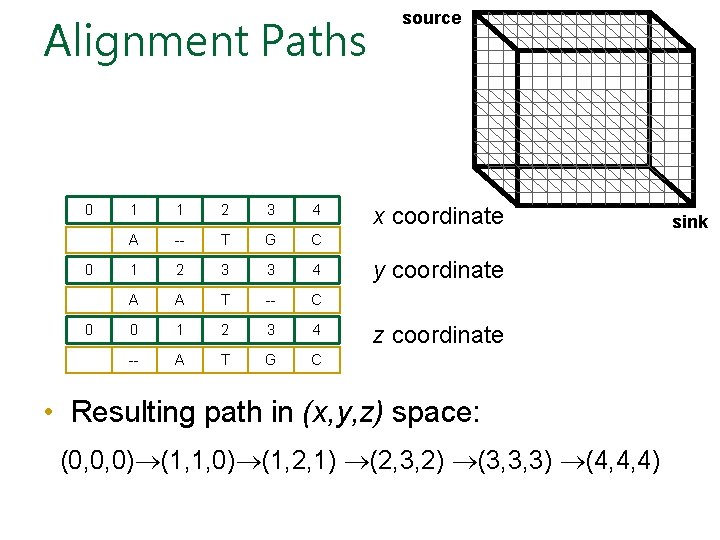
Alignment Paths 0 0 0 1 1 2 3 4 A -- T G C 1 2 3 3 4 A A T -- C 0 1 2 3 4 -- A T G C source x coordinate y coordinate z coordinate • Resulting path in (x, y, z) space: (0, 0, 0) (1, 1, 0) (1, 2, 1) (2, 3, 2) (3, 3, 3) (4, 4, 4) sink
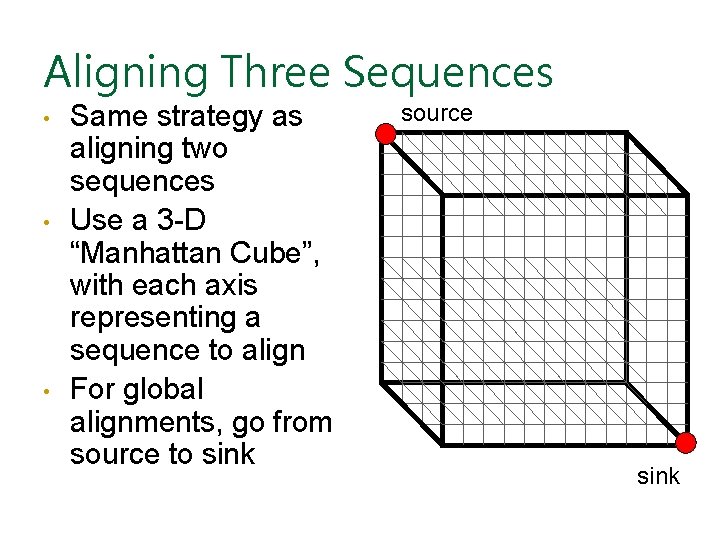
Aligning Three Sequences • • • Same strategy as aligning two sequences Use a 3 -D “Manhattan Cube”, with each axis representing a sequence to align For global alignments, go from source to sink source sink
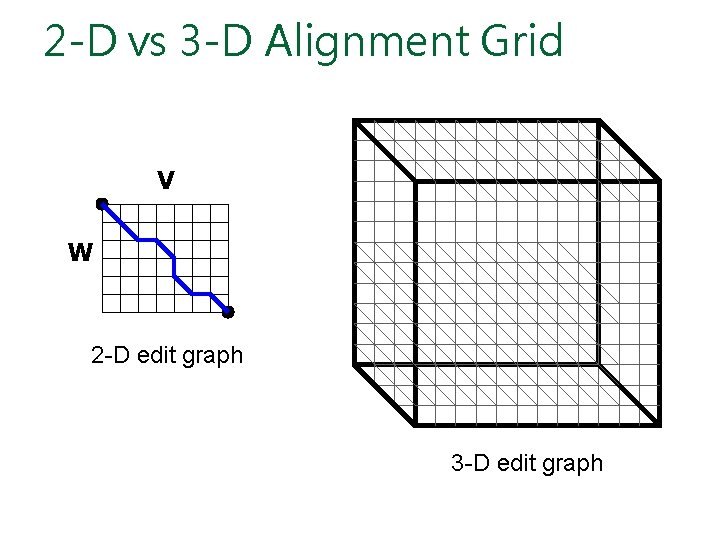
2 -D vs 3 -D Alignment Grid V W 2 -D edit graph 3 -D edit graph
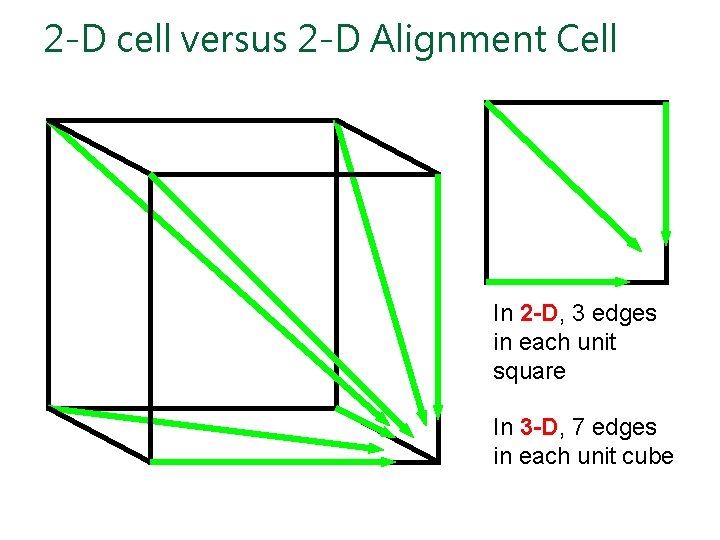
2 -D cell versus 2 -D Alignment Cell In 2 -D, 3 edges in each unit square In 3 -D, 7 edges in each unit cube
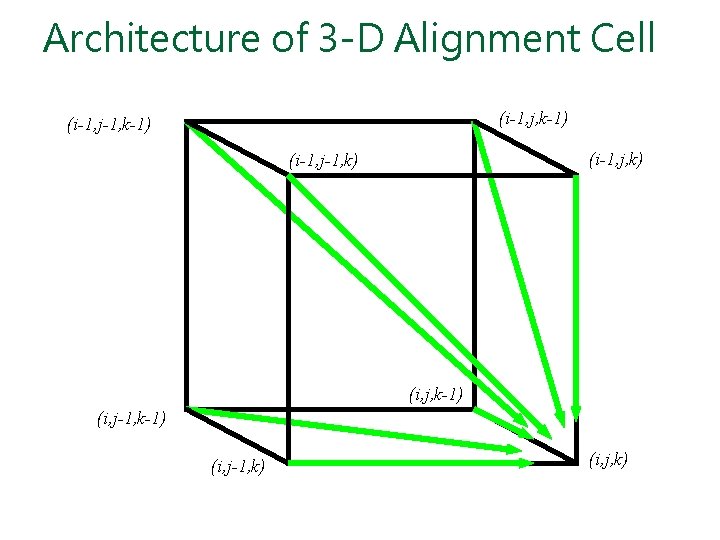
Architecture of 3 -D Alignment Cell (i-1, j, k-1) (i-1, j-1, k-1) (i-1, j, k) (i-1, j-1, k) (i, j, k-1) (i, j-1, k) (i, j, k)
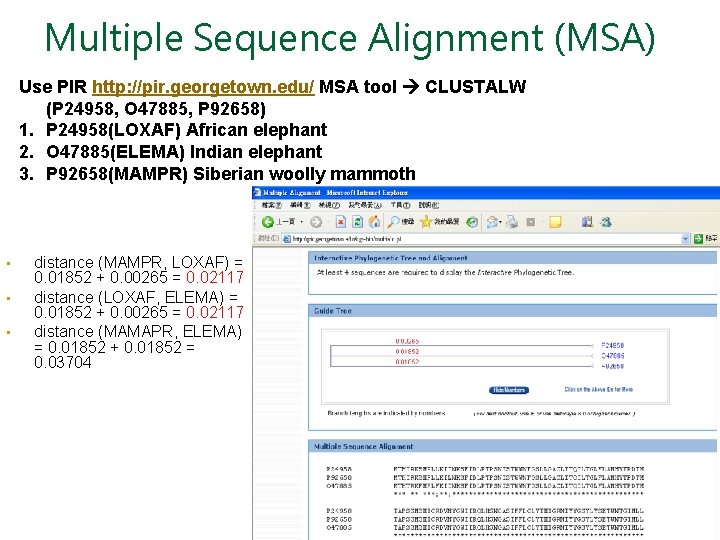
Multiple Sequence Alignment (MSA) Use PIR http: //pir. georgetown. edu/ MSA tool CLUSTALW (P 24958, O 47885, P 92658) 1. P 24958(LOXAF) African elephant 2. O 47885(ELEMA) Indian elephant 3. P 92658(MAMPR) Siberian woolly mammoth • • • distance (MAMPR, LOXAF) = 0. 01852 + 0. 00265 = 0. 02117 distance (LOXAF, ELEMA) = 0. 01852 + 0. 00265 = 0. 02117 distance (MAMAPR, ELEMA) = 0. 01852 + 0. 01852 = 0. 03704
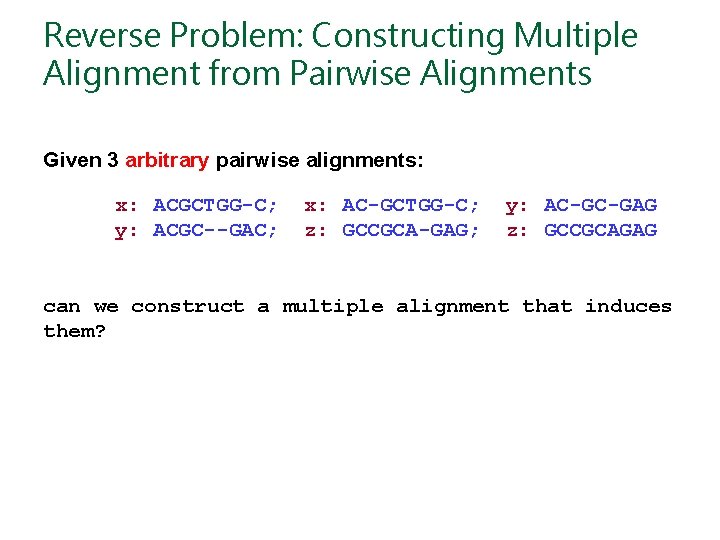
Reverse Problem: Constructing Multiple Alignment from Pairwise Alignments Given 3 arbitrary pairwise alignments: x: ACGCTGG-C; y: ACGC--GAC; x: AC-GCTGG-C; z: GCCGCA-GAG; y: AC-GC-GAG z: GCCGCAGAG can we construct a multiple alignment that induces them?
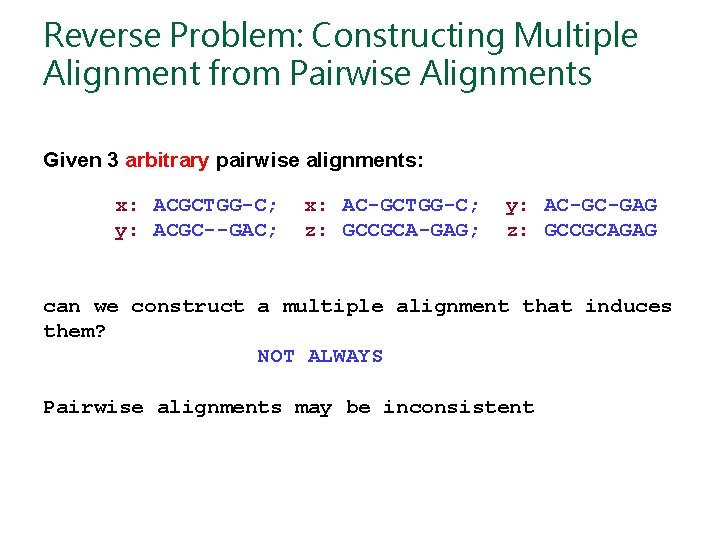
Reverse Problem: Constructing Multiple Alignment from Pairwise Alignments Given 3 arbitrary pairwise alignments: x: ACGCTGG-C; y: ACGC--GAC; x: AC-GCTGG-C; z: GCCGCA-GAG; y: AC-GC-GAG z: GCCGCAGAG can we construct a multiple alignment that induces them? NOT ALWAYS Pairwise alignments may be inconsistent
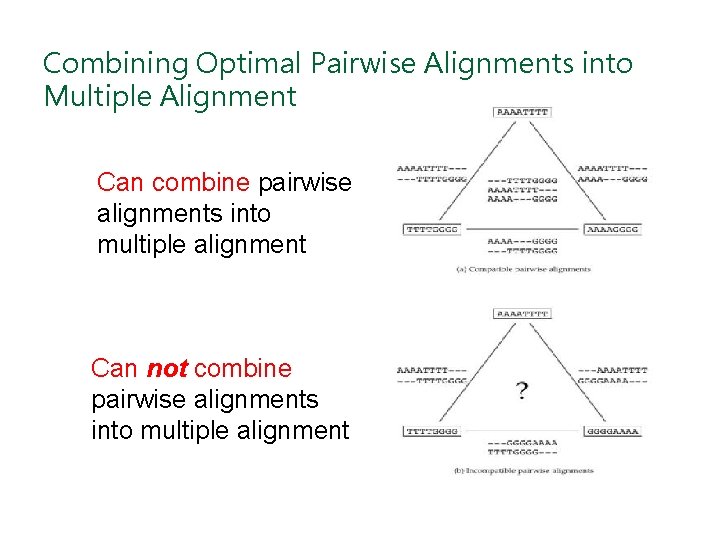
Combining Optimal Pairwise Alignments into Multiple Alignment Can combine pairwise alignments into multiple alignment Can not combine pairwise alignments into multiple alignment
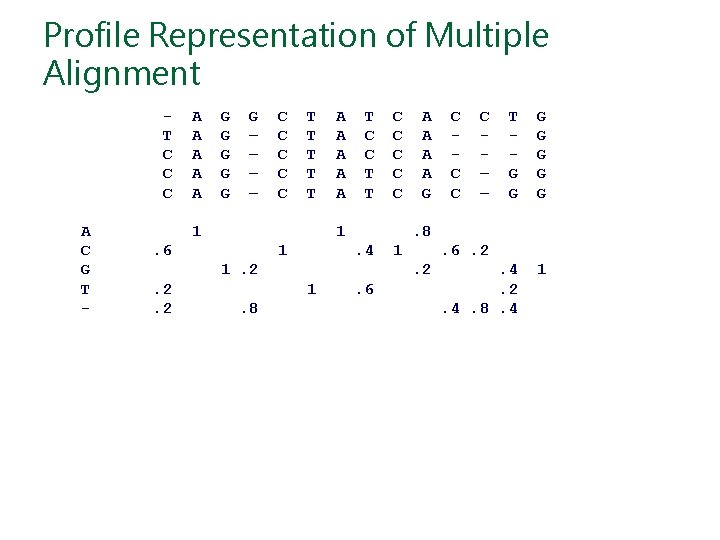
Profile Representation of Multiple Alignment T C C C A C G T - A A A G G G – – C C C T T T 1 A A A T C C T T 1 . 6 1 . 4 1 C C – – T G G G G . 4. 2. 4. 8. 4 1 . 6. 2. 2 1. 8 A A G. 8 1. 2. 2. 2 C C C . 6
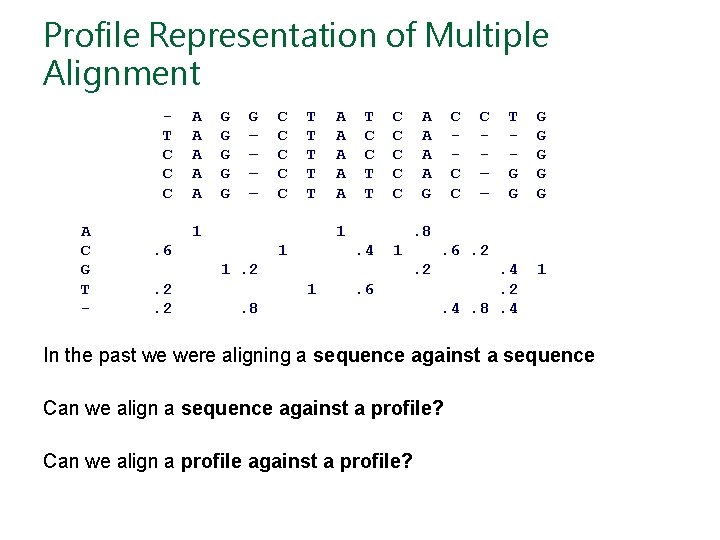
Profile Representation of Multiple Alignment T C C C A C G T - A A A G G G – – C C C T T T 1 A A A T C C T T 1 . 6 1 A A G . 4 1 C – – T G G G G . 4. 2. 4. 8. 4 1 . 6. 2. 2 1 C C C . 8 1. 2. 2. 2 C C C . 6 . 8 In the past we were aligning a sequence against a sequence Can we align a sequence against a profile? Can we align a profile against a profile?
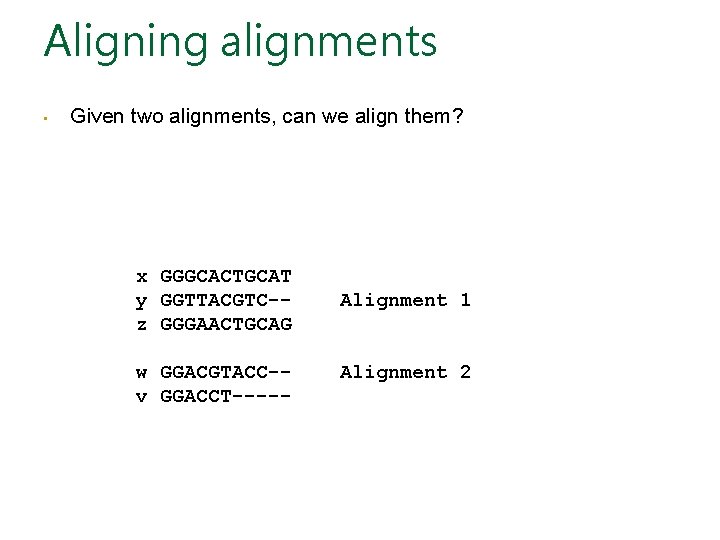
Aligning alignments • Given two alignments, can we align them? x GGGCACTGCAT y GGTTACGTC-z GGGAACTGCAG w GGACGTACC-v GGACCT----- Alignment 1 Alignment 2
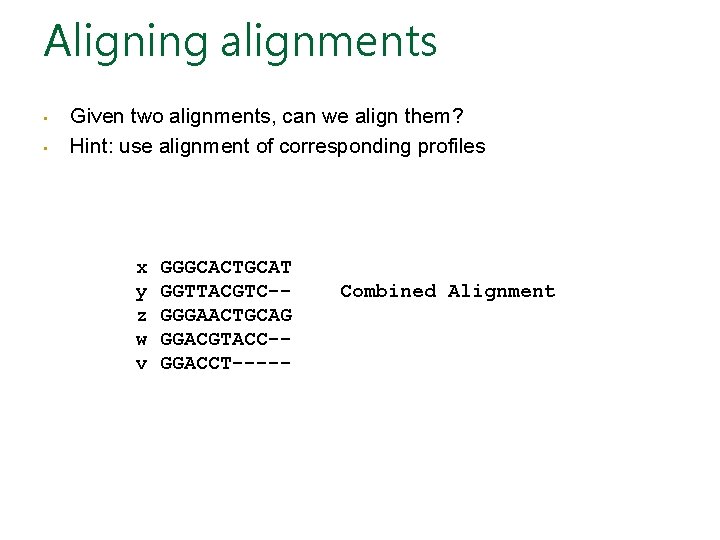
Aligning alignments • • Given two alignments, can we align them? Hint: use alignment of corresponding profiles x y z w v GGGCACTGCAT GGTTACGTC-GGGAACTGCAG GGACGTACC-GGACCT----- Combined Alignment
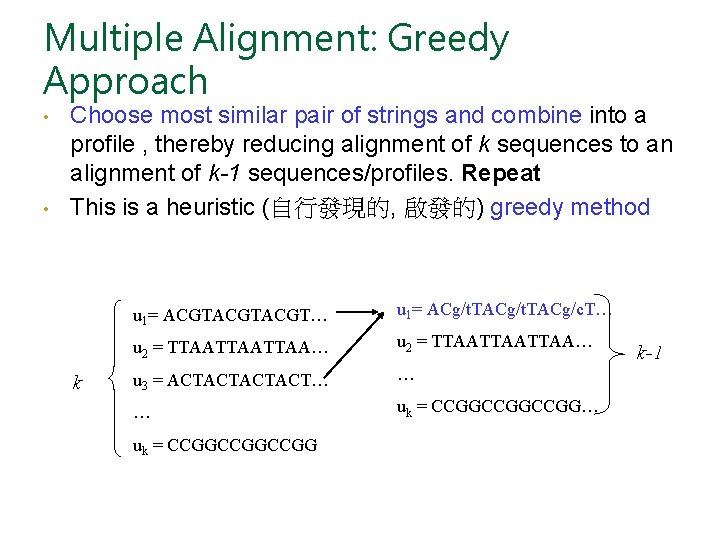
Multiple Alignment: Greedy Approach • • Choose most similar pair of strings and combine into a profile , thereby reducing alignment of k sequences to an alignment of k-1 sequences/profiles. Repeat This is a heuristic (自行發現的, 啟發的) greedy method k u 1= ACGTACGT… u 1= ACg/t. TACg/c. T… u 2 = TTAATTAATTAA… u 3 = ACTACT… … … uk = CCGGCCGGCCGG k-1
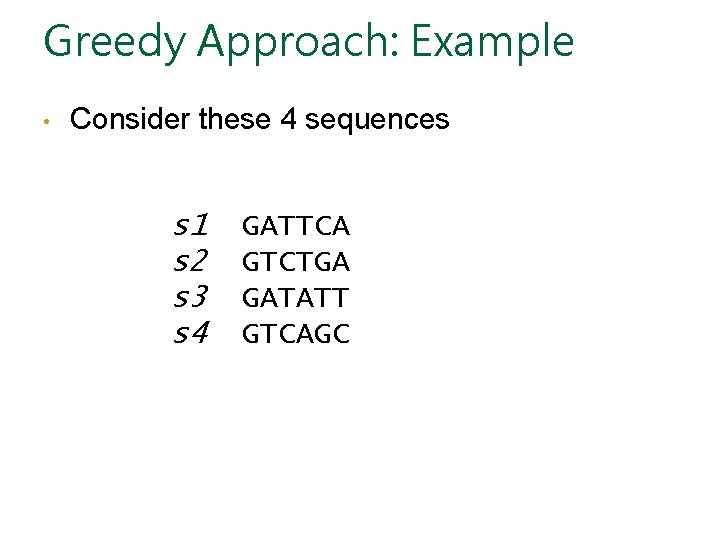
Greedy Approach: Example • Consider these 4 sequences s 1 s 2 s 3 s 4 GATTCA GTCTGA GATATT GTCAGC
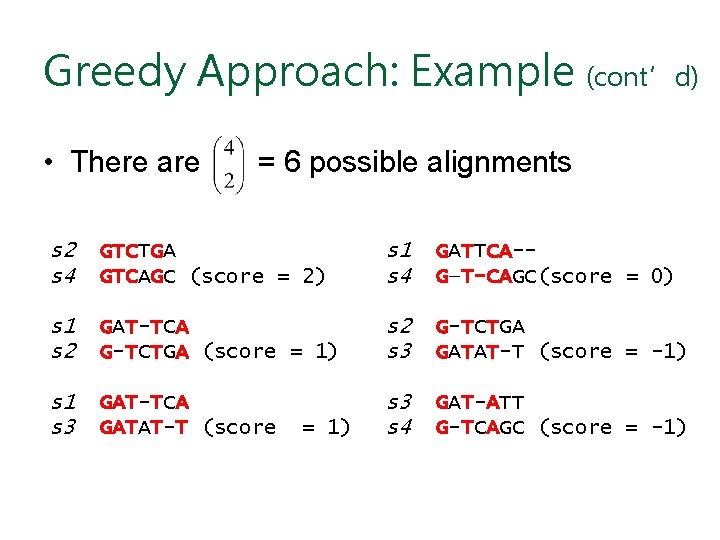
Greedy Approach: Example (cont’d) • There are = 6 possible alignments s 2 s 4 GTCTGA GTCAGC (score = 2) s 1 s 4 GATTCA-G—T-CAGC(score = 0) s 1 s 2 GAT-TCA G-TCTGA (score = 1) s 2 s 3 G-TCTGA GATAT-T (score = -1) s 1 s 3 GAT-TCA GATAT-T (score s 3 s 4 GAT-ATT G-TCAGC (score = -1) = 1)
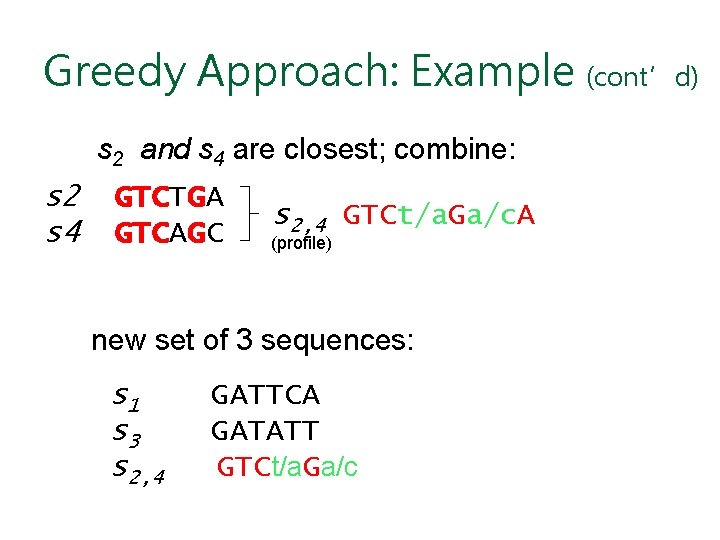
Greedy Approach: Example (cont’d) s 2 and s 4 are closest; combine: s 2 s 4 GTCTGA GTCAGC s 2, 4 GTCt/a. Ga/c. A (profile) new set of 3 sequences: s 1 s 3 s 2, 4 GATTCA GATATT GTCt/a. Ga/c
Progressive Alignment • Progressive alignment is a variation of greedy algorithm with a somewhat more intelligent strategy for choosing the order of alignments. • Progressive alignment works well for close sequences, but deteriorates for distant sequences • Gaps in consensus string are permanent • Use profiles to compare sequences
Clustal. W • Popular multiple alignment tool today • ‘W’ stands for ‘weighted’ (different parts of alignment are weighted differently). • Three-step process 1. ) Construct pairwise alignments 2. ) Build Guide Tree 3. ) Progressive Alignment guided by the tree
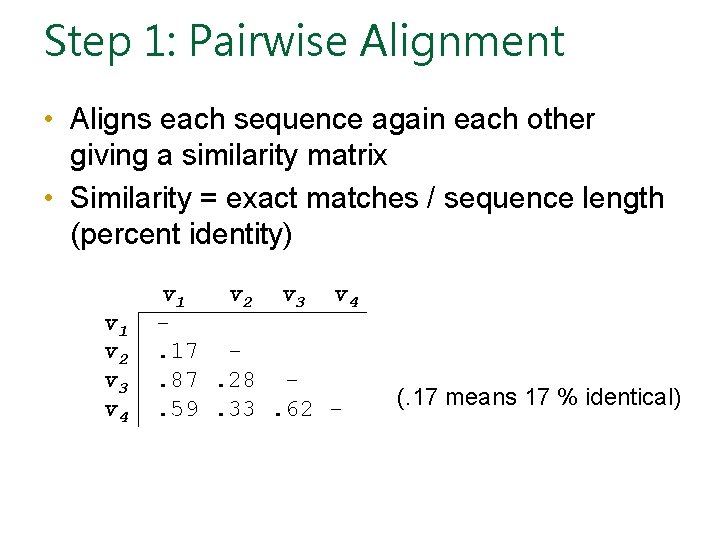
Step 1: Pairwise Alignment • Aligns each sequence again each other giving a similarity matrix • Similarity = exact matches / sequence length (percent identity) v 1 v 2 v 3 v 4. 17. 87. 28. 59. 33. 62 - (. 17 means 17 % identical)
Step 2: Guide Tree • Create Guide Tree using the similarity matrix • Clustal. W uses the neighbor-joining method • Guide tree roughly reflects evolutionary relations
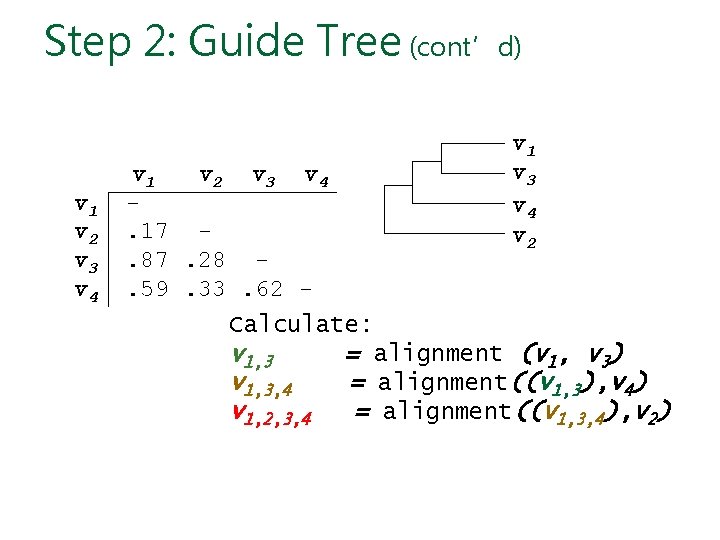
Step 2: Guide Tree (cont’d) v 1 v 2 v 3 v 4. 17. 87. 28. 59. 33. 62 - v 1 v 3 v 4 v 2 Calculate: v 1, 3 = alignment (v 1, v 3) v 1, 3, 4 = alignment((v 1, 3), v 4) v 1, 2, 3, 4 = alignment((v 1, 3, 4), v 2)
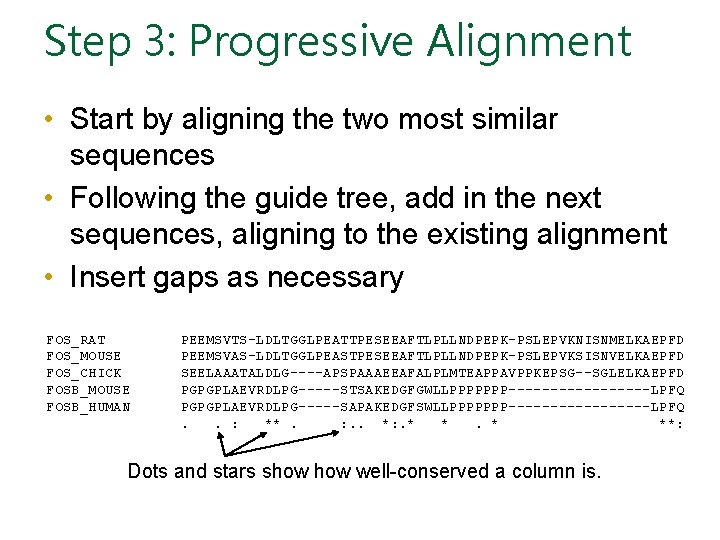
Step 3: Progressive Alignment • Start by aligning the two most similar sequences • Following the guide tree, add in the next sequences, aligning to the existing alignment • Insert gaps as necessary FOS_RAT FOS_MOUSE FOS_CHICK FOSB_MOUSE FOSB_HUMAN PEEMSVTS-LDLTGGLPEATTPESEEAFTLPLLNDPEPK-PSLEPVKNISNMELKAEPFD PEEMSVAS-LDLTGGLPEASTPESEEAFTLPLLNDPEPK-PSLEPVKSISNVELKAEPFD SEELAAATALDLG----APSPAAAEEAFALPLMTEAPPAVPPKEPSG--SGLELKAEPFD PGPGPLAEVRDLPG-----STSAKEDGFGWLLPPPPPPP---------LPFQ PGPGPLAEVRDLPG-----SAPAKEDGFSWLLPPPPPPP---------LPFQ. . : **. : . . *: . * **: Dots and stars show well-conserved a column is.
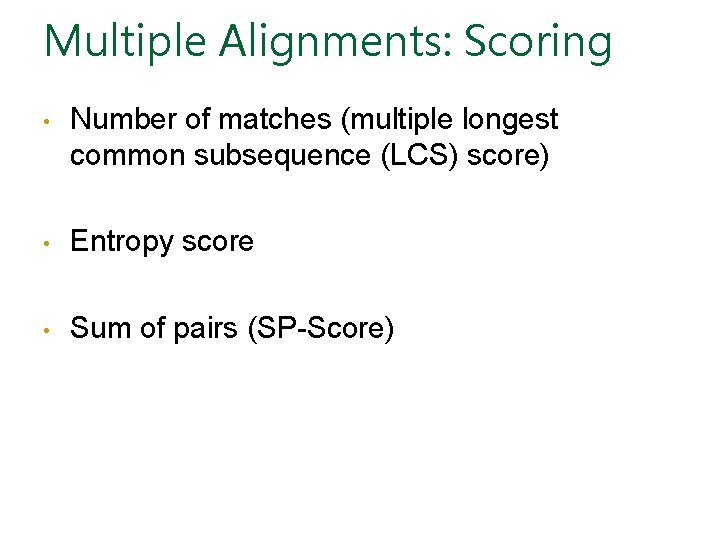
Multiple Alignments: Scoring • Number of matches (multiple longest common subsequence (LCS) score) • Entropy score • Sum of pairs (SP-Score)
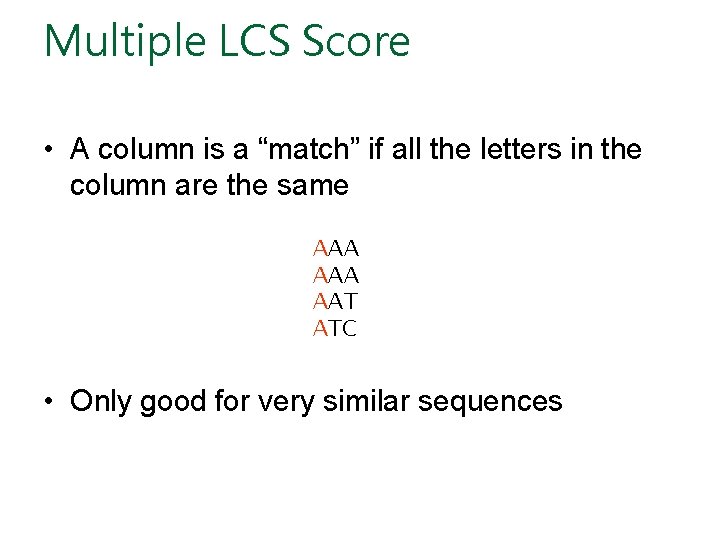
Multiple LCS Score • A column is a “match” if all the letters in the column are the same AAA AAT ATC • Only good for very similar sequences
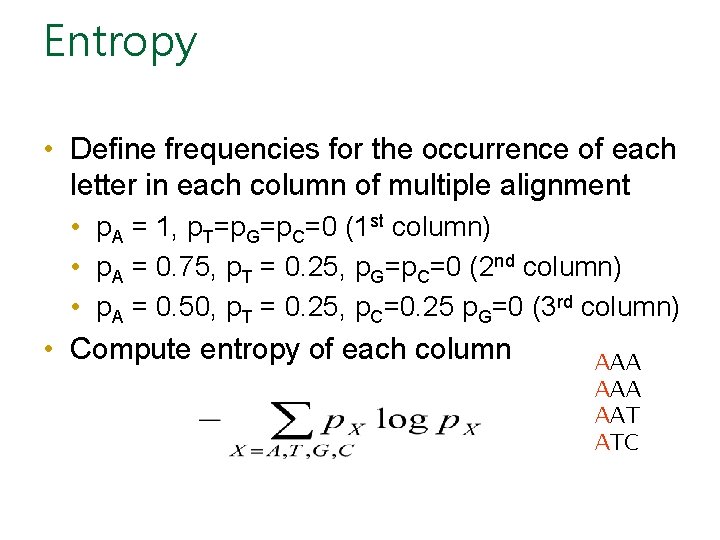
Entropy • Define frequencies for the occurrence of each letter in each column of multiple alignment • p. A = 1, p. T=p. G=p. C=0 (1 st column) • p. A = 0. 75, p. T = 0. 25, p. G=p. C=0 (2 nd column) • p. A = 0. 50, p. T = 0. 25, p. C=0. 25 p. G=0 (3 rd column) • Compute entropy of each column AAA AAT ATC
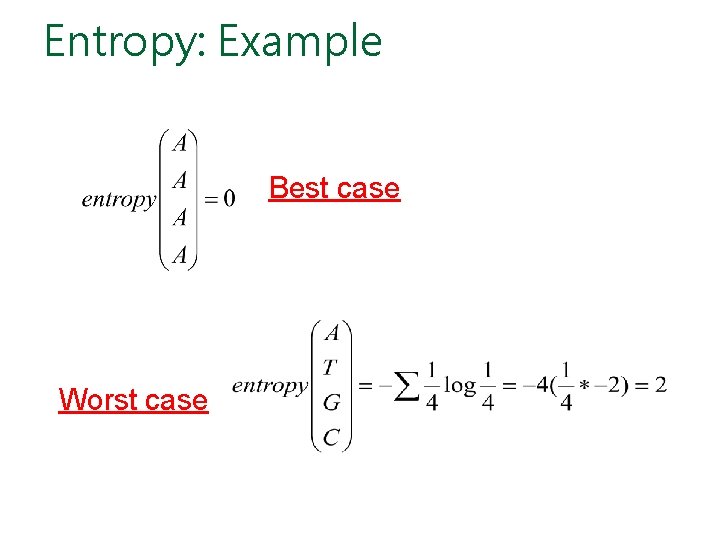
Entropy: Example Best case Worst case
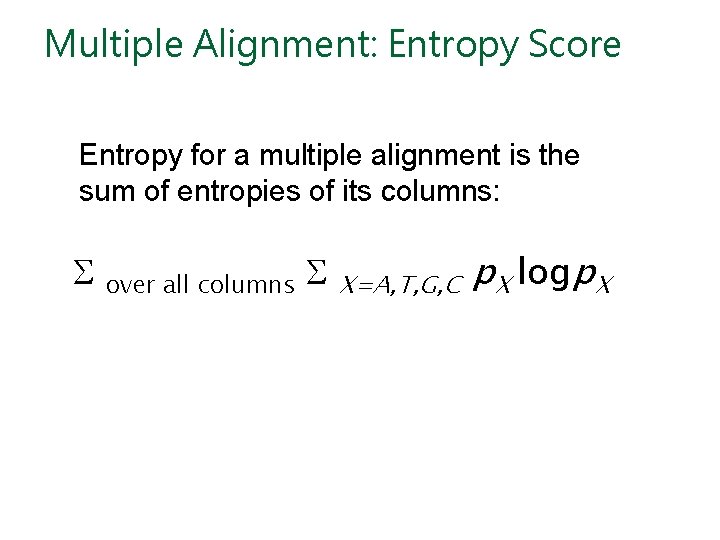
Multiple Alignment: Entropy Score Entropy for a multiple alignment is the sum of entropies of its columns: over all columns X=A, T, G, C p. X logp. X
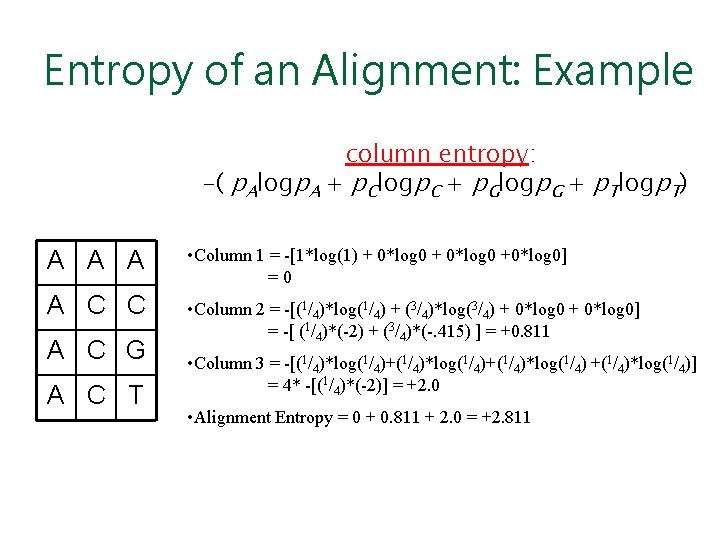
Entropy of an Alignment: Example column entropy: -( p. Alogp. A + p. Clogp. C + p. Glogp. G + p. Tlogp. T) A A A • Column 1 = -[1*log(1) + 0*log 0 +0*log 0] =0 A C C • Column 2 = -[(1/4)*log(1/4) + (3/4)*log(3/4) + 0*log 0] = -[ (1/4)*(-2) + (3/4)*(-. 415) ] = +0. 811 A C G A C T • Column 3 = -[(1/4)*log(1/4)+(1/4)*log(1/4)] = 4* -[(1/4)*(-2)] = +2. 0 • Alignment Entropy = 0 + 0. 811 + 2. 0 = +2. 811

Multiple Alignment Induces Pairwise Alignments Every multiple alignment induces pairwise alignments x: y: z: AC-GCGG-C AC-GC-GAG GCCGC-GAG Induces: x: ACGCGG-C; y: ACGC-GAC; x: AC-GCGG-C; z: GCCGC-GAG; y: AC-GCGAG z: GCCGCGAG
Inferring Pairwise Alignments from Multiple Alignments • From a multiple alignment, we can infer pairwise alignments between all sequences, but they are not necessarily optimal • This is like projecting a 3 -D multiple alignment path on to a 2 -D face of the cube
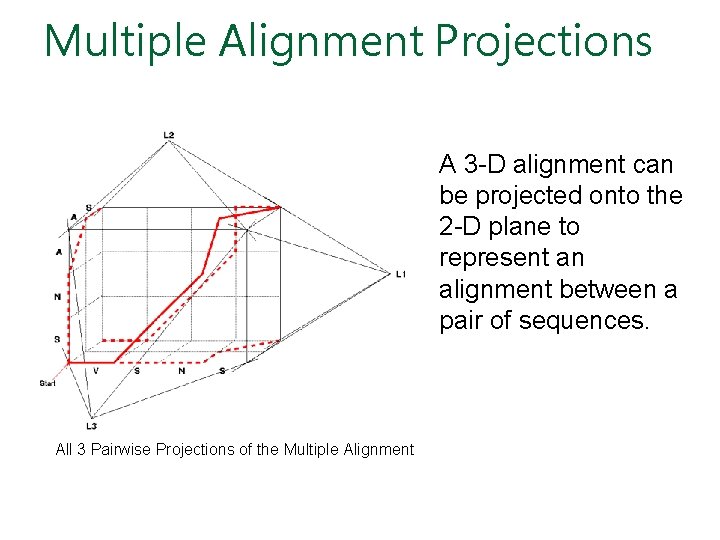
Multiple Alignment Projections A 3 -D alignment can be projected onto the 2 -D plane to represent an alignment between a pair of sequences. All 3 Pairwise Projections of the Multiple Alignment
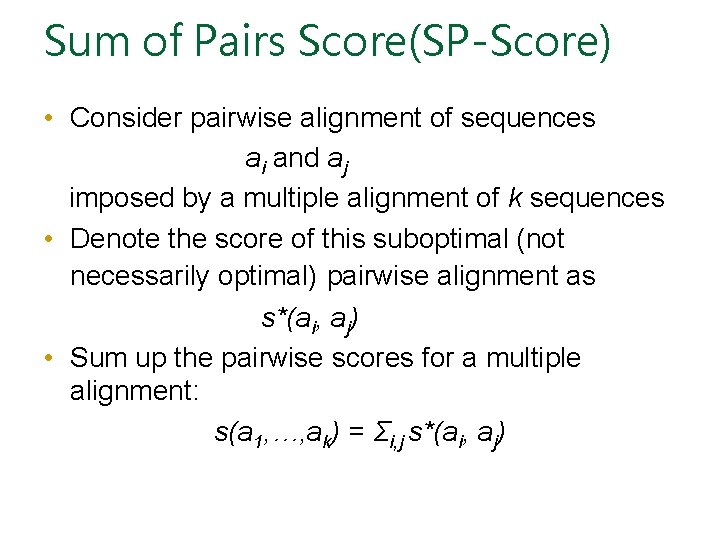
Sum of Pairs Score(SP-Score) • Consider pairwise alignment of sequences ai and aj imposed by a multiple alignment of k sequences • Denote the score of this suboptimal (not necessarily optimal) pairwise alignment as s*(ai, aj) • Sum up the pairwise scores for a multiple alignment: s(a 1, …, ak) = Σi, j s*(ai, aj)
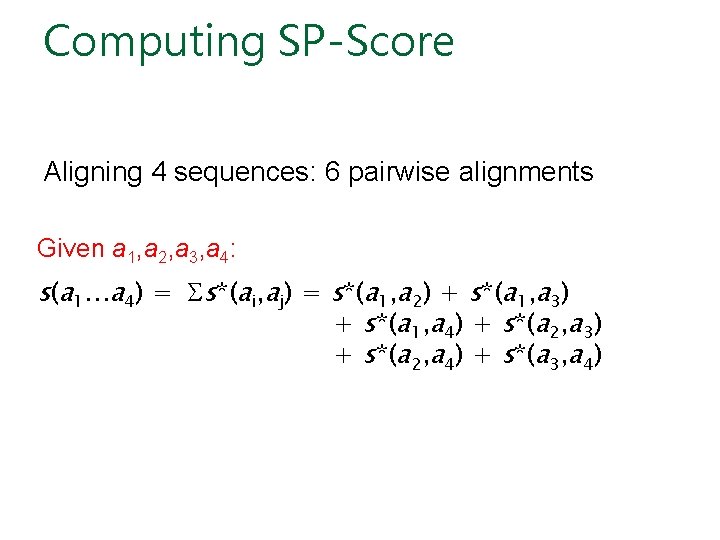
Computing SP-Score Aligning 4 sequences: 6 pairwise alignments Given a 1, a 2, a 3, a 4: s(a 1…a 4) = s*(ai, aj) = s*(a 1, a 2) + s*(a 1, a 3) + s*(a 1, a 4) + s*(a 2, a 3) + s*(a 2, a 4) + s*(a 3, a 4)
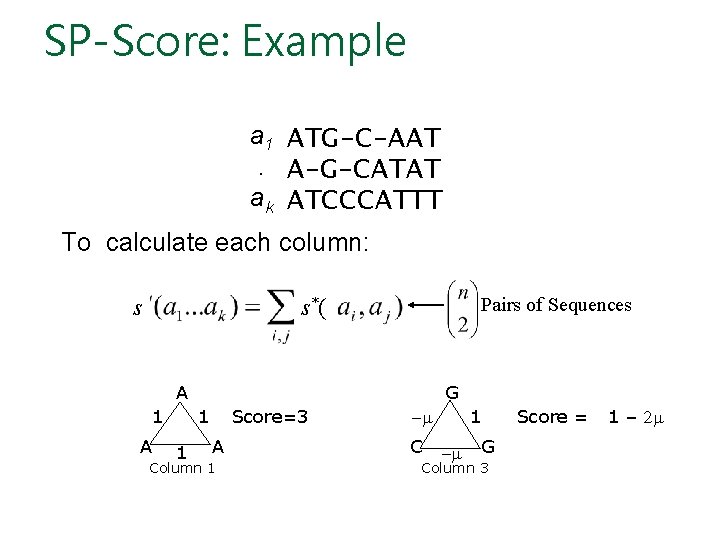
SP-Score: Example a 1 ATG-C-AAT. A-G-CATAT ak ATCCCATTT To calculate each column: s Pairs of Sequences s*( A 1 A G 1 1 Score=3 A Column 1 1 -m C -m G Column 3 Score = 1 – 2 m
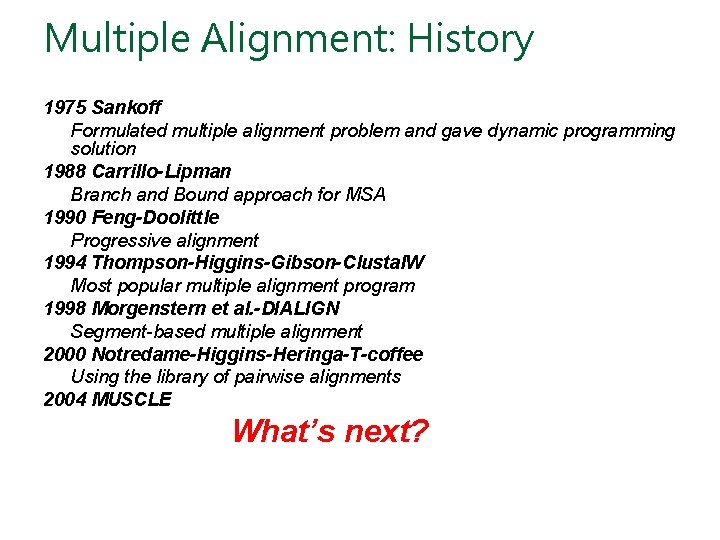
Multiple Alignment: History 1975 Sankoff Formulated multiple alignment problem and gave dynamic programming solution 1988 Carrillo-Lipman Branch and Bound approach for MSA 1990 Feng-Doolittle Progressive alignment 1994 Thompson-Higgins-Gibson-Clustal. W Most popular multiple alignment program 1998 Morgenstern et al. -DIALIGN Segment-based multiple alignment 2000 Notredame-Higgins-Heringa-T-coffee Using the library of pairwise alignments 2004 MUSCLE What’s next?
Problems with Multiple Alignment • • • Multidomain proteins evolve not only through point mutations but also through domain duplications and domain recombinations Although MSA is a 30 year old problem, there were no MSA approaches for aligning rearranged sequences (i. e. , multi-domain proteins with shuffled domains) prior to 2002 Often impossible to align all protein sequences throughout their entire length
References • • Jones N. C. & Pevzner P. A. (2004). An introduction to bioinformatics algorithms, MIT press Mount D. (2001). Bioinformatics, CSHL
- Slides: 47