
Multiple Sequence Alignment MultSeqAlign allows to detect similarities
- Slides: 13
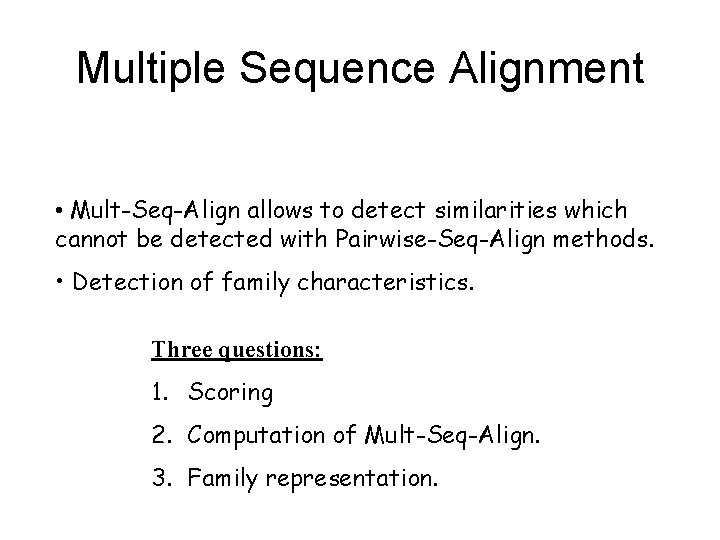
Multiple Sequence Alignment • Mult-Seq-Align allows to detect similarities which cannot be detected with Pairwise-Seq-Align methods. • Detection of family characteristics. Three questions: 1. Scoring 2. Computation of Mult-Seq-Align. 3. Family representation.
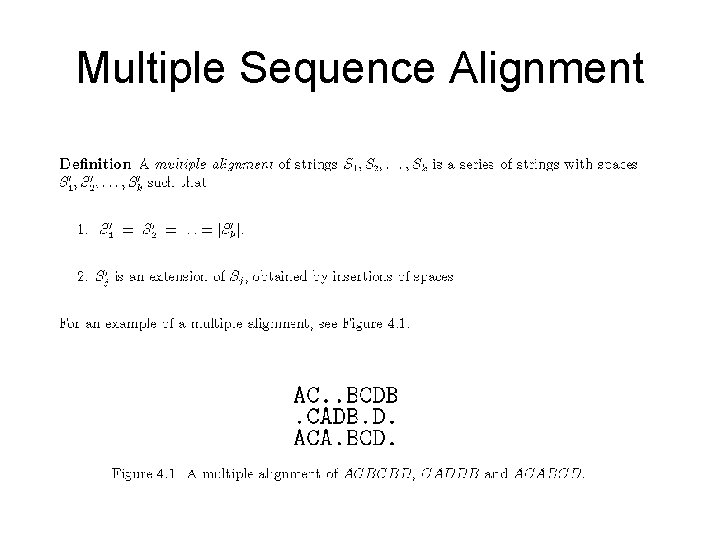
Multiple Sequence Alignment
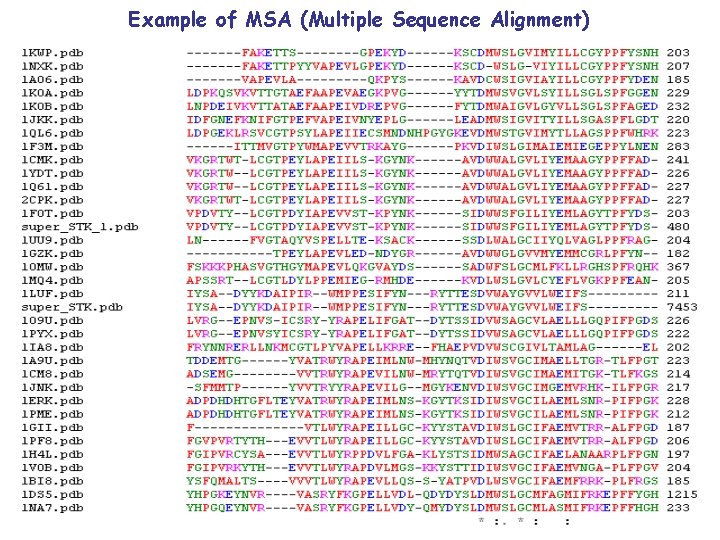
Example of MSA (Multiple Sequence Alignment)
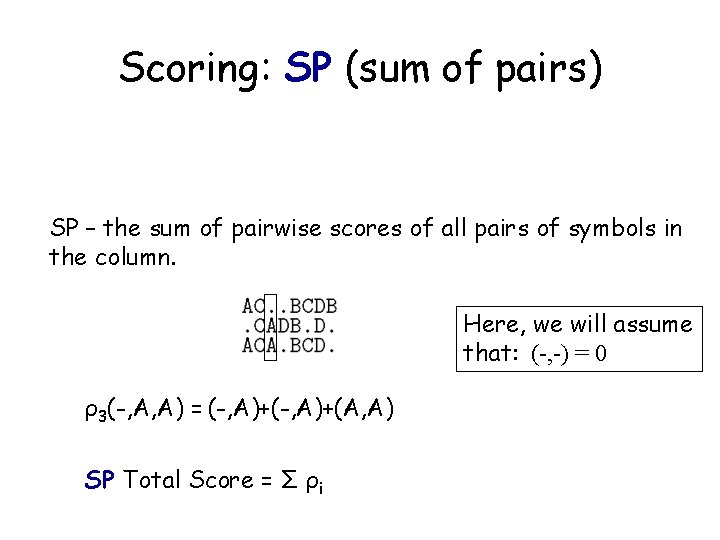
Scoring: SP (sum of pairs) SP – the sum of pairwise scores of all pairs of symbols in the column. Here, we will assume that: (-, -) = 0 ρ3(-, A, A) = (-, A)+(A, A) SP Total Score = Σ ρi
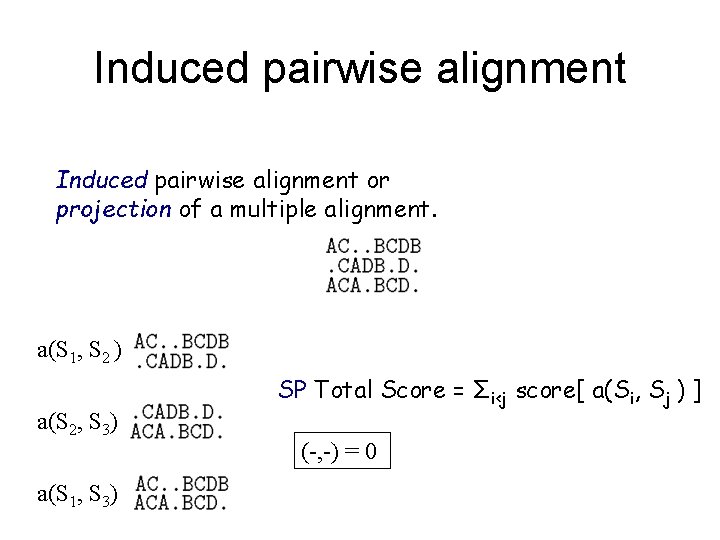
Induced pairwise alignment or projection of a multiple alignment. a(S 1, S 2 ) a(S 2, S 3) a(S 1, S 3) SP Total Score = Σi<j score[ a(Si, Sj ) ] (-, -) = 0
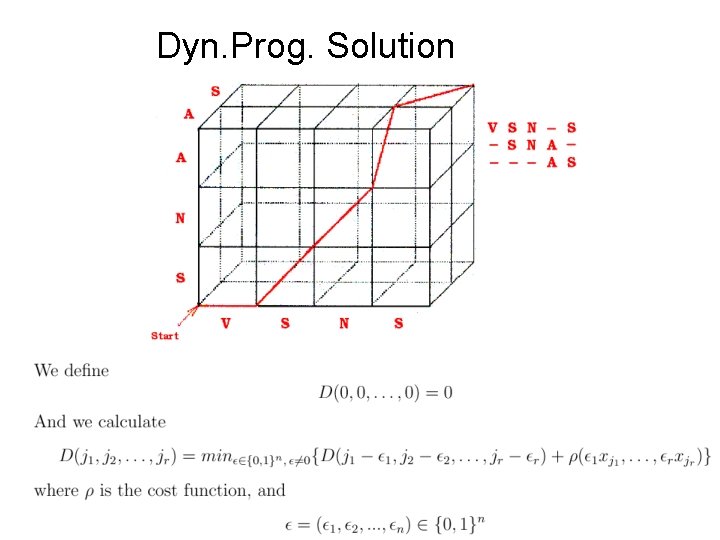
Dyn. Prog. Solution
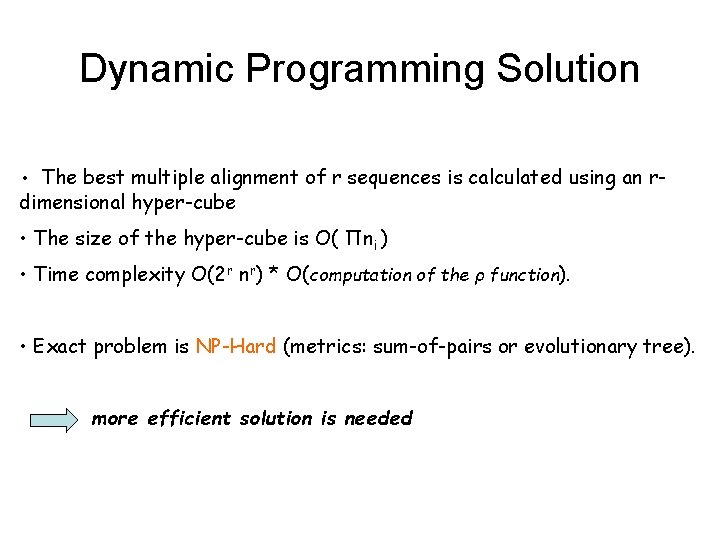
Dynamic Programming Solution • The best multiple alignment of r sequences is calculated using an r- dimensional hyper-cube • The size of the hyper-cube is O( Πni ) • Time complexity O(2 r nr) * O(computation of the ρ function). • Exact problem is NP-Hard (metrics: sum-of-pairs or evolutionary tree). more efficient solution is needed
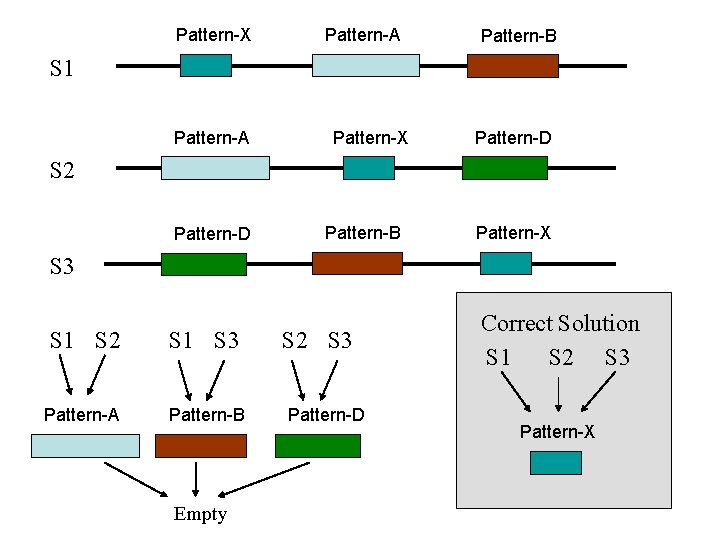
Multiple Alignment from Pairwise Alignments ? Problem: • The best pairwise alignment does not necessary lead to the best multiple alignment.
Pattern-X Pattern-A Pattern-B S 1 Pattern-A Pattern-X Pattern-D S 2 Pattern-D Pattern-B Pattern-X S 3 S 1 S 2 S 1 S 3 Pattern-A Pattern-B Empty S 2 S 3 Pattern-D Correct Solution S 1 S 2 S 3 Pattern-X
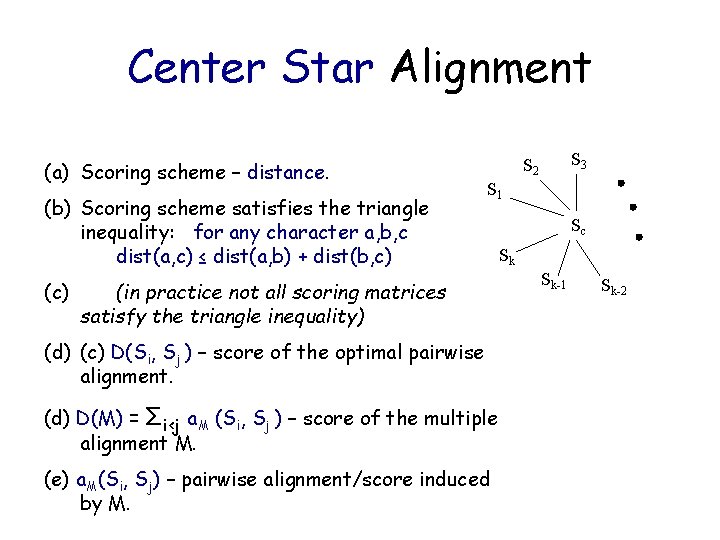
Center Star Alignment (a) Scoring scheme – distance. (b) Scoring scheme satisfies the triangle inequality: for any character a, b, c dist(a, c) ≤ dist(a, b) + dist(b, c) (c) S 3 S 2 S 1 (in practice not all scoring matrices satisfy the triangle inequality) (d) (c) D(Si, Sj ) – score of the optimal pairwise alignment. (d) D(M) = Σi<j a. M (Si, Sj ) – score of the multiple alignment M. (e) a. M(Si, Sj) – pairwise alignment/score induced by M. Sc Sk Sk-1 Sk-2
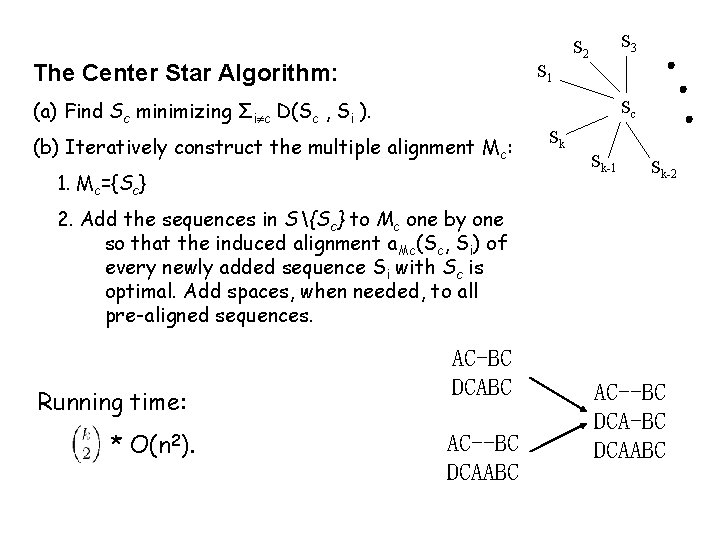
S 3 S 2 The Center Star Algorithm: S 1 (a) Find Sc minimizing Σi c D(Sc , Si ). Sc (b) Iteratively construct the multiple alignment Mc: 1. Mc={Sc} Sk Sk-1 Sk-2 2. Add the sequences in S{Sc} to Mc one by one so that the induced alignment a. Mc(Sc, Si) of every newly added sequence Si with Sc is optimal. Add spaces, when needed, to all pre-aligned sequences. Running time: * O(n 2). AC-BC DCABC AC--BC DCA-BC DCAABC
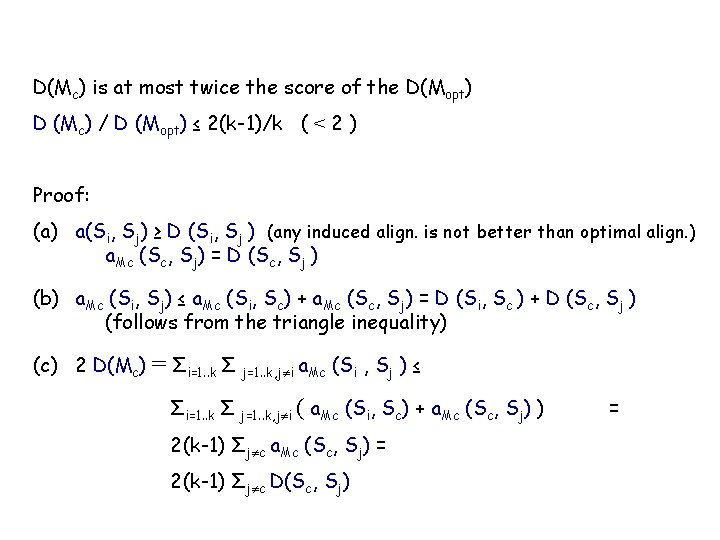
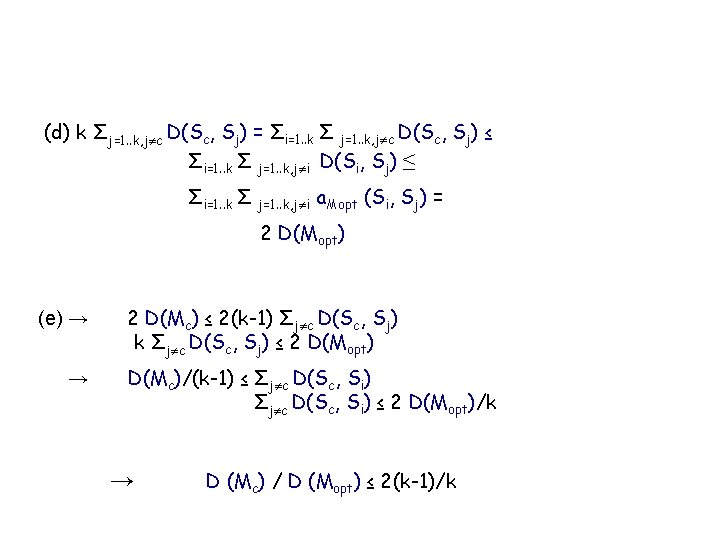
D(Mc) is at most twice the score of the D(Mopt) D (Mc) / D (Mopt) ≤ 2(k-1)/k ( < 2 ) Proof: (a) a(Si, Sj) ≥ D (Si, Sj ) (any induced align. is not better than optimal align. ) a. Mc (Sc, Sj) = D (Sc, Sj ) (b) a. Mc (Si, Sj) ≤ a. Mc (Si, Sc) + a. Mc (Sc, Sj) = D (Si, Sc ) + D (Sc, Sj ) (follows from the triangle inequality) (c) 2 D(Mc) = Σi=1. . k Σ j=1. . k, j i a. Mc (Si , Sj ) ≤ Σi=1. . k Σ j=1. . k, j i ( a. Mc (Si, Sc) + a. Mc (Sc, Sj) ) 2(k-1) Σj c a. Mc (Sc, Sj) = 2(k-1) Σj c D(Sc, Sj) =
(d) k Σj=1. . k, j c D(Sc, Sj) = Σi=1. . k Σ j=1. . k, j c D(Sc, Sj) ≤ Σi=1. . k Σ j=1. . k, j i D(Si, Sj) ≤ Σi=1. . k Σ j=1. . k, j i a. Mopt (Si, Sj) = 2 D(Mopt) (e) → → 2 D(Mc) ≤ 2(k-1) Σj c D(Sc, Sj) k Σj c D(Sc, Sj) ≤ 2 D(Mopt) D(Mc)/(k-1) ≤ Σj c D(Sc, Si) ≤ 2 D(Mopt)/k → D (Mc) / D (Mopt) ≤ 2(k-1)/k