
Multiple Sample Models James G Anderson Ph D




- Slides: 26
Multiple Sample Models James G. Anderson, Ph. D. Purdue University
Rationale of Multiple Sample SEMs • Do estimates of model parameters vary across groups? • Another way of asking this question is: Does group membership moderate the relationships specified in the model?
Uses of Multiple Sample SEMs • • Use for analysis of cross-sectional, longitudinal, experimental and quasiexperimental data and to test for measurement variance. This procedure allows the investigator to: 1) Estimate separately the parameters for multiple samples 2) Test whether specified parameters are equivalent across these groups. 3) Test whethere are group mean differences for the indicator variables and/or for the structural equations
Analytical Procedure • Estimate the parameters of the model with no constraints (i. e. , allow the parameters to differ among groups) • Compute chi-square as a measure of fit. • Re-estimate the parameters of the model after imposing cross-group equality constraints on parameters
Analytical Procedure (2) • Determine the chi square difference is significant • If the relative for of the constrained model is significantly worse than that of the unconstrained model, then individual path coefficients should be compared across samples.
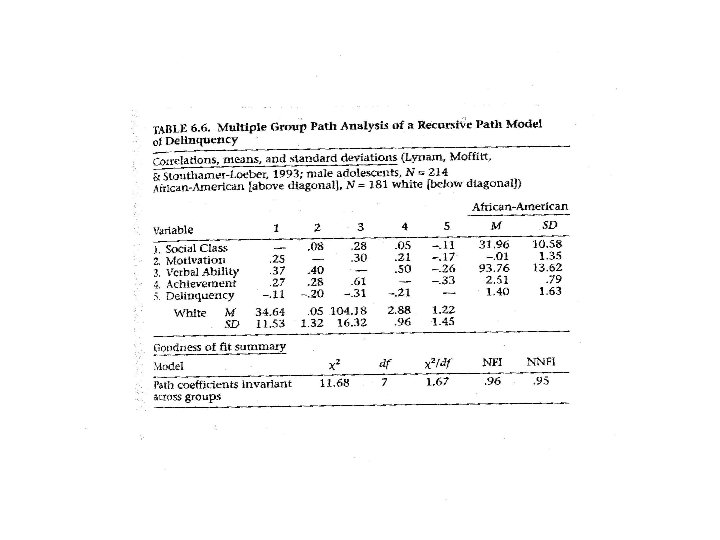
Structural Model Example Lyman, DR. , Moff, HT, Stouthamer. Loeber, M. (1993). “Explaining the Relation Between IQ and Delinquency: Class, Race, Test Motivation or Self-Control. ” Journal of Abnormal Psychology, 102, 187 -196.
Structural Model Example: Data • Covariance matrices for White (n=214) and African American (n=181) male adolescents • Total observations: n=395 • Degrees of Freedom: 2 * 5(6) = 30 2 • 7 parameters constrained to be equal
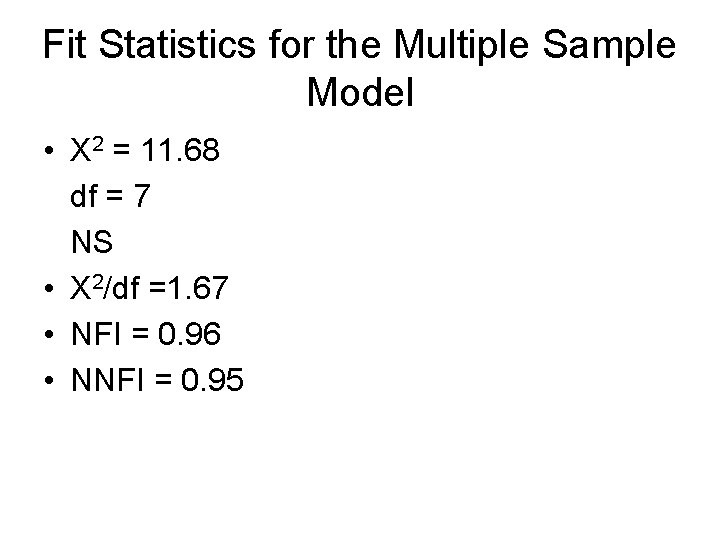
Fit Statistics for the Multiple Sample Model • Χ 2 = 11. 68 df = 7 NS • Χ 2/df =1. 67 • NFI = 0. 96 • NNFI = 0. 95
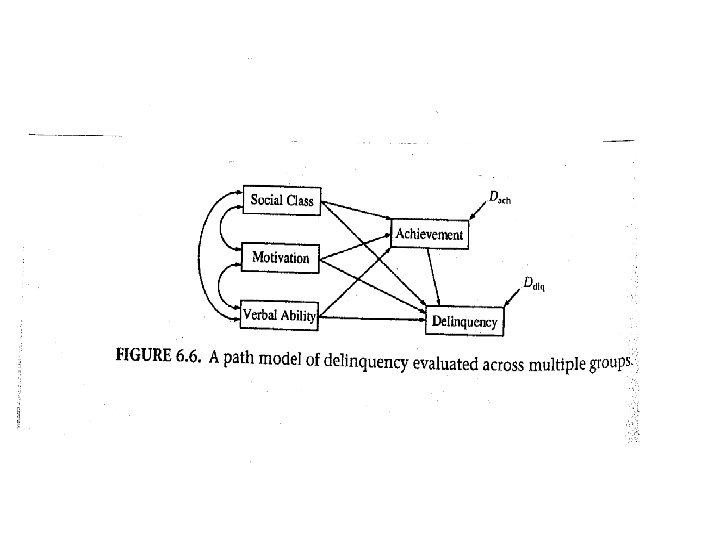
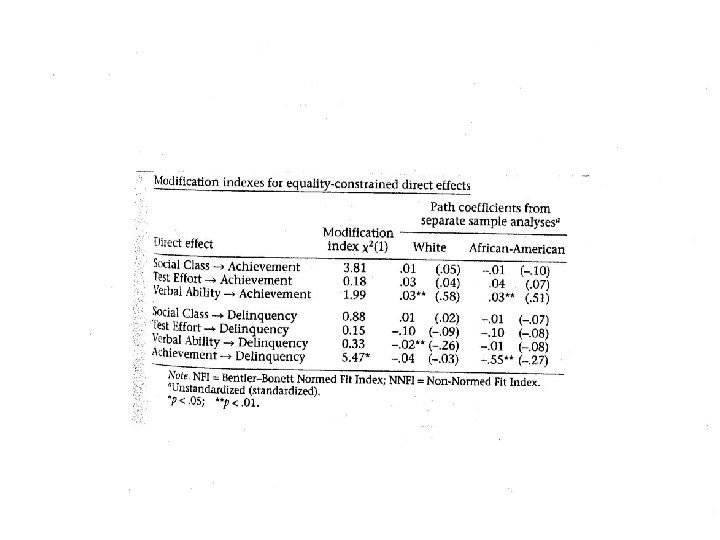
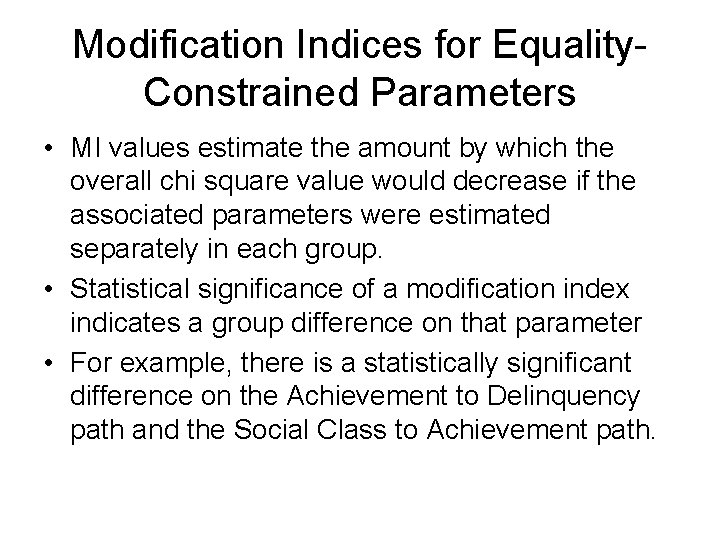
Modification Indices for Equality. Constrained Parameters • MI values estimate the amount by which the overall chi square value would decrease if the associated parameters were estimated separately in each group. • Statistical significance of a modification index indicates a group difference on that parameter • For example, there is a statistically significant difference on the Achievement to Delinquency path and the Social Class to Achievement path.
Additional Analysis • Path coefficients were estimated separately for each sample • Standardized values can only be used for comparisons within a group. • Unstandardized values are used for comparisons between or across groups.
Results • In both samples, Verbal Ability has a significant effect on Achievement. • Verbal Ability is the only significant predictor of Delinquency in the White sample. • Achievement is the only significant predictor of Delinquency in the African-American sample. • Conclusion: Among male adolescents, school has a larger role on the development of delinquency for African-Americans that for Whites
Use of Multiple Sample CFAs • Test for measurement invariance, whether a set of indicators assesses the same latent variables in different groups. • Examine a test for construct bias, whether a test measures something different in one group than in another.
Analytical Procedure • Estimate the parameters of the model with no constraints (i. e. , allow the factor loadings and error variances to differ among groups). • Compute chi square as a measure of fit. • Re-estimate the parameters of the model after imposing cross-group equality constraints parameters
Analytical Procedure (2) • Determine if the chi square difference is significant • If the relative fit of the constrained model is significantly worse than that of the unconstrained model, then individual factor loadings should be compared across samples to determine the extent of partial measurement invariance. .
Confirmatory Factor Analysis: Example Werts, CE, Rock, DA, Linn, RL and Joreskog, KG. (1976). “A Comparison of Correlations, Variances, Covariances and Regression Weights With or Without Measurement Errors. ” Psychology Bulletin, 83, 52 -56.
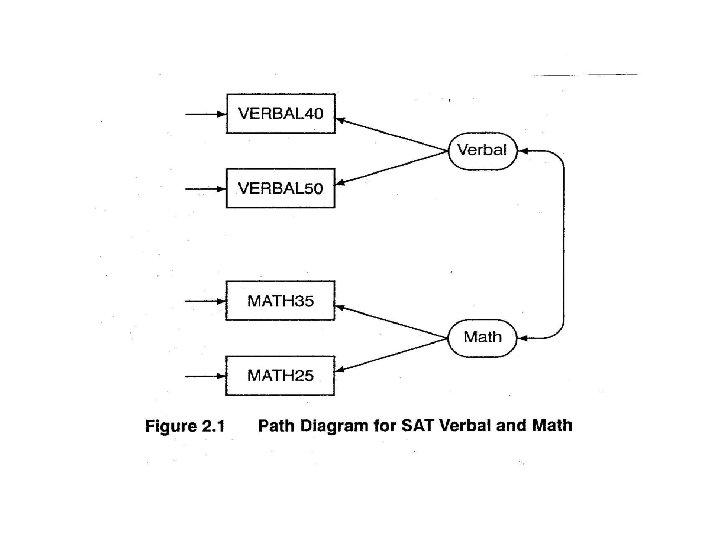
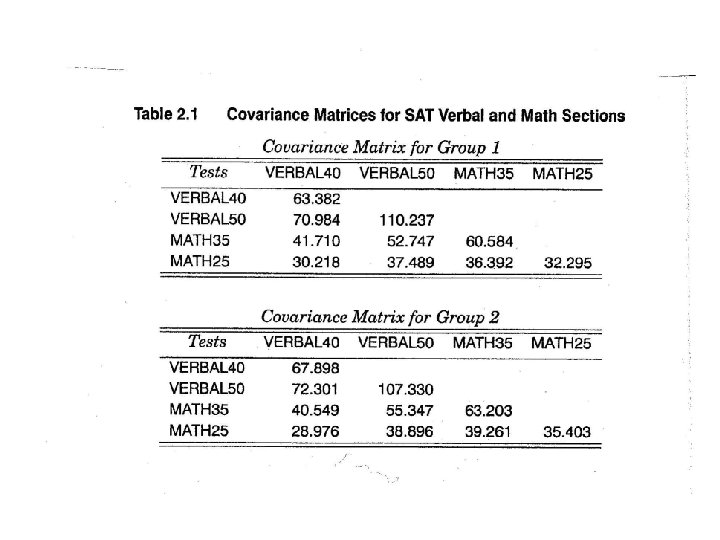
Confirmatory Factor Analysis: Data • Covariance matrices are for two samples (n 1=865 and n 2=900) of candidates who took the SAT in January 1971. • Total observations: n=1765 • Degrees of Freedom: 2 * 4(5) = 20 2
Confirmatory Factor Analysis: Results • The factor loadings are the same for the two groups. • The error variances differ between the two groups.