
MULTIPLE REVOLUTION LAMBERT S TARGETING PROBLEM AN ANALYTICAL
MULTIPLE REVOLUTION LAMBERT S TARGETING PROBLEM: AN ANALYTICAL APPROXIMATION Claudio Bombardelli, Juan Luis Gonzalo, Javier Roa Space Dynamics Group Technical University of Madrid (UPM) 6 th International Conference on Astrodynamics Tools and Techniques (ICATT) 14 -17 March 2016 Darmstadtium, Darmstadt, Germany 6 th International Conference on Flight Astrodynamics Tools & Techniques 26 th AAS/AIAA Space Mechanics Meeting, Napa, CA ICATT 1

Outline Background and motivation 1. Lambert’s Targeting Problem (LTP) 2. Applications and Challenges Optimum single-impulse time-free transfer 1. Problem formulation 2. Battin’s quartic equation D-matrix targeting 1. Review of the D matrix relation 2. D* matrix and targeting equations Performance of the method 1. Pork-chop plots comparisons 2. Speed and accuracy Conclusions

Background and Motivations (1) 1) LAMBERT’S PROBLEM Determine the finite set of (2 N+1) orbits linking two position vectors in a Keplerian field with a specified transfer time (N=max number of rev) 2) LAMBERT’S TARGETING PROBLEM (LTP) Determine the minimum impulsive delta-V (and optimum N) to maneuver a S/C in order to target a specified point in space in a fixed amount of time • If you can solve 1) then you have solved 2) as well • We present an approximate solution for 1) (under some assumptions), not 2) • STATE OF THE ART • Abundant literature on solution methods for Lambert’s problem. • The most popular method is probably Gooding’s (1990) • Fastest methods (as far as we know) are Arora-Russell and Izzo’s (2014) 6 th International Conference on Astrodynamics Tools & Techniques ICATT 3

Background and Motivations (2) THE TRAJECTORY OPTIMIZATION CHALLENGE Increasing the computation speed of a LTP solver is crucial when facing complex, high-dimesional trajectory optimization problems. example: MGA with multiple deep space maneuver (MGA-DSM) o Typically intractable using brute-force approaches (grid-sampling). Bottleneck is the LTP solver CPU time. o o Even with “lighter” more “intelligent” strategies a faster LTP solver always helps o o Pruning capability is always welcome 6 th International Conference on Astrodynamics Tools & Techniques ICATT 4
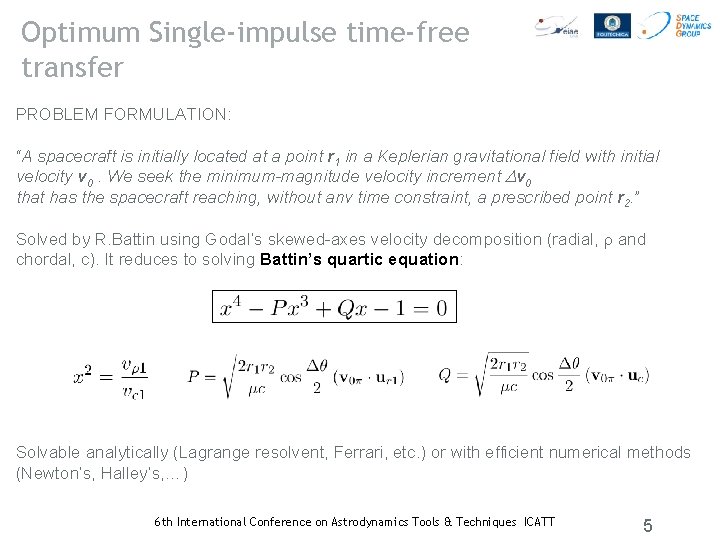
Optimum Single-impulse time-free transfer PROBLEM FORMULATION: “A spacecraft is initially located at a point r 1 in a Keplerian gravitational field with initial velocity v 0. We seek the minimum-magnitude velocity increment v 0 that has the spacecraft reaching, without any time constraint, a prescribed point r 2. ” Solved by R. Battin using Godal’s skewed-axes velocity decomposition (radial, and chordal, c). It reduces to solving Battin’s quartic equation: Solvable analytically (Lagrange resolvent, Ferrari, etc. ) or with efficient numerical methods (Newton’s, Halley’s, …) 6 th International Conference on Astrodynamics Tools & Techniques ICATT 5
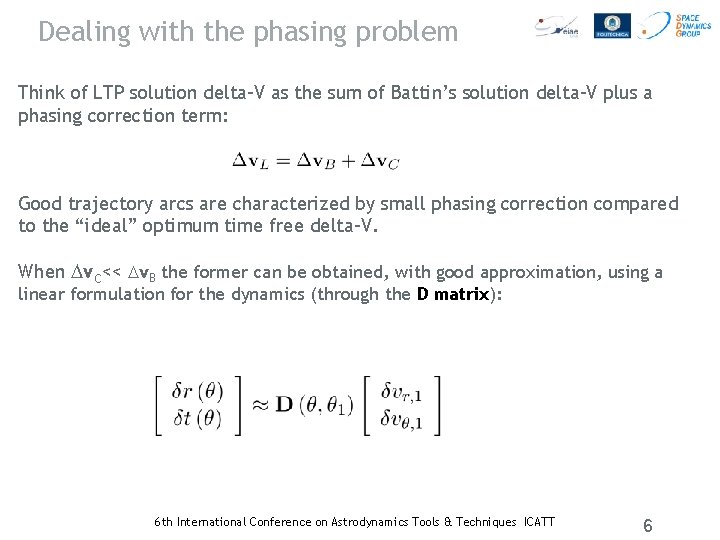
Dealing with the phasing problem Think of LTP solution delta-V as the sum of Battin’s solution delta-V plus a phasing correction term: Good trajectory arcs are characterized by small phasing correction compared to the “ideal” optimum time free delta-V. When v. C<< v. B the former can be obtained, with good approximation, using a linear formulation for the dynamics (through the D matrix): 6 th International Conference on Astrodynamics Tools & Techniques ICATT 6

The D matrix (1) The D matrix is an error state transition matrix for the Keplerian dynamics where time(t) is a state variable and the angle is the indep. variable. Analytically derived in 2014 (Bombardelli CMDA) and motivated by the collision avoidance problem. Model the state as: Consider the state “error” at = 1: The radial position (r) and phasing (t) errors at a generic can be approximated by: 6 th International Conference on Astrodynamics Tools & Techniques ICATT 7
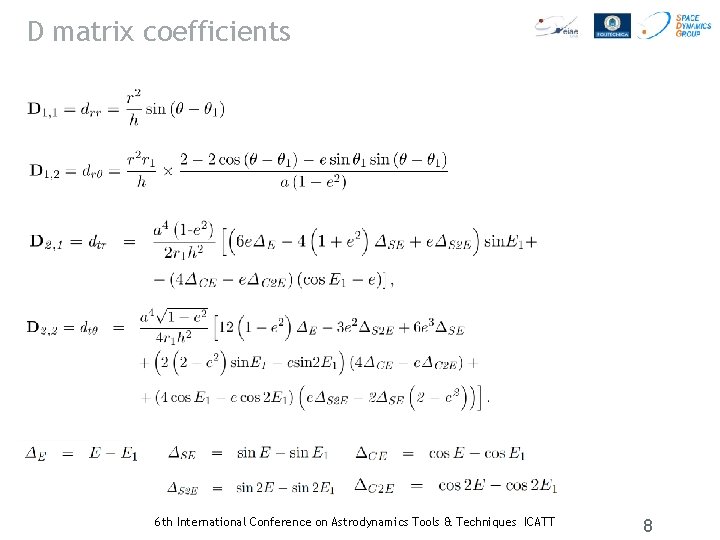
D matrix coefficients 6 th International Conference on Astrodynamics Tools & Techniques ICATT 8
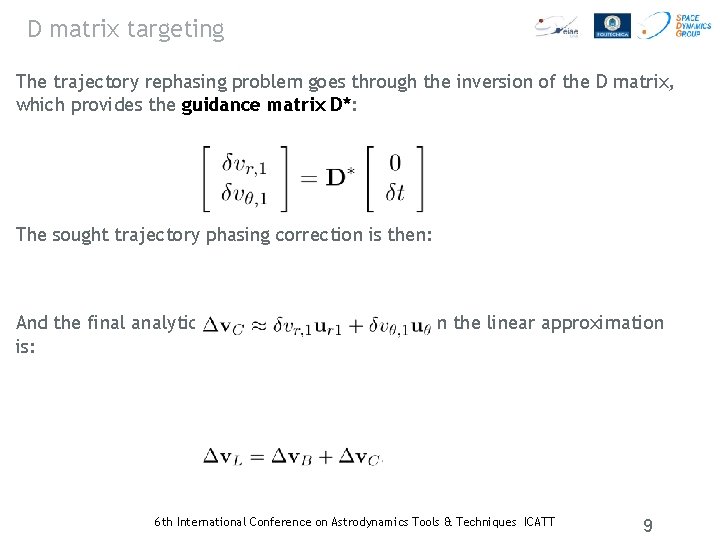
D matrix targeting The trajectory rephasing problem goes through the inversion of the D matrix, which provides the guidance matrix D*: The sought trajectory phasing correction is then: And the final analytical solution of the LTP, within the linear approximation is: 6 th International Conference on Astrodynamics Tools & Techniques ICATT 9

The Ion Beam Shepherd (IBS) Concept RESULTS 6 th International Conference on Astrodynamics Tools & Techniques ICATT 10
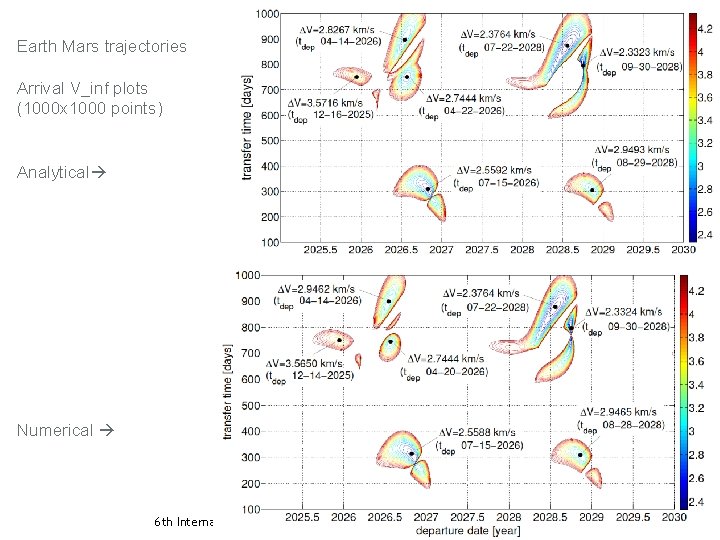
Earth Mars trajectories Arrival V_inf plots (1000 x 1000 points) Analytical Numerical 6 th International Conference on Astrodynamics Tools & Techniques ICATT 11
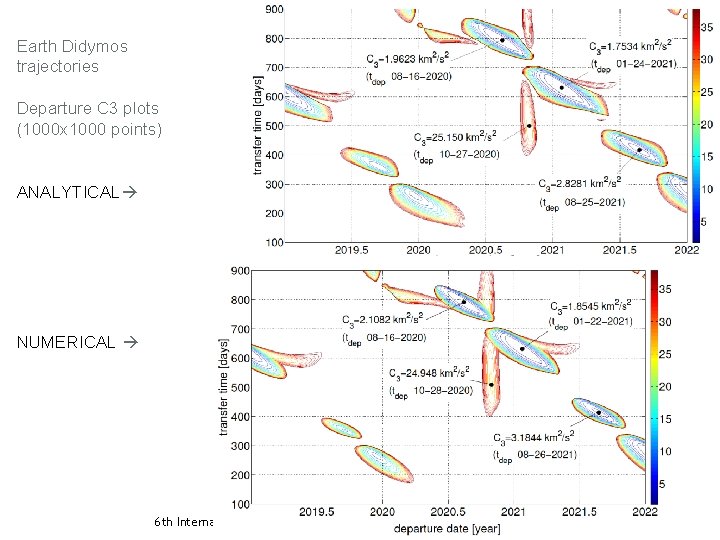
Earth Didymos trajectories Departure C 3 plots (1000 x 1000 points) ANALYTICAL NUMERICAL 6 th International Conference on Astrodynamics Tools & Techniques ICATT 12
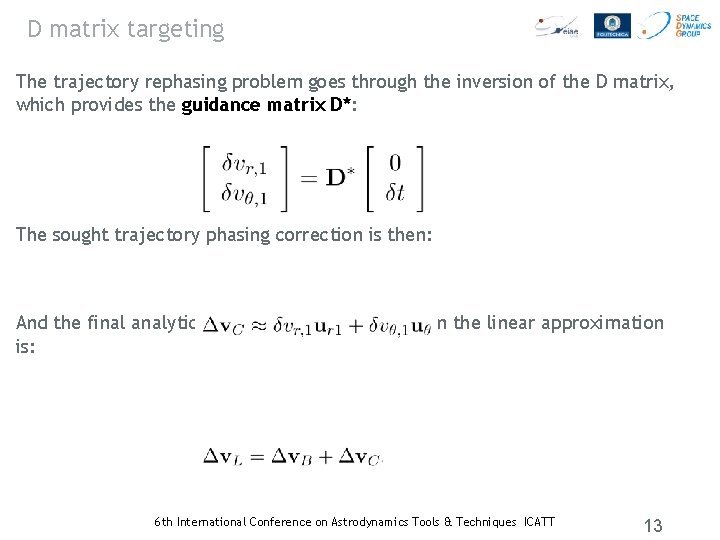
D matrix targeting The trajectory rephasing problem goes through the inversion of the D matrix, which provides the guidance matrix D*: The sought trajectory phasing correction is then: And the final analytical solution of the LTP, within the linear approximation is: 6 th International Conference on Astrodynamics Tools & Techniques ICATT 13
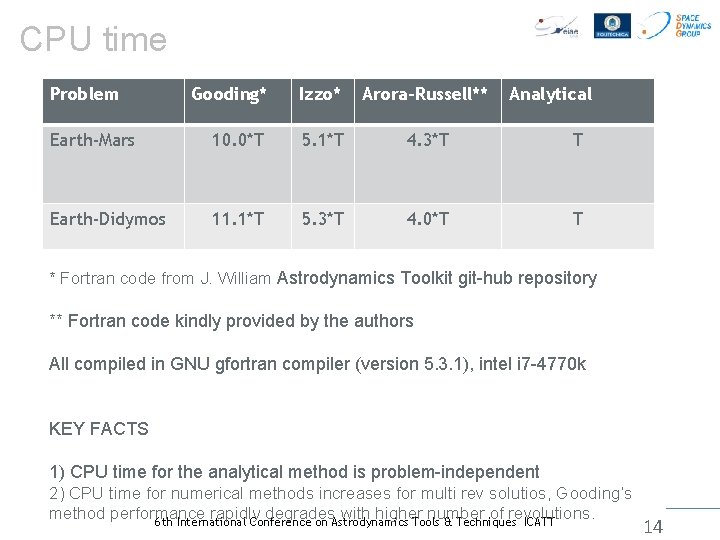
CPU time Problem Gooding* Izzo* Arora-Russell** Analytical Earth-Mars 10. 0*T 5. 1*T 4. 3*T T Earth-Didymos 11. 1*T 5. 3*T 4. 0*T T * Fortran code from J. William Astrodynamics Toolkit git-hub repository ** Fortran code kindly provided by the authors All compiled in GNU gfortran compiler (version 5. 3. 1), intel i 7 -4770 k KEY FACTS 1) CPU time for the analytical method is problem-independent 2) CPU time for numerical methods increases for multi rev solutios, Gooding’s method performance rapidly degrades with higher number of revolutions. 6 th International Conference on Astrodynamics Tools & Techniques ICATT 14
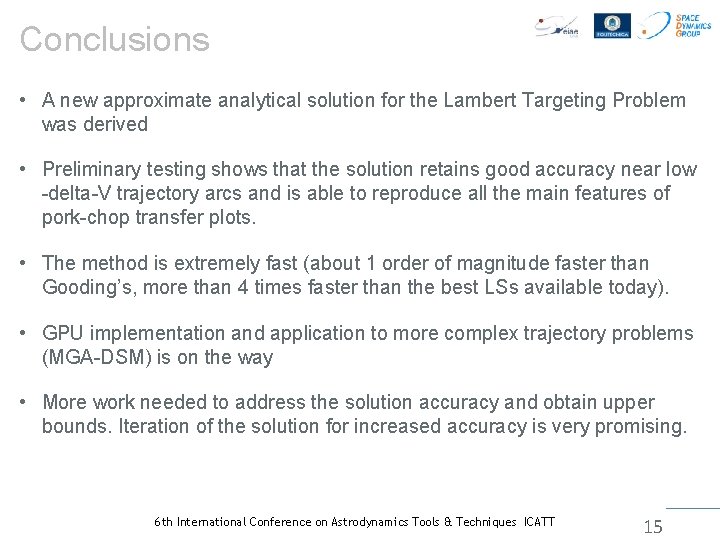
Conclusions • A new approximate analytical solution for the Lambert Targeting Problem was derived • Preliminary testing shows that the solution retains good accuracy near low -delta-V trajectory arcs and is able to reproduce all the main features of pork-chop transfer plots. • The method is extremely fast (about 1 order of magnitude faster than Gooding’s, more than 4 times faster than the best LSs available today). • GPU implementation and application to more complex trajectory problems (MGA-DSM) is on the way • More work needed to address the solution accuracy and obtain upper bounds. Iteration of the solution for increased accuracy is very promising. 6 th International Conference on Astrodynamics Tools & Techniques ICATT 15
- Slides: 15