
Multiple Perspectives of a Fidelity Scale for Enhancing

- Slides: 40
Multiple Perspectives of a Fidelity Scale for Enhancing Co-Occurring Disorder Treatment Presented by Gilbert Lichstein Vilmarie Fraguada Narloch
Who we are Vilmarie Narloch, Psy. D Manager of Training and Technical Assistance Heartland Alliance Health Illinois Co-occurring Center for Excellence Email: vnarloch@heartlandalliance. org Cell: 312 -632 -0264 Illinois Co-occurring Center for Excellence
Who we are Gilbert Lichstein, LCPC Clinical Director Gateway Foundation Chicago Independence and River North Programs Email: gslichst@gatewayfoundation. org Cell: (773) 633 -5340
Agenda Introduce the Dual Diagnosis Capability in Addiction Treatment (DDCAT) Index Discuss the development and research of the DDCAT Index Review and discuss the seven dimensions Learn about how items are scored Discuss ASPIRE program’s process through the DDCAT review, training, and follow-up
Introduction to the DDCAT Dual Diagnosis Capability in Addiction Treatment
WHAT IS THE DDCAT? Dual Diagnosis Capability in Addiction Treatment Index An instrument for measuring addiction treatment program services for individuals with co-occurring (i. e. , mental health and substance use) disorders
Why focus on co-occurring disorders? Substance use disorders are common in people with mental health disorders and vice versa Co-occurring disorders lead to worse outcomes and higher costs when left unaddressed
DDCAT DEVELOPMENT Developed by Dr. Mark Mc. Govern, Dept. of Psychiatry, Dartmouth Medical School In development since 2003 (Version 4. 0) Used feedback from experts in COD treatment, research, fidelity measures Field tested in CT and LA Proven psychometric validity
Adaptations of the tool Mental Health Treatment (DDCMHT) Health Care Settings (DDCHS) Used in a nationwide collaborative Used in development of funding agency guidelines and requirements.
Why do we need a measure of COD capacity? We are motivated internally and externally for improving services for people with COD, so we seek specific and objective approaches Generic terms of “enhanced” or “integrated” lacked specific definitions ASAM gives us a roadmap, but no definitions Providers want benchmarks and guidance in providing the best services Consumers and families want to make informed decisions about treatment options Can more efficiently focus efforts and assess outcomes
Evidence Based? Based on evidence-based fidelity methodology Fidelity adherence models to evidence-based practices or
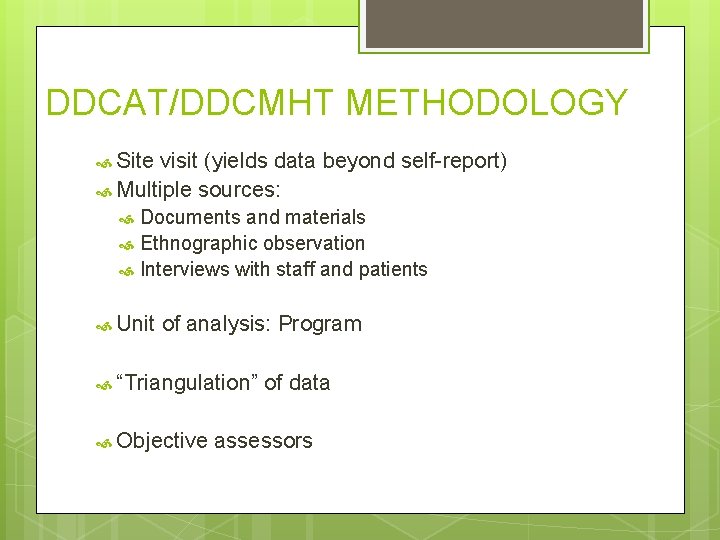
DDCAT/DDCMHT METHODOLOGY Site visit (yields data beyond self-report) Multiple sources: Documents and materials Ethnographic observation Interviews with staff and patients Unit of analysis: Program “Triangulation” Objective of data assessors
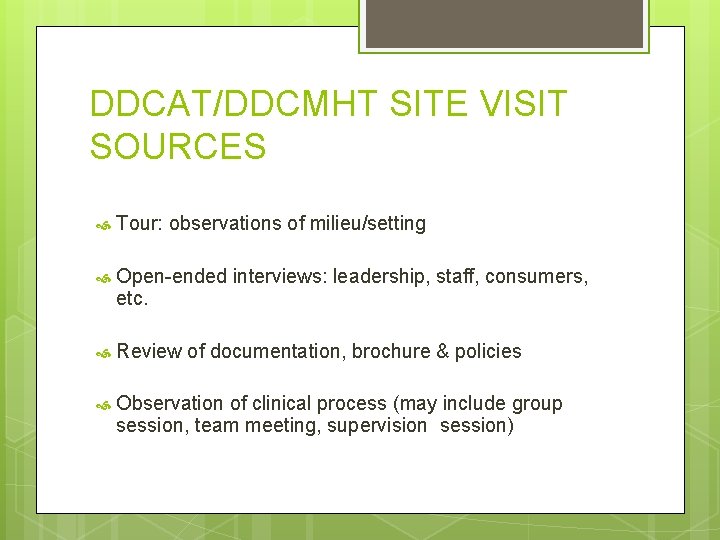
DDCAT/DDCMHT SITE VISIT SOURCES Tour: observations of milieu/setting Open-ended interviews: leadership, staff, consumers, etc. Review of documentation, brochure & policies Observation of clinical process (may include group session, team meeting, supervision session)
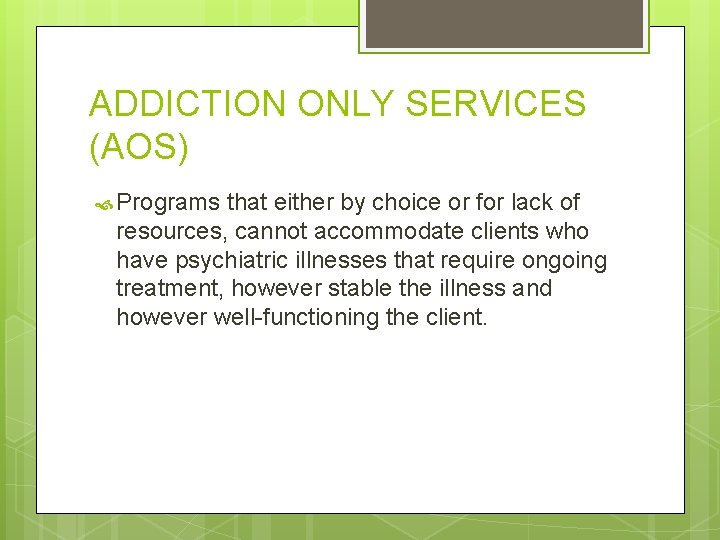
ADDICTION ONLY SERVICES (AOS) Programs that either by choice or for lack of resources, cannot accommodate clients who have psychiatric illnesses that require ongoing treatment, however stable the illness and however well-functioning the client.
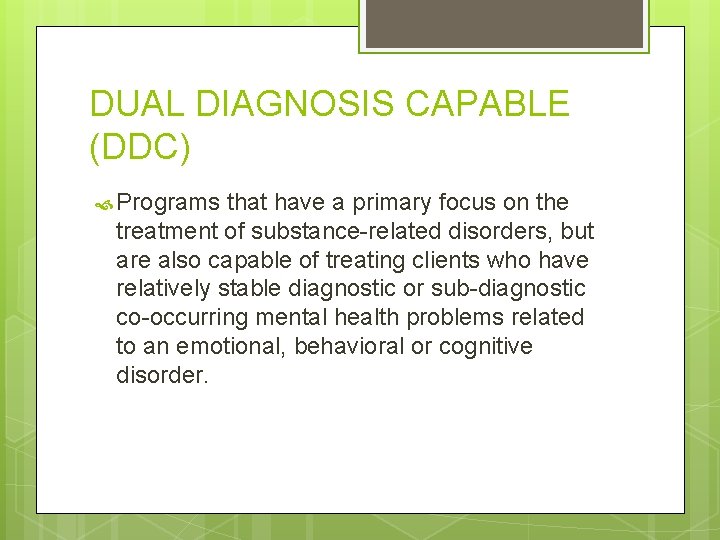
DUAL DIAGNOSIS CAPABLE (DDC) Programs that have a primary focus on the treatment of substance-related disorders, but are also capable of treating clients who have relatively stable diagnostic or sub-diagnostic co-occurring mental health problems related to an emotional, behavioral or cognitive disorder.
DUAL DIAGNOSIS ENHANCED (DDE) Programs that are designed to treat clients who have more unstable or disabling co-occurring mental health disorders in addition to their substance-related disorders.
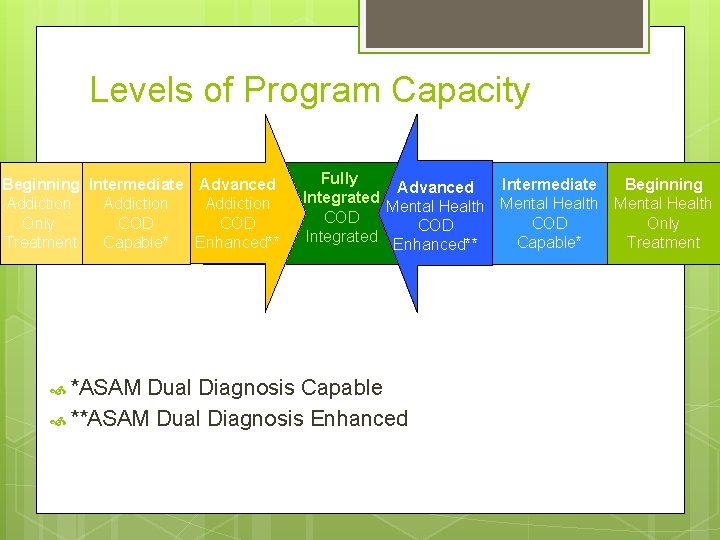
Levels of Program Capacity Beginning Intermediate Advanced Addiction Only COD Enhanced** Treatment Capable* *ASAM Fully Intermediate Beginning Advanced Integrated Mental Health COD Only COD Integrated Capable* Treatment Enhanced** Dual Diagnosis Capable **ASAM Dual Diagnosis Enhanced
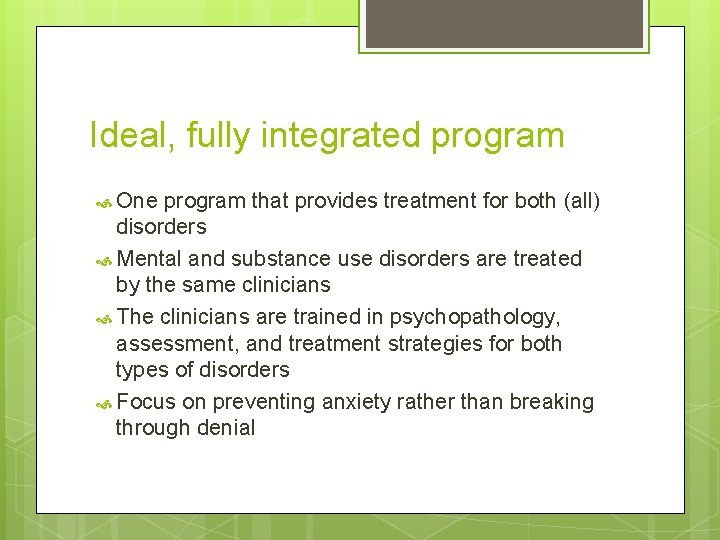
Ideal, fully integrated program One program that provides treatment for both (all) disorders Mental and substance use disorders are treated by the same clinicians The clinicians are trained in psychopathology, assessment, and treatment strategies for both types of disorders Focus on preventing anxiety rather than breaking through denial
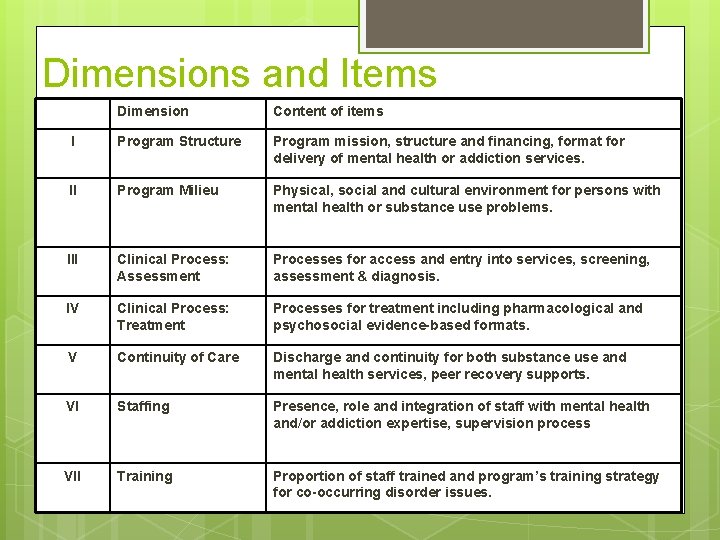
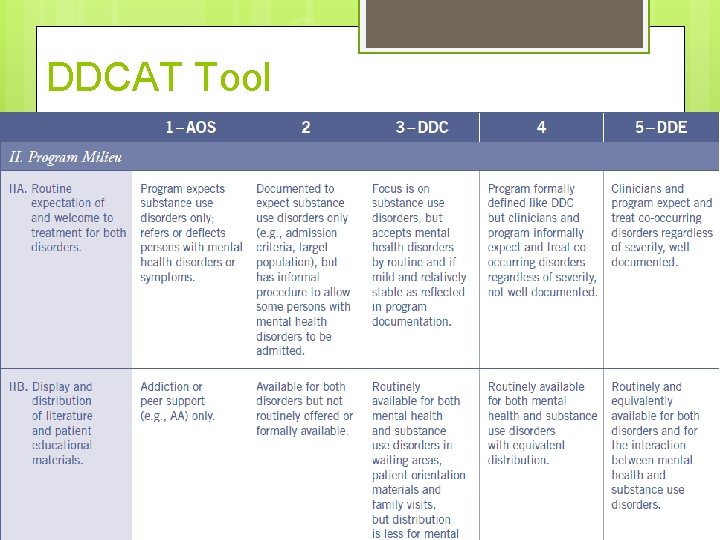
Dimensions and Items Dimension Content of items I Program Structure Program mission, structure and financing, format for delivery of mental health or addiction services. II Program Milieu Physical, social and cultural environment for persons with mental health or substance use problems. III Clinical Process: Assessment Processes for access and entry into services, screening, assessment & diagnosis. IV Clinical Process: Treatment Processes for treatment including pharmacological and psychosocial evidence-based formats. V Continuity of Care Discharge and continuity for both substance use and mental health services, peer recovery supports. VI Staffing Presence, role and integration of staff with mental health and/or addiction expertise, supervision process VII Training Proportion of staff trained and program’s training strategy for co-occurring disorder issues.
DDCAT Tool
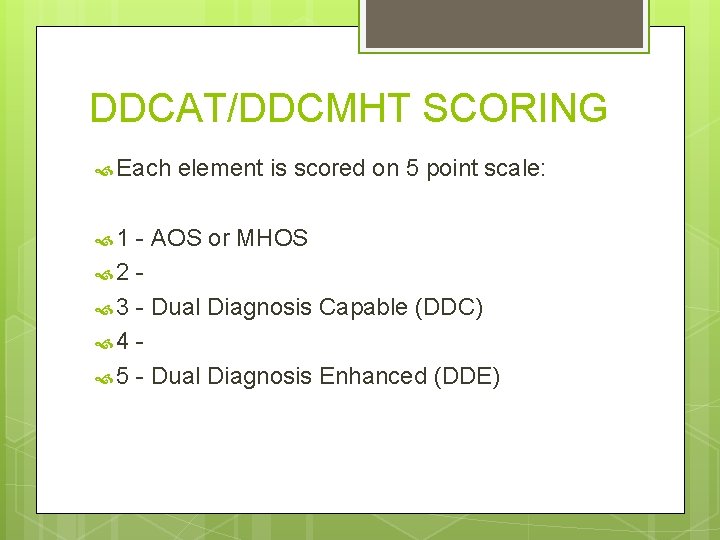
DDCAT/DDCMHT SCORING Each 1 element is scored on 5 point scale: - AOS or MHOS 2 3 - Dual Diagnosis Capable (DDC) 4 5 - Dual Diagnosis Enhanced (DDE)
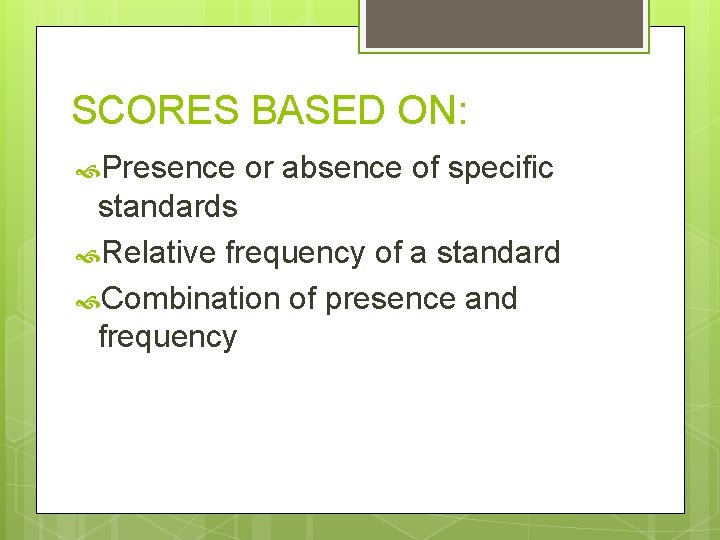
SCORES BASED ON: Presence or absence of specific standards Relative frequency of a standard Combination of presence and frequency
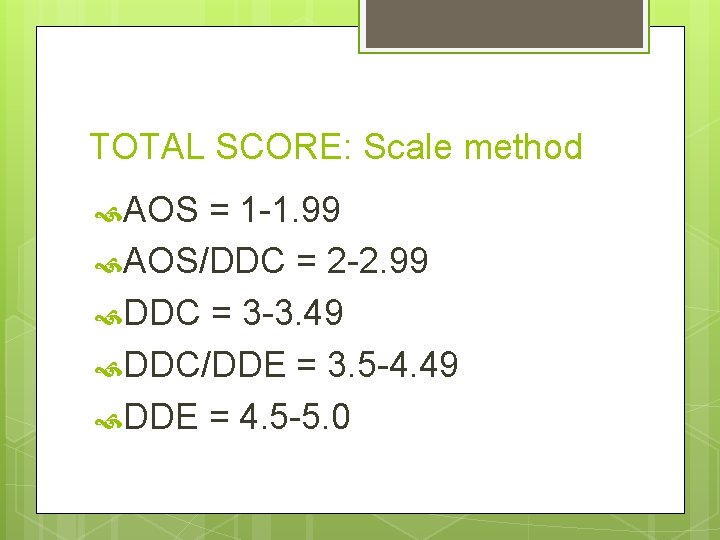
TOTAL SCORE: Scale method AOS = 1 -1. 99 AOS/DDC = 2 -2. 99 DDC = 3 -3. 49 DDC/DDE = 3. 5 -4. 49 DDE = 4. 5 -5. 0
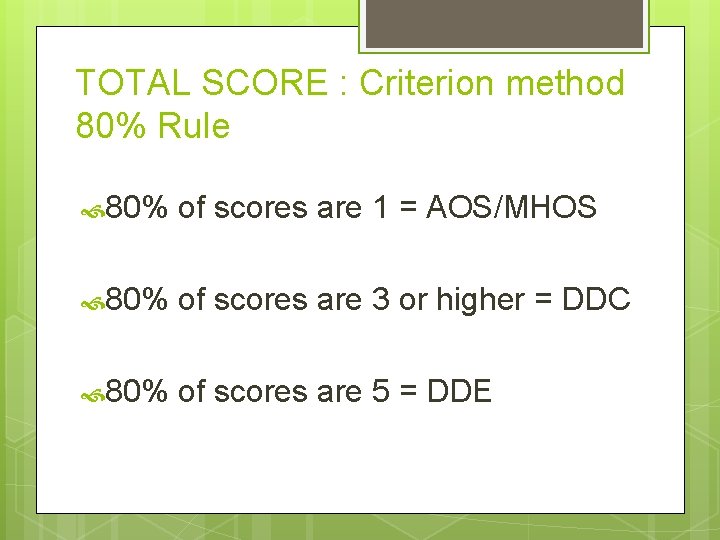
TOTAL SCORE : Criterion method 80% Rule 80% of scores are 1 = AOS/MHOS 80% of scores are 3 or higher = DDC 80% of scores are 5 = DDE
IN A NATIONAL STUDY OF 256 PROGRAMS, ONLY ONE WAS DEEMED DUAL DIAGNOSIS ENHANCED (DDE) BEA UTY Mc. Govern, et al. Dual diagnosis capability in mental health and addiction treatment services: An assessment of programs across multiple state systems. Adm Policy Ment Health. 2014 Mar; 41(2): 205214.
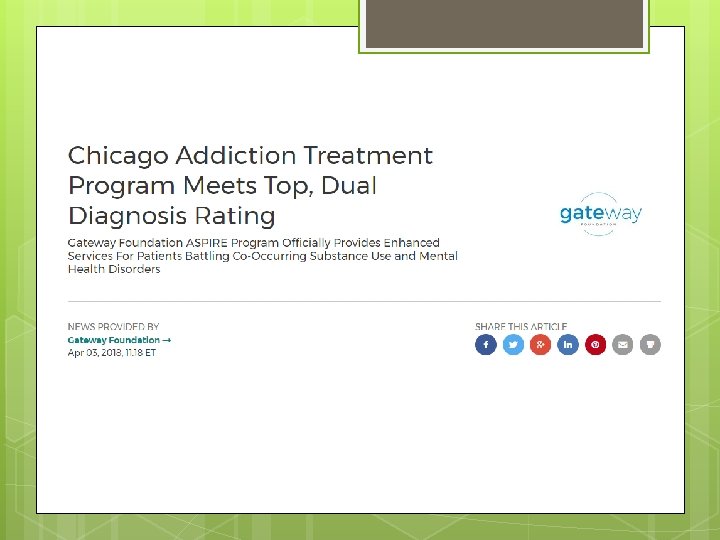
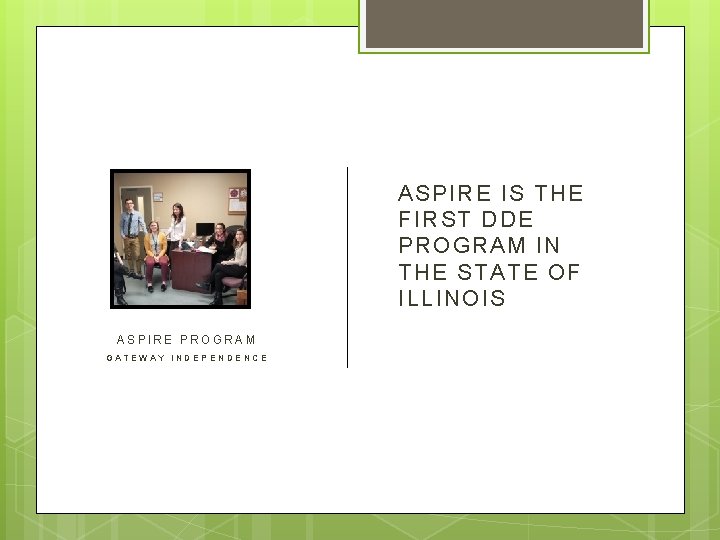
ASPIRE IS THE FIRST DDE PROGRAM IN THE STATE OF ILLINOIS ASPIRE PROGRAM GATEWAY INDEPENDENCE
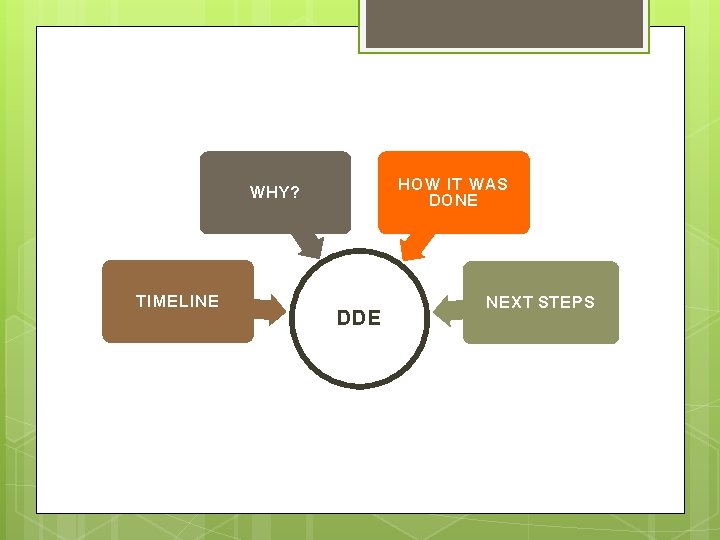
HOW IT WAS DONE WHY? TIMELINE DDE NEXT STEPS
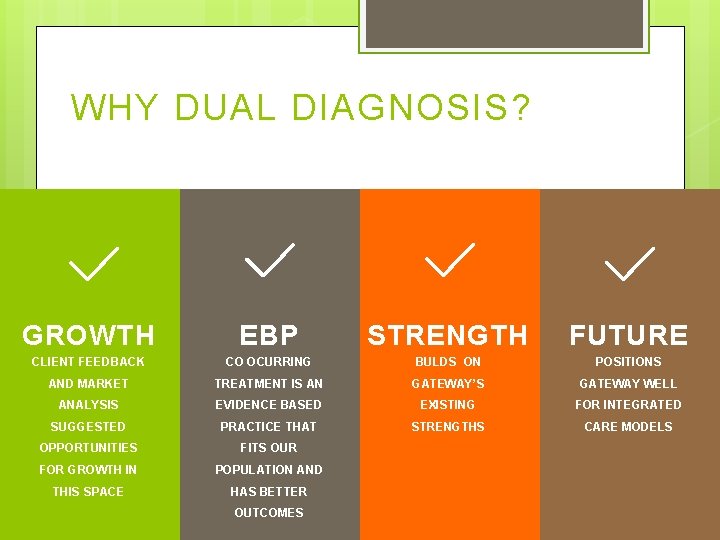
WHY DUAL DIAGNOSIS? GROWTH EBP STRENGTH FUTURE CLIENT FEEDBACK CO OCURRING BULDS ON POSITIONS AND MARKET TREATMENT IS AN GATEWAY’S GATEWAY WELL ANALYSIS EVIDENCE BASED EXISTING FOR INTEGRATED SUGGESTED PRACTICE THAT STRENGTHS CARE MODELS OPPORTUNITIES FITS OUR FOR GROWTH IN POPULATION AND THIS SPACE HAS BETTER OUTCOMES
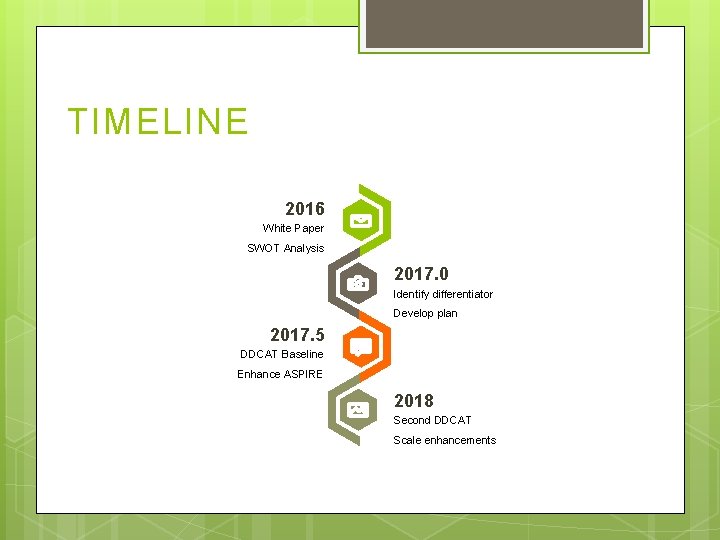
TIMELINE. 2016 White Paper SWOT Analysis 2017. 0 Identify differentiator Develop plan 2017. 5 DDCAT Baseline Enhance ASPIRE 2018 Second DDCAT Scale enhancements
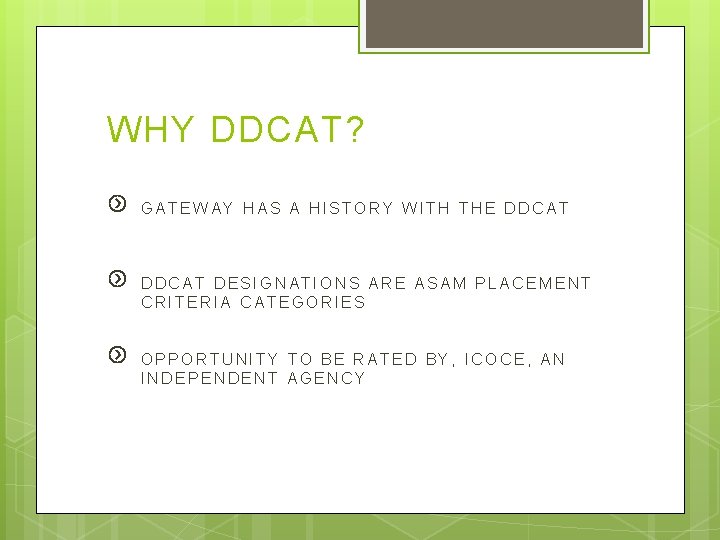
WHY DDCAT? GATEWAY HAS A HISTORY WITH THE DDCAT DESIGNATIONS ARE ASAM PLACEMENT CRITERIA CATEGORIES OPPORTUNITY TO BE RATED BY, ICOCE, AN INDEPENDENT AGENCY
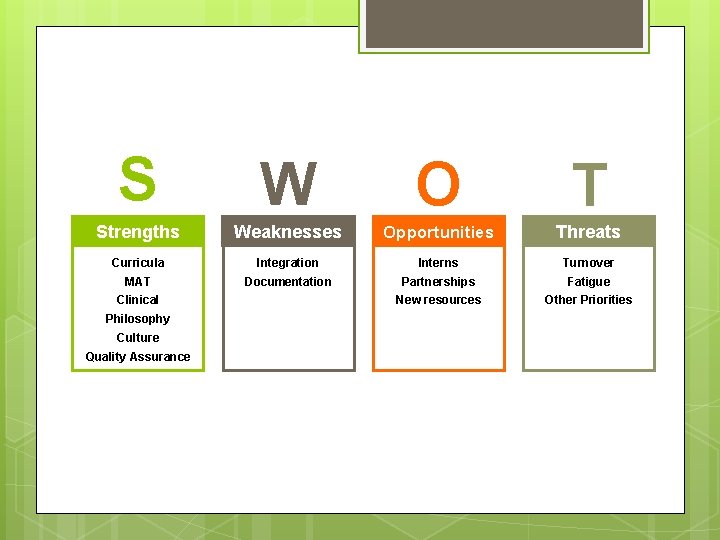
S W O T Strengths Weaknesses Opportunities Threats Curricula Integration Interns Turnover MAT Documentation Partnerships Fatigue New resources Other Priorities Clinical Philosophy Culture Quality Assurance
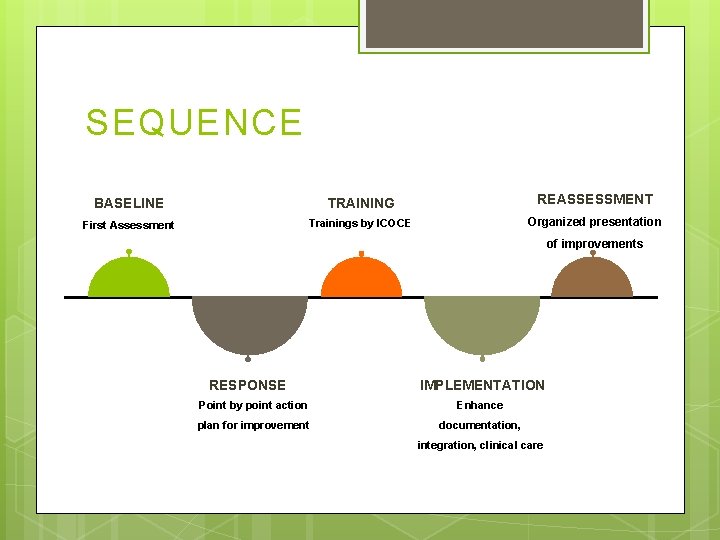
SEQUENCE BASELINE TRAINING REASSESSMENT First Assessment Trainings by ICOCE Organized presentation of improvements RESPONSE IMPLEMENTATION Point by point action Enhance plan for improvement documentation, integration, clinical care
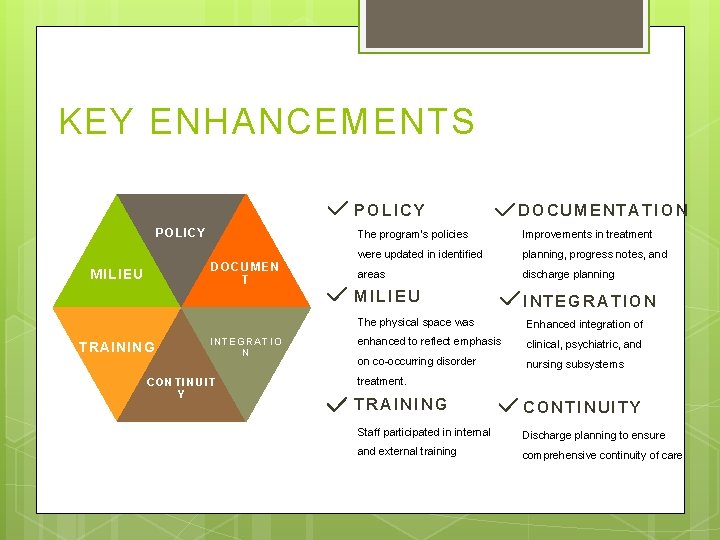
KEY ENHANCEMENTS. POLICY DOCUMEN T MILIEU The program’s policies Improvements in treatment were updated in identified planning, progress notes, and areas discharge planning MILIEU TRAINING INTEGRATIO N CONTINUIT Y DOCUMENTATION INTEGRATION The physical space was Enhanced integration of enhanced to reflect emphasis clinical, psychiatric, and on co-occurring disorder nursing subsystems treatment. TRAINING CONTINUITY Staff participated in internal Discharge planning to ensure and external training comprehensive continuity of care
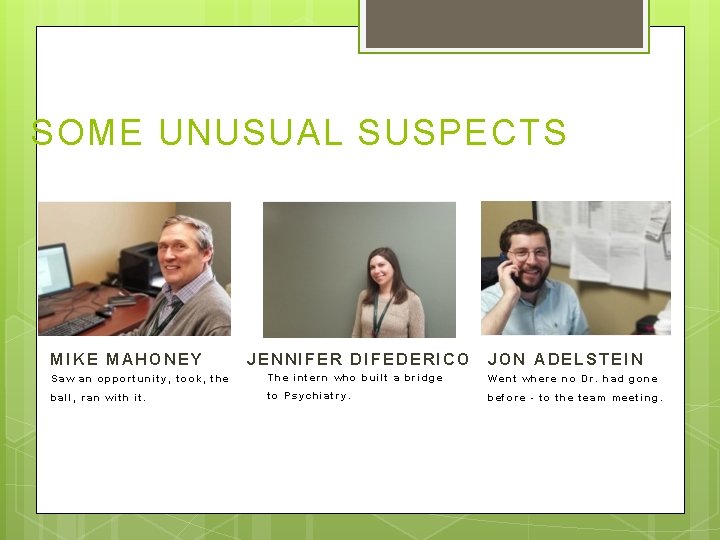
SOME UNUSUAL SUSPECTS. MIKE MAHONEY JENNIFER DIFEDERICO JON ADELSTEIN Saw an opportunity, took, the The intern who built a bridge Went where no Dr. had gone ball, ran with it. to Psychiatry. before - to the team meeting.
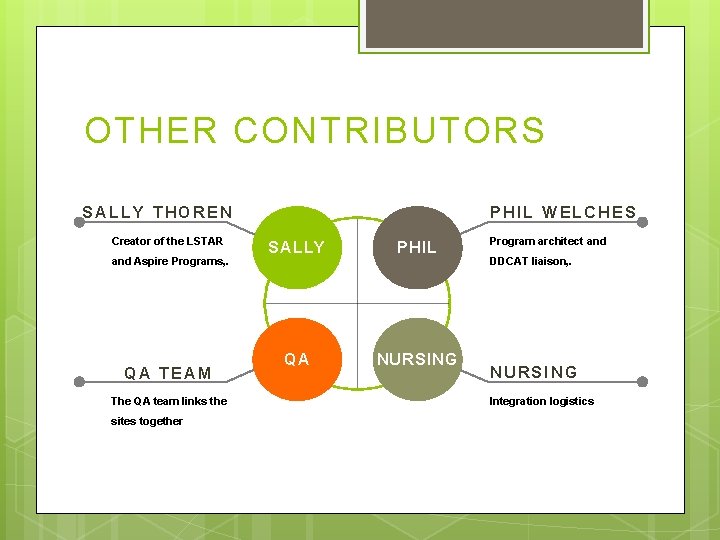
OTHER CONTRIBUTORS. SALLY THOREN Creator of the LSTAR and Aspire Programs, . QA TEAM The QA team links the sites together PHIL WELCHES SALLY PHIL QA NURSING Program architect and DDCAT liaison, . NURSING Integration logistics
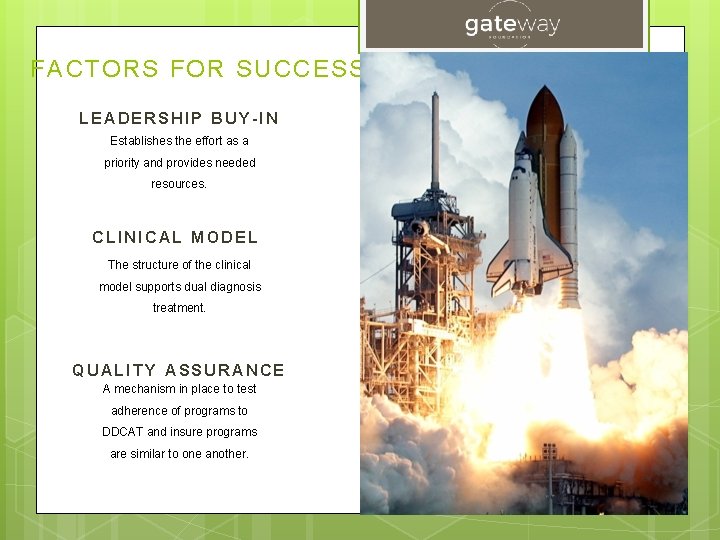
FACTORS FOR SUCCESS LEADERSHIP BUY-IN Establishes the effort as a priority and provides needed resources. CLINICAL MODEL The structure of the clinical model supports dual diagnosis treatment. QUALITY ASSURANCE A mechanism in place to test adherence of programs to DDCAT and insure programs are similar to one another.
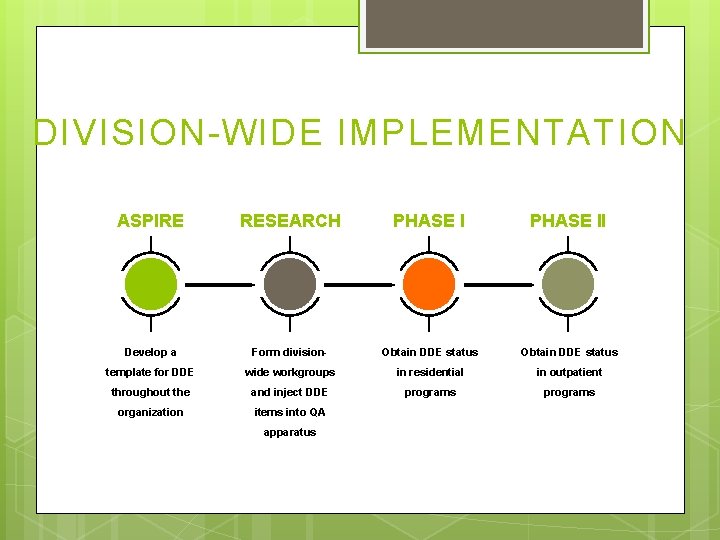
DIVISION-WIDE IMPLEMENTATION. ASPIRE RESEARCH PHASE II Develop a Form division- Obtain DDE status template for DDE wide workgroups in residential in outpatient throughout the and inject DDE programs organization items into QA apparatus
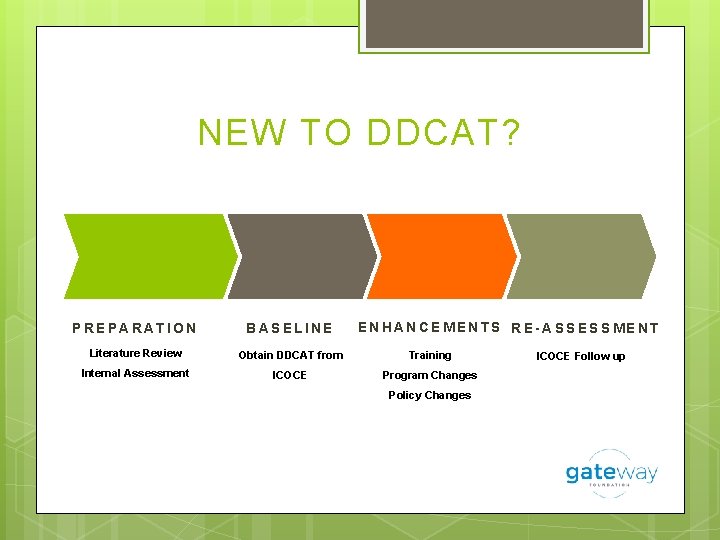
NEW TO DDCAT? ENHANCEMENTS RE-ASSESSMENT PREPARATION BASELINE Literature Review Obtain DDCAT from Training Internal Assessment ICOCE Program Changes Policy Changes ICOCE Follow up
Questions? ?