
Multiple Objective Linear Programming Decision Analysis and Optimization
Multiple Objective Linear Programming Decision Analysis and Optimization Susana Barreiro 28 - 30 April 2021
Content • Single- versus multi-objective problems • Decision making and multiple objectives • Multi-objective linear programming • Goal programming • Classical methods - conversion to single objective problems - Preemptive optimization - Weighted sums • True multi-objective linear programming - The optimality and the Pareto frontier concepts - Weighted sums - Evolutionary Multi-objective Optimization (EMO) Algorithms
Single- versus multi-objective problems
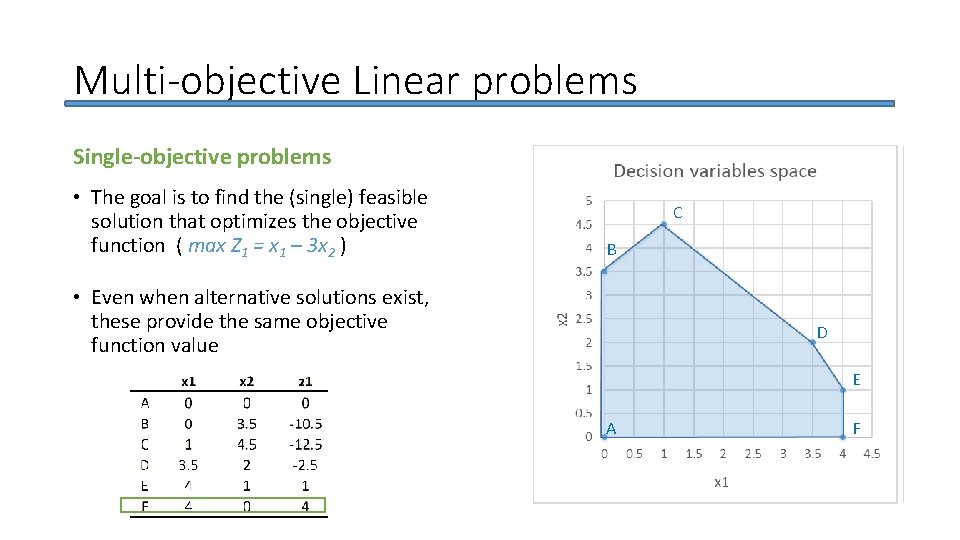
Multi-objective Linear problems Single-objective problems • The goal is to find the (single) feasible solution that optimizes the objective function ( max Z 1 = x 1 – 3 x 2 ) C B • Even when alternative solutions exist, these provide the same objective function value D E A F
Multi-objective Linear problems • In many situations more than one objective is generally important • Multi-objective programming deals with: § optimization problems with 2 or more objective functions § problem formulation differs in the expression of the objective function(s) § the evaluation of solutions is significantly different: instead of seeking an optimal or best overall solution, the goal is to quantify the degree of conflict (trade-off) • Several optimization techniques have been developed to capture explicitly the trade-offs that may exist between conflicting, and possibly noncommensurate, objectives
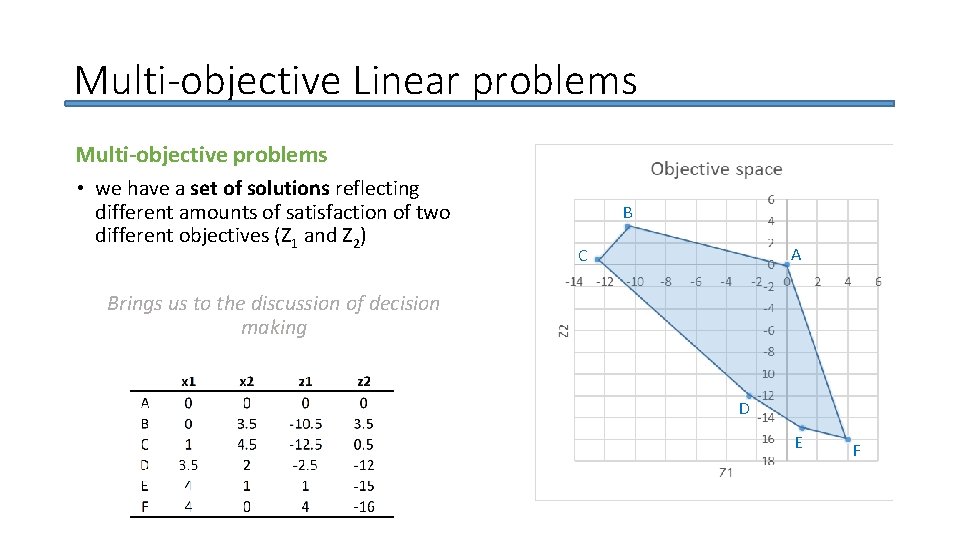
Multi-objective Linear problems Multi-objective problems • we have a set of solutions reflecting different amounts of satisfaction of two different objectives (Z 1 and Z 2) B A C Brings us to the discussion of decision making D E F
Multi-objective Linear problems For conflicting objectives the optimality concept may be inappropriate So, what does optimal mean in this case? A new concept that can measure solutions against multiple, conflicting and even noncommensurate objectives is required: the non-inferiority concept Dominance (mathematical programmers), Efficiency (statisticians and economists) Pareto optimality (welfare economists) A solution is non-inferior if there exists no other feasible solution with better performance with respect to any objective without having worse performance for at least one other objective
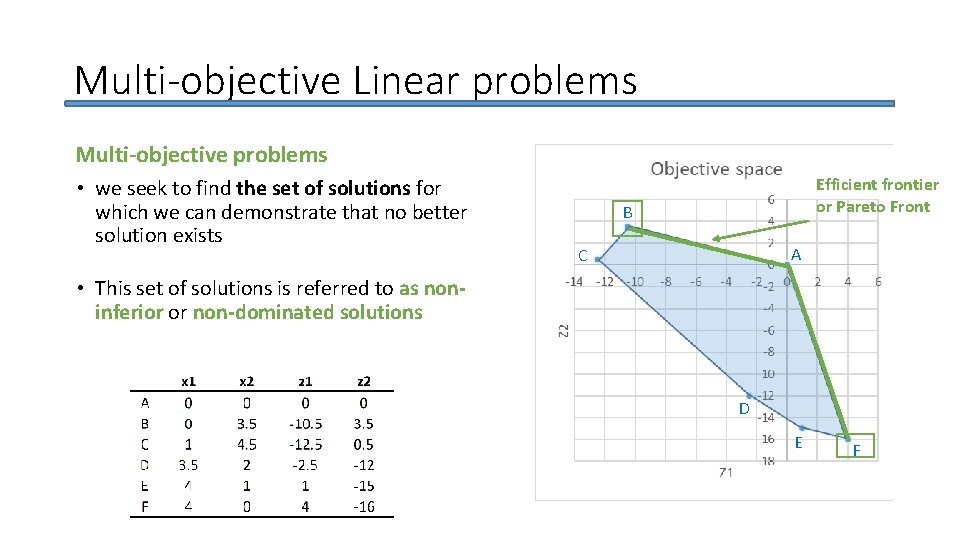
Multi-objective Linear problems Multi-objective problems • we seek to find the set of solutions for which we can demonstrate that no better solution exists Efficient frontier or Pareto Front B A C • This set of solutions is referred to as noninferior or non-dominated solutions D E F
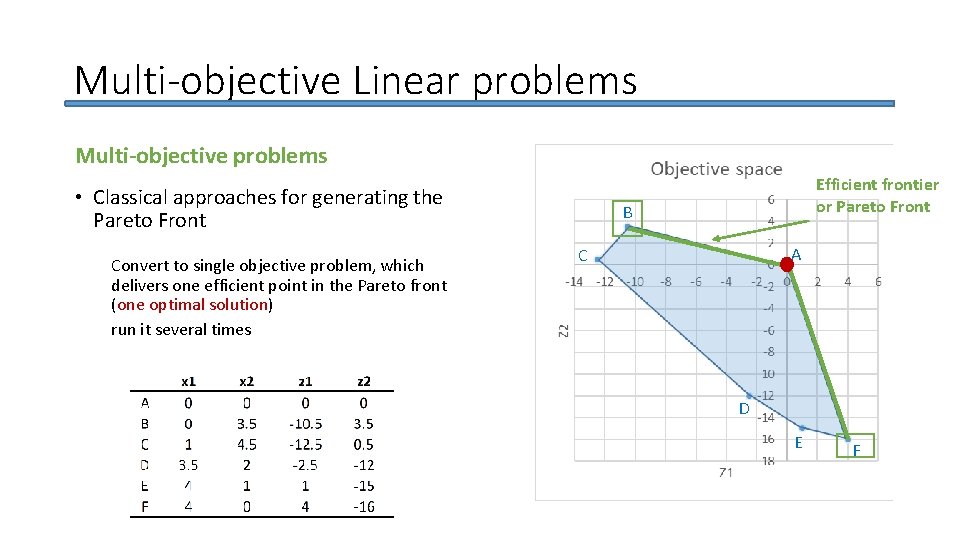
Multi-objective Linear problems Multi-objective problems • Classical approaches for generating the Pareto Front Convert to single objective problem, which delivers one efficient point in the Pareto front (one optimal solution) run it several times Efficient frontier or Pareto Front B A C D E F
Decision making and multiple objectives
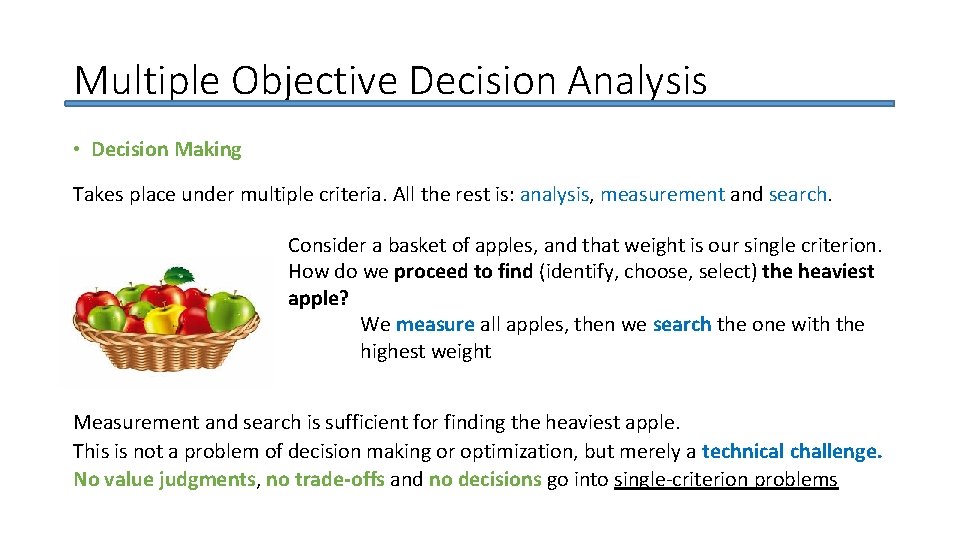
Multiple Objective Decision Analysis • Decision Making Takes place under multiple criteria. All the rest is: analysis, measurement and search. Consider a basket of apples, and that weight is our single criterion. How do we proceed to find (identify, choose, select) the heaviest apple? We measure all apples, then we search the one with the highest weight Measurement and search is sufficient for finding the heaviest apple. This is not a problem of decision making or optimization, but merely a technical challenge. No value judgments, no trade-offs and no decisions go into single-criterion problems
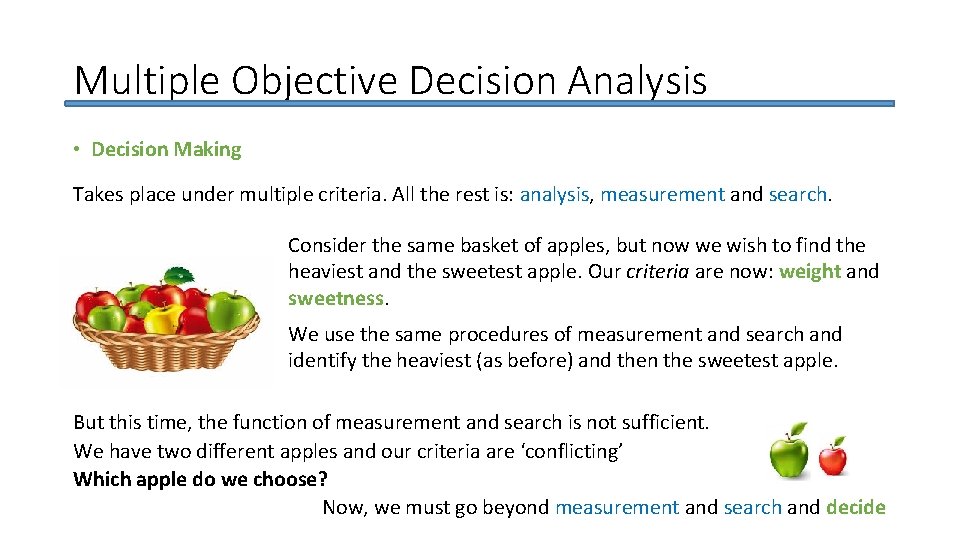
Multiple Objective Decision Analysis • Decision Making Takes place under multiple criteria. All the rest is: analysis, measurement and search. Consider the same basket of apples, but now we wish to find the heaviest and the sweetest apple. Our criteria are now: weight and sweetness. We use the same procedures of measurement and search and identify the heaviest (as before) and then the sweetest apple. But this time, the function of measurement and search is not sufficient. We have two different apples and our criteria are ‘conflicting’ Which apple do we choose? Now, we must go beyond measurement and search and decide
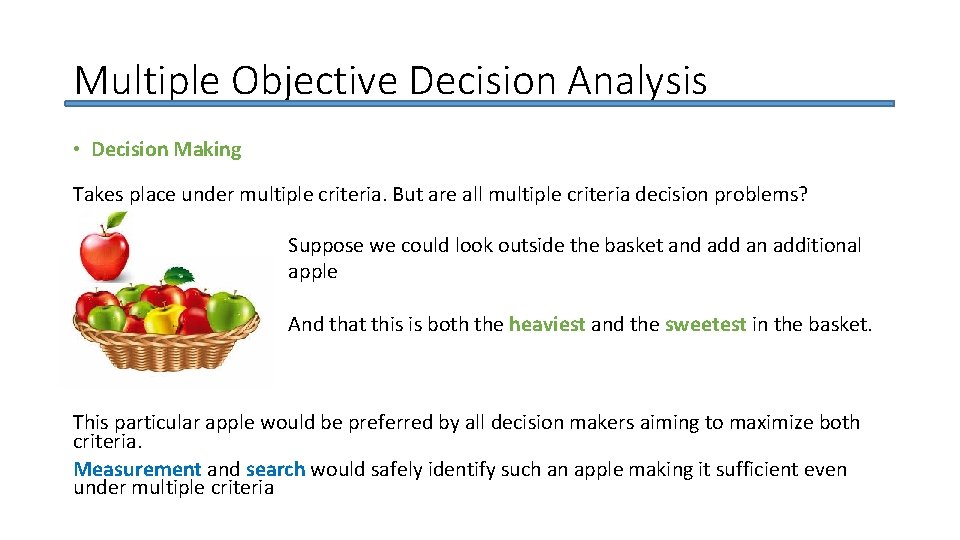
Multiple Objective Decision Analysis • Decision Making Takes place under multiple criteria. But are all multiple criteria decision problems? Suppose we could look outside the basket and add an additional apple And that this is both the heaviest and the sweetest in the basket. This particular apple would be preferred by all decision makers aiming to maximize both criteria. Measurement and search would safely identify such an apple making it sufficient even under multiple criteria
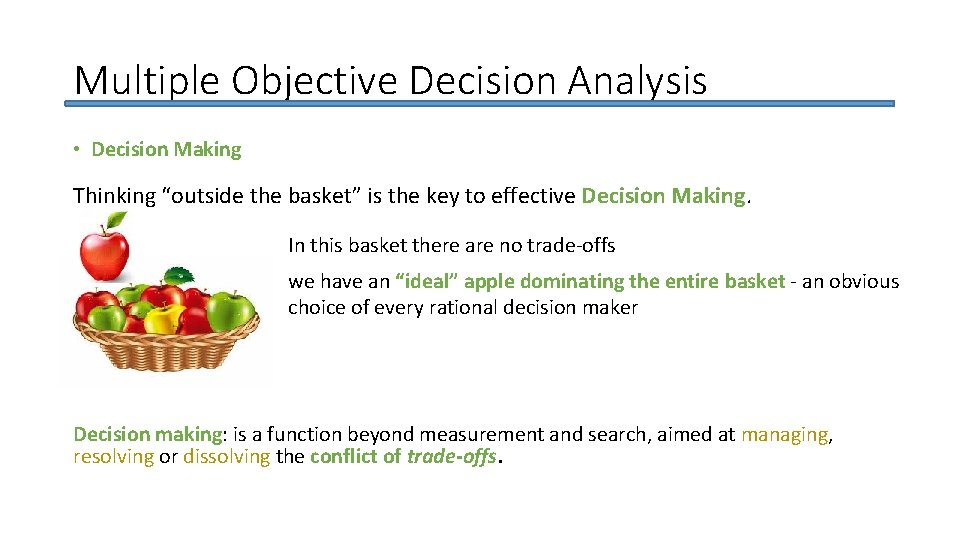
Multiple Objective Decision Analysis • Decision Making Thinking “outside the basket” is the key to effective Decision Making. In this basket there are no trade-offs we have an “ideal” apple dominating the entire basket - an obvious choice of every rational decision maker Decision making: is a function beyond measurement and search, aimed at managing, resolving or dissolving the conflict of trade-offs.
Multiple Objective Decision Analysis • Decision Making Challenges • Existence of multiple conflicting objectives (e. g. car: comfort vs price; house: square footage vs price) • Difficulty in identifying good alternatives (e. g. firing one-third of your employees, reducing everyone’s pay) • Existence of intangibles ie, difficult-to-measure (e. g. consumer satisfaction, employee morale, recreation value) • Existence Long time horizons where the consequences of decisions that must be made today, will not be known for years/decades (e. g forest management and planning) • Interdisciplinary substance of decisions and/or having multiple decision makers require information from several “areas of expertise”, (e. g. forest owners, forest managers, public laws, funding schemes) • Uncertainty and risk: not being able to precisely predict the future raises questions (one can try to use historical data, expert judgments, simulations to deal with uncertainty and risk) • Being able to quantify trade-offs: expressing the value trade-offs among the multiple objectives
Multiple Objective Decision Analysis • Multiple Objective Decision Analysis (MODA) is an operations research technique for evaluating a decision under multiple, sometimes competing and conflicting objectives or criteria. • Multi-objective optimization leads to a set of optimal solutions (known as Pareto -optimal solutions) since no solution can be considered better than any other regarding all the objectives • MODA provides a process that systematically identifies alternatives and the decision maker’s objectives that serves as the measuring device for selecting the preferred alternative given the decision space. • Decision makers try to balance multiple objectives (e. g. , cost, performance, reliability) none of which is obviously the best
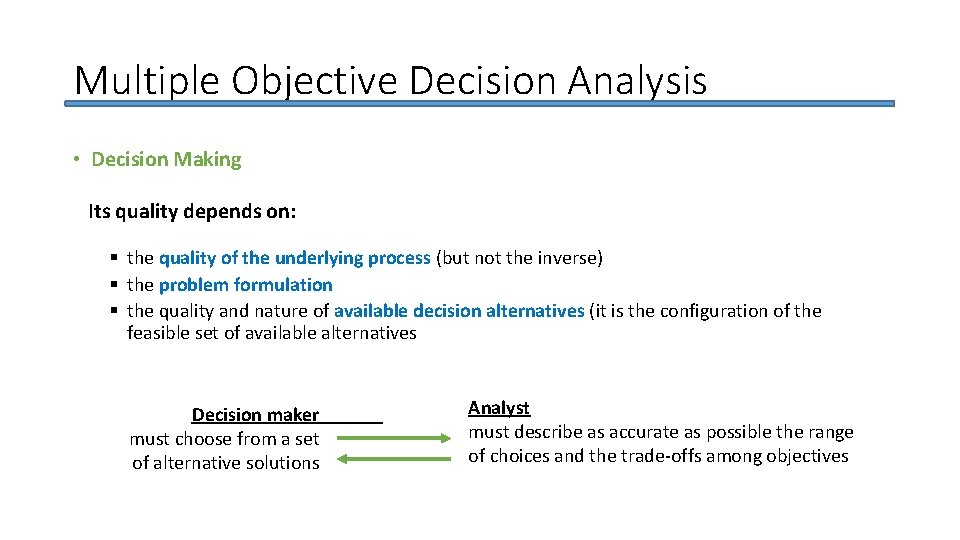
Multiple Objective Decision Analysis • Decision Making Its quality depends on: § the quality of the underlying process (but not the inverse) § the problem formulation § the quality and nature of available decision alternatives (it is the configuration of the feasible set of available alternatives Decision maker must choose from a set of alternative solutions Analyst must describe as accurate as possible the range of choices and the trade-offs among objectives
Multi-objective linear programming Goal programming Classical methods - conversion to single objective problems True multi-objective linear programming
Multi-objective linear problems Multi-objective optimization problems can be formulated as: Minimize / Maximize fi (x) i = 1, …, Nobj – number of objective functions Subject to: a set of constraints (equality and inequality, sometimes with bounded var. ) To simplify the solution process, in optimization problems with a number of objective functions, additional objective functions are usually handled as constraints HOWEVER final solutions satisfying those constraints cannot be called optimal with respect to all the objective functions
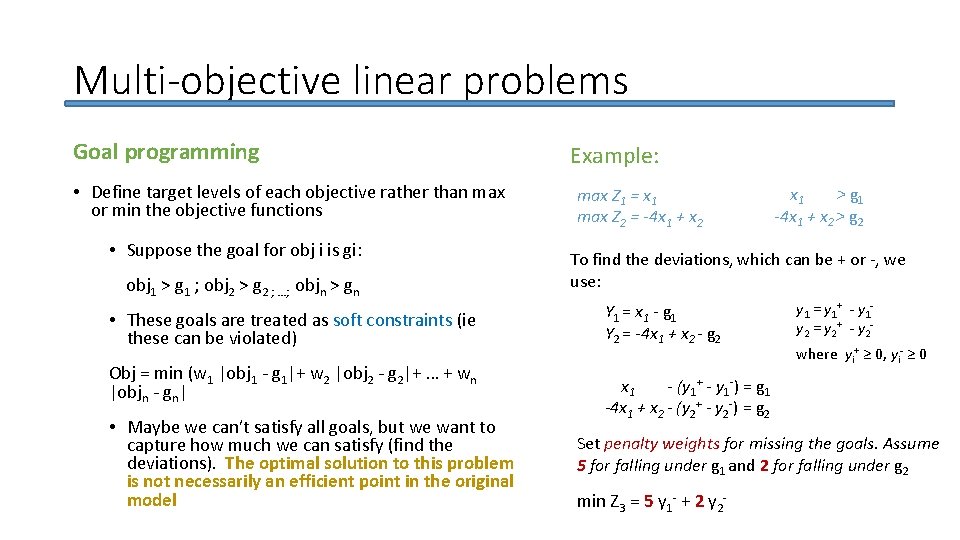
Multi-objective linear problems Goal programming • Define target levels of each objective rather than max or min the objective functions • Suppose the goal for obj i is gi: obj 1 > g 1 ; obj 2 > g 2 ; …; objn > gn • These goals are treated as soft constraints (ie these can be violated) Obj = min (w 1 |obj 1 - g 1|+ w 2 |obj 2 - g 2|+ … + wn |objn - gn| • Maybe we can’t satisfy all goals, but we want to capture how much we can satisfy (find the deviations). The optimal solution to this problem is not necessarily an efficient point in the original model Example: max Z 1 = x 1 max Z 2 = -4 x 1 + x 2 x 1 > g 1 -4 x 1 + x 2 > g 2 To find the deviations, which can be + or -, we use: Y 1 = x 1 - g 1 Y 2 = -4 x 1 + x 2 - g 2 y 1 = y 1 + - y 1 y 2 = y 2 + - y 2 where yi+ ≥ 0, yi- ≥ 0 x 1 - (y 1+ - y 1 -) = g 1 -4 x 1 + x 2 - (y 2+ - y 2 -) = g 2 Set penalty weights for missing the goals. Assume 5 for falling under g 1 and 2 for falling under g 2 min Z 3 = 5 y 1 - + 2 y 2 -
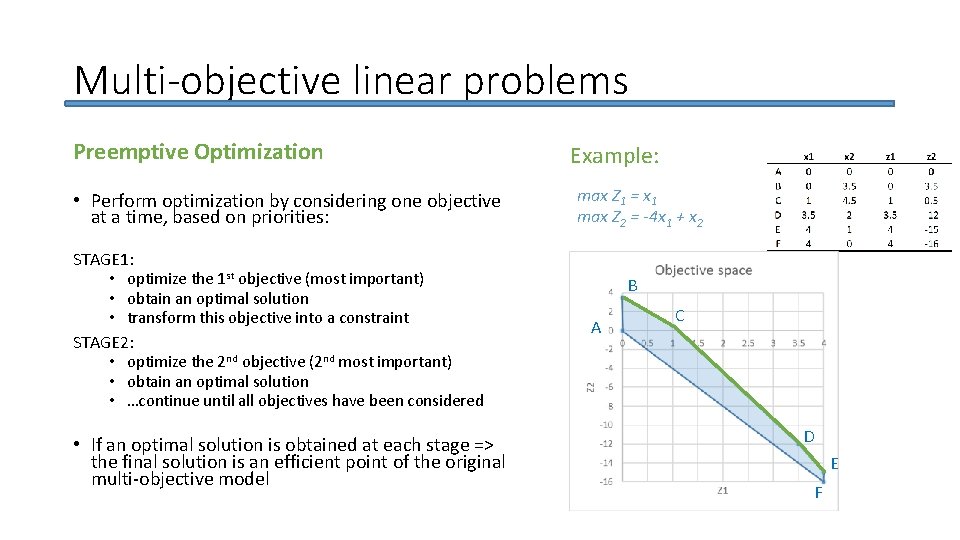
Multi-objective linear problems Preemptive Optimization • Perform optimization by considering one objective at a time, based on priorities: STAGE 1: • optimize the 1 st objective (most important) • obtain an optimal solution • transform this objective into a constraint STAGE 2: • optimize the 2 nd objective (2 nd most important) • obtain an optimal solution • …continue until all objectives have been considered • If an optimal solution is obtained at each stage => the final solution is an efficient point of the original multi-objective model Example: max Z 1 = x 1 max Z 2 = -4 x 1 + x 2 B A C D E F
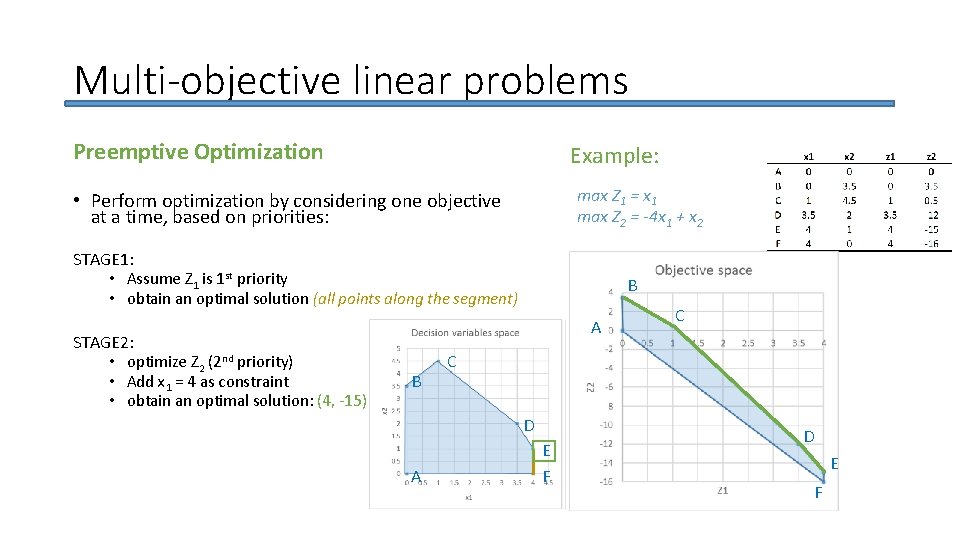
Multi-objective linear problems Preemptive Optimization Example: max Z 1 = x 1 max Z 2 = -4 x 1 + x 2 • Perform optimization by considering one objective at a time, based on priorities: STAGE 1: • Assume Z 1 is 1 st priority • obtain an optimal solution (all points along the segment) • transform this objective into a constraint STAGE 2: • optimize Z 2 (2 nd priority) C • Add x 1 = 4 as constraint B • obtain an optimal solution: (4, -15) • …continue until all objectives have been considered D • If an optimal solution is obtained at each stage => the final solution is an efficient point of Athe original multi-objective model B A E F C D E F
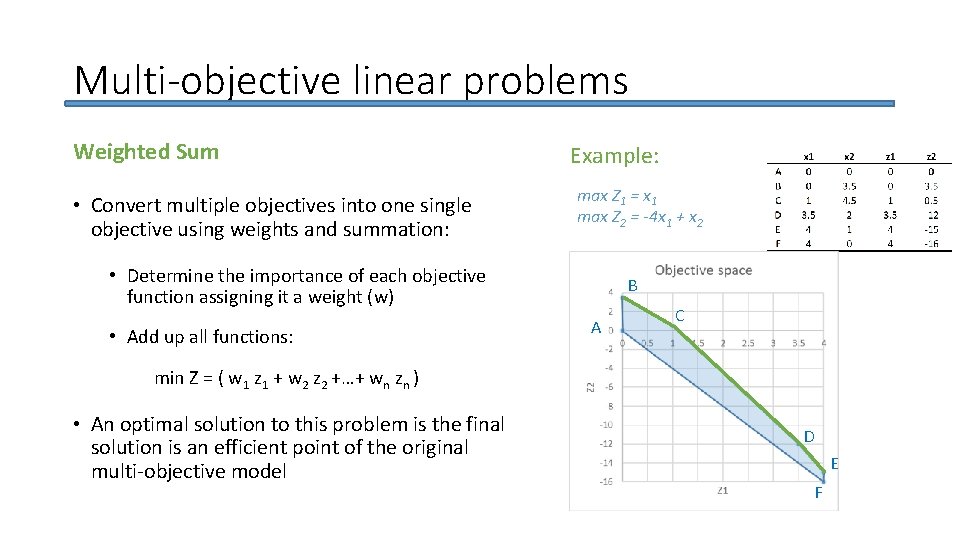
Multi-objective linear problems Weighted Sum • Convert multiple objectives into one single objective using weights and summation: Example: max Z 1 = x 1 max Z 2 = -4 x 1 + x 2 • Determine the importance of each objective function assigning it a weight (w) • Add up all functions: B A C min Z = ( w 1 z 1 + w 2 z 2 +…+ wn zn ) • An optimal solution to this problem is the final solution is an efficient point of the original multi-objective model D E F
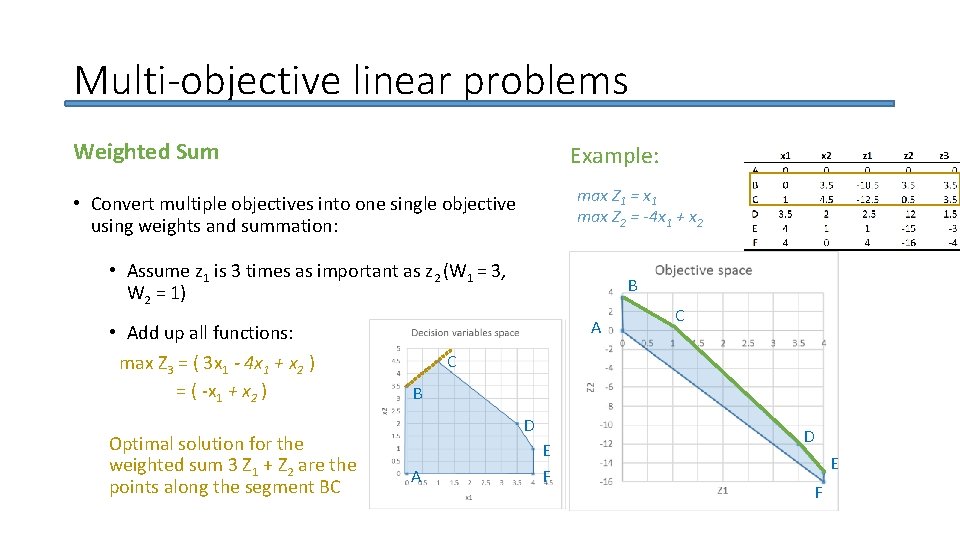
Multi-objective linear problems Weighted Sum Example: max Z 1 = x 1 max Z 2 = -4 x 1 + x 2 • Convert multiple objectives into one single objective using weights and summation: • Assume z 1 is 3 times as important as z 2 (W 1 = 3, W 2 = 1) • Add up all functions: max Z 3 = ( 3 x 1 - 4 x 1 + x 2 ) = ( -x 1 + x 2 ) Optimal solution for the weighted sum 3 Z 1 + Z 2 are the points along the segment BC B A C C B D A E F D E F
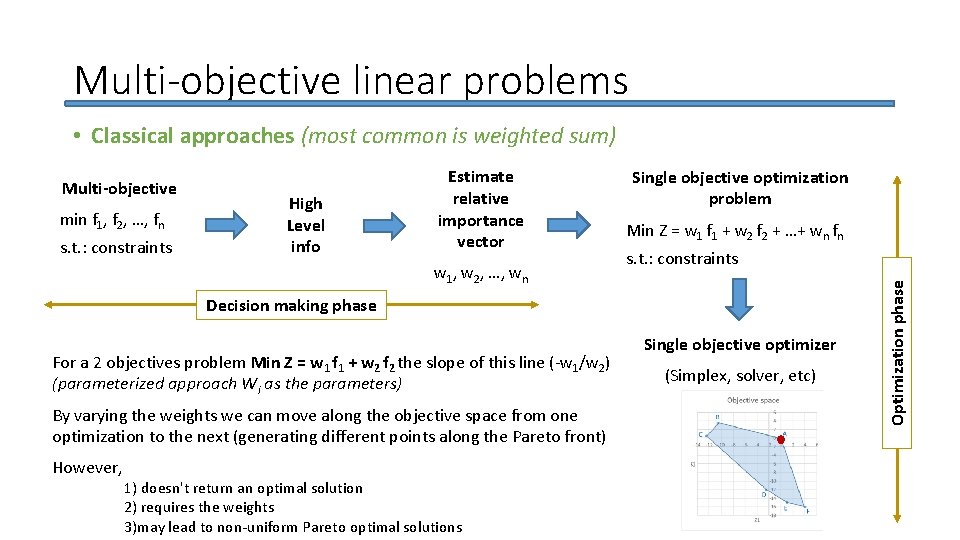
Multi-objective linear problems • Classical approaches (most common is weighted sum) min f 1, f 2, …, fn s. t. : constraints High Level info Estimate relative importance vector w 1, w 2, …, wn Single objective optimization problem Min Z = w 1 f 1 + w 2 f 2 + …+ wn fn s. t. : constraints Decision making phase For a 2 objectives problem Min Z = w 1 f 1 + w 2 f 2 the slope of this line (-w 1/w 2) (parameterized approach Wi as the parameters) By varying the weights we can move along the objective space from one optimization to the next (generating different points along the Pareto front) However, 1) doesn't return an optimal solution 2) requires the weights 3)may lead to non-uniform Pareto optimal solutions Single objective optimizer (Simplex, solver, etc) Optimization phase Multi-objective
Multi-objective Linear problems • Difficulties with the most classical approaches • The simplest options give you one solution (disregarding how many more might be) • Need to run single optimization many times to build the Pareto front • Expect a lot of problem knowledge (convex or not) - Can’t guarantee that we’ll get all the points in the convex region - How to assign weights? What weights to assign? • Aggravated for complex problems (many objective functions and several variables)
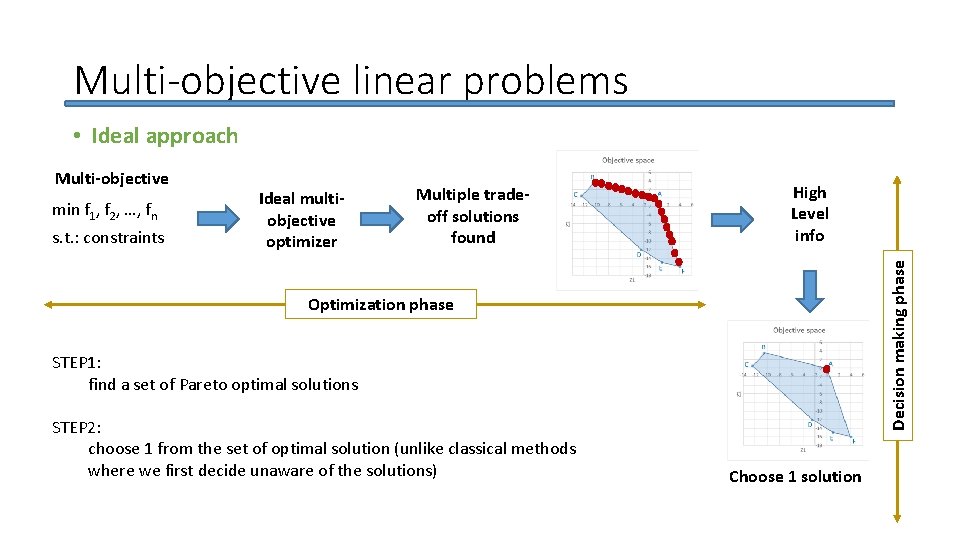
Multi-objective linear problems • Ideal approach min f 1, f 2, …, fn s. t. : constraints Ideal multiobjective optimizer Multiple tradeoff solutions found High Level info Decision making phase Multi-objective Optimization phase STEP 1: find a set of Pareto optimal solutions STEP 2: choose 1 from the set of optimal solution (unlike classical methods where we first decide unaware of the solutions) Choose 1 solution
Multi-objective linear problems • Evolutionary Multi-objective Methodologies These are no single approaches, but POPULATION APPROACHES, allowing finding several solutions simultaneously and permitting a faster search Non-Pareto techniques • Approaches that do not incorporate directly the concept of Pareto-optimum • Unable to reproduce certain portions of the Pareto front • Efficient and easy to implement, but appropriate to handle only a few objectives Pareto techniques • Use of non-dominanted ranking and selection to move the population towards the Pareto front • Require a ranking procedure and a technique to maintain diversity in the population
Multi-objective linear programming - Goal programming
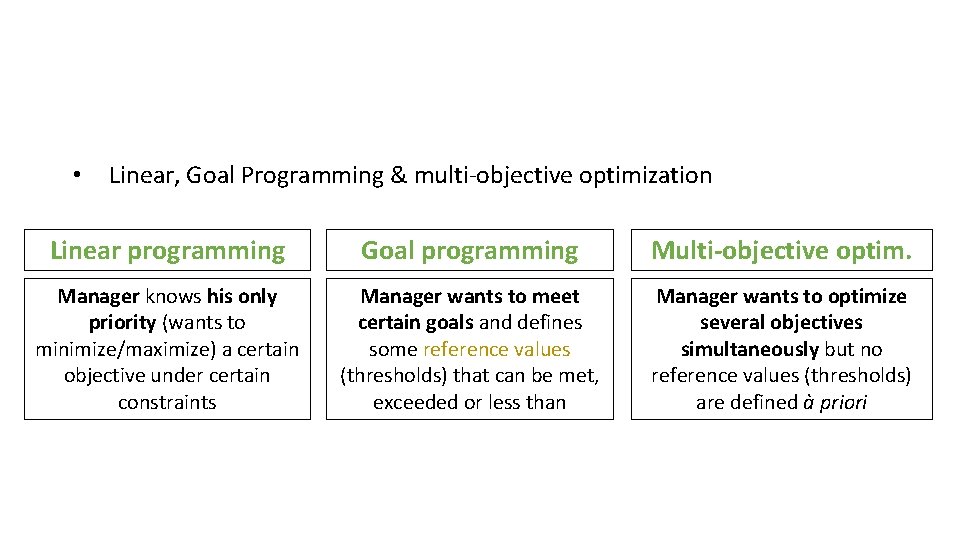
• Linear, Goal Programming & multi-objective optimization Linear programming Goal programming Multi-objective optim. Manager knows his only priority (wants to minimize/maximize) a certain objective under certain constraints Manager wants to meet certain goals and defines some reference values (thresholds) that can be met, exceeded or less than Manager wants to optimize several objectives simultaneously but no reference values (thresholds) are defined à priori
MOLP - Goal Programming • Representing some goals by constraints in effect gives them priority over the goal reflected in the objective function, because the objective function is optimized within the feasible region defined by the constraints • Deciding which goal should be selected as the objective function and which ones should be reflected by constraints is often arbitrary and difficult • Goal programming attempts to overcome these limitations while using linear programming, striving toward selected objectives simultaneously, treating them all in the same manner, although perhaps giving them different weights.
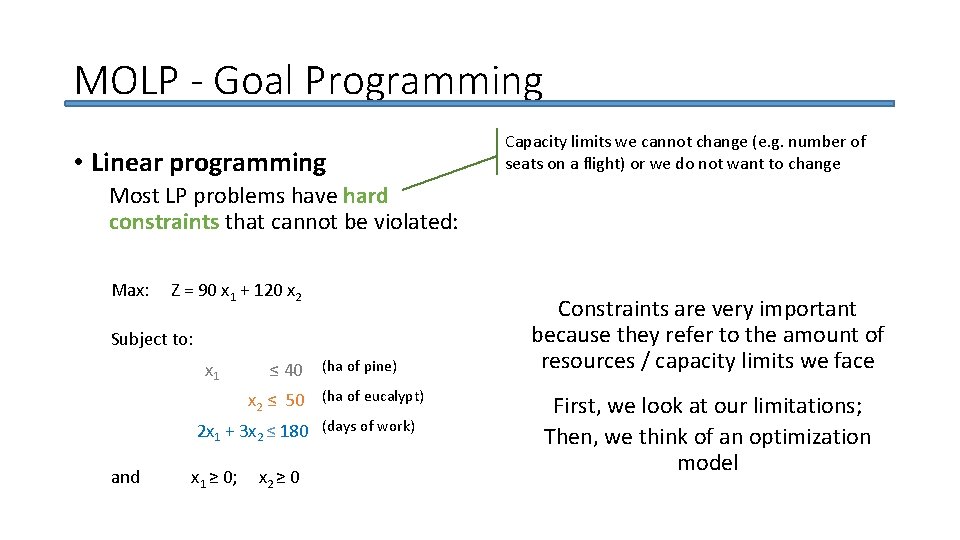
MOLP - Goal Programming • Linear programming Most LP problems have hard constraints that cannot be violated: Max: Z = 90 x 1 + 120 x 2 Subject to: x 1 ≤ 40 (ha of pine) x 2 ≤ 50 (ha of eucalypt) 2 x 1 + 3 x 2 ≤ 180 (days of work) and x 1 ≥ 0; x 2 ≥ 0 Capacity limits we cannot change (e. g. number of on aprogramming flight) or we do not want to change • seats Goal GP problems have soft constraints that represent goals or targets we want to achieve Constraints are very important because they refer to the amount of resources / capacity limits we face First, we look at our limitations; Then, we think of an optimization model
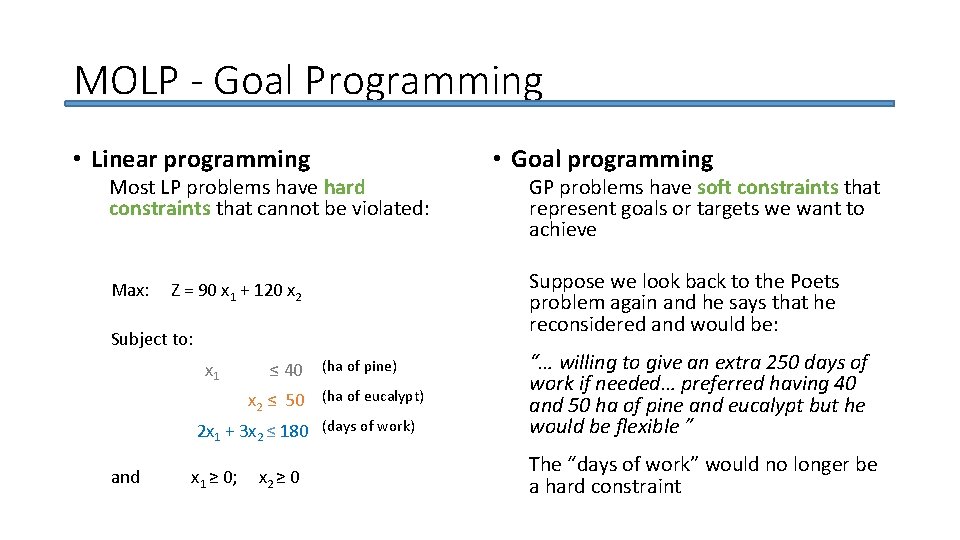
MOLP - Goal Programming • Linear programming Most LP problems have hard constraints that cannot be violated: Max: GP problems have soft constraints that represent goals or targets we want to achieve Suppose we look back to the Poets problem again and he says that he reconsidered and would be: Z = 90 x 1 + 120 x 2 Subject to: 2 x 1 + 3 x 2 ≤ 180 (days of work) “… willing to give an extra 250 days of work if needed… preferred having 40 and 50 ha of pine and eucalypt but he would be flexible ” x 1 ≥ 0; The “days of work” would no longer be a hard constraint x 1 ≤ 40 (ha of pine) x 2 ≤ 50 (ha of eucalypt) and • Goal programming x 2 ≥ 0
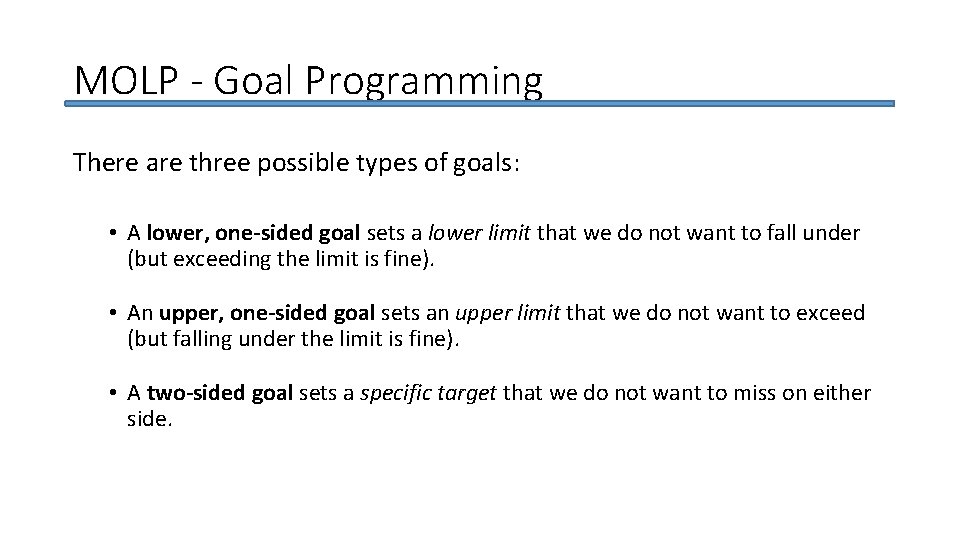
MOLP - Goal Programming There are three possible types of goals: • A lower, one-sided goal sets a lower limit that we do not want to fall under (but exceeding the limit is fine). • An upper, one-sided goal sets an upper limit that we do not want to exceed (but falling under the limit is fine). • A two-sided goal sets a specific target that we do not want to miss on either side.
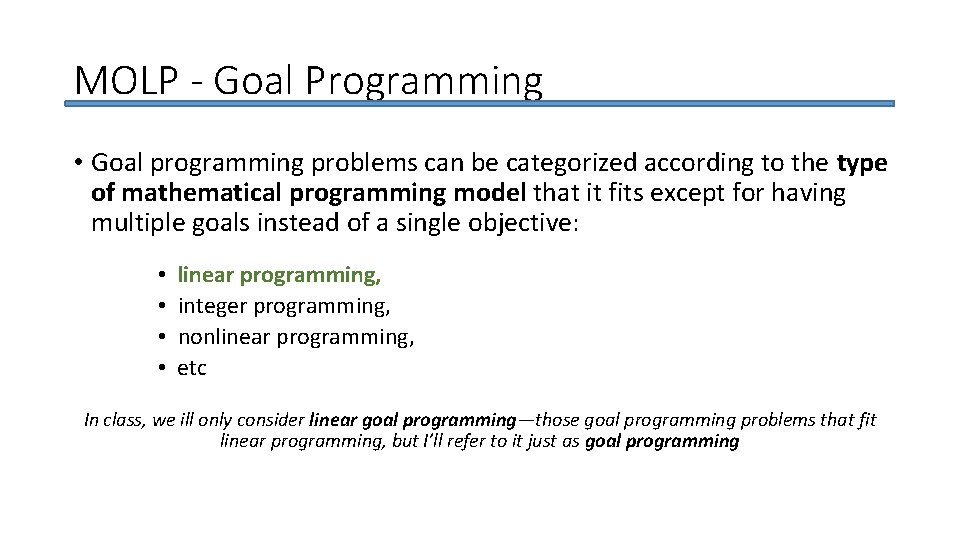
MOLP - Goal Programming • Goal programming problems can be categorized according to the type of mathematical programming model that it fits except for having multiple goals instead of a single objective: • • linear programming, integer programming, nonlinear programming, etc In class, we ill only consider linear goal programming—those goal programming problems that fit linear programming, but I’ll refer to it just as goal programming
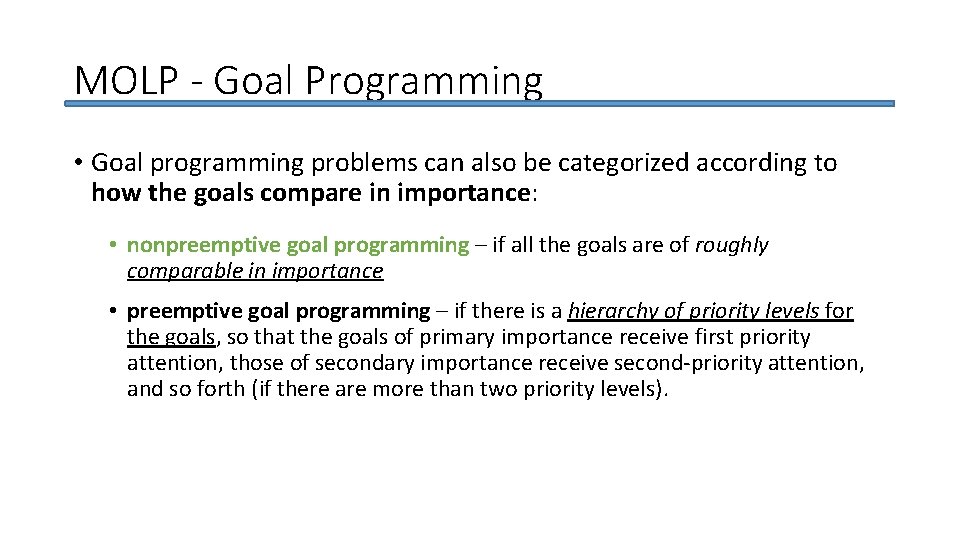
MOLP - Goal Programming • Goal programming problems can also be categorized according to how the goals compare in importance: • nonpreemptive goal programming – if all the goals are of roughly comparable in importance • preemptive goal programming – if there is a hierarchy of priority levels for the goals, so that the goals of primary importance receive first priority attention, those of secondary importance receive second-priority attention, and so forth (if there are more than two priority levels).
MOLP - Goal Programming EXAMPLE: The OR department of the DEWRIGHT COMPANY has been assigned the task of determining which mix of products should be produced. Management wants primary consideration given to the following three goals: (1) achieving a long-term profit (NPV) of at least $125 million from these products (2) maintaining the current employment level of 4, 000 employees, (3) holding the capital investment to less than $55 million.
MOLP - Goal Programming However, it probably will not be possible to attain all these goals simultaneously, priorities have been discussed leading to setting a penalty weight: 1) 5 for missing the profit goal (per $1 million under), 2) 2 for going over the employment goal (per 100 employees) and 4 for going under this same goal 3) 3 for exceeding the capital investment goal (per $1 million over) Each new product’s contribution to profit, employment level, and capital investment level is proportional to the rate of production.
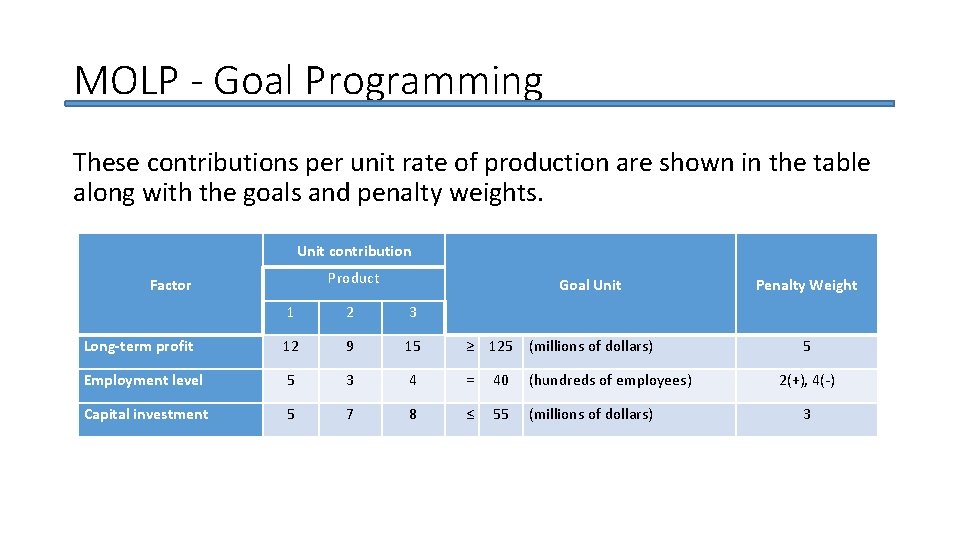
MOLP - Goal Programming These contributions per unit rate of production are shown in the table along with the goals and penalty weights. Unit contribution Product Factor Goal Unit 1 2 3 Long-term profit 12 9 15 ≥ 125 (millions of dollars) Employment level 5 3 4 = 40 (hundreds of employees) Capital investment 5 7 8 ≤ 55 (millions of dollars) Penalty Weight 5 2(+), 4(-) 3
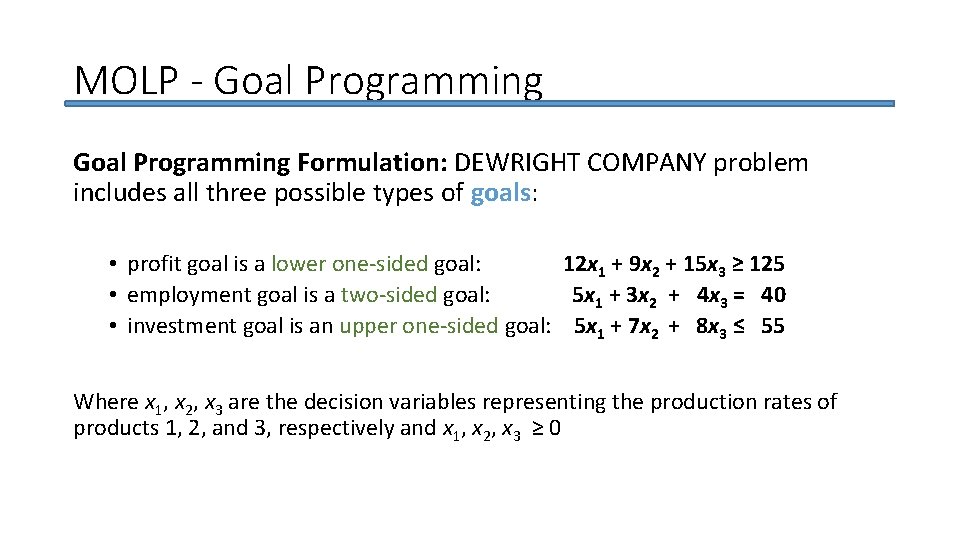
MOLP - Goal Programming Formulation: DEWRIGHT COMPANY problem includes all three possible types of goals: • profit goal is a lower one-sided goal: 12 x 1 + 9 x 2 + 15 x 3 ≥ 125 • employment goal is a two-sided goal: 5 x 1 + 3 x 2 + 4 x 3 = 40 • investment goal is an upper one-sided goal: 5 x 1 + 7 x 2 + 8 x 3 ≤ 55 Where x 1, x 2, x 3 are the decision variables representing the production rates of products 1, 2, and 3, respectively and x 1, x 2, x 3 ≥ 0
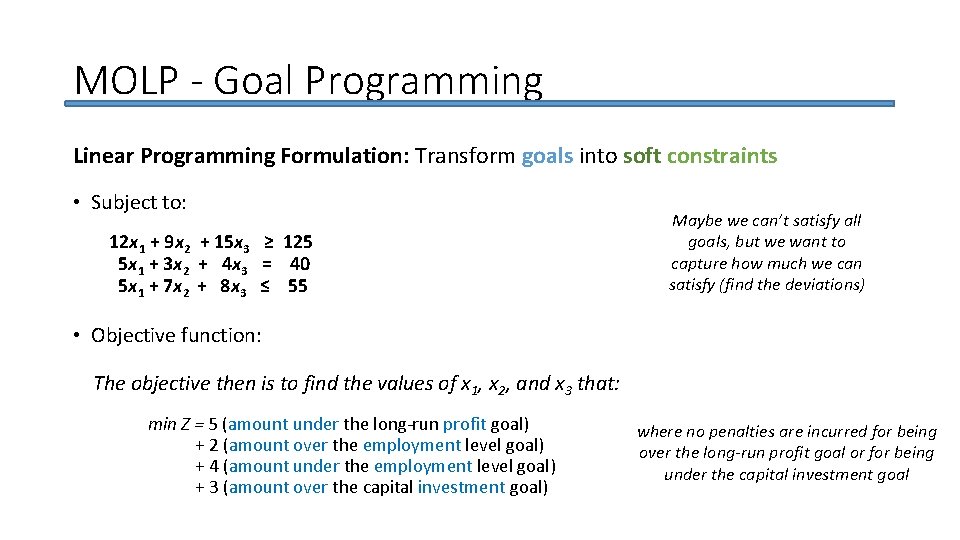
MOLP - Goal Programming Linear Programming Formulation: Transform goals into soft constraints • Subject to: 12 x 1 + 9 x 2 + 15 x 3 ≥ 125 5 x 1 + 3 x 2 + 4 x 3 = 40 5 x 1 + 7 x 2 + 8 x 3 ≤ 55 Maybe we can’t satisfy all goals, but we want to capture how much we can satisfy (find the deviations) • Objective function: The objective then is to find the values of x 1, x 2, and x 3 that: min Z = 5 (amount under the long-run profit goal) + 2 (amount over the employment level goal) + 4 (amount under the employment level goal) + 3 (amount over the capital investment goal) where no penalties are incurred for being over the long-run profit goal or for being under the capital investment goal
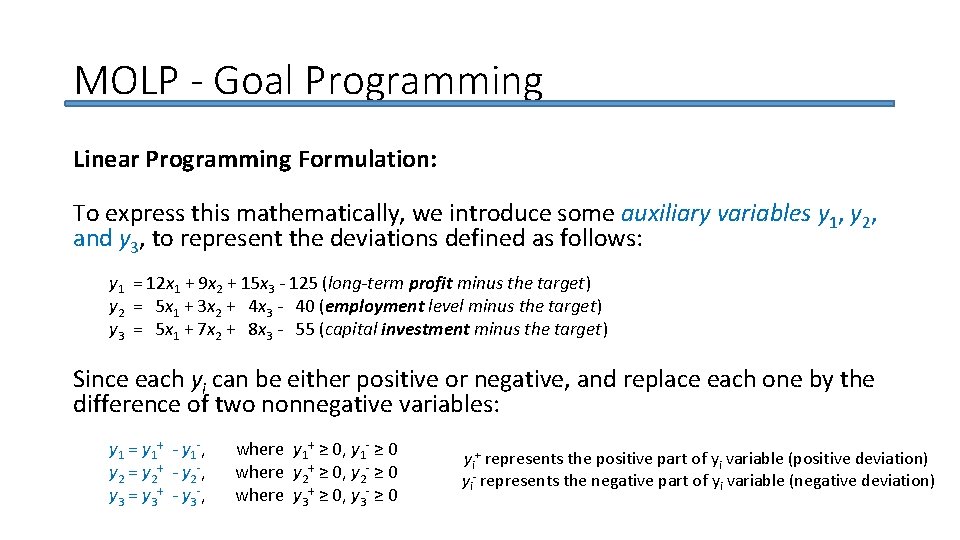
MOLP - Goal Programming Linear Programming Formulation: To express this mathematically, we introduce some auxiliary variables y 1, y 2, and y 3, to represent the deviations defined as follows: y 1 = 12 x 1 + 9 x 2 + 15 x 3 - 125 (long-term profit minus the target) y 2 = 5 x 1 + 3 x 2 + 4 x 3 - 40 (employment level minus the target) y 3 = 5 x 1 + 7 x 2 + 8 x 3 - 55 (capital investment minus the target) Since each yi can be either positive or negative, and replace each one by the difference of two nonnegative variables: y 1 = y 1 + - y 1 - , y 2 = y 2 + - y 2 - , y 3 = y 3 + - y 3 - , where y 1+ ≥ 0, y 1 - ≥ 0 where y 2+ ≥ 0, y 2 - ≥ 0 where y 3+ ≥ 0, y 3 - ≥ 0 yi+ represents the positive part of yi variable (positive deviation) yi- represents the negative part of yi variable (negative deviation)
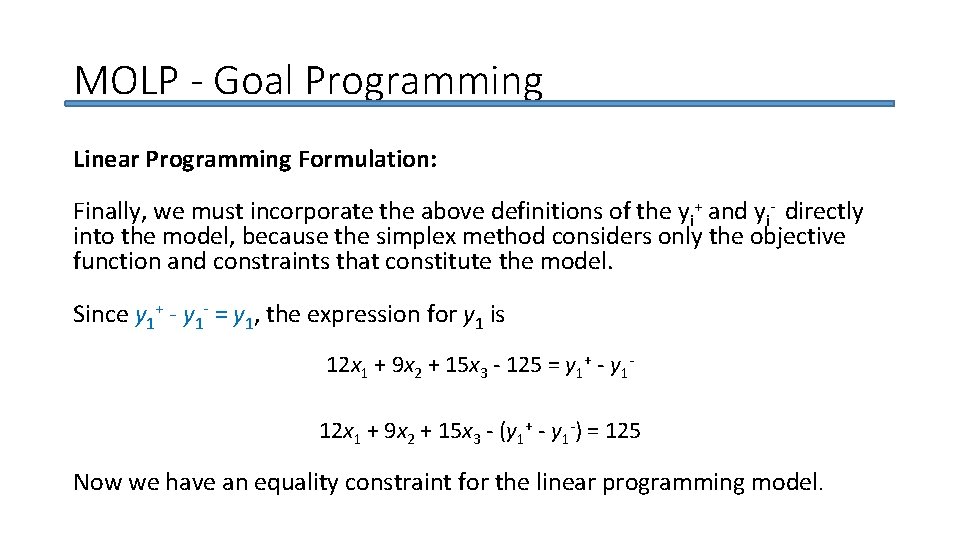
MOLP - Goal Programming Linear Programming Formulation: Finally, we must incorporate the above definitions of the yi+ and yi- directly into the model, because the simplex method considers only the objective function and constraints that constitute the model. Since y 1+ - y 1 - = y 1, the expression for y 1 is 12 x 1 + 9 x 2 + 15 x 3 - 125 = y 1+ - y 112 x 1 + 9 x 2 + 15 x 3 - (y 1+ - y 1 -) = 125 Now we have an equality constraint for the linear programming model.
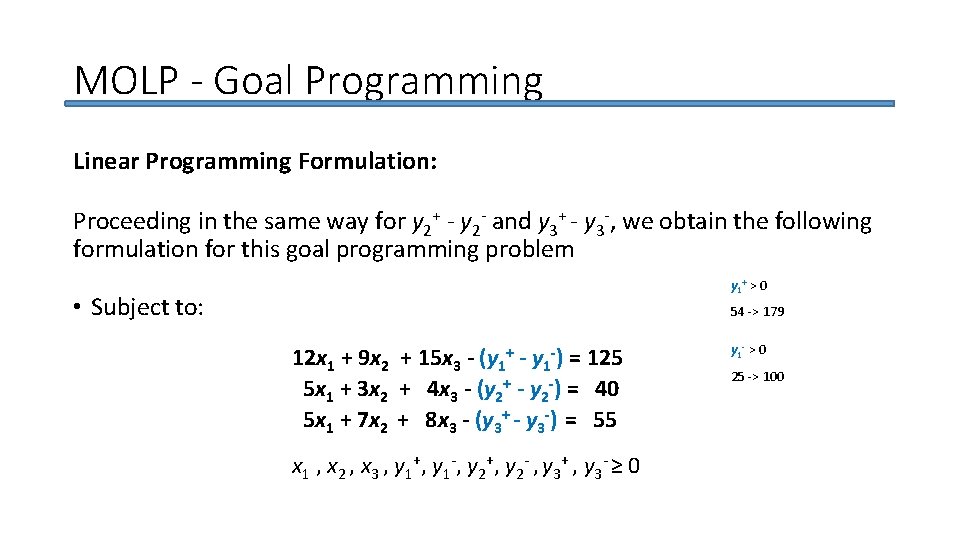
MOLP - Goal Programming Linear Programming Formulation: Proceeding in the same way for y 2+ - y 2 - and y 3+ - y 3 -, we obtain the following formulation for this goal programming problem y 1+ > 0 • Subject to: 54 -> 179 12 x 1 + 9 x 2 + 15 x 3 - (y 1 - y 1 = 125 5 x 1 + 3 x 2 + 4 x 3 - (y 2+ - y 2 -) = 40 5 x 1 + 7 x 2 + 8 x 3 - (y 3+ - y 3 -) = 55 + -) x 1 , x 2 , x 3 , y 1 +, y 1 - , y 2 +, y 2 - , y 3 + , y 3 - ≥ 0 y 1 - > 0 25 -> 100
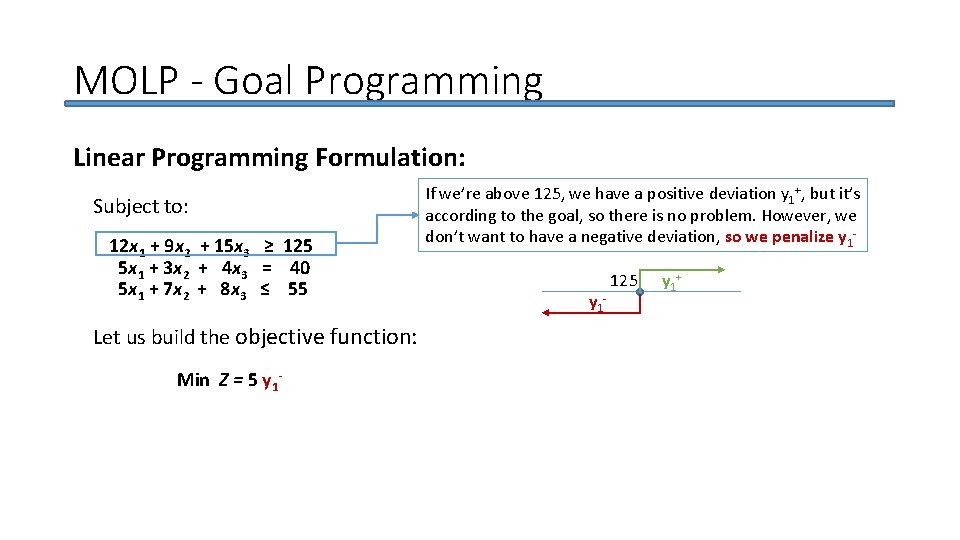
MOLP - Goal Programming Linear Programming Formulation: Subject to: 12 x 1 + 9 x 2 + 15 x 3 ≥ 125 5 x 1 + 3 x 2 + 4 x 3 = 40 5 x 1 + 7 x 2 + 8 x 3 ≤ 55 If we’re above 125, we have a positive deviation y 1+, but it’s according to the goal, so there is no problem. However, we don’t want to have a negative deviation, so we penalize y 1 y 1 - 125 y 1+ Let us build the objective function: Min Z = 5 y 1 - + 2 y 2+ + 4 y 2 - + 3 y 3+ Because there is no penalty for exceeding the profit goal of 125 or being under the investment goal of 55, neither y 1+ nor y 3 - should appear in this objective function representing the total penalty for deviations from the goals.
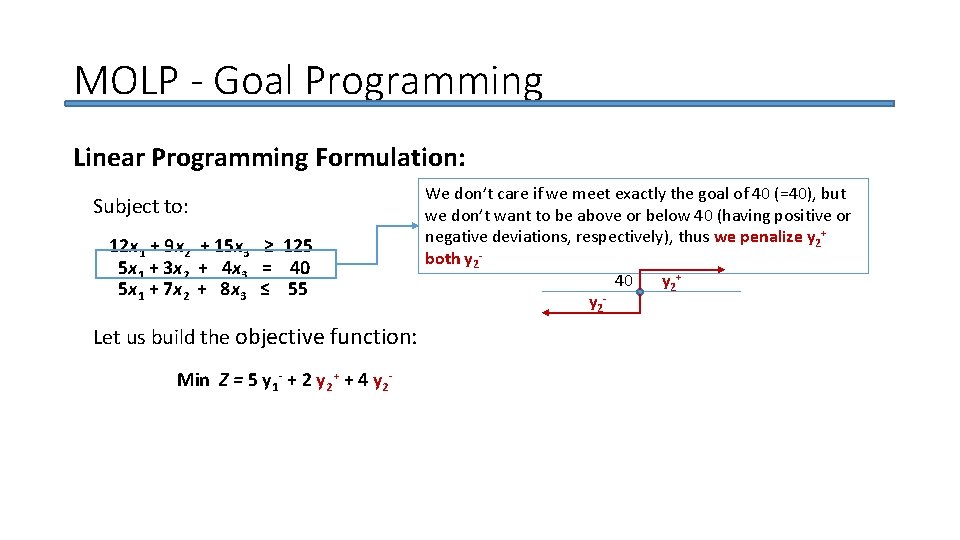
MOLP - Goal Programming Linear Programming Formulation: Subject to: 12 x 1 + 9 x 2 + 15 x 3 ≥ 125 5 x 1 + 3 x 2 + 4 x 3 = 40 5 x 1 + 7 x 2 + 8 x 3 ≤ 55 We don’t care if we meet exactly the goal of 40 (=40), but we don’t want to be above or below 40 (having positive or negative deviations, respectively), thus we penalize y 2+ both y 240 y 2+ y 2 - Let us build the objective function: Min Z = 5 y 1 - + 2 y 2+ + 4 y 2 - + 3 y 3+ Because there is no penalty for exceeding the profit goal of 125 or being under the investment goal of 55, neither y 1+ nor y 3 - should appear in this objective function representing the total penalty for deviations from the goals.
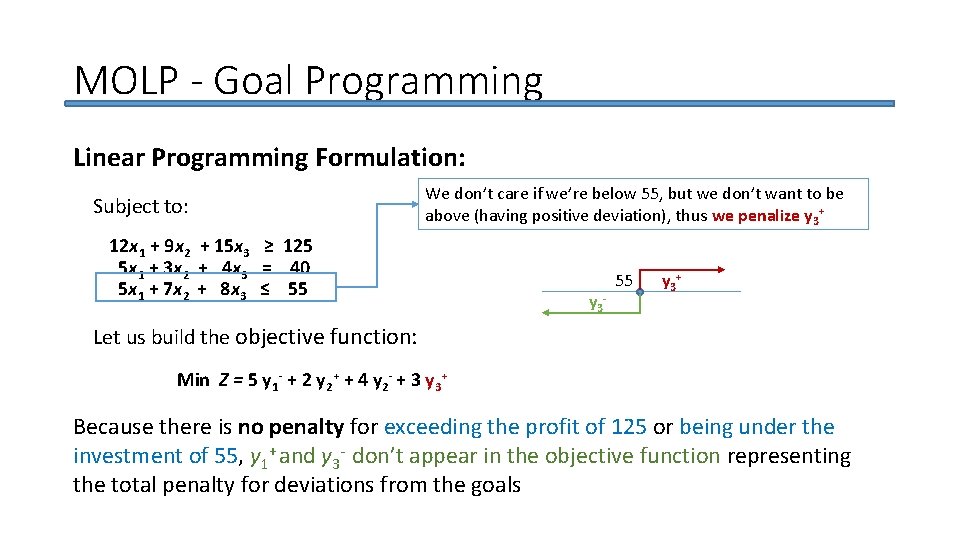
MOLP - Goal Programming Linear Programming Formulation: Subject to: We don’t care if we’re below 55, but we don’t want to be above (having positive deviation), thus we penalize y 3+ 12 x 1 + 9 x 2 + 15 x 3 ≥ 125 5 x 1 + 3 x 2 + 4 x 3 = 40 5 x 1 + 7 x 2 + 8 x 3 ≤ 55 y 3 - 55 y 3+ Let us build the objective function: Min Z = 5 y 1 - + 2 y 2+ + 4 y 2 - + 3 y 3+ Because there is no penalty for exceeding the profit of 125 or being under the investment of 55, y 1+ and y 3 - don’t appear in the objective function representing the total penalty for deviations from the goals
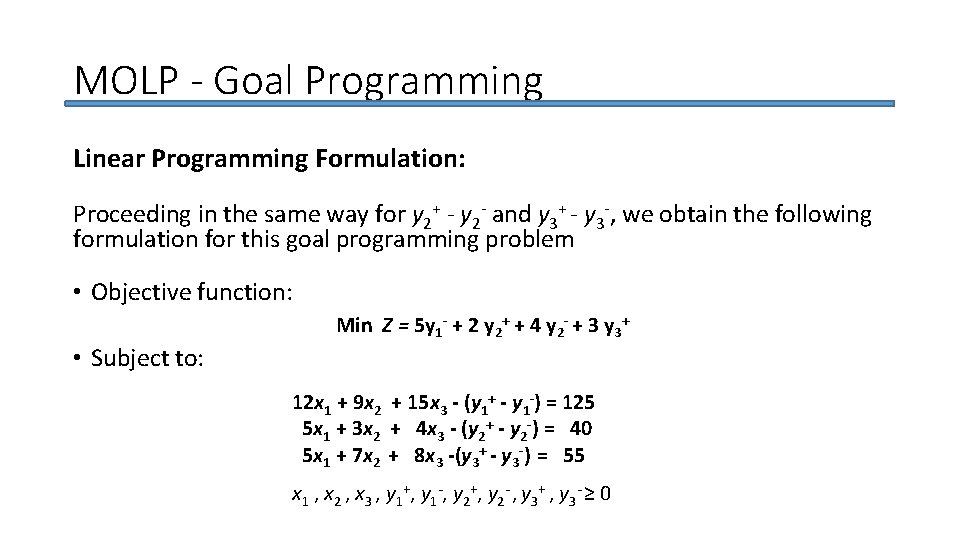
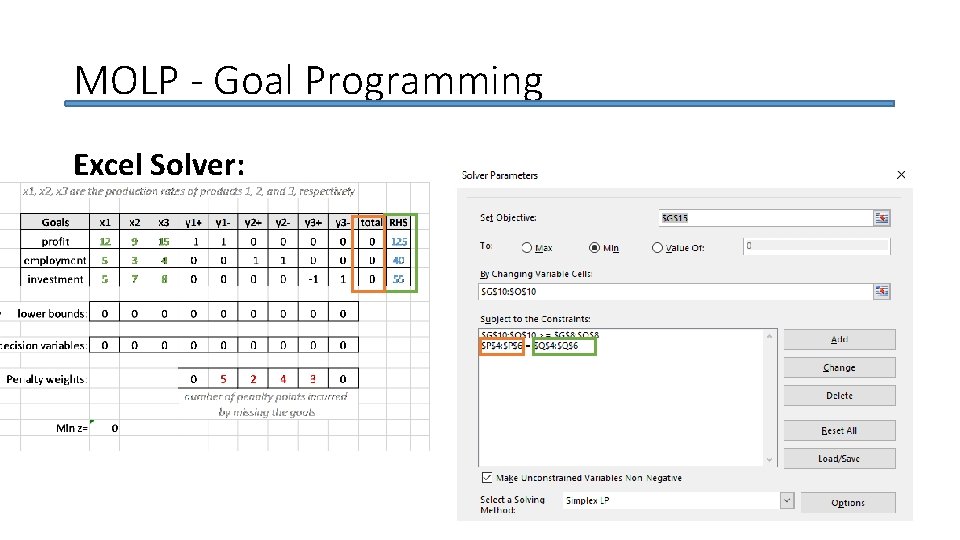
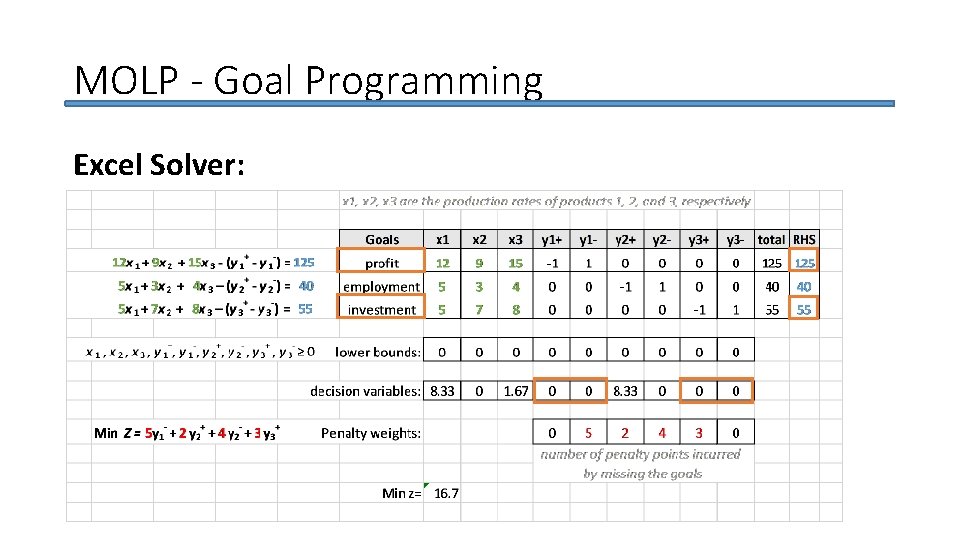
MOLP - Goal Programming Linear Programming Formulation: Proceeding in the same way for y 2+ - y 2 - and y 3+ - y 3 -, we obtain the following formulation for this goal programming problem • Objective function: • Subject to: Min Z = 5 y 1 - + 2 y 2+ + 4 y 2 - + 3 y 3+ 12 x 1 + 9 x 2 + 15 x 3 - (y 1+ - y 1 -) = 125 5 x 1 + 3 x 2 + 4 x 3 - (y 2+ - y 2 -) = 40 5 x 1 + 7 x 2 + 8 x 3 -(y 3+ - y 3 -) = 55 x 1 , x 2 , x 3 , y 1 +, y 1 - , y 2 +, y 2 - , y 3 + , y 3 - ≥ 0
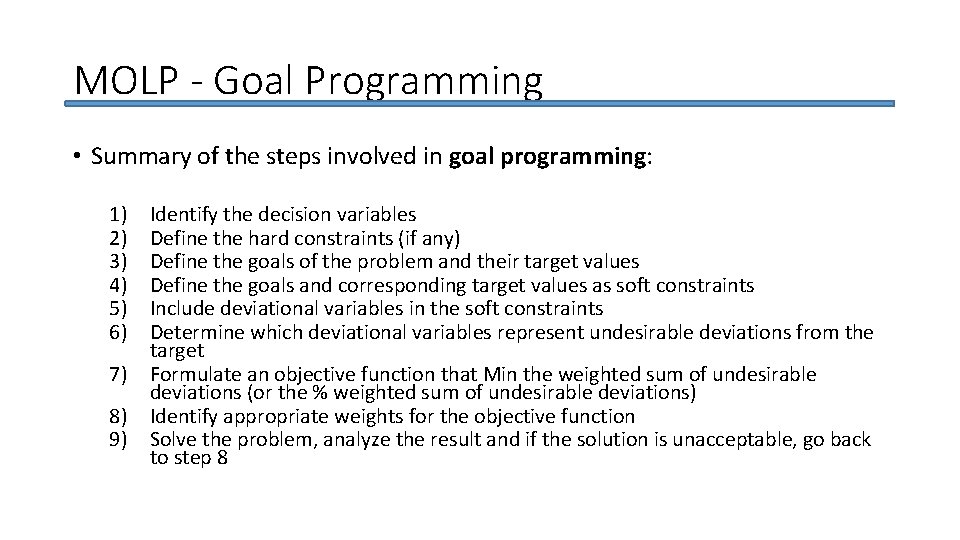
MOLP - Goal Programming • Summary of the steps involved in goal programming: 1) 2) 3) 4) 5) 6) 7) 8) 9) Identify the decision variables Define the hard constraints (if any) Define the goals of the problem and their target values Define the goals and corresponding target values as soft constraints Include deviational variables in the soft constraints Determine which deviational variables represent undesirable deviations from the target Formulate an objective function that Min the weighted sum of undesirable deviations (or the % weighted sum of undesirable deviations) Identify appropriate weights for the objective function Solve the problem, analyze the result and if the solution is unacceptable, go back to step 8
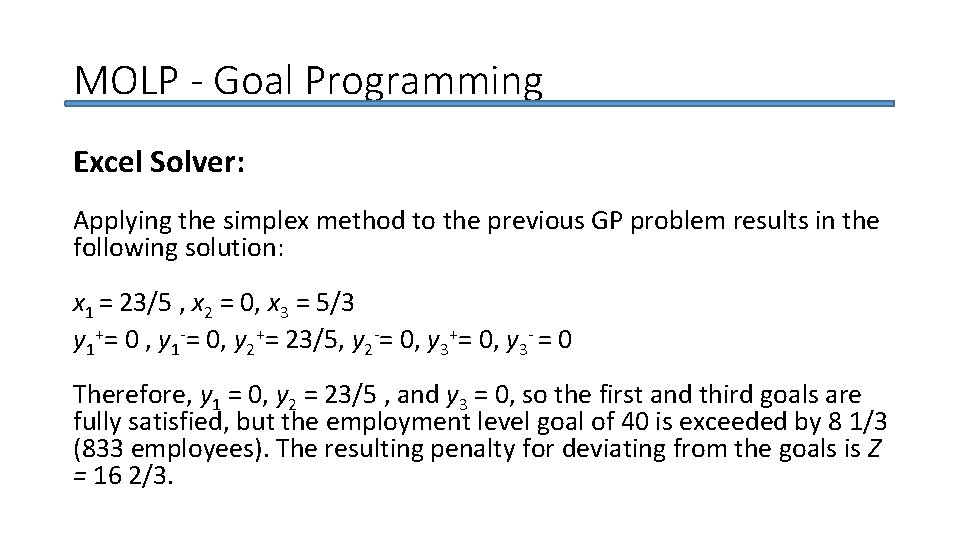
MOLP - Goal Programming Excel Solver: Applying the simplex method to the previous GP problem results in the following solution: x 1 = 23/5 , x 2 = 0, x 3 = 5/3 y 1+= 0 , y 1 -= 0, y 2+= 23/5, y 2 -= 0, y 3+= 0, y 3 - = 0 Therefore, y 1 = 0, y 2 = 23/5 , and y 3 = 0, so the first and third goals are fully satisfied, but the employment level goal of 40 is exceeded by 8 1/3 (833 employees). The resulting penalty for deviating from the goals is Z = 16 2/3.
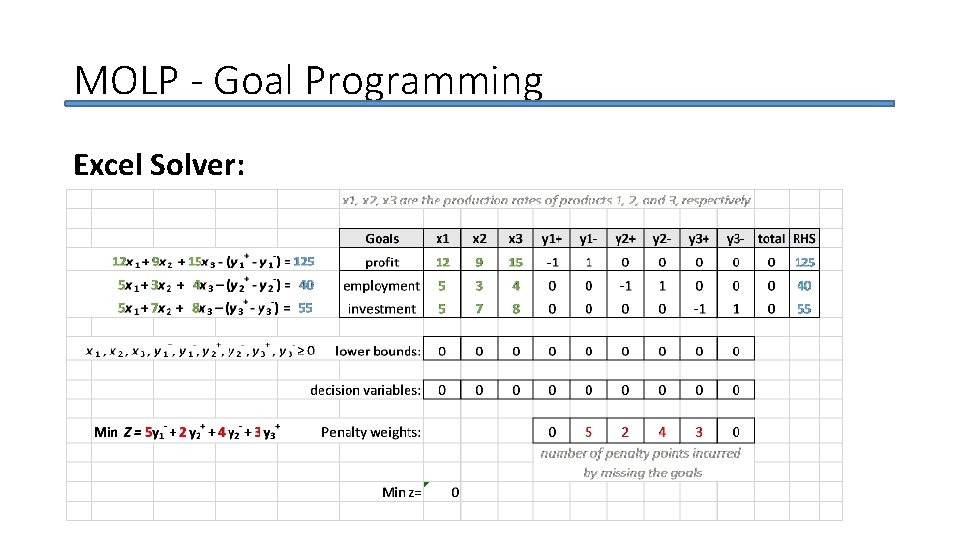
MOLP - Goal Programming Excel Solver:
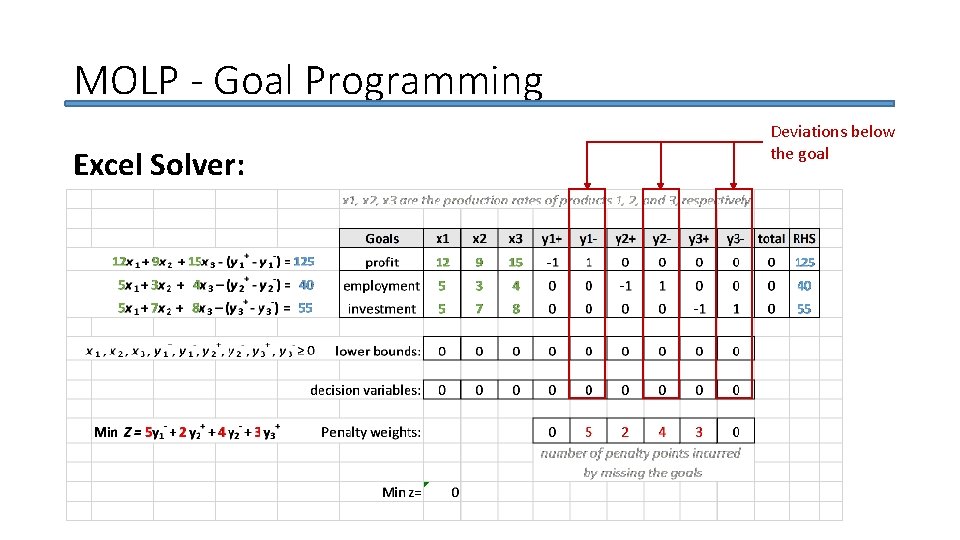
MOLP - Goal Programming Excel Solver: Deviations below the goal
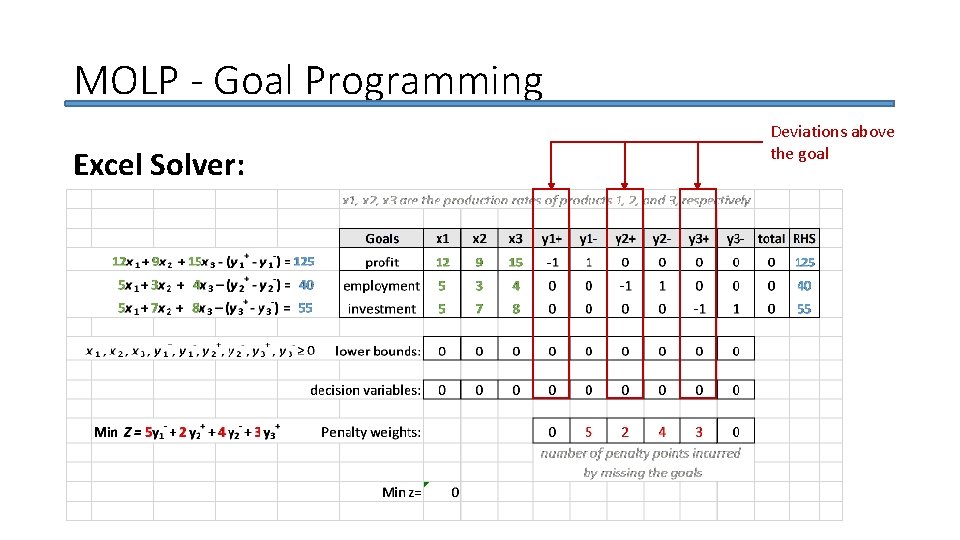
MOLP - Goal Programming Excel Solver: Deviations above the goal
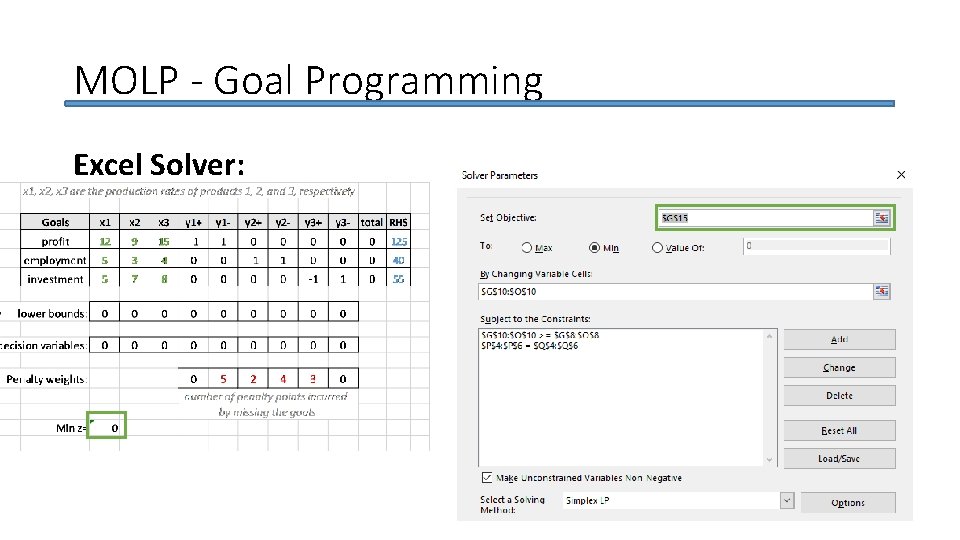
MOLP - Goal Programming Excel Solver:
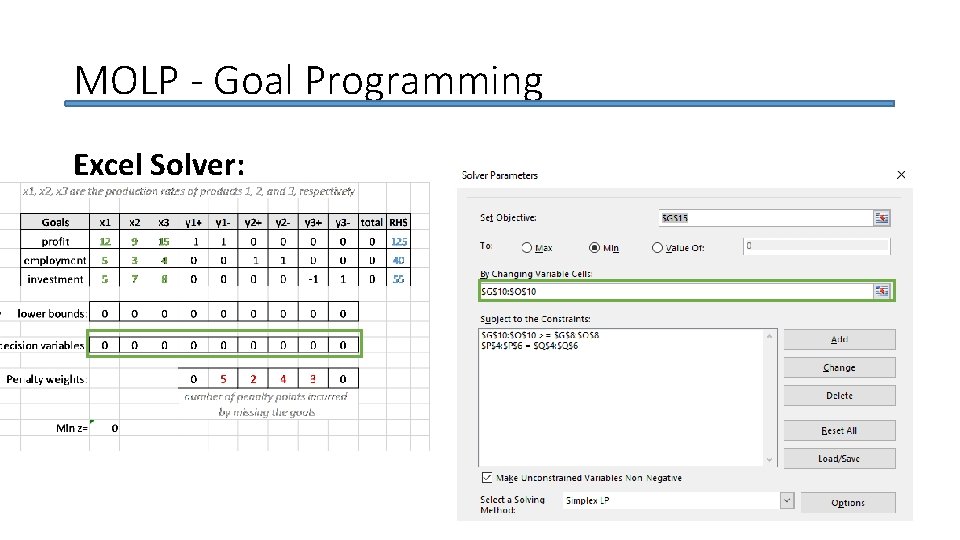
MOLP - Goal Programming Excel Solver:
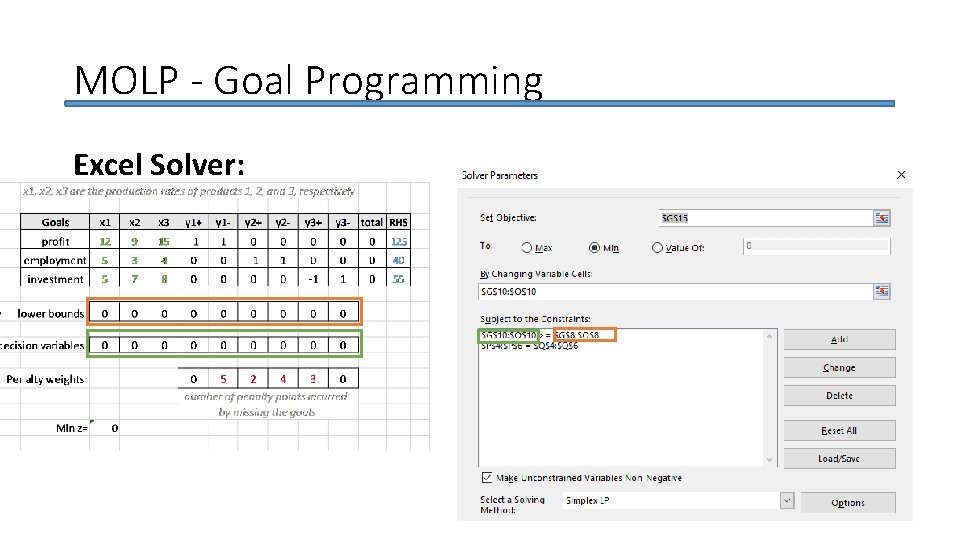
MOLP - Goal Programming Excel Solver:
MOLP - Goal Programming Excel Solver:
MOLP - Goal Programming Excel Solver:
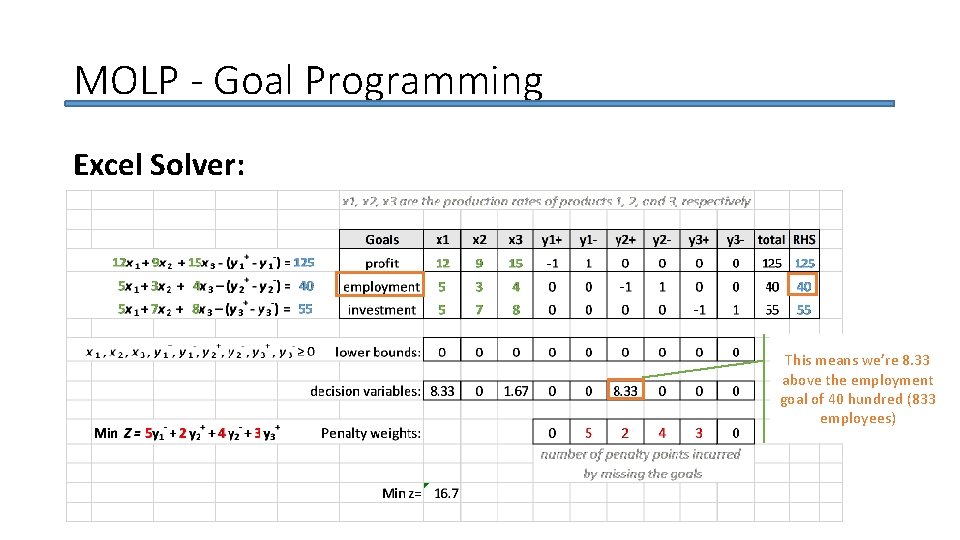
MOLP - Goal Programming Excel Solver: This means we’re 8. 33 above the employment goal of 40 hundred (833 employees)
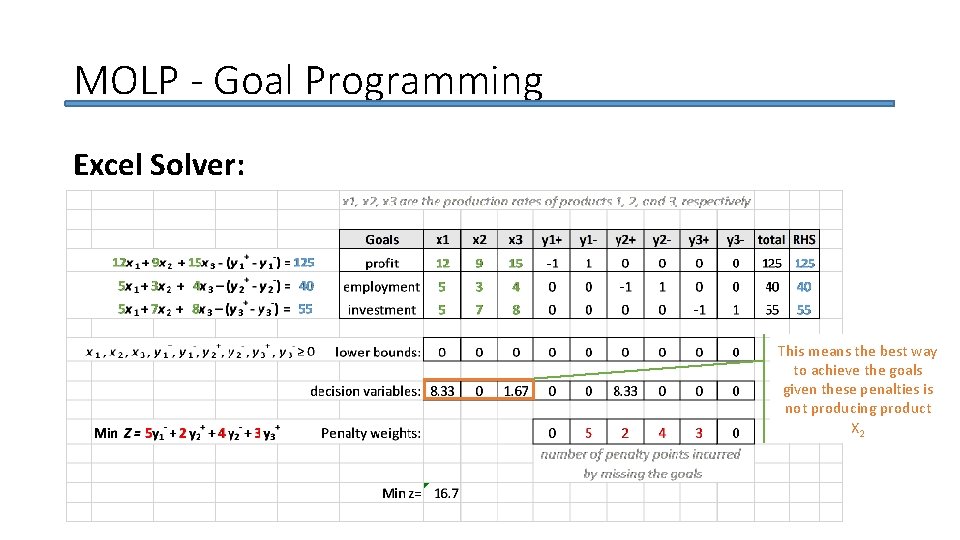
MOLP - Goal Programming Excel Solver: This means the best way to achieve the goals given these penalties is not producing product X 2
MOLP - Goal Programming • Final remarks on GP: • Different GP solutions should not be compared only on the basis of their objective function values (because from one iteration to the next weights are changed and these measure different things) -> look at solutions as a whole (not only to Z value) • Sometimes, one or more goals might be considered infinitely more important than other: in such case assign arbitrarily large weights to the deviations from these goals to ensure undesirable deviations from them never occur (Preemptive GP) Note that if these goals can be achieved the use of these large weights transforms them into hard constraints never to be violated
MOLP - Goal Programming • Final remarks on GP: • Hard constraints can be placed on a certain deviation that must never happen directly: y 5+ ≤ 50000 • The concept of deviational variables is not exclusive to GP, thus understanding the concept might be useful in other mathematical programming situations
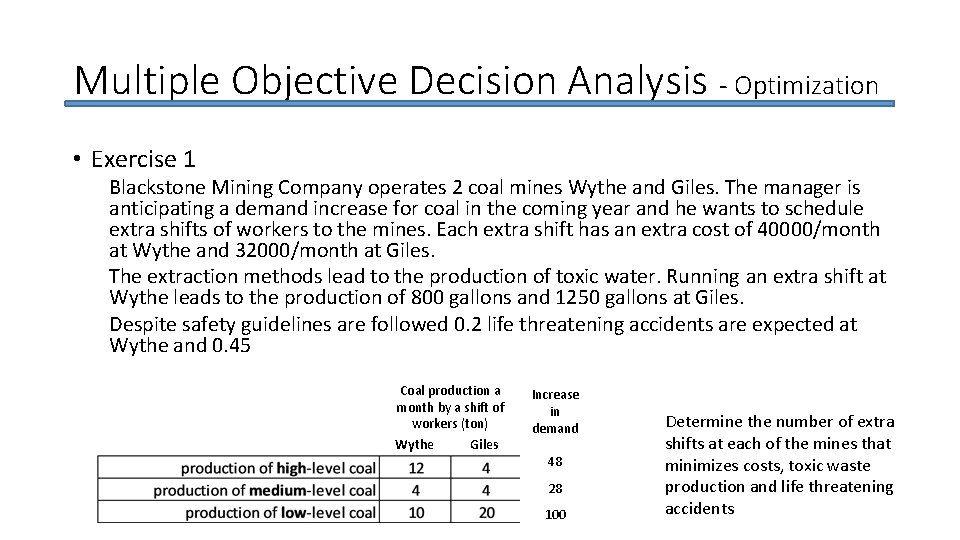
Multiple Objective Decision Analysis - Optimization • Exercise 1 Blackstone Mining Company operates 2 coal mines Wythe and Giles. The manager is anticipating a demand increase for coal in the coming year and he wants to schedule extra shifts of workers to the mines. Each extra shift has an extra cost of 40000/month at Wythe and 32000/month at Giles. The extraction methods lead to the production of toxic water. Running an extra shift at Wythe leads to the production of 800 gallons and 1250 gallons at Giles. Despite safety guidelines are followed 0. 2 life threatening accidents are expected at Wythe and 0. 45 Coal production a month by a shift of workers (ton) Wythe Giles Increase in demand 48 28 100 Determine the number of extra shifts at each of the mines that minimizes costs, toxic waste production and life threatening accidents
Multi-objective linear programming MOLP – minimizing weighted sum percent deviations
MOLP • An MOLP problem is an LP problem with more than one objective function • MOLP problems can be viewed as special types of GP problems where we must also determine target values for each goal or objective • We can solve 3 separate LP problems, independently optimizing each objective, to find values for t 1, t 2 and t 3. (where t is the target value of each goal)
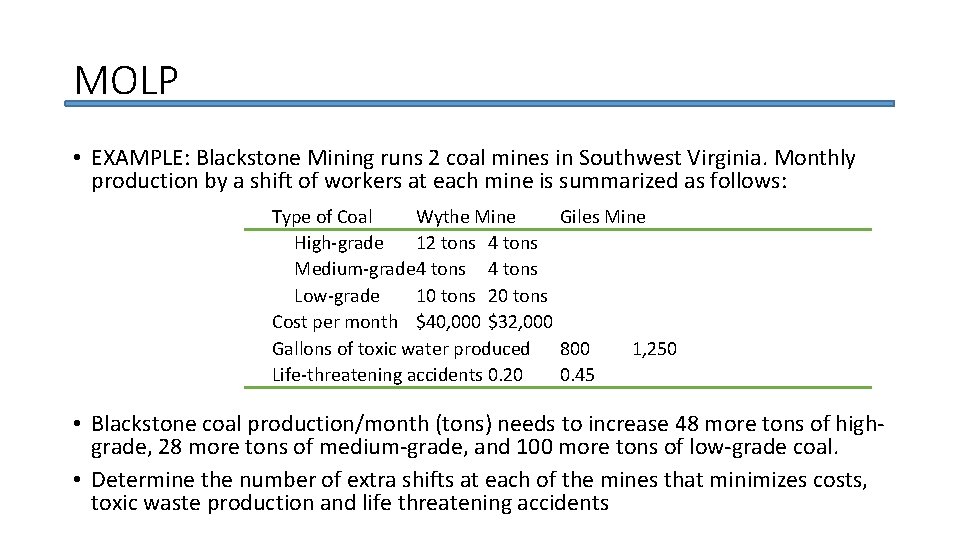
MOLP • EXAMPLE: Blackstone Mining runs 2 coal mines in Southwest Virginia. Monthly production by a shift of workers at each mine is summarized as follows: Type of Coal Wythe Mine Giles Mine High-grade 12 tons 4 tons Medium-grade 4 tons Low-grade 10 tons 20 tons Cost per month $40, 000 $32, 000 Gallons of toxic water produced 800 1, 250 Life-threatening accidents 0. 20 0. 45 • Blackstone coal production/month (tons) needs to increase 48 more tons of highgrade, 28 more tons of medium-grade, and 100 more tons of low-grade coal. • Determine the number of extra shifts at each of the mines that minimizes costs, toxic waste production and life threatening accidents
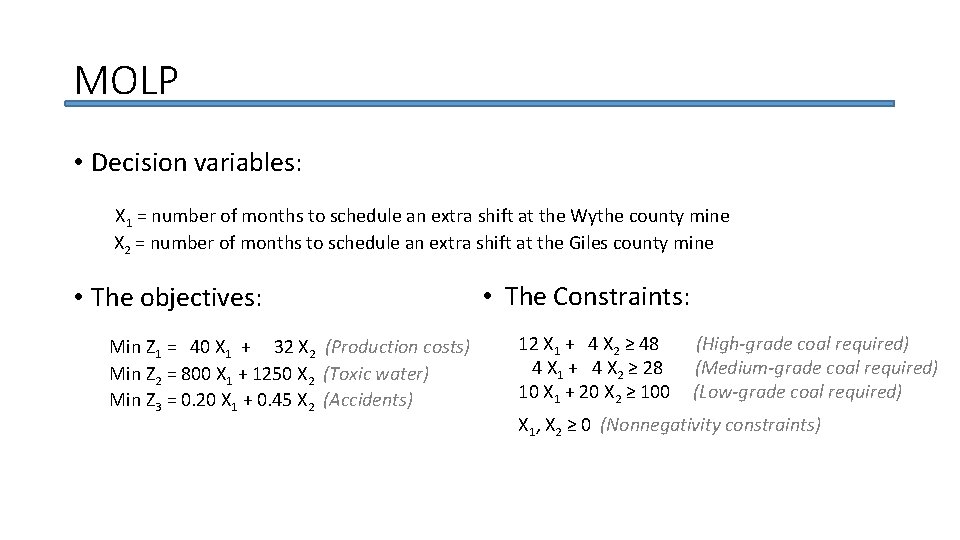
MOLP • Decision variables: X 1 = number of months to schedule an extra shift at the Wythe county mine X 2 = number of months to schedule an extra shift at the Giles county mine • The objectives: Min Z 1 = 40 X 1 + 32 X 2 (Production costs) Min Z 2 = 800 X 1 + 1250 X 2 (Toxic water) Min Z 3 = 0. 20 X 1 + 0. 45 X 2 (Accidents) • The Constraints: 12 X 1 + 4 X 2 ≥ 48 4 X 1 + 4 X 2 ≥ 28 10 X 1 + 20 X 2 ≥ 100 (High-grade coal required) (Medium-grade coal required) (Low-grade coal required) X 1, X 2 ≥ 0 (Nonnegativity constraints)
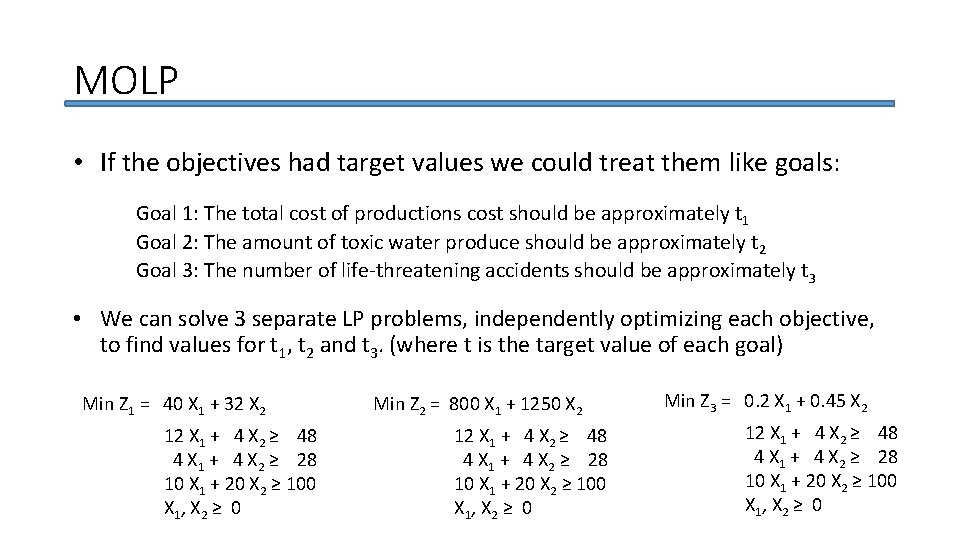
MOLP • If the objectives had target values we could treat them like goals: Goal 1: The total cost of productions cost should be approximately t 1 Goal 2: The amount of toxic water produce should be approximately t 2 Goal 3: The number of life-threatening accidents should be approximately t 3 • We can solve 3 separate LP problems, independently optimizing each objective, to find values for t 1, t 2 and t 3. (where t is the target value of each goal) Min Z 1 = 40 X 1 + 32 X 2 12 X 1 + 4 X 2 ≥ 48 4 X 1 + 4 X 2 ≥ 28 10 X 1 + 20 X 2 ≥ 100 X 1 , X 2 ≥ 0 Min Z 2 = 800 X 1 + 1250 X 2 12 X 1 + 4 X 2 ≥ 48 4 X 1 + 4 X 2 ≥ 28 10 X 1 + 20 X 2 ≥ 100 X 1 , X 2 ≥ 0 Min Z 3 = 0. 2 X 1 + 0. 45 X 2 12 X 1 + 4 X 2 ≥ 48 4 X 1 + 4 X 2 ≥ 28 10 X 1 + 20 X 2 ≥ 100 X 1 , X 2 ≥ 0
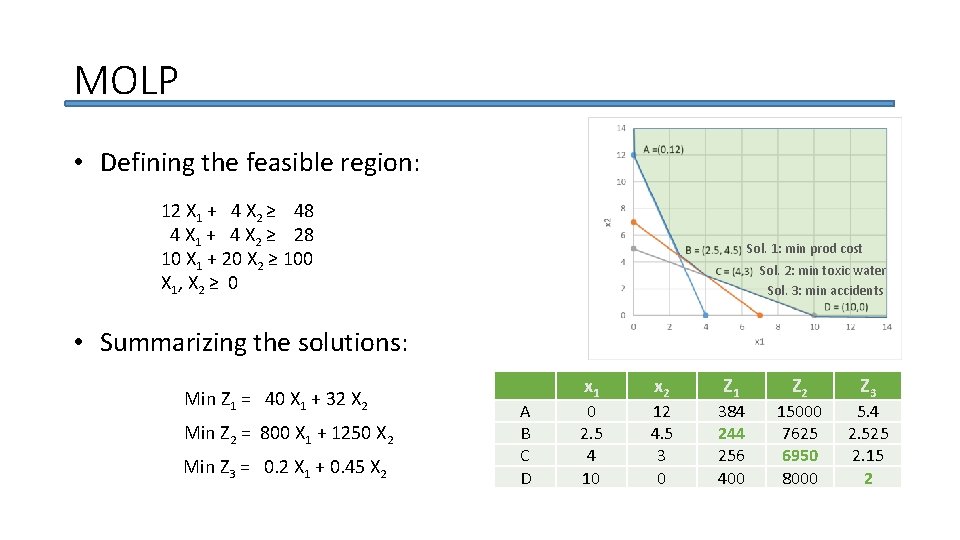
MOLP • Defining the feasible region: 12 X 1 + 4 X 2 ≥ 48 4 X 1 + 4 X 2 ≥ 28 10 X 1 + 20 X 2 ≥ 100 X 1 , X 2 ≥ 0 Sol. 1: min prod cost Sol. 2: min toxic water Sol. 3: min accidents • Summarizing the solutions: Min Z 1 = 40 X 1 + 32 X 2 Min Z 2 = 800 X 1 + 1250 X 2 Min Z 3 = 0. 2 X 1 + 0. 45 X 2 A B C D x 1 0 2. 5 4 10 x 2 12 4. 5 3 0 Z 1 384 244 256 400 Z 2 15000 7625 6950 8000 Z 3 5. 4 2. 525 2. 15 2
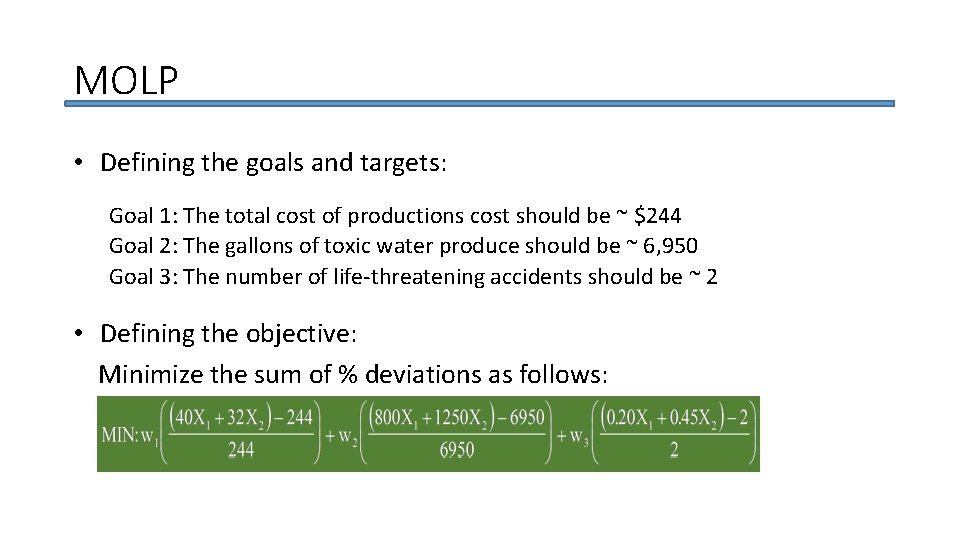
MOLP • Defining the goals and targets: Goal 1: The total cost of productions cost should be ~ $244 Goal 2: The gallons of toxic water produce should be ~ 6, 950 Goal 3: The number of life-threatening accidents should be ~ 2 • Defining the objective: Minimize the sum of % deviations as follows:
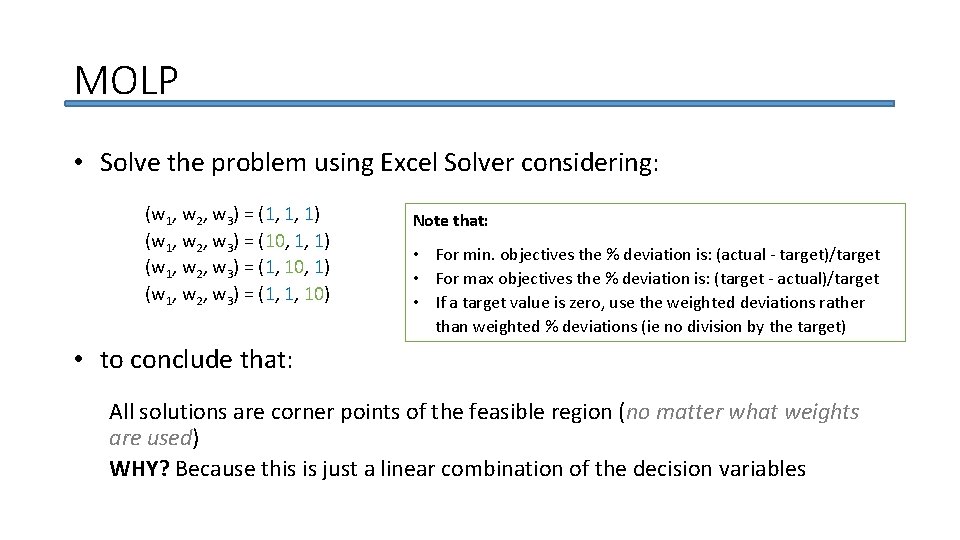
MOLP • Solve the problem using Excel Solver considering: (w 1, w 2, w 3) = (1, 1, 1) (w 1, w 2, w 3) = (10, 1, 1) (w 1, w 2, w 3) = (1, 10, 1) (w 1, w 2, w 3) = (1, 1, 10) Note that: • For min. objectives the % deviation is: (actual - target)/target • For max objectives the % deviation is: (target - actual)/target • If a target value is zero, use the weighted deviations rather than weighted % deviations (ie no division by the target) • to conclude that: All solutions are corner points of the feasible region (no matter what weights are used) WHY? Because this is just a linear combination of the decision variables
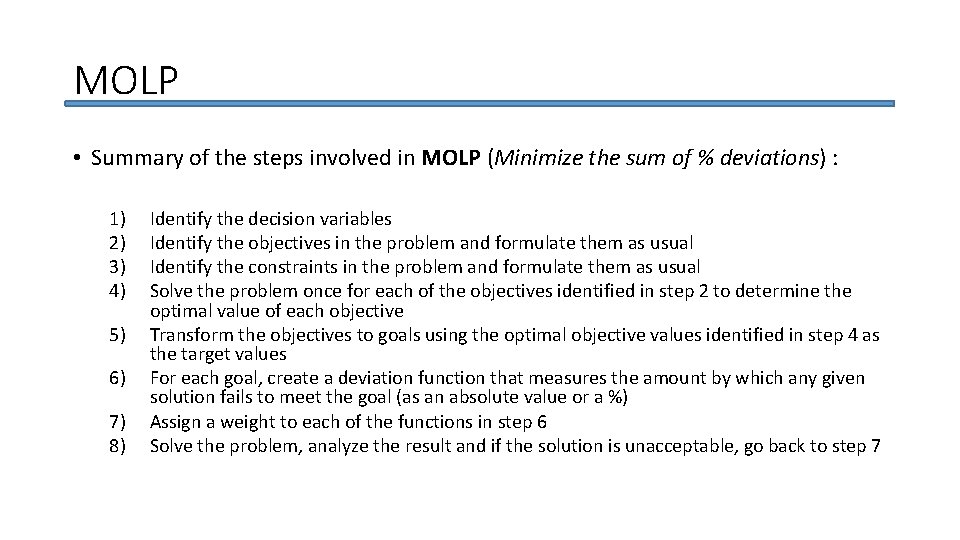
MOLP • Summary of the steps involved in MOLP (Minimize the sum of % deviations) : 1) 2) 3) 4) 5) 6) 7) 8) Identify the decision variables Identify the objectives in the problem and formulate them as usual Identify the constraints in the problem and formulate them as usual Solve the problem once for each of the objectives identified in step 2 to determine the optimal value of each objective Transform the objectives to goals using the optimal objective values identified in step 4 as the target values For each goal, create a deviation function that measures the amount by which any given solution fails to meet the goal (as an absolute value or a %) Assign a weight to each of the functions in step 6 Solve the problem, analyze the result and if the solution is unacceptable, go back to step 7
- Slides: 72