
Multiple Measure Assessment Project MMAP Caada Pilot Study




- Slides: 35
Multiple Measure Assessment Project (MMAP) Cañada Pilot Study Report to Board of Trustee From Cañada MMAP Team November 2015 11/5/2020 CAÑADA COLLEGE 1
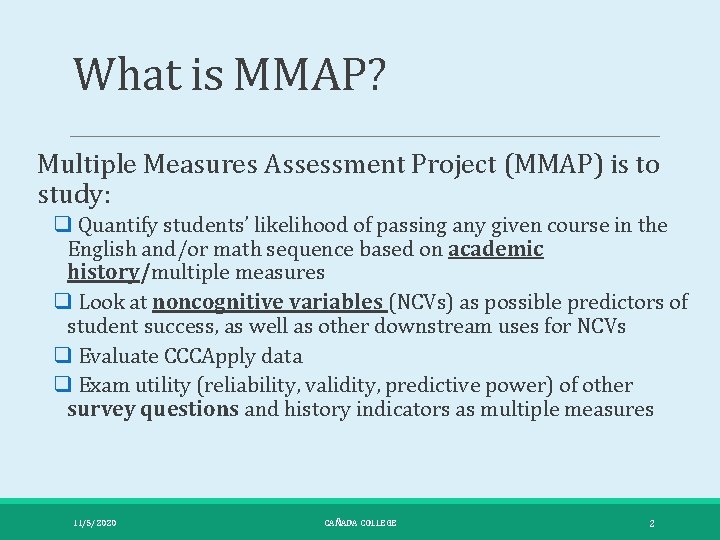
What is MMAP? Multiple Measures Assessment Project (MMAP) is to study: q Quantify students’ likelihood of passing any given course in the English and/or math sequence based on academic history/multiple measures q Look at noncognitive variables (NCVs) as possible predictors of student success, as well as other downstream uses for NCVs q Evaluate CCCApply data q Exam utility (reliability, validity, predictive power) of other survey questions and history indicators as multiple measures 11/5/2020 CAÑADA COLLEGE 2
Assumptions behind MMAP §Tests are not always the best measures §Tests alone are terrible measures §The goal of placement is to predict success §More information provides better placement 11/5/2020 CAÑADA COLLEGE 3
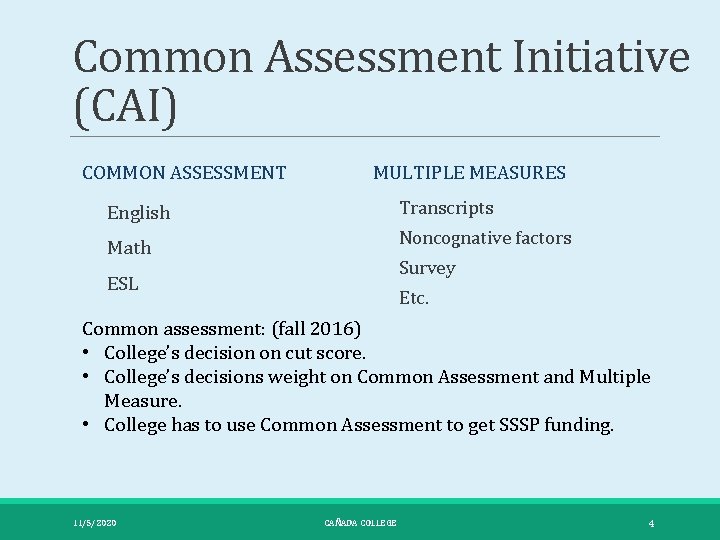
Common Assessment Initiative (CAI) COMMON ASSESSMENT MULTIPLE MEASURES English Transcripts Math Noncognative factors Survey ESL Etc. Common assessment: (fall 2016) • College’s decision on cut score. • College’s decisions weight on Common Assessment and Multiple Measure. • College has to use Common Assessment to get SSSP funding. 11/5/2020 CAÑADA COLLEGE 4
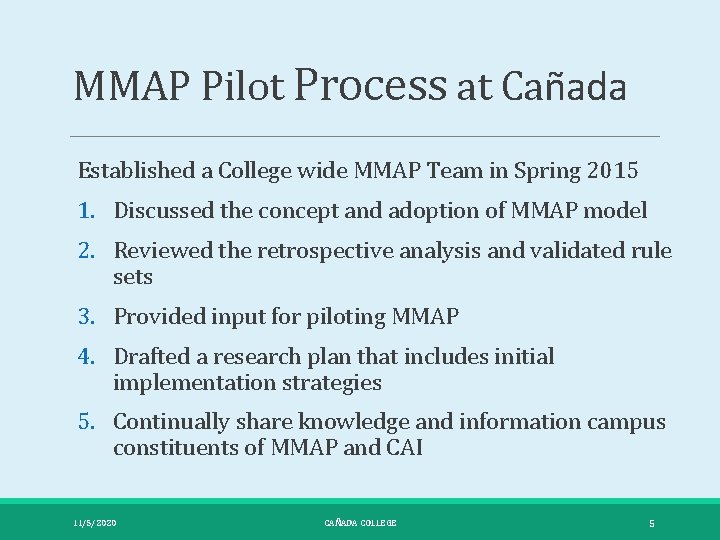
MMAP Pilot Process at Cañada Established a College wide MMAP Team in Spring 2015 1. Discussed the concept and adoption of MMAP model 2. Reviewed the retrospective analysis and validated rule sets 3. Provided input for piloting MMAP 4. Drafted a research plan that includes initial implementation strategies 5. Continually share knowledge and information campus constituents of MMAP and CAI 11/5/2020 CAÑADA COLLEGE 5
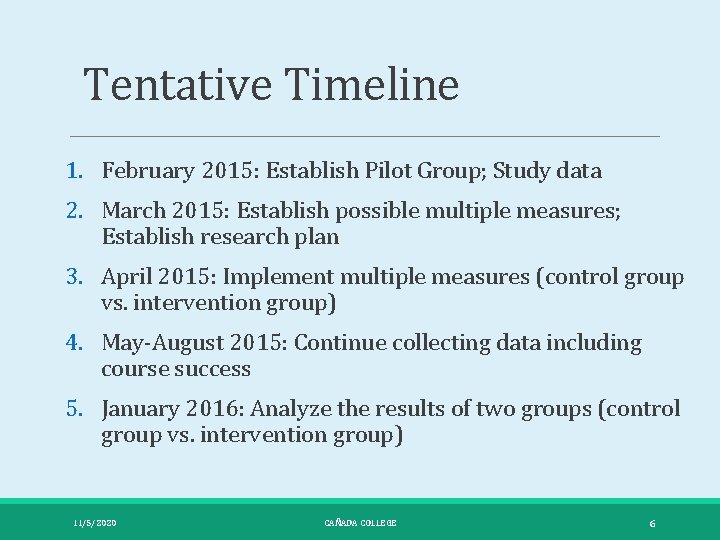
Tentative Timeline 1. February 2015: Establish Pilot Group; Study data 2. March 2015: Establish possible multiple measures; Establish research plan 3. April 2015: Implement multiple measures (control group vs. intervention group) 4. May-August 2015: Continue collecting data including course success 5. January 2016: Analyze the results of two groups (control group vs. intervention group) 11/5/2020 CAÑADA COLLEGE 6
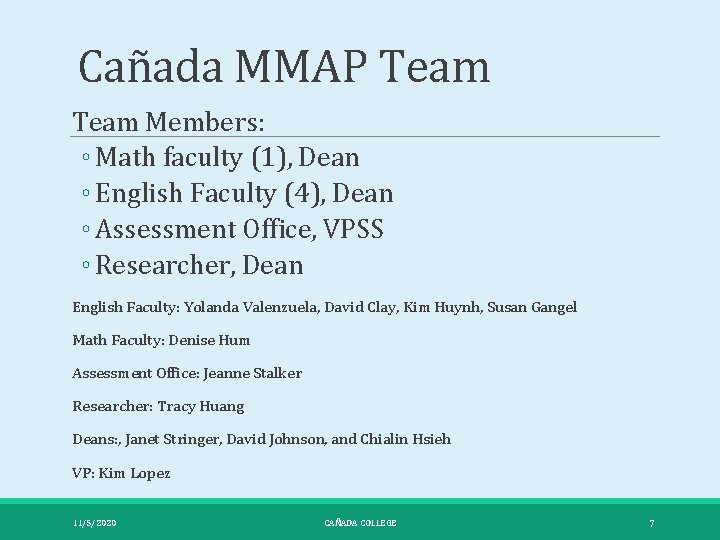
Cañada MMAP Team Members: ◦ Math faculty (1), Dean ◦ English Faculty (4), Dean ◦ Assessment Office, VPSS ◦ Researcher, Dean English Faculty: Yolanda Valenzuela, David Clay, Kim Huynh, Susan Gangel Math Faculty: Denise Hum Assessment Office: Jeanne Stalker Researcher: Tracy Huang Deans: , Janet Stringer, David Johnson, and Chialin Hsieh VP: Kim Lopez 11/5/2020 CAÑADA COLLEGE 7
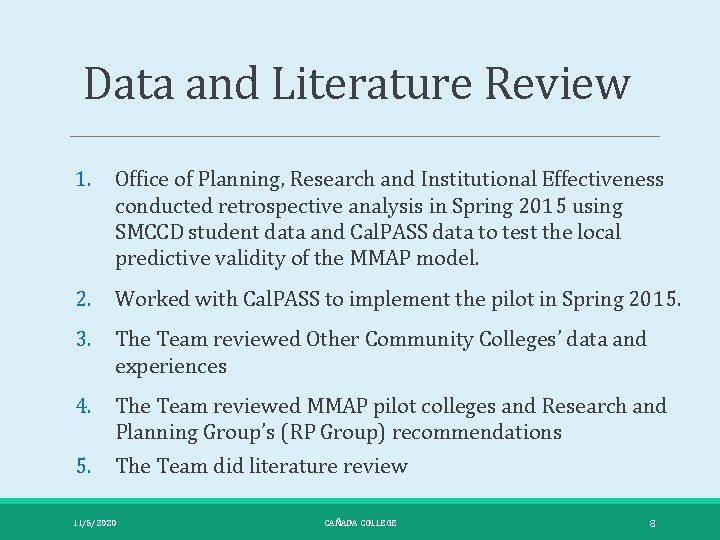
Data and Literature Review 1. Office of Planning, Research and Institutional Effectiveness conducted retrospective analysis in Spring 2015 using SMCCD student data and Cal. PASS data to test the local predictive validity of the MMAP model. 2. Worked with Cal. PASS to implement the pilot in Spring 2015. 3. The Team reviewed Other Community Colleges’ data and experiences 4. The Team reviewed MMAP pilot colleges and Research and Planning Group’s (RP Group) recommendations 5. The Team did literature review 11/5/2020 CAÑADA COLLEGE 8
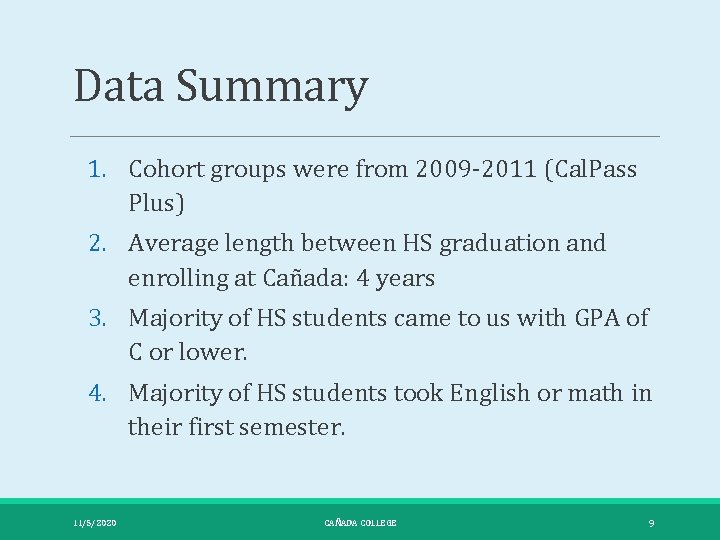
Data Summary 1. Cohort groups were from 2009 -2011 (Cal. Pass Plus) 2. Average length between HS graduation and enrolling at Cañada: 4 years 3. Majority of HS students came to us with GPA of C or lower. 4. Majority of HS students took English or math in their first semester. 11/5/2020 CAÑADA COLLEGE 9
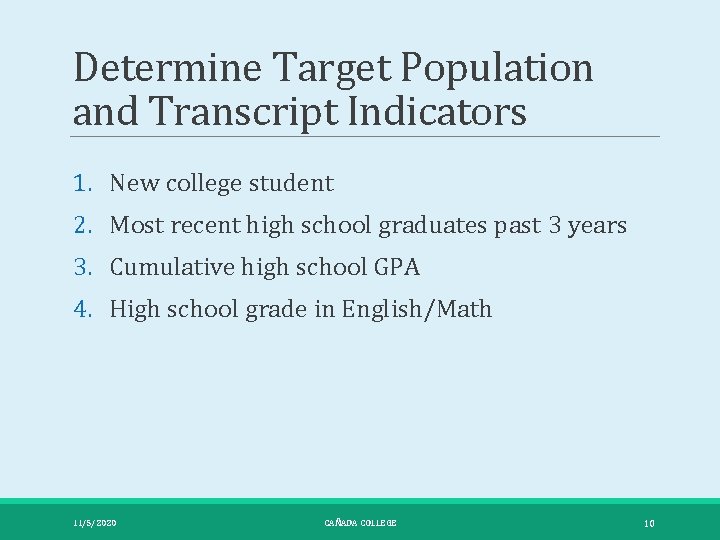
Determine Target Population and Transcript Indicators 1. New college student 2. Most recent high school graduates past 3 years 3. Cumulative high school GPA 4. High school grade in English/Math 11/5/2020 CAÑADA COLLEGE 10
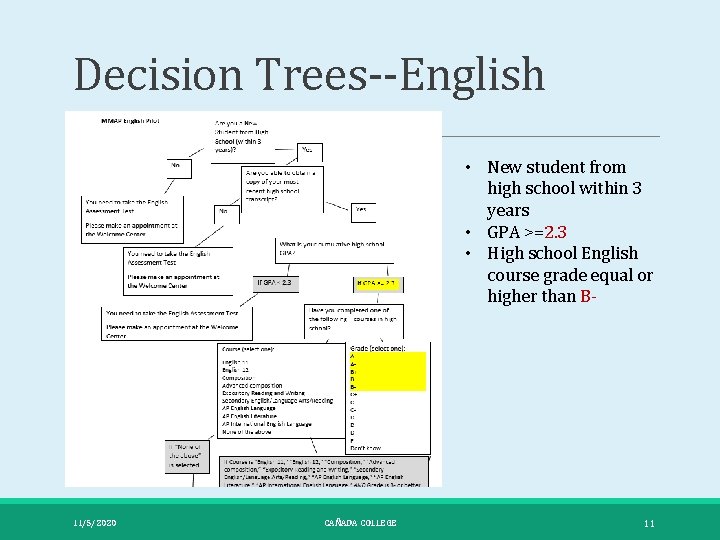
Decision Trees--English • New student from high school within 3 years • GPA >=2. 3 • High school English course grade equal or higher than B- 11/5/2020 CAÑADA COLLEGE 11
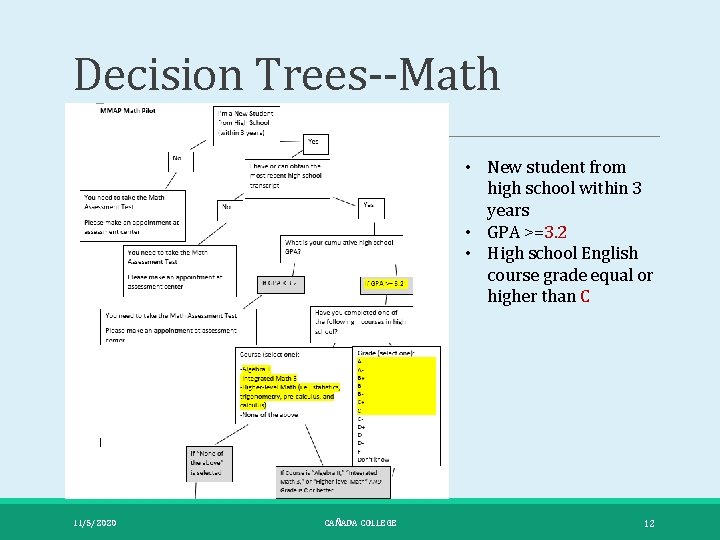
Decision Trees--Math • New student from high school within 3 years • GPA >=3. 2 • High school English course grade equal or higher than C 11/5/2020 CAÑADA COLLEGE 12
Web Application for the Decision Trees Development of the Web application ◦ English Questionnaire ◦ Math Questionnaire 11/5/2020 CAÑADA COLLEGE 13
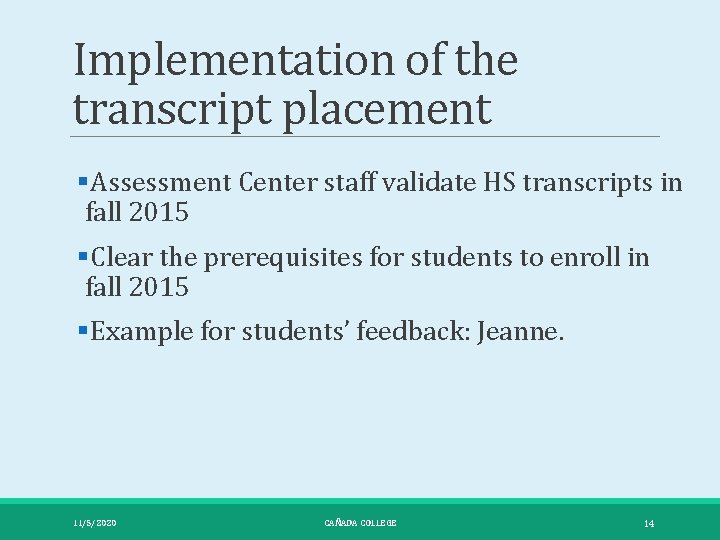
Implementation of the transcript placement §Assessment Center staff validate HS transcripts in fall 2015 §Clear the prerequisites for students to enroll in fall 2015 §Example for students’ feedback: Jeanne. 11/5/2020 CAÑADA COLLEGE 14
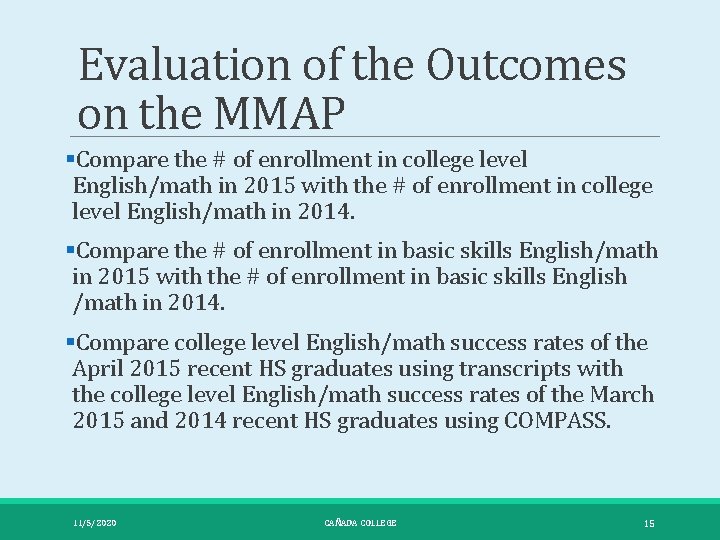
Evaluation of the Outcomes on the MMAP §Compare the # of enrollment in college level English/math in 2015 with the # of enrollment in college level English/math in 2014. §Compare the # of enrollment in basic skills English/math in 2015 with the # of enrollment in basic skills English /math in 2014. §Compare college level English/math success rates of the April 2015 recent HS graduates using transcripts with the college level English/math success rates of the March 2015 and 2014 recent HS graduates using COMPASS. 11/5/2020 CAÑADA COLLEGE 15
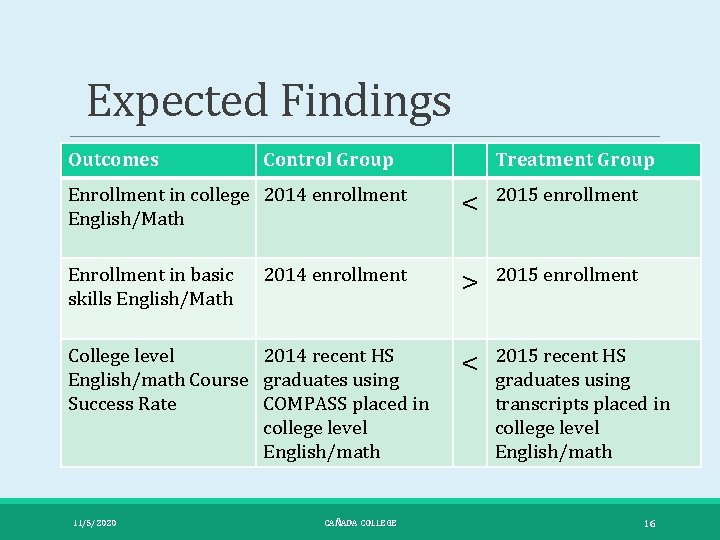
Expected Findings Outcomes Control Group Treatment Group Enrollment in college 2014 enrollment English/Math < 2015 enrollment Enrollment in basic skills English/Math > 2015 enrollment < 2015 recent HS graduates using transcripts placed in college level English/math 2014 enrollment College level 2014 recent HS English/math Course graduates using Success Rate COMPASS placed in college level English/math 11/5/2020 CAÑADA COLLEGE 16
Findings 11/5/2020 CAÑADA COLLEGE 17
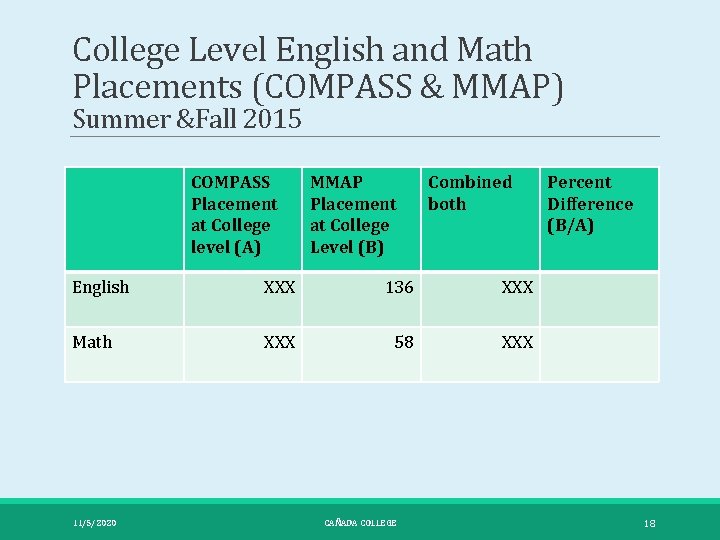
College Level English and Math Placements (COMPASS & MMAP) Summer &Fall 2015 COMPASS Placement at College level (A) MMAP Placement at College Level (B) Combined both English XXX 136 XXX Math XXX 58 XXX 11/5/2020 CAÑADA COLLEGE Percent Difference (B/A) 18
College Level English and Math Enrollment (COMPASS & MMAP) Summer & Fall 2015 COMPASS Placement at College level (A) MMAP Placement at College Level (B) Enrolled into College Level (A+B) English XXX 136 xxx + 111 Math XXX 58 Xxx + 40 11/5/2020 CAÑADA COLLEGE Percent Difference (B/A) 19
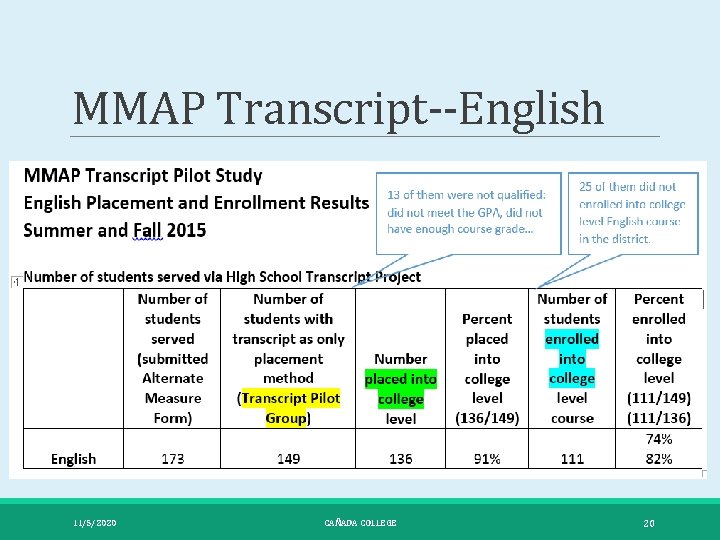
MMAP Transcript--English 11/5/2020 CAÑADA COLLEGE 20
MMAP Transcript--Math 11/5/2020 CAÑADA COLLEGE 21
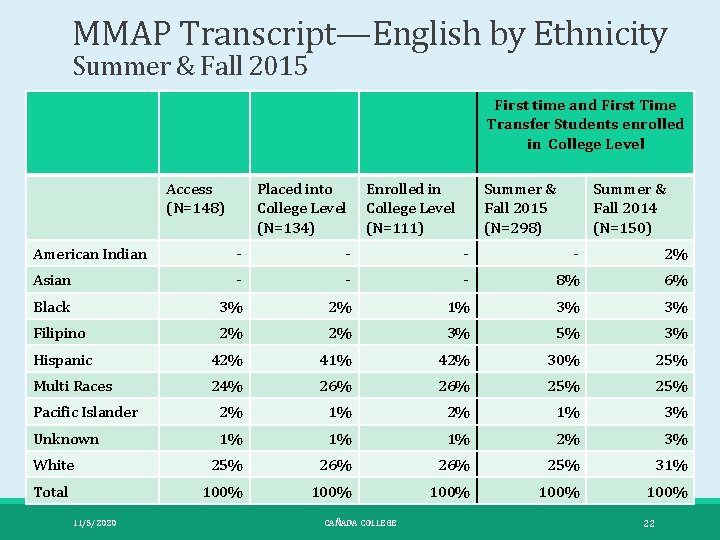
MMAP Transcript—English by Ethnicity Summer & Fall 2015 First time and First Time Transfer Students enrolled in College Level Access (N=148) Placed into College Level (N=134) Enrolled in College Level (N=111) Summer & Fall 2015 (N=298) Summer & Fall 2014 (N=150) American Indian - - 2% Asian - - - 8% 6% Black 3% 2% 1% 3% 3% Filipino 2% 2% 3% 5% 3% Hispanic 42% 41% 42% 30% 25% Multi Races 24% 26% 25% Pacific Islander 2% 1% 3% Unknown 1% 1% 1% 2% 3% White 25% 26% 25% 31% Total 100% 100% 11/5/2020 CAÑADA COLLEGE 22
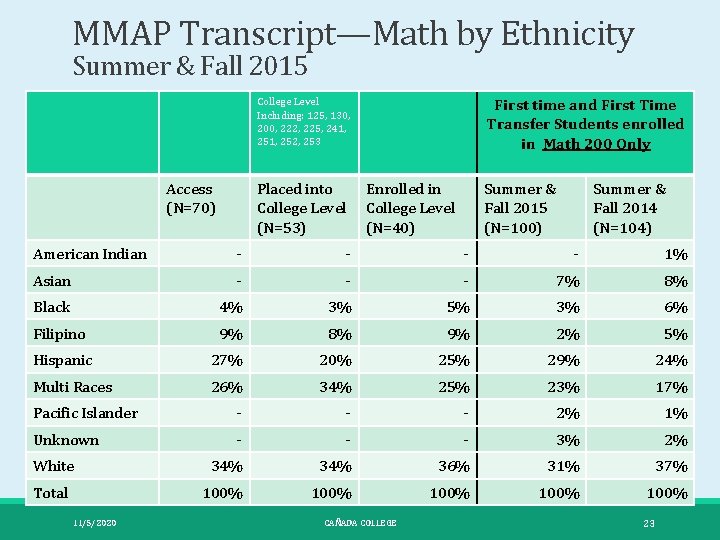
MMAP Transcript—Math by Ethnicity Summer & Fall 2015 College Level Including: 125, 130, 200, 222, 225, 241, 252, 253 Access (N=70) Placed into College Level (N=53) First time and First Time Transfer Students enrolled in Math 200 Only Enrolled in College Level (N=40) Summer & Fall 2015 (N=100) Summer & Fall 2014 (N=104) American Indian - - 1% Asian - - - 7% 8% Black 4% 3% 5% 3% 6% Filipino 9% 8% 9% 2% 5% Hispanic 27% 20% 25% 29% 24% Multi Races 26% 34% 25% 23% 17% Pacific Islander - - - 2% 1% Unknown - - - 3% 2% White 34% 36% 31% 37% Total 100% 100% 11/5/2020 CAÑADA COLLEGE 23
Demographics and Enrollment Review report for details 11/5/2020 CAÑADA COLLEGE 24
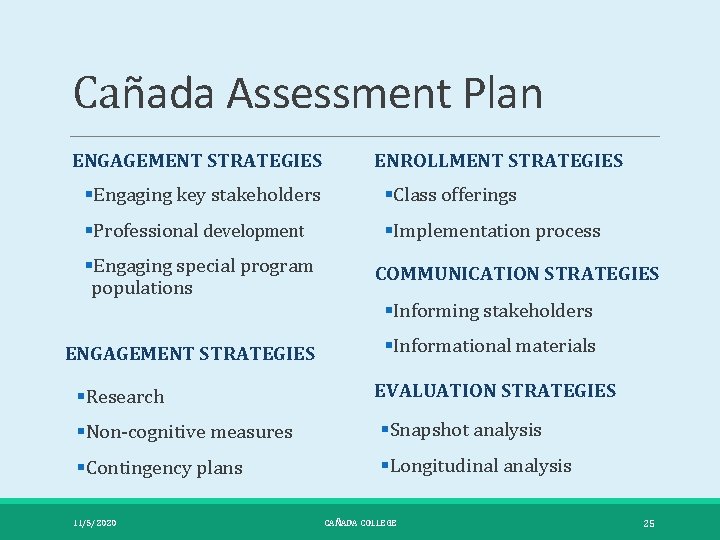
Cañada Assessment Plan ENGAGEMENT STRATEGIES ENROLLMENT STRATEGIES §Engaging key stakeholders §Class offerings §Professional development §Implementation process §Engaging special program populations ENGAGEMENT STRATEGIES COMMUNICATION STRATEGIES §Informing stakeholders §Informational materials §Research EVALUATION STRATEGIES §Non-cognitive measures §Snapshot analysis §Contingency plans §Longitudinal analysis 11/5/2020 CAÑADA COLLEGE 25
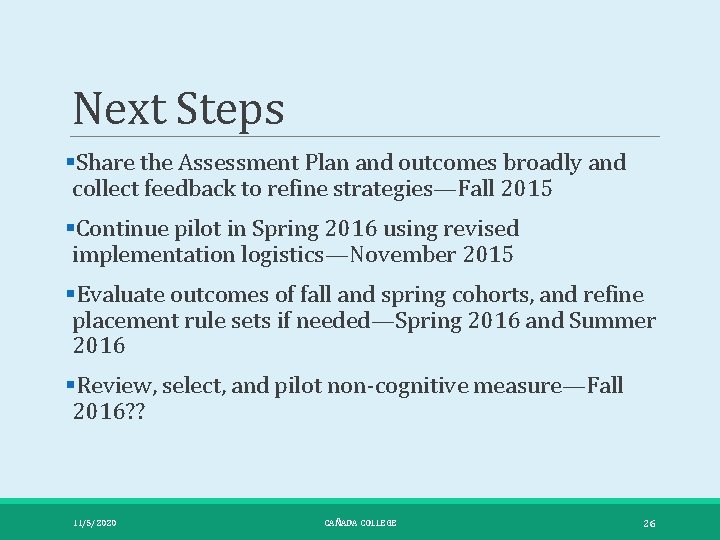
Next Steps §Share the Assessment Plan and outcomes broadly and collect feedback to refine strategies—Fall 2015 §Continue pilot in Spring 2016 using revised implementation logistics—November 2015 §Evaluate outcomes of fall and spring cohorts, and refine placement rule sets if needed—Spring 2016 and Summer 2016 §Review, select, and pilot non-cognitive measure—Fall 2016? ? 11/5/2020 CAÑADA COLLEGE 26
11/5/2020 CAÑADA COLLEGE 27
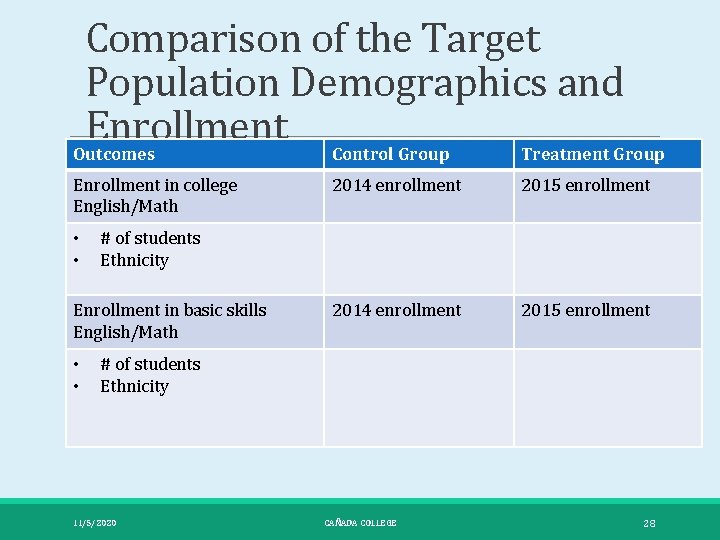
Comparison of the Target Population Demographics and Enrollment Outcomes Control Group Treatment Group Enrollment in college English/Math • • 2015 enrollment 2014 enrollment 2015 enrollment # of students Ethnicity Enrollment in basic skills English/Math • • 2014 enrollment # of students Ethnicity 11/5/2020 CAÑADA COLLEGE 28
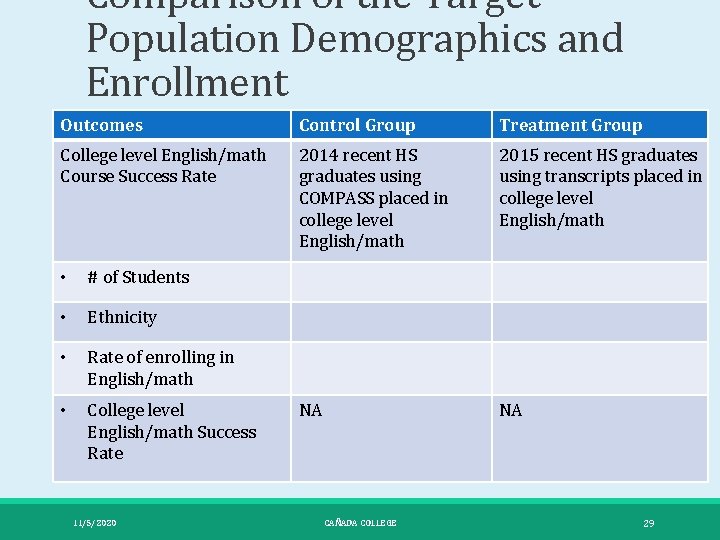
Comparison of the Target Population Demographics and Enrollment Outcomes Control Group Treatment Group College level English/math Course Success Rate 2014 recent HS graduates using COMPASS placed in college level English/math 2015 recent HS graduates using transcripts placed in college level English/math NA NA • # of Students • Ethnicity • Rate of enrolling in English/math • College level English/math Success Rate 11/5/2020 CAÑADA COLLEGE 29
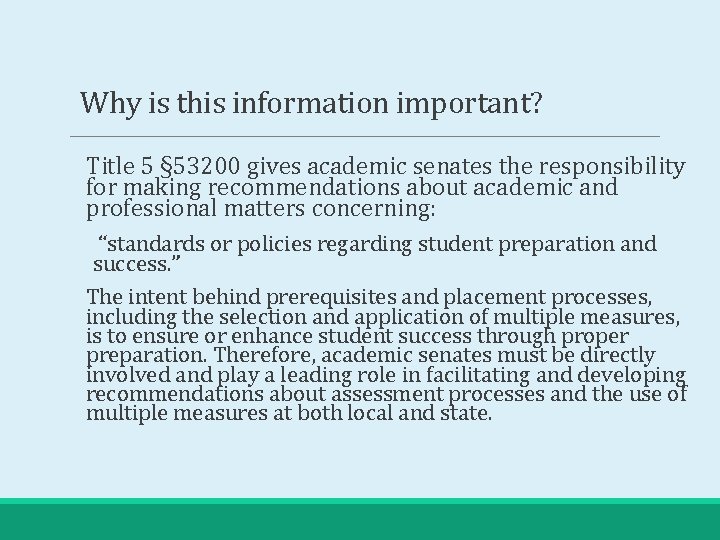
Why is this information important? Title 5 § 53200 gives academic senates the responsibility for making recommendations about academic and professional matters concerning: “standards or policies regarding student preparation and success. ” The intent behind prerequisites and placement processes, including the selection and application of multiple measures, is to ensure or enhance student success through proper preparation. Therefore, academic senates must be directly involved and play a leading role in facilitating and developing recommendations about assessment processes and the use of multiple measures at both local and state.
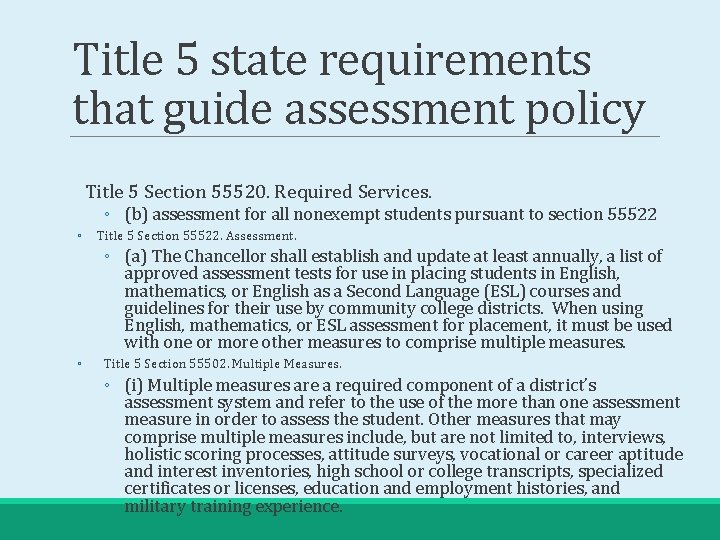
Title 5 state requirements that guide assessment policy Title 5 Section 55520. Required Services. ◦ (b) assessment for all nonexempt students pursuant to section 55522 ◦ Title 5 Section 55522. Assessment. ◦ (a) The Chancellor shall establish and update at least annually, a list of approved assessment tests for use in placing students in English, mathematics, or English as a Second Language (ESL) courses and guidelines for their use by community college districts. When using English, mathematics, or ESL assessment for placement, it must be used with one or more other measures to comprise multiple measures. ◦ Title 5 Section 55502. Multiple Measures. ◦ (i) Multiple measures are a required component of a district’s assessment system and refer to the use of the more than one assessment measure in order to assess the student. Other measures that may comprise multiple measures include, but are not limited to, interviews, holistic scoring processes, attitude surveys, vocational or career aptitude and interest inventories, high school or college transcripts, specialized certificates or licenses, education and employment histories, and military training experience.
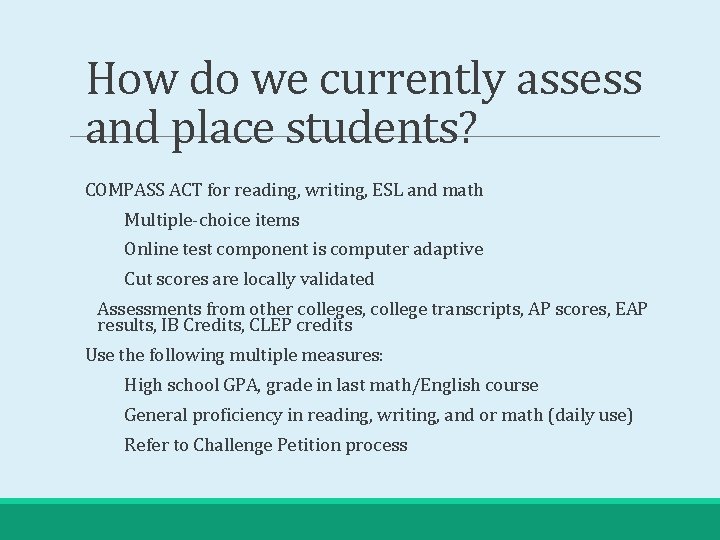
How do we currently assess and place students? COMPASS ACT for reading, writing, ESL and math Multiple-choice items Online test component is computer adaptive Cut scores are locally validated Assessments from other colleges, college transcripts, AP scores, EAP results, IB Credits, CLEP credits Use the following multiple measures: High school GPA, grade in last math/English course General proficiency in reading, writing, and or math (daily use) Refer to Challenge Petition process
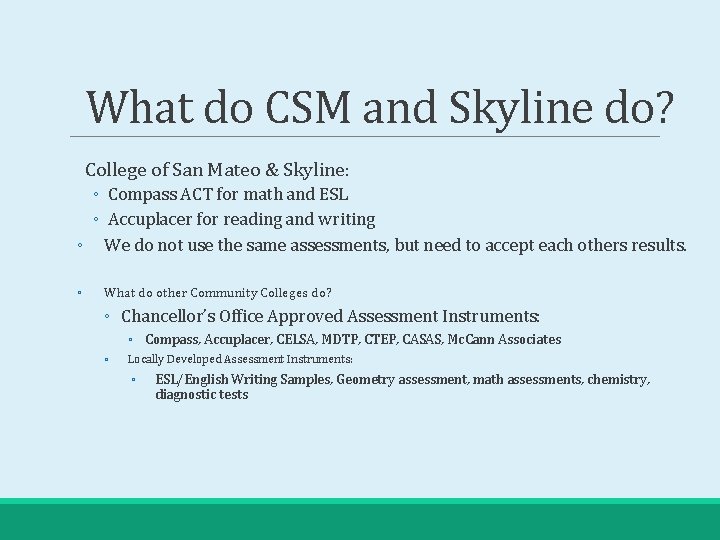
What do CSM and Skyline do? College of San Mateo & Skyline: ◦ Compass ACT for math and ESL ◦ Accuplacer for reading and writing ◦ We do not use the same assessments, but need to accept each others results. ◦ What do other Community Colleges do? ◦ Chancellor’s Office Approved Assessment Instruments: ◦ Compass, Accuplacer, CELSA, MDTP, CTEP, CASAS, Mc. Cann Associates ◦ Locally Developed Assessment Instruments: ◦ ESL/English Writing Samples, Geometry assessment, math assessments, chemistry, diagnostic tests
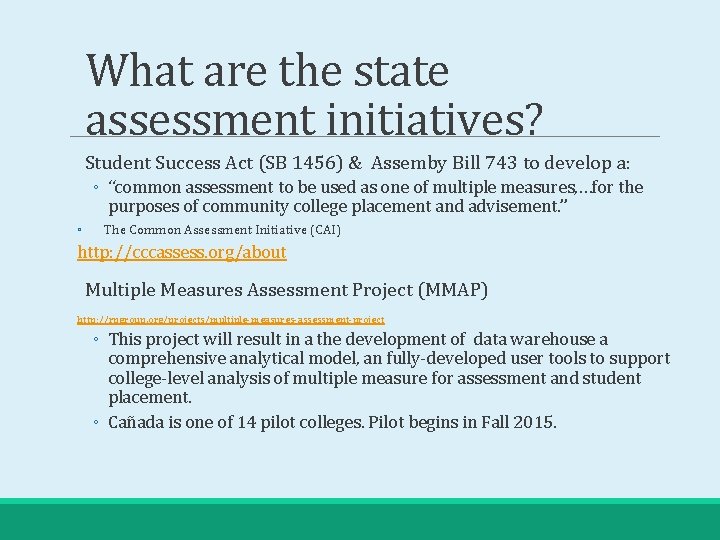
What are the state assessment initiatives? Student Success Act (SB 1456) & Assemby Bill 743 to develop a: ◦ “common assessment to be used as one of multiple measures, …for the purposes of community college placement and advisement. ” ◦ The Common Assessment Initiative (CAI) http: //cccassess. org/about Multiple Measures Assessment Project (MMAP) http: //rpgroup. org/projects/multiple-measures-assessment-project ◦ This project will result in a the development of data warehouse a comprehensive analytical model, an fully-developed user tools to support college-level analysis of multiple measure for assessment and student placement. ◦ Cañada is one of 14 pilot colleges. Pilot begins in Fall 2015.
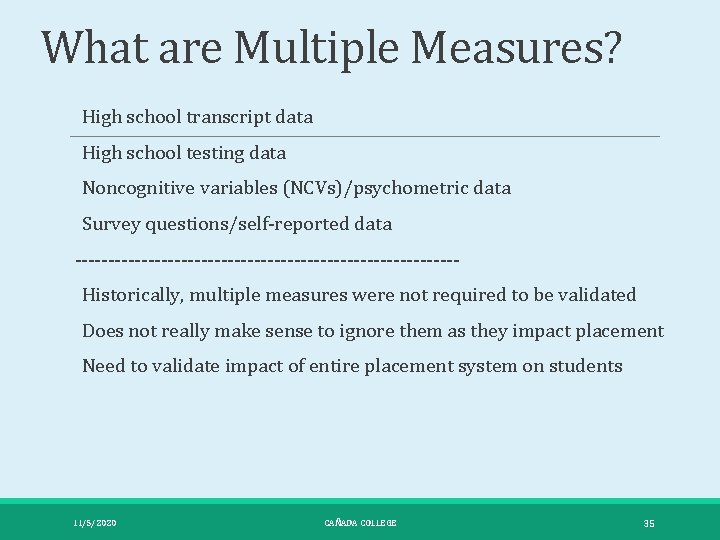
What are Multiple Measures? High school transcript data High school testing data Noncognitive variables (NCVs)/psychometric data Survey questions/self-reported data -----------------------------Historically, multiple measures were not required to be validated Does not really make sense to ignore them as they impact placement Need to validate impact of entire placement system on students 11/5/2020 CAÑADA COLLEGE 35