
Multiple Means of Inclusion Creating a Campus Culture
- Slides: 23
Multiple Means of Inclusion: Creating a Campus Culture of Access and Universal Design Antonia Levy & Christopher Leydon AHEAD Conference 2018
Outline 1. Presentation on our experiences 2. Interactive group activity 3. Conclusions
Context: CUNY and CUNY SPS • • CUNY School of Professional Studies (SPS) is a young and growing institution Part of the City University of New York (CUNY), the largest public urban university system in North America. The 3, 000 degree and certificate students at SPS are working adults, most of whom study online. CUNY SPS is also home to a Disability Studies program, offering BA, MA, and MS degrees and an Advanced Certificate.
Institutional Commitment Foundation for supporting success of students with disabilities, in no particular order: • • • Administration that supports a campus culture of access and inclusion Accessibility and Inclusion Committee tasked with policy and planning Collaboration across units--academic affairs, student services, IT, etc. Initiatives include face-to-face, hybrid, and online learning environments.
SPS Disability Studies Programs • • • Graduate Certificate in Disability Studies MA in Disability Studies BA in Disability Studies (fully online) Online tracks added for MA and Graduate Certificate (Fall 2013) MS in Disability Services in Higher Education (Spring 2016) Additional degrees and certificates in planning stages. . .
Disability Studies as underpinning In her article “Roosevelt's Sister, ” Rosemarie Garland Thomson creates a plausible if fictional biography in order to demonstrate “how institutionalizing and including disability as a subject of inquiry into humanities studies might more fully integrate disabled people into higher education and show the significances of disability to all people” (DSQ 2010). Garland Thomson’s point holds not only for the humanities, but also the social sciences and other areas of academia. Scholarly discussion of disability has the potential to change the culture of an entire institution.
Support and Collaboration A. B. C. D. Disability Services and Student Support Faculty Development and Support Accessibility and Inclusion Committee CUNY-wide collaborations
A. Disability Services & Student Support Direct support for students by disability services staff on the front end • • • Assistive technology (hardware, software, training) Alternate format textbooks Course site accessibility audits if indicated Academic adjustments (classroom accommodations) The human element--establishing sense of community remote/distance
Challenges at SPS The nature of our programs and student population presents some challenges • • • Scheduling remote real-time meetings for distance learners Lack of nighttime/weekend staff coverage for working students Students with disabilities who do not register for disability services Retention--highly motivated but education can’t be first priority Sense of community beyond the online classroom
B. Faculty Development & Support Multifaceted Approach - Raising accessibility awareness from the start (“built in”) Adding online / remote faculty support, training, and development Accessibility requirements in online learning / teaching Implementing accommodations in an online environment Technology can be “blessing and curse” regarding accessibility
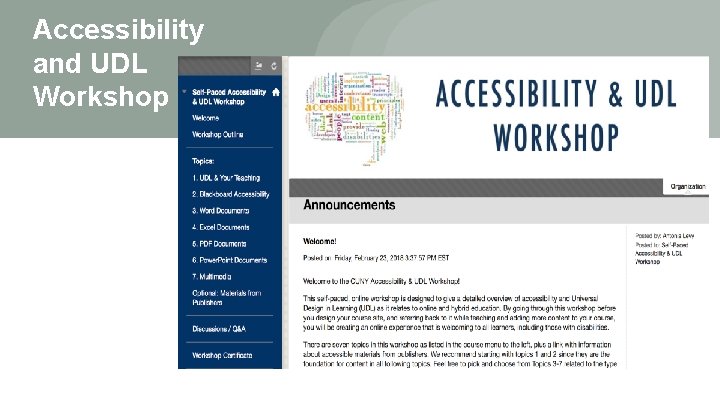
Accessibility and UDL Workshop
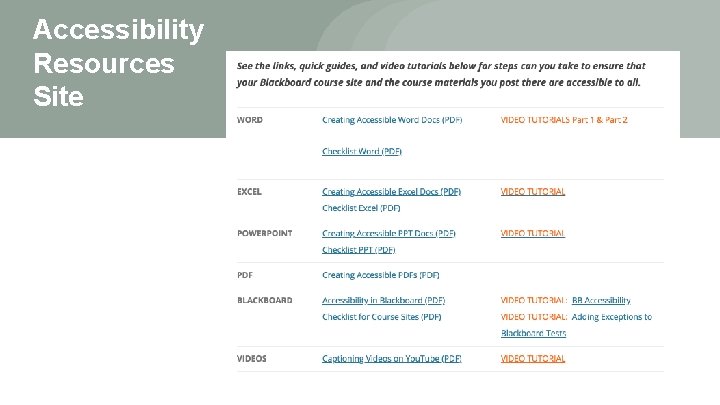
Accessibility Resources Site
Collaboration on Campus “Collaborative relationships between instructional faculty, staff, college administrators, and students with disabilities create an atmosphere where everyone’s input is valued. This collaborative atmosphere can help determine the most effective instructional and support strategies and resolve issues that may arise when educating students with disabilities in higher education. ” (Finn, Getzel, Asselin, & Reilly, 2008)
Collaboration at SPS • Webinar, blog series, presentations to faculty and academic leadership • Support for video captioning, faculty & staff training, course site reviews • Presentations at University-wide and national conferences • Grant-funded development of online UDL training course for faculty & staff • Recent acquisition of Accommodate system for Student Disability Services
C. Accessibility & Inclusion Committee - Founded in 2015 Members include - Assoc. Dean of Finance & Administration Information Technology Faculty Members and Academic Director of Disability Studies Student Association Representative Student Disability Services and CUNY LEADS Advisor Faculty Development Marketing / Webmaster Events Planning
C. Accessibility & Inclusion Committee Initiatives - Improved accessibility of commencement and other events - Drafting School accessibility policy - Pilot staff accessibility training - Coordinate accessibility efforts across units - Co-sponsoring accessibility-related events
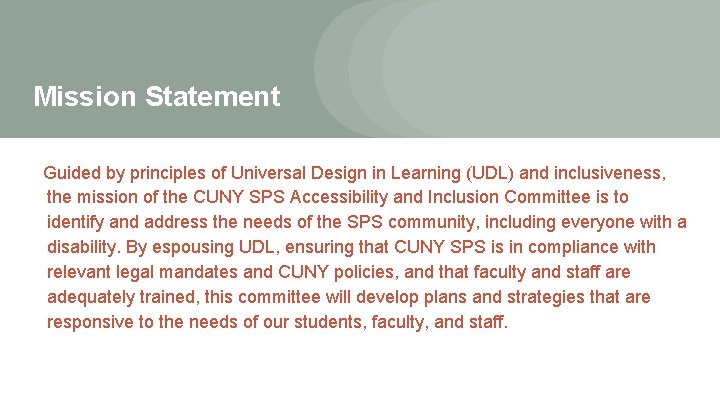
Mission Statement Guided by principles of Universal Design in Learning (UDL) and inclusiveness, the mission of the CUNY SPS Accessibility and Inclusion Committee is to identify and address the needs of the SPS community, including everyone with a disability. By espousing UDL, ensuring that CUNY SPS is in compliance with relevant legal mandates and CUNY policies, and that faculty and staff are adequately trained, this committee will develop plans and strategies that are responsive to the needs of our students, faculty, and staff.
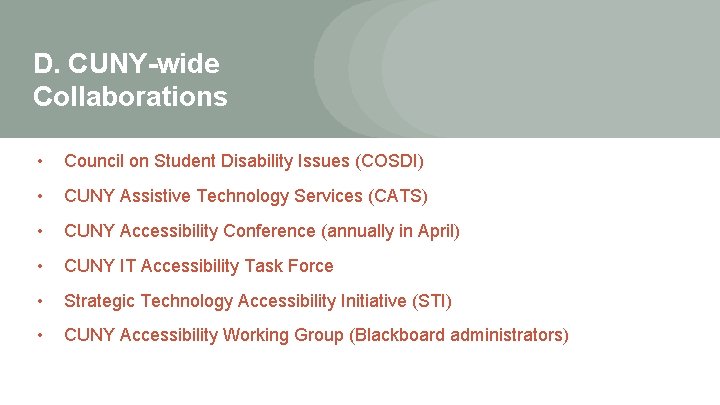
D. CUNY-wide Collaborations • Council on Student Disability Issues (COSDI) • CUNY Assistive Technology Services (CATS) • CUNY Accessibility Conference (annually in April) • CUNY IT Accessibility Task Force • Strategic Technology Accessibility Initiative (STI) • CUNY Accessibility Working Group (Blackboard administrators)
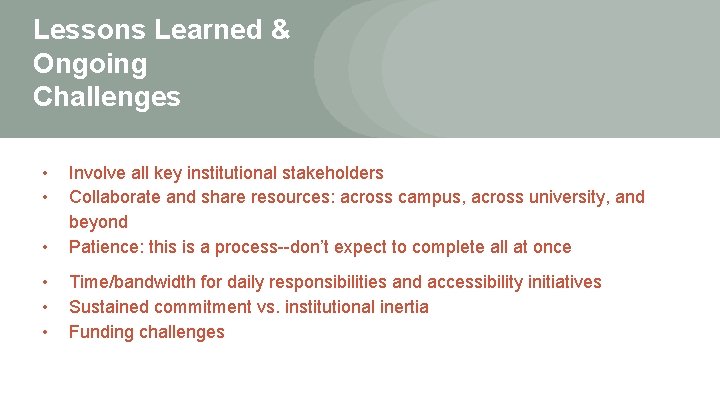
Lessons Learned & Ongoing Challenges • • • Involve all key institutional stakeholders Collaborate and share resources: across campus, across university, and beyond Patience: this is a process--don’t expect to complete all at once • • • Time/bandwidth for daily responsibilities and accessibility initiatives Sustained commitment vs. institutional inertia Funding challenges
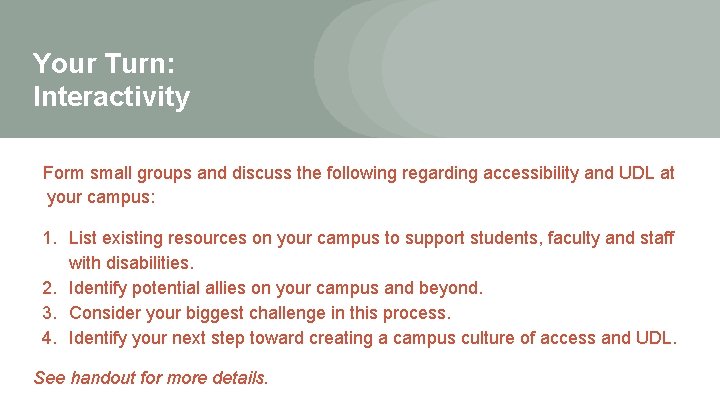
Your Turn: Interactivity Form small groups and discuss the following regarding accessibility and UDL at your campus: 1. List existing resources on your campus to support students, faculty and staff with disabilities. 2. Identify potential allies on your campus and beyond. 3. Consider your biggest challenge in this process. 4. Identify your next step toward creating a campus culture of access and UDL. See handout for more details.
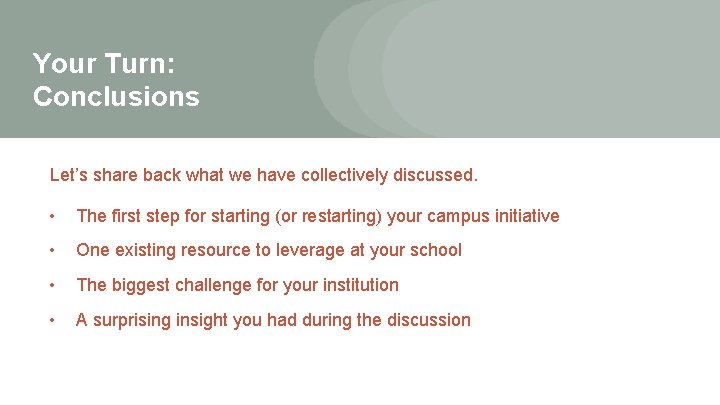
Your Turn: Conclusions Let’s share back what we have collectively discussed. • The first step for starting (or restarting) your campus initiative • One existing resource to leverage at your school • The biggest challenge for your institution • A surprising insight you had during the discussion
References • • Burgstahler, S. E. (2015). Universal Design in Higher Education. In: Universal Design in Higher Education: From Principles to Practice. Ed. S. E. Burgstahler & M. K. Young. Cambridge, MA: Harvard Education Press. 1 -20. DO-IT: Promising Practices in Student Services. http: //www. washington. edu/doit/programs/centeruniversal-design-education/postsecondary/universal-design-student-services/promising (accessed October 2017) Axelrod, J. (2014). Universal design in built and online environments. In M. L. Vance, N. E. Lipsitz, & K. Parks (Eds. ). Beyond the Americans with Disabilities Act: Inclusive Policy and Practice for Higher Education (pp. 141 -144). Washington, DC: National Association of Student Personnel Administrators. Garland-Thomson, R. (2010). Roosevelt's Sister: Why We Need Disability Studies in the Humanities. DSQ 30, 3/4.
Thank you! Christopher Leydon Student Services Coordinator CUNY School of Professional Studies christopher. leydon@cuny. edu Antonia Levy Instructional Technology & Multimedia Manager CUNY School of Professional Studies antonia. levy@cuny. edu