
Multiple Intelligence Theory Victoria Amidon EDU 416 Intelligence

![References Math. Jax, (2011). Mathematical Intelligence [jpeg] Retrieved from http: //mathematical erroring. blogspot. com.](https://slidetodoc.com/presentation_image_h2/8a55c70caff868adb680878450eb72c0/image-16.jpg "References Math. Jax, (2011). Mathematical Intelligence [jpeg] Retrieved from http: //mathematical erroring. blogspot. com.")
- Slides: 16
Multiple Intelligence Theory Victoria Amidon EDU 416: Intelligence Assessment Instructor Kenneth Caron February 11, 2017
What is Intelligence The ability to use reason to navigate the environment and solve problems. Intelligence is made up of many skill domains and encompasses both physical and mental capabilities.
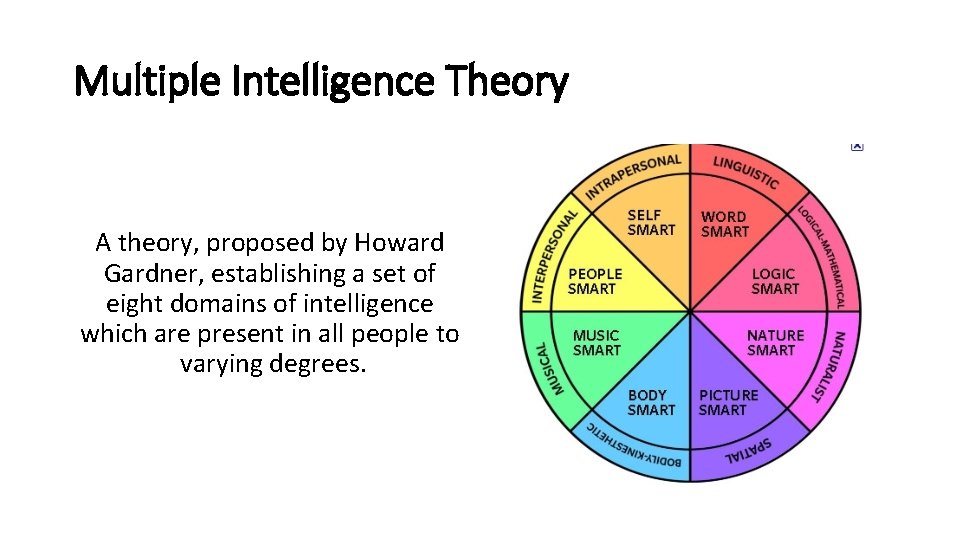
Multiple Intelligence Theory A theory, proposed by Howard Gardner, establishing a set of eight domains of intelligence which are present in all people to varying degrees.
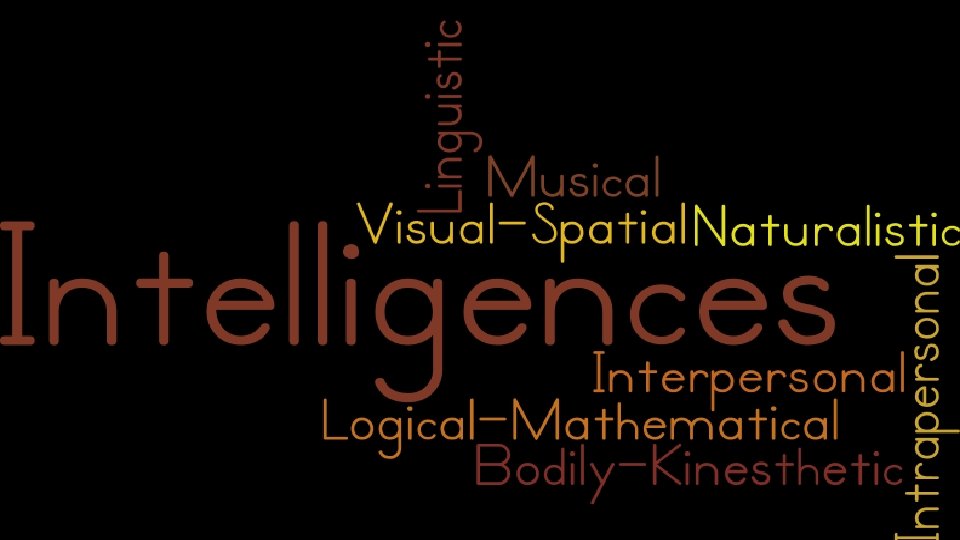
Linguistic Intelligence The knowledge of and ability to use language. The ability to use words to present and obtain information. Strengths: § Reading § Writing § Discussions § Storytelling § Spelling § Word puzzles Spatial Intelligence The capacity to picture something in your mind without having a visual image present; an appreciation and ability to understand and/or manipulate the visual and physical aspects of objects. Strengths: • Inventing • Architecture • Planning physical space • Manipulating objects in space (i. e. puzzles, Legos, mazes, tangrams)
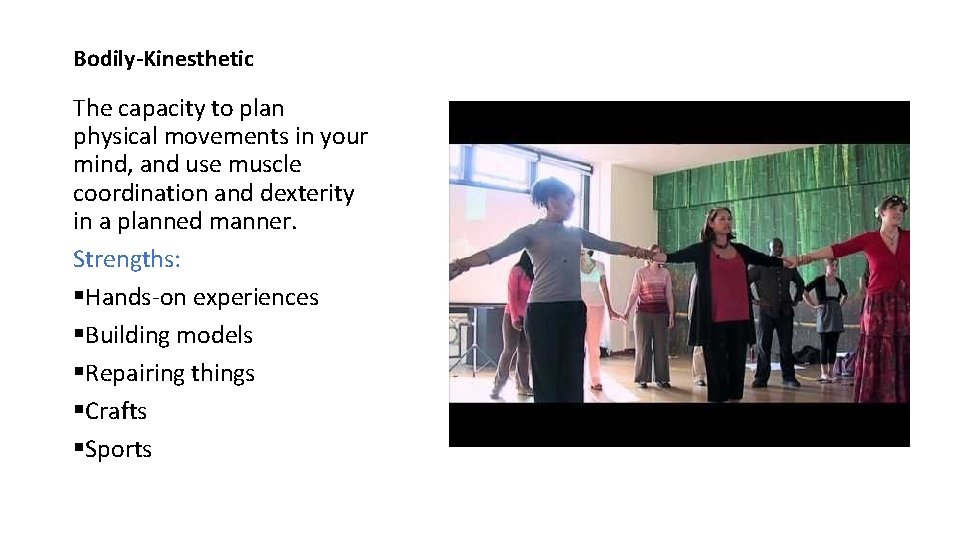
Bodily-Kinesthetic The capacity to plan physical movements in your mind, and use muscle coordination and dexterity in a planned manner. Strengths: §Hands-on experiences §Building models §Repairing things §Crafts §Sports
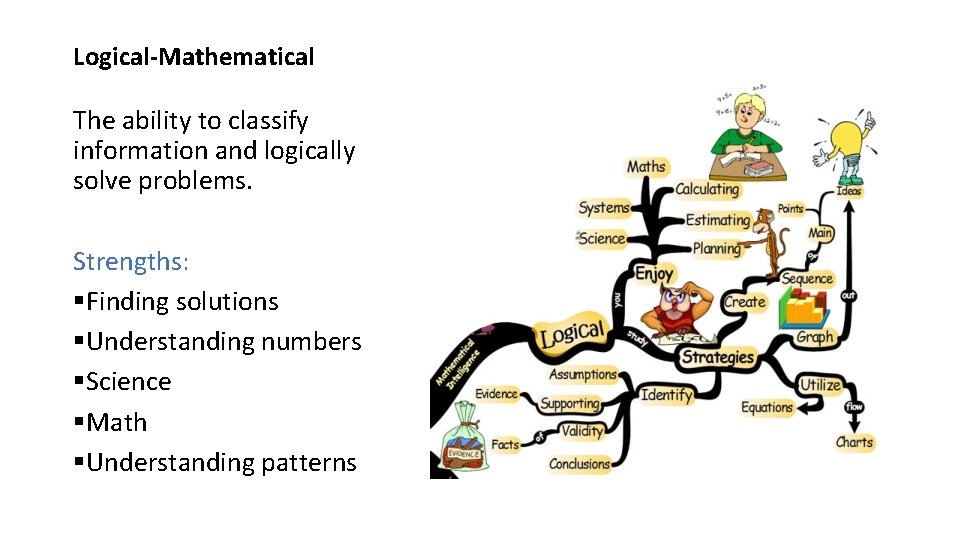
Logical-Mathematical The ability to classify information and logically solve problems. Strengths: §Finding solutions §Understanding numbers §Science §Math §Understanding patterns
Musical Intelligence The ability to perceive various parts of music such as tone, pitch, rhythm, and timbre. Strengths: § Playing Instruments § Pattern Recognition § Memorization § Listening § Sound Discrimination Naturalistic Intelligence The ability to understand, classify, and discriminate natural and living things such as animals and plants. Possesses a keen sense of the physical world, animals, plants, and nature. Strengths: § Observant of their environment § Taxonomy § Cooking
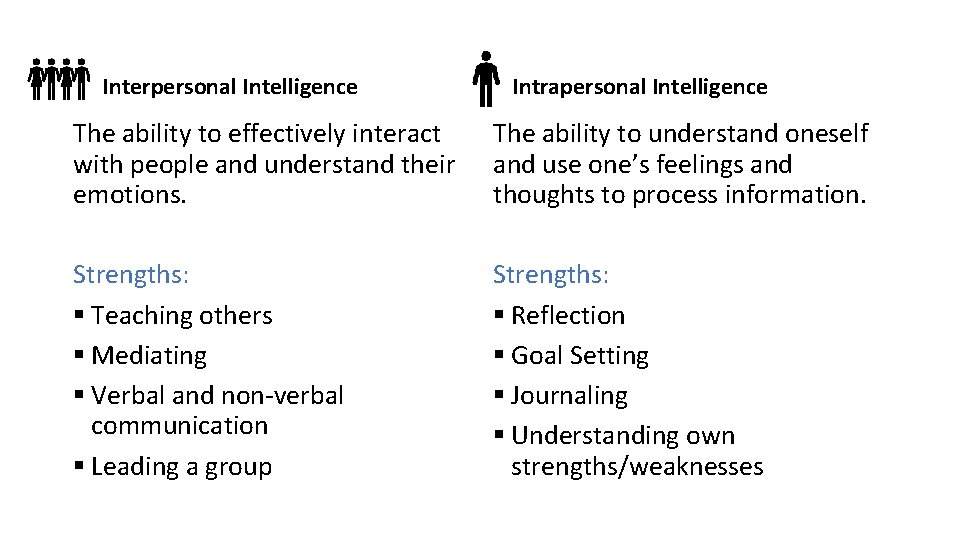
Interpersonal Intelligence Intrapersonal Intelligence The ability to effectively interact with people and understand their emotions. The ability to understand oneself and use one’s feelings and thoughts to process information. Strengths: § Teaching others § Mediating § Verbal and non-verbal communication § Leading a group Strengths: § Reflection § Goal Setting § Journaling § Understanding own strengths/weaknesses
MI Theory in the Classroom Assess the students’ MI make-up § observations § interviews § discussions about MI theory Implementation § Create lessons and learning experiences which include as many of the intelligences as possible. § Teacher creates an environment where many different forms of learning can co-exist effectively. § Teacher balances the intelligences within the curriculum to represent each one throughout the units.
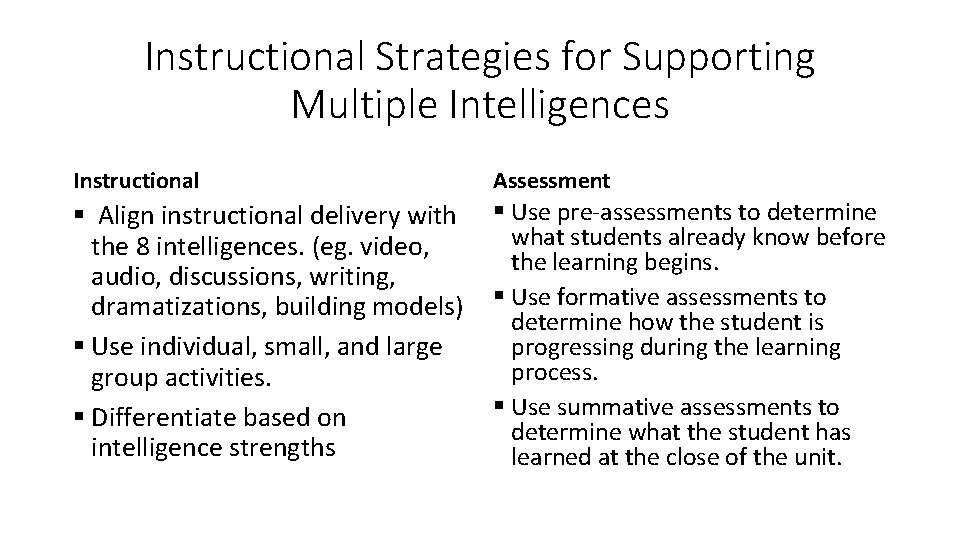
Instructional Strategies for Supporting Multiple Intelligences Instructional Assessment § Align instructional delivery with the 8 intelligences. (eg. video, audio, discussions, writing, dramatizations, building models) § Use individual, small, and large group activities. § Differentiate based on intelligence strengths § Use pre-assessments to determine what students already know before the learning begins. § Use formative assessments to determine how the student is progressing during the learning process. § Use summative assessments to determine what the student has learned at the close of the unit.
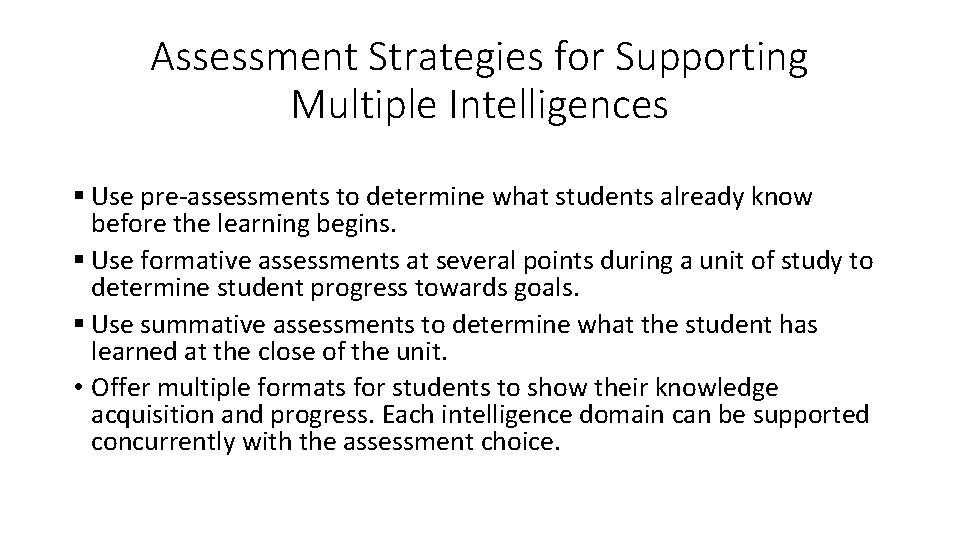
Assessment Strategies for Supporting Multiple Intelligences § Use pre-assessments to determine what students already know before the learning begins. § Use formative assessments at several points during a unit of study to determine student progress towards goals. § Use summative assessments to determine what the student has learned at the close of the unit. • Offer multiple formats for students to show their knowledge acquisition and progress. Each intelligence domain can be supported concurrently with the assessment choice.
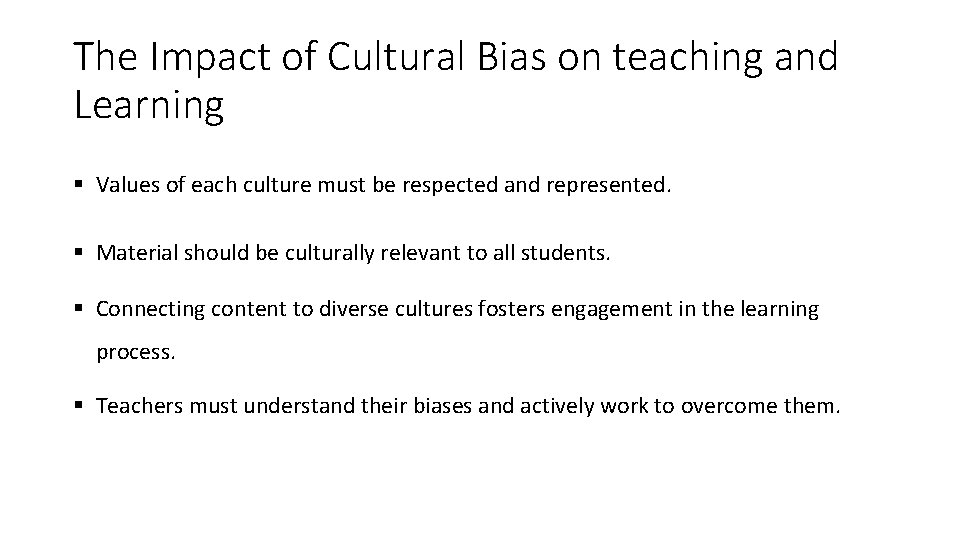
The Impact of Cultural Bias on teaching and Learning § Values of each culture must be respected and represented. § Material should be culturally relevant to all students. § Connecting content to diverse cultures fosters engagement in the learning process. § Teachers must understand their biases and actively work to overcome them.
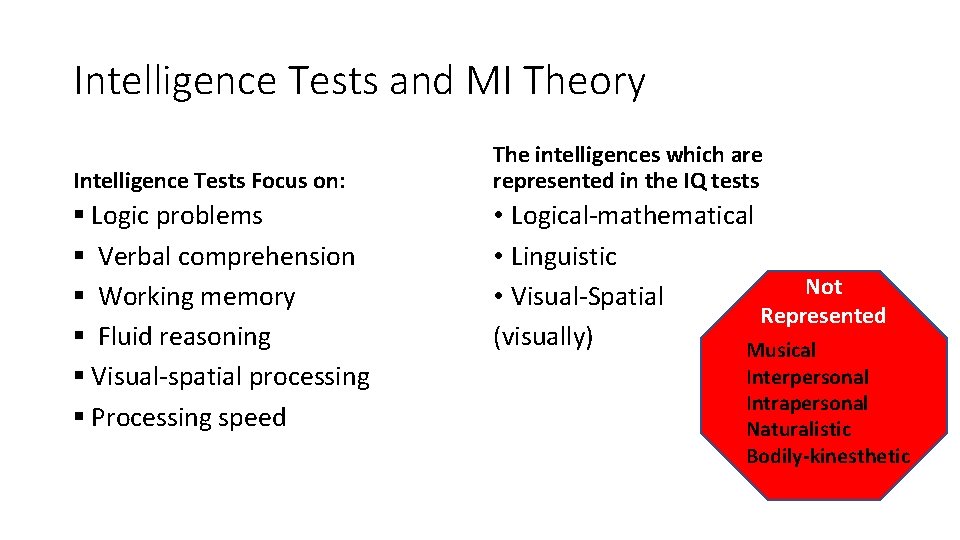
Intelligence Tests and MI Theory Intelligence Tests Focus on: § Logic problems § Verbal comprehension § Working memory § Fluid reasoning § Visual-spatial processing § Processing speed The intelligences which are represented in the IQ tests • Logical-mathematical • Linguistic Not • Visual-Spatial Represented (visually) Musical Interpersonal Intrapersonal Naturalistic Bodily-kinesthetic
References Armstrong, T. (2009). Multiple intelligences in the classroom (3 rd ed. ). Alexandria, VA: Association for Supervision & Curriculum Development. Kindle Edition. Canter, A. S. (1997). The future of intelligence testing in the schools. School Psychology Review, 26(2), 255. Retrieved from the EBSCOhost database. Gardner, H. (2011). Frames of mind. [electronic resource]: The theory of multiple intelligences New York: Basic Books, 2011. Retrieved from http: //search. ebscohost. com/login. aspx? direct=true&db=cat 02191 a&AN=aul. 10449816&site=eds-live; http: //site. ebrary. com/lib/ashford/Doc? id=10449816 "Intelligence. " Merriam-Webster. com. Merriam-Webster, n. d. Web. 19 Jan. 2017.
References Math. Jax, (2011). Mathematical Intelligence [jpeg] Retrieved from http: //mathematical erroring. blogspot. com. Creative Commons Megan J. Freudigmann, (nd. ) Multiple Intelligences [jpeg] Retrieved from http: //21 resources 4 teachers. weebly. com/multipleintelligences. html. Creative Commons Attribution-Non. Commercial-No. Derivs 3. 0 United States License. Sousa, D. A. , & Tomlinson, C. A. (2011). Differentiation and The Brain: How Neuroscience Supports the Learner-Friendly Classroom. Bloomington, IN: Solution Tree Press. The Ross Institute. (2009, February 9). Roman Architecture Through Movement. [Video File]. Retrieved from http: //www. youtube. com/watch? v=Mmfjp. LQi. RXE Tomlinson, C. A. , & Eidson, C. C. (2003). Differentiation in Practice : A Resource Guide for Differentiating Curriculum, Grades K-5. Alexandria, VA: Association for Supervision & Curriculum Development (ASCD). Willis, J. , & Mitchell, G. (2014). The neuroscience of learning: Principles and applications for educators. San Diego, CA: Bridgepoint Education.