
Multiple Instance Real Boosting with Aggregation Functions Hossein

Multiple Instance Real Boosting with Aggregation Functions Hossein Hajimirsadeghi and Greg Mori School of Computing Science Simon Fraser University International Conference on Pattern Recognition November 14, 2012
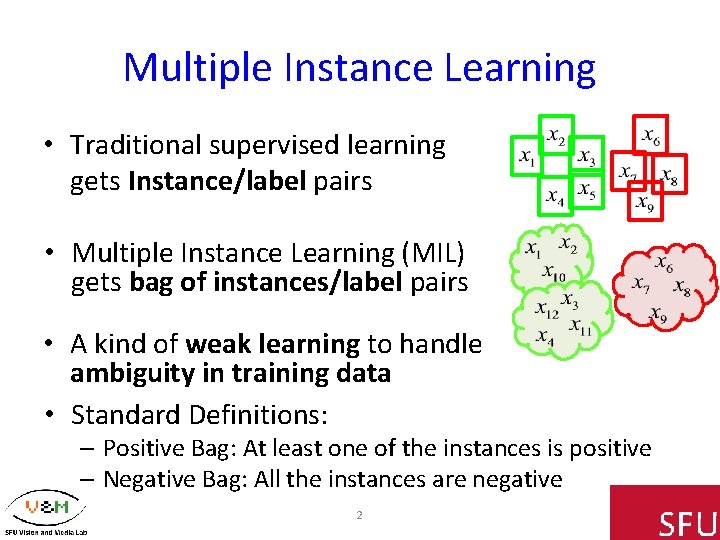
Multiple Instance Learning • Traditional supervised learning gets Instance/label pairs • Multiple Instance Learning (MIL) gets bag of instances/label pairs • A kind of weak learning to handle ambiguity in training data • Standard Definitions: – Positive Bag: At least one of the instances is positive – Negative Bag: All the instances are negative 2
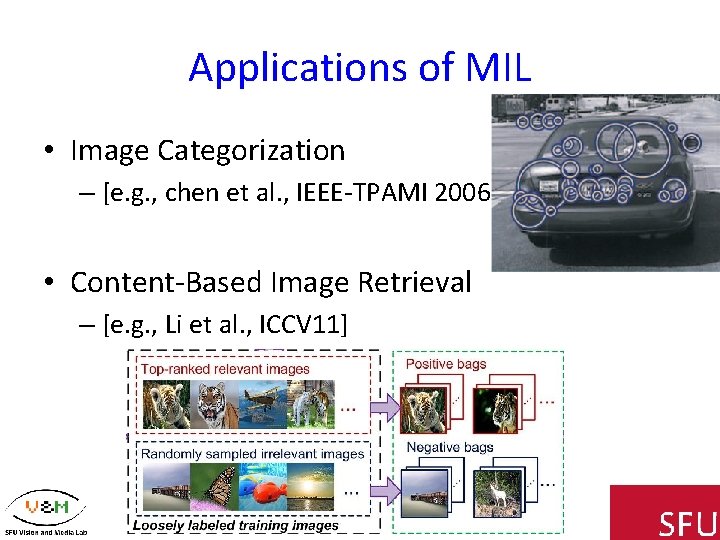
Applications of MIL • Image Categorization – [e. g. , chen et al. , IEEE-TPAMI 2006] • Content-Based Image Retrieval – [e. g. , Li et al. , ICCV 11] 3
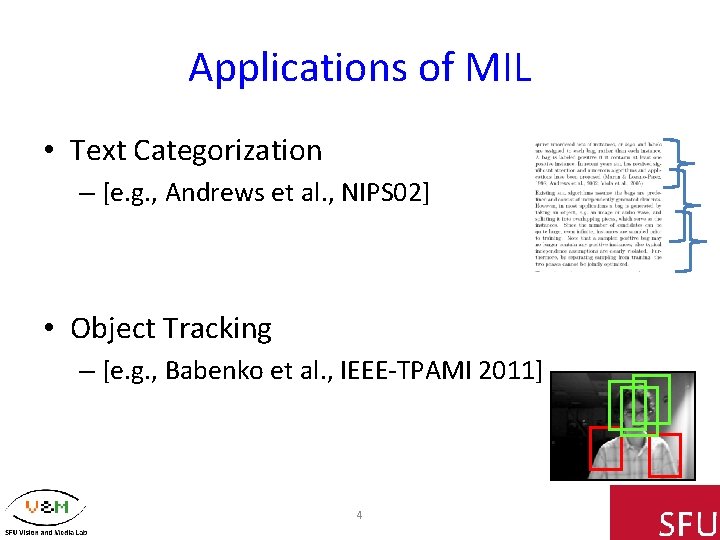
Applications of MIL • Text Categorization – [e. g. , Andrews et al. , NIPS 02] • Object Tracking – [e. g. , Babenko et al. , IEEE-TPAMI 2011] 4
Problem & Objective • The information “At least one of the instances is positive” is very weak and ambiguous. – There are examples of MIL datasets where most instances in the positive bags are positive. • We aim to mine through different levels of ambiguity in the data: – For example: a few instances are positive, some instances are positive, many instances are positive, most instances are positive, … 5
Approach • Using the ideas in Boosting: – Finding a bag-level classifier by maximizing the expected log-likelihood of the training bags – Finding an instance-level strong classifier as a combination of weak classifiers like Real. Boost Algorithm (Friedman et al. 2000), modified by the information from the bag-level classifier • Using aggregation functions with different degrees of or-ness: – Aggregate the probability of instances to define probability of a bag be positive 6
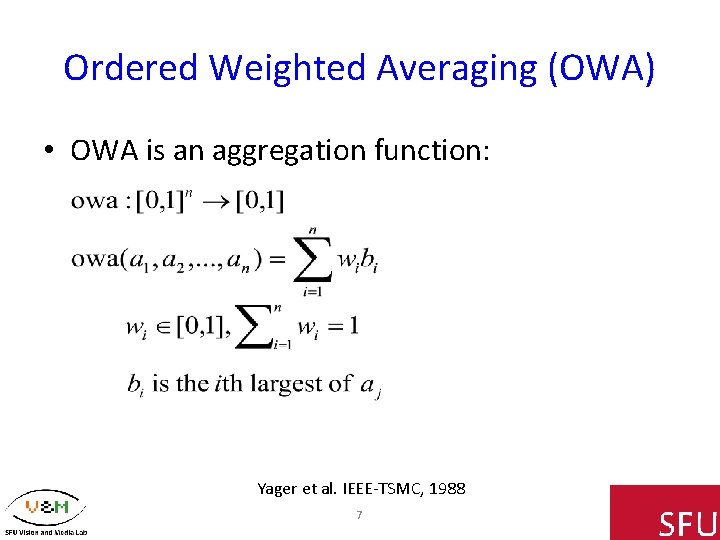
Ordered Weighted Averaging (OWA) • OWA is an aggregation function: Yager et al. IEEE-TSMC, 1988 7
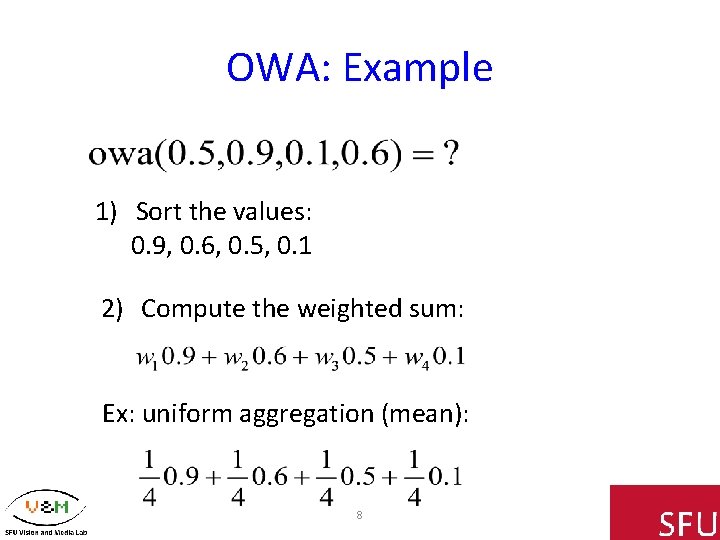
OWA: Example 1) Sort the values: 0. 9, 0. 6, 0. 5, 0. 1 2) Compute the weighted sum: Ex: uniform aggregation (mean): 8
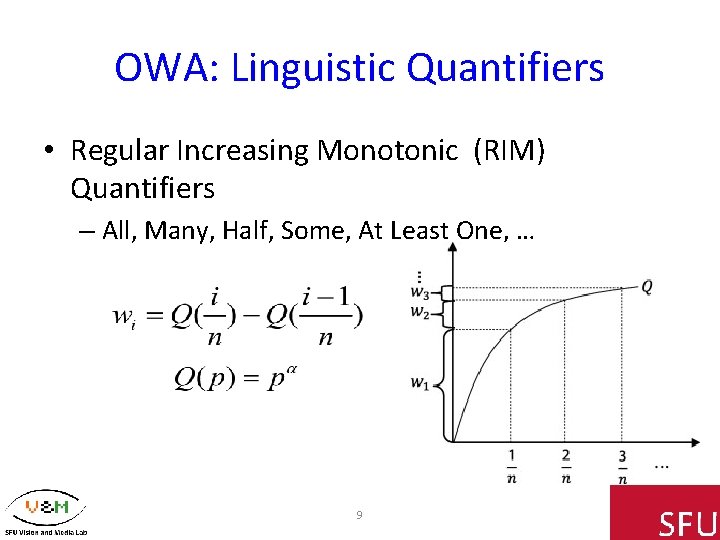
OWA: Linguistic Quantifiers • Regular Increasing Monotonic (RIM) Quantifiers – All, Many, Half, Some, At Least One, … 9
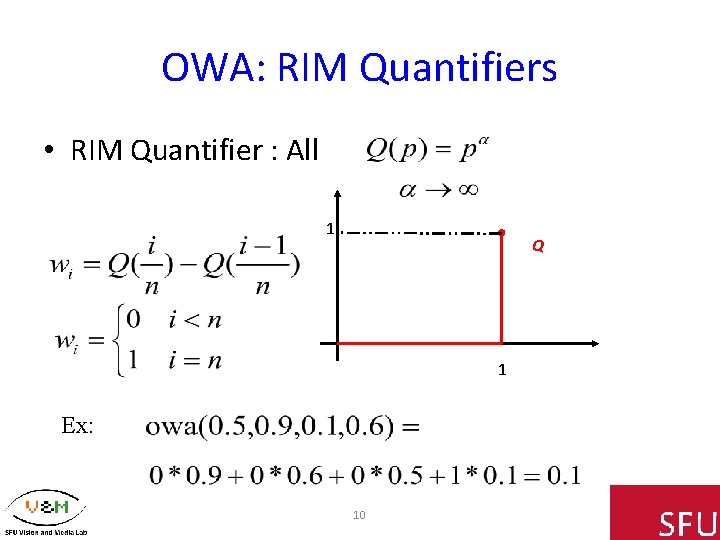
OWA: RIM Quantifiers • RIM Quantifier : All 1 Q 1 Ex: 10
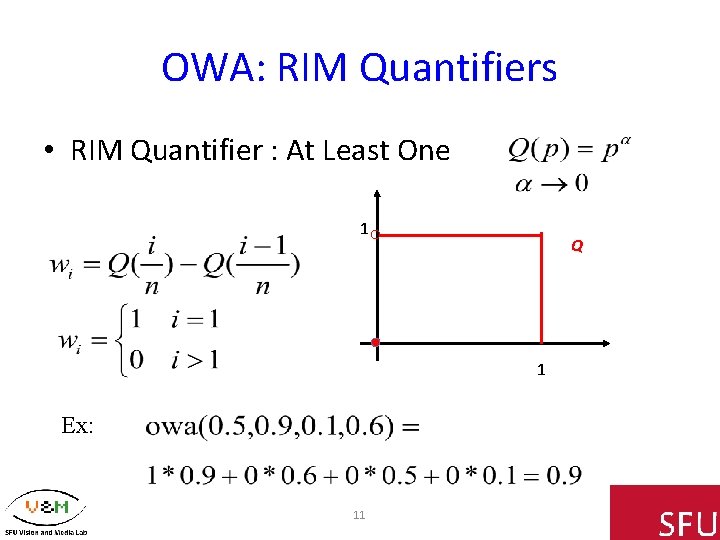
OWA: RIM Quantifiers • RIM Quantifier : At Least One 1 Q 1 Ex: 11
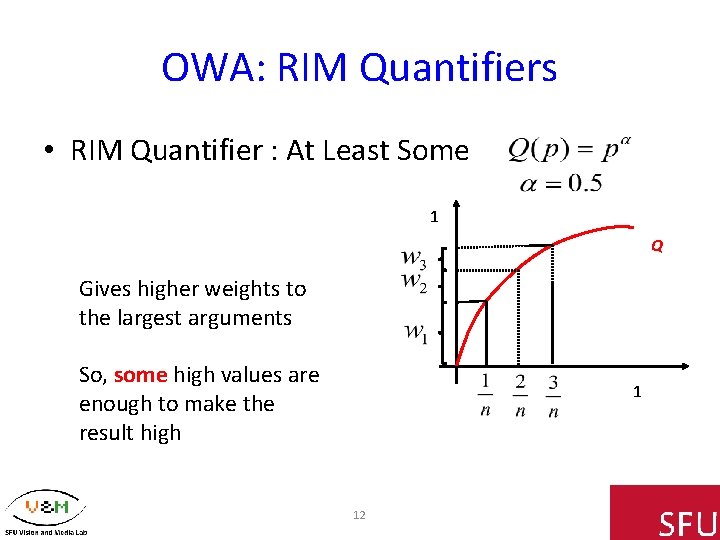
OWA: RIM Quantifiers • RIM Quantifier : At Least Some 1 Q Gives higher weights to the largest arguments So, some high values are enough to make the result high 1 12
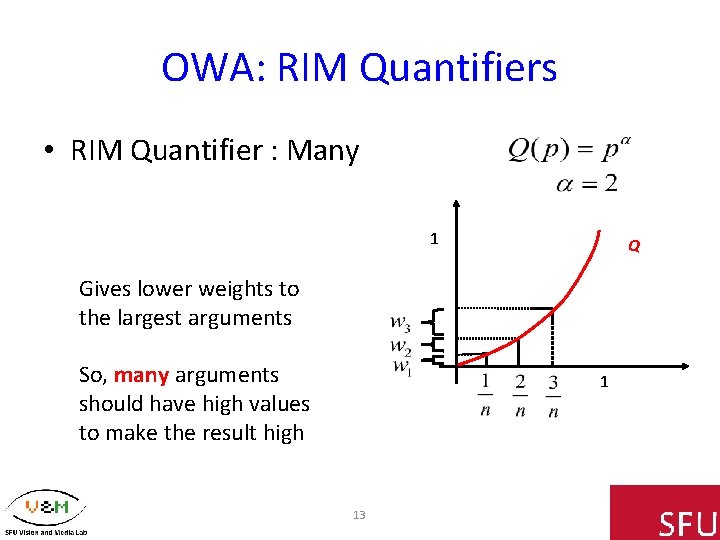
OWA: RIM Quantifiers • RIM Quantifier : Many 1 Q Gives lower weights to the largest arguments So, many arguments should have high values to make the result high 1 13
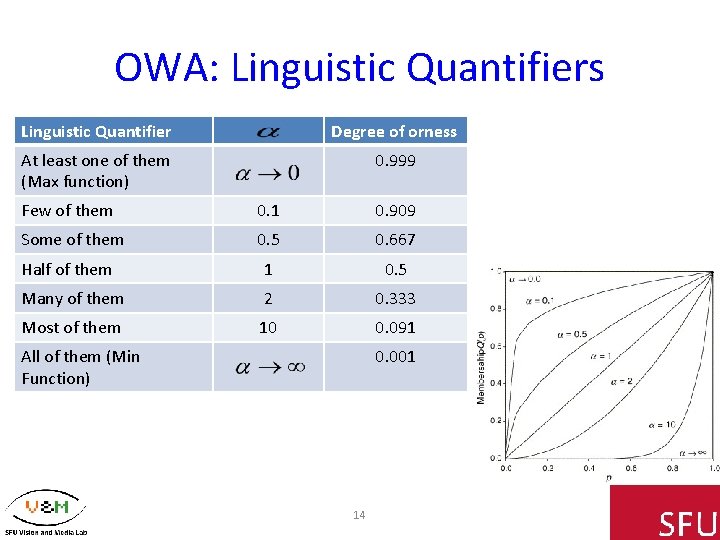
OWA: Linguistic Quantifiers Linguistic Quantifier Degree of orness At least one of them (Max function) 0. 999 Few of them 0. 1 0. 909 Some of them 0. 5 0. 667 Half of them 1 0. 5 Many of them 2 0. 333 Most of them 10 0. 091 All of them (Min Function) 0. 001 14
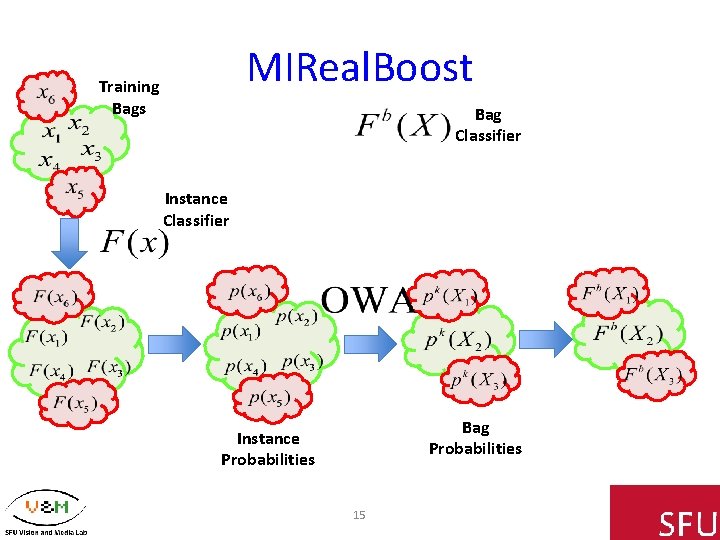
MIReal. Boost Training Bags Bag Classifier Instance Classifier Bag Probabilities Instance Probabilities 15
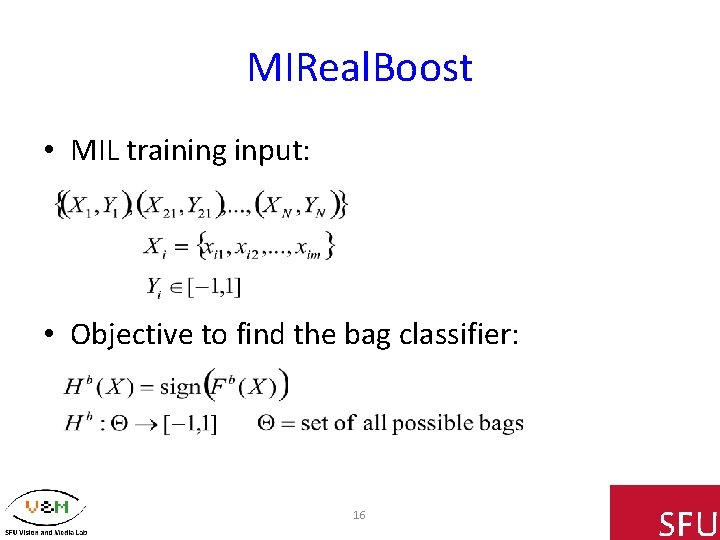
MIReal. Boost • MIL training input: • Objective to find the bag classifier: 16
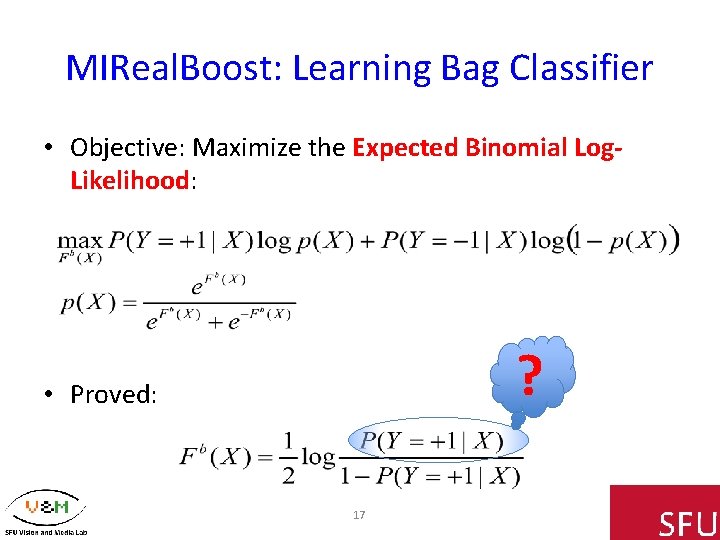
MIReal. Boost: Learning Bag Classifier • Objective: Maximize the Expected Binomial Log. Likelihood: ? • Proved: 17
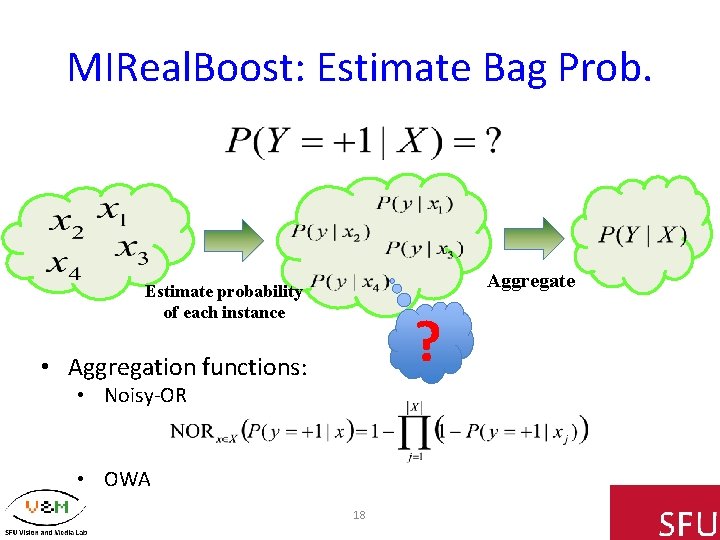
MIReal. Boost: Estimate Bag Prob. Aggregate Estimate probability of each instance ? • Aggregation functions: • Noisy-OR • OWA 18
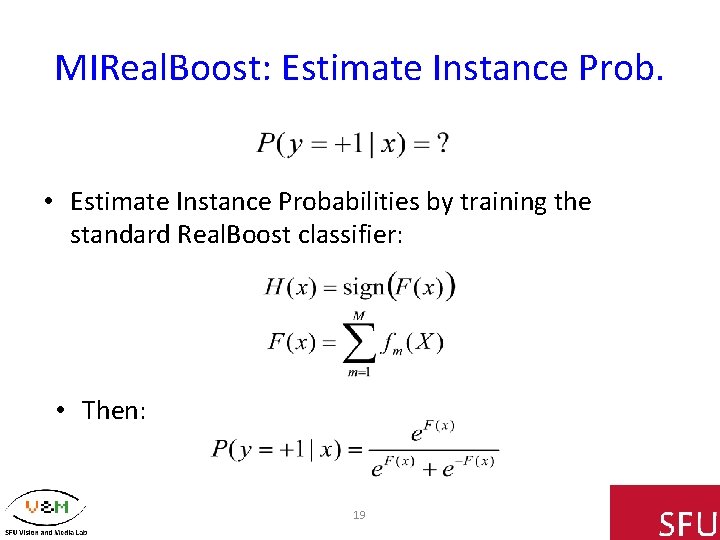
MIReal. Boost: Estimate Instance Prob. • Estimate Instance Probabilities by training the standard Real. Boost classifier: • Then: 19
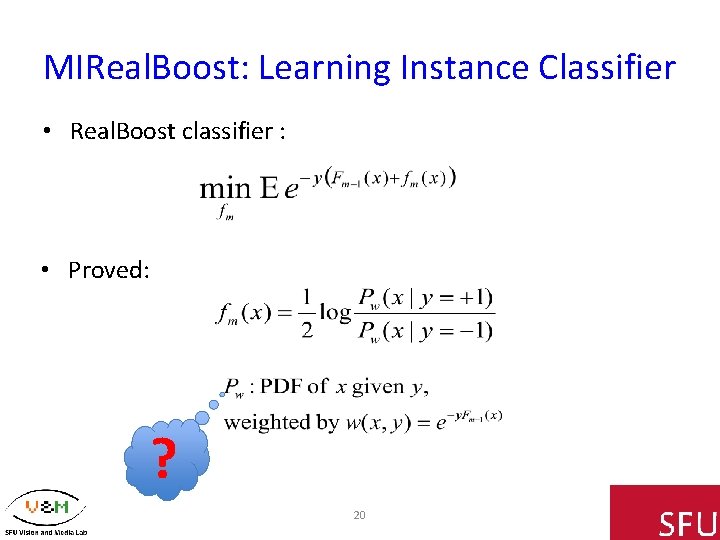
MIReal. Boost: Learning Instance Classifier • Real. Boost classifier : • Proved: ? 20
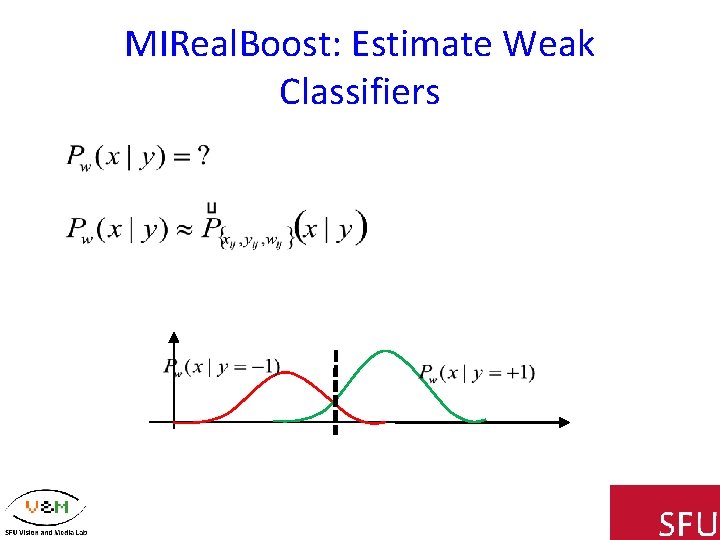
MIReal. Boost: Estimate Weak Classifiers
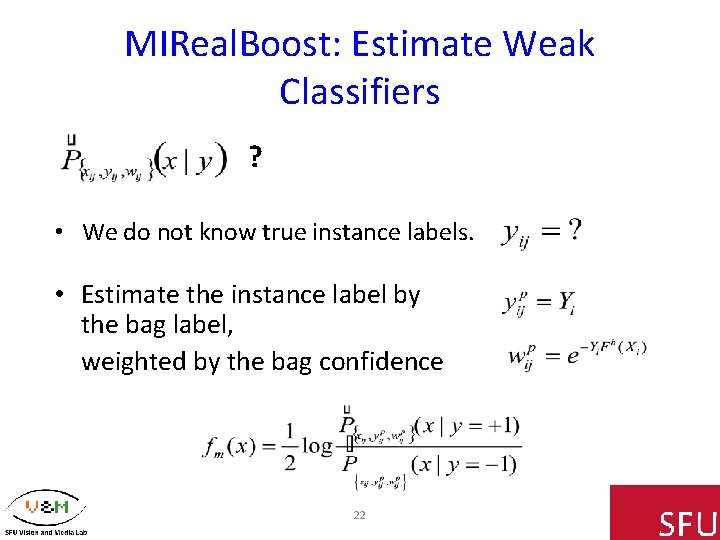
MIReal. Boost: Estimate Weak Classifiers ? • We do not know true instance labels. • Estimate the instance label by the bag label, weighted by the bag confidence 22
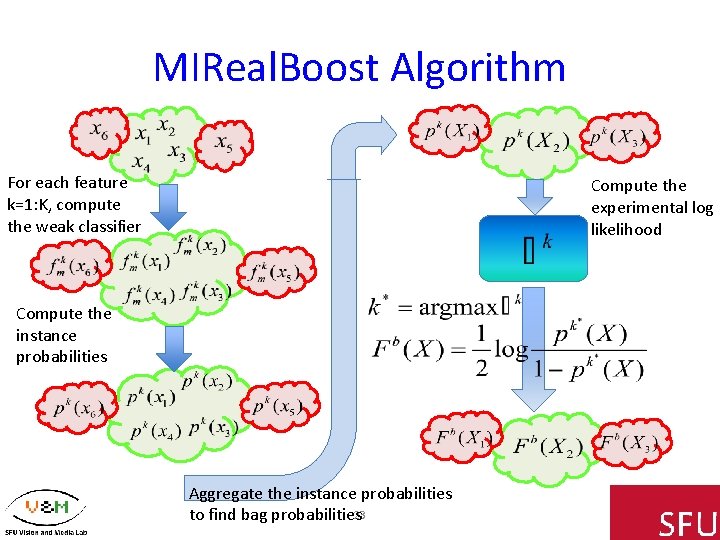
MIReal. Boost Algorithm For each feature k=1: K, compute the weak classifier Compute the experimental log likelihood Compute the instance probabilities Aggregate the instance probabilities to find bag probabilities 23
Experiments • Popular MIL datasets: – Image categorization: Elephant, Fox, and Tiger – Drug activity prediction: Musk 1 and Musk 2 24
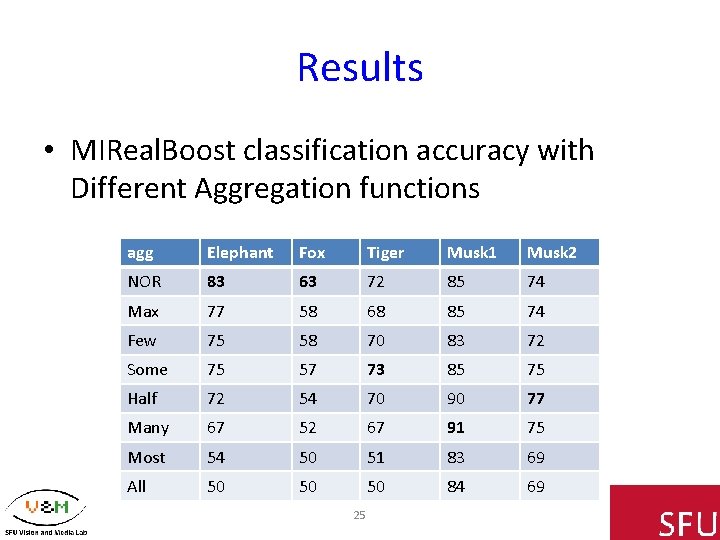
Results • MIReal. Boost classification accuracy with Different Aggregation functions agg Elephant Fox Tiger Musk 1 Musk 2 NOR 83 63 72 85 74 Max 77 58 68 85 74 Few 75 58 70 83 72 Some 75 57 73 85 75 Half 72 54 70 90 77 Many 67 52 67 91 75 Most 54 50 51 83 69 All 50 50 50 84 69 25
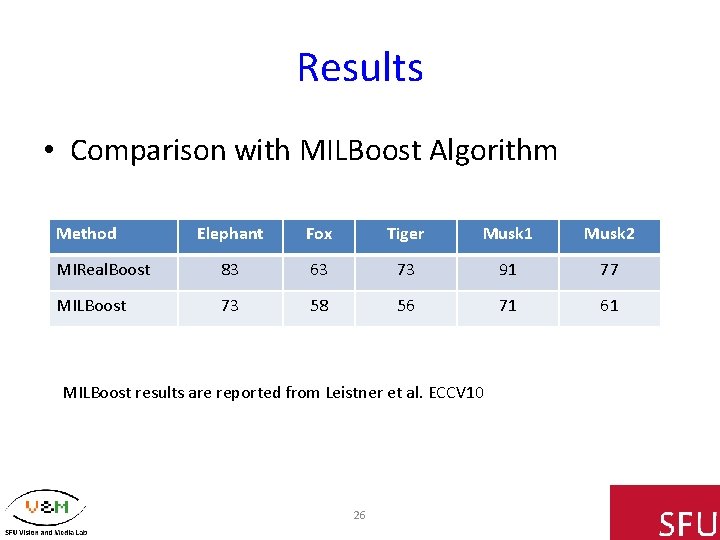
Results • Comparison with MILBoost Algorithm Method Elephant Fox Tiger Musk 1 Musk 2 MIReal. Boost 83 63 73 91 77 MILBoost 73 58 56 71 61 MILBoost results are reported from Leistner et al. ECCV 10 26
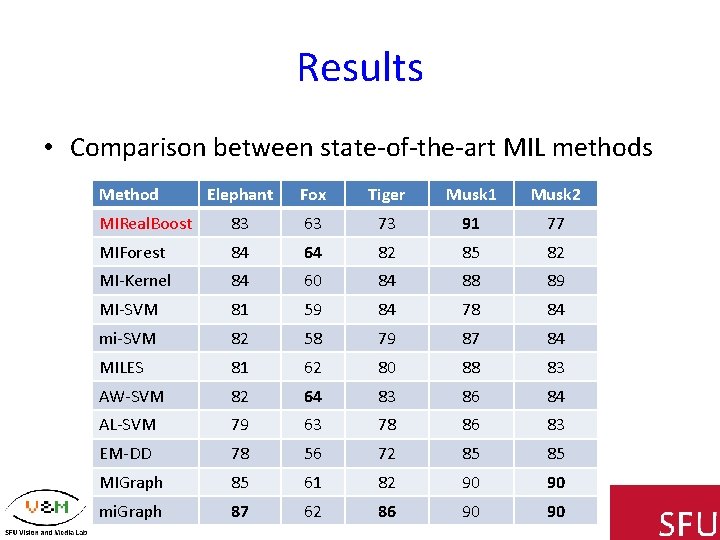
Results • Comparison between state-of-the-art MIL methods Method Elephant Fox Tiger Musk 1 Musk 2 MIReal. Boost 83 63 73 91 77 MIForest 84 64 82 85 82 MI-Kernel 84 60 84 88 89 MI-SVM 81 59 84 78 84 mi-SVM 82 58 79 87 84 MILES 81 62 80 88 83 AW-SVM 82 64 83 86 84 AL-SVM 79 63 78 86 83 EM-DD 78 56 72 85 85 MIGraph 85 61 82 90 90 mi. Graph 87 62 86 90 90 27
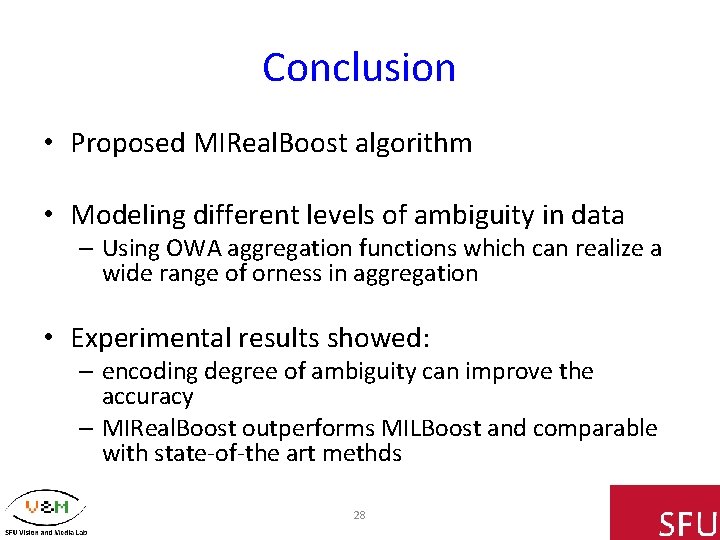
Conclusion • Proposed MIReal. Boost algorithm • Modeling different levels of ambiguity in data – Using OWA aggregation functions which can realize a wide range of orness in aggregation • Experimental results showed: – encoding degree of ambiguity can improve the accuracy – MIReal. Boost outperforms MILBoost and comparable with state-of-the art methds 28

Thanks! • supported by grants from the Natural Sciences and Engineering Research Council of Canada (NSERC). 29
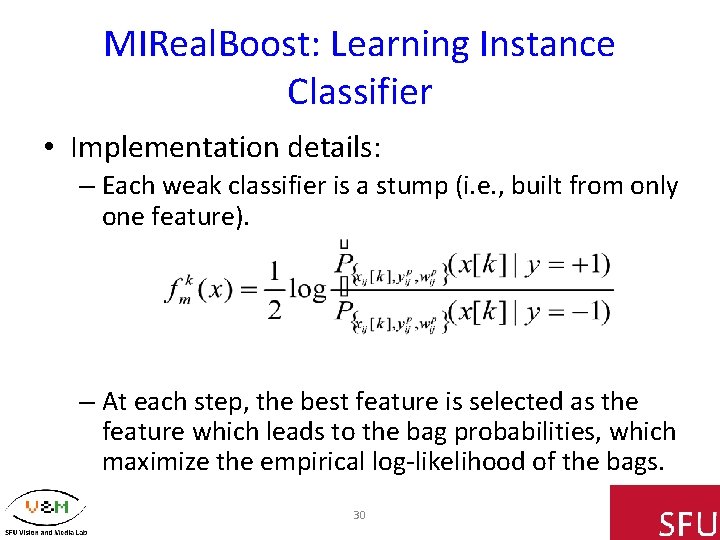
MIReal. Boost: Learning Instance Classifier • Implementation details: – Each weak classifier is a stump (i. e. , built from only one feature). – At each step, the best feature is selected as the feature which leads to the bag probabilities, which maximize the empirical log-likelihood of the bags. 30
- Slides: 30