
MULTIPLE INPUT MULTIPLE OUTPUT SYSTEMS MIMO By MOHAMMED
MULTIPLE INPUT MULTIPLE OUTPUT SYSTEMS (MIMO) By MOHAMMED BERHEA

1. Introduction MIMO Systems: § § use multiple inputs and multiple outputs from a single channel are defined by Spatial Diversity and Spatial Multiplexing
Spatial Diversity and Spatial Multiplexing • Spatial Diversity – Signal copies are transferred from multiple antennas or received at more than one antenna – redundancy is provided by employing an array of antennas, with a minimum separation of λ/2 between neighbouring antennas • Spatial Multiplexing – the system is able to carry more than one data stream over one frequency, simultaneously
Why MIMO? • There is always a need for increase in performance in wireless systems – Significant increase in spectral efficiency and data rates – High Quality of Service (Qo. S) – Wide coverage, etc. • Wireless channel that we are using is very unfriendly – Suffers from Co–channel interference and signal level fading – It provides a limited bandwidth – power falls off with distance
MIMO System solutions • By using Multiple Output Multiple Input (MIMO) systems – Diversity gain mitigates the fading and increases coverage and improves Qo. S – Multiplexing gain increases capacity and spectral efficiency with no additional power or bandwidth expenditure – Array gain results in an increase in average receive SNR. • Spatial Diversity and Spatial Multiplexing can be conflicting goals
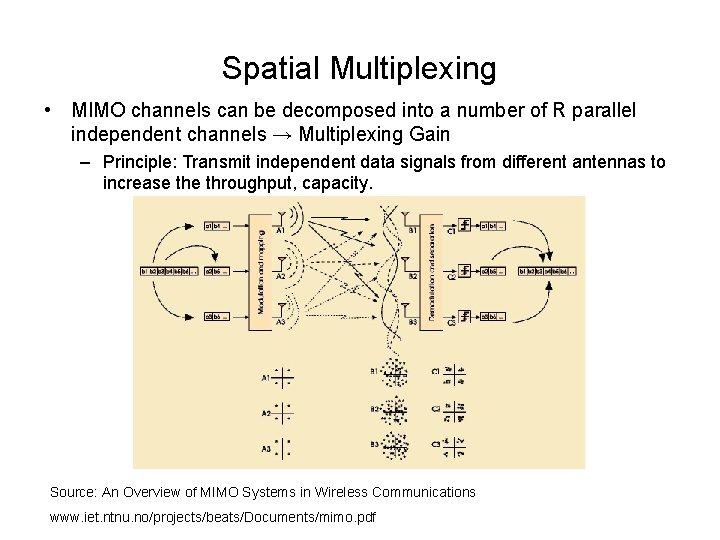
Spatial Multiplexing • MIMO channels can be decomposed into a number of R parallel independent channels → Multiplexing Gain – Principle: Transmit independent data signals from different antennas to increase throughput, capacity. Source: An Overview of MIMO Systems in Wireless Communications www. iet. ntnu. no/projects/beats/Documents/mimo. pdf
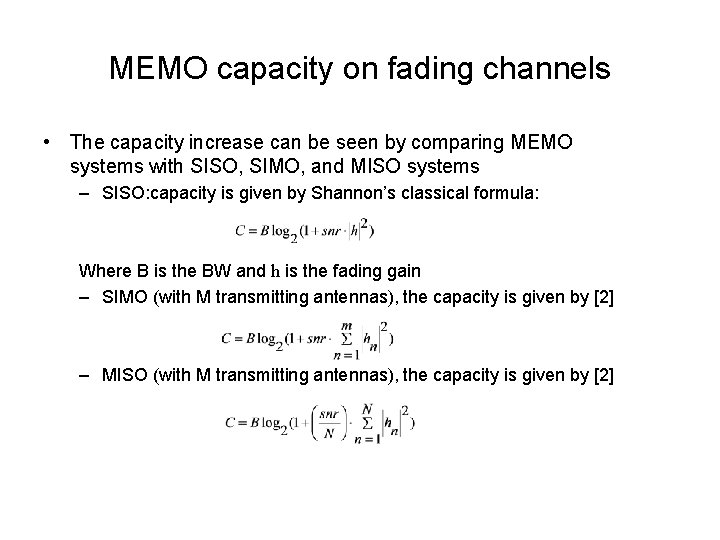
MEMO capacity on fading channels • The capacity increase can be seen by comparing MEMO systems with SISO, SIMO, and MISO systems – SISO: capacity is given by Shannon’s classical formula: Where B is the BW and h is the fading gain – SIMO (with M transmitting antennas), the capacity is given by [2] – MISO (with M transmitting antennas), the capacity is given by [2]
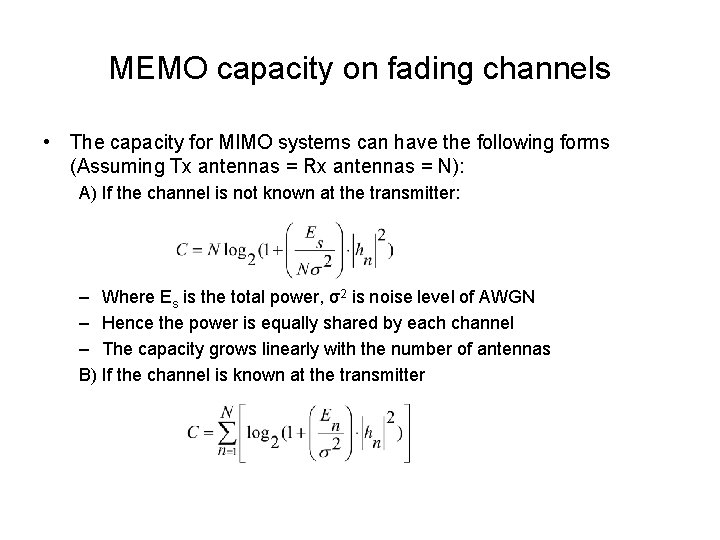
MEMO capacity on fading channels • The capacity for MIMO systems can have the following forms (Assuming Tx antennas = Rx antennas = N): A) If the channel is not known at the transmitter: – Where Es is the total power, σ2 is noise level of AWGN – Hence the power is equally shared by each channel – The capacity grows linearly with the number of antennas B) If the channel is known at the transmitter
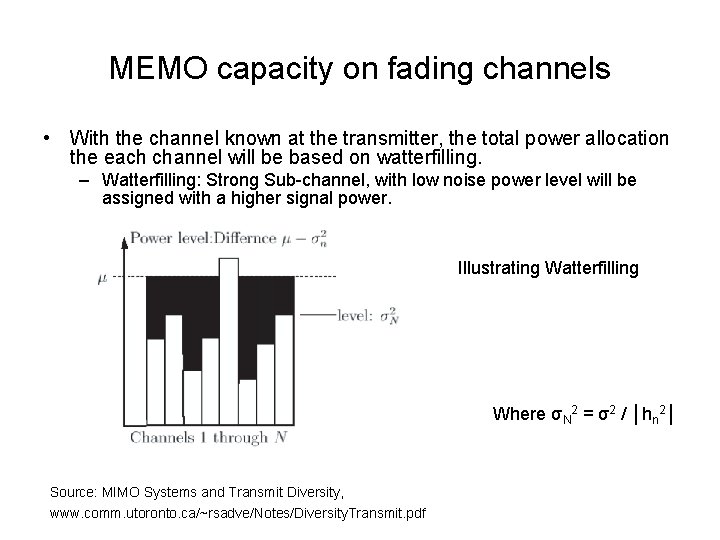
MEMO capacity on fading channels • With the channel known at the transmitter, the total power allocation the each channel will be based on watterfilling. – Watterfilling: Strong Sub-channel, with low noise power level will be assigned with a higher signal power. Illustrating Watterfilling Where σN 2 = σ2 / │hn 2│ Source: MIMO Systems and Transmit Diversity, www. comm. utoronto. ca/~rsadve/Notes/Diversity. Transmit. pdf
![Average capacity of a MIMO Rayleigh fading channel [] Source: Space-time Diversity Codes for](http://slidetodoc.com/presentation_image_h/2e99f2bd58e606d21c7ec15496cd9803/image-10.jpg "Average capacity of a MIMO Rayleigh fading channel [] Source: Space-time Diversity Codes for")
Average capacity of a MIMO Rayleigh fading channel [] Source: Space-time Diversity Codes for Fading Channels, [3]
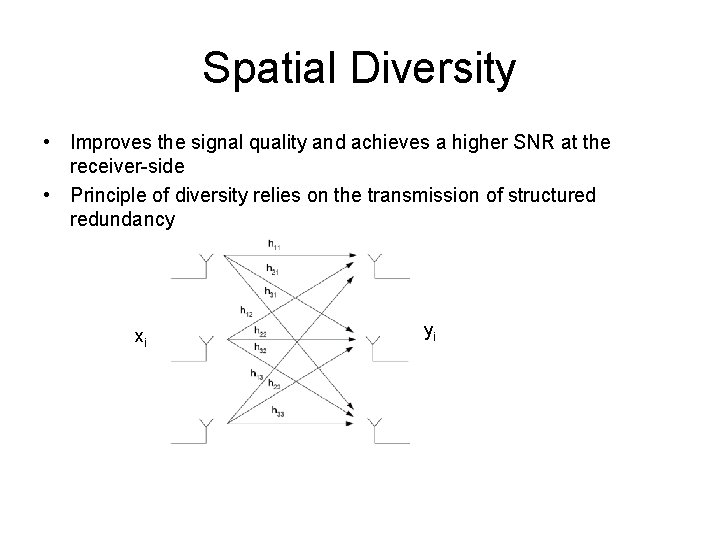
Spatial Diversity • Improves the signal quality and achieves a higher SNR at the receiver-side • Principle of diversity relies on the transmission of structured redundancy xi yi
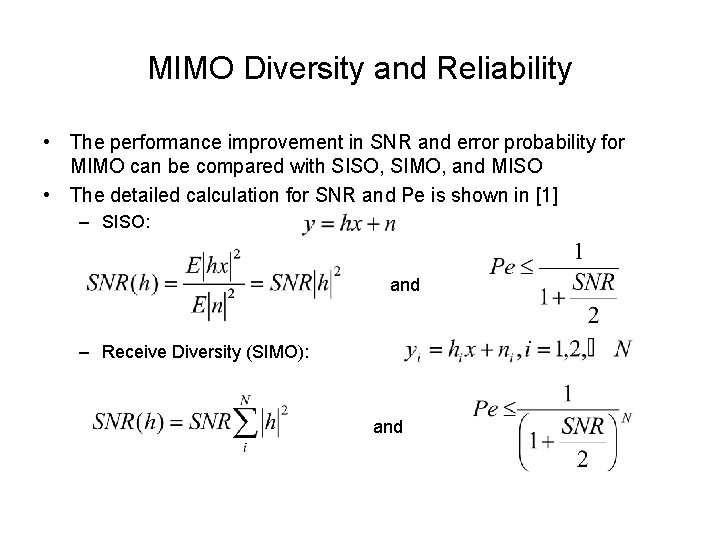
MIMO Diversity and Reliability • The performance improvement in SNR and error probability for MIMO can be compared with SISO, SIMO, and MISO • The detailed calculation for SNR and Pe is shown in [1] – SISO: and – Receive Diversity (SIMO): and
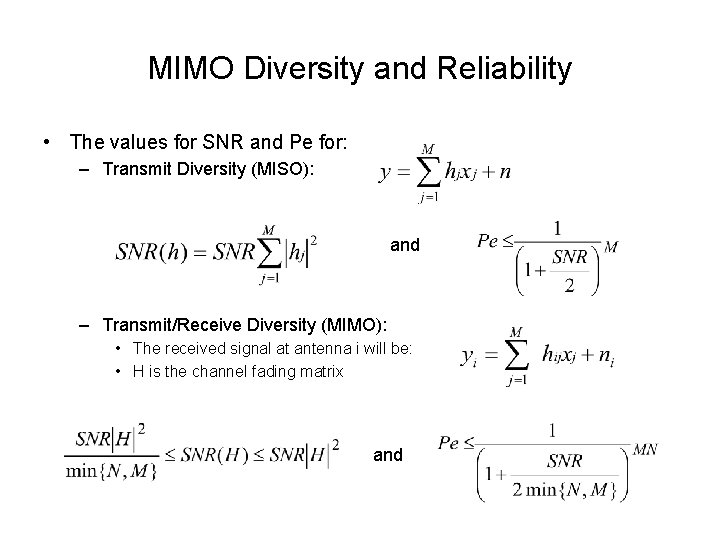
MIMO Diversity and Reliability • The values for SNR and Pe for: – Transmit Diversity (MISO): and – Transmit/Receive Diversity (MIMO): • The received signal at antenna i will be: • H is the channel fading matrix and
Conclusion • The capacity of Receive or Transmit Diversity grows logarithmically with the number of antennas • Capacity of MEMO increases linearly with the number of antennas • Using Spatial Diversity: – The SNR increases and Pe decreases when using MIMO • Spatial Multiplexing and Spatial Diversity are conflicting objectives
![References [1] MIMO Architecture for Wireless Communication: Intel Technology Journal, vol. 10, Issue 02,](http://slidetodoc.com/presentation_image_h/2e99f2bd58e606d21c7ec15496cd9803/image-15.jpg "References [1] MIMO Architecture for Wireless Communication: Intel Technology Journal, vol. 10, Issue 02,")
References [1] MIMO Architecture for Wireless Communication: Intel Technology Journal, vol. 10, Issue 02, May 2006 [2] MIMO Systems and Transmit Diversity, www. comm. utoronto. ca/~rsadve/Notes/Diversity. Transmit. pdf [3] R. A. Carrasco, Space-time Diversity Codes for fading Channel, Staffordshire University [4] D. Gesbert, M. Shafi, D. Shiu, P. Smith, and A. Naguib, “From Theory to Practice: An Overview of MIMO Space–Time Coded Wireless Systems” IEEE JOURNAL ON SELECTED AREAS IN COMMUNICATIONS, VOL. 21, NO. 3, APRIL 2003 [5] Introduction to MIMO Systems: Application Note 1 MA 102, Rohde & schwarz
- Slides: 15