
Multiple Independent Layers of Security MILS Network Subsystem
Multiple Independent Layers of Security (MILS) Network Subsystem Protection Profile (MNSPP) An Approach to High Assurance Networking Rationale 1 © 2008 Wind River Systems, Inc.
The MILS Network Subsystem (MNS) is A class of subsystem that: – runs on MILS separation kernels – is developed for environments requiring medium to high robustness (EAL 4 - EAL 6+) … is intended to solve the problem: – to provide reliable and secure network services – to be resistant to sophisticated attacks … and: – ranges over configurations defined by the MILS Network Subsystem PP – is not skewed toward a particular vendor approach – is a “pluggable” MILS component – interoperates with other MILS and non-MILS peers – gives precedence to security considerations over other considerations (e. g. throughput, simplicity, code space, etc) 2 © 2008 Wind River Systems, Inc.
The MILS Network Subsystem is also • Is scalable over a range of configurations, e. g. : – – • Large-scale MILS servers and MILS clusters MILS workstation hosts Custom networks of MILS components MILS-based high-robustness network appliances Provides flexible options for product developers – MSL or MLS realizations are possible – Interoperable with existing protocols / devices • Balances Robustness / Performance / Interoperability to achieve – (any)MNS-to-(any)MNS may lead to additional features (RFCs) – MNS-to-hostile-network must be interoperable and robust • Provides for growth and evolution – E. g. , developers may implement IPv 4 and/or IPv 6 products 3 © 2008 Wind River Systems, Inc.
MILS Network Stack Validation • Address security in layers, just as networking is implemented – Provides Defense in Depth – Allows for flexibility in protocol implementation at upper layers – Identify and secure interfaces between layers • Approach to classify networks as closed or open – Closed Network: A network in which physical security prevents unauthorized access to the nodes and media of the network. – Open Network: A network in which one or more ‘vulnerable’ points are accessible, potentially by malicious entities. – Open Networks require much more attention to threats and policies • intruders will attempt to exploit vulnerable points • We cannot know a-priori what types of systems/nodes will attach to vulnerable points • Information at all security levels must be protected until nodes are authenticated and authorized 6 © 2008 Wind River Systems, Inc.
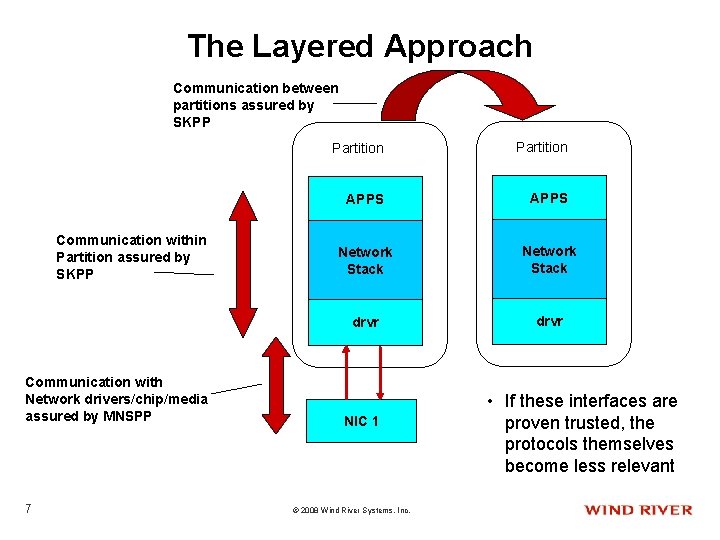
The Layered Approach Communication between partitions assured by SKPP Communication within Partition assured by SKPP Communication with Network drivers/chip/media assured by MNSPP 7 Partition APPS Network Stack drvr NIC 1 © 2008 Wind River Systems, Inc. • If these interfaces are proven trusted, the protocols themselves become less relevant
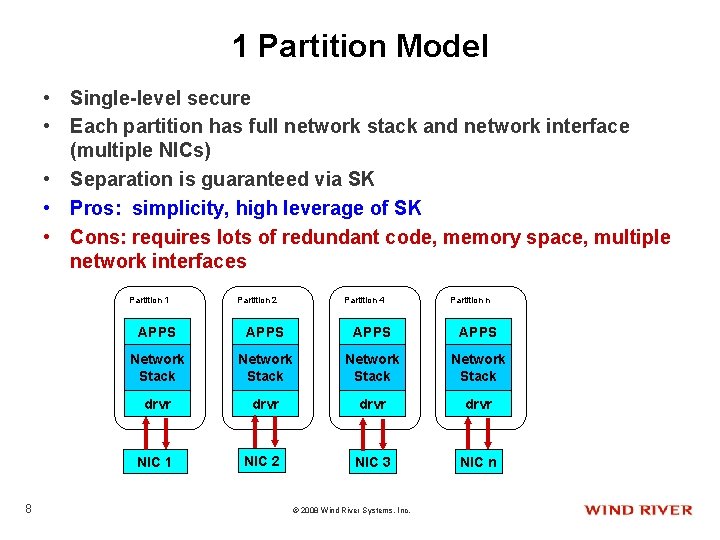
1 Partition Model • Single-level secure • Each partition has full network stack and network interface (multiple NICs) • Separation is guaranteed via SK • Pros: simplicity, high leverage of SK • Cons: requires lots of redundant code, memory space, multiple network interfaces Partition 1 8 Partition 2 Partition 4 Partition n APPS Network Stack drvr NIC 1 NIC 2 NIC 3 NIC n © 2008 Wind River Systems, Inc.
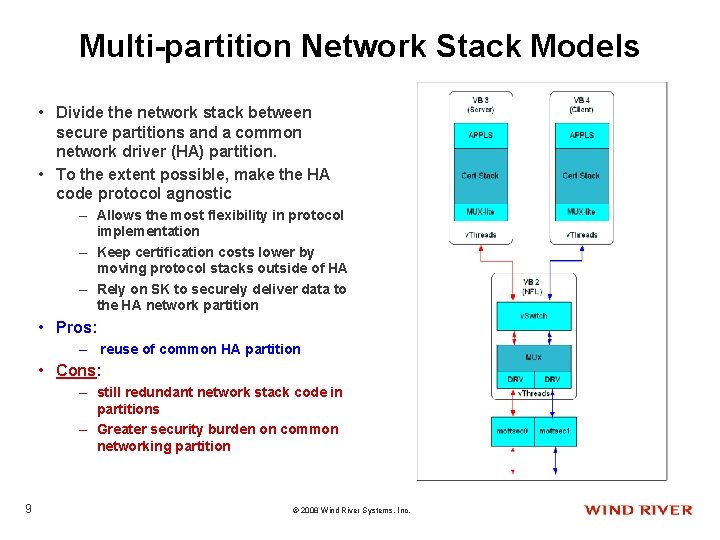
Multi-partition Network Stack Models • Divide the network stack between secure partitions and a common network driver (HA) partition. • To the extent possible, make the HA code protocol agnostic – Allows the most flexibility in protocol implementation – Keep certification costs lower by moving protocol stacks outside of HA – Rely on SK to securely deliver data to the HA network partition • Pros: – reuse of common HA partition • Cons: – still redundant network stack code in partitions – Greater security burden on common networking partition 9 © 2008 Wind River Systems, Inc.
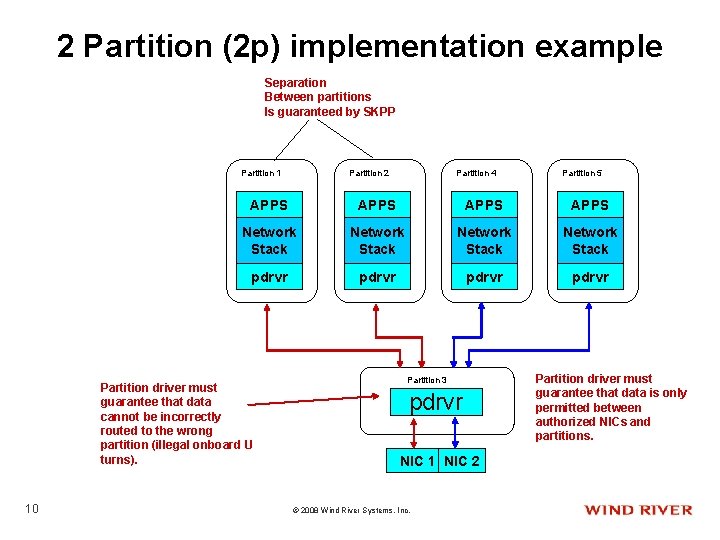
2 Partition (2 p) implementation example Separation Between partitions Is guaranteed by SKPP Partition 1 Partition 4 Partition 5 APPS Network Stack pdrvr Partition driver must guarantee that data cannot be incorrectly routed to the wrong partition (illegal onboard U turns). 10 Partition 2 Partition 3 pdrvr NIC 1 NIC 2 © 2008 Wind River Systems, Inc. Partition driver must guarantee that data is only permitted between authorized NICs and partitions.
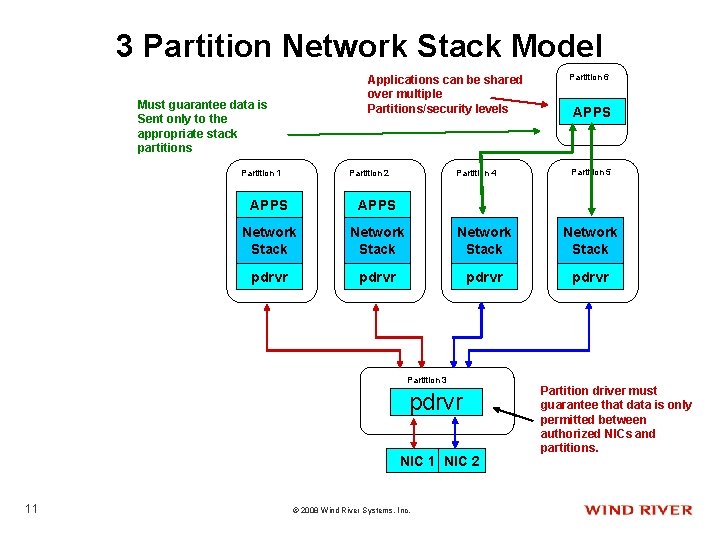
3 Partition Network Stack Model Applications can be shared over multiple Partitions/security levels Must guarantee data is Sent only to the appropriate stack partitions Partition 1 Partition 2 Partition 4 APPS Partition 5 APPS Network Stack pdrvr Partition 3 pdrvr NIC 1 NIC 2 11 Partition 6 © 2008 Wind River Systems, Inc. Partition driver must guarantee that data is only permitted between authorized NICs and partitions.
Encryption can help • If communications to the network are encrypted, accidental/malicious interception is not harmful • Must guarantee secure establishment environment – IPsec security associations – What about layer 2? • Encryption can be expensive – CPU cycles – Crypto coprocessors – Need to provide secure environment for unencrypted traffic also 12 © 2008 Wind River Systems, Inc.
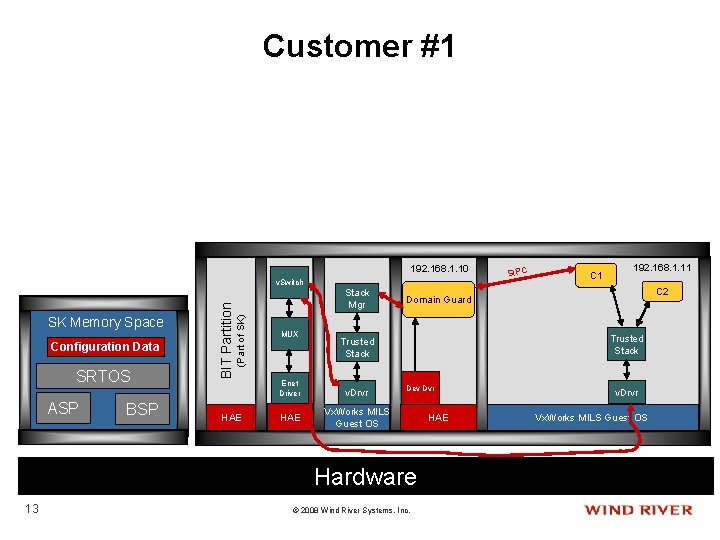
Customer #1 192. 168. 1. 10 Configuration Data SRTOS ASP BSP (Part of SK) SK Memory Space BIT Partition v. Switch HAE MUX Enet Driver HAE Stack Mgr 192. 168. 1. 11 C 2 Trusted Stack Dev Dvr Vx. Works MILS Guest OS Hardware 13 C 1 Domain Guard Trusted Stack v. Drvr SIPC © 2008 Wind River Systems, Inc. HAE v. Drvr Vx. Works MILS Guest OS
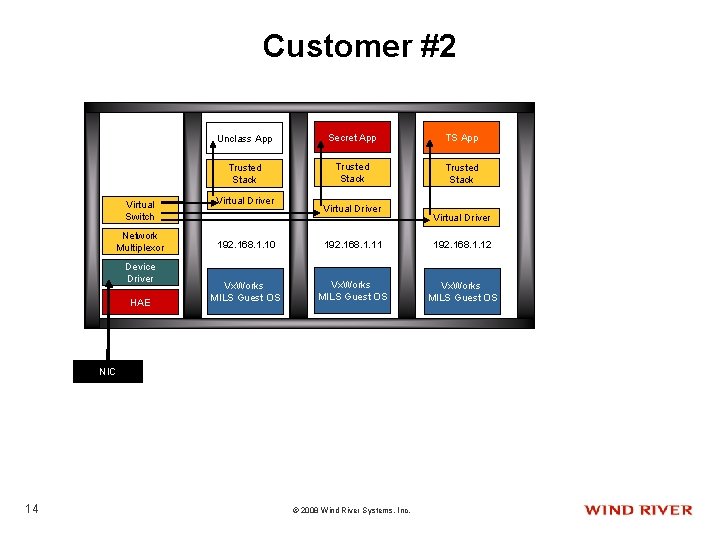
Customer #2 Virtual Switch Network Multiplexor Device Driver HAE Unclass App Secret App TS App Trusted Stack Virtual Driver 192. 168. 1. 10 192. 168. 1. 11 192. 168. 1. 12 Vx. Works MILS Guest OS NIC 14 Virtual Driver © 2008 Wind River Systems, Inc.
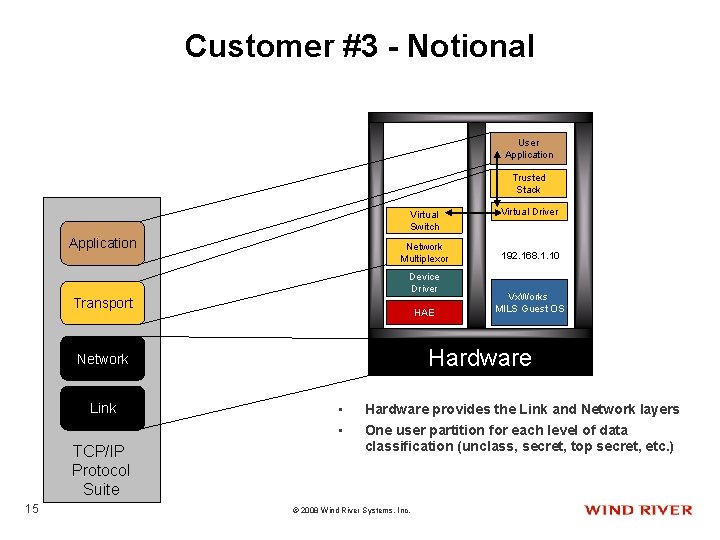
Customer #3 - Notional User Application Trusted Stack Virtual Switch Application Network Multiplexor Device Driver Transport HAE TCP/IP Protocol Suite 15 192. 168. 1. 10 Vx. Works MILS Guest OS Hardware Network Link Virtual Driver • • Hardware provides the Link and Network layers One user partition for each level of data classification (unclass, secret, top secret, etc. ) © 2008 Wind River Systems, Inc.
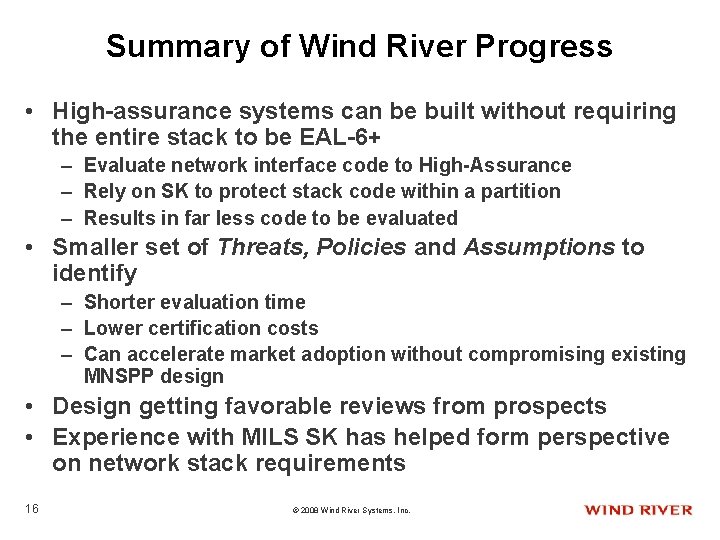
Summary of Wind River Progress • High-assurance systems can be built without requiring the entire stack to be EAL-6+ – Evaluate network interface code to High-Assurance – Rely on SK to protect stack code within a partition – Results in far less code to be evaluated • Smaller set of Threats, Policies and Assumptions to identify – Shorter evaluation time – Lower certification costs – Can accelerate market adoption without compromising existing MNSPP design • Design getting favorable reviews from prospects • Experience with MILS SK has helped form perspective on network stack requirements 16 © 2008 Wind River Systems, Inc.
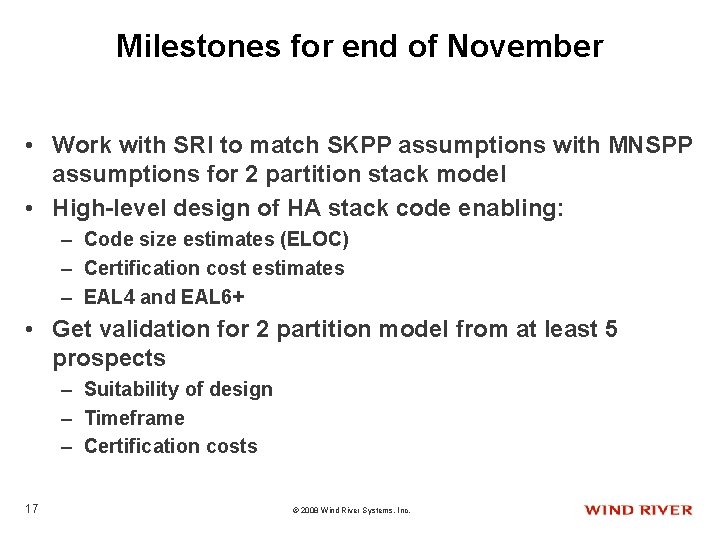
Milestones for end of November • Work with SRI to match SKPP assumptions with MNSPP assumptions for 2 partition stack model • High-level design of HA stack code enabling: – Code size estimates (ELOC) – Certification cost estimates – EAL 4 and EAL 6+ • Get validation for 2 partition model from at least 5 prospects – Suitability of design – Timeframe – Certification costs 17 © 2008 Wind River Systems, Inc.
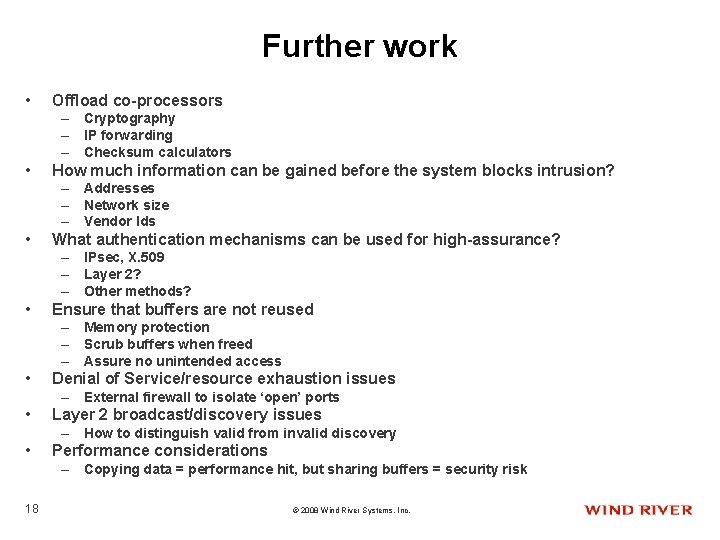
Further work • Offload co-processors – Cryptography – IP forwarding – Checksum calculators • How much information can be gained before the system blocks intrusion? – Addresses – Network size – Vendor Ids • What authentication mechanisms can be used for high-assurance? – IPsec, X. 509 – Layer 2? – Other methods? • Ensure that buffers are not reused – Memory protection – Scrub buffers when freed – Assure no unintended access • Denial of Service/resource exhaustion issues – External firewall to isolate ‘open’ ports • Layer 2 broadcast/discovery issues – How to distinguish valid from invalid discovery • Performance considerations – Copying data = performance hit, but sharing buffers = security risk 18 © 2008 Wind River Systems, Inc.

19 © 2008 Wind River Systems, Inc.
- Slides: 17