
Multiple images of a highly magnified supernova formed
- Slides: 20
Multiple images of a highly magnified supernova formed by an early type cluster galaxy lens Patrick L. Kelly et al. 2014 ar. Xiv: 1411. 6009 submitted to Nature Summarised by Poonam Chandra 7, 2020 Poonam Chandra 1
Punch line • Discovery of the first multiply-imaged gravitationally-lensed supernova. • The lens is a galaxy cluster MACS J 1149. 6+2233 at z=0. 544. . • Supernova (SN refsdal) in a spiral galaxy at z=1. 491. • Four images with diameter 2”in HST images during 3 -20 Nov, 2014. 7, 2020 Poonam Chandra 2
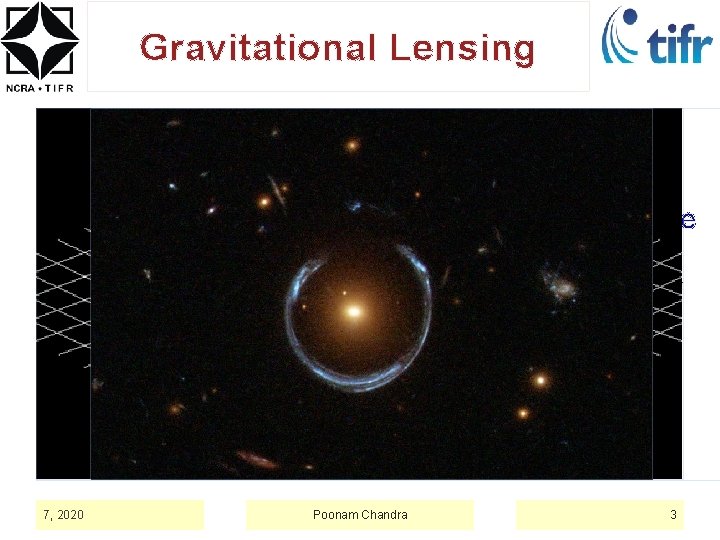
Gravitational Lensing • Gravitational Lens: Distribution of matter between source and observer. • Causes bending of light. Bending maximum closest to lens and minimum furthest from the lens. • Consequently no single focal point, focal line instead. • If observer, source and lens aligned, source appear as a ring. • If little misalignment, an arc. • Einstein ring. 7, 2020 Poonam Chandra 3
Lensing with a cluster • When the lensing mass is a galaxy group of cluster, distortion of space–time not spherical, the source will resemble partial arcs scattered around the lens. • The observer will see multiple distorted images of the same source; the number and shape of these depending upon the relative positions of the source, lens, and observer. 7, 2020 Poonam Chandra 4
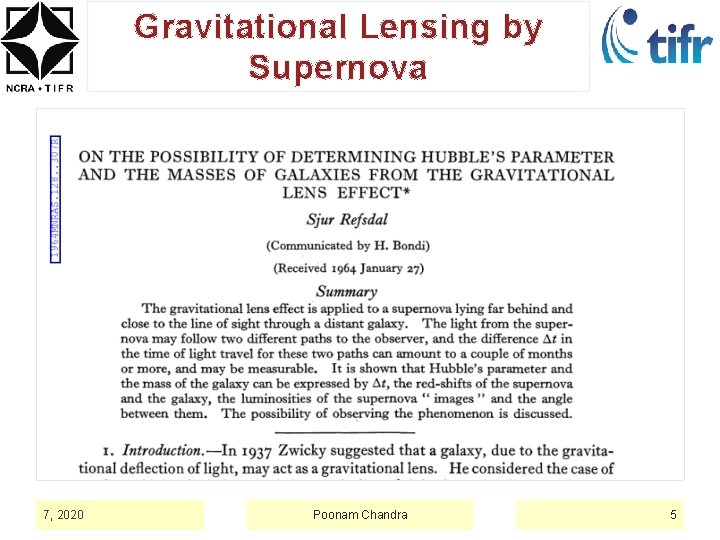
Gravitational Lensing by Supernova 7, 2020 Poonam Chandra 5
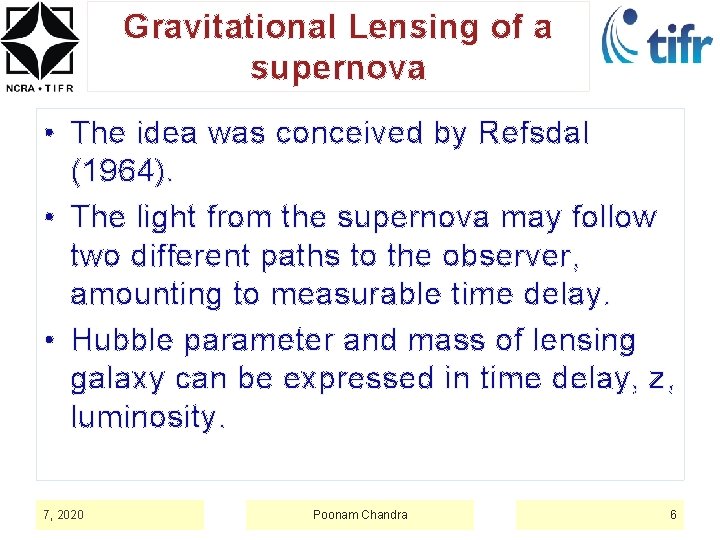
Gravitational Lensing of a supernova • The idea was conceived by Refsdal (1964). • The light from the supernova may follow two different paths to the observer, amounting to measurable time delay. • Hubble parameter and mass of lensing galaxy can be expressed in time delay, z, luminosity. 7, 2020 Poonam Chandra 6
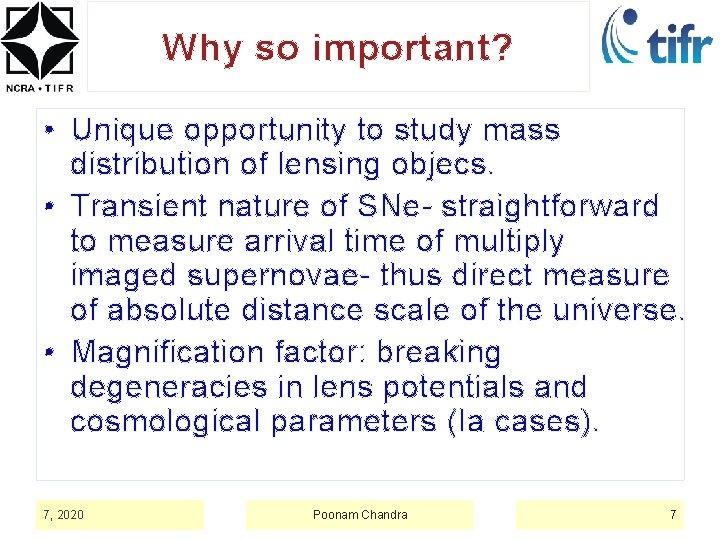
Why so important? • Unique opportunity to study mass distribution of lensing objecs. • Transient nature of SNe- straightforward to measure arrival time of multiply imaged supernovae- thus direct measure of absolute distance scale of the universe. • Magnification factor: breaking degeneracies in lens potentials and cosmological parameters (Ia cases). 7, 2020 Poonam Chandra 7
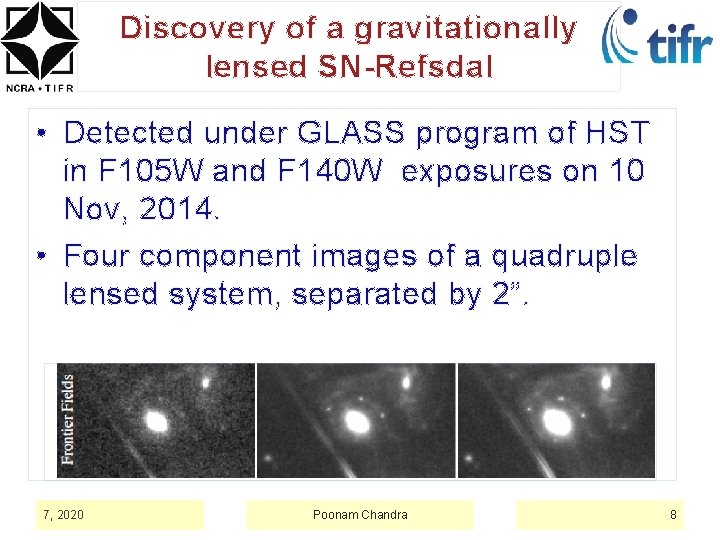
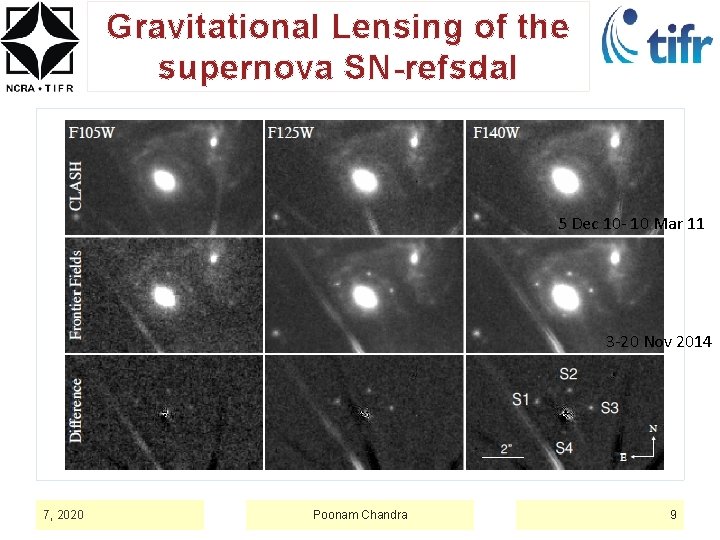
Discovery of a gravitationally lensed SN-Refsdal • Detected under GLASS program of HST in F 105 W and F 140 W exposures on 10 Nov, 2014. • Four component images of a quadruple lensed system, separated by 2”. 7, 2020 Poonam Chandra 8
Gravitational Lensing of the supernova SN-refsdal 5 Dec 10 - 10 Mar 11 3 -20 Nov 2014 7, 2020 Poonam Chandra 9
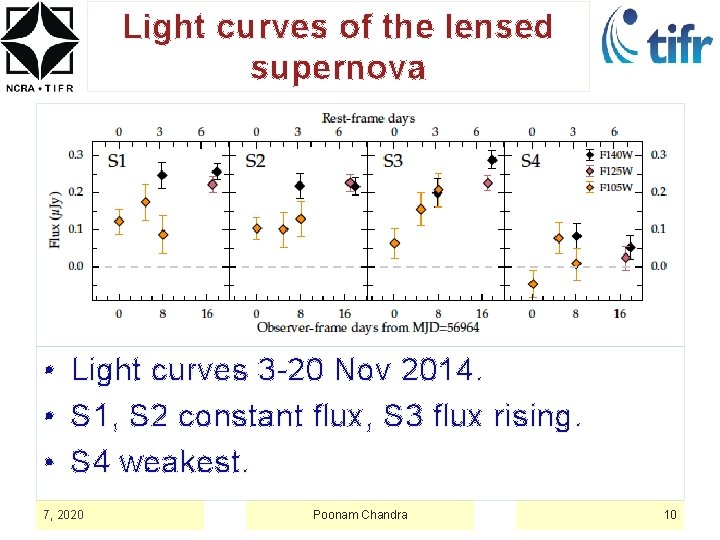
Light curves of the lensed supernova • Light curves 3 -20 Nov 2014. • S 1, S 2 constant flux, S 3 flux rising. • S 4 weakest. 7, 2020 Poonam Chandra 10
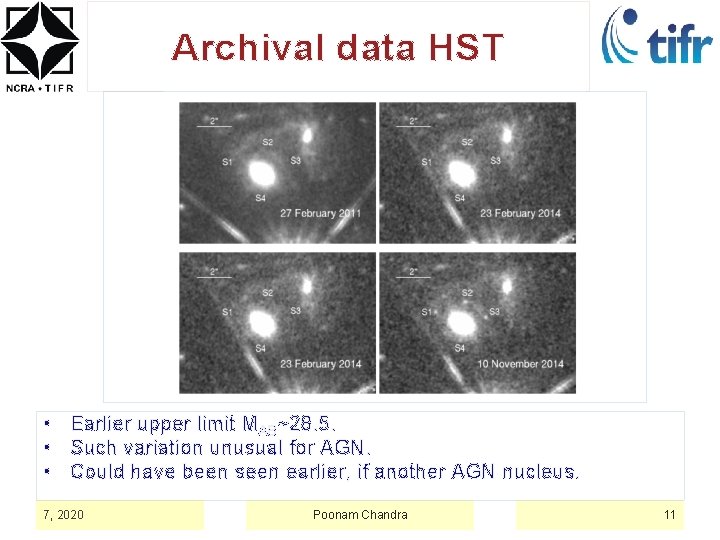
Archival data HST • Earlier upper limit M AB~28. 5. • Such variation unusual for AGN. • Could have been seen earlier, if another AGN nucleus. 7, 2020 Poonam Chandra 11
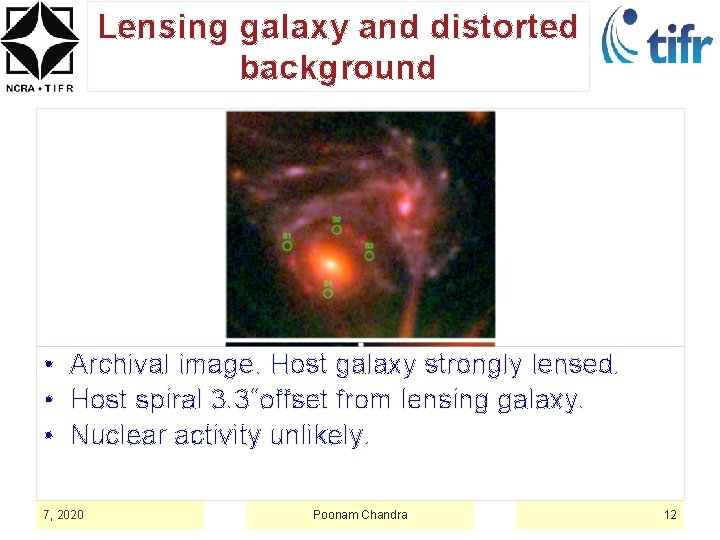
Lensing galaxy and distorted background • Archival image. Host galaxy strongly lensed. • Host spiral 3. 3”offset from lensing galaxy. • Nuclear activity unlikely. 7, 2020 Poonam Chandra 12
SN-refsdal host galaxy • Keck spectrum of the SN host galaxy on 20 Nov 2014. • Keck-LRIS long slit pointed on portion of Einstein ring between S 1 and S 2. • OII l 3727 line redshifted to l 9727, confirming redshift z=1. 491 7, 2020 Poonam Chandra 13
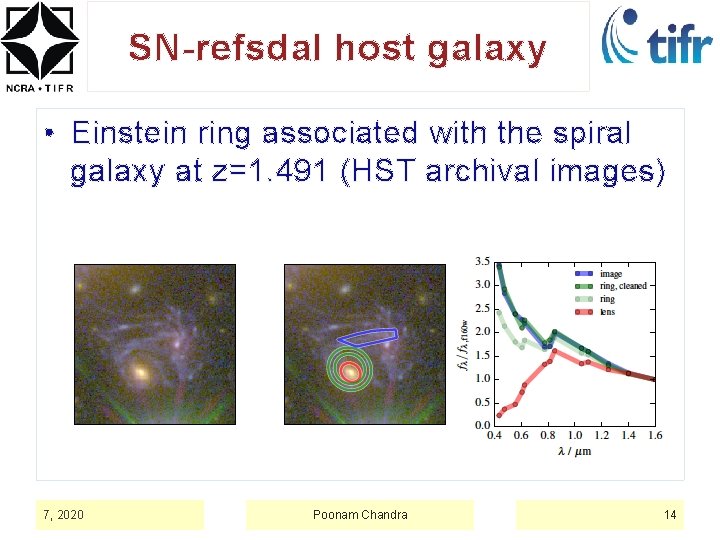
SN-refsdal host galaxy • Einstein ring associated with the spiral galaxy at z=1. 491 (HST archival images) 7, 2020 Poonam Chandra 14
Previously lensed supernova PS 1 -10 afx • PS 1 -10 afx (Charnock et al. 2013) considered superluminous Ic supernova at z=1. 388. • Quimby (2014): Gravitationally lensed Type Ia supernova magnified by a factor of 30. • Lensing galaxy at z=1. 117. • No multiple images seen. 7, 2020 Poonam Chandra 15
Three weakly gravitational lensed supernovae • Reported by Patel, B. et al. (2014). • Three gravitationally lensed supernovae behind CLASH galaxy clusters. • Two thermonuclear supernovae. • Consistent magnification from SN Ia brightness and from predicted lens map. 7, 2020 Poonam Chandra 16
Mass modeling • Complicated configuration. • A significant fraction of strong gravitational potential contriburted by massive galaxy. • Additional contribution from cluster potential. • Mass modeling very complex. • Did not attempt! 7, 2020 Poonam Chandra 17
Simple Modeling • Rough estimate of time delay and magnification ratios. • S 1 leading image, followed by S 2, S 3 and S 4. • S 4 magnification ~2, S 1 magnification ~10 (most likely contaminated by contribution from the cluster). • Since spiral galaxy itself is multiply imaged by the cluster, prediction of additional SN image a decade from now. 7, 2020 Poonam Chandra 18
Predictions from SN-Refsdal • SN-Refsdal modeling by Oguri ar. Xiv: 1411. 6443. • Constructed Mass model of MACS J 1149. 6+2233. • Model predictions: 2 additional images 10” and 30” away from S 1 -S 4. • One image predicted to appeared 17 years ago and one will appear within a year from now. • Magnification ranges from 18 (for brightest) to 4 (for the weakest). 7, 2020 Poonam Chandra 19
Conclusions • Discovery of the first multiply-imaged gravitationally-lensed supernova. • The lens is a galaxy cluster MACS J 1149. 6+2233 at z=0. 544. . • Supernova (SN refsdal) in a spiral galaxy at z=1. 491. • Four images with diameter 2”in HST images during 3 -20 Nov, 2014. 7, 2020 Poonam Chandra 20