
Multiple Factor Crosses TwoFactor Crosses A Punnett square




- Slides: 9
Multiple Factor Crosses
Two-Factor Crosses A Punnett square can be used to predict the probability of crossing two traits at once This is called a two-factor cross Example: Mendel continued his studies by crossing two pea plants that were purebred (homozygous) for two traits. One was homozygous dominant for round (R) and yellow (Y) seeds, while the other was homozygous recessive for wrinkled (r) and green (y) seeds: RRYY x rryy
Generate Gametes To determine possible gametes for each parent, we use the F. O. I. L. method from math First, Outside, Inside, Last Remember, each parent will give one allele of each gene to its offspring through the gamete it produces For these homozygous parents, we actually only wind up with one possibility for each parent. Parent 1: RY & Parent 2: ry Parent 1 Parent 2 RRYY rryy First RY ry Outside RY ry Inside RY ry Last RY ry
Set-up the Punnett Square Put the possible gametes from one parent on the top, and the possible gametes from the other parent on the side. RY RY RY We wind up with 16 possible combinations when crossing two genes. However, for this cross, 16/16 (100%) of the offspring will have the dihybrid genotype (Rr. Yy) and have round, yellow seeds. RY ry Rr. Yy Rr. Yy
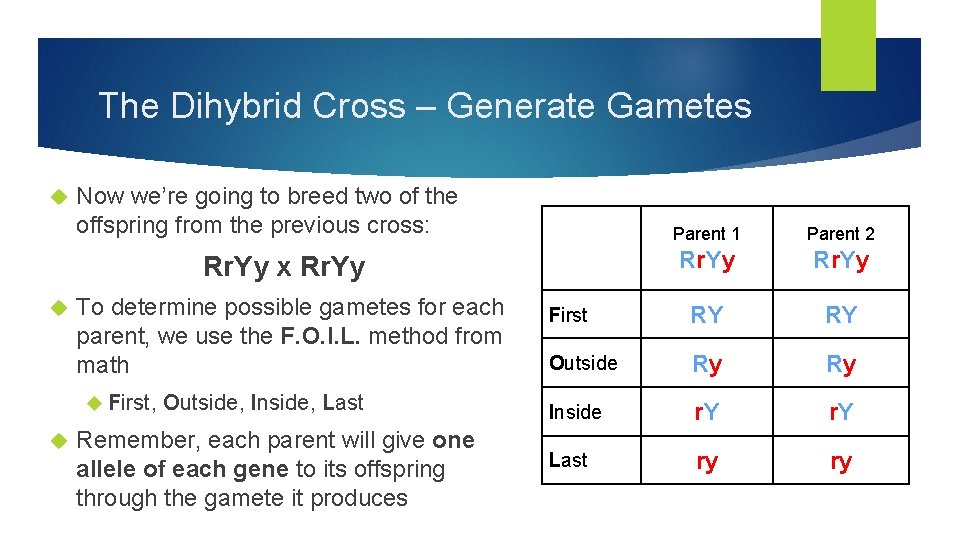
The Dihybrid Cross – Generate Gametes Now we’re going to breed two of the offspring from the previous cross: Parent 1 Parent 2 Rr. Yy First RY RY Outside Ry Ry Inside r. Y Last ry ry Rr. Yy x Rr. Yy To determine possible gametes for each parent, we use the F. O. I. L. method from math First, Outside, Inside, Last Remember, each parent will give one allele of each gene to its offspring through the gamete it produces
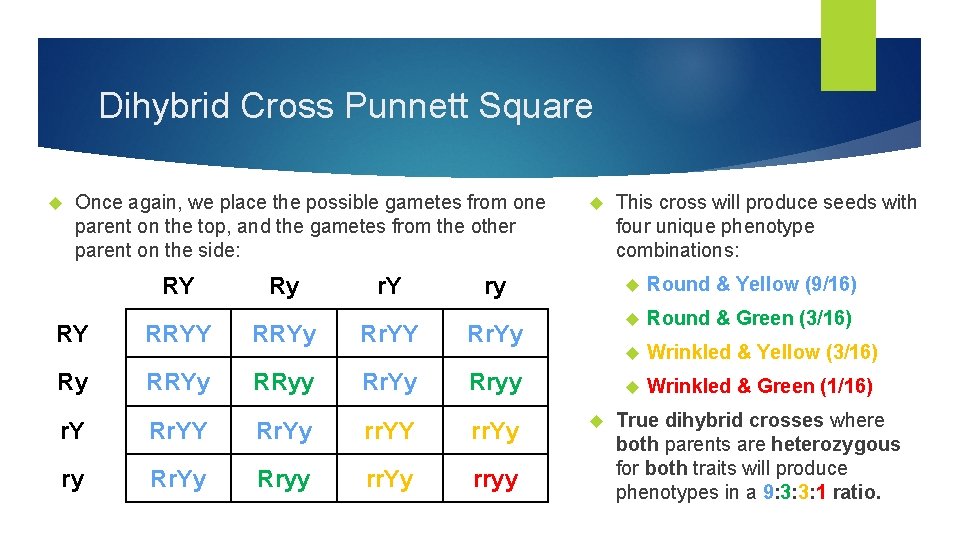
Dihybrid Cross Punnett Square Once again, we place the possible gametes from one parent on the top, and the gametes from the other parent on the side: RY Ry r. Y ry RY RRYy Rr. YY Rr. Yy Ry RRYy RRyy Rr. Yy Rryy r. Y Rr. Yy rr. YY rr. Yy ry Rr. Yy Rryy rr. Yy rryy This cross will produce seeds with four unique phenotype combinations: Round & Yellow (9/16) Round & Green (3/16) Wrinkled & Yellow (3/16) Wrinkled & Green (1/16) True dihybrid crosses where both parents are heterozygous for both traits will produce phenotypes in a 9: 3: 3: 1 ratio.
Shortcuts – Only use if you understand how to use them properly! Sometimes, you won’t actually need every column or row in the 2 -factor cross Punnett Square. For example, for the following cross there are only 2 possible gametes each parent can produce: RY Ry Ry RRYy RRyy ry Rr. Yy Rryy RRYy x Rryy Possible gametes for Parent 1 from F. O. I. L. : RY, Ry, Ry Possible gametes for Parent 2 from F. O. I. L. : Ry, ry, ry Really only RY and Ry are possibilities. Really only Ry and ry are possibilities We don’t need to actually set up columns and rows for the duplicate gametes. A smaller Punnett square will work when some of the traits are homozygous for one or both of the parents.
3+ Factors Crosses Sometimes we want to predict the probability of getting a certain genotype when crossing more than 2 genes. For these crosses it is easier to find the probability for each gene separately and then multiply them together to find out the probability of the particular genotype we’re looking for. Let’s try this trihybrid cross: Aa. Bb. Cc x Aa. Bb. Cc What fraction of the offspring can we expect to be homozygous recessive for ALL THREE traits?
Do a Punnett square for each trait A a A AA Aa aa Probability offspring is aa: ¼ B b B BB Bb bb Probability offspring is bb: ¼ C c C CC Cc cc Probability offspring is cc: ¼ Now we simply multiply the probabilities together: ¼ x ¼ = 1/64 So, we would expect 1/64 (1. 56%) of the offspring to have genotype aabbcc.